
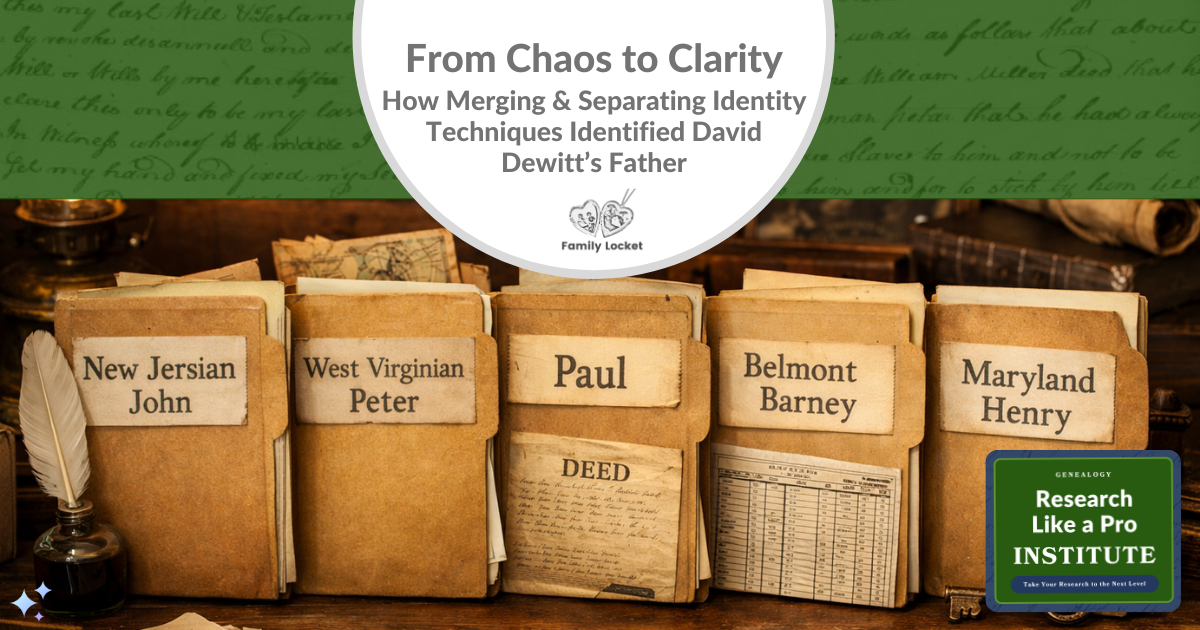
When I encountered David Lynn Dewitt in my family, I had a straightforward research question: who was his father? David was born in Maryland in 1801, married Sarah Headley in Holmes County, Ohio in 1827, had seven children, and lived his entire adult life in Richland Township, Holmes County. Simple enough, right?
Then I discovered dozens of Dewitts all of whom had Ohio connections. In the 1820s-1840s, central Ohio—specifically Holmes and Knox Counties—was crawling with Dewitts. And guess what? The names repeated over and over. There were at least four Henrys, four Barneys, three Williams, three Johns, three Peters and three Davids. Thus, the real challenge began.
These families had migrated from different places—New Jersey, West Virginia, Maryland, and eastern Ohio—suggesting they weren’t all closely related. Yet they all ended up or had connections to the same small geographic area at the same time, creating quite the genealogical challenge..
There were five men who were of the right age and had other indicators that they could have been David’s father. Any one of them could have been David’s father. But which one?
The Solution: Systematic Application of M/S Techniques
This is one of the types of problem the Merging and Separating Identities course is designed to solve. I had worked on identifying David’s father for years without success. But when I applied the M/S course technique, I was able to solve it in a couple of months. I applied almost every major technique from the curriculum. Here’s how each method contributed to the solution:
Organizing Data: Building the Foundation
First, I needed to get control of the chaos. I created a comprehensive spreadsheet with three sections:
Source Section: Every record got its own row with:
- Record type and dates
- Locations (both historical and present-day jurisdictions)
- Live links to online sources
- Reference numbers for offline sources and links to my files
Descriptors Section: Over 40 columns capturing:
- Names and variations
- Ages and birth years
- Wives and children
- Occupations
- Property descriptions
- Signatures vs. marks
- Associates and witnesses
- Geographic details
Labeling Section: Where I tracked:
- Emerging identity labels
- Rationale for grouping records
- Action items for further research
- Confidence levels
This organization proved essential. Without it, I would have been constantly re-analyzing the same records, losing track of my reasoning, and missing critical patterns. Sorting the records by a descriptor allowed me to much more easily combine profiles. For example, I hadn’t noticed that there were two different signatures which allowed me to separate two Davids. I also created columns that allowed me to capture not only descriptors from the records, but also what I call psychographics. These are behaviors and choices a person makes. That helped me label them. My favorite label from this case is “Bad Barney.” He earned his title by having three children with a woman who was not his wife while he was married to another. Ultimately, he fled the Ohio scene, surely running away from his moral and legal problems.
Identity Dossiers: Building Candidate Profiles
I identified five men who were the right age and had connections that could make them David’s father:
New Jersian John Dewitt: Right age (born about 1782), resided in nearby Knox County, had a son named Henry (a common Dewitt name), and David’s oldest son was named John. But the evidence didn’t hold up. John’s 1864 will named eight children—none named David. The 36-mile distance between their residences showed no overlap in their activities.
West Virginian Peter Dewitt: Lived in Preston, West Virginia near the Maryland border where David was born. Peter’s 1810 household included two males under ten (David’s age range). But Peter’s 1820 household had no male of David’s age, and his known children didn’t include a David.
Paul Dewitt: Had roots in eastern Ohio and a son actually named David (I called him “55-Acre David”). This looked promising until I discovered that 55-Acre David was married to Rachel at the same time David Lynn was married to Sarah. Both Davids signed an 1833 petition—proof of two different men. Paul was definitely not David Lynn’s father.
Belmont Barney: Right age, owned property in Holmes County near David. But Barney’s 1803 Ohio marriage to Hannah came after David’s 1801 Maryland birth, and all of Barney’s children were born in Ohio. Barney never showed a Maryland connection.
Maryland Henry: The only Dewitt in Maryland around David’s 1801 birth. His household composition fit a family with children. But what happened to him? He disappeared from Maryland records after 1815-1816.
Timelines: Revealing a Critical Pattern
Creating detailed timelines for each candidate revealed something crucial: Maryland Henry disappeared from Maryland tax records in 1815-1816. At almost the same moment, Ohio Henry appeared in Holmes County, purchasing land on May 26, 1815. The timing was too perfect to be coincidence. But I needed more proof.
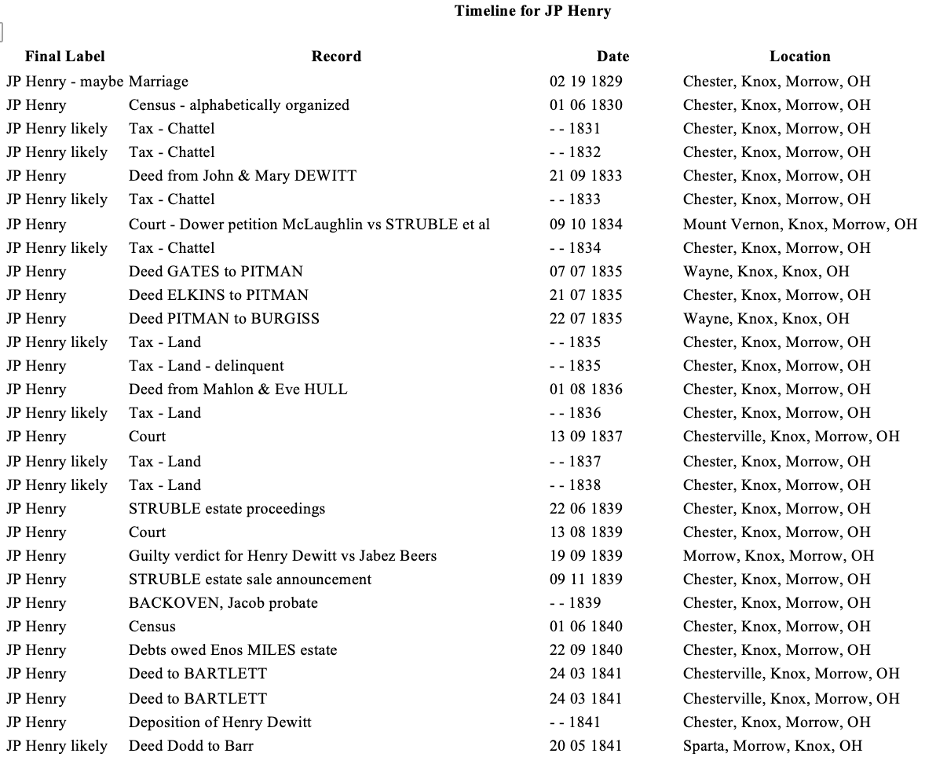
Partial timeline image courtesy of Jan Joyce, Course Coordinator
FAM Club Analysis: The Decisive Evidence
FAM Club (family) analysis proved to be the most powerful tool. When Ohio Henry died in 1821, his estate sale revealed so much:
Estate Purchasers:
- Jonathan Dewitt (administrator of the estate)
- Elijah F. Dewitt
- Barney Dewitt Jun.
- David Dewitt (bought the family Bible—a sentimental item)
- Jessee Casteel (an associate)
These weren’t random buyers—they were family. And I could prove it:
- Jonathan: Born 1793-4 in Maryland, administered the estate (typically a son’s role), remained in Richland Township his entire life.
- Elijah Friend Dewitt: His middle name “Friend” connected him to Maryland Henry’s wife Sarah Elizabeth Friend. Elijah collected money owed to Henry in Maryland in 1815 (right when Henry was moving to Ohio). Born 1792-1795 in Maryland.
- Barney Jun. (Jane’s Barney): Born 1799 in Maryland, married Jane McKee in 1823, remained in Holmes County until his 1873 death.
- David: Born 1801 in Maryland, purchased the family Bible, used his middle initial “L” to distinguish himself from 55-Acre David.
- Elizabeth: Born 1809-1810 in Maryland, married David Critchfield in 1825.
- Maria: Born 1790 in Maryland, married William Harris in 1821 (officiated by Barney Dewitt).
Onomastics: Names Tell Stories
David’s distinctive middle name “Lynn” provided a Maryland connection. Three LYNN brothers—David (yes…a David!), John, and George—lived near Henry in Garrett County, Maryland. They were Revolutionary War soldiers and wealthy landowners. In 1812, Henry proved John LYNN owed him money for wolf certificates—a direct interaction.
David’s middle name wasn’t random. Perhaps neither was his given name. Henry honored these prominent neighbors when naming his son. Similarly, Henry’s son Elijah’s middle name “Friend” honored his mother Sarah Elizabeth Friend. These naming patterns confirmed family relationships.
Geographic Analysis and Mapping
Mapping showed that Maryland Henry lived in Sandy Creek, Garrett County, Maryland—just miles from the West Virginia border where other Dewitts resided. The proximity explained some record overlap but didn’t prove relationships.
More importantly, when Ohio Henry purchased land in 1815, he was listed as “of Knox Co Ohio” though the land was in Richland Township, Holmes County (contiguous counties). The 1820 census showed no Henry heading a household in Richland, but [Elijah] Friend Dewitt’s Knox County household included a male and female over 45—the right age for his parents Henry and Sarah.
Negative Evidence: What’s Missing Matters
Other evidence, including negative evidence, finalized the case:
- David was born in Maryland in 1801—the only Dewitt in Maryland at that time was Henry
- Maryland Henry disappeared from records in 1815-1816, when Ohio Henry appeared
- Ohio Henry’s household composition (1800, 1810) fit a family that would include David
- Ohio Henry died in 1821 with an insufficient estate, matching Maryland Henry’s poverty
- David remained in Richland Township near siblings Jonathan and Jane’s Barney for his entire life
- None of the other candidates could account for David’s Maryland birth
Correlation: Connecting the Dots
The final piece involved correlating multiple data points:
- Financial situation: Maryland Henry owned no land, was taxed on minimal property (4 cattle, 2 horses), and likely squatted on his wife’s uncle’s property. Ohio Henry made only the minimum cash deposit on land and died with an insufficient estate. The poverty was consistent.
- Timeline of events: Mount Tambora erupted in 1815, causing “the year of no summer” and widespread crop failures. Henry may have left Maryland that year seeking better farming conditions, unaware the volcanic ash had global effects.
- Associates: Jessee Casteel purchased items at Ohio Henry’s estate. Casteel families lived near Henry in Maryland and had connections to Preston, West Virginia where other Dewitts resided.
The Conclusion: Maryland Henry = Ohio Henry = David’s Father
After applying every M/S technique systematically, the evidence was overwhelming:
Maryland Henry and Ohio Henry were the same person. He moved from Maryland to Ohio between 1815-1816, bringing his children with him. Three of those children—Jonathan, Jane’s Barney, and David—remained in Richland Township, Holmes County for their entire lives. Elijah moved nearby. David Lynn Dewitt was Henry’s son.
Lessons Learned
This case demonstrates why systematic M/S techniques matter:
- Organization enabled analysis: Without a comprehensive spreadsheet, which I call a “Playbook” tracking 40+ descriptors across dozens of records for multiple candidates, I would have been lost.
- Identity dossiers eliminated candidates: Building complete profiles for John, Peter, Paul, Barney, and Henry allowed systematic elimination based on birth years, locations, and family compositions.
- FAM Club was decisive: Family relationships—confirmed through estate administration, naming patterns, land transactions between siblings, and geographic clustering—provided the strongest evidence.
- Timelines revealed the key pattern: The simultaneous disappearance and appearance of the Henrys and other Dewitts wouldn’t have been obvious without timeline analysis.
- Negative evidence strengthened the case: What wasn’t present in records (David in other candidates’ wills, Maryland connections for other candidates) was as important as positive evidence.
- Correlation synthesized everything: No single piece of evidence proved the case. The correlation of financial status, migration timing, family connections, naming patterns, and geographic proximity created an overwhelming preponderance of evidence.
Why This Matters for Your Research
Every genealogist faces M/S challenges. The techniques that solved this case—spreadsheet organization, identity dossiers, timeline analysis, FAM/FAN Club work, onomastics, mapping, negative evidence, and systematic correlation—work for any M/S problem.
Your same-named ancestors are waiting to be correctly identified. The tools and techniques from the Merging and Separating Identities course can help you untangle their stories with confidence. Learn more and register here: https://familylocket.com/product/merging-and-separating-identities/








Leave a Reply
Thanks for the note!