

Nicole and Diana discuss early Love County records. Nicole shares her experience at the Love County Clerk’s office, detailing her discoveries in cemetery research at Burneyville and Leon Cemeteries, and her findings in early deeds, including the Sophie Williams – R.E. Frazier Deed. She also provides historical context on Indian Territory land allotments. Nicole then discusses a case of mistaken identity while following a paper trail and shares insights into understanding index organization. She also highlights additional family discoveries, such as the Rice Mortgage Release, and explores town patent books, including the John O. Briscoe Town Patent and a patent granted to the Deacons of the Church of Christ of Leon. Listeners will learn about the process of researching early county records, how to navigate historical land transactions, and the importance of careful analysis in genealogical research.
This summary was generated by Google Gemini.
Transcript
Nicole (1s):
This is Research Like a Pro, episode 383: Early Love County Records. Welcome to Research Like a Pro a Genealogy Podcast about taking your research to the next level, hosted by Nicole Dyer and Diana Elder accredited genealogy professional. Diana and Nicole are the mother-daughter team at FamilyLocket.com and the authors of Research Like a Pro A Genealogist Guide. With Robin Wirthlin they also co-authored the companion volume, Research Like a Pro with DNA. Join Diana and Nicole as they discuss how to stay organized, make progress in their research and solve difficult cases. Let’s go.
Newspapers.com (42s):
Today’s episode is sponsored by
Nicole (43s):
Newspapers.com. Hello everybody, welcome to Research Like a Pro.
Diana (49s):
Hi Nicole, How are you today?
Nicole (52s):
I’m doing great. I’ve been working a little bit on my Sally Keaton phase three research project, which is focusing on Izard County and Fulton County, Arkansas. And it’s been really neat to look at some of the land grants. You know, some of the only records that I can get are federal level because of burned courthouses, but one of the children of Sally Keaton married a man named Bartholomew Balance and he patented land in Izard County in 1860. And so I’ve been looking at the History Geo website to see the First Landowners Project shows you who owns land where, and who the neighbors were. So I’ve been analyzing that and just getting started with my research in that way.
Diana (1m 35s):
Oh, that’s fun. I love that you’re researching where all of our ancestors, well not all of them, but where we had some and where I’ve done a lot of research. So it’s fun. You’re a little bit later in time, so a little bit different. Do you have tax records to work with?
Nicole (1m 49s):
Not yet. That’s on my research plan though,
Diana (1m 51s):
To see what they’ve got.
Nicole (1m 52s):
Yeah,
Diana (1m 53s):
Great.
Nicole (1m 53s):
I’m just kind of behind, I’m a little behind the rest of the study group.
Diana (1m 57s):
That’s okay.
Nicole (1m 58s):
But, but it’s coming together. The research plan is, is almost done. I used AI to make my locality guides. I used Deep Research at Chat GPT for Izard County and Fulton County. And I’m kind of doing another one of my AI experiments to see how good those locality guides are and I’m using them to make my research plans and then yeah, we’ll see how they go.
Diana (2m 22s):
Yeah, I think it’s fun to just continue to test AI. I’m working on writing my report right now and this is the fourth phase of my Cynthia Dillard research, if you can believe it. So working on the background information, I created a project in Claude with my three previous projects and asked Claude to write the background based on what I discovered in those three. And the AI did a pretty good job. I had to do quite a bit of telling it what I didn’t want and to include some things I did want, but it went through my reports and found the source citations and I asked it to put all the source citations in line and then when I copied that and pasted it as mark down in my Word document, it all came in really nicely.
Diana (3m 12s):
So I was pretty happy with that. I, as I’ve been reading through it, I’ve noticed some things I need to add, there are a couple things I took out, but it sure saved me a lot of time just having all of that synthesis done on my previous reports. So I think I’ve got my background information done and now I want to start working on my findings and I’ve got a research log. I downloaded the research log and the timeline in a CSV file and put that in my Claude project. So I’m going to experiment a bit with asking it to write paragraphs for me from different rows. I’m not sure how well it’ll be able to read the CSV and that will be part of my test to see how it, how it goes.
Nicole (3m 55s):
Well from using a CSV recently in Claude, here’s my advice, I think you should just, the first prompt when you upload the CSV file, have it just extract everything into a table. Then it doesn’t have to keep going back and trying to read the file ’cause it struggled with that the day I was doing it.
Diana (4m 12s):
Excellent idea. So didn’t you put the table back in as Project Knowledge?
Nicole (4m 17s):
You could or you could just use that conversation.
Diana (4m 20s):
To continue… Oh, I like that idea a lot. Yeah, sometimes it does struggle to read things, so that’s a great idea.
Nicole (4m 28s):
Okay. Especially when you come back later to it, you know, if you wanna, usually the same day it can still read the file but sometimes it, it struggles.
Diana (4m 36s):
Yeah.
Nicole (4m 37s):
But I wonder if it would work better if you link to the file from your Google Drive, ’cause I know Claude can do that.
Diana (4m 44s):
Yeah, I’ve linked to different things from Google Drive, so I could put the CSV, I could create a Google sheet, you know, this is from Airtable. I wish we could link to Airtable, but I could make it a Google sheet and link that I, I’ll have to experiment a little bit, I’ll see what it can do, see what the best way is to work with that. But I definitely spend a lot of time on my research log with the really good source citations and good notes and summaries and comments. So I feel like all the material is there for AI to help write my report so I don’t have to reinvent anything.
Diana (5m 25s):
I’ve already done a ton of writing in the log, so I really wanna work on seeing the best way to get that information out of it. So thank you for the idea to do a table. That’s really, I’ll have to try two or three different things and see what works best.
Nicole (5m 41s):
Yeah.
Diana (5m 41s):
Alright, well let’s do some announcements. We have our Research Like a Pro webinar for November coming up. This will be November 15th at 11:00 AM Mountain time. Our presenter is Alice Childs, and the title is Autosomal DNA Analysis Helps Pinpoint Probable Parents for Cornelia Ingersoll. Cornelia Ingersoll was born about 1788 in Carmel, Dutchess (Later Putnam) County, New York.
Diana (6m 25s):
Cornelia’s life after her marriage to Henry Stogdil. However, extensive documentary research in the Carmel area failed to reveal her parents’ names. Autosomal DNA analysis left little doubt that Cornelia was the granddaughter of Josiah Ingersoll, Sr. However, Josiah fathered multiple children with two different wives. Autosomal DNA analysis combined with additional documentary research helped pinpoint Cornelia’s most likely parents. And in this webinar, Alice will be talking about autosomal DNA analysis using multiple test takers, half relationships and network graphs, New York research, pre-1850 research, probate records and church records. So, so many amazing topics. Alice is an accredited genealogist specializing in US research, specifically in the Mid-Atlantic states of New York, Pennsylvania, Maryland, New Jersey, and Delaware.
Diana (7m 6s):
She is a graduate of the Research Like a Pro and Research Like a Pro DNA study groups and has subsequently served as a mentor for both study groups. Alice is currently serving as the Assistant Director of the BYU Center for Family History and Genealogy. She is also a professional speaker and the author of the GenealogyNow blog at alicechilds.com, where she shares family history, resources and inspiration for genealogists of all ages and stages. Alice holds a Bachelor of Science Degree in Psychology from Brigham Young University. When she’s not researching, Alice enjoys spending time with family, reading historical fiction, quilting and gardening.
Diana (7m 46s):
So our next study group will be with DNA begins February, 2026. And if you’re interested in joining us as a peer group leader, the application is on our website. Please join our newsletter that comes out every Monday to get our latest news and for upcoming conferences, we’re excited about RootsTech, which will be happening March 5th through 7th in Salt Lake City. And you can register for $69 starting now.
Nicole (8m 13s):
Yay. RootsTech will be so fun. Well, after doing a lot of research at Love County, I wanted to go back there and learn about other records that existed. So today’s podcast episode is going to be about learning about some of the early records at Love County Courthouse, just kind of exploring. My first day I had found a like 20 records for the Harris family, and so the second day I went back to the courthouse and I didn’t have like a specific research plan beyond exploring the oldest volumes to see what I might find there. Day two would prove interesting in some unexpected ways.
Nicole (8m 55s):
Sometimes courthouse research yields really valuable discoveries. Not because you know what you’re looking for, but because you stumble upon records that help you understand the historical context and your ancestors’ world. So this is our fifth episode on my research trip to the Love County Courthouse and other areas in Love County. So we’re continuing on with the series today.
Diana (9m 21s):
Well you started off the day by going to the cemetery and that was the Burneyville Cemetery where John C. Harris was buried and you were able to document members of the Frazier family, relatives of Dock Harris’s wife Allie, who was also buried there. You found the graves of Allie’s parents, Nancy (Briscoe) Frazier and Richard Frazier. And I’m so glad that you found them and took pictures because when I was there just a month ago, I was able to use the little map we had as well as pictures for me to quickly find the same headstones. And I was trying to use the GPS coordinates, which worked really well for some of the family, but was a little off for some of the others.
Diana (10m 5s):
So you know, cemeteries are always a little tricky trying to figure out exactly where people are. So then you went over to the Leon Cemetery where Arza Harris, who was John C’s third wife, was buried along with two of her children. So you also took some time to drive around the actual land parcels you’d identified in your deed research. So you made good use of your time there and having your rental car so you could drive all over. It’s such a beautiful rural area. I loved visiting there.
Nicole (10m 38s):
Right, it was really green when I was there in May. So was it green when you were there?
Diana (10m 43s):
Yeah, it was beautiful, beautiful, beautiful.
Nicole (10m 48s):
Well, after my tax findings the day before, I knew John C. Harris owned land in the town of Marietta. It had sometimes been called Marietta City in the tax records, but I had not found any of the deeds for that land in Marietta yet. I knew he was taxed for in 1908. So I looked for early deed indexes, and on the first day of my research I had used indexes that started in 1914, which I thought maybe there were some index books for the period between 1907 and 1914 when the county was created. You know, I looked at a bunch of different volumes that didn’t have their spines showing. I did eventually find an index for earlier years.
Nicole (11m 30s):
This deed index contained the earliest recorded deeds from the county’s formation in 1907 and the years immediately following, and it was for Township seven South Range two East, which is the area that includes Marietta City, and paging through the index I came across a deed on January 31st, 1908 in volume one, of the deeds that immediately caught my attention because of the grantee’s name R. E. Frazier. And given that I had just visited the Burneyville Cemetery where my ancestor Richard Frazier was buried, I was excited to potentially find a connection. And Deed Book 1, when I looked inside had handwritten, instead of typed, deeds that had been copied and rebound into a new book, as all of the deed books had been recently rebound into red hardcover really sturdy books and book one contained the foundational land transactions that established the county’s property ownership.
Nicole (12m 29s):
And so it was interesting to be looking in that like early deed book.
Diana (12m 35s):
Ooh, that is so very interesting. So the other deed books did not have that same little explanation about the land transactions.
Nicole (12m 45s):
There wasn’t an explanation per se, it’s just what I noticed in the Volume 1 of those deeds. It just, they were handwritten and they were like the very first deeds.
Diana (12m 57s):
Okay, well the 1908 deed, which was the R.E. Frazier deed that you’d seen in the index, and it was for Sophie Williams and then R.E. Frazier and it had some really fascinating details about these complex land transactions because this is that transition period from Indian territory to Oklahoma statehood. So the grantor was Sophie Williams and she was née Sophie Bob, which means she was born Sophie Bob, identified as a mixed blood Choctaw Indian woman over 18. And she had a co-grantor, Jonas Williams.
Diana (13m 38s):
The grantee was R.E. Frazier of El Dorado, Kansas and it was for $200. So the property description named a very specific piece of land that was within Section 21 Township seven South Range two East, located in Love County, Oklahoma. And the deed specifically stated it was for inherited lands representing one fourth of Sophie Williams’ surplus filings. So this provided insight into how tribal members were disposing of lands they had received beyond their primary allotments. And you were really struck with the historical significance of what you were viewing.
Diana (14m 19s):
These were the very first official property transactions recorded after Oklahoma statehood and pinpointed that transition from the territory’s complex tribal land systems to the American federal property law framework, so with the federal land system. So that is so neat that you were able to see that and understand what was going on there.
Nicole (14m 45s):
Yeah, it was really
Newspapers.com (14m 47s):
neat. Let’s have a quick word from our Sponsor. Ever wondered what life was really like for your ancestors? With Newspapers.com you can explore the world they lived in through their eyes, in their time. Search over a billion newspaper pages dating from 1690 to 2025 and uncover the stories that shaped your family’s past from birth and wedding announcements to obituaries and community news. These pages hold the milestones and everyday moments that connect you to your roots, but it’s more than names and dates, it’s about standing in their shoes. Picture reading the local paper your great-grandmother once held or stumbling on a forgotten article about your grandfather’s first business. These aren’t just clippings, they’re pieces of your family story. Newspapers.com turns curiosity into connection. Start your journey today at Newspapers.com because sometimes the past isn’t just history, it’s a story waiting to be discovered. Come make infinite discoveries today on Newspapers.com. Use promo code FamilyLocket for a 20% discount on
Nicole (15m 38s):
your subscription.
Diana (15m 39s):
So now let’s talk about this whole idea of Indian Territory land allotments. And this is such a great use for AI. So you used Claude AI and gave it the task to use its research capabilities and write a report based on the web sources about land allotments during this transition from Indian Territory to Oklahoma statehood. And so AI came back with this report. It said, the transition from Indian Territory to Oklahoma statehood between 1900-1910 fundamentally transformed over 6.3 million acres of Chickasaw Nation Territory through federal allotment policies administered by the Dawes Commission.
Diana (16m 21s):
Under the Curtis Act of 1898 and the 1902 Choctaw Chickasaw supplemental agreement, each Chickasaw citizen received 320 acres of allotted land with each designating a homestead of up to 160 acres that remained inalienable during their lifetime. Beyond these homestead designations, tribal members could dispose of their “surplus” allotted lands through a systematic alienation schedule. One fourth could be sold after one year, another fourth after three years. And the remaining half after five years from patent issuance. This surplus land disposal process generated the complex web of certificates of purchase, federal patents, and tribal nation conveyances that appear in courthouse records.
Diana (17m 14s):
As tribal members like Sophie Williams sold their surplus filings to non-Indian purchasers through competitive bidding systems administered by the Commissioner to the Five Civilized Tribes. The entire process created over 250,000 enrollment applications, final roles for 101,000 approved tribal members and a hybrid legal framework where federal trust law intersected with emerging state property regulations after Oklahoma statehood in 1907. Well Claude did a pretty good job summarizing all of that. That’s pretty fascinating.
Nicole (17m 47s):
Yeah, it was nice to get some background information on all of that. Well I was initially pretty excited about this potential family connection and I continued searching for additional records involving this R.E. Frazier. I found Sophie Williams had executed a lease to RE Frazier for additional land in Section 20 and 29 in Township seven South Range two East on the same day, January 31st, 1908, suggesting that he was actively acquiring property in the area. And following Frazier’s ownership chronologically, I discovered he held onto these lands until February 21st, 1912 when now identified as being of Butler County, Kansas, he sold the consolidated properties in Sections 20, 21 and 29 to Rupert P Bowles.
Nicole (18m 39s):
A major clue about RE Frazier’s identity was that his 1912 deed did not include a wife as a co-grantor. And most of the other deeds that I had seen so far in Love County did include a spouse if there was one. And my ancestor Richard E. Frazier, was married to Nancy E Briscoe Frazier and resided in Burneyville until his death in 1911. Nancy survived him and she died in 1924. So as I analyzed these records more carefully, it became clear that RE Frazier in the deeds of 1908 and 1912 was not the same Richard E. Frazier buried in the Burneyville Cemetery because he died in 1911.
Nicole (19m 20s):
Also the geographic references to El Dorado, Kansas and Butler County, Kansas. The timing, no spouse and other contextual clues indicated that this was a different person entirely. A reminder that common names can lead us astray without careful analysis. And initials also can be tricky because his name probably wasn’t Richard, maybe it was Robert or something else. So while it was kind of disappointing, this discovery was a valuable insight into the broader patterns of land speculation and investment occurring during Oklahoma’s early statehood period with investors from Kansas and other states actively acquiring and trading Indian territory surplus lands.
Diana (20m 1s):
That is super interesting. And this reminded me that he has, there’s a Richard Frazier born the exact same year as him in the same county, I believe in Missouri. And I had them confused for a long time and they were cousins. So I don’t think this would be the same one, however it could be. And they obviously have different parents, but they are on the same line. And this whole idea of same named men is such a problem in our genealogies. So good job in figuring that out that this was not ours, even though it was probably exciting and he could totally be related, you know, there was a group of Fraziers there, but it could also not be related just like some of the Harrises aren’t related,
Nicole (20m 43s):
Right? And with those common surnames, like Harris is an obviously common surname, but Frazier I think is less obvious that it’s common, but I think it is pretty common. Yeah, I mean we probably all know someone named Frazier and so it’s just important to remember that some of these names are very common
Diana (21m 0s):
And especially if we don’t live in an area that maybe see that surname as much. You know, we’ve all had the experience where we’re researching in a county and we think our surname is so unique and then there’s just a ton of people there with that surname. Yeah, whether they’re related or not,
Nicole (21m 15s):
Right, because their great-grandfather settled there and now they have them and all their cousins living there.
Diana (21m 22s):
Exactly. So the next thing to really understand was this indexing system and how it had evolved during its early years. So there was an index titled “6-7-8 South 1-2-3 West – Book 1,” and that covered the period from the beginning of the county till November 1913. And then this early comprehensive index revealed important information about the county’s administrative development. After that date of November, 1913, the indexes were reorganized and split into more specific geographic divisions. So there was 6-7-8 South, 1 West: Book 1 of 4 books, and 6-7-8 South, 2 West: Book 1 of 4 books, and 6-7 South, 3 West: Book 1 of 3 books.
Diana (22m 11s):
So it sounds like they really had to start dividing things up. So interesting to be, there looking at the records right at the beginning of how they’re trying to get organized. Well this reorganization reflected how the county was growing and many more land transactions starting to take place. And so they needed a more detailed indexing system. And when we go into research, whether it’s online or at a courthouse like this, we really have to figure out the indexing system. We’ve gotta understand how things are organized because it can affect how we are searching and we might be missing something if we don’t understand that there is another book for the rest of the years or for the rest of the alphabet or how they have divided things up.
Nicole (22m 60s):
That’s so true. You know, and I almost did miss some things because I didn’t know where all these indexes were, but having three days was key. Well, while I was working through this early index, I found several additional records that helped provide context for my Harris family research. And one particularly interesting discovery was a mortgage release. And this was in Miscellaneous Book 5 dated March 2nd, 1909, involving J.D. and S.A. Rice and John C. Harris. This document revealed that John C. Harris had previously loaned $250 to J.D. and S.A. Rice secured by lots 1 and 2 in block 4 in the town of Marietta.
Nicole (23m 44s):
The mortgage release confirmed that the Rices had fully satisfied their debt and John C. Harris was releasing his claim on their Marietta property. I originally had misunderstood this record and I even wrote about it wrong In my Kinship Determination Project, I scanned the mortgage and assumed that because it was for lots 1 and 2, it was the same property that John was taxed on in 1908 and forward. However, reading it now I realize that it was for lots 1 and 2 of block 4, while the other property was lots 1 and 2 of block 63. So different blocks. But as I walked in the courthouse the first morning I had taken a picture of a map on the wall in the hall of the courthouse and it was a map of of Marietta City.
Nicole (24m 30s):
And before even knowing it was significant to my research, I had taken a picture of it and the map shows that block 63 and block 4 are actually adjacent to each other through their backyards. So lots 1 and 2 of these blocks are also adjacent. So that was their neighbors. So I had incorrectly assumed that John C. Harris was paying off his mortgage in this mortgage release. However it was the other way around. So his neighbors, the Rice family paid off their mortgage to him. So he must have owned, he must have loaned them money maybe because he was their neighbor or perhaps he sold them that land. I couldn’t find a deed for this land from John C.
Nicole (25m 9s):
Harris to JD Rice. So more research will be needed to figure that out. But this discovery was significant for several reasons because it demonstrated that John C. Harris was financially stable enough to make substantial loans to other community members providing insight into his economic status in those early years of Love County. And the transaction also revealed business relationships within the community showing how he, John C. Harris, supported each other’s property acquisitions through private financing arrangements. So hopefully I can find, if there is a deed for the Rice family to see is it truly a, a loan from a neighbor friend or was it that Rice purchased the land from John C.
Nicole (25m 54s):
Harris where John C. Harris had bought all the town lots and then sold half of them to the neighbors. Right now, I’m not sure, but those are the two options.
Diana (26m 5s):
Interesting. I love how that you took that deed and then really thought about what it meant and how it showed that he was financially stable enough to be making loans because that economic status is really important in understanding our ancestors and can be the reason why they moved or you know, did a number of things. Well, one of the most intriguing discoveries of the afternoon was a set of volumes labeled “Town Patent Books.” And these older volumes looked really interesting, but they had a challenge. They did not have an apparent index system, so they required page by page examination to look for those relevant records.
Diana (26m 48s):
So you decided to just do it, systematically page through these volumes and looking for any names connected to our family. And congratulations, it proved worthwhile because you found several interesting discoveries that really shed light on this broader community context. So the town patents were for Burneyville, Orr, Leon, and many more.
Nicole (27m 14s):
Right, so we had talked a little bit about these town ideas in the last episode, but basically they, in Love county, had two kinds of land. Land that wasn’t in a town or city, and then land that was in a town. And so the town lots were divided differently than regular land outside of the towns. And so outside of the towns it was just what Section, Township, Range, Aliquots. And then within the town it was like a block number and then you know, it could be lots 1 and 3 of block 63. So I think what these Town Patent Books were were like the original people who purchased a lot within the town.
Nicole (27m 60s):
And I didn’t see a book for Marietta, I did see Burneyville, Orr, Leon, so I wondered where that other one was. But the first one that I saw that had a name I recognized was the John O Briscoe town patent. And the name Briscoe is familiar to us because Nancy E Briscoe is the mother of Dock Harris’s wife, Alice Frazier. And so there’s definitely some Briscoes in our family tree right there. I just don’t know exactly who this John O Briscoe was in relation to them. But the grantor of the town patent was the Choctaw and Chickasaw Nations and then the grantee was John O Briscoe and the property was lots 1 and 2 in block 91 of the town of Orr within Chickasaw Nation Indian territory.
Nicole (28m 53s):
So these were done before statehood. So the towns were organized in 1904. Around then that’s when this patent was given and he paid $5.13. So it doesn’t really sound like much. The significance is that this deed is showing the official transfer of land from the Chickasaw nation to Briscoe and it was recorded in Indian territory. So I don’t really know for sure that the family connection between John O Briscoe and our ancestor Nancy E Briscoe, I’ll have to do additional research. But it was neat to see that this type of small town property transaction existed in a time before statehood during the territorial period.
Nicole (29m 40s):
I did ask Claude to do deep research on this topic and it said the Dawes commission systematically surveyed and platted 308 town sites across Five Civilized Tribes territories, with town lots auctioned to the public through detailed processes that generated extensive patent records found in courthouses. Communities with populations exceeding 200 were surveyed and platted under Congressional acts of 1900 and 1902, while smaller towns could have up to 40 acres set aside for municipal purposes.
Nicole (30m 23s):
Federal appraisal boards—comprising a federal appointee, tribal appointee, and occupant appointee— determined improvement values for existing occupants who received compensation from town site sale proceeds. The Choctaw and Chickasaw nations retained significant involvement in these processes despite losing governmental sovereignty under the Curtis Act, participating in patent execution for town lots and maintaining revenue distribution systems for tribal members. These town patents which granted individual ownership of lots within established municipalities appear frequently in courthouse records alongside the certificates of purchase and final conveyances that documented the two-step process of federal oversight followed by tribal nation completion of property transfers.
Diana (31m 4s):
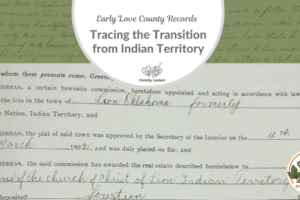
Well that’s really interesting and I’m looking at the image that you put into the blog post and I noticed that it is signed by Green McCurtan who was the Principal Chief of the Choctaw Nation. So that’s cool. And then there was the Governor of the Chickasaw Nation, PS Mosley that also signed it. So that’s fascinating. How interesting. I had no idea this is how all of this territory was organized and the was distributed.
Nicole (31m 34s):
Yeah, it was seems like a complex thing with the multiple jurisdictions, you know, the federal oversight and then the Nations. So it was interesting to see the records created from that.
Diana (31m 46s):
Absolutely. Well another fascinating discovery was a town patent granted to the deacons of the Church of Christ of Leon. And this was particularly meaningful because we know that the Harris family belonged to the Church of Christ, but you weren’t certain whether they attended services in Leon, Marietta or both communities. So the church patent gave some insight into how religious communities were establishing their institutional presence during this territorial transition period. And it also reinforced the importance of Leon as a community center for the Harris family. We knew that John C. Harris had business connections there and Arza Harris lived there and now there is some evidence of the family’s likely church community being formally established there with this property ownership.
Diana (32m 37s):
So this was a great discovery and it’s such a good reminder that we can benefit so much from understanding all the context you were able to see so much in this research session about the community and the institutions like churches. So you know, just a good reminder for all of us to think about our ancestors in the context of a whole community, not just looking at their property transactions and family relationships.
Nicole (33m 10s):
Right. And the Church of Christ itself did not have hardly any records at all just based on their beliefs in their organization. But I did purchase a book called Churches of Christ in Oklahoma that helped me understand the church a little bit better and their, any record keeping practices that they had. So because they didn’t really keep any records, it was nice to have this showing that where the church property was, and based on the information summarized by Claude and the Deep Research Project, it seems like the church might have already existed there.
Nicole (33m 51s):
And then they formalized the process of whoever’s already there get like paying a little bit to the Choctaw and Chickasaw Nations for the land they’re already using. So I think that might’ve been what was happening, who knows for sure. But it was really neat. And so this was like the end of my second day of research. It showed that patience and systematic exploration of early records can yield some treasures even when the initial discoveries don’t exactly lead where I expected them to. But it really did help me understand some of the historical context and just what was happening during that territorial transition period to statehood.
Nicole (34m 32s):
So in our next episode about this research trip, we’ll talk more about continuing the tax record research that I had done later that afternoon on day two.
Diana (34m 44s):
Wow, you were able to do so much. I’m so impressed with how much you got done with all of your research. So neat. Well, we hope everyone listening has enjoyed hearing about this onsite research and this transition between Indian territory and statehood. It’s just a good reminder of how every location is unique and it’s so good to just dig in and see what you can learn. All right, well thanks everyone for listening and we will talk to you next time.
Family Locket (35m 15s):
Bye-bye. Bye. Thank you for listening. We hope that something you heard today will help you make progress in your research. If you want to learn more, purchase our books, Research Like a Pro and Research Like a Pro with DNA on Amazon.com and other booksellers. You can also register for our online courses or study groups of the same names. Learn more at FamilyLocket.com/services. To share your progress and ask questions, join our private Facebook group by sending us your book receipt or joining our courses to get updates in your email inbox each Monday, subscribe to our newsletter at FamilyLocket.com/newsletter. Please subscribe, rate and review our podcast. We read each review and are so thankful for them. We hope you’ll start now to Research Like a Pro.
Links
Early Love County Records: Tracing the Transition from Indian Territory – https://familylocket.com/early-love-county-records-tracing-the-transition-from-indian-territory/
Sponsor – Newspapers.com
For listeners of this podcast, Newspapers.com is offering new subscribers 20% off a Publisher Extra subscription so you can start exploring today. Just use the code “FamilyLocket” at checkout.
Research Like a Pro Resources
Airtable Universe – Nicole’s Airtable Templates – https://www.airtable.com/universe/creator/usrsBSDhwHyLNnP4O/nicole-dyer
Airtable Research Logs Quick Reference – by Nicole Dyer – https://familylocket.com/product-tag/airtable/
Research Like a Pro: A Genealogist’s Guide book by Diana Elder with Nicole Dyer on Amazon.com – https://amzn.to/2x0ku3d
14-Day Research Like a Pro Challenge Workbook – digital – https://familylocket.com/product/14-day-research-like-a-pro-challenge-workbook-digital-only/ and spiral bound – https://familylocket.com/product/14-day-research-like-a-pro-challenge-workbook-spiral-bound/
Research Like a Pro Webinar Series – monthly case study webinars including documentary evidence and many with DNA evidence – https://familylocket.com/product-category/webinars/
Research Like a Pro eCourse – independent study course – https://familylocket.com/product/research-like-a-pro-e-course/
RLP Study Group – upcoming group and email notification list – https://familylocket.com/services/research-like-a-pro-study-group/
Research Like a Pro with DNA Resources
Research Like a Pro with DNA: A Genealogist’s Guide to Finding and Confirming Ancestors with DNA Evidence book by Diana Elder, Nicole Dyer, and Robin Wirthlin – https://amzn.to/3gn0hKx
Research Like a Pro with DNA eCourse – independent study course – https://familylocket.com/product/research-like-a-pro-with-dna-ecourse/
RLP with DNA Study Group – upcoming group and email notification list – https://familylocket.com/services/research-like-a-pro-with-dna-study-group/
Thank you
Thanks for listening! We hope that you will share your thoughts about our podcast and help us out by doing the following:
Write a review on iTunes or Apple Podcasts. If you leave a review, we will read it on the podcast and answer any questions that you bring up in your review. Thank you!
Leave a comment in the comment or question in the comment section below.
Share the episode on Twitter, Facebook, or Pinterest.
Subscribe on iTunes or your favorite podcast app.
Sign up for our newsletter to receive notifications of new episodes – https://familylocket.com/sign-up/
Check out this list of genealogy podcasts from Feedspot: Best Genealogy Podcasts – https://blog.feedspot.com/genealogy_podcasts/



Leave a Reply
Thanks for the note!