

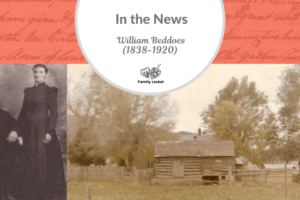
In this episode of the Research Like a Pro Genealogy podcast, Diana and Nicole discuss “In the News: William Beddoes (1838-1920).” Nicole shares her work on the Sally (Keaton) Reeves phase 3 research plan in Fulton and Izard Counties, Arkansas, and then Diana introduces the topic of researching ancestors in newspapers to gain insight into their community, family, and work ethic. She highlights her second great-grandfather, William Beddoes, and his pivotal role in establishing Salem, Utah. Nicole then provides a life summary of William Beddoes, including his birth in England, emigration to Utah, family, and involvement in establishing the town of Salem, based on his obituary. Diana then discusses the history of the Salem Canal, its construction, and the Salem Irrigation and Canal Company. She also explains what a “2×4 scantling, grooved, and into which water is poured to secure the level” is, providing historical and cultural context for this primitive leveling device. Diana then connects William Beddoes to the Salem Canal, evaluating the accuracy of his obituary’s claims by referencing Lyman Curtis’s role and census records. Finally, Nicole outlines future research possibilities, including the “Salem Irrigation and Canal Company Records” collection at Brigham Young University. Listeners will learn about researching ancestors through newspapers, the history of the Salem Canal, and how to evaluate historical claims using various records and resources.
This summary was generated by Google Gemini.
Transcript
Nicole (1s):
This is Research Like a Pro, episode 384: In the News – William Beddoes (1838-1920). Welcome to Research Like a Pro a Genealogy Podcast about taking your research to the next level, hosted by Nicole Dyer and Diana Elder accredited genealogy professional. Diana and Nicole are the mother-daughter team at FamilyLocket.com and the authors of Research Like a Pro A Genealogist Guide. With Robin Wirthlin they also co-authored the companion volume, Research Like a Pro with DNA. Join Diana and Nicole as they discuss how to stay organized, make progress in their research and solve difficult cases.
Nicole (40s):
Let’s go. Hi everyone and welcome to Research like a Pro. Today’s episode is sponsored by newspapers.com.
Diana (48s):
Hi Nicole. How’s it going today?
Nicole (51s):
Hey, it’s going well. I’m working on my research plan and I’ve been analyzing Sally Keaton Reeve’s family to see which of her family members lived in Izard and Fulton Counties, Arkansas in the 1860s-80s and just developing kind of a list of when they were all in which county. And I ended up having to color code things because it was just tricky trying to figure out when were they all in Fulton County, when were they all in Izard County? And the color coding helped. They just had a bulleted list for each person and now some of the bullets, the whole text for that bullet is red for Izard County and then for Fulton it’s blue and that just has helped a lot.
Nicole (1m 35s):
But now I can kind of clearly imagine when people were aware and basically they all moved away from Fulton County before records are available because of the county courthouse fire in 1870 so, and then the, when they’re in Izard, there’s nothing available either because of the courthouse fire in the eighties. So it’s just all substitute records from the federal level and state level.
Diana (2m 1s):
Oh yes, I know all about that. All those fun records that you use. But isn’t it great that we do have some substitutes because otherwise what would we do if we only had county records? We would be so stuck.
Nicole (2m 15s):
Right.
Diana (2m 15s):
Especially in Izard County.
Nicole (2m 18s):
Yeah, so I put at the top of my list to locate some of the son’s land on land patents. So I have the son-in-law, I know he had land and then I think the other, one of the other sons might have had a land patent too. Then my second item was tax research and from my locality research I learned like you probably already knew that they have tax records at the state level, so those are digitized down there in Full Text Search. So I’m excited to do that.
Diana (2m 46s):
Yes, when I learned that those records were on the state level and that they showed so much more information than the derivative I’d been using, I was so happy because I, for some reason I had it in my head that only the derivative existed. Sometimes that happens, the originals are gone and we just have this derivative and then I discovered that they were on the state level on the Family Search catalog, not in Izard County. So that was a really good lesson to teach me to look at the other jurisdictions and see what they have. So…
Nicole (3m 20s):
Yes, I think I had to learn that lesson too with another state, maybe Missouri, but the, the way I usually found tax records in the past for like Fauquier County, Virginia was going to the county page at the Family Search catalog. But for some time, sometimes you have to do the state page and then within that state’s page for the tax records, they have multiple listings of various microfilms that cover different counties.
Diana (3m 46s):
Exactly. So in that case, you know, a, a good search term for the Family Search catalog would just be to use the keyword search and perhaps put in, You know, like Izard County tax records because that probably would pull up something in the county collection as well as the state collection.
Nicole (4m 5s):
Oh yeah.
Diana (4m 5s):
Yeah. I found the keyword search helps for sometimes finding things in odd places where you
Nicole (4m 10s):
That’s a really good idea.
Diana (4m 12s):
are not really expecting them to be.
Nicole (4m 17s):
Yes. Well, coming up next in our Research Like a Pro Webinar Series for 2025 is your presentation, mom.
Diana (4m 24s):
Yay. I’m so excited to present all my information about Henderson Weatherford.
Nicole (4m 29s):
Yes. So on December 16th at 11:00 AM, that’s a Tuesday, Mountain Time, she will be presenting Challenging Accepted Ancestry: A New Look at Henderson Weatherford’s Family Origins. That title is very telling. It’s going to be fun to hear about what we used to think about Henderson Weatherford’s family and what you were able to uncover. But it’s great to see this careful analysis of historical records overturning commonly accepted family connections that were originally based on surname and geographic proximity. Well Henderson Weatherford’s case study demonstrates an effective methodology for questioning family relationships found in online trees through systematic evaluation of tax records, census documents, land records, and probate files.
Nicole (5m 14s):
You can also learn how how indirect and negative evidence can build a compelling case for new family connections. So in her lecture, we’ll look at the role of DNA in confirming or rejecting hypotheses that are derived from documentary research. And the topics included in this lecture will be Arkansas, Texas, tax roles, negative Evidence, and direct Evidence, land, Probate Census, DNA, and Burned Counties.
Diana (5m 42s):
That’s all about Izard County and the tax roll that we were just talking about. So I’ll be showing how I use those.
Nicole (5m 48s):
That will be great. And it is funny how our research, even though we’re working on different lines, keeps intersecting at Izard County Arkansas.
Diana (5m 56s):
Can’t get away from Izard County.
Nicole (6m 0s):
No. Well the next study group, it will be Research Like a Pro with DNA and that will begin February of 2026. So if you’ve noticed a pattern, we always have the DNA study group in the beginning of the year, starting in February, going through the spring, ending in May, and then the Research Like a Pro study group in the fall that doesn’t include DNA in the lessons, but you certainly could use it as a source. But that will be in the fall of 2026 if you’d like to be a peer group leader just apply on our website and you get complimentary registration for the study group. If you haven’t joined our newsletter, feel free to sign up to get our weekly newsletter that comes out every Monday with links to any of our new posts on our blog, our upcoming lectures, coupon codes, new podcast episodes, new videos on YouTube and all things like that.
Nicole (6m 48s):
As far as upcoming conferences, we are looking ahead to March when RootsTech and Salt Lake City will be convening. We’re excited to be attending that March 5th-7th, 2026.
Diana (7m 0s):
Yes, it’s so far in advance, isn’t it? But there’s always a lot of exciting things at the beginning of the year and RootsTech is one of those. Well, today we are talking about one of our ancestors, William Beddoes, and this was one of my 52 Ancestors blog posts for the year. I don’t even get close to 52 ancestors, but I’m happy if I just get maybe five or 10 ancestors furthered on their life stories. And this is one of them. This one is all about William Beddoes and William is one that we know quite a bit about because he left some histories, his wife has some histories.
Diana (7m 42s):
There was just quite a bit written about this couple and I had some neat stories about them, but I wanted to do something a little bit different and dig into something that I didn’t know much about in his life. And so I had the prompt, you know, Amy Johnson Crow gives us a prompt for the 52 Ancestors and I had the prompt to do newspapers in the paper or In the News and I thought, okay, let me see if, you know who would be interesting, who haven’t I written about yet? And I settled on William Beddoes, he is my second great-grandfather, so your third great-grandfather Nicole, and he played a pivotal role in establishing Salem, Utah in the late 1800s and early 1900s.
Diana (8m 27s):
And so I went searching for some records and information on Family Search Family Tree to see if I could get something interesting to base my 52 Ancestors post on him, something In the News. So the item that I found in his details was an obituary and that gave me a really good starting point for researching some more about his life’s accomplishments and also as so often happens, we get just a little bit of a clue that we need to go find out more about. And that’s what happened with this little bit of research.
Nicole (9m 7s):
Oh fantastic. Well let me give the life summary of William Beddoes just to set the stage for this. William was born June 17th, 1838 in East Wall, Shropshire, England, and he died November 1st, 1920. And so he lived a long time. He was 83 years old when he died. He joined the Church of Jesus Christ of Latterday Saints in England in 1866. Then he emigrated to Utah with his wife, Mariah Brock House, in 1868 and they had 14 children. Wow, that’s a lot. And they now have a really large posterity. So a lot of cousins out there. William’s profile in the Family Search Family Tree shows 40 sources and 33 memories.
Nicole (9m 53s):
An obituary for William gave us the clue to his involvement in the establishment of the town of Salem. It says, The great possibilities of agricultural in this part of the state were soon realized by Mr. Beddoes and he set about developing extensive irrigation plans. With Lyman Curtis he made the Salem Canal, which has served to convert many thousand acres of useless land into a veritable garden and it was due largely to his efforts that Salem and the surrounding country have been reclaimed for agricultural purposes and that Salem has become famous for its fruits and vegetables. He was one of the first to realize the possibilities of the land of the Payson valley under irrigation and after clearing off his homestead then covered with sagebrush he started work on what is today the Salem canal.
Nicole (10m 50s):
Wow, that was fun, and the author of this obituary is unknown but it maybe was one of his children. I wonder how many of the claims about William and this obituary are true. And so learning more about the Salem Canal in historical sources and whatnot could help evaluate the veracity of William’s accomplishments mentioned in this obituary.
Diana (11m 7s):
Right. There are some fun things in that obituary. I love the terminology that it was a veritable garden and I certainly can relate to the land being covered with sagebrush because even now here in Utah, areas that are not developed yet just have sagebrush because without water you can’t do a lot. So it was very important to have this canal built and have water brought to the masses. So one of the first things I wanted to do was learn about the history of the Salem Canal. Salem, Utah had an interesting name at the beginning. It wasn’t named Salem, it was initially named Pond Town because of the pond formed from springs that settled in a hollow.
Diana (11m 51s):
And as we all know in the desert, water is of great importance and especially to these early pioneers because it was so hot and dry in the summer. So in 1856 the early settlers built a dam to allow water to accumulate and eventually hold enough water to irrigate the farms, which is really neat. But despite this initial endeavor, they needed more water to grow crops in the Utah desert. And so they had another source of water which was the Spanish Fork River And it had plenty of water, but you needed a canal system to divert part of that river to Salem.
Diana (12m 32s):
So by 1865, the settlers decided to move forward with this plan and the initial construction took place from 1866 to 1869. So this canal runs from the mouth of Spanish Fork Canyon through Salem to the Payson Hill. A few years later, the Salem Irrigation and Canal Company was incorporated and it distributed 2,208 shares as a nonprofit corporation. Through the years, the canal has been improved with concrete lining and additional piping And it still is the primary source of irrigation water for Salem and Payson farmers rely on the water for 2,465 acres of farmland.
Diana (13m 16s):
So that is really neat and I know all about canal systems having grown up in Idaho with the exact same thing, diverting water from the Snake River in this case and through canals to water all the farmland for miles and miles around. So it’s so neat this engineering that takes place at the beginning of a settlement and that really enables that area to be developed and people to farm and make a living. Well, there was a little bit of information in the obituary that talked about the construction of this canal and it said the work was accomplished under great hardship and difficulty.
Diana (13m 57s):
No engineer was available to direct the work and no surveying instruments could be secured. The only instrument was a piece of two by four scantling, which was grooved and into which water was poured to secure the level.
Nicole (14m 13s):
Alright, yes, that does sound difficult. Also, I don’t understand everything in that. So let’s review some of these terms. So scantling, what does scantling mean? Well, you turned to AI to define the term. I love that it’s a great place to get definitions for terms that might not be in our dictionary or just might be a little different. And so the prompt was simple. What is a two by four scantling, grooved, and into which water is poured to secure the level. Well ChatGPT’s description is a two/four scantling grooved and into which water is poured to secure the level is describing a primitive leveling device used in carpentry, surveying and early building trades.
Nicole (15m 6s):
So ChatGPT then breaks it down for us. So scantling, a scantling is simply a small timber or piece of lumber of standard size, and a two/four scantling refers to a two by four piece of wood. Today we’d just write it 2 x 4 with the little x. In older terminology, two, four or two by four was shortened in some trades to 2/4. So that explains that. And then grooved, what does that word mean? Well, a groove was cut lengthwise along the top edge of the scantling. This groove was shallow and designed to hold liquid.
Nicole (15m 51s):
Next water is poured to secure the level. So before the bubble spirit levels became common workmen used water levels since water always seeks its own level and by pouring water into the groove, the workmen could see whether it sat evenly along the whole timber and if the water was deeper at one end the board was out of level and when the water surface was even from end to end the scantling, and thus the work being built, was level. So that was a great description from ChatGPT. It goes on to say that this device was an early leveling tool for builders, masons or carpenters. It was especially useful in rough construction where metal spirit levels weren’t yet widely available and sometimes instead of just a groove, two boards were connected with a water filled tube, which would be a more portable water level.
Nicole (16m 42s):
Well, getting this historical and cultural context is a great use of AI and this description made perfect sense once all the words were defined.
Diana (16m 54s):
Right. It was fun to see what it was because obviously I’d never heard of a scantling. I’ve used the level, the kinda levels we have nowadays for, you know, doing our things around the house, like getting a picture level when you’re hanging a picture. But never knew what they did in the olden days for their, what they called primitive engineering. So I just marvel at how amazing it was they could figure out how to do something monumental like this. So cool. Now let’s have a word from our Sponsor. Ever wondered what life was really like for your ancestors? With Newspapers.com you can explore the world they lived in through their eyes, in their time. Search over a billion newspaper pages dating from 1690 to 2025 and uncover the stories that shaped your family’s past from birth and wedding announcements to obituaries and community news.
Diana (17m 47s):
These pages hold the milestones and everyday moments that connect you to your roots, but it’s more than names and dates, it’s about standing in their shoes. Picture reading the local paper your great-grandmother once held or stumbling on a forgotten article about your grandfather’s first business. These aren’t just clippings, they’re pieces of your family story. Newspapers.com turns curiosity into connection. Start your journey today at Newspapers.com because sometimes the past isn’t just history, it’s a story waiting to be discovered. Come make infinite discoveries today on Newspapers.com. Use promo code FamilyLocket for a 20% discount on your subscription. Well of course after I was doing some research on the Salem Canal and the scantling, I wanted to know how accurate was that obituary stating Williams’s involvement in the canal.
Diana (18m 37s):
You know, obituaries can sometimes have some exaggeration. So I realized that some points ring true and others not so much. The obituary says with Lyman Curtis, he made the Salem Canal. So naming Lyman Curtis does add evidence to the statement as Curtis is recognized for his role in directing the Canal project. The town was actually renamed Salem based on Curtis’s hometown of New Salem, Massachusetts. He was one of those original settlers in 1856 and he actually had experience in building irrigation systems. Now the 1870 census is the first one where the Beddoes household would be enumerated in the United States because they had emigrated in the 1860s and it does show William Beddoes and household residing in Pond Town, hadn’t yet been officially renamed Salem.
Diana (19m 31s):
He was a laborer by profession and the census reflects the family’s English roots. It shows that William was 31, English, born in England, parents of foreign birth, cannot read or write at this time. His wife Mariah was 28. She was keeping house also born in England. Serena Beddoes age five was at home, born in England, Matilda age three, born in England and then Emma age 3/12s was the first child born in Utah, and she was born in February of 1870. And then we know that the census was taken on July 29th, 1870. The post office was Payson.
Diana (20m 12s):
Now by 1880, William was a farmer but he still could not read or write. But interestingly by the 1900 census he had learned those skills and he would actually go on to become a leader in the community. His obituary finishes up with this statement, the Upbuilding of Salem is one of Mr. Beddoes early ambitions and he served as president of the town of Salem for 16 years from the time of incorporation. Every public improvement accomplished under his direction, including the building of the city hall, and much of the material for its construction was purchased with money donated by Mr. Beddoes. He also laid out the cemetery and provided for the building there on and the fencing.
Diana (20m 56s):
He was one of the most public-minded citizens the city ever had and everything for its advancement was championed by him. It was he who brought the first telephone into the city and he directed and built the first meeting house. He was active in the church as he was in the affairs of the city and consistent in all things, he was recognized as one of the foremost citizens of the section in which he lived. So continuing to learn more about William from newspapers and other sources could give us more details about these accomplishments. So fun to read all of those items. Hopefully they’re not too exaggerated because those are really neat.
Diana (21m 39s):
And I love also that he came from England, probably pretty humble circumstances, they were not of the upper class at all. And here he comes to Utah to the new world and helps to make a new town. How awesome.
Nicole (21m 56s):
I love that. And it’s interesting to see the fact that he was not reading and writing in 1870, but by 1900 he had learned those skills. And it just shows, you know, like how much Utah was working and growing as a community at that time to help educate all of the people who had moved there. Many of them were impoverished immigrants from England and other places. So it was neat that, neat to see the development over time. And we’ve seen this with other people in the side of the family where they were just basically paupers, some of them inmates at like Workhouses in England and then they came to Utah and with the development of the economy there, they were able to gain education and become leaders of the community.
Nicole (22m 47s):
So it’s neat to see the same thing happening with William Beddoes. And so here are some ideas that you came up with for future research on William Beddoes. There’s an interesting collection titled Salem Irrigation and Canal Company Records that’s part of the L. Tom Perry Special Collections, Harold B. Lee Library, and Brigham Young University, Harold B. Lee Library in Provo, Utah. So that could hold some information about William Beddoes and his involvement with Lyman Curtis in the canal. That would be great. Is neat to see that the name of Lyman Curtis was verified in the obituary and in the other sources as a person who worked on the canal, that’s like a great idea to research in this special collection and just dive into the manuscripts.
Nicole (23m 31s):
It would be a great experience to just learn more about manuscript collections too. And the early years of the canal would probably be the most interesting as far as William Beddoes. The description of the collection is promising. It says administrative history: In 1865, the CI citizens of Salem, Utah decided to follow the example of the people of Spanish Fork who had earlier organized an irrigation company to take water out of the Spanish Fork River. They wanted to increase the agricultural capability of the area east of the existing Salem pond, which due to the natural slope of the land had been impossible to irrigate.
Nicole (24m 10s):
Lyman Curtis and two of his brothers made a survey for the canal from the Spanish Fork River to the Payson. The collection includes articles of incorporation, accompanied trust deeds, minutes of board meetings and resolutions, annual reports, legal documents, correspondence, tax records, receipts, and miscellaneous items relating to the function of the Salem Irrigation and Canal Company in Salem, Utah between 1866 and 1979. The collection is arranged in four series, so the first series, Salem Irrigation and Canal Company Minutes is from 1866 to 1979. And the second series has legal documents from 1878 forward.
Nicole (24m 52s):
The third series has financial records starting in 1873 and then the fourth series has company business records from 1907 on. So those first three series could be interesting and that would be great to see what did those company minutes say about who was involved and who was there. Yeah, you should go there and it’s too far from you. Check it out.
Diana (25m 14s):
I know that would be really a neat project to follow up with that. And it’s always interesting to get into those manuscript collections and see what you can discover, see what they kept and how neat that that’s just right there at Brigham Young University. So yep, that might be something I do on the off season between study groups when I’m not actively working on a different research project.
Nicole (25m 38s):
Yeah, it’s fun. Last, you know, when I was there at the special collections it was really great, really easy to get the diaries brought out. So yeah, it was a good experience. I would’ve loved to do this. Maybe we should do it together when I come for the summer.
Diana (25m 54s):
There you go, that would be fun. Alright, well this was a fun little project. You know, it’s kind of like a little mini project when I write these 52 ancestor posts, but of course as in everything, I always end up with more questions. So I really am excited to dig more into the sources. I want to learn more about everything it said in his obituary about being a leading citizen of the town and all the work that he did. And I’m sure there are other records out there that talk about that. Maybe a town history or county history. I’ll have to just, you know, make that one of my goals to learn more about his life.
Diana (26m 36s):
I love that we have got clues, you know, I look at these things like these life stories and obituaries as clues to then go dig into original records to find out what else we can discover. So it was a fun project, fun to learn more about William.
Nicole (26m 53s):
Yeah, and the funny thing about Pond Town, the original name of Salem, I was recently, a few years ago, I don’t remember exactly when, at a wedding for a family member on the Dyer side and their reception was at like a place that is adjacent to Salem Pond and there was a big grassy area and a bridge that went over the pond and the kids loved going over the bridge and we had to keep an eagle eye out watching the kids playing near the pond ’cause we didn’t want them to fall in. But it is a beautiful place and it’s fun to think about our ancestors living there.
Diana (27m 28s):
That’s so neat. Well, I looked really quickly at Family Search and see that in 1851 in England when William was still living there, he was a miner in stone. That would not have been fun. You know, I dunno if a miner in stone meant that he probably didn’t have to go underground, or maybe he did. I’m not sure what that means. So there’s another, you know, option for research to find out what that really meant. But definitely he was able to really, really become much more than just a miner in England. So yeah. That’s neat. That’s neat. That was a hard life.
Nicole (28m 5s):
That would be a hard life. I wouldn’t wanna be a miner.
Diana (28m 9s):
No, and no opportunity to rise above your station at that time. You know, mid 1800s in England you pretty much were, you were pretty much stuck with with what you had and that that was your life. So it’s neat to see how he came to Utah and was able to learn to read and write, and just had such an interesting life, and had all those 14 children, which amazing, maybe I should say it was amazing for his wife, Mariah, that she had those children.
Nicole (28m 42s):
That’s right.
Diana (28m 42s):
Well she is! We have another one, our Cynthia Royston had 14 children as well. So those are very tough women. Two very different parts of the country having all those children. That’s fun. Well, thanks everyone for listening and hopefully you’ve got picked up some ideas about researching your own ancestors and writing about them. It certainly is a great way to add just a little bit to their stories by doing these little short vignettes. So thanks for listening and we’ll talk to you next time. Bye-bye.
Nicole (29m 14s):
Bye. Thank you for listening. We hope that something you heard today will help you make progress in your research. If you want to learn more, purchase our books, Research Like a Pro and Research Like a Pro with DNA on Amazon.com and other booksellers. You can also register for our online courses or study groups of the same names. Learn more at FamilyLocket.com/services. To share your progress and ask questions, join our private Facebook group by sending us your book receipt or joining our courses to get updates in your email inbox each Monday, subscribe to our newsletter at FamilyLocket.com/newsletter. Please subscribe, rate and review our podcast. We read each review and are so thankful for them. We hope you’ll start now to Research Like a Pro.
Links
In the News: William Beddoes (1838-1920) by Diana Elder – https://familylocket.com/in-the-news-william-beddoes-1838-1920/
Sponsor – Newspapers.com
For listeners of this podcast, Newspapers.com is offering new subscribers 20% off a Publisher Extra subscription so you can start exploring today. Just use the code “FamilyLocket” at checkout.
Research Like a Pro Resources
Airtable Universe – Nicole’s Airtable Templates – https://www.airtable.com/universe/creator/usrsBSDhwHyLNnP4O/nicole-dyer
Airtable Research Logs Quick Reference – by Nicole Dyer – https://familylocket.com/product-tag/airtable/
Research Like a Pro: A Genealogist’s Guide book by Diana Elder with Nicole Dyer on Amazon.com – https://amzn.to/2x0ku3d
14-Day Research Like a Pro Challenge Workbook – digital – https://familylocket.com/product/14-day-research-like-a-pro-challenge-workbook-digital-only/ and spiral bound – https://familylocket.com/product/14-day-research-like-a-pro-challenge-workbook-spiral-bound/
Research Like a Pro Webinar Series – monthly case study webinars including documentary evidence and many with DNA evidence – https://familylocket.com/product-category/webinars/
Research Like a Pro eCourse – independent study course – https://familylocket.com/product/research-like-a-pro-e-course/
RLP Study Group – upcoming group and email notification list – https://familylocket.com/services/research-like-a-pro-study-group/
Research Like a Pro with DNA Resources
Research Like a Pro with DNA: A Genealogist’s Guide to Finding and Confirming Ancestors with DNA Evidence book by Diana Elder, Nicole Dyer, and Robin Wirthlin – https://amzn.to/3gn0hKx
Research Like a Pro with DNA eCourse – independent study course – https://familylocket.com/product/research-like-a-pro-with-dna-ecourse/
RLP with DNA Study Group – upcoming group and email notification list – https://familylocket.com/services/research-like-a-pro-with-dna-study-group/
Thank you
Thanks for listening! We hope that you will share your thoughts about our podcast and help us out by doing the following:
Write a review on iTunes or Apple Podcasts. If you leave a review, we will read it on the podcast and answer any questions that you bring up in your review. Thank you!
Leave a comment in the comment or question in the comment section below.
Share the episode on Twitter, Facebook, or Pinterest.
Subscribe on iTunes or your favorite podcast app.
Sign up for our newsletter to receive notifications of new episodes – https://familylocket.com/sign-up/
Check out this list of genealogy podcasts from Feedspot: Best Genealogy Podcasts – https://blog.feedspot.com/genealogy_podcasts/




Leave a Reply
Thanks for the note!