
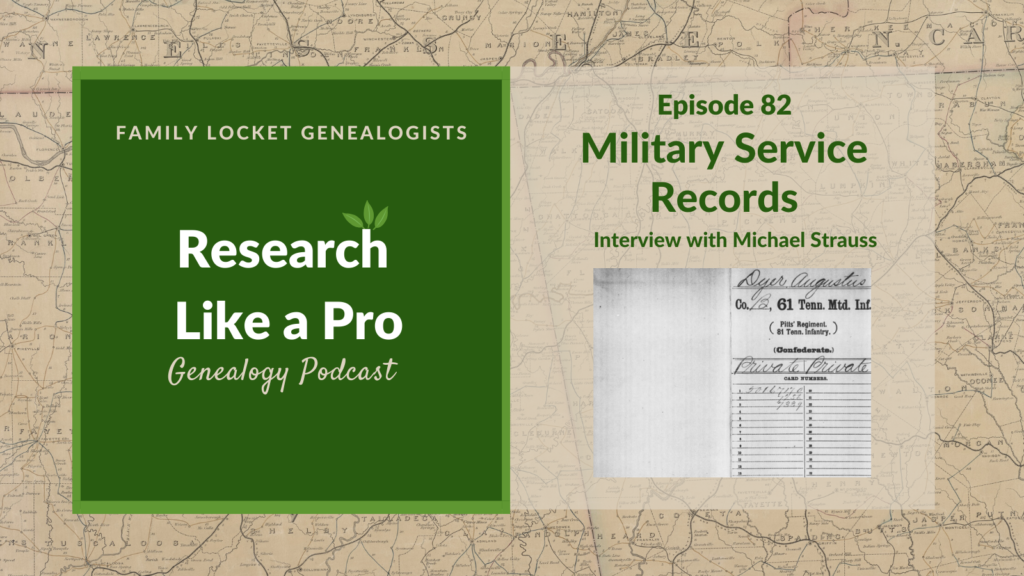
Today’s episode of Research Like a Pro is an interview with Michael Strauss, Accredited Genealogist Professional. Michael is an expert on United States federal records and military records. We will talk about military service records beginning with the Revolutionary War and ending with the Philippine Insurrection (1898-1902). Michael shares how Fred Ainsworth was instrumental in creating the compiled military service records and what you might find in them. We also discuss the Official Military Personnel Files of the 20th century and how to access them. Join us for an informative discussion on military service records!
Transcript
Nicole (1s):
This is Research Like a Pro episode 82: Military Service Records with Michael Strauss. Welcome to Research Like a Pro a Genealogy Podcast about taking your research to the next level, hosted by Nicole Dyer and Diana Elder accredited genealogy professional. Diana and Nicole are the mother-daughter team at FamilyLocket.com and the creators of the Amazon bestselling book, Research Like a Pro a Genealogists Guide. I’m Nicole co-host of the podcast join Diana and me as we discuss how to stay organized, make progress in our research and solve difficult cases.
Nicole (43s):
Let’s go, Hi everyone and welcome to the show. I’m Nicole Dyer co-host of the Research Like a Pro Genealogy Podcast. I’m here with Accredited Genealogist and cohost Diana Elder. Hi, Diana, how are you?
Diana (59s):
I’m doing well, Nicole, how are you doing?
Nicole (1m 2s):
Great. Have you recovered from SLIG yet?
Diana (1m 5s):
Yes, I am finally getting back to work and getting rested up again after a week of not getting enough sleep. So that was a great week and I am glad to be done, I have to admit.
Nicole (1m 18s):
It was a wonderful week and we had the chance to see our guests today there, Michael, today we are interviewing Michael Strauss an Accredited Genealogist about Military Service Records. Hello, Michael, welcome to the show.
Michael Strauss (1m 30s):
Well, hello, Nicole and Diana. It’s good to, good to hear from both of you.
Diana (1m 35s):
Let’s start off with kind of an introduction of Michael. I first met Michael, I believe it was that at BYU Genealogy and Family History conference a few years ago. And then because we both present at similar conferences, we just kind of keep running into each other. And last week at SLIG, Michael coordinated an entire course. And so it was fun to see that he was doing that. I didn’t take that course, however, I would love to take your course sometime, but can I just ask, when did you get started with your actual genealogy research?
Michael Strauss (2m 9s):
Well, Diana, I started doing genealogy research when I was a teenager. So I started when I was 12 years old. For me, it was kind of an interesting way of getting involved with family history as it was a middle-school project for me at the school I attended in Pennsylvania. I’m a Pennsylvania native, and I remember getting the assignment in my, it was a humanities assignment, but it was part of my history class. And when I did that, I went home to my parents, basically asking for help. And my parents pretty much pushed me aside and kind of sent me to my grandparents who were obviously older and asked me to contact them regarding family history information.
Michael Strauss (2m 53s):
And I like a typical 12 year old had no interest in doing this. It was like, oh, this is so boring. I don’t think I want to do this. And I did. And immediately I could not believe how much fun this was and the rest is history. I continue doing it and have continued since that time for over 40 years.
Diana (3m 14s):
So you are a bit of an expert in military records, is that right?
Michael Strauss (3m 20s):
Yeah. I do a lot of military research. Most of my lectures center around both military and federal records as obviously military records are found inside of federal records.
Diana (3m 33s):
So I’m sure there’s something that kind of attracted you to military records. Was it living in Pennsylvania, the sight of so much warfare, you know, with Civil War, Revolutionary War, did that lead to your interest or just because as a teenager, that just seemed like really an interesting way to go with your research?
Michael Strauss (3m 50s):
Well, for me, it was a combination of several things. One was of course my interest in history. I loved all things history and Pennsylvania is a very historic state. As you mentioned, there was the battle of Gettysburg from the Civil War, a number of Revolutionary War engagements, Valley Forge was nearby my home where I lived and grew up at Philadelphia was close enough that I could travel there. But my interest also stemmed from the fact that I also am a Coast Guard veteran. So I had served in the military.
Diana (4m 23s):
Oh, of course. That makes perfect sense. And I’m so glad that you’ve had this great interest in military records because we are going to benefit from it today, as we talk about the compiled military service records.
Nicole (4m 36s):
So can you tell us about what are compiled military service records?
Michael Strauss (4m 40s):
These are the records that essentially show that an individual has served in the military. Now just want to make one thing clear that they are called compiled military service records from the time of the American revolution through to the Phillipine insurrection, which would be roughly 1902. And then after that, they evolve to become called the official military personnel files and they are held at different places.
Nicole (5m 8s):
Okay. That is really good to know. So what is the cutoff again? Where do they change?
Michael Strauss (5m 14s):
About 1902, the, the time of the Phillipine insurrection, the war after the Spanish American war.
Nicole (5m 21s):
Okay. Thank you. So what does the record group at the National Archives where we can find these?
Michael Strauss (5m 27s):
Yeah, so the record group that would cover these records is going to be found in a record group 94, that is a National Archives record administration record group. As you probably already know that the National Archives was never set up for genealogists, it was set up for those doing scholarly or historic research. And it’s really genealogists that use the records more so obviously, but the records themselves come directly, are directly recorded in that record group.
Nicole (5m 58s):
Wonderful. And is there a way that we can access an index for them online?
Michael Strauss (6m 2s):
Yeah. There are a number of places to find them online, so you can get them online on both Ancestry, Fold3, which of course is owned by Ancestry. And the FamilySearch also has a number of these records digitized already. Now, not all the wars are fully digitized, but a number of the early wars have already become available online in that regard.
Diana (6m 25s):
So let’s just go back to kind of the beginning about why these were even created and how they were created and when they were created. Can you tell us a little bit about the history?
Michael Strauss (6m 35s):
Oh, I’m really happy to be able to tell you that because very few people know the story behind why these records exist. And I think this needs to be shared, especially to genealogists because they would have more appreciation as to why the records were created. So a man by the name of Fred Ainsworth, who was a Colonel at that time, later would become a general, he was the head of the Record and Pension office and he had a team of clerks that worked for him. And it was his responsibility to take applications of men who were applying for their pensions. So these were mainly Civil War veterans, may be veterans that were from the Indian wars, which were the post Civil War years during reconstruction in the years later.
Michael Strauss (7m 20s):
And what he did was he would take the applications for the men applying for their pensions. These were elderly men, of course, or men who had been wounded. And it was his job to painstakingly go through the records to determine the validity of their claim. Obviously he’d have to prove that they had served. He had to look to see if they had received a dishonorable discharge or a general discharge, and he needed to know that they would be able to obtain a pension based on the laws, because there are laws in place at this time, different pension acts. And you can imagine it became very painstaking to do this because he had to look up individually every person.
Michael Strauss (8m 2s):
So he approached the War department with an idea that he would catalog, index and edit these records. And he was given permission to do that. And in turn, he started working on all the different wars up to that point. Now it’s important to note how he did it. So he worked on some of the earlier wars first, and then he started working on some of the other wars. Now he had some problems though. He ran into some issues. So the Revolutionary War was a problem and it required that he would reconstruct some of the records. And that was in part because of a fire that occurred in November 8th, 1800.
Michael Strauss (8m 44s):
It was a fire in the War department that burned and destroyed lots of records. So he went to the Interior department, cause that related to land, men would get bounty land. And he went the state department as well. So he was able to go to different areas of the government to try to reconstruct those files. The only wars that he did kind of in real time, so he indexed and cataloged them as the events occurred, was the Spanish American war, because that was done at the time that he was doing all of this work. So the other wars were all cataloged and stamped the date that he did it, but the latter Spanish American war, the Boxer rebellion, the Phillipine Insurrection, those were basically done in real time.
Diana (9m 33s):
It is amazing to me that because of one man we have this huge set of records that shed so much light on our ancestors.
Michael Strauss (9m 41s):
Oh, I know it amazes me as well. And what a and what’s really neat is, and a lot of people don’t know this, at the archives they have a room named after Fred Ainsworth. You know, I would recommend that genealogists if they make a trip to the archives to please just ask to see the room, because it it’s just neat to be able to go into the room that was named after him. And we can thank him for these records. And the other thing that a lot of people don’t realize about him is when the archives opened their doors in the year, 1934, that was when it was created and open to the public, Ainsworth, he died two weeks before they opened their doors. So yeah, he never saw the place where the records were to be housed.
Diana (10m 23s):
Interesting. Well, I’m sure you know the National Archives very well having lived back east for so long, but now you’re out here in Utah. So do you go back often for research trip?
Michael Strauss (10m 34s):
I do. I tend to frequently go back. I do a lot of work with forensic work as well. So I do state and probate work. So I spend a lot of time in New York, New Jersey and the surrounding area and being from Pennsylvania, I also visit my parents and other family members. So anytime that I get to go back for a research trip, I’m really agreeable to that.
Nicole (10m 56s):
Well, let’s talk some more about how record keeping evolved after the Ainsworth period.
Michael Strauss (11m 3s):
Okay. So what, what he did was he intended on having the records pretty much look identical. So for the most part, the records appear to be the same. So the records are divided into the different war periods. So the Revolutionary War is your first war that they have these records. Then there’s the war of 1812, which everyone is familiar with. But there’s a period in between that. A lot of people aren’t familiar with and it was called the Old War Period. So it essentially ends, or excuse me, it begins in 1784 at the end of the American Revolution and it ends in 1811, which is the year proceeding the War of 1812. There were some Indian wars, there was several smaller conflicts that we were involved in.
Michael Strauss (11m 50s):
Maybe both you and Diana are familiar with the, the Shays’s Rebellion. And there was the Whiskey rebellion of 1794. These were emergencies in which troops were called up under the presidency of George Washington and Ainsworth collected the muster rolls and indexed and cataloged those men. They were all thrown into that Old War period. And then you have, of course the Mexican war of 1846, the Civil War of 1861, the Spanish American war of 1898. And then it ends with the Boxer Rebellion and the Phillipine Insurrection with 1902. So they’re all done identically
Nicole (12m 29s):
Thank you for explaining that, that’s really helpful to understand. And I have heard of the Shays’s rebellion and the Whiskey Rebellion, and I don’t, I never considered that there would be muster rolls from those periods. So that’s good to bring that to our attention in case we have anyone who lived in that time period in that place.
Diana (12m 48s):
So let’s go through each of the different wars and just talk a little bit about what is available for each one of them, because I believe they’re all a little bit different. I, I think it would be helpful for our listeners to just focus in a little bit on each one. So let’s start with the Revolutionary War. And can you tell us what, what is in those records?
Michael Strauss (13m 8s):
Okay, well, the earliest war, the Revolutionary War is going to be a little bit different than the rest. Remember I alluded to the fact that there was the fire of the year 1800. So the records are not as complete as are the other war periods. So depending on what Ainsworth was able to collect from the other three departments, again, Interior, Treasury, and the a and the State department, he was able to collect and try to reconstruct those men’s service files. So some of the information might not all be there, but for the most part you’re going to have, of course their mustering information, their muster out information, it’s going to collect details about their service.
Michael Strauss (13m 48s):
But again, it’s going to be limited. The records, of course, for the Revolution are fully indexed and they are available for the most part online. You’ll be able to access these on Ancestry. That’s probably the, the, one of the nicest interfaces that will allow you to search the Revolutionary War period, compiled military service records.
Diana (14m 9s):
So one of the questions I have is when we are looking at our ancestors’ information on Ancestry, is that all there is to it, or is there more at the National Archives? Because I know sometimes we get an index card like with the pensions, and then we know there’s a whole file behind that at the National Archives. So for these records, is the information we’re seeing on Ancestry all there is, or is there more?
Michael Strauss (14m 36s):
No, there’s definitely more, there’s records that were never indexed by Ainsworth when he was doing this. And it’s an, and I’m really glad that you asked that because that’s another area that I think is a little bit of a misnomer for researchers and genealogists. So when these records were indexed by Ainsworth, he collected what he had, essentially. He was able to go through what was available initially, but more records were located, and at that time he did not include them inside the original compiled military service records. So there are documents and papers that are inside the file, and that’s great, and that’s what you’re looking at when you request the compile Military Service record, that’s what you’re getting.
Michael Strauss (15m 19s):
But then there were documents that were unfiled, ones that never made it into the, the document that he had cataloged and indexed. They were just papers outside of the compiled military service record. So what he did was he indexed and cataloged those separately, and those were done as a separate entity all together. So those are a set of records that people will omit looking at at the archives because well, one, they don’t know they exist. So if you know, they exist, you can ask the archives to look at the unindexed documents that are attached to the Compiled Military Service Records.
Michael Strauss (16m 1s):
Additionally, there were several others. So there was Carded Medical Records, not all the medical records made it into the file, not all of them. So they had separate medical records. There was something called Record of Events. An earlier name, they were called was Caption Cards. That was the Revolutionary War era, but they evolved to become called Record of Events, or ROE cards. Now what these were were very simple, again, these never made it inside the file, so these were cards that were cataloged for the military unit. So Diana and Nicole, if you had an ancestor who served in the Civil War for an example, and you wanted to know more about them, obviously you would get their service record, but the service record really wouldn’t tell you what the regiment was doing.
Michael Strauss (16m 48s):
So if they served in the 93rd Pennsylvania, it would only tell you that the person had served, when they served, their dates of promotion, that sort of thing, and if they were hurt, injured, killed, whatever had happened to them, but you wouldn’t know what the regiment did from day to day, month to month, the events cards that he created tells us what the regiment did. So those are an important part of the Compiled Service Records, but never made it inside the files, they were kept separate by Ainsworth. The other last couple of were related to bookmarks. So at the bottom of the Service Records, from time to time, you may see a Bookmark Notation.
Michael Strauss (17m 32s):
This is essentially a number, it’s a series of letters and numbers. If you find a bookmark notation, that means there’s another file on top of the Compiled Military Service record and you have to request that directly from the Military Archivist. These have never been digitized. They’ve never been filmed. They’re only available on site in Washington, DC at the Archives. To get a bookmark file you had to have had something happened to the soldier that’s outside of the routine. So the soldier had, they, they, they made an error in the records. So they notated something in his original record that was wound up being an error, so the file had to be corrected.
Michael Strauss (18m 14s):
That’s a bookmark notation. Or an individual of one a, I looked for, I noticed that almost all the men and one regimen had the same bookmark file. And I was like, why are there 600 men with the same bookmark number? It made no sense to me. I couldn’t figure it out. So I requested the file for the individual I was interested in cause I had the bookmark number and it wound up being a cavalry unit. So all the men who had that same bookmark number, all supplied their own mounts, their own horses. So the government paid them for it. It was something outside of the routine. So that created a bookmark file.
Michael Strauss (18m 53s):
The last two were the Colored Troops records. That was obviously Civil War, but the Colored Troops records that he created were a little different in that many of them included what we consider to be like manumission papers, where the former slave was released from slavery and the master would sign off essentially saying that this individual is free and could now do as they please, so they had slavery related papers attached to the file. And then the last set of records that’s outside of the CMSRs, that’s what they’re abbreviated as, was called the Ainsworth’s list, obviously named after Fred Ainsworth, and they were essentially like the record of event cards, but they centered on the strengths of the regiments.
Michael Strauss (19m 41s):
So they would tell you the names of the commanding officer. They would tell you the strength of each company by number. So not only do you know where the companies and regiments are going, you know how big they are. So that’s the records that fall outside of the Compiled Military Service Records that very few people know about.
Nicole (20m 1s):
Thank you for explaining that. And I’ve always wanted to go to the National Archives and see some of those original records. A follow-up question with that is from the Compiled Military Service Records, you know, those came from the muster rolls, are the originals of the muster rolls and, and the other records still available for researchers?
Michael Strauss (20m 21s):
Oh yes. They never threw them out obviously. They are the original muster rolls. Have, have either you or Diana, have you ever had the opportunity to see an original one in person I mean?
Nicole (20m 32s):
No, I haven’t.
Michael Strauss (20m 32s):
All right. So just to give you an idea of what they look like, they’re extremely large. So imagine a table that you might have in your dining room that’s a regular kitchen size table. They are about roughly about two and a half feet wide by similar length, and they are folded, multilevel folded. And these were the original ones that were carried into the field and filled out by the first Sergeant and of course signed by the company commanders and then turned into the War department. So Ainsworth intended for these records to be preserved. And that’s another reason why these were created because obviously they deteriorate over time.
Michael Strauss (21m 16s):
Now you, as a researcher, could see those only in the case, if the original record that Ainsworth created, the index that he created, if it’s not readable, if there’s something missing or something wrong with the record, then you could request to see the original.
Nicole (21m 34s):
So interesting. You know, we’re trained as genealogists to always see the original and I’ve always wondered, should we consider those compiled military service records to be good enough, close enough to the originals? Or should we, you know, do our reasonably exhaustive research and go look at the original muster rolls. So what do you think?
Michael Strauss (21m 53s):
Well, remember they are abstracted word for word. So every word that he took off the originals, he put on to the cards that he had created. So it is a mirror image of the records exactly as they’re filed. You could ask to see one, certainly I don’t know what the reply would be from the Archives. They’re likely not to let you see it unless you have a reason to be able to see it, that the record that you were originally looking at was destroyed or just not available.
Nicole (22m 23s):
That makes sense. Thank you.
Diana (22m 24s):
Well, I was so interested to hear all of that. Also while you were talking, I decided to look up one of my ancestors, or actually kind of a collateral relative, and I have a Conquest Royston who was in the Revolutionary War and I’m just looking at his company muster role. And I think there are about 16 or 17 cards and they basically give the date and the company. And there’s not a lot of information that appears on these cards. So when you are doing research, how do you recommend someone actually use these cards? Like in this case with so many different cards, with just a little bit of information, how would you typically use that to put together a case?
Michael Strauss (23m 9s):
Well, remember you’re you are doing a full history of an individual. So the idea behind this is to use the Compiled Service Records as a starting point, from there, you would continue on to other sets of primary records that would cover other war related material. So everyone starts at one point, you have to have a starting point. You can’t do military research on someone until you establish the fact that they had served. So that was the purpose of the Compiled Service Records. But as you alluded, it has limited information. It’s only going to pertain to their service period of time. As far as the genealogy is concerned there’s virtually none.
Michael Strauss (23m 50s):
I mean, it’s not really set up to do Genealogy. As far as that’s concerned, you would go to the next steps and those next steps are the pension record. The next step, after that for the earlier wars up through 1855, at least, are to look for bounty land applications. Remember our country was rich in land while we were poor in cash. So men could be paid for their service with granting them public domain land. And this was done for the first three major war periods, the Revolution, the War of 1812, and the Mexican war, which by the way, is a separate topic all together on its own.
Nicole (24m 26s):
I bet. Now Diana asked you about what is available for the Revolutionary War. And we’ve talked a little bit about the old war period. What can you tell us about the war of 1812 and that engagement?
Michael Strauss (24m 41s):
Okay. So the war of 1812 of course is our second domestic conflict with England. And as you know, the war of 1812 was going to have essentially the same set of records that the Revolution and the other wars afterwards, remember these wars all look similar. So the war of 1812, the Mexican war, the Civil War, the Spanish American war, the records are really all essentially the same in appearance. He took the same muster rolls from each War and essentially just indexed and cataloged them. So they are meant to look identical. I want to note that there was one change as far as the Civil War was concerned, because remember the Civil War, you know, it’s obviously Americans fighting Americans.
Michael Strauss (25m 25s):
We’re not fighting a foreign power as we are in the other wars. So Ainsworth also collected these Confederate side as well. So the Confederate records were obviously in the custody of the Confederate States of America government. And when Richmond fell, those records were turned over to the federal government and in turn Ainsworth was able to collect those as well.
Diana (25m 51s):
I’m so grateful he did the Confederate soldiers as well, because that is where a lot of our ancestors served, in the Confederacy. And I know I had one individual that I was researching and found so much information that talked about, you know, desertion and hospitalization and illness, and then finally dying. But it gave me the opportunity to trace him all the way through the war, to his final death.
Michael Strauss (26m 19s):
Oh, absolutely. You can follow a completely through and something else that Ainsworth also did that I think was really helpful, I believe you had a prior episode on your podcast where you talked about men have similar names or same names, as I remember. And, and I thought this was important that he did this as well. So if you have a common name, you might have some confusion as to whether or not you’re looking at the right person. Now Ainsworth did these records individually by war. But what he also did on the index cards is below the name and the unit, because unit designations would be repeated in multiple wars, you know, that doesn’t mean the unit just disappeared they would be reused in another war.
Michael Strauss (27m 0s):
And what he did was in parentheses below the name and the unit, he would put the war. So you would know you’re looking at only Spanish American war compiled military service records. And you’re not going to waste your time looking at the war of 1812, if you’re not interested in that war. So he took out all that.
Nicole (27m 20s):
That is a great idea. So helpful. And I’ve often found that men of the same name have been confused even within the same engagement within the Civil War, but usually we can figure it out based on what county that regiment was mustered from.
Michael Strauss (27m 35s):
Right, and that’s where the record of event cards and the Ainsworth list will help you.
Nicole (27m 40s):
I have never used the Ainsworth list. So I’m excited to try that. The record of events have been so useful to me in my research with the Civil War and you know one record of events I will have to mention. It mentioned that the book that the clerk was keeping was lost when the unit was captured. So they tried to reconstruct it later, but couldn’t remember all of the details. And I thought, oh goodness, I wonder how much of this unit’s information is accurate because it looked like some of it might’ve been remembered incorrectly.
Michael Strauss (28m 14s):
Well, nice thing about the record of event cards and the Ainsworth list, these have been digitized and they’re on FamilySearch. So they are available from the Revolution up to the Phillipine Insurrection on FamilySearch.
Nicole (28m 24s):
Oh, great, I’m going to go take a look at those after this.
Michael Strauss (28m 29s):
You’ll absolutely love them. They’re really wonderful.
Diana (28m 31s):
So it sounds like we need to check Fold3, Ancestry and FamilySearch if we’re going to get a complete picture of an ancestor, because the records can be in all three places,
Michael Strauss (28m 42s):
Right. That’s all online, but it’s not complete for every war. So take into account that it’s going to be not everything online, but what’s not online is available on site.
Diana (28m 52s):
Okay. So if we’re going to really dig into these military records, we need to really educate ourselves. And this is perfect this entire podcast I think we’re all learning so much. I really love that you went in depth on how these were created because Ainsworth, I’m looking at a card right now, he created this entire card, right? So he’s got like, you’re mentioning the war, and a place for the name, and the regiment, and the place for all the different things that could have happened to the individual like casualties or extra remarks. So he had to come up with these cards. Is that correct?
Diana (29m 32s):
He’s the one ,his department, created the formatting of these cards.
Michael Strauss (29m 36s):
That is correct. It was a printed form that he created that was reused over and over and over again for each work period.
Diana (29m 44s):
So interesting. I think I have looked at these hundreds of times, never thought about the origin of them. I think I just thought that they were always there.
Michael Strauss (29m 51s):
Yeah. Now like Paul Harvey, you know the rest of the story.
Diana (29m 56s):
Absolutely. All right. Well, let’s see, we’ve talked about several of the wars. I don’t think we’ve talked a lot about the Spanish American war. So tell us a little bit about what’s available for that war.
Michael Strauss (30m 8s):
Okay. So the Spanish American war, just to recap, that is again, the same format that they’re using for the previous wars. For the, for the most part, the, the forms are reused over and over again, and they’re tailored to the individual wars. So there might be some information that one war requires that another just, they just simply don’t ask for in the Service Records. So the Spanish American War is going to take into account three individual war period. So it’s Spanish American war of 1898, which is about seven months in length. You’ve got the Boxer Rebellion, which is the year 1900 that was an ugly little incident that we had. It was with the Chinese.
Michael Strauss (30m 48s):
And then we have also the, the Phillipine insurrection, which was from 1899 to 1902 when there’s a treaty signed. But the war continues on with guerrilla warfare as late as 1913. But the records themselves, again, are found within the compiled military service records. And these are cataloged and indexed by Ainsworth as the events occur. And he is doing this based on the muster rolls at the time because of their current.
Nicole (31m 21s):
Good to know. We haven’t talked very much yet about the Navy and the Marine Corps. Can you tell us what records are available for these two?
Michael Strauss (31m 29s):
Okay. I’m glad you mentioned that, Nicole, because that’s also important to know. So Ainsworth touched on his records for all his war periods strictly based on the army and his was strictly volunteers. So after he’d completed this, he went back to the War department and said, I’d like to now do the regular army. This is not the Navy. This is not the Marine Corps. This is not the Revenue Cutter service. This is the regulars. So they did not let him do it and hence the regular army has no such listing like this. If you have someone in the regular army, you’re going to have to contact the Archives. The only thing that’s online for the regular army was the original ledger books that it lists the enlistments themselves, and that’s it.
Michael Strauss (32m 16s):
Beyond that you have to go to the Archives for everything else to reconstruct the entire service file. If they were wounded, discharged, dishonorably discharged, captured anything that would have happened to someone in the regular army, you have to go through the process at the Archives. Now that’s the regular army. So the Navy in the Marine Corps and the Revenue Cutter Service were all done differently. Ainsworth never collected these records. These were not his scope of what he was to do. He strictly ended with the volunteers. So the Navy has a similar version of compiled military service records, at least up through the War of 1812, but they were not indexed by Ainsworth they were done by someone else.
Michael Strauss (33m 1s):
And afterwards the Navy created what were called Rendezvous Reports. Now the name implies exactly what they are. Sailors would rendezvous at a specific place and they would enlist in the Navy. Now they were in major ports, so Philadelphia, New York, Charleston, Boston, maj, you know, Baltimore, major ports where men could be easily recruited into the Navy. And there’s a set of records created to show Navy enlistments up through 1891. After that date, the Archives has limited records for Navy enlistments, they’re essentially enlistment jackets.
Michael Strauss (33m 42s):
And then they evolve into the records in St. Louis, which are the 20th century records, but the Rendezvous Reports are online at least from 1846 to 1891. And they’re available on Fold3 so they are available for free. So that’s the Navy. The Marine Corps had their equivalent of the compiled military service records. They were called Size Roles. So if you re just recap this, the volunteer army is to compiled military service records. The Navy is the rendezvous reports, the Marine Corps is the size roles. It’s essentially the same thing. It’s just really just redone for the branch of service.
Michael Strauss (34m 23s):
And then finally it leaves us with the Revenue Cutter Service. Now, the reason I know about them is the Revenue Cutter Servi in 1915 became the United States Coast Guard, and I’m a Coast Guard veteran. So I, I had it drilled into my head when I was in bootcamp, the early history of the Coast Guard. So the lifesaving service, a lighthouse service and the Revenue Cutter Service all formed together to become the Coast Guard. Well, at that time, pre-1915, those records, they don’t have rendezvous reports, they don’t have size roles, all they have, their equivalent is called Shipping Articles. So each branch has their own set of records that catalog their service members, but they’re called different things and they carry different information.
Michael Strauss (35m 10s):
So hopefully that helps a little bit
Nicole (35m 12s):
That does, that’s really interesting that only the volunteer records were cataloged by Ainsworth. And it does sound like it will be a little more work to go find out about those regular army enlistments and Marine Corps and Navy.
Michael Strauss (35m 25s):
I mean, it takes some diligence, but once it’s done, it’ll be well worth your time.
Diana (35m 30s):
For someone who doesn’t know if their ancestor served, what would be their first step, if it’s not indexed online, you know, it’s just buried in the National Archives. What would you suggest that you do to try to understand their Military Service and try to find out if they even served?
Michael Strauss (35m 47s):
Okay. So for the, for the volunteers, you know, it’s obviously very easy to do it. Cause most of the wars are indexed. For the Navy you have at least the bulk of the years available online. So that’s pretty good to do. The Marine Corps has muster rolls that will take you to the size roles. So the Marine Corps does have muster rolls going back to the 1700s all the way up through 1958 and they’re on Ancestry. So if you find someone in the muster rolls, that’s in the Marine Corps, well then, you know, for certain there’s going to be a corresponding size role. So get the size role when you go to the Archives. And then the regular army, again, they’re indexed online as well. So there is a way to get for the most part, really all the branches with some form online, at least as a starting point with the exception of the Revenue Cutter Service.
Michael Strauss (36m 38s):
They’re just really just not online right now.
Diana (36m 40s):
Okay. So that is really good to know. This is a wonderful era to be doing family history, Isn’t it? It was so much available online to get us started.
Michael Strauss (36m 50s):
So much has evolved over the years.
Diana (36m 53s):
Well, let’s talk about the OMPF files. What are those? When did they start being kept? How do we obtain them?
Michael Strauss (37m 3s):
Okay. So what you’re referring to is the Official Military Personnel Files. Our government has a habit of using acronyms to describe record groups. So the compile military service records are also known as CMSRs. Well, it’s the same thing for these records. So the Official Military Personnel Fil are cataloged the same way. Now these records are housed, not in National Archives in Washington, DC. These are housed at the National Personnel Records Center in St. Louis, Missouri. So they are located at a different facility all together. And these cover essentially 19th century wars.
Michael Strauss (37m 45s):
So they’re going to cover World War 1, World War 2, the Korean and Vietnam wars, and obviously peace time periods in between because we certainly had an Army and a Navy and our other military branches that certainly existed. They didn’t cease to exist. It’s just that we weren’t at war every single year of the 20th century. So there are the peace time periods where enlistments were certainly a part of that. And then we had that ugly little incident that proceeded World War 1, in which we pursued Francisco Poncho Via it was called the punitive ex expedition of 1916.
Michael Strauss (38m 26s):
That was that event that John Pershing crossed the border. And we had an army literally follow Via to try to capture him. And there are thousands and thousands of soldiers who have their records in St Louis that referred to that conflict as well.
Nicole (38m 41s):
Well, that’s not something I’ve ever heard of that record group.
Michael Strauss (38m 46s):
Yep. It’s another set of records that are available to us as researchers.
Diana (38m 51s):
Now, a lot of people, when they think about researching those records, they think about the big fire of 1973, that destroyed a lot of things. So can you tell us just a little bit about that and what records are still available? How would we go about trying to find if our ancestors record survive?
Michael Strauss (39m 10s):
Right. So what’s you’re referring to Diane is that huge disastrous fire that ravaged the building on July 12th, 1973. So the records themselves were housed in a archival facility in St. Louis, but it didn’t destroy the entire building. It actually took four days to bring the fire under control. And when they investigated the fire afterwards, they were never able to determine the cause of the fire. But what they do know for certain is that it was a disaster to our federal government as far as record keeping was concerned. It affected the records of the Army and the Air Force. Now I list those separately, and I’m noting this to you is because the Air Force has created out of the Army individuals who were in the air service during the first world war, you know, the Aero squadrons, that was part of the Army’s records.
Michael Strauss (40m 4s):
So the losses were pretty straightforward. So Army personnel, who were discharged between November 1st, 1912 through January 1st, 1960. So you are taking into account at least four war periods. There’s about 80% loss. So think about it from say a mathematical point of view, four out of every five records has the potential of destruction, either water damage, fire damage, or altogether been burnt and it’s completely gone. And in the case of these records, the archives has tried to painstakingly reconstruct these files. The other set of records that were lost were the Air Force records.
Michael Strauss (40m 46s):
Remember it’s a separate entity in ’47. So in September of ’47 through January 1st of ’64, so this takes into account the Vietnam conflict. They experience about 75% loss, but it only starts alphabetically after the name of James Hubbard. So an airman in their ranks, it only affects half the alphabet. So the half of the alphabet that is affected is 75% loss. The Navy, the Marines, the Coast Guard, they’re unaffected by the fire because their house in another part of the building that the fire centrally never reaches. So the Archives after this disaster decides, you know what, we have to do something about this.
Michael Strauss (41m 30s):
I mean, this is a huge loss you’re talking between 16 and 18 million files roughly that are destroyed or some form of damages part of that. So the archives decide well, what if we contact veterans and ask them to reconstruct the files? Why couldn’t we ask them to send in copies of their discharge papers? So people would bring in their own information and mail it in and they would put it into the original files and they would have now a reconstructed file. The other file type was called a burnt file or a B file. It’s a burnt file. So some files you’ll find were partially destroyed, but maybe not fully destroyed.
Michael Strauss (42m 13s):
So the archives will let you see those. And then the last type of file was called an auxiliary file. Now, if your record was completely destroyed and there is nothing left at the very least, you will walk out with an auxiliary file, which is essentially a payroll record. So the payroll records survived. They were in another part of the building with, so it will at least reconstruct some part of the service if the full file has been destroyed. So I don’t know if anybody’s ever explained that to you, but that’s how they work in St. Louis.
Diana (42m 49s):
That is so good to know. Well, it’s interesting because when I was at SLIG, someone was telling me that they had requested their ancestors file and that it was being reconstructed for them. So they said they needed some time, but then they could go there and like you were saying, you would be able to view it.
Michael Strauss (43m 8s):
So as an, as a researcher, you just don’t show up at their door. That’s not the way this works. So the National Archives allows for you to just come in to Washington, you can view the records and request them as you want. The National Personnel Records Center in St. Louis is not set up the same way. It’s a limited facility, has limited seating. They need to know you’re coming. So there’s one of three ways in which you get records there, you either make an appointment on a specific date and you request the records ahead of time, so you give them the list of what you want. They send you an email and tell you what’s available. You know, this record has been destroyed, but we do have the reconstructed file we could give you in place of, or we only have the auxiliary file to give you, but you know what you’re going to get ahead of time.
Michael Strauss (43m 57s):
The second way is to employ an independent researcher and the archives will give you a list of people to, to communicate with and work out arrangements, to hire someone. And the third and final way is to do it through mail. It just takes forever it seems, but, but they get an awful lot of requests in a given week. The other thing that I think people need to know about these records is what’s actually available. What is considered archival? What can you actually see and not see? This is confusing because this is a new facility. Everything in Washington archives is public record. You can see anything you want, at the personnel record center it is not the same case.
Michael Strauss (44m 43s):
So anyone who’s was discharged 62 years ago or more right down to the day. Anyone discharged before that date is considered public record. After that date who was discharged is not public record, that is restricted. So that’s a rolling date. That date moves forward every calendar day. So that is how they keep that information secure. And if you’re a person you were interested in was discharged less than 62 years ago, then you have to request through the freedom of information act information on that person, but just know and understand that you may get limited information unless you are immediate family.
Michael Strauss (45m 26s):
So obviously we’re talking about the Vietnam era. So if you are not immediate family, you’re likely not to get a whole lot of information because is restricted by the law.
Diana (45m 37s):
Wow. That is such good information, you know, until we actually do the research, we order records, we have that hands-on approach. We just don’t really understand what it takes to get a record. So this is really, really helpful.
Michael Strauss (45m 51s):
This is something that all researchers need to know about.
Nicole (45m 53s):
Thank you, Michael. Well, I think we’re out of time for today’s episode, we have covered so much information. Diana, do you have any final thoughts and the questions for Michael?
Diana (46m 3s):
I think that I am going to relisten to this episode a few times, because there was so much information and it’s just making me think of all the different ancestors who served in the military and how I really need to do much more research on them. So thank you so much, Michael. This has been fabulous.
Michael Strauss (46m 20s):
I was glad to be able to help and to be able to have your listeners hear something that is really, really important.
Nicole (46m 28s):
Agreed. It is important and you are certainly a wealth of knowledge on the subject. So we thank you so much for taking the time to come and talk with us today.
Michael Strauss (46m 37s):
Thank you very much. Again, both of you.
Nicole (46m 39s):
Alrighty, everyone. We hope you have a great time listening today and we will talk to you again next week. Bye-bye
Diana (46m 48s):
Bye-bye everyone.
Nicole (47m 14s):
Thank you for listening to Research Like a Pro with Diana Elder, accredited genealogy professional and Nicole Dyer. We hope that something you heard today will help you make progress in your own genealogy research. If you like what you heard, please leave us a review on iTunes or Stitcher or visit our website, FamilyLocket.com to contact us. You can find our book Research Like a Pro a Genealogist’s Guide on Amazon.com and other booksellers. We hope you’ll start now to Research Like a Pro.
Links
Genealogy Research Network – website of Michael Strauss, includes his lectures, speaking schedule, and contact form, or reach via email – mlstrauss@genealogyresearchnetwork.com
U.S. Compiled Revolutionary War Military Service Records, 1775-1783 – Ancestry.com collection
U.S. Compiled Service Records, Post-Revolutionary War Volunteer Soldiers, 1784-1811 – Ancestry.com collection
War Of 1812 Service Records – Fold3.com collection
Mexican War Service Record Index – Fold3.com collection
Mexican War Service Records – Fold3.com collection to browse
Civil War Service Records – Fold3.com collection to browse
Spanish-American War Service Record Index – Fold3.com collection
Spanish-American War Service Records – Fold3.com collection to browse
Colored Troops – Fold3.com collection
List of the Adjutant General’s Office for carded records of military organizations: Revolutionary War through Philippine Insurrection : the Ainsworth list – digitized microfilm at FamilySearch.org
United States Naval Enlistment Rendezvous, 1855-1891 – FamilySearch.org Collection
U.S. Army, Register of Enlistments, 1798-1914 – Ancestry.com Collection
United States Registers of Enlistments in the U.S. Army, 1798-1914 – FamilySearch.org Collection
Access to Official Military Personnel Files (OMPF) – Information at archives.gov
Study Group – more information and email list
Research Like a Pro: A Genealogist’s Guide by Diana Elder with Nicole Dyer on Amazon.com
Thank you
Thanks for listening! We hope that you will share your thoughts about our podcast and help us out by doing the following:
Share an honest review on iTunes or Stitcher. You can easily write a review with Stitcher, without creating an account. Just scroll to the bottom of the page and click “write a review.” You simply provide a nickname and an email address that will not be published. We value your feedback and your ratings really help this podcast reach others. If you leave a review, we will read it on the podcast and answer any questions that you bring up in your review. Thank you!
Leave a comment in the comment or question in the comment section below.
Share the episode on Twitter, Facebook, or Pinterest.
Subscribe on iTunes, Stitcher, Google Play, or your favorite podcast app.
Sign up for our newsletter to receive notifications of new episodes.
Check out this list of genealogy podcasts from Feedspot: Top 20 Genealogy Podcasts







Leave a Reply
Thanks for the note!