Welcome to the John James (1750-1813) Y-DNA project! Family Locket Genealogists are working on behalf of our client, Katherine James (John James’s fifth great-granddaughter).
This project seeks Y-DNA testers to place John James’s line within the broader James haplogroup and to determine a possible non-parental event (NPE) within either the James or West surname.
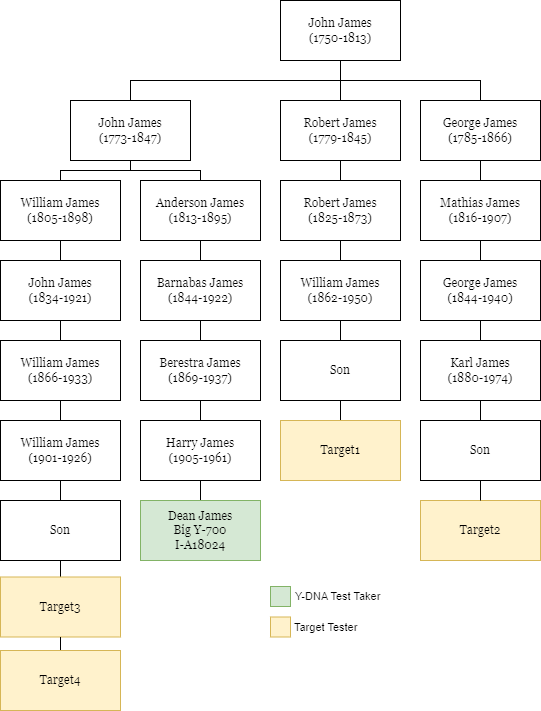
We’re looking for men who represent an all-male line of descent through John James and his sons:
- John James (1773-1847), who married Susanna Shouse (1779-1864)
- Robert James (1779-1845), who married Anna Stagner (?-1853)
- George James (1785-1866), who married Lydia West (1787-1854)
The diagram below illustrates John James’ male descendancy lines and potential testers for the Y-DNA test. Dean James (green box) has already taken a Y-DNA test.
 Who We’re Looking For
We’re looking for men who carry the James surname who descend from John James (1773-1847), Robert James (1779-1845), and George James (1785-1866) through a direct paternal line – that means your father, your father’s father, and so on must have had this surname. Women cannot take a Y-DNA test because they lack a Y chromosome, but they can help by encouraging their fathers, brothers, uncles, or male cousins who qualify to participate. Even if you’re not actively researching your family history, your Y-DNA results could be the missing piece that helps connect multiple family branches.
How Does It Work?
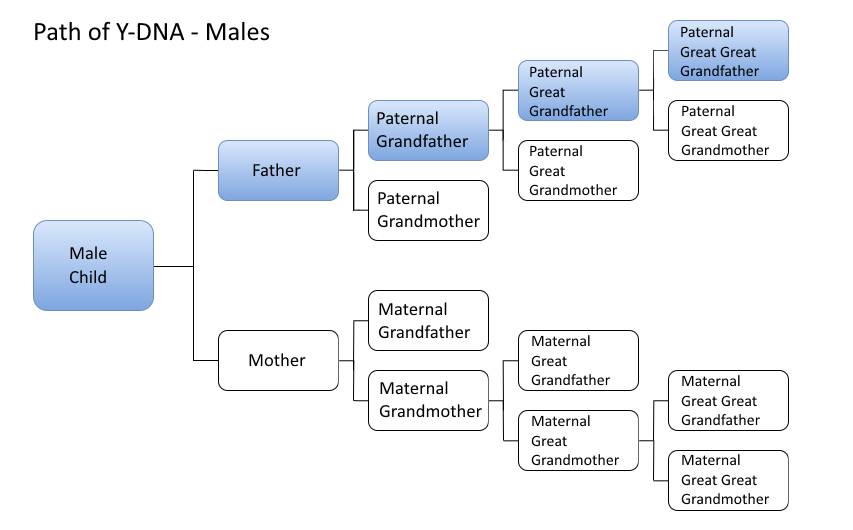
Y-DNA testing offers a unique window into your direct paternal ancestry – the father’s father’s father’s line that typically follows your surname. Unlike other DNA tests, Y-DNA is passed down virtually unchanged from father to son, generation after generation. It is an incredibly powerful tool for confirming family connections and breaking through brick walls in your family tree.
The image below from the International Society of Genetic Genealogy Wiki shows the path of Y-DNA inheritance.
When you take a Y-DNA test, you’ll receive results that show your haplogroup (your ancient paternal ancestry) and a list of genetic matches – other men who share a common paternal ancestor with you. The test looks at specific markers on the Y chromosome, and the number of matching markers between two men can help estimate how recently they share a common ancestor. For example, if two men match on 37 out of 37 markers, they likely share a common ancestor within the past 6-10 generations. This makes Y-DNA testing particularly valuable for surname projects and for verifying paper-trail research.
By joining our Y-DNA project, you can help contribute to a broader understanding of your family line. Many genealogists have knocked down decades-old brick walls through Y-DNA testing, discovering that their documented ancestor wasn’t who they thought or confirming family legends about their origins. Your DNA could be the key to solving these genealogical puzzles for yourself and others who share your paternal line.
How To Get Involved
1) If you are a male line descendant of John, Robert, or George James and have already taken a Y-DNA test, please consider sharing your results with us.
2) If you have not yet taken a Y-DNA test but are willing to do so, please contact me regarding possible funding. Testing will start at the 37-marker level; selected results may be upgraded later.
3) If you’re a female who knows of a potential candidate for Y-DNA testing for this project, please let me know his details or encourage him to contact me directly.
Your Y-DNA test results will not be published without your permission, and you may elect to participate in this project using a non-identifying pseudonym, such as John1 or Robert1, to represent your paternal line and your number within that line.
Please contact us at Diana@familylocket.com.
Learn more about our research team at FamilyLocket.com.