
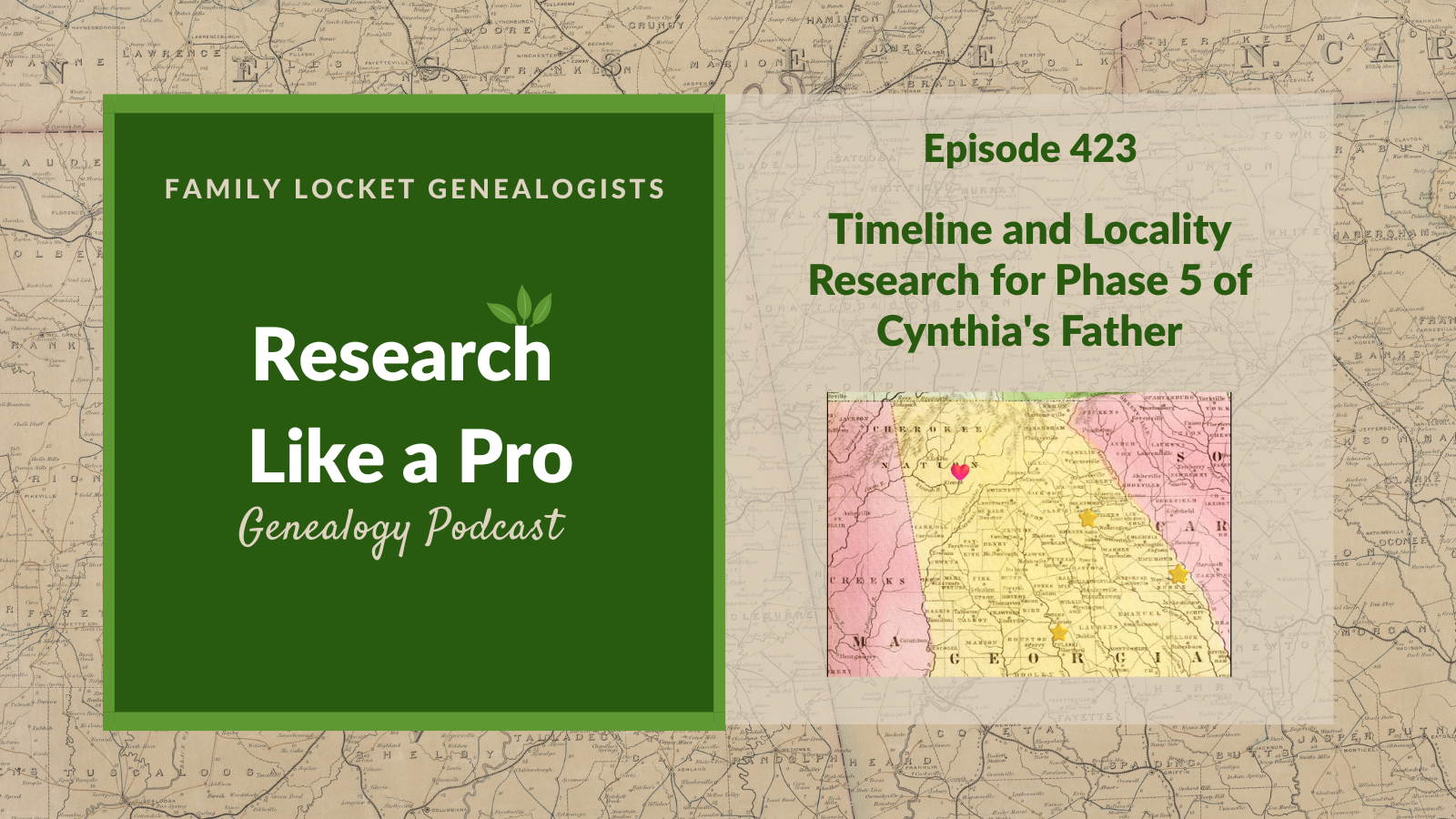
This episode explores the ongoing genealogical project to identify the biological father of Cynthia (Dillard) Royston, an ancestor who remains a mystery after years of research. Diana and Nicole focus on the fifth phase of this investigation, which involves utilizing DNA and documentary evidence to connect Cynthia to potential candidates among the Dillard men who drew lots in the 1832 Georgia Gold Lottery. Diana explains how she organizes this project using Airtable to track timelines and research logs while eliminating data duplication. She also shares her strategies for managing and selecting records, such as census data from 1840 to 1880, to establish a baseline for Cynthia’s birth between 1815 and 1818.
Listeners learn about the practical application of locality research in genealogy as Diana investigates the counties associated with the Dillard candidates. She contrasts the availability of records in Pulaski and Oglethorpe counties, which have extant records and no major courthouse disasters, with the challenges of Burke County, where fires destroyed many documents. Diana describes how she uses the FamilySearch Wiki and 1832 maps to contextualize the migration of these men relative to Cass County. By walking through her research process, the hosts demonstrate how to combine timeline creation, map analysis, and targeted locality research to build a strategy for complex DNA projects.
This summary was generated by Google Gemini.
Transcript
Nicole (1s):
This is Research Like a Pro Episode 423 Timeline and Locality Research for Phase five of Cynthia’s Father. Welcome to Research Like a Pro a Genealogy Podcast about taking your research to the next level, hosted by Nicole Dyer and Diana Elder accredited genealogy professional. Diana and Nicole are the mother-daughter team at FamilyLocket.com and the authors of Research Like a Pro A Genealogist’s Guide. With Robin Wirthlin they also co-authored the companion volume, Research Like a Pro with DNA. Join Diana and Nicole as they discuss how to stay organized, make progress in their research and solve difficult cases.
Nicole (41s):
Let’s go. This episode is sponsored by Newspapers.com. Hi everyone. Welcome to Research Like a Pro.
Diana (49s):
Hi Nicole. How are you doing today?
Nicole (52s):
Hey, I’m great. I have to say that it was so fun when I came home from our summer, summer vacation to look in the mail and see the latest edition of the National Genealogical Society Quarterly, NGSQ, and see our family, our ancestors on the cover. And so congratulations on getting your article published and for going through that whole process. And it was just so fun to flip through the article and see all of the research and writing that you had done. The title is, Naming Patterns and Family Associates Link Thomas Beverly Royston to His Georgia Roots, by Diana Elder, AG, AGL.
Nicole (1m 32s):
And this is in the June 2026 edition. So it’s just super fun to see the picture of Isabella and Robert Cisnie Royston on the cover and the little portraits of the past, about the couple in the photo, and then going back in time further on the Royston line, your article.
Diana (1m 54s):
Well, I was pretty excited to see that as well. It’s been a dream of mine to publish this story or this research on Thomas Beverly Royston and I just swung for the fences and said, well, why not do it in the NGSQ, the National Genealogical Society Quarterly? So sometimes people start out with a journal that’s made more local level, not the big national one. And I just thought, well, let’s just see what happens. So, so I submitted it and oh, it was such a process. It was so much work but so worth it. And I learned an amazing amount from it and did so much more research and made more discoveries in the whole process.
Diana (2m 38s):
So it was really worth it and it’s really exciting to have it out there now.
Nicole (2m 44s):
Hooray. Well, our announcements are that the next webinar in the Research, Like a Pro Webinar Series is Tuesday, August 18th: Tracing Mathilda: Finding an Ancestor’s Swedish Birthplace through American Records presented by Torhild Shirley, Accredited Genealogist. And this is about identifying an immigrant ancestors’ birthplace and crossing the ocean in genealogical research. So that will be fun. And she’ll talk about passenger lists, household examinations and Sweden. And Torhild is a native Norwegian and she is an accredited Genealogist professional and she’s got a lot of experience, over 30 years. So she’s a great researcher and writer, and I think you’ll learn a lot.
Nicole (3m 26s):
So if you haven’t signed up for the webinar series for this year, you can still do so. You’ll get access to all 12 of the monthly webinars and the research reports that go with them, which are super helpful if you are trying to learn how to write research reports. The next Research Like a Pro study group is starting right away. It’s beginning August 26th, and you can still register up until August 20th, so you have a little more time. And there are nine lessons. There are 13 total weeks, but four of those are break weeks where you’ll be working on your assignments in writing. And so we hope you’ll join us. And just as a reminder, you can always join our weekly email newsletter that comes out every Monday.
Nicole (4m 7s):
If you sign up for that, you’ll get a, an email once a week with new blog posts and upcoming lectures and coupon codes all rolled into one email. Just kind of an update from us. Once again, we are going to be attending the virtual APG Professional Management Conference online on October 14th through 17th. We’re both giving a couple talks, so we look forward to seeing anyone there who’s attending that.
Diana (4m 31s):
All right, well, let’s get started with our topic of the day, which is number two in our series on Finding a Father for Cynthia Dillard Royston. So we’ve talked a lot about her in the past, and I am working on phase five. Well, actually I have now completed it and I’ve been, you know, separating it out and writing blog posts and we’re doing podcasts based on those. So you can always go read the posts and see images and such that we talk about. But we’re just going to talk today about what I did after my research objective. So every single phase I’ve done, this is my fifth phase, and I have had to focus very specifically on what I wanted to do.
Diana (5m 16s):
I mean, it’s an overwhelming thing to say, okay, I’m just going to discover the father of a woman who’s born 1816 in Georgia. You know, there’s, there’s a lot that can go into that. And so I have eliminated many Dillard candidates and I’m really hoping that in the end I will have one man left standing and the documentary and the DNA evidence will all point to him as her father and I can write a case study just like I did for her husband, Thomas Beverly Royston. So these two have just been probably my very first research candidates when we first started researching, Nicole, and it’s funny that I’m still working on them.
Diana (5m 57s):
So I think we all, we all have ancestors like that.
Nicole (6m 1s):
Yep,
Diana (6m 2s):
We want it, we just wanna figure this out. So I feel like each phase, I’m getting a little bit closer, if nothing else, to eliminate candidates, but in this one I do have, you know, I think I did make some good progress this time. So this is part two and we’re going to talk all about the Timeline and Locality Research. So interestingly enough, I did have a new locality here, actually a few different localities, and that just came from my objective. So even though we might have a lot of extensive experience researching, like say for me it would be in Georgia counties like Morgan and Green County where Thomas Royston was living for this project, I had some new counties and so I have to study that county as well.
Diana (6m 55s):
There are always things like boundary changes, record loss, historical context, geography that can be very, very different from county to county, even in the same state, even if they are neighboring counties. So it’s really important to do that locality study for your new phase.
Nicole (7m 14s):
So important. Well, because of this being a DNA project, you split this into five phases with objectives for each phase. And so the overall objective is to use DNA and documentary evidence to discover Cynthia Dillard Royston’s biological father. Cynthia was born about 1815 in Georgia and died on August 2nd in 1882 in Collin County, Texas. Cynthia married Thomas B Royston about 1833 or 1834, possibly in Cass County, Georgia. So that’s our overall objective. And you’ve been doing multiple phases and now we’re on phase five. So the, the Objective for Phase Five is for documentary research, to seek connections between Cynthia Dillard Royston and three men who drew lots in Cass County, Georgia in the 1832 Gold Lottery: James Dillard of Pulaski County, Odom’s District;
Nicole (8m 7s):
Joseph B Dillard of Oglethorpe County, Hargroves District, and Roliver Dillard of Burke County, 68 District. So that’s what the focus will be for documentary research. And then for DNA, the focus for this, the, you know, the focus or the objective is, to further analyze the DNA network graph for additional Dillard connections and seek additional DNA evidence through Y-DNA testing and expanding DNA coverage for Cynthia’s genome. So kind of some specific goals there for this session in the DNA.
Diana (8m 40s):
Exactly. Well, let’s dive into the, a discussion on the timeline. And as all of our listeners know, we love to use Airtable for our timelines and research logs. And I use the latest template. Every year Nicole will redo the template, usually in conjunction with the study group. And so for Research Like a Pro with DNA, we have Research Like a Pro with DNA 4.2 2026, which is the latest template. And you can always go find that on Airtable universe. It, it’s a free template, you can see how it works. It’s really neat because I remember back when we started Airtable many years ago, it was pretty basic compared to what we have now, right Nicole?
Nicole (9m 23s):
Yeah,
Diana (9m 24s):
It’s way different, way different. But as we use Airtable and as people in our study group use it, they will suggest things or you know, we’ll think of ways to tweak features. And often we will get a question, well, we get this question a lot that well, do I need to start a new Airtable base? I already have this base for my ancestor, do I need to start over? And it really just depends on your situation. So I do already have an extensive Airtable research log with records for Cynthia and Thomas Beverly Royston, and all of their 14 children. I created that when I used this family for accreditation, and I think it’s got like a hundred rows in it, but my objective here is to research these three Dillard men who may or may not even connect to Cynthia.
Diana (10m 13s):
So I decided to start a brand new base, plus I wanted to use the new base and the capabilities that it has built into it. And so I gave it a title, Cynthia Dillard’s father, 2026 DNA project, because you know, if you start getting all these different bases for an ancestor, it’s good to have some kind of a marker in the title to help you remember which one is this one. So the Airtable base is set up to eliminate duplication of data entry, which I love. So the first thing that you do when you get started is you enter your source. So for instance, the 1850 census or a deed or a will, whatever source you want to have in your timeline.
Diana (10m 55s):
So first of all, you put that in the research log table, and then there’s an automation, that you do have to switch on when you, when you duplicate the base and use it for yourself, but once you have that switched on, you can just check the little box in that field and it will duplicate that source over in the timeline table. So it was so handy. I, for instance, would enter the census from 1850 and then I could use it twice, once for Cynthia’s birth date of say 1815 in that census, and also for her residence in 1850. And so rather than, you know, creating that new row every time an Airtable manually, I could just use the automation and it would fill in automatically the source citation and details and such.
Diana (11m 45s):
And the only other thing I’d have to do in the Airtable log, the, the timeline portion of Airtable would be to just change whether it was for her birth or her residence, and just adjust it a little bit for what I wanted it to indicate. So what did I put in the timeline for Cynthia? Well, the key records I have specifically for her and this project were the five censuses from 1840 to 1880. And those give clues to her birth year. So important for these people, and it doesn’t matter whether they’re early 1800s or they’re 1900s, you know, whatever, we’ve gotta have a pretty good idea about when someone was born.
Diana (12m 28s):
And in this case, my best information just comes from the census. So of course they don’t all agree, but I can get a good consensus, I can get a good range. So I have a good baseline for her birth in Georgia between 1815 and 1818. And that’s a pretty small, you know, range of years. That’s not bad. I’ve seen other, other people that maybe have a range of like 15 years, but her range is, is within three years, which is pretty good. So I did not add all the records I had collected for her husband, Thomas Royston and her 14 children, just the ones that were key. I did add three death certificates of her children that show the mention of her maiden name is Dillard, because that’s really important, you know, where did we get the Dillard surname?
Diana (13m 19s):
And so I did note that. All right, let’s take a break and have a word from our sponsor. Are you ready to take your family history research beyond names and dates? If so, Newspapers.com is a game-changer for genealogists of all levels. With access to over a billion pages of historical newspapers, you can uncover rich, untold stories about your ancestors that you won’t find anywhere else. Imagine discovering a detailed obituary that reveals the extended family, or a local news story that highlights your great-grandmother’s role in the community. Maybe you’ll come across a photo capturing a moment in your ancestor’s life—something that brings their story vividly to life.
Diana (14m 1s):
Newspapers captured the everyday details—announcements, happenings, achievements, and challenges—that paint a fuller picture of who your ancestors were and what their world was like. These primary sources reveal the social history behind the names on your family tree and help you connect with your past in a personal, meaningful way. Searching is simple and intuitive, letting you explore by name, location, or date to unearth those hidden gems. Ready to enrich your research with stories you won’t find in traditional records? Visit Newspapers.com/FamilyLocket today and get 20% off a subscription. Start turning your family tree into a family story.
Nicole (14m 43s):
Well, let’s talk more about your timeline. So you created a timeline for Cynthia in Airtable, that was great then, because in the past you’d found this DNA connection to another Dillard person who we think might be a brother Elijah Dillard of Pike County, Alabama. You also created his timeline, and I think this is from a past phase, right? This isn’t like you were adding more to Elijah’s timeline right here.
Diana (15m 11s):
Right. I had done an entire project about Elijah learning more about him.
Nicole (15m 17s):
Great. So comparing kind of Cynthia and Elijah’s timelines during this step of the process in phase five, it still looks like they could be siblings. It’s so interesting because he was born about 1816 to 1825 of, you know, looking at those census records and his death record, which are in conflict as to the exact year and place, it says he could have been born in Georgia or Alabama, and so while that’s conflicting, it still fits well with the hypothesis that they were siblings, Cynthia and Elijah, because Cynthia was born between 1815 and 1825 in Georgia. So it’s about the same time. Well, looking at Elijah’s timeline, it, it includes all the records that you have for him, the censuses, the land, patents, deeds, his marriage, military records, and his death record.
Nicole (16m 8s):
And I’m guessing the censuses you have for Elijah are those where he’s an adult, right?
Diana (16m 13s):
Right.
Nicole (16m 14s):
Yeah, because like, like with Cynthia, you don’t know his parents or his Dillard origins, so nothing really in the records you’ve already found holds a big clue to his Dillard father. And so I guess I have a question for you about that. Do you feel like you’ve exhausted most of the records out there for Elijah, or are you feeling like there might be more to find? And I know that’s not in the scope of this project, but just curious.
Diana (16m 44s):
Well, since I did the project, we really have so many more records on Full Text Search, so I have not used things like court records, which as we know often have some really great clues. So the records I do have for him, like you say, the census, the first census is the 1850 census up until his death in 1886. I have the census every 10 years. And then I have the earliest records are his land patents. So he has land patents in Alabama in 1848. And then after that there are several records for him where he settles in Alabama, there’s, you know, like I said, the censuses, there’s a military record, he’s actually got a widow’s pension.
Diana (17m 32s):
His wife applied for a widow’s pension. So by no means do I feel like that is absolutely exhaustive.
Nicole (17m 41s):
Yeah.
Diana (17m 41s):
So yeah, I feel like there really is more I could do with him. And that project on him did have a list of future research. There were some other Dillards that were in his area where he lived. He was down in Pike County and I did some research on some of them to see if they could really be eliminated as relatives or could be relatives. And I think most of them I eliminated, but with having no connection to him. But I believe there’s maybe one or two that still needed more work on that. So yeah, after really thinking about it, there’s definitely more work I could do, I think.
Nicole (18m 23s):
Nice.
Diana (18m 23s):
Yeah. And you know, that’s just the way it is with all of these. I feel like I’m gonna have every Dillard thoroughly researched.
Nicole (18m 30s):
Yeah.
Diana (18m 30s):
In all Alabama and Georgia. We’ll see.
Nicole (18m 33s):
You are.
Diana (18m 34s):
We’ll see. But I was just going to note that I did decide to do a complete timeline for Elijah. I already had it in a different air table base, and so I just copied it over to this one. But it was pretty fast because the citations were already created and you know, you might think that’s a lot of work, but it actually isn’t that much work to just take some of your old information. Plus it’s a good opportunity, like we teach at the beginning of a project to review what you have on a person to see if you really have pulled all the relevant information out of a source.
Nicole (19m 9s):
Yeah.
Diana (19m 9s):
So it was good to go through all of his records, again, remind myself of what I knew about him. And even though this project wasn’t to research him, it helped me remember, you know, what was going on. Because part of this objective is to seek a wide DNA tester through his lines. And so I wanted to kind of remember what was going on with Elijah.
Nicole (19m 35s):
Yes.
Diana (19m 36s):
Well, locality research ended up being in three different counties because they had three different Dillard men that I was researching. And these are all men that had a draw in the gold lottery of Cass County Georgia up in 1832. It’s up in the northwest part of the state. And that’s where Cynthia, we think, met and married Thomas Beverly Royston. So I really wanted to look at the three Dillards who had some reason to have some dealings up in that area. And so they were three men that were from different counties, kinda spread throughout Georgia: Pulaski, Oglethorpe, and Burke.
Diana (20m 16s):
In this instance, I didn’t do a really thorough locality guide for each county, but I kind of knew exactly what kind of records I wanted. So I went straight to the FamilySearch Wiki and catalog to see what was extent and available. So I knew I was going to need probate deed, census, marriage and court records. And the FamilySearch Wiki has those nice tables that tell you when records are available and then in the catalog, you know, you can see exactly what there is. And I was hoping that there would be enough records to find at least birth, death, and marriage dates for these men.
Diana (20m 56s):
Because in the lottery records, all you get is their residence. You have no idea how old they are, they could have been 21, they could have been 50. And so I was doing some real really basic research on them. I also knew that there could be online trees pointing to records and family connections. So when I looked at Pulaski County on the FamilySearch Wiki page, I was very, very happy to see that many of the records I hoped to search were available and there was no known courthouse disaster. We’re always so happy to find that out. And so I knew I could do some research planning on those records from 1810 to 1820 and learn more about James Dillard.
Diana (21m 37s):
And then in Oglethorpe County, I was hoping that it would also have many records available. And I saw here that the records were ex extent since the county’s inception in 1793. So hurray, no known courthouse disaster. And so I hope that the research into Joseph B Dillard would also be fruitful.
Nicole (21m 58s):
Fantastic. Well, let’s talk about Burke County, Georgia. So Burke County was a different story with the FamilySearch Wiki reporting two courthouse fires, one in 1825 and one in 1856. So sadly, records in this county would not be so plentiful, but you’ve learned, Mom, that some of the records are often saved. So earlier years can still hold valuable information. And when county records are missing, you can turn to alternative jurisdictions such as federal and state. The FamilySearch full text search feature can potentially find the research subject named in other counties. So that could be helpful.
Nicole (22m 39s):
But the overall takeaway from Burke County is that researching Tolliver Dillard might be a little more difficult.
Diana (22m 47s):
Right. You know, whenever you see courthouse fires, your immediate response is, oh boy, now it’s gonna be more challenging. But also it can lead you to the opinion that, oh, maybe this is why we haven’t found information because those records are gone.
Nicole (23m 3s):
Yeah. So that could be a a clue in and of itself.
Diana (23m 8s):
Right.
Nicole (23m 8s):
So maybe Tolliver is the one!
Diana (23m 12s):
Maybe.
Nicole (23m 12s):
Wouldn’t that be fun?
Diana (23m 13s):
Yeah, I love it.
Nicole (23m 16s):
Well, let’s talk about maps. So you looked at an 1832 Georgia map, which showed where these counties lay relative to Cass County, which was the 1832 Gold lottery location. And in the map you can see the three counties and you put stars on them, which is fun marking the counties where the lottery stated as the residents of each Dillard man. And then you put a heart to mark the approximate location of Cass County. And then the stars show Pulaski, which is the furthest south, Burke on the South Carolina border, and Oglethorpe on the furthest north and nearest to Cass County. So that’s cool that you annotated the map like that.
Diana (23m 53s):
Well, Georgia has a lot of counties, and once you figure out where they are on the map, it’s always nice to just be able to remind yourself and look at them really quickly and say, oh yeah, that’s where they are.
Nicole (24m 5s):
Yeah,
Diana (24m 5s):
So some of these states had lots of counties, and I think Georgia might be one that has the most. But I love it that there are these historical maps, and this was from David Rumsey and it’s titled Southern States 1832 by Francis Junius Huntington. And it’s such a great map. I mean, I love these historical maps that show what the counties look like at the time that you’re studying.
Nicole (24m 27s):
Yeah. The internet has really made accessing maps so much easier.
Diana (24m 33s):
Absolutely. Yeah. You know, none of these places were very close to Cass County, and so they would’ve all had to travel a considerable distance to get up there to take care of business. But you know that this was, they did it, people traveled all the time, just took ’em longer. But they did, they did travel. So just really interesting to look at the map and think about what that would’ve been like for them to go forward. So with that timeline created and the locality research conducted, I felt like I had a pretty good handle on this project getting, getting my feet on the ground, getting a foundation for it.
Diana (25m 14s):
I had not researched Cynthia for a few years, you know, I took a break from her and for the last two or three years I’ve been doing Clemsy Cline and the Weatherfords. So it was really good for me to go back and get my head back into specifically her and Elijah. And that was helpful. I had researched Thomas Beverly Royston a lot because I was doing the case study, but you know, I had to switch gears here and now go into the Dillards. So same locations, just different families.
Nicole (25m 45s):
Yeah. That’s funny that you had kind of collaterally gotten clues about Cynthia because you were doing your case study for the NGSQ on Thomas B Royston, her husband.
Diana (25m 56s):
Exactly. Because that’s where I discovered Cass County. Before that I did not realize he’d gone up there and it was through Full Text Search and through newspaper articles that I discovered records that really took me to a new place for him. So it’s just been really interesting to think about the research that we were both working, you know, in the early two thousands when we started doing this, and how far we have come with being able to discover things easier and more online. It’s just makes a huge difference in our research.
Nicole (26m 35s):
I just have so many questions about this 1832 Gold Lottery in Cass County, Georgia. I just, I know you probably researched it a little bit, but how did that work? Did they have to be present or could they send an agent, and like why were they eligible and stuff?
Diana (26m 53s):
Yeah, well, in the report I did write about that because,
Nicole (26m 56s):
I have to read it.
Diana (26m 59s):
It is a very interesting time. I mean, all the Georgia Land lotteries are interesting and they did, they had very specific requirements for each one. And women were eligible. You know, I’ve got women that won lots in the lottery and that’s part of my case study that Thomas’s mother did that she, she drew a lot and yes, they often had agents that went ahead and did, took care of the, the selling of the land and such, but women were very much eligible. So there were all sorts of things that you could draw a lot for you.
Diana (27m 39s):
You had to be of a certain age, and sometimes that differed from year to year, and you could draw a lot, usually if you’d been a resident for a few years, you know, just a big long list usually. I can’t even tell you how many, there’s long lists of eligibility. So,
Nicole (27m 57s):
Well, I guess my question is, and you’ll probably get to this after you’ve done the research on these guys, like did they actually go to Cass County? Like can you track that through the land? But I guess that’s a spoiler or a future episode.
Diana (28m 11s):
That would be so lovely to be able to track that. But guess what, Cass County had record loss and does not have any of those records from those years in the 1830s that would show land and deeds and maybe court records, all of that. Nope. That’s so hard. That’s all gone. So that makes, you know, that’s the extra wrinkle in it as well. And to do the research on Thomas up there, it was newspapers and sometimes the records were in other counties that didn’t get destroyed. So, yeah, this is one of the challenges for us with record loss in the South. That’s why it makes research a little bit trickier,
Nicole (28m 53s):
And it really is pointing to that being a clue for why you haven’t found Cynthia’s parents. Because if these are the counties they were in, like Tolliver, Cass and Burke, then how could you put it together, you know?
Diana (29m 10s):
Right. Because pretty much things that are have like a will, or something that’s just very obvious, though people have discovered those and put those out there online in family trees. As soon as we started putting things on family trees on the old RootsWeb, remember we would put our tree out on RootsWeb. So usually those things are out there, and so if they’re not, then you just really wonder, okay, what did happen that has negated the records that we need? So just adds a little bit of negative evidence when it all comes together, doesn’t it?
Nicole (29m 48s):
Yes. Wow. Well, this has been fun talking about locality research and your timelines and Airtable for this project. And if you wanna see a screenshot of what her annotated map or her Airtable base looks like, you can look at the blog post that will be linked in the show notes about the Timeline and Locality Research.
Diana (30m 10s):
Yeah, I love doing the timeline. It’s one of my favorite parts of the process, and especially if it’s an ancestor I have not researched before, then it’s so interesting, you know, your first time going through all the records, seeing what’s out there, and if it’s your ancestor that you researched many years ago, it’s fun to look at things with new eyes. So really valuable step. And I go back to that timeline over and over again when I’m doing the research to find the records and look at them, you know, answer any questions that I have as I’m going. So really valuable to have it developed.
Nicole (30m 48s):
Yes.
Diana (30m 48s):
Well, with my timelines created and the locality research conducted, my next steps are going to be DNA analysis and research planning, which we will talk about in part three in this series. So thanks everyone for listening, and we will talk to you next time.
Nicole (31m 8s):
All right. Bye-bye.
Diana (31m 9s):
Bye-bye.
Nicole (31m 44s):
Thank you for listening. We hope that something you heard today will help you make progress in your research. If you want to learn more, purchase our books, Research Like a Pro and Research Like a Pro with DNA on Amazon.com and other booksellers. You can also register for our online courses or study groups of the same names. Learn more at FamilyLocket.com/services. To share your progress and ask questions, join our private Facebook group by sending us your book receipt or joining our courses to get updates in your email inbox each Monday, subscribe to our newsletter at FamilyLocket.com/newsletter. Please subscribe, rate and review our podcast. We read each review and are so thankful for them. We hope you’ll start now to Research Like a Pro.
Links
Finding a Father for Cynthia: Phase 5 – Part 2: Timeline and Locality Research – https://familylocket.com/finding-a-father-for-cynthia-phase-5-part-2-timeline-and-locality-research/
Sponsor – Newspapers.com
For listeners of this podcast, Newspapers.com is offering new subscribers 20% off a Publisher Extra subscription so you can start exploring today. Just use the code “FamilyLocket” at checkout.
Research Like a Pro Resources
Airtable Universe – Nicole’s Airtable Templates – https://www.airtable.com/universe/creator/usrsBSDhwHyLNnP4O/nicole-dyer
Airtable Research Logs Quick Reference – by Nicole Dyer – https://familylocket.com/product-tag/airtable/
Research Like a Pro: A Genealogist’s Guide book by Diana Elder with Nicole Dyer on Amazon.com – https://amzn.to/2x0ku3d
Research Like a Pro with AI Workbook – Second Edition (eBook) – https://familylocket.com/product/research-like-a-pro-with-ai-workbook-second-edition-ebook/
14-Day Research Like a Pro Challenge Workbook – digital – https://familylocket.com/product/14-day-research-like-a-pro-challenge-workbook-digital-only/ and spiral bound – https://familylocket.com/product/14-day-research-like-a-pro-challenge-workbook-spiral-bound/
Research Like a Pro Webinar Series – monthly case study webinars including documentary evidence and many with DNA evidence – https://familylocket.com/product-category/webinars/
Research Like a Pro eCourse – independent study course – https://familylocket.com/product/research-like-a-pro-e-course/
RLP Study Group – upcoming group and email notification list – https://familylocket.com/services/research-like-a-pro-study-group/
Research Like a Pro Institute Courses – https://familylocket.com/product-category/institute-course/
Research Like a Pro with DNA Resources
Research Like a Pro with DNA: A Genealogist’s Guide to Finding and Confirming Ancestors with DNA Evidence book by Diana Elder, Nicole Dyer, and Robin Wirthlin – https://amzn.to/3gn0hKx
Research Like a Pro with DNA eCourse – independent study course – https://familylocket.com/product/research-like-a-pro-with-dna-ecourse/
RLP with DNA Study Group – upcoming group and email notification list – https://familylocket.com/services/research-like-a-pro-with-dna-study-group/
Thank you
Thanks for listening! We hope that you will share your thoughts about our podcast and help us out by doing the following:
Write a review on iTunes or Apple Podcasts. If you leave a review, we will read it on the podcast and answer any questions that you bring up in your review. Thank you!
Leave a comment in the comment or question in the comment section below.
Share the episode on Twitter, Facebook, or Pinterest.
Subscribe on iTunes or your favorite podcast app.
Sign up for our newsletter to receive notifications of new episodes – https://familylocket.com/sign-up/
Check out this list of genealogy podcasts from Feedspot: Best Genealogy Podcasts – https://blog.feedspot.com/genealogy_podcasts/



Leave a Reply
Thanks for the note!