
If you have an ancestor who is still a mystery despite years of research, you’ll relate to my Cynthia (Dillard) Royston project. I am currently working on phase 5 as part of the Research Like a Pro with DNA study group. Each phase has focused on a specific objective and has eliminated many Dillard candidates. Eventually, I hope to have one man left standing, whom documentary and DNA evidence point to as Cynthia’s father. In part two of this series on my research, I’ll share how I created the project timeline and conducted locality research.
An important part of the research process is to create a timeline relevant to the research objective. Depending on the objective, we can either include everything we know about our subject or be more selective. Next, we do locality research to learn about the background and records that will be important to our research. We may have extensive experience researching a certain county, but when the research shifts to another county, we need to study it. Boundary changes, record loss, historical context, and geography can be similar or vary widely from county to county, and especially from state to state.
Here is the full series:
Finding a Father for Cynthia: Phase 5 – Part 1 Research Objective
Finding a Father for Cynthia: Phase 5 – Part 2: Timeline and Locality Research
Finding a Father for Cynthia: Phase 5 – Part 3: Research Planning
Finding a Father for Cynthia: Phase 5 – Part 4: Research Log and Source Citations
Finding a Father for Cynthia: Phase 5 – Part 5: Report Writing – Analysis & Correlation
Research Objective
Because this is a DNA project, I have split my phase 5 objectives into one for documentary research and one for DNA analysis.
Overall Objective
Through DNA and documentary evidence, discover Cynthia (Dillard) Royston’s biological father. Cynthia was born about 1815 in Georgia and died on 2 August 1882 in Collin County, Texas. Cynthia married Thomas B. Royston about 1833 or 1834, possibly in Cass County, Georgia.
Phase 5 Documentary Research Objective
Seek connections between Cynthia (Dillard) Royston and three men who drew lots in Cass County, Georgia in the 1832 Gold Lottery: James Dillard of Pulaski County, Odams District; Joseph B. Dillard of Oglethorpe County, Hargroves District, and Roliver Dillard of Burke County, 68 District.
Phase 5 DNA Research Objective
Further analyze the DNA network graph for additional Dillard connections and seek additional DNA evidence through Y-DNA testing and expanding DNA coverage for Cynthia’s genome.
Timeline for Cynthia (Dillard) Royston
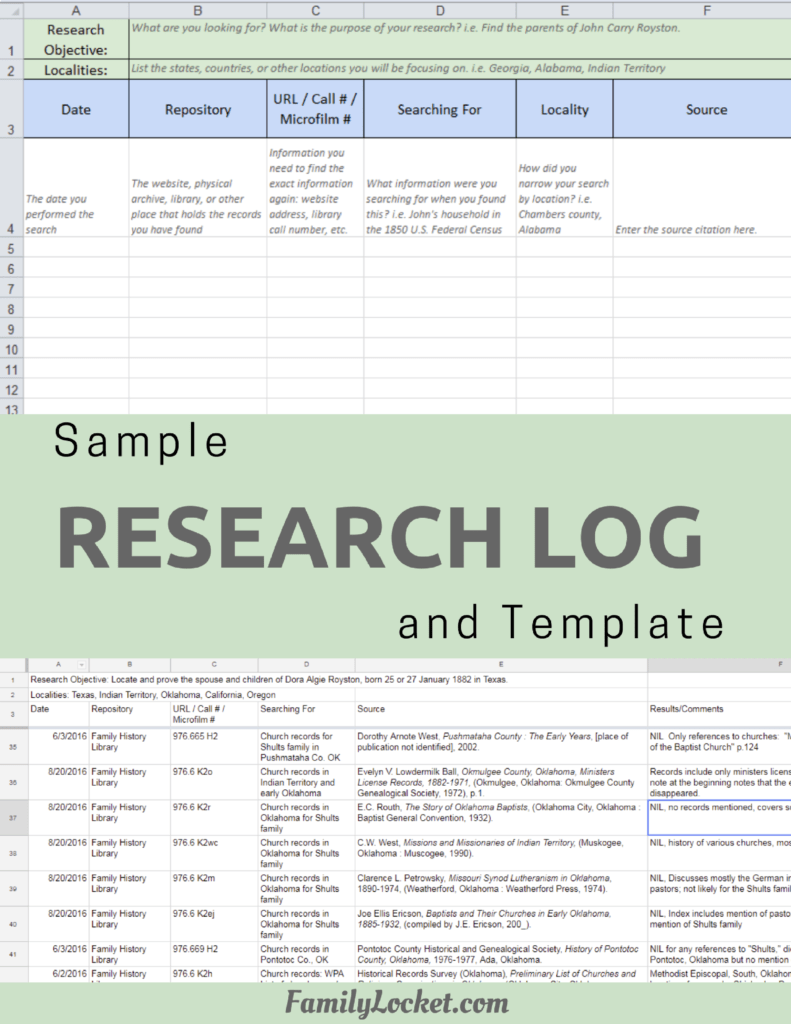
I use Airtable for my research log and timelines, and the latest template that Nicole has created is RLP with DNA 4.2 (2026). She continues to tweak features on the basic research log she developed several years ago. One question that we often get is when to start a new Airtable base. I already have an extensive Airtable research log with records for Cynthia and Thomas Beverly Royston and all of their fourteen children. Because my objective for this project is to research three Dillard men who may or may not connect to Cynthia, I decided to start a new base and titled it “Cynthia Dillard’s Father 2026 DNA Project.”
The Airtable base is set up to eliminate duplication of data entry. My process is to first enter the source (census, deed, will, etc.) into the research log table, then use the automation in Airtable to duplicate that source in the timeline table. In this way, I can enter a census once in the research log, then use that same census in the timeline for birth and residence.
The key records I have for Cynthia and this project are the five censuses from 1840 to 1880 that provide clues to her birth year – key to connecting her to her birth family. I did not add the many records I have collected for her husband and fourteen children. Those censuses gave me a good baseline for her birth in Georgia between 1815 and 1818.
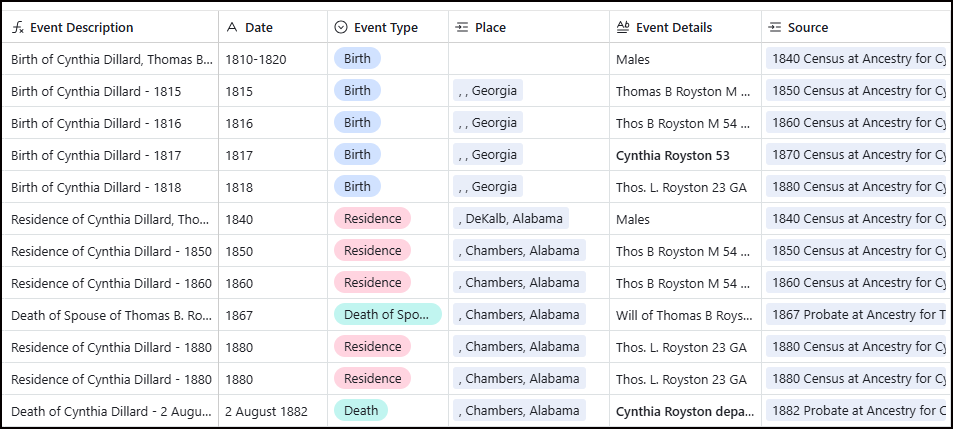
Timeline for Cynthia
Timeline for Elijah Dillard
DNA shows a connection between Cynthia and Elijah Dillard of Pike County, Alabama, so I also created his timeline. His birth years, per the census and his death record, range from 1816 to 1825 in Georgia or Alabama. This fits well with my hypothesis that Cynthia and Elijah are siblings, born in Georgia between 1815 and 1825.
Elijah’s timeline includes all the records I have for him: census, land patents, deeds, marriage, military, and death. Like Cynthia, none of Elijah’s records hold a clue to his Dillard origins.
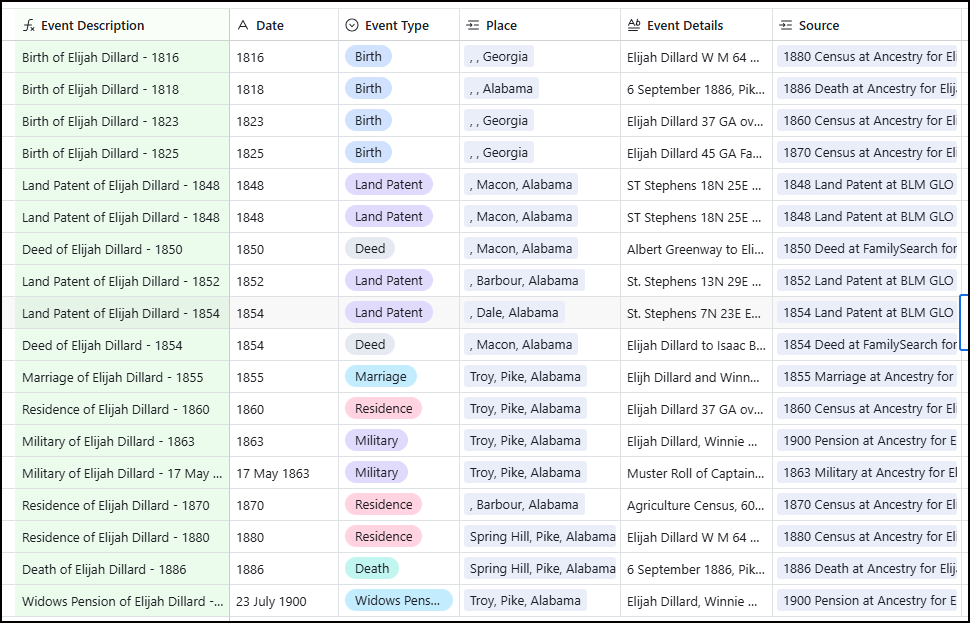
Timeline for Elijah Dillard
Locality Research
My research objective pointed to three Georgia counties of interest for my Dillard research: Pulaski, Oglethorpe, and Burke. Generally, I create a locality guide for each county, but in this instance, I turned straight to the FamilySearch Wiki what records were extant and available. From my experience researching Georgia, I know that the key records are probate, deeds, census, marriage, and court records. Since I hadn’t researched these men previously, I hypothesized that there would be plenty of records to find approximate birth, death, and marriage dates. Also, there could be online trees pointing to records and family connections that have already been discovered.
Pulaski County, Georgia
Viewing the FamilySearch Wiki page, I saw that many of the records I hoped to search were available and there is no known courthouse disaster. Research planning could focus on records available from 1810 and 1820, which should yield good results for learning more about James Dillard.
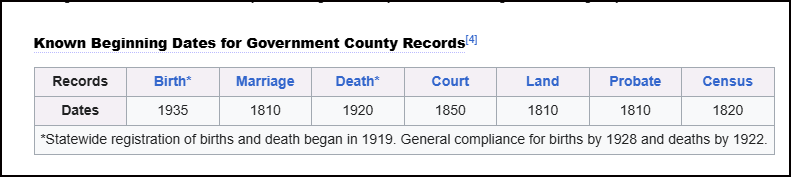
Pulaski County, Georgia, Record Dates
Oglethorpe County, Georgia
I was hoping Oglethorpe would also have many records available. After viewing the FamilySearch Wiki page, I saw that records here have been extant since the county’s inception in 1793. Again, there is no known courthouse disaster. Research into Joseph B. Dillard should be fruitful.

Oglethorpe County, Georgia, Record Dates
Burke County, Georgia
Burke County was a different story, with the FamilySearch Wiki reporting two courthouse fires – one in 1825 and one in 1856. Sadly, records in this county would not be so plentiful. I’ve learned, though, that some records are often saved, so earlier years can still hold valuable information. When county records are missing, I turn to alternative jurisdictions, such as federal and state. The FamilySearch full-text search feature can also find the research subject named in other counties. Researching Roliver/Tolliver Dillard might be more difficult.
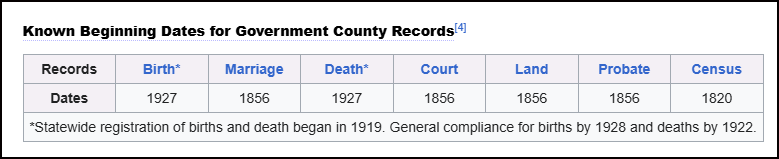
Burke County, Georgia, Records Dates
Maps
Viewing an 1832 Georgia maps showed where these counties lay relative to Cass County, the 1832 Gold Lottery location. In the map below, you can see the three stars marking the counties where the lottery stated as the residence of each Dillard man. The heart marks the approximate location of Cass County, and the stars show Pulaski (furthest south), Burke (on the South Carolina border), and Oglethorpe (furthest north and nearest to Cass County).1
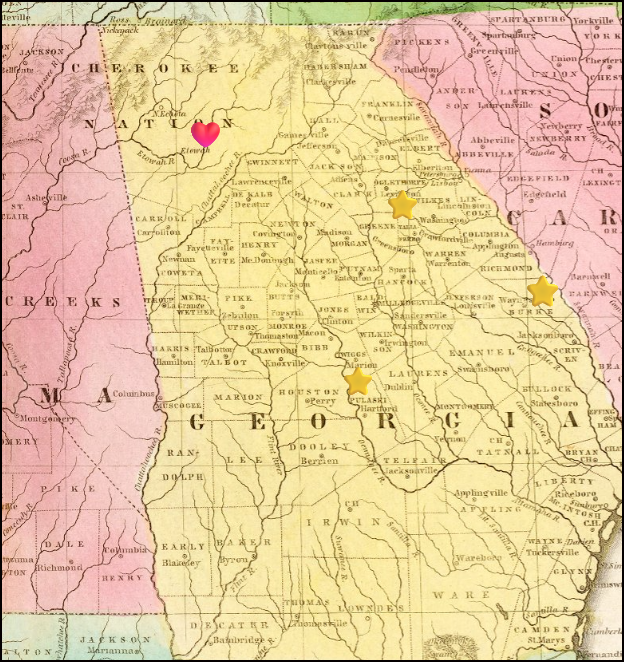
Southern States, 1832, by Francis Junius Huntington
Viewing the map and realizing the distance that each man would need to cover, I wondered if any of them undertook the migration northwest to settle. Instead, they might have entered the lottery to win the land and then sell it. Research could uncover their story and discover if Cynthia had any connection to one of them.
With the timelines created and locality research conducted, my next steps will turn to DNA analysis and research planning. Stay tuned for part 3 in this series.
Best of luck in all your genealogical endeavors!
Sources
- Francis Junius Huntington, “Southern States, 1832; DavidRumsey.com (https://www.davidrumsey.com/luna/servlet/detail/RUMSEY~8~1~372544~90139387:Southern-States- : accessed 14 June 2026).









2 Comments
Leave your reply.