
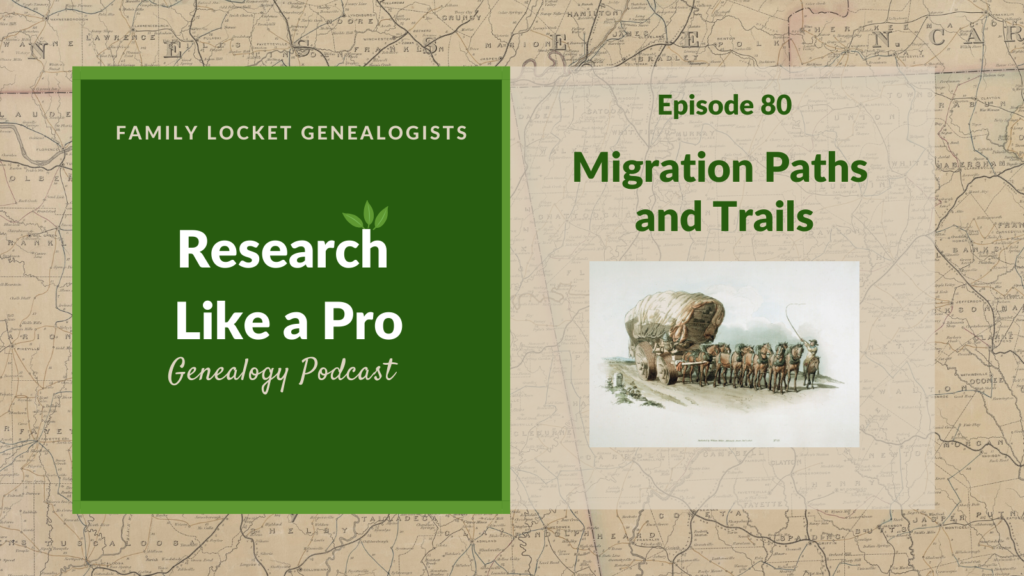
Today’s episode of Research Like a Pro is about locating the route your ancestors might have taken as they traveled to a new area. Exploring migration could open up new areas of research in your genealogy brick walls. Taking a look at the historical roads and trails that our ancestors possibly traveled can add to their story and help understand more about their lives. It might even lead to more discoveries that could expand our knowledge of the family and extend the ancestry. Join us as we discuss how to learn more about migration paths and trails.
Transcript
Nicole (1s):
This is research like a pro episode, 80 Migration Trails and Roads. Welcome to Research Like a Pro a Genealogy Podcast about taking your research to the next level, hosted by Nicole Dyer and Diana Elder accredited genealogy professional. Diana and Nicole are the mother-daughter team at FamilyLocket.com and the creators of the Amazon bestselling book, Research Like a Pro a Genealogists Guide. I’m Nicole co-host of the podcast join Diana and me as we discuss how to stay organized, make progress in our research and solve difficult cases. Let’s go.
Nicole (43s):
Hi everyone, and welcome to the show. I’m Nicole Dyer, co-host of the Research Like a Pro Genealogy Podcast. I’m here with my mom Accredited Genealogist, Diana Elder. Hi, Diana, how are you?
Diana (54s):
I’m great, Nicole, how are you doing?
Nicole (56s):
I’m doing great. What have you been working on lately?
Diana (59s):
Well, right now I’m working on getting all the syllabi information together for NGS. I am presenting three classes and you’re doing your two classes for the National Genealogy Society conference, which will be in Salt Lake City in may, and so excited to be doing that. But I’ve got some work ahead of me cause I’ve got to get my syllabus done in the next few days.
Nicole (1m 22s):
Well, great. Let’s do our listeners spotlight. We got an email from Tamber and she’s in our e-course and I wanted to read this on the podcast too. She says, “I appreciate this course and the podcast so much. I have learned great strategies for getting organized, tracking progress, and the benefits of writing even just for myself so I know where I left off next time that I come back to a particular study. When I worked on my source analysis, I realized that I had a lot of authored sources. So I started working on getting original sources right away. One question is whether researching for the original source should be part of the source analysis or part of the research plan.” So what do you think about that question, Diana?
Nicole (2m 3s):
Would you do the ordering of the original sources right away or wait until the research plan?
Diana (2m 9s):
It depends on how much work it would be to get the original source. Sometimes I see that there’s a marriage record on its index on Ancestry, but there’s no original image, but then I see the Family History Library microfilm number in the citation. And I know that I can go straight to that microfilm if it’s digitized and look that up pretty quickly. And so in that kind of a situation, I will go get the original so that I have better information to put into my timeline. But if it’s something like ordering a certificate from England and it’s going to take several weeks, then I will often put that in the research plan. Just depends.
Nicole (2m 46s):
That’s a good idea. Tamber had another question. And she said, “as we are conducting research and finding sources, should we update the source analysis as we find the new sources?” So what do you think on that question?
Diana (2m 59s):
Yes, I do like to update the source analysis. I like to have that timeline be a true timeline. So as I’m researching, if I find something that fits over in there, I will just go put it in because I think it’s really valuable to have a timeline of an ancestor’s life, everything we found about them. And often I turned my research log into sort of a timeline as well, putting things in chronological order, but in my research lag, I also have all the negative searches and that can clutter it up. So I like to have my timeline to see everything that’s known about an ancestor. So of course we can update it and really keep it fresh and new with everything we’re finding.
Nicole (3m 40s):
Great. Okay. Well, our subject today is Migration Trails and Roads.
Diana (3m 44s):
Okay. This is going to be a fun episode. I think that this is something we may not have thought about in our research and locating the route that our ancestors might have taken as they travel to a new area can really open up new areas of research, especially in our genealogy brick walls. We can take a look at the historical roads and trails that they possibly traveled, because it can add to the story as well as helped understand more about their lives. And it can also lead to more discoveries that could expand our knowledge of the family and extend the ancestry. So how do we get started with figuring all this out? Well, you’ll want to start with the timeline because this will point out the approximate dates that they move between locations.
Diana (4m 28s):
We want to look at the birthplaces of each family member, as well as extended family and associates, because our ancestors often traveled as a group. We can also look at land, probate, and church records to find clues about previous locations or new residences. And we use every single clue in the records to discover that possible migration. So let’s just look at an example and creating a timeline for my Benjamin Cox research project. I discover the following migration based on census, tax, land and court records. So he was in Ohio from 1791 to 1819, that was his birth.
Diana (5m 8s):
Until 1819. I found him last in a tax record there. And then he showed up in Indiana in the 1820 census and he was there until 1835 and in 1835, I found him getting married in Arkansas. And he was there until 1844, which was his last record in a tax list. And then from that point on, he was in Texas from 1845 until the 1870 census. And he died sometime after 1870 I’m conjecturing because I can’t find him in the 1880 census. So I have a pretty good timeline from 1791 to 1870. And you can see that with quite a migration, Ohio, Indiana, Arkansas, and Texas.
Diana (5m 52s):
So having all of those basic years and places nailed down, then I can more discoveries in the records.
Nicole (5m 59s):
Great. So the next step would be to learn about the history of the area. And we do this in locality research. It is pretty important to learn about the history of where our ancestors lived, because it can help us understand why they came there or why they left another place. And we usually talk about these in terms of the push and the pull factors. So what events happened in the community that pushed them to a new area, what factors pulled them to that new place? Some common push factors could be that the land was farmed out. There were too many settlers, not enough land, maybe there was an economic depression, often it was a lack of inheritance for younger sons, or religious reasons, the devastation of war, all kinds of things.
Nicole (6m 47s):
Some common pull factors where the promises of new land, economic opportunities in new places, adventure, joining family who had previously gone ahead to a new area. So how do we know, how can we discover these things? Well, county histories are a go-to source for this kind of information in the late 1800s, a bunch of counties created county histories, and often it was in conjunction with the Centennial celebrations of the founding of the United States. So if you are researching and accounting, go check and see if they created a county history in the late 1800s, around 1880, and often you’ll find that they will talk about why the original settlers came to that region and who they were and the roads that they took to get there and some of the places they came from, if there were a whole bunch coming from a certain region to the new place.
Diana (7m 43s):
Oh my goodness, I love county histories. They are so interesting. And you never know what you’re going to find in them. Often they were interviewing the oldest settlers and they would just give their memories of what the history was. And of course, we have to always verify that, but you know, whether the facts were embellished or not, it does give you a sense of why people were coming into the area. So going back to my example of our ancestor, Benjamin Cox, I had learned that in 1820, he was in the Flat Rock township of Indiana and the census show this as Delaware county. But I was a little confused because doing research in the locality portion of the project, I learned that the county wasn’t even organized until 1827.
Diana (8m 29s):
So why would the census show that it was Delaware county? Well, I learned that the designation really was for the Delaware new purchase and these were land seated in 1818 by the Delaware nation. And I learned that Flat Rock township became part of Bartholomew county with the formation of that county in 1821. So here I was doing a locality guide for Delaware county thinking that all these records for Benjamin Cox would be there. And it turns out the actual township he lived in, Flat Rock, was not even part of that county ever. It was just confusing in the census. And I learned a lot about this from a county history for Bartholomew county.
Diana (9m 11s):
It said the Indian title to the lands within Bartholomew county was extinguished in the year 1818, and the first sell of lands within the limits of her then extensive domain was made on the sixth day of January. So that was just a great little tidbit of information. And as I read that, I thought, okay, the pull of fresh land available for fresh settlement was likely why Benjamin Cox left Ohio because I had him in 1819 in tax lists, and then 1820, there he is in the census. Why did he move in there? Well, because the Delaware nation had ceded their lands and now the white settlers were coming in to claim that land.
Diana (9m 53s):
And the interesting thing was the county history talked all about the richness of the land. And it’s kind of fun. I’ll just read a little portion of it because it shows how sometimes they embellished a little bit. This county history says there’s probably no county in the state that furnishes a greater variety of soil than Bartholomew county. Few, if any counties can boast of the inherent wealth, she possesses, no township is barren or fruitless. Each have streams that water them and along their banks, the grounds are unusually rich and fertile. So this was great land apparently. Yes. I also suspect that Benjamin was an adventure because he did not settle down. And he followed a pattern of migration all the way up until 1860, when he finally settled down in Bell county, Texas.
Diana (10m 38s):
So even when he came to Texas, he moved around a bit, and he was 69 finally. Now, during this time he was also a Texas Ranger. So I’m guessing that he had enough adventure being a Texas Ranger and protecting his community from Comanche raids to warrant staying put finally.
Nicole (10m 56s):
Wow, he was really moving around a lot. Do you think that there were any factors having to do with the Civil War that influenced him because after 1860 he was in Texas. So I just am curious what you had thought about that .
Diana (11m 10s):
He didn’t join any military unit for the Civil War, being in Texas, because he was so old by that time. And the last census I have him in is 1870. So I’m sure the Civil War was a factor, but whether any of the fighting came into his area is something that I will just need to research more about. That’s a good point. I don’t know.
Nicole (11m 32s):
Yeah. I’m curious because Texas was mostly Confederate, but then Ohio was kind of a Northern state, but he was kind of going through some of those middle states and some of those Western border states, there was a lot of conflict in the 1850s and sixties over that would become a slave state or not. So it would be interesting to look into that and see what the leanings were in those counties, where he lived.
Diana (11m 55s):
From all the different records that I’ve seen he never did own any slaves and he was in Arkansas and Texas did have slave holding individuals. So maybe he was against slavery and he could have been on the Union side in his thoughts or his leanings, whether he fought or anything. So that’s an interesting thing to think about. Most of our Southern ancestors were Confederates, but I would be interested to know more about where their thoughts and positions were.
Nicole (12m 28s):
Right. I wonder, did he have any sons that you’ve tracked down?
Diana (12m 33s):
Only one, and I don’t remember seeing anything about Civil War service in the brief look I had at his tree, it was part of my DNA project to verify that the different proposed children and I don’t remember anything about that. So I should go look, the rest of his children were all daughters. And I don’t remember seeing any Civil War service among any of their husbands either.
Nicole (12m 56s):
That’s interesting. Yeah. Texas was kind of the wild west. I think a lot of people did join in, but some just kind of went to Texas to escape I think, and not be part of it.
Diana (13m 4s):
Yeah, that’s a whole ‘nother area of research that we could certainly delve into.
Nicole (13m 8s):
Well, I know you’re going to continue researching Benjamin Cox and his family. So I can’t wait to hear what you find out about the son and any more history on them as it relates to the Civil War, which is one of my favorite topics.
Diana (13m 20s):
I will put that on my to do list.
Nicole (13m 24s):
Well, let’s talk about finding more local history. How do you locate that county or local history to give you those clues? So the way that you would do that is to just do a Google search for the county and the state. This will give you some articles on Wikipedia and the FamilySearch Wiki, and maybe some other websites that people have made about the county. You can also use the FamilySearch catalog to locate digitized copies of county histories, because as you know, FamilySearch has been digitizing a lot of their books and they have a great new digitized books website. So go to the catalog and look for the county and go to the subject on history.
Nicole (14m 5s):
So you can just start by typing them the county. And once you get into that history category, you’ll probably notice that there are county histories or other types of histories there that are available to view whether you go to the library itself or whether they’ve been digitized. Another thing you would do is just do a simple Google search. For example, Bartholomew county, Indiana county history. You may discover that there are a lot of sources already out there for that on the FamilySearch Wiki page, the article for the Bartholomew county Wiki page list three local history and links to websites such as the FamilySearch digital library, but also Hathi Trust and the Internet Archive.
Nicole (14m 49s):
And these are great sources for county histories. So you could even go straight to the Internet Archive and type it in, or even Google books, because these are usually in the public domain because if they were published back in the 1880s, then they are able to be digitized. So check all these different places and you might get lucky and be able to search through a county history that’s been digitized by just typing in what you’re interested in learning about.
Diana (15m 16s):
Yes, and I have found very few county histories that were not available online. I feel like they were published so long ago that they’re in the public domain and they are readily available in a variety of places. So it really is a wonderful time to be researching where we can find these just at home on our computer screens. Let’s talk a little bit about discovering the actual migration roads and trails. Once we’ve discovered the reasons why our ancestor might’ve moved to a new location, then we want to dig in and learn about the roads, trails or rivers that he might have traveled. And there are several really good websites where we can start our search.
Diana (15m 56s):
There’s one called Maps, et cetera. And it’s titled, Principle Routes of Trade in Migration 1840 to 1850. You can also just go straight to the FamilySearch Wiki and the title of the article there is United States Migration Internal, internal means within the United States. So they are differentiating from migration from Europe or other countries to the United States. And then Cyndi’s list has a whole bunch of links to other articles under the migration routes, roads and trails category, and Wikipedia, it has a great article on historic trails and roads in the United States.
Diana (16m 37s):
And we’ll have a link to our blog posts with all of those different websites and links in the show notes for you. So I love the FamilySearch Wiki, because you can also go to the main page for each state and it will have migration lists that there, and you can click on that and it’ll take you to migration page just for that state. And it will show you all the different migration routes that pass through the state. So back to my Benjamin Cox project, when I viewed Indiana migration, I saw several different possible routes that he could have followed as he moved from Ohio to the Flat Rock township of Bartholomew. And I clicked on each route to get an explanation and a map.
Diana (17m 20s):
And I explored the various routes and I was pretty interested in the Cumberland road as a possibility for the migration. I also hypothesized that he could’ve followed a river route because this was really early. This was 1819 to 1820, and often the rivers were the chosen route before the roads had been more traveled by people migrating west. So we will probably never know specifically what road our ancestors took unless its in a county history, or its in a personal history or family history, but we can certainly look and see what is the most likely route.
Nicole (17m 58s):
Yeah, that’s a good idea because then you can use that in your research. So if you’re missing your ancestor for 10 years and you hypothesize, he took the Cumberland road, you can then go look at stops along the Cumberland road to see if he stopped for awhile. And one of those places, that’s the idea behind migration paths is to not only add it to the history and the narrative of your ancestor’s life, but then use it to help you find more information about them. So you can research different possibilities for how they would have gone. Maybe you want to find out if they went by boat or wagon, handcart, horseback, rail, or a combination of those, then you can also consider what the route was used for.
Nicole (18m 44s):
Was it a commercial postal, military, or exploratory route, or was it just used for settling a new location? So often a route began with one purpose and then became popular with settlers following it, because if there was a road, settlers would rather take a road rather than just forging their own path. So then once you discovered that possible migration route and have learned about it and how it went, then you can search and learn about the possible stopping points along the way. And you can look at that area as records for the ancestral surname and also certain names of associates of your ancestor or the same surnames found along that migration route in tax records and census records. And if so, this can be an important clue that you’re on the right track with the research.
Nicole (19m 29s):
Like we’ve talked about, the migration probably took place over a period of several years. Benjamin Cox didn’t move immediately from Ohio to Texas. He stopped off in Indiana, then Arkansas, and at least three locations in Texas and left records in each place that add to his story. So if you’ve just found a starting place and the ending place, and none of the places in between, you may have some more work to do to find if they left records in many other places, often our brick wall ancestors are like this aren’t they, where we just don’t know where they were for 20 years.
Diana (20m 5s):
It’s helpful because we do have the census records and sometimes we’ll get lucky and pick them up on the census or in a marriage record, but there could possibly be even more migrations for Benjamin Cox that I just don’t know about cause I don’t know where to search for the records in between, you know, did he go straight to Arkansas from Indiana or did they stop off again midway? One of the interesting things that I found was that son of his, that I was talking about, he has a location of Missouri thrown in there and I haven’t searched any Missouri records, but Missouri is on its way down to Arkansas from Indiana. So that’s possible too.
Nicole (20m 42s):
That is interesting.
Diana (20m 43s):
Yeah. When you were talking about checking for the different associates and the different places, I think that is a really helpful point. And that is one of the things that helped me to know that the 1820 census was correct for Benjamin Cox, because that’s a pretty common name on there. A lot of Benjamin Cox’s just in Ohio and Indiana in that census and several of the right age. So how did I decide that that was even the right location in the first place? Well, also in that location were men by the name of Barbe, the surname, B A R B E, and that was Benjamin Cox’s wife’s name, Casa Barbe.
Diana (21m 25s):
We have a marriage record for them in Ohio. So I reasoned that this group came together, the Barbes and the Cox’s and the associates really helped to make a case for that. So, you know, we have to really carefully look at all the people around our ancestors, especially that whole idea of them migrating as a group with other family members that can help us to make sure we’ve got the right person. We’re not just jumping to conclusions that this person with the same name in this two areas, our person they’re connected with the same people that they were in a previous location that really solidifies our case.
Nicole (22m 1s):
I think sometimes we are so used to using the location that a person lived as one of the main identifiers for them. So it can be tricky when they show up in a different place that we didn’t know they lived in. And we may ask ourselves, is this the same person or is this a different person, but it is great to use those associates as another identifier. Like you mentioned, especially with the name like Barbe.
Diana (22m 29s):
Yeah. That’s an unusual name. And I love it when our ancestors either have an unusual name or they have an associate that has an unusual name because that’s so helpful. Sometimes that’s the only thing that helps us connect them from one location to the next. So the other thing, I was just going to mention what the Benjamin Cox project, this was a DNA project. And I was tracing all of his children also from a migration from Ohio to Texas. And it was really interesting to see that they followed a similar migration. As I looked at their marriage records and census records and texts records for each of his daughters and his son.
Diana (23m 10s):
And that migration actually helped me to verify that they were his children because they followed the same path and he would go ahead, have a location. And then they would follow.
Nicole (23m 21s):
He was a trailblazer, wasn’t he?
Diana (23m 23s):
Yeah.
Nicole (23m 24s):
Well, I was thinking about people who may have died along the trail. A lot of our ancestors were on more risky or dangerous migration paths like them Mormon migration from Illinois out to Utah. And we have on dad’s side, the Keach family who were handcart pioneers and their story is pretty interesting because they ended up stopping in Nebraska and the mother of their family died there. So the family stopped. They didn’t want to continue on to Utah after such a tragedy. So they just stayed there for a while. And then one of the daughters married a local Hollinsworth and they eventually all moved out to Idaho about 10 or 15 years later.
Nicole (24m 6s):
So when there are tragedies like that, along the way, people in the family who died, learning about the migration could help you understand because many of the handcart pioneers did die along the trail. And so you can kind of figure out sometimes through indirect evidence and negative evidence that a family member may have passed away during a migration.
Diana (24m 25s):
I think that’s a really good point. So many of our ancestors didn’t leave the story. Some of them did, and I’m so grateful for those, but so many of them didn’t and migration can just be that little bit of extra information that brings their story more to life. You know, we can research other people who did leave stories of what it was like to take the river and travel to a new location, to kind of understand what it might’ve been like for our ancestor can help us to put a little bit more information and interest into our stories as well as to get our research furthered.
Nicole (25m 4s):
It’s really true. And, you know, I had a lot of fun doing that when I was in college and I was really researching Sarah Jane Miller, our ancestor who came from England and also was a handcart pioneer. And she didn’t leave a diary or many stories about her experience, but a lot of other people wrote daily journals about what the passage was like on the ship. They were on the Enoch train. I think it was what it was called. And then when they were on the railroad and to Council Bluffs and what it was like everyday on the handcart. So I could find tons of journals and diaries to flesh out her story. And what I found was that that handcart journey went really well. They left on time in the summer and hardly anybody died, just a couple older people and they walked really fast and everyone got there safely pretty much.
Nicole (25m 51s):
So that was an interesting one to find out, because whenever you hear handcart pioneers, you think this must have been a difficult, tragic crossing. Another thing too about migration. Remember when I was researching on dad’s side, the Henrys and they had a sister like a half sister who stayed behind and didn’t come out to Nabu and she had a very strange migration path. She lived her whole life in West Virginia, except for one census this year, she was out of Kansas. It wasn’t until I researched all of her children that I figured out what she was probably doing and reading some old letters that have been transcribed into the sisters, personal histories.
Nicole (26m 33s):
And it said there was a mine disaster and her son-in-law died. And then her daughter died and they were out west. And so she had gone out west to pick up her grandchildren and bring them home. And in the, she was caught on the census record in Kansas.
Diana (26m 48s):
Oh, that’s so interesting. So often we think that they’re in the census record cause they’ve settled there and been there for a few years, but they were just caught there. That’s so funny.
Nicole (26m 57s):
Right? It was interesting because in the letters that her half sister in Utah was writing back and forth to her, she would always say like, oh yeah, Mary is still at this post office. I had this, the timeline showing that she stayed in this place most of her whole life. But then for this one census year, she was in a weird place. So it was interesting and learning the story about the mine disaster and her son-in-law passing away, really brought it to light and helped figure out what was going on. It really shows how important it is to trace the FAN club and to understand the local history.
Diana (27m 34s):
You know, one thing you said just triggered a thought. We can also check newspapers for migration, because if we look back in those early newspapers of an area, they might give us some really good clues about our ancestors. I know that I was able to place Thomas Beverly Royston in a certain county in Georgia in 1831, I believe because the newspaper had him in a list of letters that were left at the post office for him. So often the newspapers would have these long lists of letters for different people for that year or that month or that quarter. And so, you know that your ancestor must’ve been there at some point in time because people were writing letters to that address and that can put them in a certain place and time, which has kind of a different source that you might not think about.
Diana (28m 23s):
But I did use that in my proof argument for him.
Nicole (28m 27s):
Great. Well, this has been a fun discussion of Migration Trails. Thank you everybody for listening. We hope you have a great week and we will talk to you again next week.
Diana (28m 36s):
All right. Bye bye everyone. Bye
Nicole (28m 40s):
Bye. Thank you for listening to Research Like a Pro with Diana Elder, accredited genealogy professional and Nicole Dyer. We hope that something you heard today will help you make progress in your own genealogy research. If you like what you heard, please leave us a review on iTunes or Stitcher or visit our website, FamilyLocket.com to contact us. You can find our book Research Like a Pro a Genealogist’s Guide on Amazon.com and other booksellers. We hope you’ll start now to Research Like a Pro.
Links
Back to the Basics: Migration Trails and Roads
Study Group – more information and email list
Research Like a Pro: A Genealogist’s Guide by Diana Elder with Nicole Dyer on Amazon.com
Thank you
Thanks for listening! We hope that you will share your thoughts about our podcast and help us out by doing the following:
Share an honest review on iTunes or Stitcher. You can easily write a review with Stitcher, without creating an account. Just scroll to the bottom of the page and click “write a review.” You simply provide a nickname and an email address that will not be published. We value your feedback and your ratings really help this podcast reach others. If you leave a review, we will read it on the podcast and answer any questions that you bring up in your review. Thank you!
Leave a comment in the comment or question in the comment section below.
Share the episode on Twitter, Facebook, or Pinterest.
Subscribe on iTunes, Stitcher, Google Play, or your favorite podcast app.
Sign up for our newsletter to receive notifications of new episodes.
Check out this list of genealogy podcasts from Feedspot: Top 20 Genealogy Podcasts



Leave a Reply
Thanks for the note!