
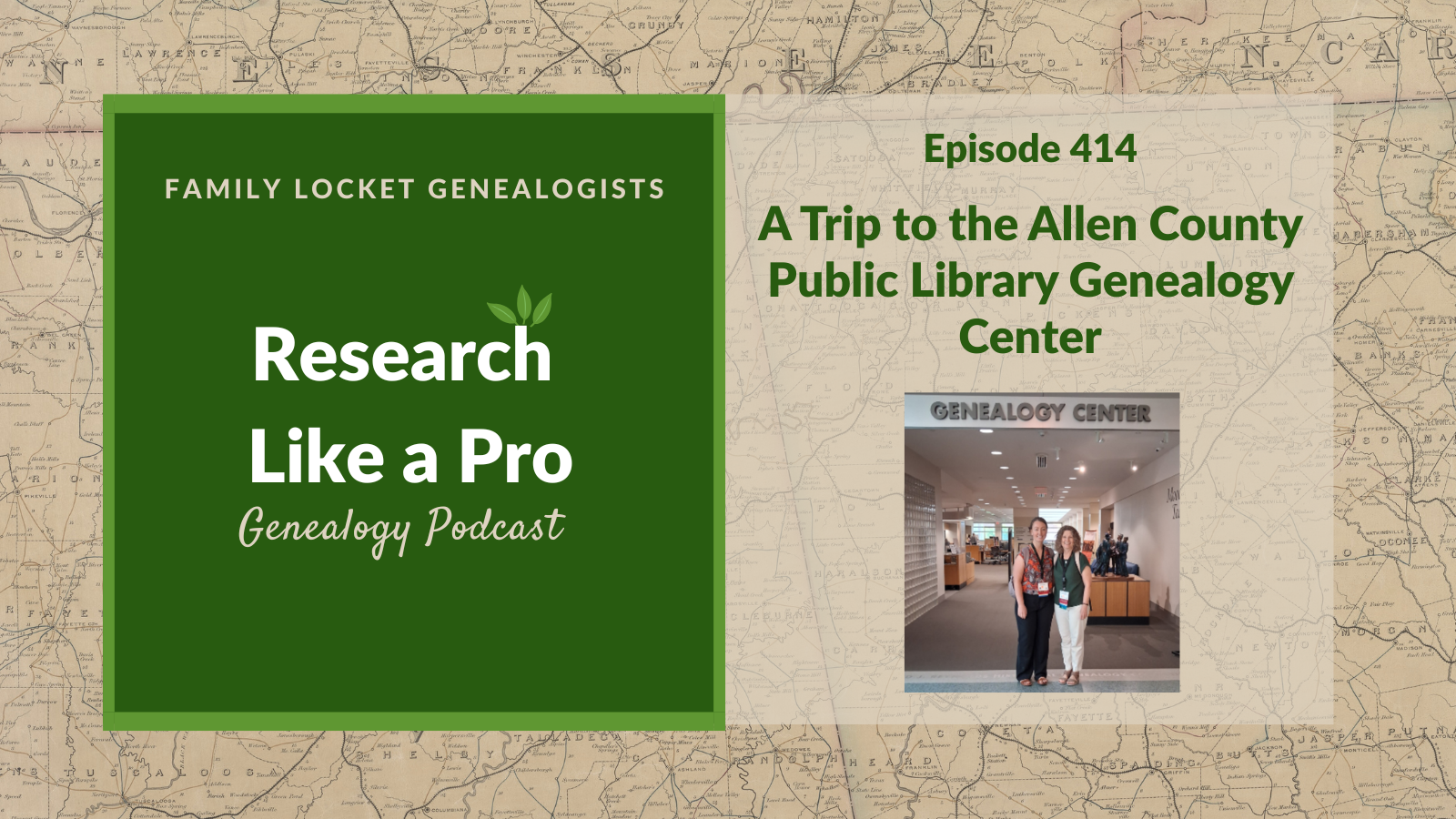
Diana and Nicole share their recent visit to the Allen County Public Library Genealogy Center in Fort Wayne, Indiana, where they explore the facility’s premier resources. Listeners learn how to use the Periodical Source Index (PERSI) to locate articles by keyword, surname, or locality. The pair explains the value of city directories for tracking individuals after 1950 to uncover addresses and occupations. They also offer guidance on utilizing published family histories, specifically on evaluating an author’s methods and identifying primary source clues within these volumes.
The discussion shifts to the library’s expansive collection of locality-based books, including county histories and cemetery abstracts, and their methodology section containing various research guides. Listeners gain insight into the benefits of accessing subscription-based databases and locked FamilySearch collections while onsite. Finally, Diana and Nicole address the library’s transition to digital microfilm viewing, noting that physical film remains accessible for those who prefer it. By the end of the episode, listeners understand how to prepare for a research trip to this center and maximize their time while working with its collections.
This summary was generated by Google Gemini.
Transcript
Nicole (0s):
This is Research Like a Pro episode 414: A Trip to the Allen County Public Library Genealogy Center. Welcome to Research Like a Pro a Genealogy Podcast about taking your research to the next level, hosted by Nicole Dyer and Diana Elder accredited genealogy professional. Diana and Nicole are the mother-daughter team at FamilyLocket.com and the authors of Research Like a Pro A Genealogist’s Guide. With Robin Wirthlin they also co-authored the companion volume, Research Like a Pro with DNA. Join Diana and Nicole as they discuss how to stay organized, make progress in their research and solve difficult cases.
Nicole (44s):
Let’s go. This episode is sponsored by Newspapers.com. Hi everyone and welcome to Research Like a Pro.
Diana (49s):
Hi Nicole. How are you doing today?
Nicole (51s):
Hey, I’m doing great and I’m working on my portfolio for certification and making progress there. How about you?
Diana (59s):
I am having so much fun finishing up my Cynthia Dillard research project and writing the report. And as always, as I’m writing each section, I’m thinking of more things that I need to go research and figure out and I’m doing so much work on all of these Dillards that show up in Georgia. I have about decided that I’m going to be ending up doing a Dillard case or one-name study in Georgia of the Dillards. I’m going to have explored every family there pre-1850. So I am basically disproving, but I’m working now on the Tolliver Dillard, I don’t remember know if you remember when we talked about Tolliver such an interesting name. So he’s the last one I need to just prove and it’s just been really fun.
Diana (1m 40s):
You know, I love digging into the records and here’s a tip for all of our listeners, I have been loving FamilySearch’s simple search as opposed to full text search. So simple search you just put in what you know about your person. Like you know, I just put in something like I’m researching James Dillard and he was in Georgia and I believe he was, can’t remember which county. Anyway, I put the county in about the year and then it just went out and found so many records. It was really interesting. It just works a little differently than full text search and then you can still filter by record collections and such. So I’ve been having some fun just playing with that and finding some great court records and land records and genealogies, all sorts of things.
Nicole (2m 28s):
Well that’s so exciting. I need to try the simple search more often.
Diana (2m 33s):
Yeah. Well I just thought I’m just gonna try this. I wanna just have some fun here and it was good. I have, I found some good things. So well let’s do some announcements. We have our Research Like a Pro Webinar Series coming up on Tuesday, June 16th at 11:00 AM Mountain Time and the title of this is, Geography, Negative Evidence and Autosomal DNA Reveal a Child Bride’s Father. And our presenter is Barb Groth.
Diana (3m 12s):
So a little bit more about this topic: Mildred was first located in Newton, Texas when she married Cornelius Kelley on 18 April 1900. No direct evidence ties her to either the date and place of her birth or the name of her father. Negative and indirect evidence combined with DNA autosomal matches prove that Mildred Katherine Kelley, born in October of 1882, was the daughter of William Wilton Beasley.
Diana (3m 57s):
So the topics Barb will be covering will be Texas, Georgia, Same-name individuals, Legal Context, Probate Records, Negative Census search, Voter Registration and Tax Rolls, AncestryDNA matches. So all the types of things that come together for a great, great webinar. Barb is an accredited Genealogist in the Great Lakes region and specializes in German-American families and unknown parentage cases. Our next Research Like a Pro Study Group begins in August of 2026 and registration is now open so we hope you will join us. If you’d like to be a peer group leader the application is on our website. And as always, please join our newsletter to find out what we’re doing and see if there’s any coupons we’re offering for upcoming conferences. We are excited about the Association of Professional Genealogy Professional Management Conference, that’s kind of a mouthful, that is October 14th through 17th and Nicole and I are both teaching there.
Diana (4m 39s):
I’m teaching about Easy Client Resource Management Tools and Nicole, and also doing a panel about Genealogists sharing how they built courses that Teach and Inspire. And Nicole has the panel on podcasting and also a workshop on Airtable and AI. So all sorts of fun different things that we’re going to be talking about.
Nicole (4m 59s):
That’s gonna be a fun conference. Well today we are talking about the Allen County Public Library Genealogy Center and it’s one of the premier genealogical research resources in the US and if you’re ever there in Fort Wayne, Indiana, you should schedule a few days to go research there. It was so fun at the recent National Genealogical Society conference that we got to go there and spend an afternoon exploring the center. And so we’re gonna talk about that today, some of the resources available there, some of the things we found while we were there and some tips for what to do before you go.
Diana (5m 35s):
Well, we have probably talked about the Allen County Public Library a little bit in connection to PERSI, which is the Periodical Source index. So this is such an amazing collection. What has happened through the years is that genealogy and historical societies have published newsletters, journals, magazines, and each one of those has information that could further our research. So the acronym PERSI is what we often say and you use it to find articles and you can search by locality, surname, keyword, or research techniques.
Diana (6m 16s):
And we would recommend that you experiment with the search because you don’t know what you’re going to find until you put it in there. So it doesn’t hurt to try a surname search, but if your surname is really common, you’re going to have a lot. So it works better if your surname is unusual. So for example, I put in Royston, which is less common and it had only 22 results. However, when I put in Cox hoping to find something on my Benjamin Cox, there were 2000 hits, which was a few too many to wade through. Then I decided to try locality search for two of my common counties, Chambers County, Alabama, and Izard County, Arkansas. And I was really hoping I would find some historical information that could add to my research some context because both of those families I’ve researched so much lately, the Roystons and the WeatherFords and in the Izard County historian I found this lovely map.
Diana (7m 10s):
It was of the Trail of Tears as it went through the area. So I had never connected the Trail of Tears, which was when the Cherokees were being driven out of Georgia. Creeks and Cherokees, and they were passing through northern Arkansas. It was going right through the Izard County area and it was 1838 and this was exactly when my Clemsy Cline and Henderson Weatherford were living there in that county. And so what a great piece of context to add to their story that they likely knew about them and it must have affected them somehow. You know, it was I’m sure the big news, and such a sad time.
Diana (7m 54s):
Well what if you can’t visit in person? So I had ahead of time used the index and made my list of periodicals to pull from the shelves when we were in person in Fort Wayne for the National Genealogical Society Conference. So I could just go over to the shelves and pull off the periodicals. But what if you’re not there? You can order any article for $7.50 and they will email it or mail you a copy, and so you can still get these. If you are going to the FamilySearch library in Salt Lake City they do have many periodicals as well. But I love that Fort Wayne is just all about helping you to just get those in your hands.
Diana (8m 40s):
So if you are going to go in person, then for sure look at the catalog first, find all your articles of interest and then if you have your list you can quickly pull them from the shelves and either scan or photograph, photograph them with your phone, which is exactly what I did. I used my photo and my little trick is always to image the title page first and then the rest of the pages in the article. Then you can easily make your citation ’cause you’ve got all the all the information right there on the title page.
Nicole (9m 13s):
Wow, that’s great. What a good tip. Well another fun thing that the Allen County Public Library has is city directories. And they have a lot of these, it’s pretty impressive. Their directories cover every state and major city and starting in the late 1800s and continue through the 20th century. So privacy concerns make it hard to order vital records in the 20th century, the latest US census is 1950. So to track a person after 1950 a city directory is so helpful. It’s invaluable. You can pinpoint an individual or couple and learn their address and sometimes their occupation, since the city directories are alphabetical, searching for possible relatives in the city can yield really good results.
Nicole (9m 58s):
So you can also find people of the same surname. You can find neighbors living on the same street by using the address. When I was there, we were going to leave soon and I wanted to go explore and I found the city directory section and the aisle I happened to look at was city directories from Washington State, which was so fun because I grew up there, I was born there, and on my Elder side, that’s where my dad was born and his parents raised their family there. And so I was kinda looking around to see if there was a Seattle directory. There were some other cities in Washington. And the last directory I looked at was a giant 1977 Seattle City directory.
Nicole (10m 43s):
And it was the biggest book I’ve I’ve seen. It was huge. I mean I’ve seen some oversized books that were bigger, but this was the biggest city directory I think I’ve ever seen. So I picked it up and carried it over to the nearest table and flipped it open, tried to find the Elder section and sure enough, once I got to the Elder section, I saw my grandpa’s name, C William Elder and his wife Renee. It actually had Renee’s maiden name initial H, and it provided my grandpa’s occupation as a teacher and it gave the school that he taught at, which was Denny Junior High School. And then as I looked at the other Elders, I saw my grandpa’s mother, Irma H Elder for Irma Henry, which was her maiden name and gave her address, too.
Nicole (11m 33s):
So it was really neat to be able to look in this old city directory and find my family listed there.
Diana (11m 41s):
Oh that’s great. And I saw a lot of people in that room with stacks of directories doing directory research, which is so neat.
Nicole (11m 50s):
Yeah, it is fun. And the other fun thing about the city directories, they are located in the movable shelf section.
Diana (11m 58s):
Yes, those were so neat. So there’s little buttons on the end and if you push a button it will move the shelf, and it won’t move if someone is standing in the middle so it won’t squish anybody, we were kind of worried about that. So it can sense if there’s a person. But yeah, to make more space, they have this amazing movable shelf system. That was very cool. Well, like every good genealogy library, the Allen County Public Library has thousands of volumes of family histories and genealogies and they’re arranged by surname. So you can just go to your surname and look at all the different books about those. And these are published and available in many libraries sometimes or sometimes they’re just one of a kind books.
Diana (12m 47s):
And those are the ones that some family member has compiled all by themselves. There’s only one copy in the world and they’ve donated it to the library. These genealogies range from colonial era all the way to the present. And they are just like online trees. They can have very good research and sources, and they can have questionable connections and few, if any, sources. So how would you want to use these books? Well, I would recommend first check to see if any of the families are those you are researching. And again, if you have a less common name it might be more likely that it’s your family. And if it does contain your ancestors, then look for sources in the genealogy or family history that lets you know what the original source documentation was or even clues.
Diana (13m 35s):
So you might see a reference to a family bible or a deed or a will. And then you could make a list of records to locate with the date and possible repository. But sadly, you might also find no documentation, especially if this was in the era where it wasn’t such a big deal to cite your sources, then you will need to examine the genealogy for clues. And something you really want to look at is when it was published and who is the author. I always like to look for some type of a preface or an introduction and it might have at the beginning this two or three page discussion about how the compiler worked really hard writing letters and going to gather this family information from you know, three states.
Diana (14m 22s):
And it may tell you all about that. You know, these people might have interviewed living family members decades ago who provided their own or their close relatives’ birth and death dates. Maybe the compiler scoured cemeteries or actually went to the courthouse or the town clerk and looked at the records. So you just don’t know. You do your best to try to figure things out about how much veracity to to give these. So you also look at the date of compilation and compare that with the dates of information. So if the genealogy was compiled in 1880, then the information for family members in the 20 or 30 years preceding, it could be firsthand and could be fairly accurate.
Diana (15m 6s):
However, if the book is compiled in 1980, a hundred years later on those same family members, then it’s definitely not relying on firsthand information. And it could, could be relying on something that’s more error prone.
Nicole (15m 21s):
That’s such a good introduction to evaluating genealogies. And before the podcast we were talking a little bit about how important it is to evaluate these print sources in genealogy, whether it’s a printed family history book or genealogy or some other printed source that we find. And sometimes seeing a family grouping in print makes us feel like it has more evidence or must be verified or something. But I think just like any other source, we need to evaluate it carefully. Alright, let’s have a word from our Sponsor. We have all been there scouring the aisles for a Father’s Day gift that doesn’t feel like an afterthought this year. Skip the generic and give him a gift subscription to Newspapers.com, the world’s largest online newspaper archive with over a billion pages of history.
Nicole (16m 8s):
Newspapers.com puts Dad just a click away from uncovering photos and stories that haven’t been seen in decades, whether it’s finding his own birth announcement, reading local sports clippings from his glory days or stumbling upon a 1920s advertisement for his grandfather’s shop. The level of detail is incredible. The best part, it’s a gift you can explore together. It turns a quiet Sunday afternoon into a journey of discovery where he might see his own passions, like a love for aviation, or a knack for carpentry, reflected in the lives of the ancestors who came before him. Once he finds those hidden gems Newspapers.com makes it simple to save, print, or share these discoveries with the whole family, preserving them for generations to come. This father’s day, give him more than a card, give him a connection to his roots and a way to keep family stories alive for the next generation.
Nicole (16m 53s):
Head to Newspapers.com, buy Dad a gift subscription, and start discovering your history together. Visit newspapers.com/familylocket today and enjoy 20% off a subscription. Well back to the Allen County Public Library. They have shelves filled from top to bottom with books of all kinds. And so let’s talk now about a different type of book: locality based books. So the periodicals that we already mentioned earlier are bound into books and shelved in the geographical area, either by state or county. And some are, I think also by city. So here you might find books filled with cemetery abstracts, county histories and more.
Nicole (17m 37s):
And if you create an account, you can make a list before your visit through the library catalog and use it to find specific volumes. Or you could simply locate the area of interest and browse the books. To make room for all of these books the Allen County Public Library has the movable shelves. So with a click of a button you can open up a new aisle. Sometimes they don’t move how you want them to, but it is good to know that they won’t close on a person who’s standing in the aisle. But the movable shelves are really cool. And when I was there I really wanted to just go explore one of the counties that I’m really familiar with. So I did go over to the the section for Anderson County, which was Pendleton District in South Carolina and found some new resources that I hadn’t seen before and was able to take several over to the table.
Nicole (18m 27s):
And it’s fun ’cause they even have these little black carts for people to use. So you can fill up your cart with as many books as you want and take it over to your table and not have to carry them all in your arms, you can push a cart.
Diana (18m 39s):
It’s a really lovely library, I have to admit. It’s so fun to go and we obviously didn’t have enough time to explore, but I loved it. And as I was doing my tour, you know, I, I like to just walk around and see what’s, what’s up at these types of libraries. We actually did a formal tour with one of the staff, but then I was just walking, seeing what pictures I wanted to take and I found a section of the library, it was clear in the back, and it had methodology books and it was teaching, you know, all the different types of methodologies, like source citations, there were three copies of Elizabeth Shown Mills’ Evidence Explained, and so many books.
Diana (19m 20s):
And I thought, oh, I wonder if it’s got Research Like a Pro. And so it was by author’s surname. So I found Elder and I found copies of both Research Like a Pro and Research Like a Pro with DNA, which was so fun. And the neat thing was these were hardbound books, which we don’t even offer those on Amazon. So the library must have had them rebound. And I noticed that all the books were hard copies. And so, you know, that just speaks to the library’s mission to collect books that will last.
Nicole (19m 50s):
Yeah, I thought that was so interesting that they had put hardcover on them and I wonder how they did it. It must have been, they must have a system for that and that’s really cool and good job walking around the library to find all those.
Diana (20m 2s):
It was impressive how they did it as they looked like that was how they were supposed to be. I mean they were beautiful. So it was fun and we got a picture with them because of course we had to have a picture with them.
Nicole (20m 13s):
Well now that we’ve talked about all the books, let’s talk about their digital collection. So the Allen County Public Library has access to many genealogy databases like you might expect for a genealogy library. Both those which are free and those that are subscription based. And since Genealogists don’t necessarily want to subscribe to every database available this is such a great opportunity to try out some of those paid sites like MyHeritage, Find My Past or the Full Ancestry subscription that you don’t have. And they also have other databases for African-American research, indigenous population research, Jewish research, Japanese and Chinese research, plus many more.
Nicole (20m 53s):
As a FamilySearch affiliate the Allen County Public Library has access to most of the locked collections that need to be viewed at a FamilySearch center or the FamilySearch library. And this is a huge benefit for those researching in Fort Wayne that you don’t have to be in Salt Lake in order to access those locked collections. And I actually had an image I needed to look up that was in a locked collection and that we were told that you could use your laptop and just being connected to the wifi there would be enough to make the collection be unlocked. And they said sometimes it doesn’t work perfectly. So for me it didn’t work, and so I just used my Allen County public library card, you can get a guest card when you come or you can sign up for one beforehand.
Nicole (21m 39s):
And so I had signed up beforehand, so I had a library card card and I used that to log onto one of their computers and that’s how I was able to get the image that was locked on FamilySearch. So it worked pretty well. Just be aware that you might need your library card number to use the computer.
Diana (21m 58s):
Well if I was doing research in China for Chinese ancestors, I would just be so curious to see what they have because that’s kind of an unusual database they have, right? They’re in the Midwest. So super neat just to see all the different groups that are being serviced there by this amazing center. Now as we were taking our tour, we went by the microfilm room and it was room full of microfilm readers, but nobody was in there because those films are now digitized and you just view them by computer, but the films are still housed on the floor and if you really want to go look at the microfilm, you can, you go get the film out of the cabinet and go put it in the reader.
Diana (22m 42s):
So it was kind of neat to see that because I can imagine 15 years ago that room would’ve been humming with people cranking the microfilm. Just things have changed. So, you know, to sum this up, we really loved our visit to the genealogy center. We’d heard so much about this library and it was really neat to go be there in person and see all the treasures there for our family history research. I was so impressed with how they’re constantly adding to the collection. And I’ve heard Curt Witcher, who is the Director of Special Collections speak many times, he presents at RootsTech and and various conferences.
Diana (23m 24s):
And he is just such an advocate for acquiring materials that will help us further our family knowledge. And so we’re so very thankful for his efforts and his staff, which was fabulous. So if you are ever in the neighborhood, if you’re ever in Fort Wayne Indiana, or if you just need to have a trip to go research, that would be a good place to spend a week probably. So even if you only have a few hours like we did, you can get something done if you plan ahead. But we were grateful we had the opportunity to finally check it out. Such a great, such a great resource.
Nicole (24m 2s):
Such a great place. And you know, there’s a lot of similarities with the FamilySearch Library, with how fun it is to go look at the books for a whole, you know, a county and see everything that there is in a book, in book and periodical form, and just really explore what the periodicals are like and see what’s available for future research projects and just get a little bit more familiar with the genealogy periodical. And I think sometimes PERSI and the periodicals is a bit challenging to understand if you haven’t seen a genealogy periodical and been able to flip through it. So it’s a really good benefit to be able to actually visit the library there and look at a few different periodicals.
Diana (24m 43s):
Yes, I looked at a lot and it was just really neat and found some good stuff. I mean, those, you never know what they’re going to have in them, so well worth your time.
Nicole (24m 52s):
Right. Well, Thank you for sharing with us about the Allen County Public Library and writing this blog post. If you wanna read a blog post that Diana wrote about it, you can go check that out. It has a bunch of pictures and you can kind of see what it’s like. So we’ll link to that in the show notes. But thanks everyone for listening. We hope you have a great week and we’ll talk to you again next week. Bye-bye.
Diana (25m 14s):
Bye-bye.
Nicole (25m 53s):
Thank you for listening. We hope that something you heard today will help you make progress in your research. If you want to learn more, purchase our books, Research Like a Pro and Research Like a Pro with DNA on Amazon.com and other booksellers. You can also register for our online courses or study groups of the same names. Learn more at FamilyLocket.com/services. To share your progress and ask questions, join our private Facebook group by sending us your book receipt or joining our courses to get updates in your email inbox each Monday, subscribe to our newsletter at FamilyLocket.com/newsletter. Please subscribe, rate and review our podcast. We read each review and are so thankful for them. We hope you’ll start now to Research Like a Pro.
Links
APG Virtual Professional Management Conference – https://www.apgen.org/pmc2026.php
Allen County Public Library Genealogy Center blog post by Diana – https://familylocket.com/a-trip-to-the-allen-county-public-library-genealogy-center/
PERSI (Periodical Source Index) – https://www.genealogycenter.info/persi/
ACPL Genealogy Databases – https://www.acpl.lib.in.us/genealogy/research-resources
Sponsor – Newspapers.com
For listeners of this podcast, Newspapers.com is offering new subscribers 20% off a Publisher Extra subscription so you can start exploring today. Just use the code “FamilyLocket” at checkout.
Research Like a Pro Resources
Airtable Universe – Nicole’s Airtable Templates – https://www.airtable.com/universe/creator/usrsBSDhwHyLNnP4O/nicole-dyer
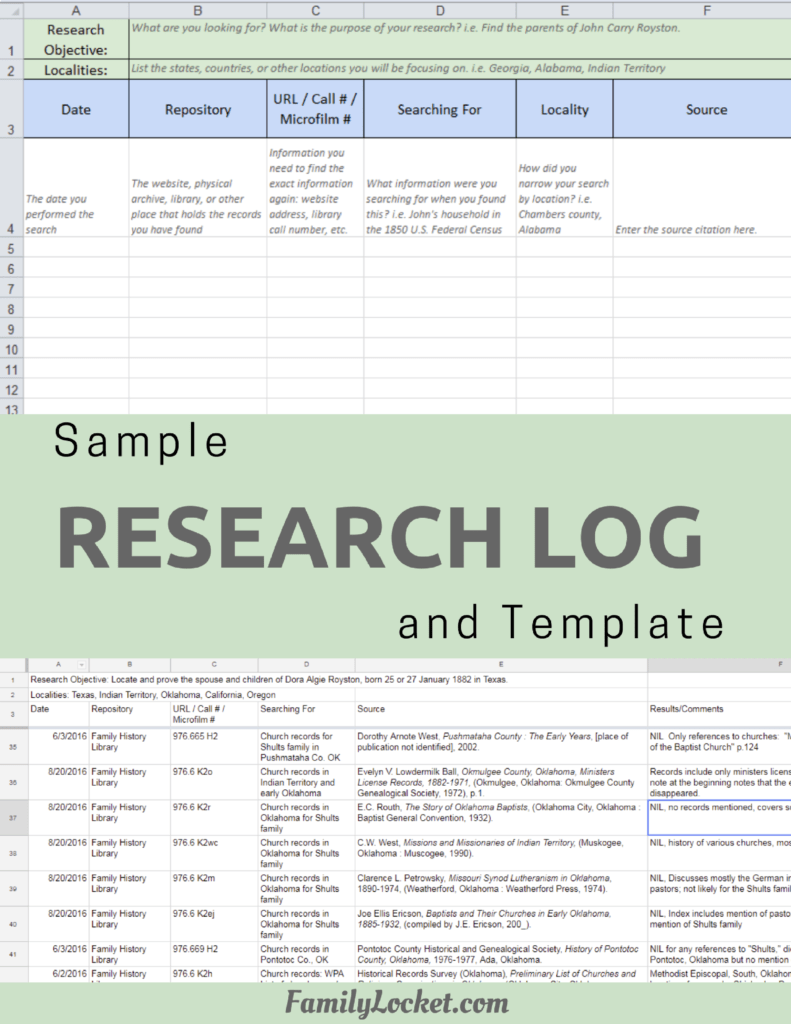
Airtable Research Logs Quick Reference – by Nicole Dyer – https://familylocket.com/product-tag/airtable/
Research Like a Pro: A Genealogist’s Guide book by Diana Elder with Nicole Dyer on Amazon.com – https://amzn.to/2x0ku3d
Research Like a Pro with AI Workbook – Second Edition (eBook) – https://familylocket.com/product/research-like-a-pro-with-ai-workbook-second-edition-ebook/
14-Day Research Like a Pro Challenge Workbook – digital – https://familylocket.com/product/14-day-research-like-a-pro-challenge-workbook-digital-only/ and spiral bound – https://familylocket.com/product/14-day-research-like-a-pro-challenge-workbook-spiral-bound/
Research Like a Pro Webinar Series – monthly case study webinars including documentary evidence and many with DNA evidence – https://familylocket.com/product-category/webinars/
Research Like a Pro eCourse – independent study course – https://familylocket.com/product/research-like-a-pro-e-course/
RLP Study Group – upcoming group and email notification list – https://familylocket.com/services/research-like-a-pro-study-group/
Research Like a Pro Institute Courses – https://familylocket.com/product-category/institute-course/
Research Like a Pro with DNA Resources
Research Like a Pro with DNA: A Genealogist’s Guide to Finding and Confirming Ancestors with DNA Evidence book by Diana Elder, Nicole Dyer, and Robin Wirthlin – https://amzn.to/3gn0hKx
Research Like a Pro with DNA eCourse – independent study course – https://familylocket.com/product/research-like-a-pro-with-dna-ecourse/
RLP with DNA Study Group – upcoming group and email notification list – https://familylocket.com/services/research-like-a-pro-with-dna-study-group/
Thank you
Thanks for listening! We hope that you will share your thoughts about our podcast and help us out by doing the following:
Write a review on iTunes or Apple Podcasts. If you leave a review, we will read it on the podcast and answer any questions that you bring up in your review. Thank you!
Leave a comment in the comment or question in the comment section below.
Share the episode on Twitter, Facebook, or Pinterest.
Subscribe on iTunes or your favorite podcast app.
Sign up for our newsletter to receive notifications of new episodes – https://familylocket.com/sign-up/
Check out this list of genealogy podcasts from Feedspot: Best Genealogy Podcasts – https://blog.feedspot.com/genealogy_podcasts/




2 Comments
Leave your reply.