
About a year and a half ago, while working on my Kinship Determination project (KDP) for BCG certification, I needed a death certificate for a sister of my second-great-grandfather, who was the subject of the middle generation of my study. I knew her name, I knew when she died, and I knew the county. What I didn’t expect was just how thoroughly an index could obscure someone whose identity I thought I already had pinned down.
This is the story of Margaret Cinderella (Harris) Bone—and a reminder that indexes are made by humans, and humans make mistakes.
Note: Claude Sonnet 4.6, an AI assistant, was used to help write this blog post.
Starting with What I Knew
I was confident about the basics. Margaret Cinderella Bone, born 5 February 1868 according to the family Bible,[1] was a sister of my research subject and had died in Love County, Oklahoma, on 11 February 1928, according to her headstone.[2]
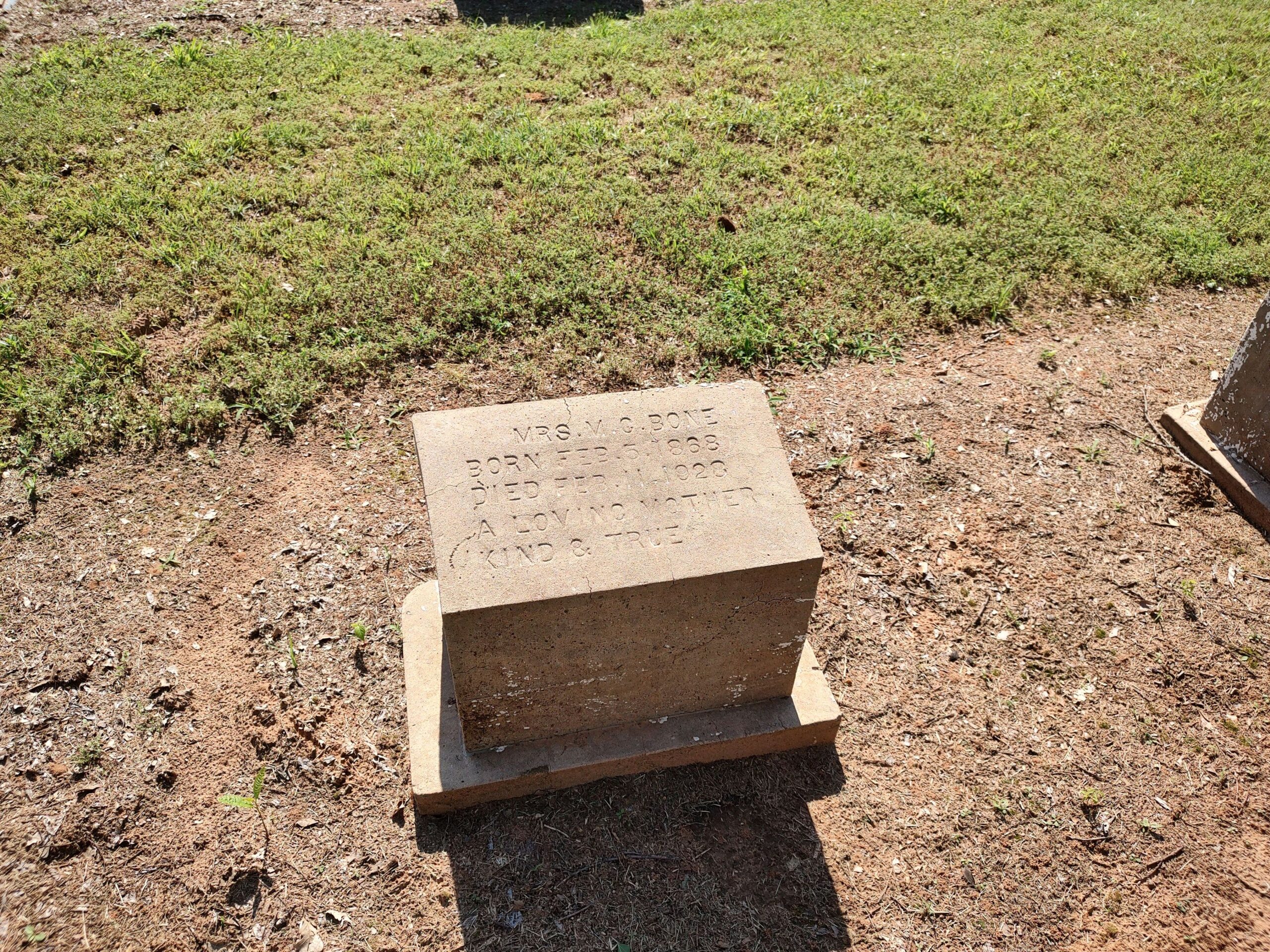
Image: Margaret Cinderella (Harris) Bone’s headstone, showing her death date of 11 February 1928
Armed with a full name, a birth date, a death date, and a county, I expected the index search to be straightforward.
It was not.
Permutation After Permutation
Using the OK2Explore Oklahoma State Vital Records Index “Seach Death Records” database at https://ok2explore.health.ok.gov/App/DeathSearch, I tried nearly every reasonable variation of her name that I could think of:
- Margaret Cinderella Bone
- Margaret Bone
- Margaret C. Bone
- M* Bone
- C. Bone
- Bone
- Just the surname Bone, narrowed to a death year of 1928
- Just the death date of 11 February 1928 with nothing else
None of it worked. The index simply would not surface her. Even searching by her death date didn’t help.
I ordered death certificates for several of her siblings in May 2024 and received them not long after, but Margaret’s remained elusive. I let myself give up on hers for a while. But something nagged at me—I had a feeling her certificate really was out there, sitting in the index under some form I hadn’t thought to try. So I came back to it.
Searching Without a Name
This time, I gave up trying to out-guess the spelling of her name altogether. Instead, I stripped my search down to the bare facts I was certain of: sex, county, and the month and year of death. Here’s what that search looked like:
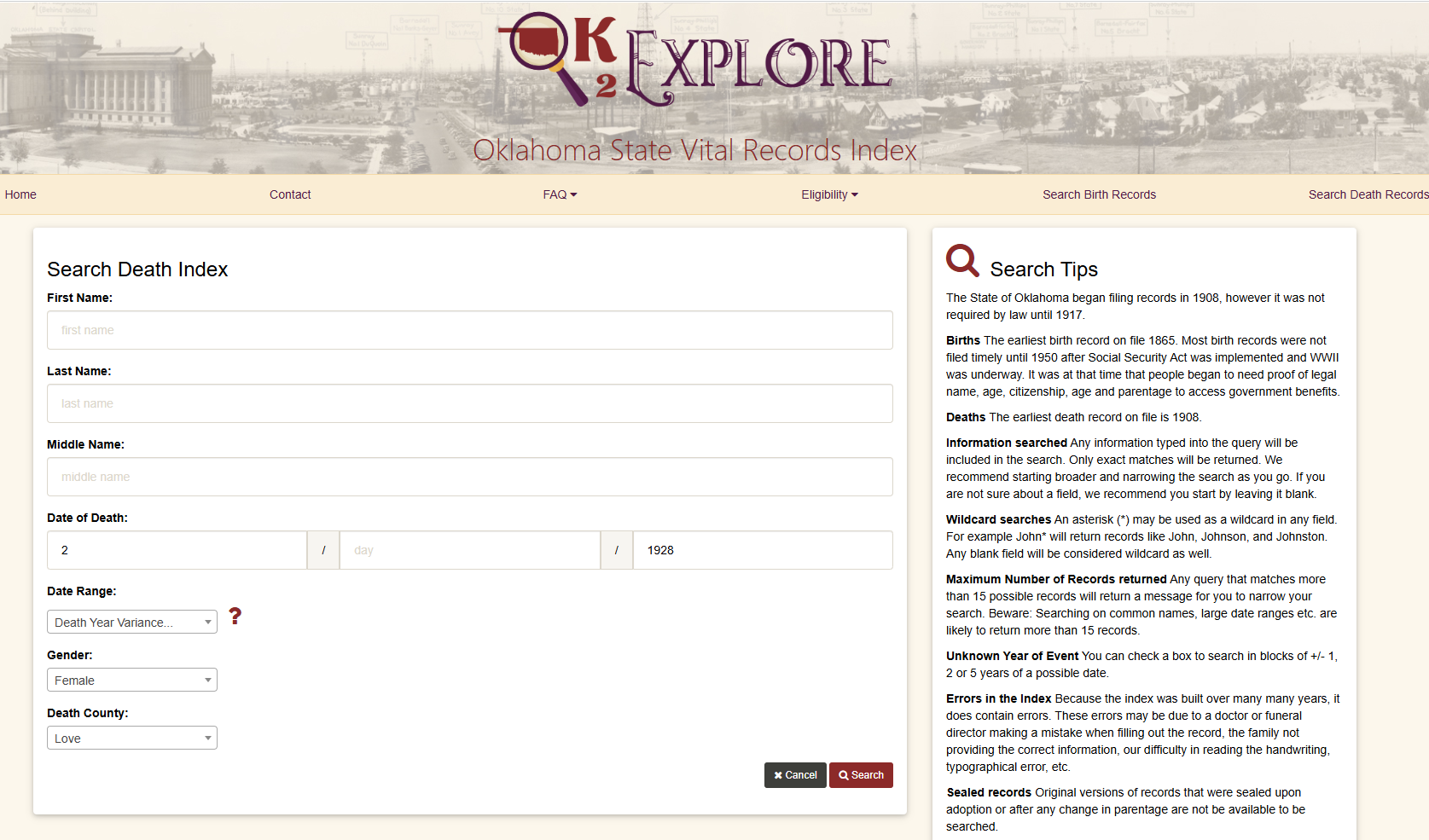
Index search page filled in with only “Female,” “Love County,” and “February 1928″—no name fields
Searching for nothing but her gender, county, death month, and death year finally turned up the record, indexed as Margotte C. Bane, with a death day of February 12 (rather than February 11 as her headstone stated):
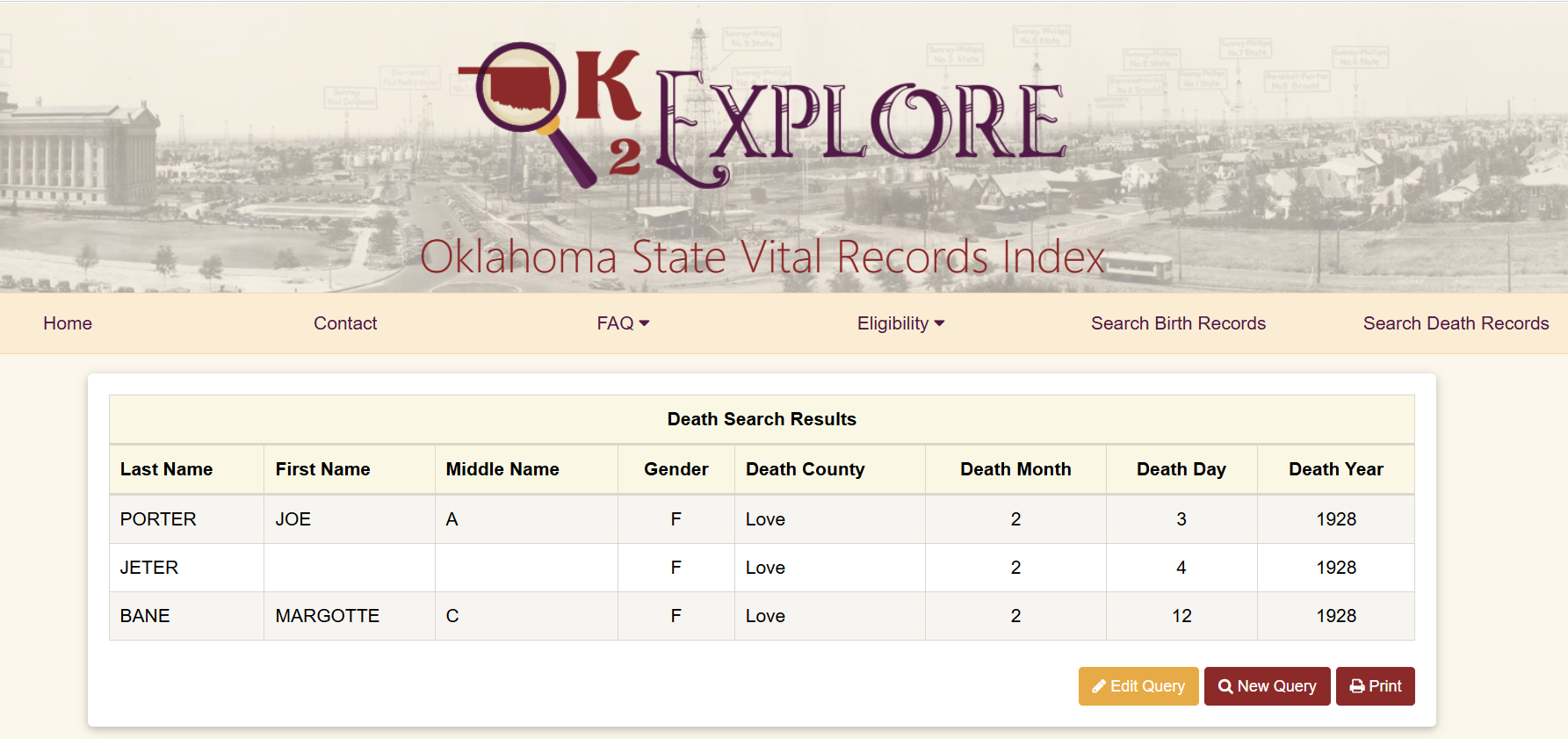
Search results page showing the index entry for “Margotte C. Bane,” died 12 Feb 1928, Love County, Oklahoma
Once I saw why, the mix-up made a lot more sense, and it also explained why none of my earlier name searches had worked. Many online indexes use some form of phonetic matching—Soundex or a similar algorithm—that’s supposed to catch minor spelling variants like this. This particular index, it turned out, did not seem to use any such matching at all. It wanted something much closer to an exact string match, and “Bane” was just different enough from “Bone” that none of my searches ever crossed paths with it.
Looking at the search tips on the search page now with 20/20 hindsight, I realize that I could have found it with a simple asterisk search: M* B* and year of 1928. This has been such a good lesson to keep trying and use the search tips provided by each database. This particular site spells it out plainly: “Only exact matches will be returned,” and an asterisk can be used as a wildcard in any field. Had I read those tips before I started searching instead of after I’d already found the record, I could have found it sooner. It’s a good reminder to always check for a “search tips” or “help” link before diving into an index, especially one we haven’t used before.
The Death Certificate
I ordered the certificate right away, and it arrived in December—just in time. I was able to incorporate it into my KDP before turning the project in on 31 December 2024.
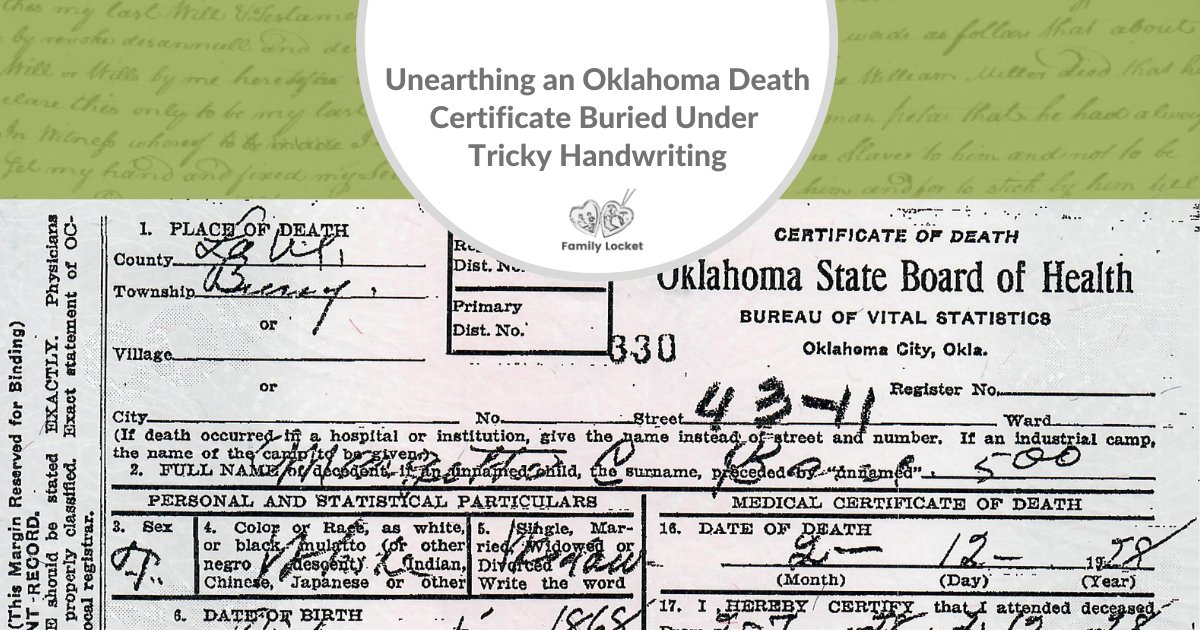
Once I had the certificate in hand, I understood the indexer’s confusion even better—the name was tricky to read. It’s the only Oklahoma death certificate I have from the 1920s; the rest of my certificates for this family date from 1931 and later, using a slightly revised form with more generous space for writing in the name, race, and marital status. This 1928 form, by contrast, seems to have been designed with almost no room left for the clerk to actually write.
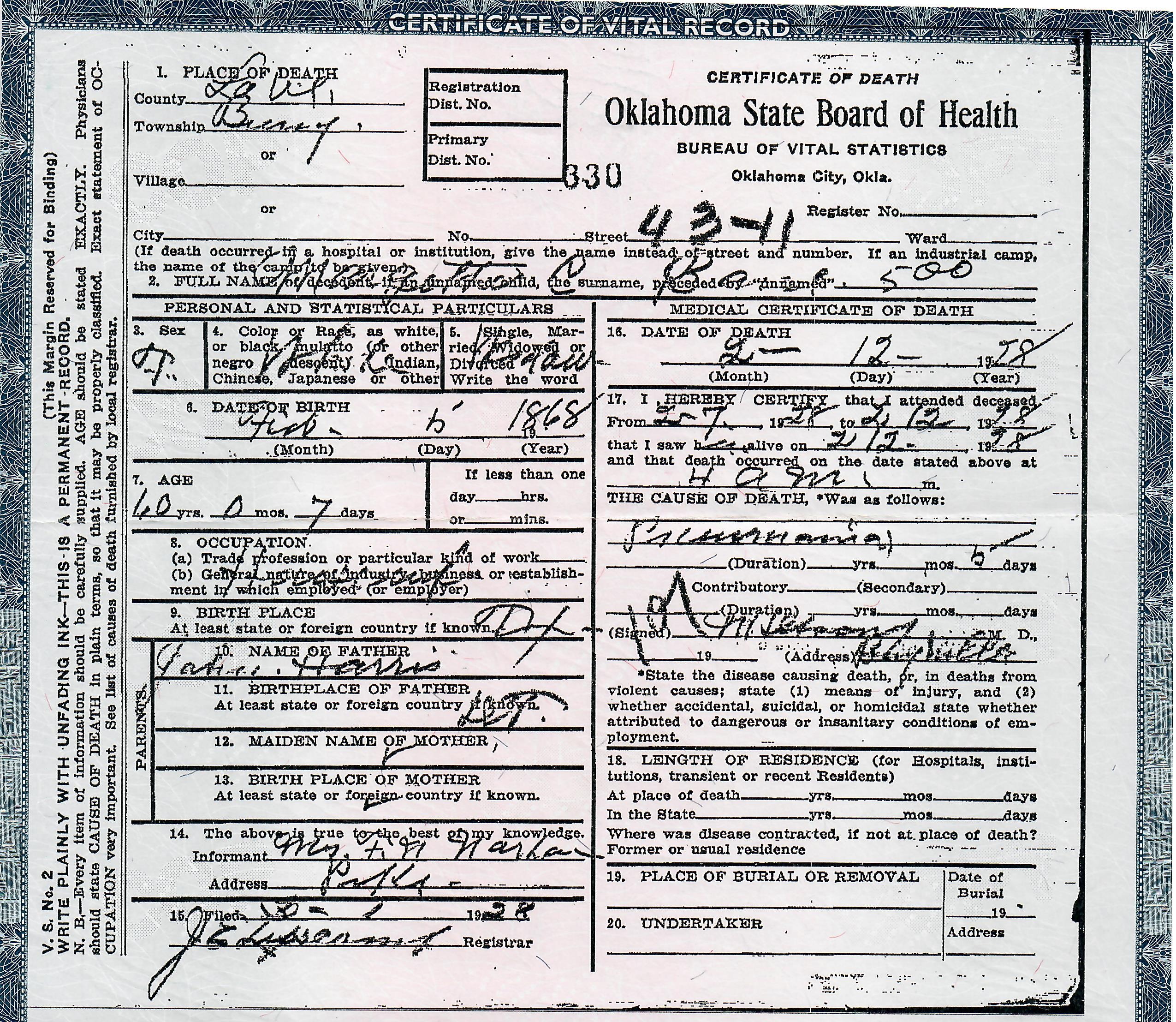
1928 Oklahoma Death Certificate of Margotte C. Bane [Bone]
The full name in box 2 isn’t written on a blank line at all—it’s scrawled directly on top of the printed instructional text (“FULL NAME of decedent, if an unnamed child, the surname, preceded by ‘unnamed'”), so the handwriting and the pre-printed text overlap and compete for the same few inches of space. The result looks like “Margotte C. Bone,” but it’s genuinely difficult to be certain, since the loops of the cursive letters tangle with the printed words underneath them. Box 4 (color or race) and box 5 (marital status) have the same problem: the clerk had to write “white” and “widow” crammed into the same narrow line as a half dozen pre-printed options (“white, black, mulatto,” “Single, Married, Widowed or Divorced. Write the word”), leaving very little room to write clearly. Even the informant’s address and the physician’s signature are abbreviated and squeezed into tight corners. It’s no wonder a later transcriber, working from a scan or microfilm copy of a form like this, misread an “o” as an “a.”
Here’s what the certificate revealed, once I’d worked through it line by line:
Certificate of Death, Oklahoma State Board of Health, Bureau of Vital Statistics Certificate No. 330
- Place of death: Love County, Burney Township
- Full name: Margotte [Margette?] C. Bane [Bone?]
- Sex: Female
- Color or Race: White
- Marital status: Widow
- Date of birth: 5 February 1868
- Age: 60 years, 0 months, 7 days
- Occupation: Housewife
- Birthplace: Texas
- Father: John Harris (birthplace not known)
- Mother: Maiden name and birthplace left blank
- Informant: F. M. Markham
- Filed: 3-1-1928, by Registrar J. E. [Lyscamp?]
- Date of death: 12 February 1928, 4:00 a.m.
- Attending physician’s care: 7 February 1928 to 12 February 1928
- Cause of death: Pneumonia, duration 5 days
- Signed: M. [De?rony?][3]
The age at death—60 years, 0 months, 7 days—combined with the stated birth date of 5 February 1868, neatly confirms the 12 February 1928 death date on the certificate. This matches the family Bible’s birth date exactly,[4] which strengthens my confidence that the certificate’s death date is correct and the headstone’s 11 February is the one slightly in error, although either could be incorrect. Headstones are often carved weeks or months after a death, based on family recollection rather than the official record, so small date discrepancies like this one are not unusual.
Putting the Certificate to Work in the KDP
With the certificate in hand just days before my deadline, I was able to add it to my child list for this family and cite it properly in my source notes. Here’s a look at how it came together in the final document. These are just the first four of ten children that I documented for John and Malissa Harris:
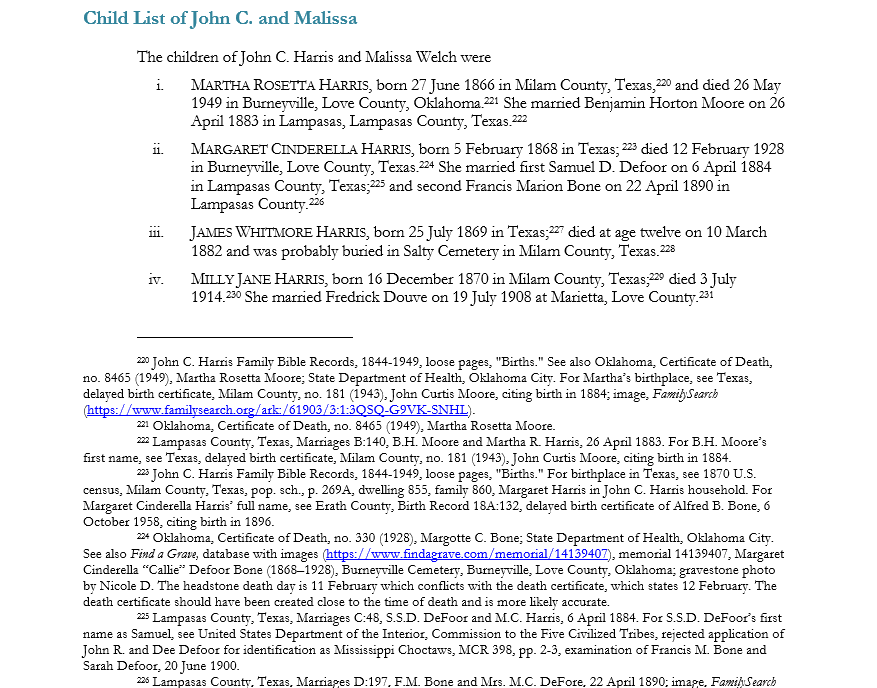
Screenshot of KDP Word document showing the child list entry for Margaret Cinderella Bone and the accompanying source citations
Lessons for Fellow Researchers
The process of finding this death certificate taught me a few things worth sharing:
- Don’t assume the index uses phonetic matching. Many people search a name once or twice, conclude the record doesn’t exist online, and move on. Some indexes use Soundex-style algorithms that catch spelling variants; plenty of others don’t, especially smaller state or county-level databases. Read and use the search tips associated with the database, if any.
- Try searching with no name at all. When you’re confident about the place, the approximate date, and the sex of the person you’re seeking, a name-free search—filtered only by those demographic and geographic details—can be remarkably effective at flushing out a difficult entry.
- Expect small discrepancies between derivative sources and originals. A headstone, a Bible record, or a family memory may give a date that differs by a day or two from the official record. Allow wiggle room in your search terms – the day, month, year, or other details, might be different than what other records say.
- Even common names can be spelled in uncommon ways. Margaret isn’t an unusual name by any means, but clerks and informants sometimes recorded names however they happened to hear or write them that day. A name you’d never think to second-guess might show up in the original record—and in the index—looking nothing like what you expected.
- Don’t underestimate how much the quality of the original source can affect legibility and accuracy. Cramped or poorly designed forms, faded or smudged ink, low-quality microfilm or digital scans, and handwriting that varies widely from one clerk to the next can all stand between you and an accurate reading of a record. When any of these factors come into play—especially when handwriting overlaps with pre-printed text, as it did here—transcription errors become far more likely, no matter how careful the original clerk or the later indexer happened to be. It’s worth remembering that every record passes through several hands and processes before it reaches us, and each step is an opportunity for something to get lost or garbled along the way.
I’m glad I didn’t let my first round of failed searches end my search. While Margaret Cinderella (Harris) Bone’s death certificate wasn’t a critical piece of evidence in my Kinship Determination project, it mattered because I wanted complete documentation for every child of John Christian Harris. Being able to gather consistent death certificates for all of his children was satisfying and Margaret’s arrived with just days to spare before my 31 December 2024 deadline. What oddly indexed names have you found with creative database searches? Please share in the comments!
Notes
[1] John C. Harris Family Bible Records, 1844-1949, loose pages, “Births”; privately held by Georgie Lee Spradlin, Kingston, Oklahoma, 2008; image online, “Memories,” FamilySearch (https://www.familysearch.org/memories/memory/89810965 : accessed 25 Apr 2024). Georgie Lee is the granddaughter of John C. Harris’s second wife, Arza, through their daughter Ruthie Marie. These loose pages were tucked inside a bible of a different size, according to Carolyn Lauderdale, a descendant of John C. Harris through his daughter Margaret. The first set of entries was written in one hand with a dark blue pen, and includes entries from 1844-1887. These entries have consistent handwriting and ink color and were probably transcribed all at once. The second set of entries was written in a different hand with a black pen and includes dates from 1909-1949, likely by Arza, and is not in a consistent hand, suggesting they were added at different times.
[2] Find a Grave, database with images (https://www.findagrave.com/memorial/14139407 : accessed 13 December 2024), memorial 14139407, Margaret Cinderella “Callie” Defoor Bone (1868–1928), Burneyville Cemetery, Burneyville, Love County, Oklahoma; gravestone photo by Nicole D. (contributor 47743838).
[3] Oklahoma, Certificate of Death, no. 330 (1928), Margotte C. Bane [Bone]; State Department of Health, Oklahoma City.
[4] John C. Harris Family Bible Records, 1844-1949, loose pages, “Births”; privately held by Georgie Lee Spradlin, Kingston, Oklahoma, 2008; image online, “Memories,” FamilySearch (https://www.familysearch.org/memories/memory/89810965 : accessed 25 Apr 2024).










Leave a Reply
Thanks for the note!