
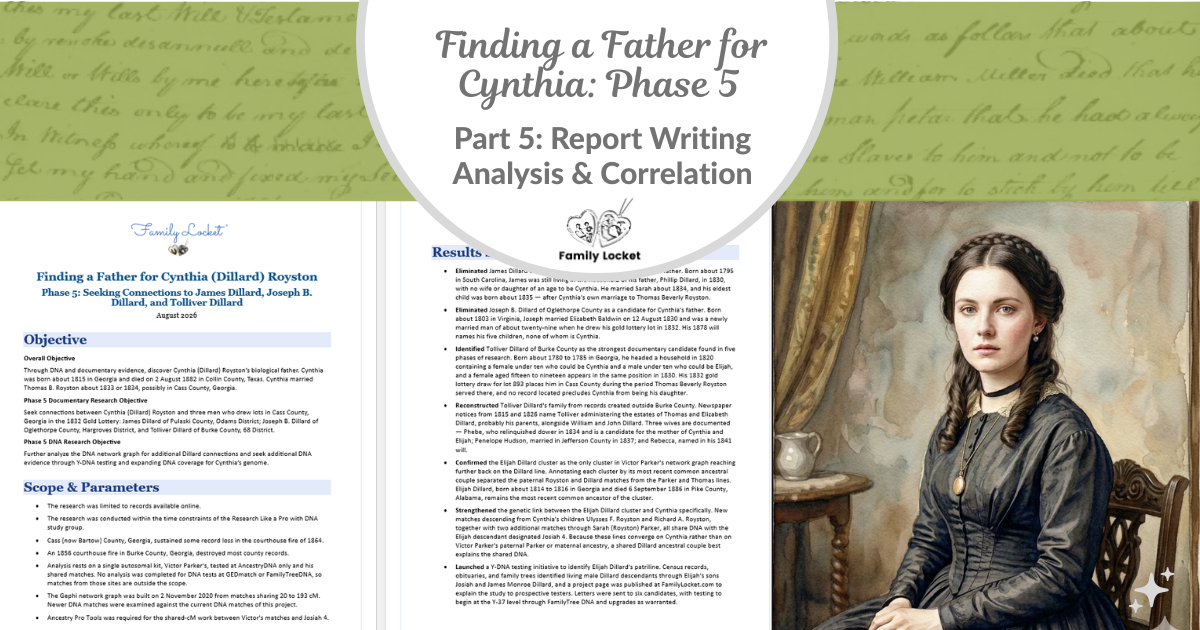
If you have an ancestor who is still a mystery despite years of research, you’ll relate to my Cynthia (Dillard) Royston project. I am currently working on phase 5 as part of the Research Like a Pro with DNA study group. Each phase has focused on a specific objective and has eliminated many Dillard candidates. Eventually, I hope to have one man left standing, whom documentary and DNA evidence point to as Cynthia’s father. In this last part of the series detailing my research, I’ll share how I wrote the report- analyzing and correlating the evidence found within the fifty-nine entries in my Airtable research log. A link to the full report is at the end of this blog post.
Here are previous posts in this series:
Finding a Father for Cynthia: Phase 5 – Part 1 Research Objective
Finding a Father for Cynthia: Phase 5 – Part 2: Timeline and Locality Research
Finding a Father for Cynthia: Phase 5 – Part 3: Research Planning
Finding a Father for Cynthia: Phase 5 – Part 4: Research Log and Source Citations
Objective
The first step in any research report is placing the objective at the beginning. This helps the reader understand the goal of the project. I don’t always separate the objective as I did here, but this helped me clearly see the overall picture of what I wanted to accomplish.
Overall Objective
Through DNA and documentary evidence, discover Cynthia (Dillard) Royston’s biological father. Cynthia was born about 1815 in Georgia and died on 2 August 1882 in Collin County, Texas. Cynthia married Thomas B. Royston about 1833 or 1834, possibly in Cass County, Georgia.
Phase 5 Documentary Research Objective
Seek connections between Cynthia (Dillard) Royston and three men who drew lots in Cass County, Georgia in the 1832 Gold Lottery: James Dillard of Pulaski County, Odams District; Joseph B. Dillard of Oglethorpe County, Hargroves District, and Tolliver Dillard of Burke County, 68 District.
Phase 5 DNA Research Objective
Further analyze the DNA network graph for additional Dillard connections and seek additional DNA evidence through Y-DNA testing and expanding DNA coverage for Cynthia’s genome.
Scope and Parameters
The Scope & Parameters section explains some of the limitations in the research. I noted that research was limited to online records, that it was bounded by the timeframe of the Research Like a Pro with DNA study group, and — critically — that Cass (now Bartow) County sustained record loss in the 1864 courthouse fire, and that an 1856 fire in Burke County destroyed most county records. For the genetic portion of the report, I explained that I used only my key test-taker’s DNA at Ancestry and that I viewed new matches for this project.
Results Summary
The results summary previews the research conducted for the reader. Using active verbs strengthens the writing. Rather than a long list of statements, I prefer a limited list of bullet points, each centered on one subject. This is a section I typically ask AI to write based on my report. In this case, I used Claude Opus 5 High for complex tasks. I wanted the AI to take it’s time in reading my report and pulling accurate facts and analysis from the findings. I was very pleased with the result. Claude AI used good active verbs: Eliminated, Identified, Reconstructed, Confirmed, Strengthened, and Launched. As in all AI work, I carefully read each bullet point and found no errors. Here is one example:
Eliminated James Dillard of Pulaski County as a candidate for Cynthia’s father. Born about 1795 in South Carolina, James was still living in the household of his father, Phillip Dillard, in 1830, with no wife or daughter of an age to be Cynthia. He married Sarah about 1834, and his eldest child was born about 1835 — after Cynthia’s own marriage to Thomas Beverly Royston.
Background
The Background section carries three parts. First, a project overview establishing Cynthia — born about 1815 in Georgia, died 2 August 1882 in Collin County, Texas, her maiden name known only from the death certificates of three of her fourteen children.
Second, a summary of Phases 1 through 4, so a new reader doesn’t have to read four prior reports to follow this one. Phase 1 disproved George W. Dillard when the Mahone Family Bible revealed the 1815-born Dillard female was Mariah L. Dillard. Phase 2 eliminated ten more candidates. Phase 3 introduced the DNA and the Elijah Dillard hypothesis. Phase 4 narrowed to Cass County and eliminated the Cass County Dillard households.
Third, I wrote an explanation of the 1832 Georgia Gold Lottery itself—how it ran concurrently with the Cherokee Land Lottery, why gold lots were 40 acres instead of 160, who qualified and who was excluded. Then I built a table of the three Cass County drawers with their counties of origin, militia districts, and lot numbers, and annotated an 1832 map of Georgia with stars at Pulaski, Oglethorpe, and Burke and a heart at Cass. Seeing those three counties scattered across the state, with Cass far up in the northwest corner, reframed the whole question: what would bring a man from Burke County, on the South Carolina border, into Cherokee territory?
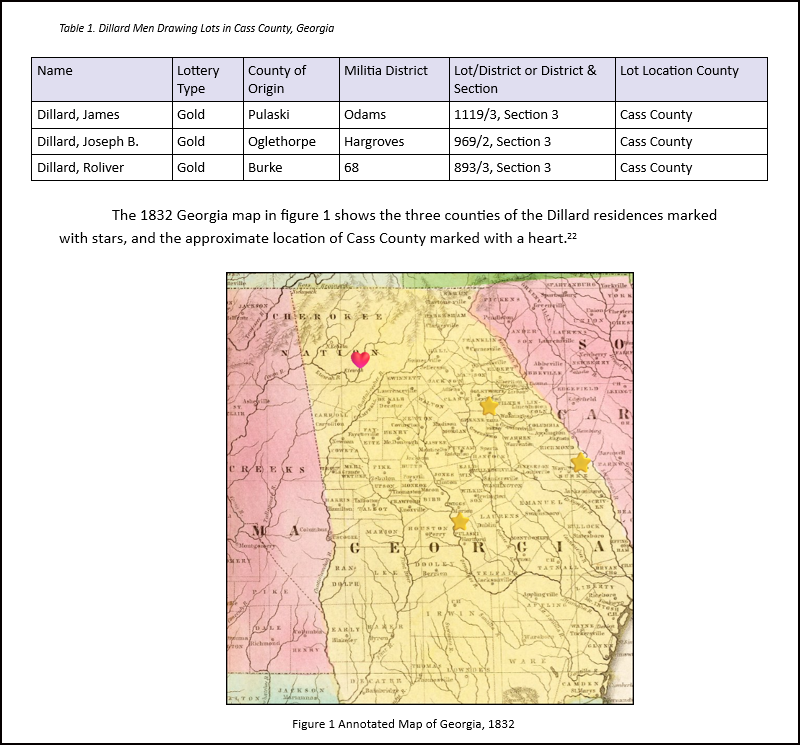
Portion of the background section of the report
Findings & Analysis: Documentary
Because I had grouped my Airtable log by person and sorted chronologically, each man already had a timeline. That grouping became the section structure directly. I wrote James, then Joseph, then Tolliver. At the end of each section, I wrote a summary of my analysis.
James Dillard of Pulaski County
Records for James were readily available, and soon into the research it became apparent that he was not Cynthia’s father. James’ father Phillip Dillard’s 1828 will named five children, James among them. When I transcribed Phillip’s 1830 household line by line and assigned each tick mark to a named person, James likely appeared as the male aged 30 to 39 with no wife beside him — and the female aged 10 to 14 was almost certainly his sister Rebecca Ann, not a daughter. He married Sarah about 1834, and his oldest child, Wilmington, was born about 1835, after Cynthia’s own marriage. Born about 1795 in South Carolina, he was old enough to be Cynthia’s father, but his timeline showed that he was a single man until his 1834 marriage and could not have been the father of Cynthia, who was born about 1815.
Joseph B. Dillard of Oglethorpe County
Joseph was eliminated based on age. He and Elizabeth Baldwin took out a license on 11 August 1830 and married the next day. Born about 1803 in Virginia, he was a newly married man of about twenty-nine when he drew his lot in 1832. Joseph would have been only 13 when Cynthia was born. Moreover, his 1878 will names his five children. None is Cynthia.
Tolliver Dillard of Burke County
Tolliver required the longest treatment, and I subdivided it: census records, family (parents, wives, children), headright land grants, tax records, land records, death, and a summary of evidence. Burke County burned in 1856, so nearly everything I used was created in another jurisdiction — an Augusta Chronicle notice from 1815 naming Tolliver and William Dillard administering Thomas Dillard’s estate; an 1826 notice naming Tolliver and John Dillard as executors for Elizabeth Dillard, probably his parents; a Bibb County deed in which Phebe, wife of Tolliver, relinquished dower in 1834; a Jefferson County marriage to Mrs. Penelope Hudson on 6 June 1837; state headright warrants totaling 1,214 acres across eight Burke County warrants between 1815 and 1836.
I began with a census analysis to see if the 1820 and 1830 censuses had a placehold for a female of Cynthia’s age and a male of Elijah’s age. I transcribed each household and bolded my hypotheses in place — Cynthia? beside the female under ten in 1820, Elijah? beside the male under ten. In 1830, a female aged 15 to 19 sits in exactly the position Cynthia should occupy. By 1840, that slot is empty, which is what you’d expect if she was in DeKalb County, Alabama, with Thomas Beverly Royston. Writing the placeholders into the report rather than just asserting a conclusion let me see the possibilities.
The tax digests, 1855 through 1859, produced a small correction I would have missed otherwise. The 1850 and 1860 censuses show Tolliver Jr. holding the real estate — but the tax records show Tolliver Sr. retained ownership until his death in 1861, while Jr. paid only a poll tax until 1857. Building that into a table with acres, land value, enslaved people, debts, and taxable totals made the discrepancy visible in one glance. (It also surfaced an obvious clerical error: the 1855 acreage of 2,494 should almost certainly read 1,494.)
For the eight headright warrants I used AI assistance to transcribe and summarize, and cited it in the footnote as such, alongside the FamilySearch citation.
Because Tolliver’s section had the most research, the summary of evidence was more involved.
The census records show a likely birth year of 1780 to 1785 and a possible birthplace in Georgia for Tolliver Dillard, Sr. Three records name three different wives: an 1834 land record names Phoebe Dillard, an 1837 newspaper and marriage record reveals Mrs. Penelope Hudson as the next wife, and Tolliver’s 1841 will names Rebecca, his wife. Tolliver resided consistently in Burke County, Georgia, which had record loss destroying records before 1856. All records for him prior to that time were from another jurisdiction or recorded later in Burke County.
His 1832 land lottery draw in Cass County ties him to Cynthia Dillard. She likely met Thomas Beverly Royston in this area by 1834, which also experienced record loss. The dearth of records during this era in both Burke County and Cass County could account for the lack of evidence of a direct connection. No record precludes Cynthia from being Tolliver’s daughter, as the early census enumerations include placeholders for a female born about 1815. DNA research will need to provide a connection.
DNA Background
I wrote a DNA Background section explaining all three testing types — mtDNA, Y-DNA, and atDNA — even though this phase only used two. Victor Parker, Cynthia’s great-grandson, inherited about 12.5% of his DNA from her and up to 6.25% from each of her parents, and has over 63,000 matches at AncestryDNA.
This section also reiterated the previous work I had done with the Gephi network graph, and I used several visuals to illustrate the clusters. The most important one showed the peach cluster that had previously identified Elijah Dillard as the MRCA (Most Recent Common Ancestor).
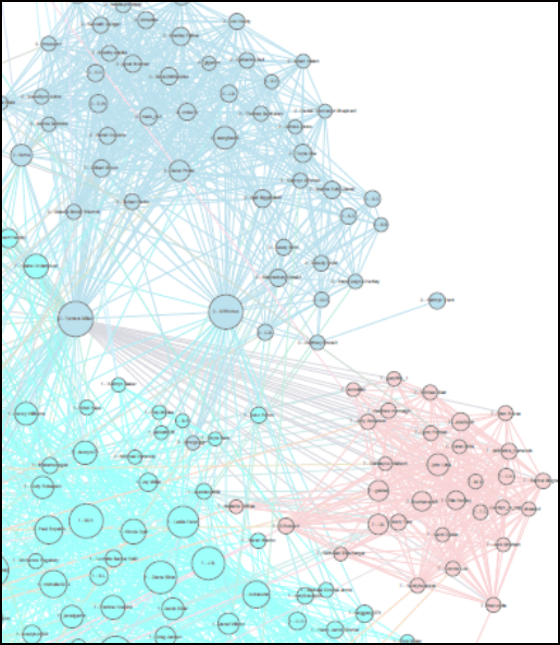
Peach cluster MRCA = Elijah Dillard, Aqua Cluster MRCA = Robert C. Royston (son of Cynthia), Blue Cluster MRCA = Richard A. Royston (son of Cynthia)
DNA Findings and Analysis
The findings section did three things. First, I re-annotated every cluster in Victor’s network graph by its most recent common ancestral couple. Paternal Royston and Dillard matches concentrated in the upper right; Parker and Thomas matches in the lower left. Only the Elijah Dillard cluster reaches further back on the Dillard line.
Second I tested whether that cluster could be explained by some other line of Victor’s. New matches descending from Cynthia’s children Ulysses F. Royston (1837–1863) and Richard A. Royston (1855–1928), plus two more through Sarah (Royston) Parker, all share DNA with the Elijah descendant I’ve labeled Josiah 4. Because those lines converge on Cynthia and not on Victor’s Parker or maternal ancestry, a shared Dillard ancestral couple is the best explanation. The 20 to 29 cM shared amounts sit comfortably within the 3C1R, 3C2R, and 3C3R relationships a sibling connection would predict.
Third, I documented the Y-DNA initiative: candidate male Dillard descendants identified through Elijah’s sons, Josiah and James Monroe; a project page published at FamilyLocket.com to explain the study; and letters sent to six candidates. Testing begins at Y-37 with FamilyTree DNA, joining the Dillard and Dill** Surname Project, with upgrades as warranted.
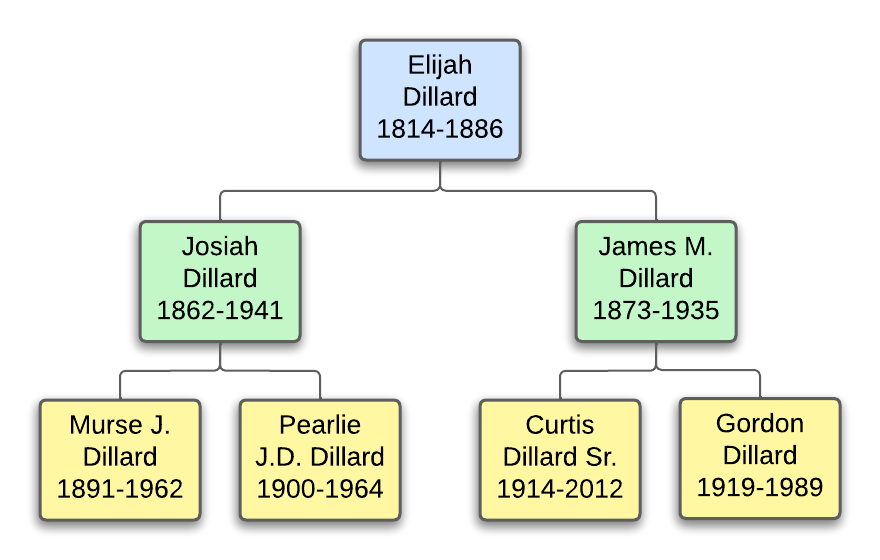
Male descendancy lines of Elijah Dillard with potential Y-DNA testers
Conclusion
The conclusion provides an opportunity to reiterate the preliminary conclusions throughout the report in both the documentary and DNA sections. I used Claude AI again for this section using only my report. The bullet points were very similar to the results summary but did accurately sum up the research. The final paragraph pulls everything together.
Taken together, the documentary and genetic evidence now converge on a single working hypothesis: that Cynthia (Dillard) Royston and Elijah Dillard were siblings, and that their father was possibly a Dillard with a documented presence in Cass County in the early 1830s. Tolliver Dillard of Burke County is the only candidate examined to date who satisfies both conditions and whom no record excludes. The hypothesis remains unproven — no record names Cynthia as his daughter, and the atDNA evidence, while consistent, does not by itself identify the shared ancestral couple. Y-DNA results from a male Dillard descendant of Elijah, compared against the Dillard and Dill** Surname Project, offer the most direct means of testing whether Elijah’s patriline traces to Tolliver’s Burke County family.
Future Research Suggestions
Future research suggestions can include any portions of the research plan that weren’t accomplished as well as new ideas from the findings. I didn’t have time to recruit new autosomal DNA testers on Ancestry, so that will go into future research. I also noted to complete the Y-DNA testing underway, recruit a tester from Tolliver’s proven male line through Tolliver Jr., research Tolliver’s proposed father and brothers, establish Phebe’s identity and death date, and return to phase 4 suggestions to research neighboring county lottery winners.
This project made good progress, and I’m hopeful that the Y-DNA especially will provide some clarity. It’s exciting to have discovered Tolliver Dillard as a possibility for Cynthia’s father. With the record loss in both Burke and Cass counties that could have records connecting them, this could become a case of negative evidence. The DNA will have to add the final proof, however.
Best of luck in all your genealogical research!
Research Report: Cynthia Dillard Father Candidate Phase 5 Report August 2026












2 Comments
Leave your reply.