
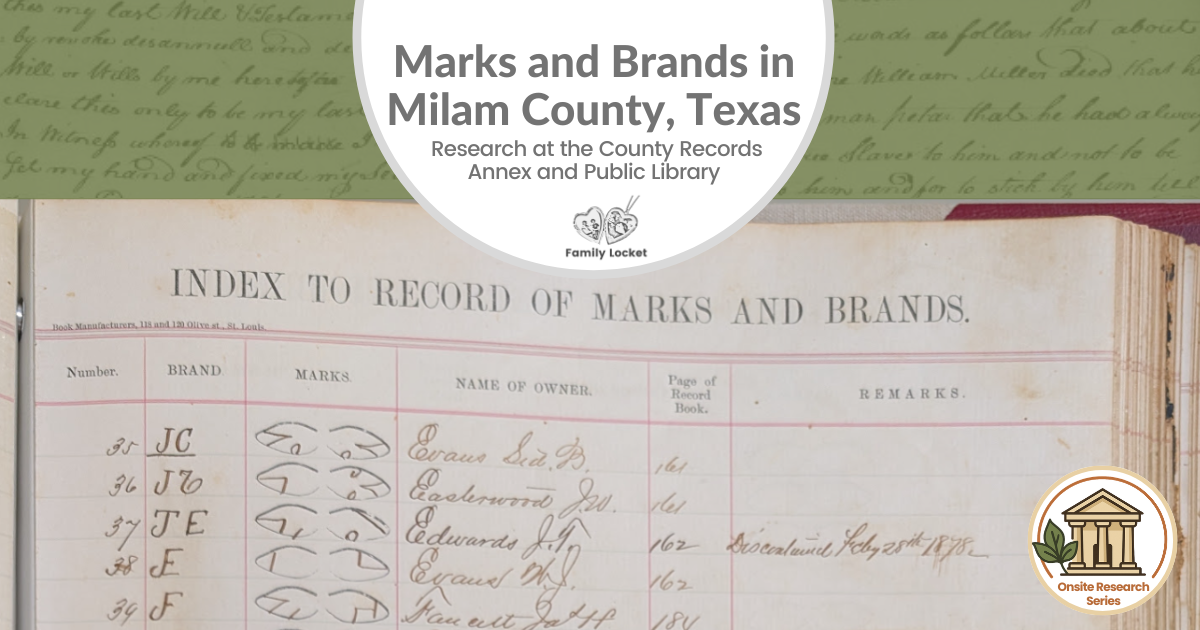
Sometimes during an onsite research trip, the record you want seems just out of reach. That’s what happened when I visited the Milam County records annex in Cameron, Texas, looking for more records about my fourth-great-grandfather. By the end of the day, though, a small-town library in Rockdale had given me exactly what I needed. In this post, I’ll share the story of that day, explain what marks and brands records are and why they mattered to our ancestors.
Claude Opus, an AI assistant, helped write this blog post.
This is the next post in our onsite research series. Read the other posts here:
- Onsite Research: Beyond Digitized Records: explains the onsite research series
- How to Prepare for an Onsite Genealogy Research Trip: explains the kinship determination project and my research objectives
- Treasure Hunt at the Love County Courthouse: Uncovering Land Records: describes my deed research in Love County, Oklahoma
- Love County Tax Records: Research Adventures in an Old Jail: describes my tax record research in the treasurer’s storage room
Why Milam County? Picking Up the Trail of James B. Harris
James B. Harris (1819–1899) is my fourth-great-grandfather on my mother’s father’s side. He is the father of John C. Harris, who became the oldest generation in my Kinship Determination Project (KDP) for BCG certification. As I explained in an earlier post, I originally planned for James to be the top generation of my KDP. When I ran out of time to document all his children, I restructured the project to begin with John. James was still the person I wanted to know better. He was born in Kentucky, and by 1850 he was enumerated in the combined Milam and Williamson County census in Texas, living near a John Harris whom I hypothesize was his father.[1]
Milam County is one of the original counties of the Republic of Texas, created in 1836, and it later gave up territory to several newer counties. Many Milam County deeds are digitized, but I wondered if there were additional records kept by the county clerk that I hadn’t found online.
What Are Marks and Brands, and Why Were They Recorded?
Before I describe the trip, here is some background on what these records are. If you’ve never used one, you’re not alone. I hadn’t paid much attention to marks and brands until I was in the Milam County, Texas, county records annex, and found a Marks and Brands index.
In the days before fences, cattle, horses, and hogs roamed freely across the open range, and settlers needed a way to prove which animals belonged to whom. Texas settlers relied on livestock markings as vital, permanent proof of ownership in an era when cattle freely roamed the open range and theft was a constant threat. To establish a legal claim to their livestock, ranchers applied a brand, which is a unique identifying mark—often made of letters, numbers, or symbols—burned permanently into the animal’s hide. Because earlier Spanish brands were often intricate pictographs that incoming Anglo-American settlers couldn’t read, early Texans developed easily recognizable designs to quickly identify their stock. As a secondary measure, ranchers also used an earmark, defined as a supplementary ownership mark created by cutting a specific shape or design into one or both of the animal’s ears. Together, these officially registered marks allowed cowboys to easily spot their cattle during large roundups and provided the necessary legal evidence to prosecute thieves.[2]
Recording a mark or brand with the county turned it into legal evidence of ownership. Owners registered their marks and brands with the county clerk. Richard H. Chisholm became the first person to register a brand in Texas in 1832, and it was illegal to use or alter someone else’s brand or to use an unregistered one.[3]
The design of a brand had its own vocabulary. No law regulated where a brand was placed, but cowboys customarily branded cattle on the left hip, and brands are read from top to bottom and left to right. A leaning letter is called “tumbling” and a horizontal one “lazy,” and brands could also be “walking,” “running,” or “flying” depending on the extra lines added.[4]
The practice continues today. Texas still requires brands to be re-registered every ten years in each county where the owner operates.[5]
Why Genealogists Should Care
For family historians, marks and brands records are valuable for several reasons:
- They place a person in a county on a specific date. This is especially helpful in the years between censuses or when tax records are missing.
- They often give a residence. The Milam County register includes a column for the owner’s community, which can help you find someone within the county.
- They reveal occupation and economic activity. A registered brand suggests the person owned livestock and was invested in stock raising, and the record may say whether the brand was for cattle, horses, or both.
- They can point to family relationships. Family members sometimes registered similar marks or brands, and brands were sometimes transferred to heirs or buyers. In Matagorda County, for example, Greenbury Savage and Isabell Savage registered identical marks on 23 May 1857.[6]
- They are often undigitized. Many brand books remain only at county offices or on microfilm, which makes them a great target for onsite research.
Arriving in Cameron
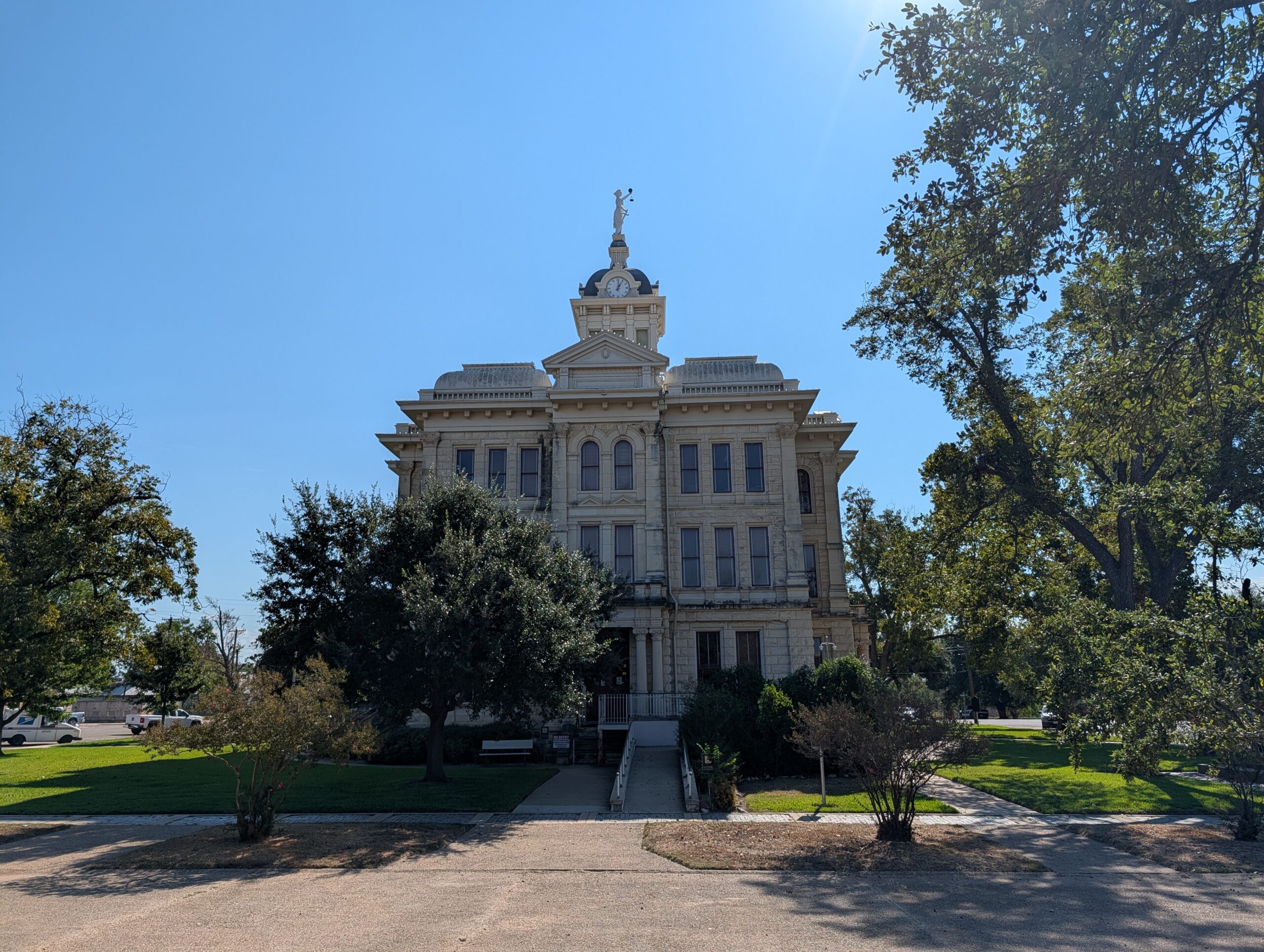 The historic Milam County Courthouse in Cameron, Texas.
My first stop was Cameron, the county seat. The Milam County Courthouse is a beautiful limestone building on the square, topped by a clock tower and a statue of Lady Justice. It was fun to stand outside and imagine James B. Harris coming to town on county business. If you go, though, don’t expect to research there. The county clerk’s office and its records have moved to a county annex nearby, at 107 W Main St in Cameron, open Monday through Friday, 8:00 am to 5:00 pm.[7] This was a good reminder of a tip from my preparation post: always call ahead and confirm where the records are kept, not just the hours. A county’s courthouse and its records aren’t always in the same building.
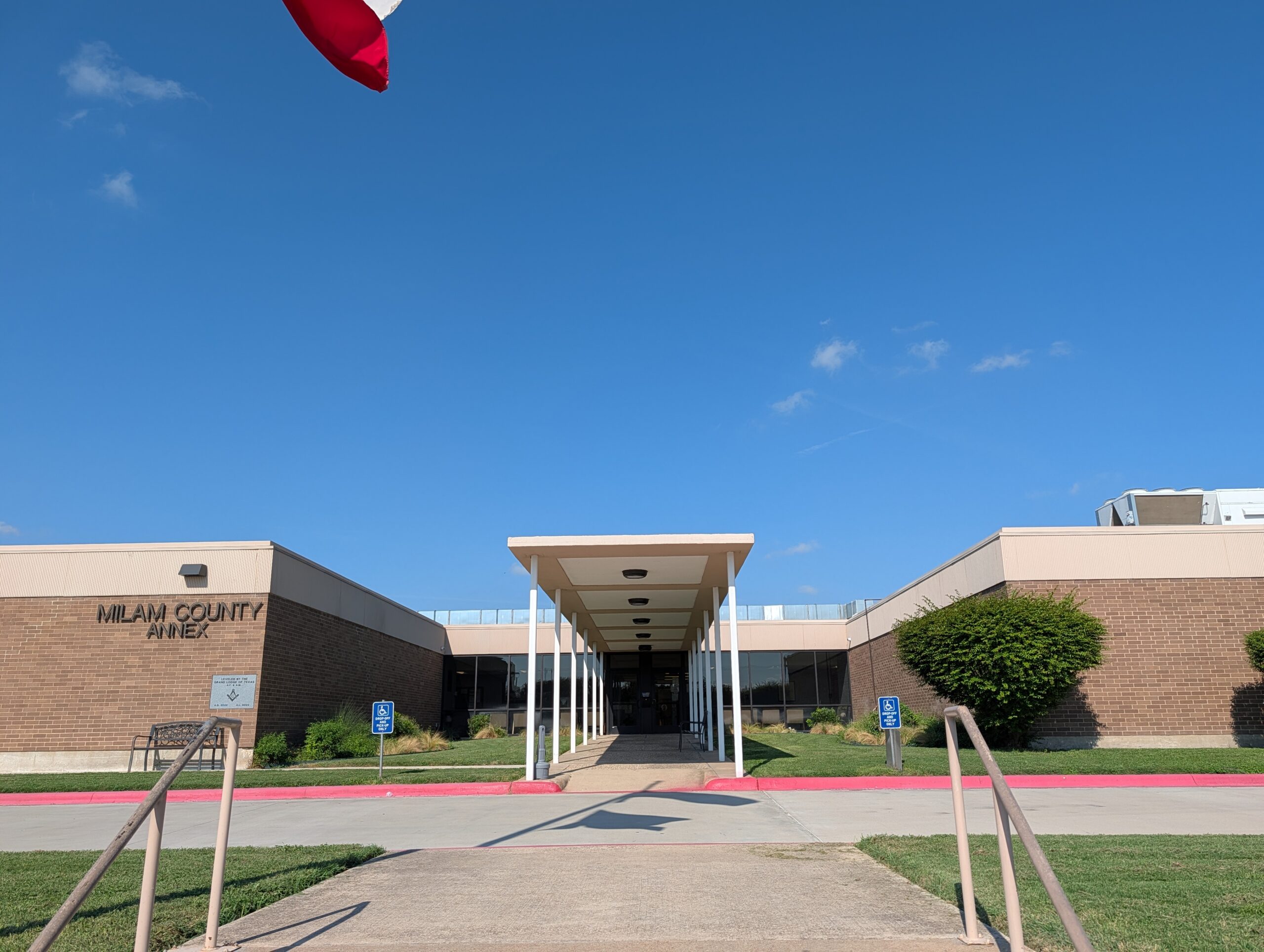
Milam County Annex
The Index to Marks and Brands
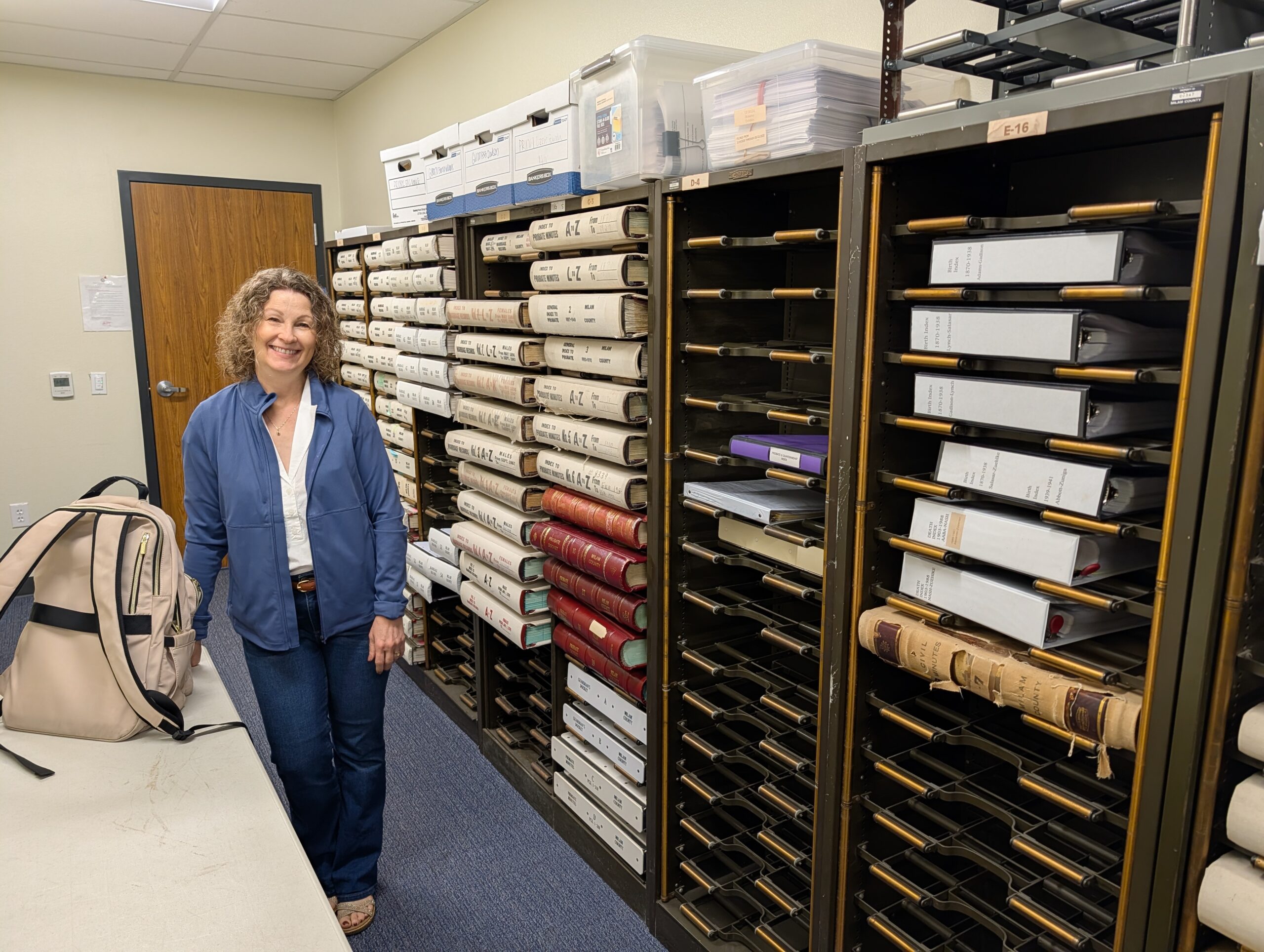
Mom in the public research room of the clerk’s office
At the annex, I introduced myself to one of the women working in the clerk’s office and told her I was hoping to research about my ancestors. She let Mom and I into the public research room and let us peruse the index volumes and other volumes in the room. There were deed indexes, marriages, commissioner’s minutes, and more. Then I saw the index to marks and brands and got excited!
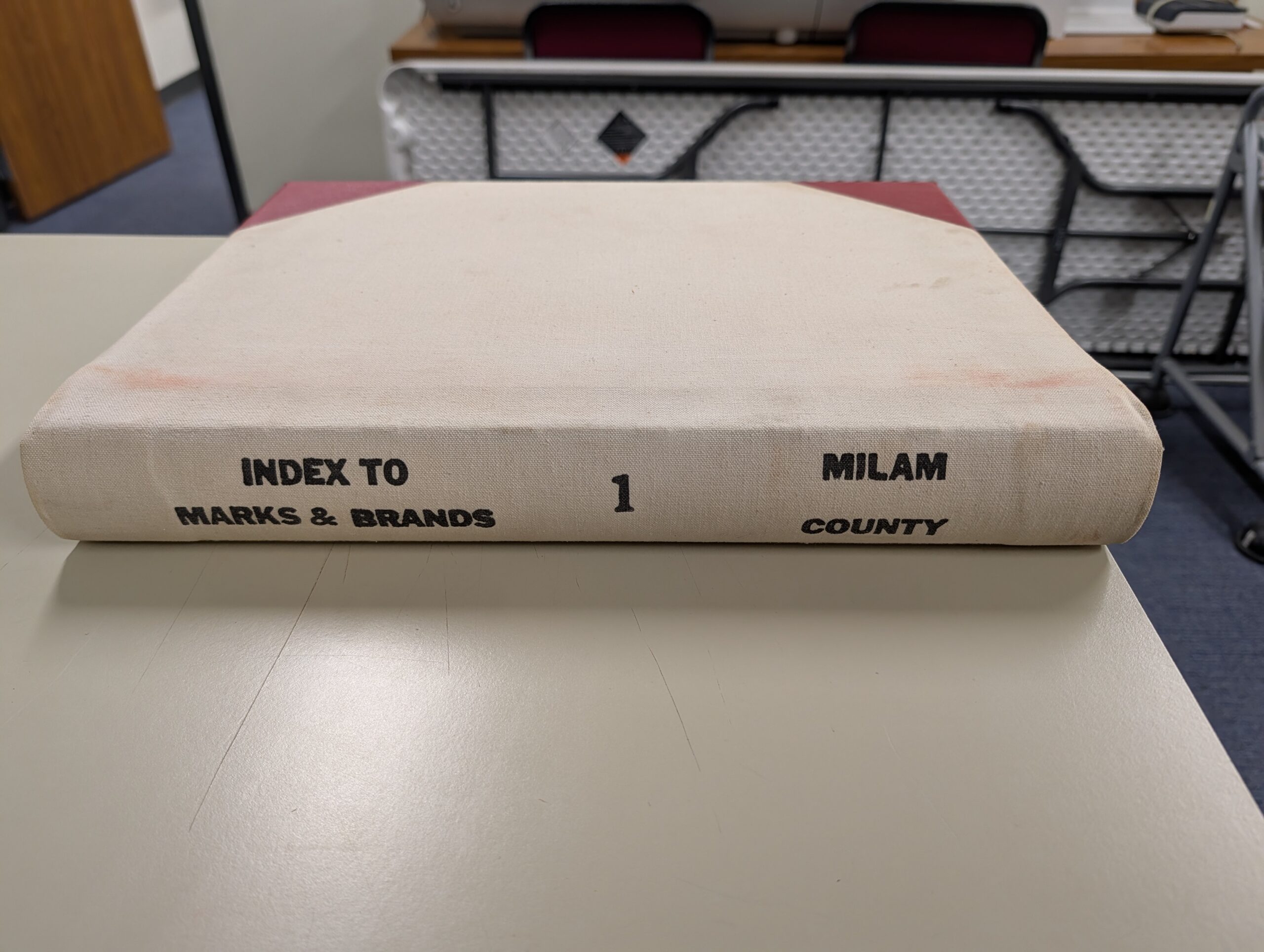 Index to Marks & Brands, volume 1, at the Milam County Clerk’s annex.
This was a new record type to me, and I new the Harris family owned cattle.
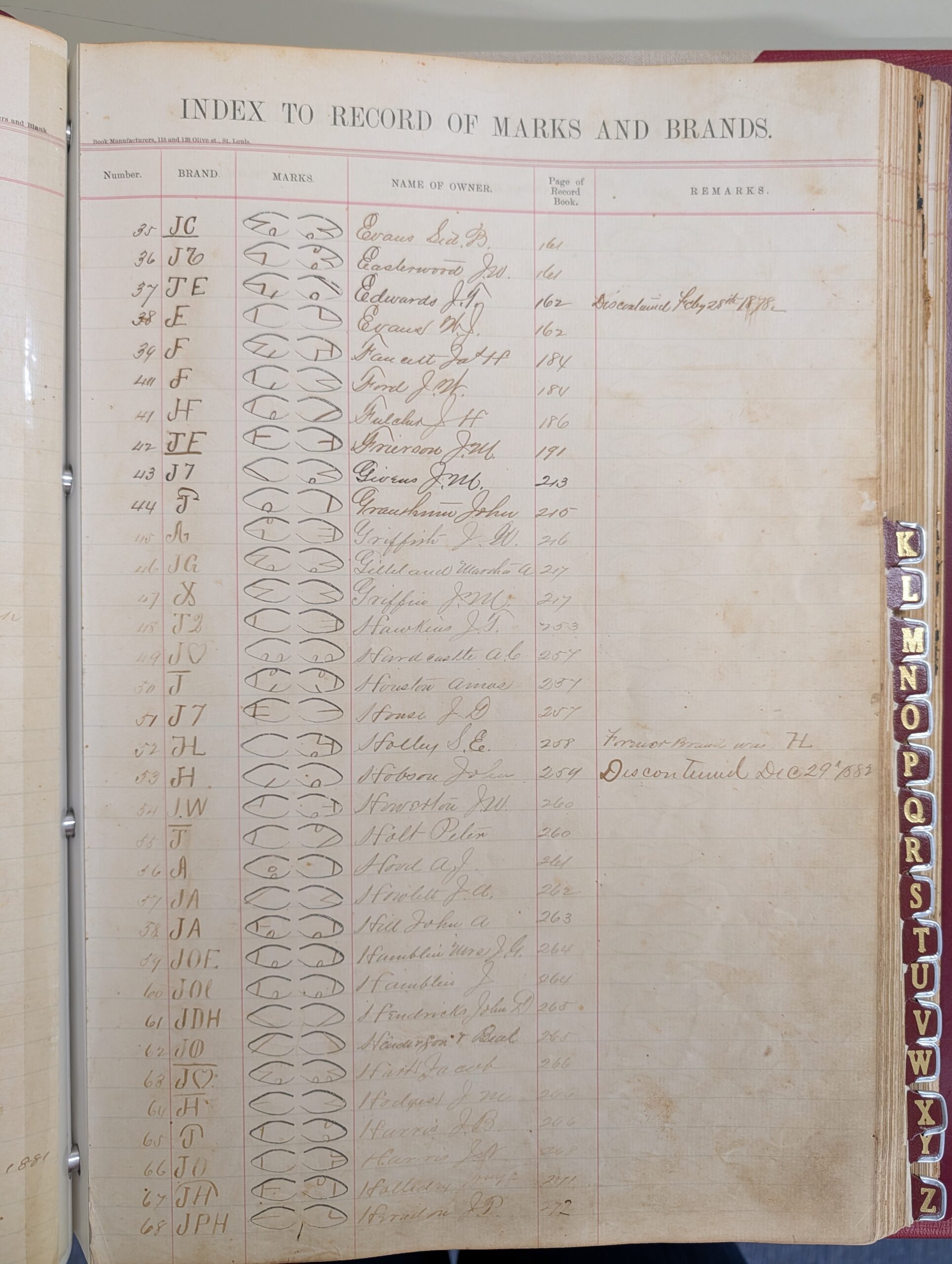
A page from the “Index to Record of Marks and Brands,” Milam County, vol. 1.
The index was a volume alphabetized but the beginning letter of the brand. Each page was a printed form with columns for the number, a drawing of the brand, a drawing of the ear marks, the name of the owner, the page of the record book, and remarks. Instead of simply listing owners alphabetically, the index seemed to be organized by the brand itself. In the J section, every brand on the page began with the letter J, and within that section the owners were listed roughly in alphabetical order by surname: Evans, Easterwood, Edwards, Fawcett, Ford, Gierson, Givens, and so on. Lettered tabs ran down the right edge of the book. When I looked for James B. Harris in the ‘H’ section, he wasn’t there. I got lucky by trying the J section, corresponding to his first initial.
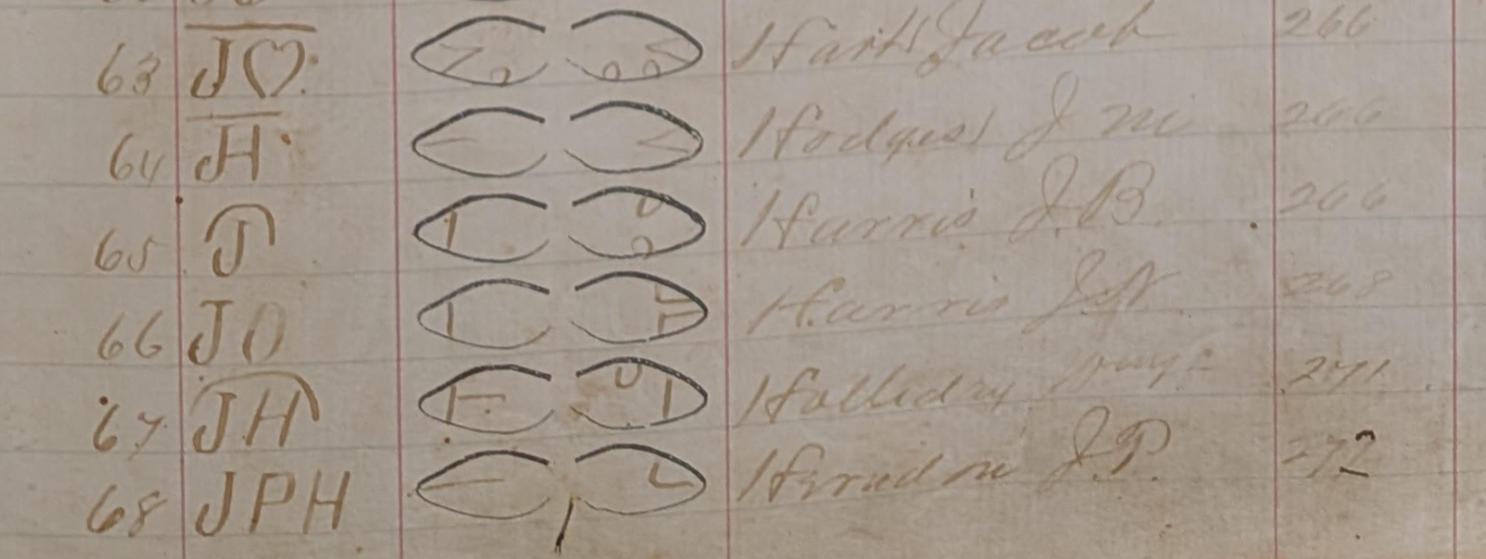
Entry 65, J.B. Harris, with his brand and ear marks, referencing page 266 of the record book.
And there he was: entry number 65, “Harris J.B.,” with a reference to page 266 of the record book.[8] The drawing of his brand looks like a J beneath a curved arc. The drawing of his ear marks shows a cut at the tip of the left ear and a two notches in the right ear. Just below him was entry 66, J.N. Harris, with a “JO” brand recorded on page 268. Of course I wondered whether he might be a relative, but I don’t think it is.
The index was exciting, but it was only a pointer. I wanted to see the actual record, with the date, the owner’s residence, and the full written description. I asked whether I could see volume 1 of the record book. Unfortunately, she wasn’t able to locate it, or perhaps it wasn’t practical for her to retrieve it that day. I’m not sure which. Older volumes are sometimes stored off-site or in an area staff can’t easily reach during a busy workday. I photographed the index page, thanked her, and tried to be content with what I’d found. Still, I left the annex a little disappointed.
Looking back, I think a phone call a few days earlier, asking specifically whether volume 1 of the marks and brands record was available, might have given the staff time to locate it before I arrived. This is the same lesson I learned in Kentucky. A request that seems simple to us may require advance notice for staff.
A Detour to Rockdale and a Microfilm Surprise
Later that day we drove to Rockdale, in the southern part of Milam County, and stopped at the Patterson Memorial Library, which houses the Milam County Genealogical Society’s research center.
Mom and I at the library
I mostly wanted to see what local history resources they had. As I looked through their microfilm, I discovered a box of Milam County marks and brands.
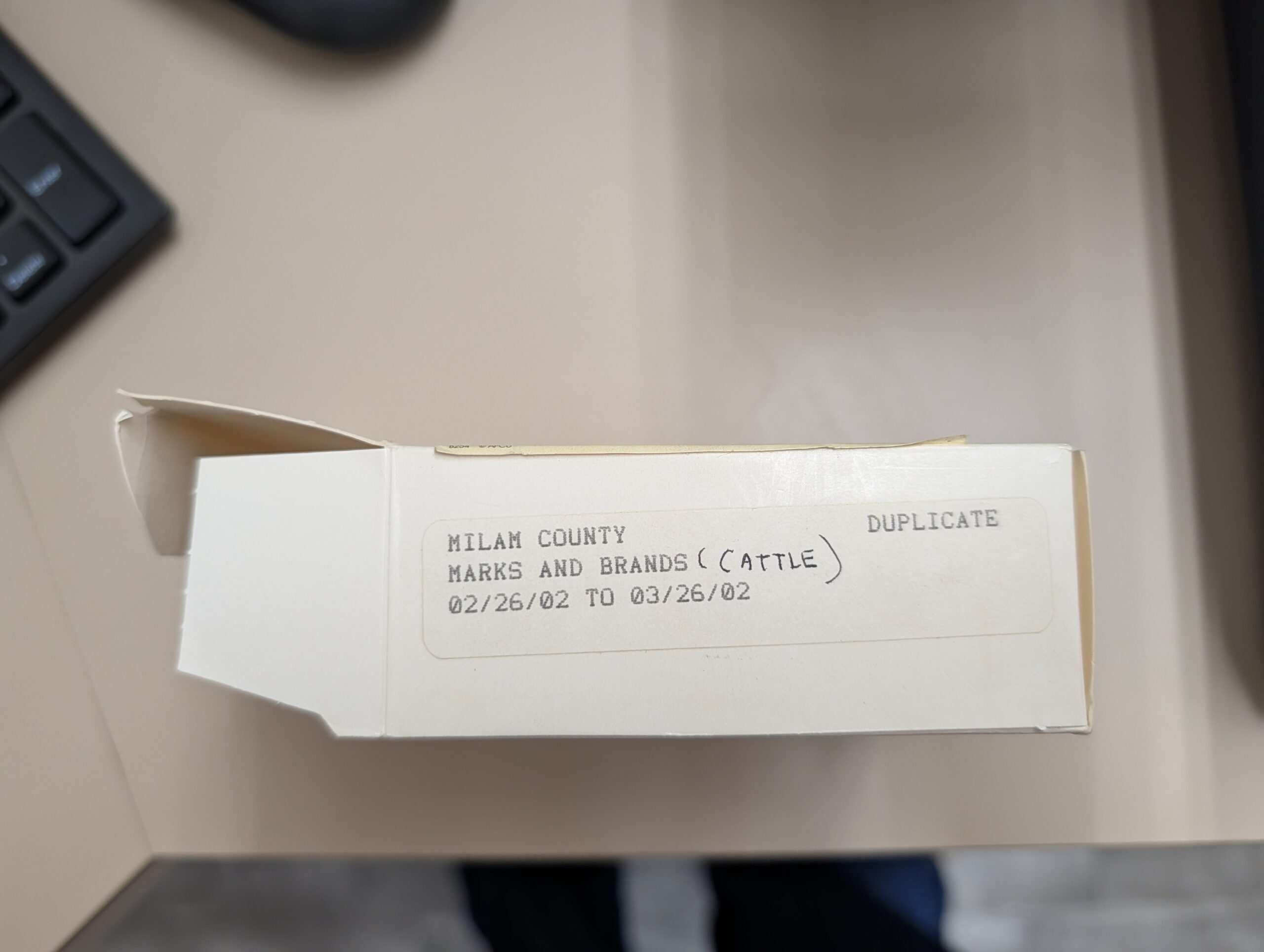
Microfilm box: Milam County Marks and Brands (Cattle), Patterson Memorial Library.
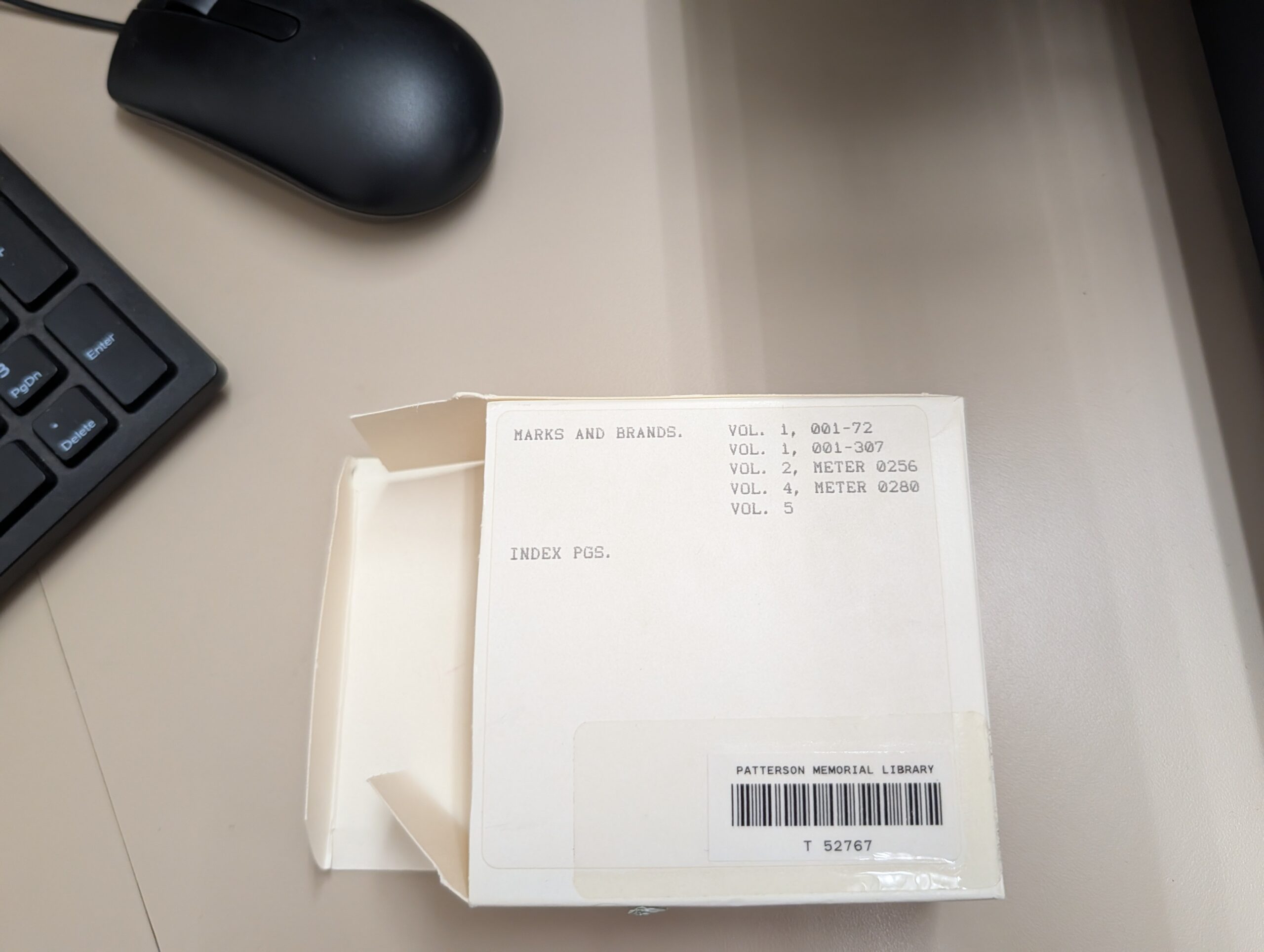
Microfilm box listing the volumes on the reel, call number T 52767.
The box was labeled “Milam County Marks and Brands (Cattle),” with filming dates of 26 February to 26 March 2002. The side of the box listed the library’s barcode T 52767, and listed its contents as “Marks and Brands. Vol. 1, 001-72; Vol. 1, 001-307; Vol. 2, Meter 0256; Vol. 4, Meter 0280; Vol. 5; Index Pgs.” Volume 1 was right there on the film!
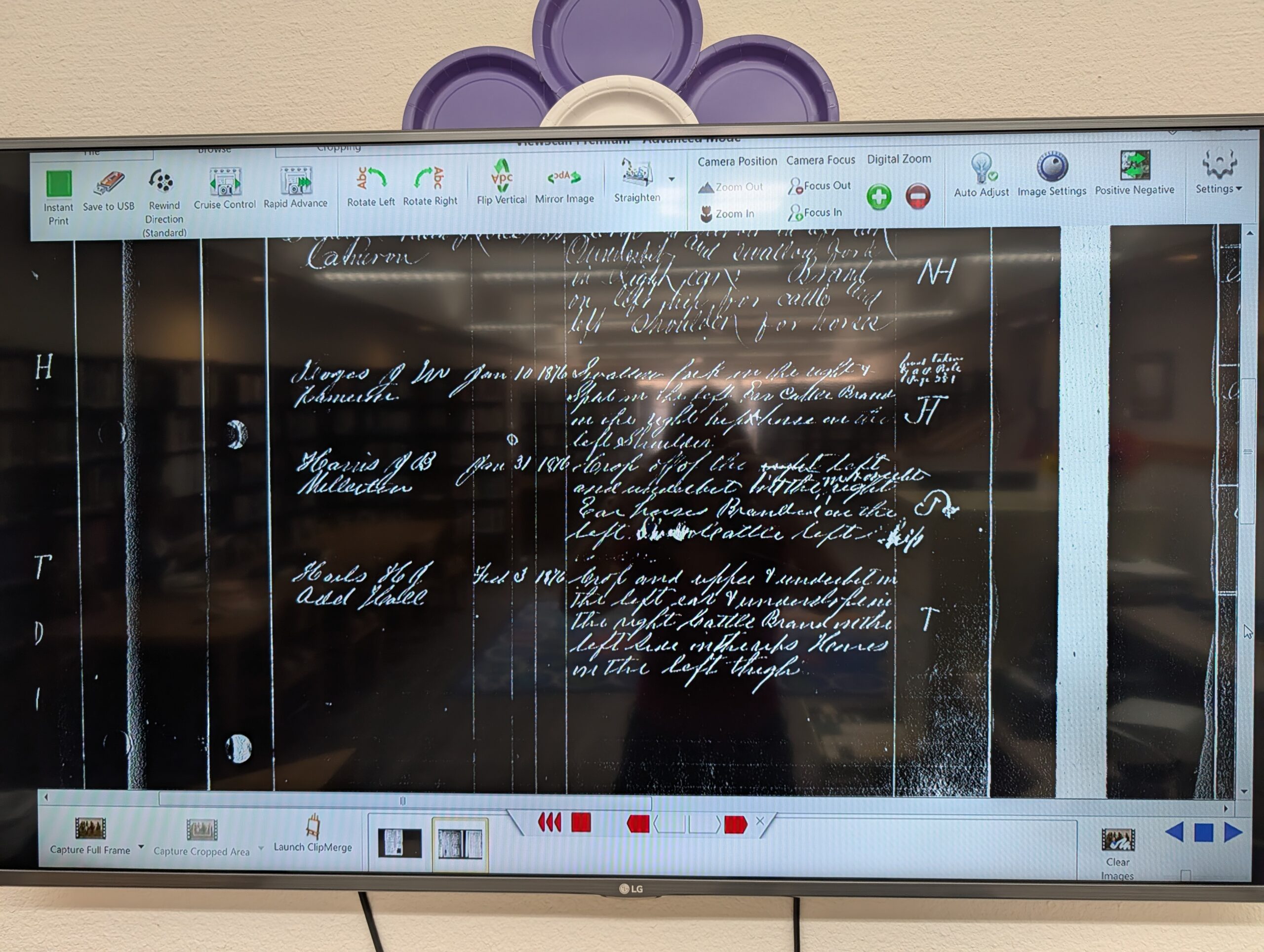
J.B. Harris’s brand record, vol. 1, p. 266, on the library’s microfilm reader.
I loaded the film into the library’s digital microfilm reader, which displayed the images on a large wall-mounted screen, and advanced to page 266. Sure enough, there was the entry for J.B. Harris, recorded on 31 January 1876.[9] I saved the scan to my mom’s jump drive (because I wasn’t prepared with my own). Here is my transcription of the entry:
Harris J B | Millerton | Jan 31 1876 | Crop off of the right left and underbit [in?] the right [interlined illegible text] Ear horses Branded on the left Shoulder Cattle left hip. | [brand drawing – J with curved line over it]
The clerk seems to have corrected the ear description as he wrote, crossing off right and writing left, then interlining some text (which I couldn’t read).
After not being able to view volume 1 of the marks and brands records at the county clerk’s office that morning, finding the record later at the public library was a delight. It was also a lesson in looking beyond the county office. Libraries, genealogical societies, and historical societies sometimes hold microfilmed copies of county records. These copies are often more accessible than the originals, especially for early volumes that are fragile or stored away.
What the Brand Tells Us About James B. Harris
J.B. Harris’s residence in the marks and brands register was Millerton. When I got home, I turned to the 1870 census, to see if it correlated with this location. Six years before he registered his brand, James Harris, age fifty and born in Kentucky, was enumerated in Milam County with a post office of Millerton.[10] The match gave me confidence that the J.B. Harris in the brands book was my James B. Harris. I haven’t seen records in Milam County that imply there were two J.B. Harrises.
The census also gives a picture of James’s household and finances just a few years before the brand was recorded. He was listed as a farmer with real estate valued at $350 and a personal estate valued at $300. Living with him were Matha Harris, age 48, his wife, and William (22), James (14), Samuel (13), Martha (8), Louisa (7), and Hannah. My ancestor John C. Harris, born in 1846, had already left home by 1870, so he doesn’t appear in this household.
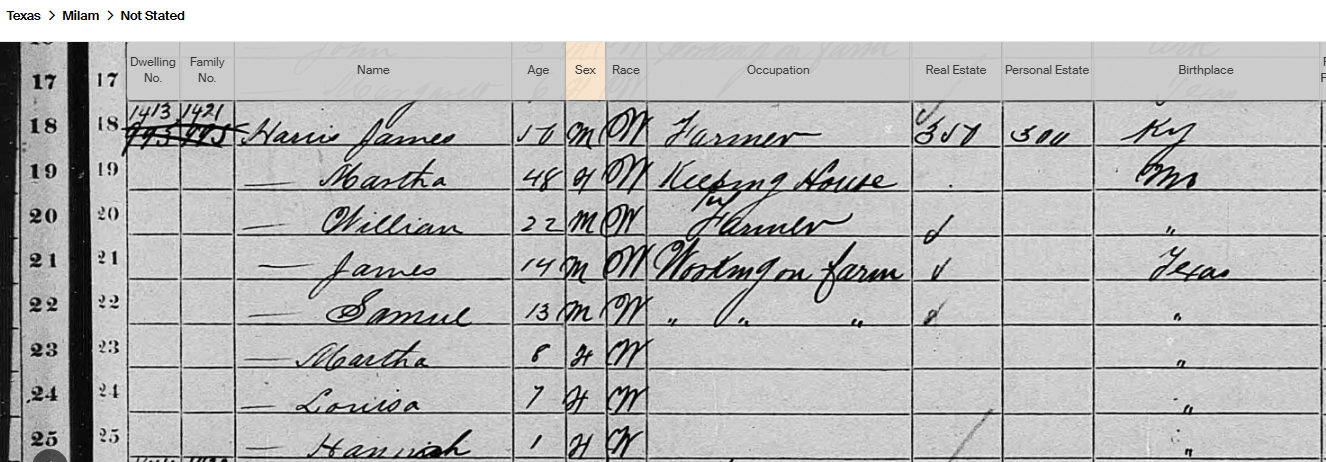
Ancestry image for James Harris in the 1870 census of Milam County, Texas.
Correlation with Tax Records
I did quite a bit of tax research on James B. Harris in preparation for writing my KDP. Tax rolls document James B. Harris’s fortunes in Milam County across nearly four decades. He first appeared in 1854 as a landless taxpayer who paid only a poll tax and small state and county taxes,[11] just months after claiming his preemption right. By 1855 he was taxed on 320 acres worth $190, which he held by preemption as the original grantee, though he owned no taxable personal property. The next year, his land was described as lying on the First Yegua Creek.[12] In 1857, the year his patent was issued, James was assessed for the same 320 acres along with four horses and a yoke of oxen, for a total value of $370.[13]
James B. Harris does not appear on the county rolls from 1858 through 1865,[14] but Confederate records show he was still farming in Milam County during the Civil War. In August 1864, James Harris delivered 46 pounds of bacon to the tax-in-kind depot, and on 1 January 1865, J.B. Harris was named among the county’s delinquent taxpayers, owing $72 in bacon.[15]
After the war, James was taxed in 1866 on 300 acres from the J.E. Smith survey, valued at $200, along with five horses and fifteen cattle.[16] His property peaked in 1870 and 1871, when his 245 acres were valued at $1,225 and his total assessment, including six horses and twenty-five cattle, reached $1,505.[17] Through the rest of the decade his acreage shrank—to 200 acres in 1873, 115 acres from 1874 to 1876, and 157 acres in 1877—while he kept a modest stock of horses, cattle, and hogs. In 1876, when he registered his mark and brand, he was taxed for 25 cattle. This volume was likely created in 1876 due to the courthouse fire of 1874. The fire probably destroyed the county’s earlier volumes of marks and brands.
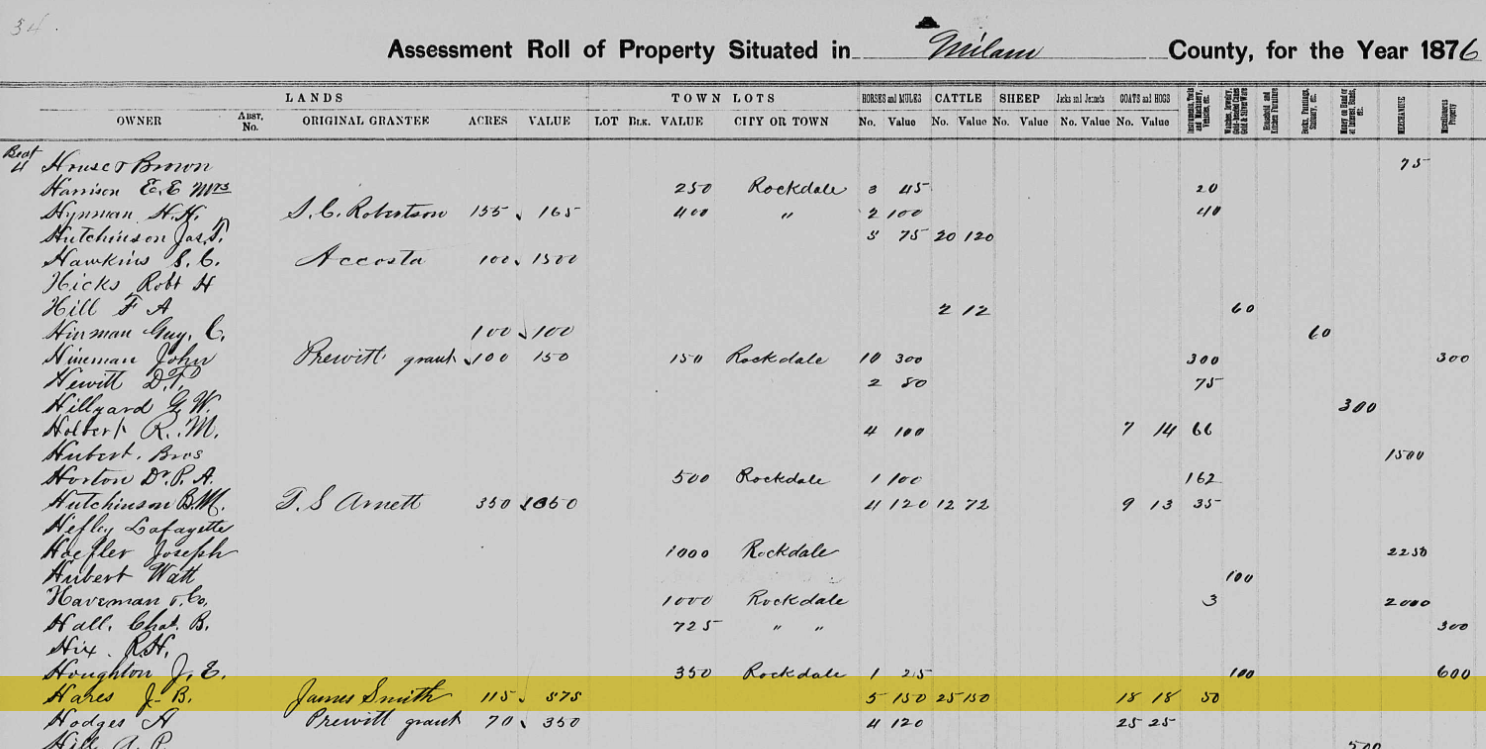
In 1874, his sons J.C. and B.F. Harris were listed on the lines directly below him.[18] By 1879, James owned no land and was taxed only on two horses or mules worth $40,[19] consistent with his move to San Saba County by 1880, where I found evidence of him being taxed a couple times in the early 1880s.
J.B. Harris was again taxed in Beat 4 of Milam County in 1887 and 1890, the last time on just one horse, two cattle, and two hogs,[20] suggesting James and Martha had returned to Milam County, where Martha died in 1890, and was buried in Salty Cemetery.[21]
It was fascinating to correlate the marks and brands reigster with census and tax records showing James B. Harris’s occupation as a cattleman. I asked AI to summarize James’ fortunes based on what I wrote in my KDP, and here’s the result:
James B. Harris’s story in the 1870s is less about losing everything than about deciding to let go. After the Civil War he bought 300 acres in southwestern Milam County, and by 1870 he was running a thriving farm that produced 1,000 bushels of corn and five bales of cotton, with his sons working beside him. Then the railroad arrived in 1874 and the town of Rockdale sprang up next to his land. Between 1873 and 1878, James sold the property piece by piece for roughly $2,900, about $12 to $13 an acre at a time when Texas land averaged less than $3. Yet by 1880, at about sixty, he and Martha had moved west to the rough frontier of San Saba County. He was nursing a weak back, Martha was ill, and only two young daughters were still at home. Whatever cash the land sales brought didn’t last. When the couple returned to Milam County later in the decade, James was taxed on just $75 in personal property, and by 1890 only a horse, two cattle, and two hogs. The national depression after the Panic of 1873, the loss of his sons’ labor on the farm, failing health, and the hardships of frontier life all likely played a part. Exactly where the money went remains one of the questions his records haven’t yet answered.
It was neat to discover his cattle marks and brands during my research trip! I also discovered a survey of his land from the 1850s in the county clerk’s office, which I’ll share about in a future post.
Tips and Takeaways
Before Your Visit
- Confirm where the records are kept. In Milam County, the clerk’s records are in an annex, not in the historic courthouse. Many Texas counties have made similar moves.
- Ask for specific volumes in advance. If you need an early or fragile volume, call ahead and ask whether staff can retrieve it for your visit.
- Check for copies elsewhere. Search the FamilySearch catalog, local libraries, and genealogical societies for microfilm, transcriptions, or abstracts of the records you need.
- Learn the record type. Knowing how marks and brands were recorded and described helps you read and interpret them quickly onsite.
- Bring a jump drive. You never know when you might need to save an image to it!
During Your Research
- Photograph the index entry and the book’s spine. Even if you can’t see the original record, the index documents that the record exists and tells you where to find it later.
- Learn how the index is organized. Marks and brands indexes may be arranged by brand design rather than by surname. Ask staff if the arrangement isn’t obvious.
- Don’t assume a shared surname means kinship. Research same-name individuals in the county before connecting them to your family. A quick look at the J.N. Harris households showed they weren’t part of my family.
- Be gracious when things don’t work out. Clerk’s offices are busy with current business. A friendly, appreciative approach keeps the door open for future requests.
- Stay open to detours. My best find of the day came from a library visit I almost didn’t make.
Documentation and Follow-up
- Photograph the microfilm box. The box labels gave me the library’s call number, the volumes on the reel, and the filming dates, which I needed for my source citation.
- Cite the version you actually used. If you viewed a microfilm copy, your citation should say so.
- Record what you couldn’t access. Note that volume 1 was not available at the annex on the date of your visit. That way you’ll know why you used the microfilm copy, and future researchers will too.
- Transcribe carefully, including corrections. Strike-throughs and insertions in the original are part of the record. Note them in your transcription rather than silently fixing them.
- Use other records to correlate data. The 1870 census and tax records helped build the identity of James B. Harris.
Have you found an ancestor’s brand or ear mark? I’d love to hear about it in the comments below!
[1]1850 U.S. census, Williamson County, Texas, population schedule, Milam and Williamson, p. 335b, dwelling 78, family 87, James Harriss household; database with images, Ancestry (https://www.ancestry.com/discoveryui-content/view/1091019:8054 : accessed 18 July 2025). See also p. 336b, dwelling 93, family 103, John Harris household.
[2] David Dary, “The History and Significance of Cattle Branding in Texas,” Handbook of Texas, Texas State Historical Association (https://www.tshaonline.org/handbook/entries/cattle-brands : accessed 11 October 2026).
[3] Ibid.
[4] Ibid.
[5]“Texas Brand Registration,” Texas and Southwestern Cattle Raisers Association (https://tscra.org/?p=118626 : accessed 11 October 2026).
[6]“Matagorda County, Texas Brands and Marks 401–500,” Matagorda County TXGenWeb (https://usgenwebsites.org/TXMatagorda/brands/brands401-500.htm : accessed 11 October 2026).
[7]“Milam County Clerk – County Annex,” Deeds.com (https://www.deeds.com/recorder/texas/milam/ : accessed 11 October 2026).
[8] Milam County, Texas, Index to Record of Marks and Brands, vol. 1, no. 65, J.B. Harris, referencing record book p. 266; County Clerk’s Office, County Annex, Cameron.
[9]Milam County, Texas, Record of Marks and Brands, vol. 1: 266, J.B. Harris, 31 January 1876; microfilm T 52767, Patterson Memorial Library, Rockdale, Texas.
[10] 1870 U.S. census, Milam County, Texas, population schedule, p. 310A, dwelling 1413, family 1421, James Harris; database with images, Ancestry (https://www.ancestry.com/discoveryui-content/view/14558780:7163 : accessed 25 April 2024); citing NARA microfilm publication M593, roll 1598.
[11] Milam County, Texas, Tax Roll, 1854, p. 5, tax payer no. [blank], James B. Harris; image, FamilySearch (https://www.familysearch.org/ark:/61903/3:1:939J-419X-YL : accessed 20 December 2024).
[12] Milam County, Texas, Tax Roll, 1855, p. 4, line 9, tax payer no. [illegible], James B. Harris; image, FamilySearch (https://www.familysearch.org/ark:/61903/3:1:939J-419X-D9 : accessed 20 December 2024). Milam County, Texas, Tax Roll, 1856, p. 5, tax payer no. 70, James B. Harris; image, FamilySearch (https://www.familysearch.org/ark:/61903/3:1:939J-419F-N2 : accessed 20 December 2024).
[13] Milam County, Texas, Tax Roll, 1857, p. 5, tax payer no. 77, James B. Harris; image, FamilySearch (https://www.familysearch.org/ark:/61903/3:1:939J-419X-JS : accessed 20 December 2024).
[14] Milam County, Texas, Tax Rolls, 1858–1865, negative searches for James B. Harris; images, “Texas, County Tax Rolls, 1837-1910,” FamilySearch (https://www.familysearch.org/search/collection/1827575 : accessed 20 December 2024).
[15] Texas Adjutant General’s Department, Confederate Tax-in-Kind Records, Depot No. 4, 2nd Congressional District, Milam County, Texas, Report of Articles Received, August 1864, p. 2, James Harris; and Report of Delinquent Tax Payers Residing in Milam County, 1 January 1865, p. 104, J.B. Harris; image copies printed in Lynna Kay Shuffield, Milam County Texas: Index to the Tax-in-Kind, 1864-1865 (Houston: Lynna Kay Shuffield, 2007), 34 and 7; image copy, FamilySearch Books (https://www.familysearch.org/library/books/viewer/133027/ : accessed 29 December 2024).
[16] Milam County, Texas, Tax Roll, 1866, p. 15, J.B. Harris; image, FamilySearch (https://www.familysearch.org/ark:/61903/3:1:939J-4198-YY : accessed 19 December 2024).
[17] Milam County, Texas, Tax Roll, 1870, p. 16, J.B. Harris; image, FamilySearch (https://www.familysearch.org/ark:/61903/3:1:939J-419Z-DS : accessed 5 November 2024). Milam County, Texas, Tax Roll, 1871, p. 25, J.B. Harris; image, FamilySearch (https://www.familysearch.org/ark:/61903/3:1:939J-419Z-15 : accessed 5 November 2024).
[18] Milam County, Texas, Tax Roll, 1873, p. 34, J.B. Harris, abstr. no. 263; image, FamilySearch (https://www.familysearch.org/ark:/61903/3:1:939J-419L-KW : accessed 5 November 2024). Milam County, Texas, Tax Roll, 1874, p. 27, J.B. Harris, abstr. no. 263; image, FamilySearch (https://www.familysearch.org/ark:/61903/3:1:939J-419L-7Y : accessed 18 December 2024). Milam County, Texas, Tax Roll, 1875, p. 31, Beat 4, J.B. Harris, abstr. no. 263; image, FamilySearch (https://www.familysearch.org/ark:/61903/3:1:939J-4192-T3 : accessed 18 December 2024). Milam County, Texas, Tax Roll, 1876, p. 34, Beat 4, J.B. Hares; image, FamilySearch (https://www.familysearch.org/ark:/61903/3:1:939J-419K-F6 : accessed 18 December 2024). Milam County, Texas, Tax Roll, 1877, p. 49, J.B. Harris; image, FamilySearch (https://www.familysearch.org/ark:/61903/3:1:3Q9M-C3SR-D3TY-T : accessed 29 December 2024).
[19] Milam County, Texas, Tax Roll, 1879, p. 55, Beat 4, J.B. Harris; image, FamilySearch (https://www.familysearch.org/ark:/61903/3:1:3Q9M-C3SR-D3TN-G : accessed 29 December 2024).
[20] Milam County, Texas, Tax Roll, 1887, p. 59, Beat 4, J.B. Harris; image, FamilySearch (https://www.familysearch.org/ark:/61903/3:1:939J-4PS2-7F : accessed 3 November 2024). Milam County, Texas, Tax Roll, 1890, p. 77, Beat 4, J.B. Harris; image, FamilySearch (https://www.familysearch.org/ark:/61903/3:1:3Q9M-C3S5-YSW1 : accessed 29 December 2024).
[21] Find a Grave, database and images (https://www.findagrave.com/memorial/58236576/martha-harris: accessed 11 Oct 2026), memorial page for Martha Hooser Harris (20 Dec 1821–5 Nov 1890), Find a Grave Memorial ID 58236576, citing Salty Cemetery, Salty, Milam County, Texas, USA; Maintained by Stanley W. Hibdon (contributor 47130385).










Leave a Reply
Thanks for the note!