
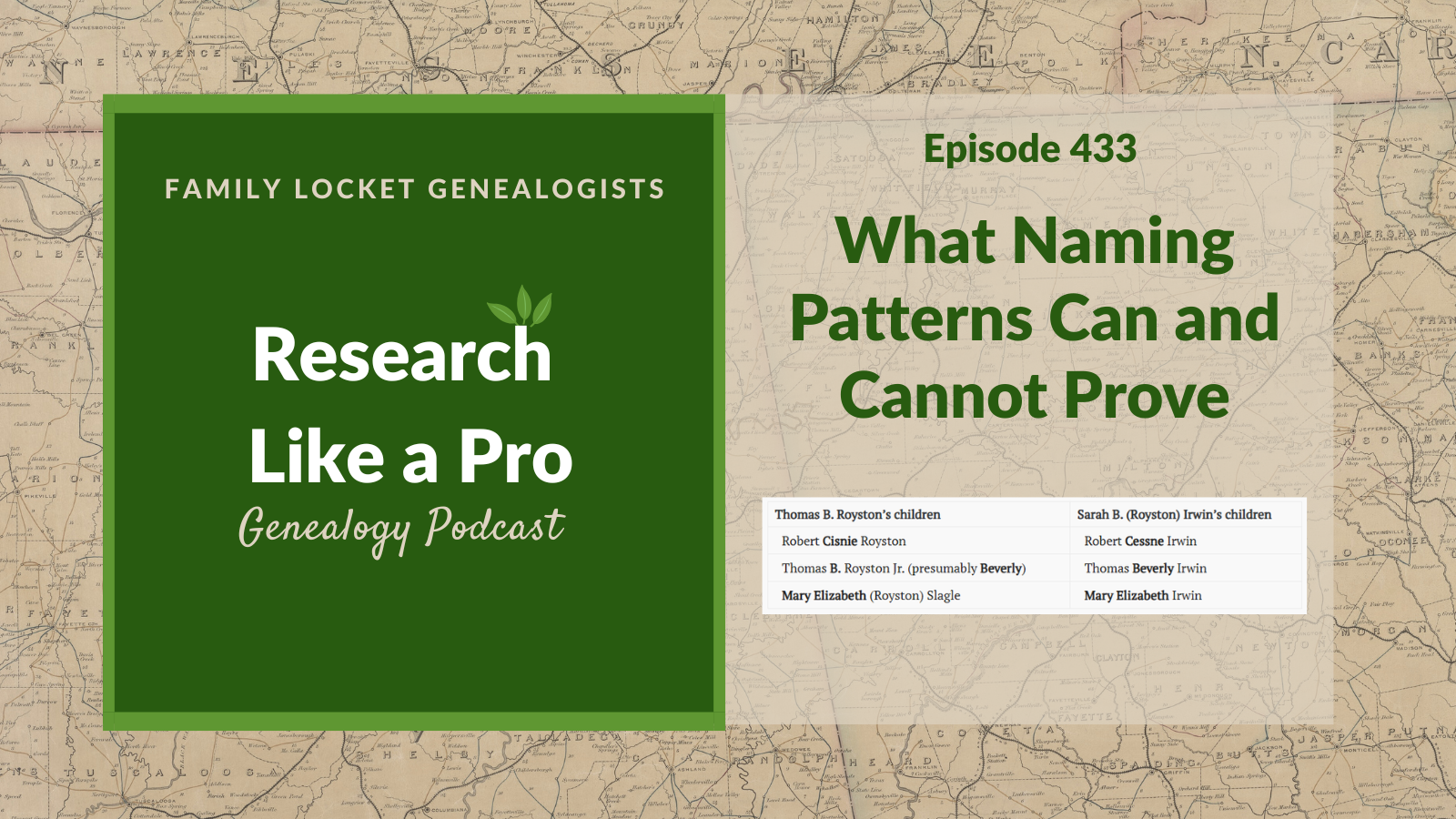
Diana and Nicole examine how ancestral naming patterns serve as crucial supporting evidence in genealogical research. Focusing on the Royston line, they analyze two 1850 households in Alabama and Georgia—headed by Thomas B. Royston and Sarah B. Royston Irwin—where both families independently gave their children matching first and middle names, including Robert Cisnie and Cessne, Thomas Beverly, and Mary Elizabeth. They explain how uncommon middle names derived from the Cessna surname carry significant evidentiary weight by revealing family connections and sentiment, whereas common first names provide little proof on their own.
Listeners learn five practical tips for applying naming patterns to their own research: building a solid documentary case first, weighting surname middle names heavily while discounting common first names, chasing initials across alternative records, recording exact spelling variants, and accounting for names that do not fit the pattern. Through this case study, Diana and Nicole demonstrate how naming evidence helps confirm kinship when combined with thorough record correlation.
This summary was generated by Google Gemini.
Transcript
Nicole (1s):
This is Research Like a Pro, Episode 433: What Naming Patterns Can and Cannot Prove. Welcome to Research Like a Pro a Genealogy Podcast about taking your research to the next level, hosted by Nicole Dyer and Diana Elder accredited genealogy professional. Diana and Nicole are the mother-daughter team at FamilyLocket.com and the authors of Research Like a Pro A Genealogist’s Guide. With Robin Wirthlin they also co-authored the companion volume, Research Like a Pro with DNA. Join Diana and Nicole as they discuss how to stay organized, make progress in their research and solve difficult cases. Let’s go.
Nicole (40s):
Today’s episode is sponsored by Newspapers.com. Hello everyone and welcome to Research Like a Pro.
Diana (47s):
Hi Nicole. How are you doing today?
Nicole (49s):
Hi Mom, I’m doing well and we just had such a fun conference at APG. Did you have a good time?
Diana (57s):
Yes, I did. I enjoyed doing the panel discussion on courses with Jan Joyce and Angela Packer McGhie and Sue McNelly. So they were all good friends and colleagues and it was so fun to talk about how we each do different types of courses and give tips and ideas for other people who want to also try to do some courses that they can market.
Nicole (1m 18s):
I love that. It’s so fun. When we were talking about ideas for the APG conference and what to propose, I just thought this would be fun to do a panel. So I’m glad you did a panel, too. The podcasting panel was really fun. There were four of us, Andrew Cook from Family Tree Magazine and they have a podcast, and Drew Smith from the Genealogy Guys, and Mark Thompson from the Family History AI Show. And it was so fun to talk about how we all set up our shows and you know, what it’s like and what technology we use and then how we find content and make it a community and just all the different things, and everyone had so many unique ideas, so many similar ideas. So it was fun to see, you know, the ways that we have done our podcasts. And then the overarching message of our panel was anyone can start a podcast and everyone in the genealogy space who’s doing different areas of research or different specialties, they have something to share and to offer.
Nicole (2m 12s):
And so if you’re thinking about starting a podcast, you should, it’s a fun way to share your expertise and get your voice heard and carve out a niche for yourself.
Diana (2m 21s):
Absolutely. Well I know when I was doing a research project a few years ago and it was going down into Mexico and I didn’t know a lot about Mexican research, I was searching for a genealogy podcast that was centered on Mexico and I found one, there were just a few episodes, but it was really fun to listen to those and and just kind of get in my head how it works with a different, completely different area than I usually research. So I love podcasts and I agree there’s always room for more, more education.
Nicole (2m 51s):
Completely agree. And it was fun to hear the people who attended their thoughts and their questions and panels are just a different and fun experience.
Diana (2m 59s):
I loved it. Well I’m glad that we both got to do that and do our other classes as well and now it’s onto the next thing, right? Yeah. Alright, well let’s do some announcements. We have our Research Like a Pro webinar series coming up on November 21st. I can’t believe it’s already November that we’re talking about. And this one will be titled A Family for Michael Miller: A Case Study Using Y-DNA and Indirect Evidence. Our presenter is Alice Childs, who is an Accredited Genealogist. We’re so excited to hear again from Alice, but let’s learn a little bit about what this webinar will be all about. Michael Miller was born about 1805 in Pennsylvania.
Diana (3m 39s):
A lifelong resident of Adams County, Michael spent the latter part of his adulthood in Cumberland Township. However, records documenting Michael’s birth and parentage had not been discovered. This case study illustrates the use of systematic candidate elimination along with Y-DNA testing to identify Michael’s father and ancestral family. So topics that we will cover are Pennsylvania, Pre-1850 Census Analysis, Tax Records, Wills & Estates, Court Records, Y-DNA. Now to learn a little bit about Alice: Alice is an Accredited Genealogist professional specializing in U.S. Mid-Atlantic states research and is a researcher for us here at FamilyLocket Genealogists.
Diana (4m 22s):
She has presented at RootsTech, the APG Professional Management Conference, the New York State Family History Conference, and the UGA Summit of Excellence and various local conferences. Alice has also volunteered as a mentor for aspiring professionals in the ICAPGen and ProGen study groups and served as the Communications Manager for the Salt Lake Institute of Genealogy. Currently she is the Assistant Director at the Brigham Young University Center for Family History and Genealogy, where she mentors students in genealogy research and facilitates the creation of quality online family history resources available to the public at no cost. So we are very excited to have Alice back and doing an amazing presentation.
Diana (5m 5s):
Our next Research Like a Pro with DNA Study Group will be spring 2027, from February 3rd to May 19th, and this study group will meet weekly on Wednesdays with four break weeks and registration will open December 1st, 2026. If you have been thinking about doing a study group with us, this is a great one if you want to learn how to use DNA in your genealogical research. We will follow a step-by-step process that will help you either confirm or reject a relationship you’ve traced through documentary research, or test the hypothesized ancestral relationship. We offer our study groups twice a year Research Like a Pro in the fall and Research Like a Pro of DNA in the spring.
Diana (5m 49s):
So this is your shot to get in there and learn about DNA. You can join our email list for updates. We have a study group news email, and if you have been through the study group or the DNA independent study course, you can apply to be a peer group leader. And the application is on our website and you get complimentary registration. And we’ve got some upcoming conferences, RootsTech March 4th through 6th 2027. And right now they’re offering their early bird pricing. So this is a great day to get in and sign up for that. And of course they have their online offering, which is completely free.
Diana (6m 31s):
They’ll have 200 plus new online sessions in over 20 languages. And Nicole and I are each giving three presentations. We’ll be there in person at RootsTech and I believe we each have one being streamed or recorded for online viewers as well. So I have one titled ◦ Scattered Clues, Whole Lives: Correlating Evidence for Women Before 1850. Then another one titled Analysis and Correlation Building Persuasive Research Reports. And my final one, ◦ Working in Phases: A Framework for Complex Research Problems.
Nicole (7m 7s):
Those are gonna be so fun.
Diana (7m 9s):
Yes, they are. They’re all methodology based. Well, and the research reports is a fun one just talking about how to bring it all together. So I’m excited to get those all ready and to present those. And then Nicole’s are ◦ Using AI to Find Common Ancestors of DNA Matches, which I believe you did last year, right? Something similar to that.
Nicole (7m 30s):
Yeah, I just thought I would focus in a little bit. Last year I talked more broadly about DNA and AI and this one is just really focusing on one task.
Diana (7m 38s):
I love that. And then another one of your topics that you like to do, Beyond the Spreadsheet: Airtable for Research Logs. So that will be fun because there’s some fun new things with Airtable I’m sure you will share as well in that one.
Nicole (7m 52s):
Yeah.
Diana (7m 53s):
And then speaking of panels, you are doing a panel titled ◦ The Future of AI in Genealogy – 2027. And this will be with Angela Packer McGhie, Steve Little, David Rencher, and Mark Thompson.
Nicole (8m 7s):
Yeah, Mark Thompson organized that one. So he’s gonna be the, probably the person in charge of it, but it’ll be fun to participate and talk about AI and genealogy.
Diana (8m 17s):
Well, and I love how each of you comes from a little bit different background, a little bit different, what you’re doing with your genealogy. And that’s the beauty of a panel is getting a lot of different perspectives and ideas. So that will be great. And RootsTech is coming fast. So exciting. Be sure you join our newsletter. It comes out each Monday with new posts, upcoming lectures, coupon codes and such. And then we have a couple of interesting institutes that we wanna talk about. One is our Research Like a Pro Institute i. Merging and Separating Identities, which is coming in 2027. Jan Joyce coordinates this and if you’re interested, go to the FamilyLocket website, click on shop, and then in the dropdown list you’ll find Institute Courses and you can click through to read the overview as well as each session’s description.
Diana (9m 10s):
So I have participated in that, such a great institute. And our other institute that we’re talking about is part of the Salt Lake Institute of Genealogy, SLIG, and this is spring, this will be all virtual in 2027 and it’s Becoming an Accredited Genealogist® Professional. So this one is going to be coordinated by Lisa Stokes. And Lisa and I put together the very first Institute on Accreditation several years ago. And I stepped back because I didn’t have enough time to continue. But Lisa has just continued to make that just an amazing course. So for anyone who is interested in learning about accreditation, this is such a good way to learn all the different skills and everything you need to know about the accreditation process.
Diana (10m 2s):
And the great thing about this one is that it’s every week. So you have a chance in between to develop and practice the skills that you’ll need. So you are going to be learning about research methodology, evidence analysis, citations, research reports, research logs, research planning, the four generation project and more. And then you’ll also learn what to expect from the ICAPGen testing and have opportunities to practice and receive feedback. And if you don’t have the goal to accredit, you can still do the course because it will help you become a better researcher. And I know when I first started accreditation, that was my goal. I wanted to just become better ’cause I needed to break down some of those southern brick walls.
Diana (10m 48s):
And as all of you who have been listening for a long time, know that that was really what gave me my jumpstart to doing what I do today. So I highly encourage everyone to check into the course and see what you think. It will run on Thursdays from March 18th to April 27th and it will be from 8:00 AM to 2:45 PM Mountain Time. So you can go enroll now and make sure you get a spot. It’s at the Salt Lake Institute of Genealogy website and we will have a link in the show notes if you need that. So hopefully some of you listening will decide you want to try that out and see what you can learn.
Nicole (11m 27s):
Wow, that was a lot of announcements. Great job.
Diana (11m 30s):
It was a lot of announcements, a lot of great things out there in the genealogy world.
Nicole (11m 35s):
So true. You know, there’s a lot of institute courses that you can take and we try to highlight the ones that we’re offering. Plus this Accredited Genealogist one is going to be so valuable for those who are thinking about doing that. So yeah, hopefully something we’ve talked about today will be the right education opportunity for you.
Diana (11m 53s):
Right, ’cause there’s a lot of things out there to choose from.
Nicole (11m 58s):
Well, speaking of learning, let’s learn about naming patterns. And the topic today of our episode is naming patterns in the Royston line. And we’ve been talking a lot about the Royston research that you’ve done, mom, and it’s gonna be fun to continue that discussion today.
Diana (12m 15s):
Right. I love talking about it and it’s just so neat. The different things that I have learned from doing this research. So many different facets of research and different methodologies and record types, it’s just amazing.
Nicole (12m 28s):
It is. And naming patterns can be really key evidence, improving relationships, but you actually have to have the records to support it. I mean, I’ve seen people who try to say this is the middle name of a person, but then I never see any record that has that middle name. So sometimes I think middle names are kind of like made up or passed down through oral traditions or guessed. So we’ll talk about, you know, finding these records to support naming patterns. And we’re gonna focus on the Royston project. And so our ancestor, Robert Cisney Royston, your second, my third great grandfather had a unique middle name. And that proved important in tying him to his Alabama and Georgia origins.
Nicole (13m 13s):
It provided the clue that set you on the path that identified the next generation of Roystons. So that’s really neat. And Cisney is such a unique middle name.
Diana (13m 23s):
Yes it is. And that was very, very helpful because as we’ll talk about, as soon as I found a marriage record for a Polly Cessna and Thomas Royston, oh a light bulb went off in my head and I thought, I wonder if there’s a connection. So, you know, we don’t wanna ever discount any of those little ideas that we might have, even if they don’t pan out.
Nicole (13m 46s):
Well in your case study, which is titled, Naming Patterns and Family Associates Link Thomas Beverly Royston to His Georgia Roots, you stated the following, and I’ll just read this from the article, “Children’s naming patterns provide additional evidence of common parentage. Thomas B. Royston and Sarah B. (Royston) Irwin named children with similar, if not identical, first and middle names. Thomas named children Robert Cisnie, Thomas B. (presumably Beverly), and Mary Elizabeth Royston. Sarah named children Robert Cessne,” I mean it’s spelled slightly different, but same name probably, “Robert Cessne, Thomas Beverly, and Mary Elizabeth Irwin.”
Nicole (14m 29s):
“The Roystons may have chosen these names to honor their mother Mary and their half-siblings, Robert and Elizabeth Cessna” and those, I mean those three names are basically the exact same names. So that is pretty stark when you put those together. Well, you had 18 pages of narrative and 105 footnotes before this paragraph. And you had used census, land, probate, court, tax, and marriage records along with newspaper articles, gravestones, even a legislative act and a county history in your proof argument. The naming patterns paragraph was kind of a nice way to add that final bit of evidence that what you had shown already, that the, these people were family and siblings and this naming patterns paragraph showed that the siblings knew their family and honored them by naming their children after them.
Diana (15m 22s):
Right. You know, when you’re writing up a proof argument, you have to decide where to put all the different pieces of evidence. And I could have started with this, that maybe would’ve been an interesting way, you know, after you write and publish, you think, oh I could have done that. You know, different orders of presenting the evidence. But after giving everything, putting everything together, it just seemed like it was kind of the icing on the cake to put that last little bit about the naming patterns. So let’s talk a little bit more about this family and these naming patterns and these people that we just talked about. In 1850 we had two households about a hundred miles apart, and one was in Chambers County, Alabama, and this is Thomas B Royston, who was in that one recorded as Thomas B Royester, which I had learned that was kind of a common, you know, switching around of the name or, or different spellings.
Diana (16m 17s):
The other was Marietta, Georgia across the border. And this was headed by Judge David Irwin and with his wife. And she was listed as Sarah B. Irwin, born in Green County, Georgia. This is one of those censuses where the enumerator just decided to be helpful and give us the county of birth. And it was amazing and so helpful. So I love that. And then from the 1830s to the 1860s, each of these households had a child that they named Robert Cessna or Robert Cisney, a child named Thomas Beverly, and a daughter named Mary Elizabeth. So that’s a pretty striking coincidence.
Diana (16m 57s):
So by itself, could I have, you know, said these are definitely brother and sister? No, I needed to really bring together all the records and do the analysis and correlation that could show exactly how everybody was related and how everything came together to prove these relationships.
Nicole (17m 16s):
Yeah, that’s such a good point that we’re not just using, I mean this is a whole case study behind this, but we’re focusing in on one little part of it, which is the naming patterns. So it’s fun to put the children side by side. So in your blog post that goes along with this episode, we have a little table that shows Thomas B Royston’s children on the left, Sarah B Royston Irwin’s children on the right. So lining up in the first row are Robert Cisnie Royston and Robert Cessne Irwin, and then second child, Thomas B Royston Jr., presumably Beverly as that middle initial) and then on the other column, Thomas Beverly Irwin, and then Mary Elizabeth Royston and Mary Elizabeth Irwin.
Nicole (18m 1s):
It’s so funny that they both had a boy and then a boy and then a girl and that they went ahead and named them the same exact name. And the fact that they weren’t living next to each other might be part of the reason. Because when I am naming my children, I’m not thinking to myself, oh I wanna name my children the same names as their cousins. You know, I’m like, I wanna get a unique name for my child.
Diana (18m 29s):
Yes, that’s so true.
Nicole (18m 31s):
So it, it sure is interesting to see this kind of play out and it kind of makes me feel like it, there must have been some coincidence involved, at least a little too.
Diana (18m 41s):
I just wonder if they wrote letters back and forth and they probably did, you know, that’s how our people kept in touch with each other. They did write letters all the time, and I know they did because I have, in the newspapers, I have a record of letters kept to the post office for Thomas B Royston, you know, a couple different times in different areas. So I’m sure they wrote letters and you know, these children weren’t all born at the same time. You know, maybe, maybe Robert Cisnie Royston was maybe younger than Robert Cessne, maybe, she said, I just had a baby, and he said, well I’m gonna name a child that too. We have no idea their correlation or their correspondence how right.
Nicole (19m 20s):
Now I wanna go look up their ages. But I’m sure they didn’t plan to, and even they might have, but
Diana (19m 30s):
Who knows? Who knows. But the neat thing is just thinking about what each of these people meant to the other, you know? Why
Nicole (19m 38s):
Right, they obviously liked these people they named their children after.
Diana (19m 42s):
Well, and Thomas Beverly Royston and he and his wife, Cynthia had 14 children. So they had probably about twice as many as Sarah. And not all of those, you know, coordinate with, with each other. These are the three that are very similar. However, Thomas did name a, a daughter Sarah. So he did name one after his sister, but I don’t believe she had a sister named after herself. Okay. Or a daughter named after herself.
Nicole (20m 5s):
That makes sense. I guess in my mind I was thinking they all, each only had three and it was in this order. So
Diana (20m 12s):
No.
Nicole (20m 14s):
How many children did the Irwins have?
Diana (20m 15s):
I don’t remember, but I’m thinking maybe about six.
Nicole (20m 19s):
Okay, got it. So they, they definitely were using the same names for some of the children than they maybe were getting creative with some of the other names.
Diana (20m 27s):
Yeah, yeah, the, the Royston sons were very biblical names. There’s like a Benjamin and Joseph. Well then there was Ulysses who was,
Nicole (20m 36s):
Oh I remember him
Diana (20m 37s):
after a president. And then the daughters were just like very, I don’t know, Margaret, Mariah, Sarah, this Mary Elizabeth. You know, they were just pretty normal names. But it was just these patterns of these middle names that stuck out. And then of course when you get to know the families and the history, you realize why they use those names.
Nicole (21m 1s):
Right. Interesting. Well we might be tempted to stop here and decide that these names being in common prove that these two are siblings, Thomas B Royston and Sarah B Royston Irwin. But there are some other things that could go the other way with this. You know, Robert, Thomas, Mary, and Elizabeth, those names are all very common in the south. And both families also had a daughter named Margaret. And that could just be a coincidence since no ancestor has emerged from the research who could be the namesake yet, you know, maybe she’s on the Dillard side.
Diana (21m 38s):
That would be so neat if that really was true, ’cause we still don’t know who Cynthia’s parents are. So maybe her mother was a Margaret.
Nicole (21m 44s):
I guess that wouldn’t explain why Thomas’s sister would’ve named a child Margaret.
Diana (21m 47s):
That’s, it’s true.
Nicole (21m 48s):
And it’s not really a rare name, but
Diana (21m 50s):
It could be just that they both like the name.
Nicole (21m 53s):
Yeah. It’s
Diana (21m 53s):
Just that does happen.
Nicole (21m 54s):
they have to think of a name, another baby.
Diana (21m 59s):
Yep. Well where is the real evidence and the important name for this Robert Cisnie or Robert Cessna is not necessarily Robert, but it is the Cisnie and Cessna that’s, that’s very different and very interesting. You know, it’s just not a coincidence. So both of them are phonetic renderings of Cessna, which is a surname and it’s the family in which Mary Baker first married. So Mary is their mother, Mary Baker Cessna Royston bore three Cessna children by her first husband, Samuel, Robert Baker Cessna, Elizabeth “Betsy” Cessna, and Samuel C Cessna. And then she married John Cary Royston in Green County, notice Green County, in 1803.
Diana (22m 43s):
And then she had Thomas and Sarah. So the Cessna children and the Royston children were half siblings. So you know, this is, this next generation with the middle name is not an accident and the name had to come from somewhere. It was uncommon enough in Georgia and Alabama that the pool of plausible sources is very small. And when two people in different states both do it, you know, it stops being a coincidence. And kind of the same way with Mary Elizabeth. Those are two common names. And we learned that Mary was, you know, the mother’s name Thomas and, and Sarah’s mother was Mary, and Elizabeth would’ve been their half-sister.
Diana (23m 27s):
I find it very interesting that they both use that same pairing of Mary Elizabeth, you know, instead of Elizabeth Mary or two separate daughters. The other interesting thing is that Robert Baker Cessna, their half brother was actually living with Sarah towards the ends of his life in 1850. He’s right there in the David Irwin household. He’s 52. And it also notes that he was also born in Green County and he’s there again in 1860 age 64. So you know, we see that obviously he was important to these, this brother and sister and he just continues to live with, with sister Sarah and not, he didn’t go west with Thomas.
Diana (24m 14s):
Maybe he didn’t wanna migrate anymore. He is getting older. He is like, I’m staying put, I’m not going into Alabama. You can go do that and start over, but I’m staying here. So we don’t really know. But it is neat to see that he stayed with Sarah and lived with her probably the rest of his life.
Nicole (24m 31s):
Wow. So what’s your thought on, on Samuel just being like a kind, older brother? ’cause he was a half brother, right?
Diana (24m 39s):
Robert? Yeah, there was a Samuel as well, but we don’t see him connecting with the family anymore.
Nicole (24m 45s):
Oh, got it.
Diana (24m 45s):
Yeah, Robert was the one that stayed with the family. Well yeah, I think he was the older brother. So the children were, were all coming, growing up in the same household it seems. So they were little when their dad died, Samuel died and then their mom remarried John Royston. And so they were probably maybe teenager-ish when she had these younger children. And John Royston was not a good dad. He deserted the family. He probably wasn’t even a good dad when he was in the household. And so my feeling is that perhaps Robert Cessna kind of stepped in as the older brother and was maybe more of a father figure to those younger children perhaps.
Diana (25m 28s):
You know, he was always very connected to the family. They all migrated together and he was very involved in witnessing and being an agent to pay the taxes for their mother. You know, he is very involved in their lives and he never married. So, you know, they, he stayed connected with them and he was the uncle who never married. So you know, the half brother and uncle. So I, you know, I would, be so neat if we actually knew if they ever went back to visit each other. You know, did the Alabama Roystons go back to Georgia or vice versa, did they travel a bit? Did they keep in contact?
Diana (26m 7s):
We just don’t know.
Nicole (26m 9s):
Yeah, I’m super curious about that too. But I think your theory is really plausible and it makes a lot of sense that after the second husband, John Royston kind of took off and wasn’t there, that the oldest brother would step into that kind of paternal role and be just such a good influence on the younger children it seems like ’cause they really revered him by and named their children after him.
Diana (26m 35s):
Right.
Nicole (26m 35s):
Awesome. Well, none of the six names that we’ve been mentioning, you know, of those three children with the same name, none of them were a document were documented on a birth certificate or a marriage license or a death certificate. Every one of them came from a source category where the informant had family knowledge of the middle names. So first was the gravestone of R. C. Royston and he is buried in Parks Cemetery, Stephens County, Oklahoma. But his marker only gives his initials. Then a family letter expands that C into Cisnie. This survives in a 1966 letter from Effie Lorain Shults Bassett to Bobby Gene Shults, my grandpa, your dad, and a piece of correspondence written nearly a century after the fact.
Nicole (27m 25s):
So this is a piece of family knowledge that was passed down. And like I was saying earlier, I think sometimes the middle names are passed down like that in families not necessarily kept on a government record that we have access to now, but that family knowledge,
Diana (27m 42s):
Right. That was so beneficial because if I didn’t have that letter, I would not ever know what was Robert C, what was the C? I would’ve just been guessing.
Nicole (27m 52s):
Yes. That reminds me of the Harris line where we had some family letters too that told us the names of individuals. Well there was also an estate file and on the estate file, Thomas’s son appears as Thomas B Royston Jr in the Chambers County estate papers. And the father’s middle name is also written out as Beverly. So we have the father’s name and we can kind of guess we’ve been saying presumably the son who’s the junior is probably gonna have the same middle name. There’s obviously cases where that’s not the case as well. But,
Diana (28m 30s):
Well, I had to trace down a little bit when I was doing the case study. I was trying to find evidence for Beverly and it was tricky because Thomas was usually Thomas B or TB Royston. And, but then on that, the file folder for the estate record, you know how they have a file folder and FamilySearch just digitizes the whole things. And it very clearly said Thomas Beverly Royston. So whoever was filling that out in Chambers County knew his middle name. But then as I looked through every single record, I finally found a deed there in Chambers County that said Thomas Beverly Royston. So that was exciting. And then here’s the other interesting thing.
Diana (29m 11s):
There are three generations. So there’s Thomas, he had a son, Thomas B, who had a son, Thomas B and his grandson, there is a record where he is named Thomas Beverly as well. And so I could see, okay, it makes sense that the Beverly just kept getting passed down. But you know, it was, I had to do some sleuthing to find out the real evidence for that name.
Nicole (29m 35s):
Wow. Yeah, that really does make it seem more concrete to see that there was a grandson with the same middle name.
Diana (29m 44s):
Right.
Nicole (29m 45s):
Wow. Well there was also a newspaper death notice. Sarah’s son’s obituary in the Marietta Journal of January 14th, 1916, names him as Thomas Beverly Irwin and identifies his father as the honorable David Irwin deceased. So that was probably a great thing to find.
Diana (30m 7s):
That was,
Nicole (30m 8s):
And then more gravestones, R.C. Irwin’s middle name was expanded on his gravestone as Cessne, as was Mary E Royston to Mary Elizabeth. So sometimes those gravestones do spell out the full name.
Diana (30m 22s):
Right.
Nicole (30m 22s):
Well, four different record types, none of them civil registrations like birth certificates or death certificates. And three of the four are the kinds of sources that require digging deeper. Middle names are great, but they tend to survive in exactly those places, those harder sources because middle names are what family use and what bureaucracies tend to abbreviate. So if you want to expand an initial look where people were writing about each other rather than where clerks were filling, filling out forms.
Diana (30m 54s):
Yeah, I love that idea that we just look for things like, say people were writing about each other, obituaries, newspapers, letters, you know, where people are really putting down the names as they knew them.
Nicole (31m 8s):
Now let’s have a word from our Sponsor. Fall is the season of family, and October is Family History Month. So why not take your research beyond names and dates? Newspapers.com gives you access to over a billion pages of historical newspapers, full of the stories that census records leave out. Picture an obituary that lists every surviving relative, a school newsletter naming your grandfather on the honor roll, or a hometown photo of an ancestor at the county fair. Those small, everyday moments are what turn a family tree into a family story. Then take those discoveries to your next family gathering. Nothing starts a conversation like a headline about Grandpa’s high school football win. Searching is simple, by name, place, or date.
Nicole (31m 51s):
Visit Newspapers.com/FamilyLocket today for 20% off a subscription. Newspapers.com — discover the past, one story at a time.
Diana (31m 58s):
Alright, so now let’s talk about spelling variance. And we are going to run across spelling variations all over the place in our research. The reasons are, some of them are that the family simply may not have formalized their surname for several generations, or clerk and census enumerators could spell the names the way they heard them, not necessarily how the family spelled them, then we have indexers who can misread difficult handwriting, and all of those different variations that we see in the records, we can keep a list of them and use them for comparison and even as ideas for additional searching. So for instance, Royston appears as Royester as we talked about in the 1850 census in Alabama and Roysdon in Louisiana when one of the associated family members, Solomon Roysdon ends up in Louisiana and then Irwin appears as Javin in the 1870 Cobb County census.
Diana (32m 59s):
So that probably was supposed to be an I and it just got written down. Or maybe looking at it, we thought it was a J because I would think they, that’s kind of, that doesn’t sound the same Irwin and Javin or who knows, maybe it did. And then we have Cessna, which has some really interesting things. It was Cessnida in 1850, so C-E-S-S-N-I-D-A, it was Cessney with NEY and then Cisna in Morgan County court and census records. And then there was a printed index which called it Sepna and they had, instead of the double S, they misread it as a P.
Diana (33m 38s):
So you know, you have to kind of know your spelling variations and how things could be misindexed to try to find those. And the 1840 census for Mary is also Cisem. So lots of interesting variations for that Cessne name.
Nicole (33m 58s):
Wow. It really shows that we have to expand our searches because so many of those would be not possible to be found if you just type in Cessne the way that you originally saw it on our ancestors in the letter.
Diana (34m 11s):
Yeah, it was a tricky one because it could have been spelled with the C or the S and you would think that full text search or different search engines would pull that up. But I thought I saw it, not necessarily, they didn’t always pull those up as you know, you had to do the variations yourself when you’re doing the searching. Always good to say the name and then think of all the different ways it could be said or spelled and start your list of variations.
Nicole (34m 37s):
And some of them you just, there’s no way to know that it’s gonna be Cessnida in 1850. So you just have to kind of like search with an open mind and wild cards and realize, okay, I am not finding them. Maybe this is one where the name just got completely butchered or changed or you know, creatively expanded into Cessnida.
Diana (35m 0s):
Exactly. Well on a different tangent, a different family, my Clemsy Weatherford was indexed, or actually the numerator wrote her, as Clamsy Wellaford, which is like completely changing that surname.
Nicole (35m 14s):
That was 1870, right?
Diana (35m 14s):
That was in Missouri.
Nicole (35m 15s):
Kind of makes you wonder if there was like a Yankee that came down and couldn’t understand those southern accents and just struggled to write down the names
Diana (35m 24s):
Maybe so. But that one was a tricky one too. We love our naming patterns and our, our interesting names.
Nicole (35m 32s):
Yeah, sometimes I think southern names are just really unique and those nicknames too. Alright, well let’s talk about correlating the evidence because when writing a proof argument you have to make decisions about where to put these pieces of evidence. So do you start with the naming pattern paragraph or do you end with it in this case? Do you choose to present the documentary evidence then use the naming patterns? It seems like that’s kind of what you chose. So you could have done so many different things. But that’s such a great way to kind of end with the naming patterns because it, it’s like a strong, kinda like a nail in the coffin almost. Like this is not possible to be a coincidence.
Nicole (36m 13s):
It’s too similar. And so it, it’s cool to see how you present, presented all of the evidence. And then the final nail in the coffin is, and look the naming patterns really show you that they have to be siblings. So let’s kind of review how you did that. So in February, 1830, Thomas B Royston served as a trustee for Sarah B Royston, both of Clarke County Georgia, in a marriage settlement, protecting her property ahead of her marriage to David Irwin. John and Betsy Dawson and Robert Cessna witnessed it. So we have them not listed as siblings, but you can just kind of infer that. And then in 1831, Thomas paid tax in Morgan County on 202 and a half acres in Newton County in on the waters of the Yellow River adjoining land originally granted to M.
Nicole (37m 5s):
Cessna. Then an 1827 land lottery grant went to “John Royston’s orphan” of Gaines District, Morgan County. And the land was later sold by David Irwin in Stewart County. And that carries the same lot and the description. So all of these pieces of discreet evidence kind of come together. Then we have Mary Cessna, Robert Cessna, John Dawson, Thomas Royston, and the Irwins all moved together through Greene County, Clarke County and Morgan County and then to the Alabama counties, right? Cass County, Cherokee and Cobb.
Diana (37m 39s):
Right. They’re, they’re on the border of Georgia near Alabama up in the northeastern part of the state or northwestern part of the state. So it was a pretty significant move up to that area that they all moved together.
Nicole (37m 50s):
So all of those counties are in Georgia.
Diana (37m 55s):
They are.
Nicole (37m 56s):
Gotcha. So putting all of these pieces of evidence together, that is the case. Tax digests, a marriage settlement, a land lottery grant and a migration cluster. The naming pattern arrives afterward and does something the other evidence can’t quite do on its own. It shows that these people thought of themselves as kin, as relatives. Land records show proximity and shared interest. A child named Robert Cisney shows sentiment. So since they were naming their children after their siblings, we can see they believed they were related. Reverse the order and the whole thing becomes a little bit different, maybe unsound.
Nicole (38m 37s):
Start from the names and you are pattern matching Robert, Mary, and Thomas across a region where those names are everywhere you could find matches in many families. So I think it’s a great way to put the evidence into order this way.
Diana (38m 51s):
Right. And those names are fairly common, you know, Robert, Mary and Thomas. But it’s when you get those middle names and when you just see all the interactions between the family members that you just really pull out those naming patterns. So a few things to think about if you are have also seen something similar in your family history, I would say build the documentary case first. So your naming evidence corroborates it can help you get started when you see it. Like for me, seeing the Cessna and knowing about the Cisney middle name really put me on the track of this family. But there was so much research that went into, you know, really proving it, putting it together and then think about those surnames and middle names.
Diana (39m 41s):
They are really important. The common first names not so much because as we said, there’s lots of Marys and Margarets and Sarahs and Thomases and Roberts. So you know, trying to find something that is more unique like Cisney or Cessna as a middle name was, was really helpful. And then initials can be helpful. So a middle initial, as we often see in the records is really an unanswered questions. So how are we going to track down what in the world that middle initial is? So what I found in this case was I had to look all sorts of places. I had the estate file, the file folder, obituaries, family letters, bible records, the naming of a junior, all of those give you a real clue to what those middle initials could be.
Diana (40m 27s):
And then as we said a couple times, record every spelling as written so that you can get a nice list of spelling variations for your searches. And then you can also account for the names that don’t fit. So as I mentioned, Thomas had 14 children and Sarah had at least seven and only three of those really match up. But the strength of this really wasn’t in how many names lined up, it was just really knowing how those specific names lined up given everything else that we knew and trying to decide about the importance of them. The other thing that kind of just made me think about family relationships, neither one of them named a son, Samuel Cessna, who was the other half brother, and he did not migrate with the family.
Diana (41m 18s):
He takes off and goes somewhere else, which makes me wonder did he, did they just not like Samuel? Was he the black sheep of the family that went somewhere else? You know, he just didn’t seem to stay connected with them, which I think you see in all sorts of different families. So that was kind of an interesting to think about as well.
Nicole (41m 36s):
Yeah, it makes you wonder if Samuel was just mean or something,
Diana (41m 43s):
Who knows? But he did not stay. He did not stay around them. So who knows?
Nicole (41m 48s):
It really gives you some insight into know what the family might’ve been like to imagine all these things and it kind of makes you wanna write a historical fiction novel about the family.
Diana (42m 1s):
There you go. That’s funny.
Nicole (42m 2s):
Alright everyone, well Thank you for listening. We hope you enjoyed this discussion of the naming pattern evidence in the Royston research. And if you haven’t read Diana’s article yet, you can do that at the National Genealogical Society Quarterly and so we will talk to you again next week. Have a great week. Bye-bye.
Diana (42m 21s):
All right, bye-bye everyone.
Nicole (42m 20s):
Thank you for listening. We hope that something you heard today will help you make progress in your research. If you want to learn more, purchase our books, Research Like a Pro and Research Like a Pro with DNA on Amazon.com and other booksellers. You can also register for our online courses or study groups of the same names. Learn more at FamilyLocket.com/services. To share your progress and ask questions, join our private Facebook group by sending us your book receipt or joining our courses to get updates in your email inbox each Monday, subscribe to our newsletter at FamilyLocket.com/newsletter. Please subscribe, rate and review our podcast. We read each review and are so thankful for them. We hope you’ll start now to Research Like a Pro.
Links
Three Names, Two Households: What Naming Patterns Can and Cannot Prove – https://familylocket.com/three-names-two-households-what-naming-patterns-can-and-cannot-prove/
Sponsor – Newspapers.com
For listeners of this podcast, Newspapers.com is offering new subscribers 20% off a Publisher Extra subscription so you can start exploring today. Just use the code “FamilyLocket” at checkout.
Research Like a Pro Resources
Airtable Universe – Nicole’s Airtable Templates – https://www.airtable.com/universe/creator/usrsBSDhwHyLNnP4O/nicole-dyer
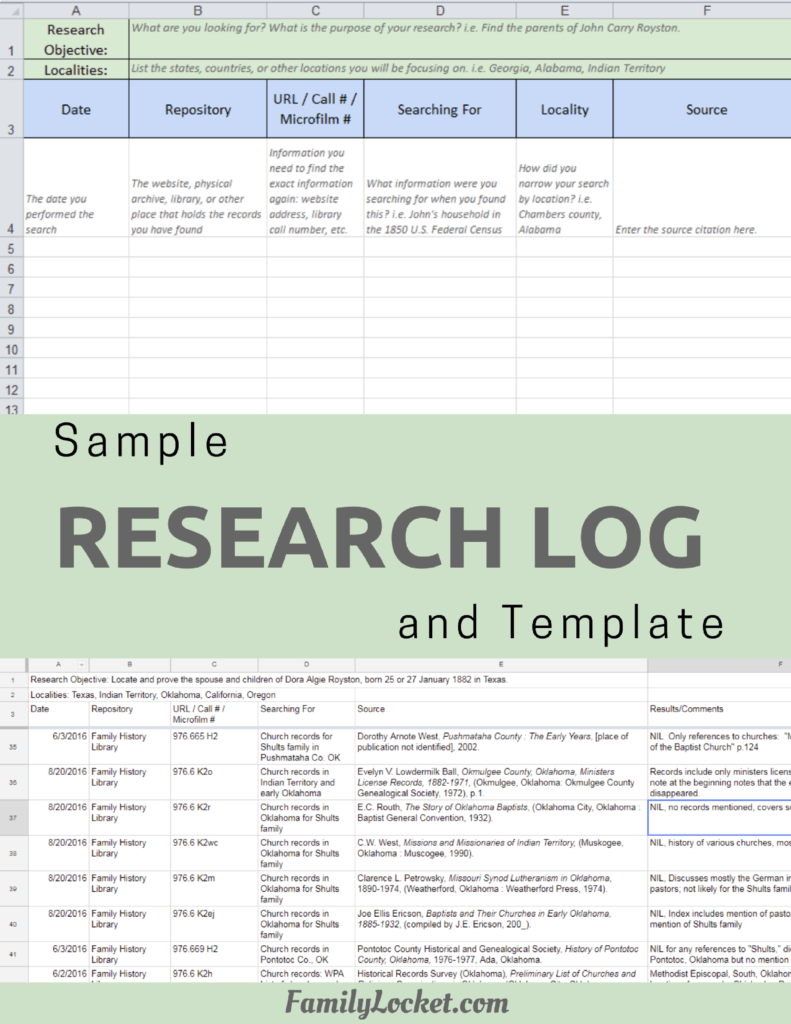
Airtable Research Logs Quick Reference – by Nicole Dyer – https://familylocket.com/product-tag/airtable/
Research Like a Pro: A Genealogist’s Guide book by Diana Elder with Nicole Dyer on Amazon.com – https://amzn.to/2x0ku3d
Research Like a Pro with AI Workbook – Second Edition (eBook) – https://familylocket.com/product/research-like-a-pro-with-ai-workbook-second-edition-ebook/
14-Day Research Like a Pro Challenge Workbook – digital – https://familylocket.com/product/14-day-research-like-a-pro-challenge-workbook-digital-only/ and spiral bound – https://familylocket.com/product/14-day-research-like-a-pro-challenge-workbook-spiral-bound/
Research Like a Pro Webinar Series – monthly case study webinars including documentary evidence and many with DNA evidence – https://familylocket.com/product-category/webinars/
Research Like a Pro eCourse – independent study course – https://familylocket.com/product/research-like-a-pro-e-course/
RLP Study Group – upcoming group and email notification list – https://familylocket.com/services/research-like-a-pro-study-group/
Research Like a Pro Institute Courses – https://familylocket.com/product-category/institute-course/
Research Like a Pro with DNA Resources
Research Like a Pro with DNA: A Genealogist’s Guide to Finding and Confirming Ancestors with DNA Evidence book by Diana Elder, Nicole Dyer, and Robin Wirthlin – https://amzn.to/3gn0hKx
Research Like a Pro with DNA eCourse – independent study course – https://familylocket.com/product/research-like-a-pro-with-dna-ecourse/
RLP with DNA Study Group – upcoming group and email notification list – https://familylocket.com/services/research-like-a-pro-with-dna-study-group/
Thank you
Thanks for listening! We hope that you will share your thoughts about our podcast and help us out by doing the following:
Write a review on iTunes or Apple Podcasts. If you leave a review, we will read it on the podcast and answer any questions that you bring up in your review. Thank you!
Leave a comment in the comment or question in the comment section below.
Share the episode on Twitter, Facebook, or Pinterest.
Subscribe on iTunes or your favorite podcast app.
Sign up for our newsletter to receive notifications of new episodes – https://familylocket.com/sign-up/
Check out this list of genealogy podcasts from Feedspot: Best Genealogy Podcasts – https://blog.feedspot.com/genealogy_podcasts/



Leave a Reply
Thanks for the note!