
County histories are one of my go-to sources when researching an ancestor. They can provide valuable information about the early settlers, churches, businesses, schools, and more in the community. Biographies are often included, which can give clues about family connections. This type of source, however, can vary greatly depending on the author or group compiling the history. This can often be a historical or genealogical society, but it may also be an individual. County histories may have been published a hundred years ago or very recently. Some include sources, but often they do not, so we must determine the veracity of the information in the published source.
On our recent research trip to Texas, I focused on Benjamin Cox, a Texas Ranger and early settler. Before leaving home, I reviewed what I knew about Benjamin, and a county history published on Ancestry was a starting point for finding additional sources about this era of his life. A serendipitous stop at the Milam County Genealogical Society Research Center yielded two more histories with additional stories and details.
Our day began with research at the Milam County Annex, where we reviewed records for our Harris branch of the family. Although the records had been moved to the Annex, we wanted to visit the historic Milam County Courthouse, which was lovely. From there, we drove to the Milam County Genealogical Society Research Center, housed in the Lucy Hill Patterson Memorial Library. While Nicole viewed newspapers on microfilm, I found the county histories section and reviewed the Bell County volumes.
-
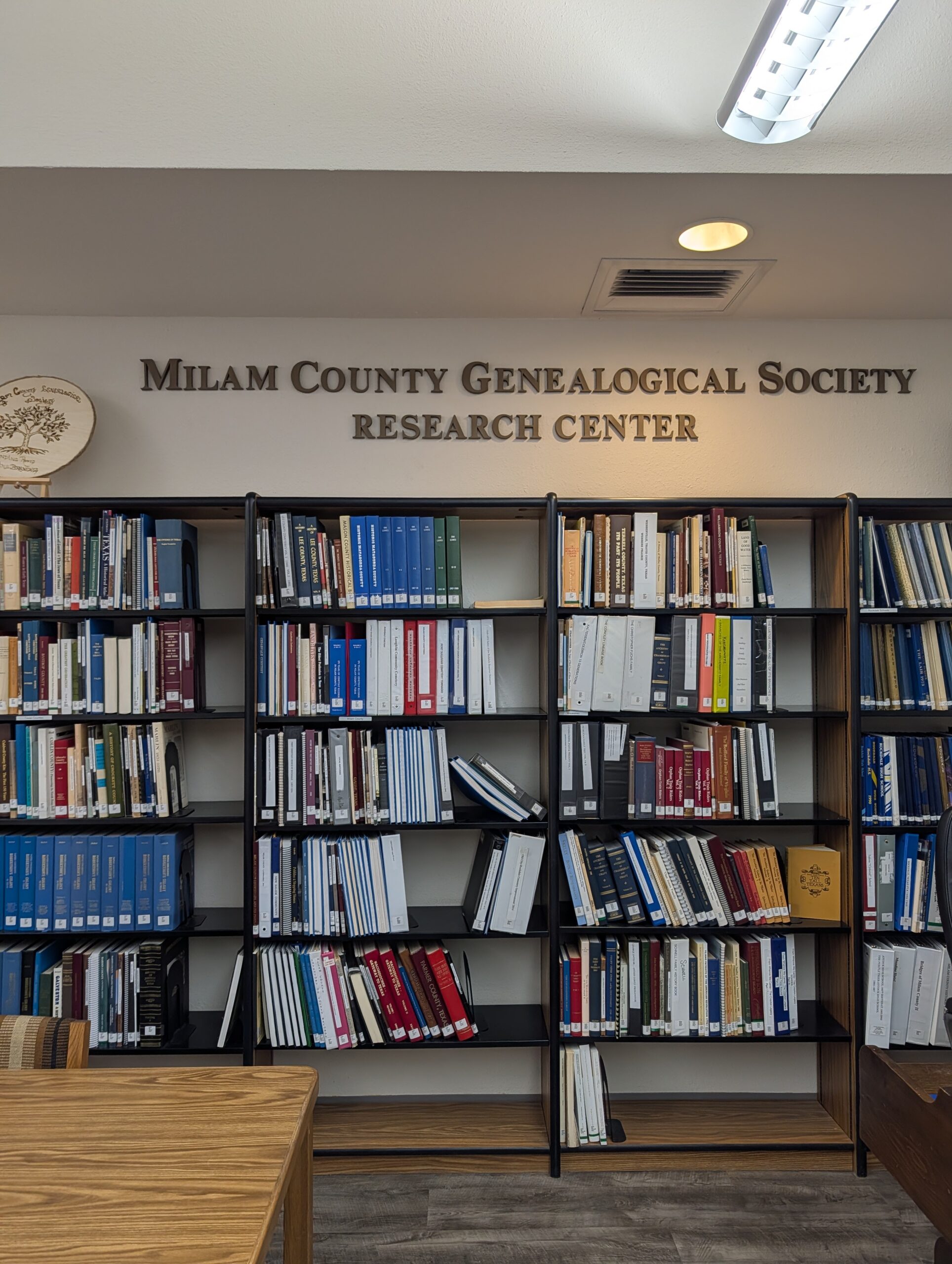
- Research Center at the Lucy Hil Patterson Memorial Library
-
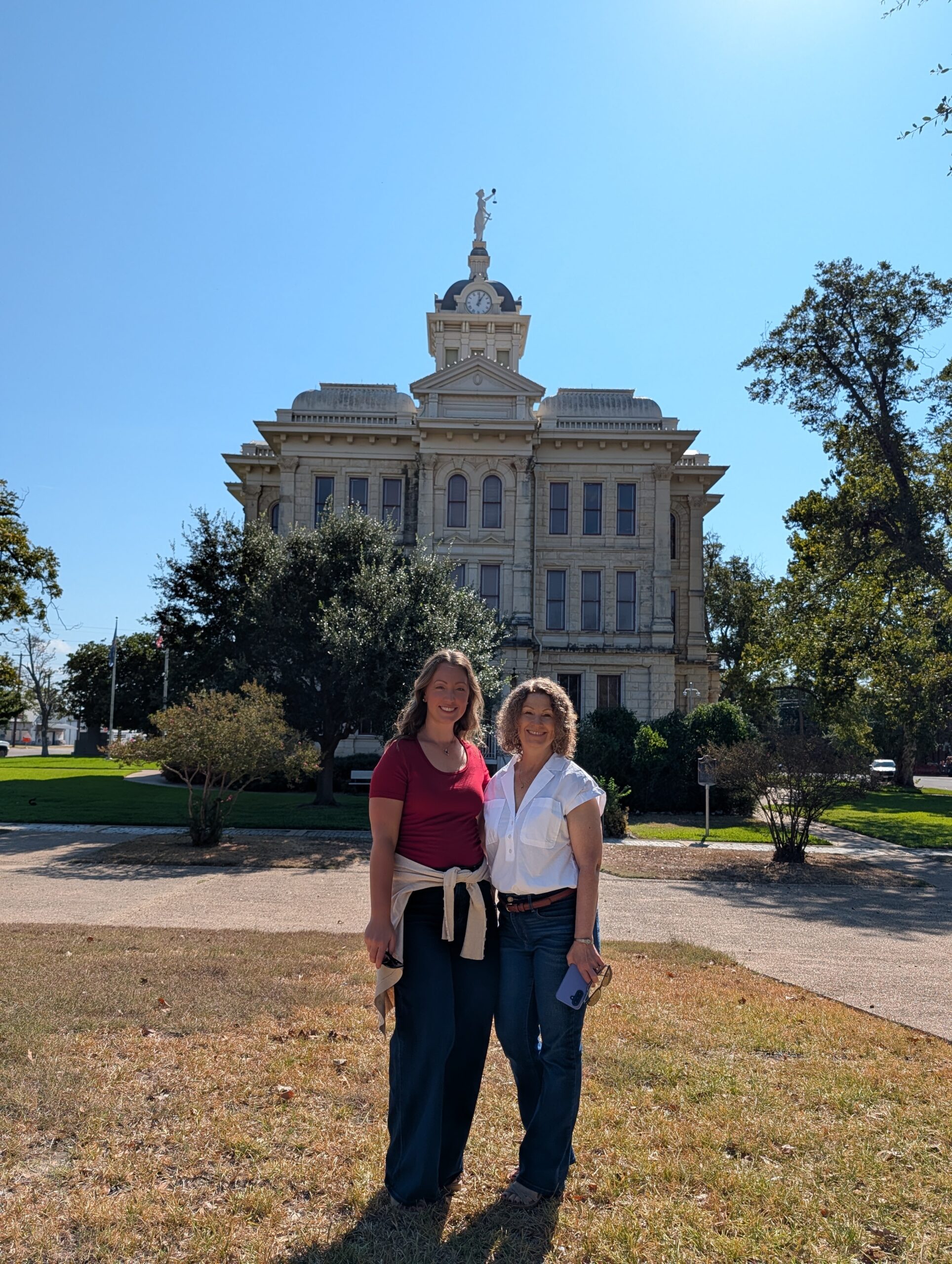
- Nicole and Diana – Milam County, Texas, Courthouse
The History of Bell County
The History of Bell County, by George W. Tyler and edited by Charles W. Ramsdell, is digitized on Ancestry and gave me my first clues that Benjamin Cox was a Texas Ranger. The author was born in 1851, and he spent his childhood in Bell County. After law school in Virginia and Tennessee, he settled in Belton and began practicing law. Later in life, he amassed notes and sources for his history of Bell County. The editor explained:
He was always so eager to seek out more information that he could never bring himself to finish the task. At his death, the writing was incomplete, and some was in the form of rough notes. The editor of this volume revised and condensed the manuscript and, in a few instances, filled in the narrative.
One source the history noted was the private journal of the late Major John Henry Brown. We always strive to locate the source for an authored work such as this history. Since I had reviewed this history online before my trip, I saw that The History of Bell County included a source – one of which was the “private journal of the late Major John Henry Brown.”
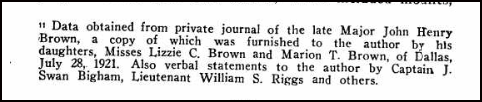
George W. Tyler, The History of Bell County, edited by Charles W. Ramsdell
The history discussed a ranger company called “The Independent Blues” and named Benjamin Cox as an officer. The history named the men in the company and included verbal statements to the author about it as sources. A chapter titled “Indians, Frontier Rangers and Gold Hunters” provided the reason for the formation of the Independent Blues. Tyler discussed the various Native American tribes in the area of the reservation that had been set aside for the “Caddoes, Anadarkoes, Keechies, Ionies, etc.” These tribes from eastern Texas knew more about raising crops than the Comanche, and when a drought made it difficult to graze cattle, the Comanches began raiding the settlements in and around Bell County.
The History of Bell County goes into depth about one of the incidents that involved the murder of John and Jane Riggs and the abduction of their young daughters.
Posses were made up in several neighborhoods to pursue these Indians. Major John Henry Brown, Capt. M. W. Damron, Ben Cox, James R. Sutton . . . were members of the posses. The names of the others – there were a number of others- are not available.”
Because the information came from interviews and John Henry Brown’s journal, the details of the raids and rangers seemed more likely to be accurate.
The Story of Bell County, Texas, Volume 1
When we stopped at the Milam County Genealogical Society Research Center, I was thrilled to find two additional county histories. The Bell County Historical Commission produced The Story of Bell County, Texas, Volume 1, by E.A. Limmer Jr., Chairman, Editor-in-Chief, and compiler. Originally copyrighted in 1988, this much later than Tyler’s history draws on books, diaries, and interviews with firsthand accounts of the Indian raid of 1859. This history also quoted George W. Tyler’s The History of Bell County. The editor sought to expand the story beyond Tyler’s work and added additional details from a letter by Rhoda Riggs Conover, one of the girls abducted in the raid.
Another early account came from Zilpha Polk of Belton, who gave an interview around 1935 and described how the Riggs girls escaped and spent the night at her father’s home. Interestingly, her father was Anderson Sutton, connected to Benjamin Cox through his second wife, Elizabeth Donoho Sutton. The Suttons and Cox family had settled on Nolan Creek where the raid took place. Zilpha also named Benjamin Cox, her father, brother Jesse Wilson Sutton, and an uncle, Jimmy Sutton, as members of the possee.
The Story of Bell County attempts to make sense of the various accounts and remarks, noting that Zilpha’s list of men “appears in the same order in Tyler’s history so Sutton may have used the list in Tyler rather than any first-hand account.” This seems to be an interesting mix of first-hand and second-hand information.
The Story of Bell County, Texas also includes a lengthy biographical section on Benjamin Cox, submitted by Carole Fry Owen. The biography focuses on Benjamin Cox’s time in Bell County and his family with his second wife, Elizabeth Donoho Sutton. Since the Suttons were a large clan and had settled in Bell County on Nolan Creek with Benjamin Cox, the information about the mixed Sutton-Cox family is much more complete on the Suttons and answered some of the questions I had about which children were from Benjamin Coxes’ first marriage and which were from Elizabeth’s first marriage, and which were theirs. I’ve seen many family trees with these children attributed to the wrong couple.
Bell County: A Reprinted History – Central Texas Histories and Biographies, Volume 1
This county history again draws on written accounts and quotes J.T. DeShields in Wilbarger’s Indian sketches. It also provides the following source:
We will now quote the narrative of the youngest girl, as detailed to the writer in a letter dated Medina City, Bandera County, Texas, April 24, 1886.
The history continues with this statement.
As soon as the news of the murder of Riggs and his wife and Pierce reached Belton, it, of course, created great excitement, and soon two companies – one under John Henry Brown and the other under ‘Uncle Ben Cox’ – were formed and went in pursuit.
Much of the story was the same as the other two histories, but the addition of “Uncle Ben Cox” revealed his standing in the community. At 68, he was likely the oldest ranger and well respected.
All three histories provided details about the Independent Blues and the raid that prompted its organization. Each also named Benjamin Cox, so my next research step was to find additional sources to shore up the evidence. Could I locate John Henry Brown’s diary? Was there a muster roll for this Texas Ranger group? All questions that our next stops in Texas would answer. Stay tuned!
Tips for Assessing a County History
- Start your study of a locality by locating and studying county histories, but don’t take every statement as fact before analysis.
- Carefully read the front matter that describes the author, compiler, and/or editor to discover their motivation for publishing the history.
- Comb through the history for clues to the sources used. Some histories have no sources, but others add them to the front or scatter them throughout.
- Analyze each informational item independently. As in the Bell County histories, some facts were first-hand accounts, others were second-hand, and yet others were impossible to trace to an informant.
Best of luck in all your genealogical research!









Leave a Reply
Thanks for the note!