
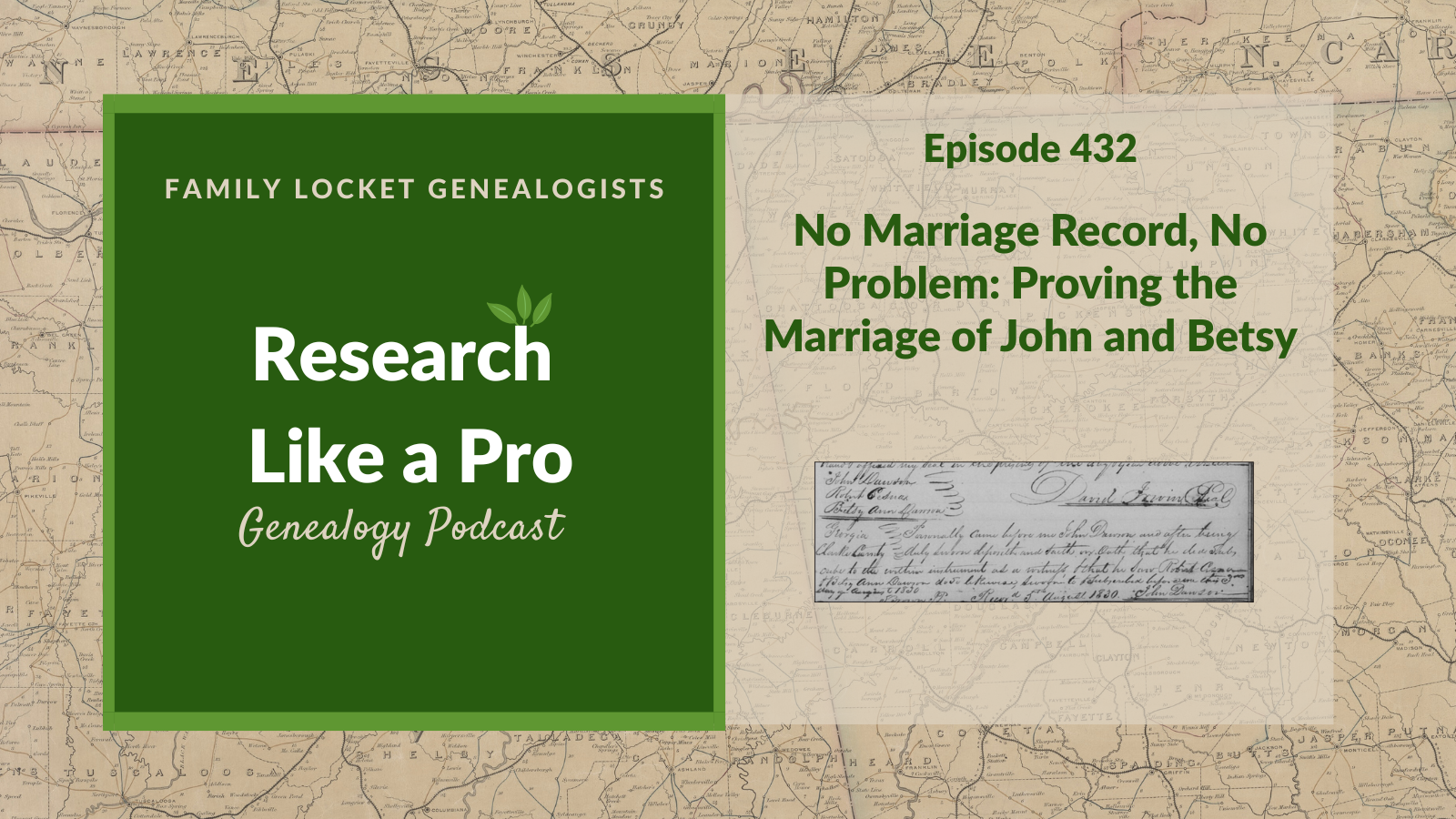
Diana Elder and Nicole Dyer discuss how to prove an ancestral marriage when no direct marriage record exists, using Diana’s research on John Dawson and Elizabeth “Betsy” Cessna. They break down the steps of the proof argument, including bracketing the marriage window between 1811 and 1816, conducting negative searches in regional county records, and uncovering extensive financial and legal associations between Dawson and the Cessna family over twenty years.
They also examine a key 1830 marriage settlement naming Betsy Ann Dawson alongside her brother Robert Cessna and John Dawson, as well as census data and migration patterns that confirm the relationship. Listeners learn how to build a solid proof argument using indirect evidence, association networks, and thorough research logs when direct vital records are missing.
This summary was generated by Google Gemini.
Transcript
Nicole (1s):
This is Research Like a Pro Episode 432: No Marriage Record, No Problem – Proving the Marriage of John and Betsy. Welcome to Research Like a Pro a Genealogy Podcast about taking your research to the next level, hosted by Nicole Dyer and Diana Elder accredited genealogy professional. Diana and Nicole are the mother-daughter team at FamilyLocket.com and the authors of Research Like a Pro A Genealogist’s Guide. With Robin Wirthlin they also co-authored the companion volume, Research Like a Pro with DNA. Join Diana and Nicole as they discuss how to stay organized, make progress in their research and solve difficult cases. Let’s go. Today’s episode is sponsored by Newspapers.com.
Nicole (45s):
Hi everyone. Welcome to Research Like a Pro.
Diana (48s):
Hi Nicole, How are you today?
Nicole (50s):
Hey, Mom, doing well. Just having a great time talking with you about genealogy. Let’s talk some more about our trip to Texas.
Diana (59s):
Okay, well today let’s talk about the two cemeteries that we visited. So the first one is called the Mooreville Cemetery in Falls County, Texas. And this was so fun because we were driving south from Dallas towards Austin. We would end up in Austin and we were driving along and I saw this sign that said Falls County and I thought, I know we have somebody in Falls County, and I had this feeling that it was our Hickman Monroe Shults, that that was where he lived out the rest of his life. Looked up his profile really quick on my Ancestry app on my phone and saw he was buried in the Mooreville Cemetery and then doing a quick Google search found it was only six miles off the road, so we did a little detour.
Diana (1m 47s):
This was not on our research plan at all because hadn’t realized it was gonna be right there on the way. And it was so fun because it wasn’t that hard to find. We drove in, found this little cute cemetery and luckily Find A Grave had a picture, so we could envision what the headstone looked like. And amazingly they’re off to the left. It was right there. So you know, it was probably one of the easiest headstones and cemeteries to find in my experience so far. And it was really fun to, to find that. And then to also find that his daughter-in-law was also buried next to him and that gravestone still looked pretty good.
Diana (2m 27s):
And it was old. He died on May 12th, 1899. So you know, over a hundred years old, still legible, still standing. So that was a fun little fun little detour to the cemetery.
Nicole (2m 39s):
Yeah, I still can’t believe that as we’re driving along, you just looked that up and we figured out that we could just turn here for a quick little detour while I was driving. It was very spontaneous and very fun.
Diana (2m 52s):
It was. It’s so funny because we talk a lot about being very prepared for these research trips and as we continue talking more about these, you’ll see that we were really prepared for other repositories and things on this trip, but this one was just like a little serendipity. So it was fun.
Nicole (3m 7s):
Yeah, every time we crossed a new county we were like, Hmm, that county, that sounds familiar, is that one that we’ve researched in? ‘Cause our ancestors all seemed to kind of go through this central Texas area south of Dallas at one point or another.
Diana (3m 22s):
Yeah, they were in, they moved around a lot. So one year they’d be in one county in the census and then the next 10 years they’d be in another one. And so I think we could have probably visited pieces of land that they lived on, all sorts of different things. But you know, we were on a schedule so we didn’t have time to do that. But we did have time to go to the cemetery because we don’t have that many ancestors that we actually know where they’re buried in Texas. So this was kinda special.
Nicole (3m 50s):
Well another special one that we made a plan to see was Martha Hoosier Harris, who I researched as part of my Kinship Determination Project for certification. And she was the mother of my oldest generation, John C. Harris. And so we had made a plan to go to the Salty Cemetery in Milam County, which is includes the towns of Cameron and Rockdale. In Cameron we went to the courthouse and Rockdale was near where the cemetery was. So we stayed in Cameron and after we checked into our hotel and ate dinner, we drove out towards Rockdale, and then another 15 minutes past Rockdale after driving on this really quiet road that went by a bunch of ranches we saw a whole bunch of deer and then we got to the Salty Cemetery, which had like a chain around the gate, but luckily it wasn’t padlocked so we could just unwrap the chain, open the gate and drive in.
Nicole (4m 43s):
And after searching everywhere we could not find the headstone of Martha. But there was a picture on Find a Grave. So we knew what it looked like and we knew it was there and it didn’t look like a concrete one that would eventually get like weathered away. It was a lot more long lasting stone. So we kept walking around. Sadly we were wearing sandals and we kept stepping on these little pokey things. What were those called again?
Diana (5m 5s):
Well we call ’em goat heads here in the West and they’re the most annoying weeds ’cause when they dry out you have these like little burrs just like terrible, stick to everything. So
Nicole (5m 18s):
Super obnoxious. Yeah. So we had kept stepping all over those and getting them on our feet. But then eventually I found a headstone laying down that looked like the right shape. And as I got closer I saw that it was Martha’s headstone. So it was really fun to see her headstone there. And she died in 1890 and her husband James B. Harris migrated to Indian territory with their son John C. Harris and he was buried in the Burneyville Cemetery in Oklahoma there. And so I had already visited and seen that cemetery. And so it was neat to be able to see his wife Martha’s headstone. And it was neat that she had a headstone at that that time period in Texas because I think a lot of the time our ancestors who died in Texas in the 1850s to 1900s don’t always have a a headstone in a cemetery.
Nicole (6m 7s):
So it was neat to be able to see that. And she was surrounded by family members. Her sister-in-law, Sarah Harris Ralston and her family were all buried there. So that was really neat to see them all kind of in the same part of the cemetery together.
Diana (6m 26s):
Right. It’s just another lesson to learn that usually your people are buried near a family and so if you can see who they’re all buried around or who’s buried around them and then sometimes it adds some depth to the family history, you make some more connections that maybe you hadn’t made in the past. So we were happy that we found both the headstones. It would’ve been sad if we had to leave this cemetery and never found Martha ’cause we really wanted to find Martha. And I was very grateful that you found the headstone lying down because it was really hot and humid and we were getting tired of being out there.
Nicole (6m 60s):
Yeah,
Diana (7m 1s):
It was fun. Well let’s do some announcements. For our Research Like a Pro Webinar Series for October on the 20th we have got Yvonne Fenster presenting, When DNA Reveals Hidden Identities: Investigating Whether Minnie James Was Born Fannie Tattoon.
Diana (7m 45s):
Could Fannie Tattoon and Minnie James be the same person? This investigation examines a compelling hypothesis that emerged when DNA matches revealed shared ancestry through both Gilbert Tattoon (Fannie’s father) and James H. Clayton (Minnie’s husband)—connecting two seemingly unrelated Connecticut families. With Fannie vanishing from records after childhood and Minnie appearing as an adult without prior documentation. The analysis draws on genetic data, Connecticut records, and other documents to determine whether they are separate individuals or one woman who changed her identity after being orphaned. So, for topics we’ll learn about Connecticut, the Dana Leeds method, misattributed parentage, identity research, name change investigation, orphanes children, DNA analysis, disappearing ancestors, vital records, Social Security Records, church Records, BanyanDNA, comparative timeline analysis, African American Research, City Directories, maps and the FAN club.
Diana (8m 28s):
Oh my goodness, a whole host of records and topics. Yvonne is a professional genealogist who is accredited through ICAPGen in the Upper South region of the US and brings expertise in DNA analysis, particularly in cases involving cousin marriages and Y-DNA research, which helps break through genealogical brick walls. She’s a graduate of the Research Like a Pro and Research Like a Pro with DNA study groups and has subsequently served as a mentor for both. She holds an Associate of Science in Nursing from Onondaga Community College, a Bachelor of Science in Biology from Bridgewater State College, a Doctor of Philosophy in Neuroscience and Physiology from the State University of New York at Upstate Medical University in Syracuse, and Postdoctoral training at Cornell University in Ithaca.
Diana (9m 26s):
When not uncovering family histories, Yvonne enjoys quilting, cooking, and spending time with her grandchildren and husband. We are looking forward to the next Research Like a Pro of DNA study group beginning in February and registration for that will open soon in December. Please join our newsletter that comes out each Monday to find out about new posts, upcoming lectures, any coupon codes we have running at the time. And looking forward to the Texas State Genealogical Conference. That is November 6th and 7th, its online and in-person. And I have two talks that are prerecorded so you can watch those anytime you want once you’re part of the conference and once they’re available, one is called, Uncovering Her Story: Research Methods for Pre-1850 Female Ancestors.
Diana (10m 6s):
And the other is, • From Complex to Clear: Transform Court Records with AI Tools. And then our Research Like a Pro Institute, our Merging and Separating Identities course starts in January, 2027 and registration is now open. Jan Joyce is coordinating it and if you want to check it out, head to FamilyLocket, click on ‘Shop,’ and then ‘Institute Courses’ and you’ll find an overview and a description of each session there.
Nicole (10m 33s):
Great. Alright, well today we’re talking about Writing the Proof Argument with AI and when a marriage record cannot be found, how can you connect two individuals in the early years of the 19th century? And so when you were writing about Thomas Beverly Royston and his family connections, you kind of found a lot of cool new things about this family in the early 1800s as you were writing this proof argument. And one of the cool things was Thomas Beverly Royston’s half sister, Elizabeth “Betsy” Cessna. And so you had seen this name John Dawson and it was connected with the Royston and the Cessna records, but it wasn’t until writing the case study on Thomas that the conclusion was formed about this couple based on the records and you fully documented the records on John Dawson in your research log.
Nicole (11m 28s):
But for the case study you didn’t really have room to completely develop the proof for the marriage. So going in and adding all the relationships to the FamilySearch Family Tree is when you realized that it would be helpful to include a written conclusion. So it sounds like you turned to AI to help write the proof argument. And how was that?
Diana (11m 48s):
Well it’s actually, it was really nice because I used a Claude project and I feel like AI is getting smarter and smarter and writing better and using what I, what I have instead of just making things up. So I had a thorough research log with all my notes, comments and citations. And then the case study had all the correlation and analysis that AI could draw from. So I used both of those items in my project knowledge and I found that the proof was 99.9% accurate. So reading through it and verifying everything, there were only a couple of words that I needed to change that didn’t seem quite right.
Diana (12m 30s):
But I will just note that if I had not given AI my case study and my research log, I don’t think it could have done as good of a job. Obviously it would not have had the sources, it would not have had the background. So you know this, this once again told me that AI is best used in our genealogy as an assistant. This was really fun and I was able to use that as a blog post and could put that into the FamilySearch, you know, the proof argument so it could prove the relationship because as you’re going to see as we talk through the case, this is one that it needs a lot of different pieces to come together to figure it out ’cause there is no record.
Diana (13m 16s):
So let’s think about marriage records and what we usually use. So sometimes there is a marriage license, or a bond, or administer’s return, and sometimes we don’t have anything. So when we do have a situation where there is no record, we have got to assemble that evidence from everything that does survive. And sometimes those are things like tax records, guardian bonds, deed witnesses, censuses, and tracking those people who stayed close to the research subject for many, many years. In this case it was for 30 years.
Nicole (13m 56s):
Wow. That’s the method you used then in your NGSQ case study on Thomas Beverly Royston, where the Cessna, Royston, Irwin and Dawson families kept turning up in each other’s records across six Georgia counties. So one relationship in that article go: “Elizabeth Cessna and John Dawson probably married between 1810 and 1816, although no marriage record has surfaced.” So if you want to read that article, it was published in the NGSQ in June, 2026 and it’s called Naming Patterns and Family Associates Link Thomas Beverly Royston to his Georgia Roots.
Nicole (14m 37s):
So it’s so cool that you got that published. Well this episode is going to expand that single sentence about Elizabeth Cessna and John Dawson probably got married between 1810 and 1816, into a little bit of a longer discussion of the problem and the marriage and the sources that gave the evidence. So let’s start with a problem Elizabeth. Betsy Cessna was the daughter of Samuel Cessna and Mary Polly Baker Cessna Royston of Green County, Georgia. No marriage record names her, no death record names her, apart from her childhood guardianship papers, exactly one document in 30 years of searching calls her by a married name and it calls her Betsy Ann Dawson.
Nicole (15m 20s):
The question then is, can we establish that Betsy Cessna married John Dawson and when?
Diana (15m 28s):
Okay, so you know first of all is really getting some identity, and the actual fact that her father was Samuel Cessna is well documented. He died by May 19th, 1797 when his widow Mary and John Cessna, I haven’t tracked down John Cessna, I’m guessing it’s a brother, perhaps an uncle, a cousin, I don’t know, some relation, but Mary was his wife and they applied for letters of administration on his estate in Green County. And then in 1805 we have a land lottery where Robert, Elizabeth, and Samuel Cessna were listed as persons entitled to draws as orphans.
Diana (16m 12s):
So that gave those three orphans a name. And then in 1808 there was a guardian record and this was a Robert Royston and a Richard Royston, and they signed a guardian bond in Green County for Elizabeth Cessna, orphan of Samuel Cessna, deceased. So directly identifying her as the daughter, which is just an awesome record. And the record went on to say binding them in the sum of $3,000 to furnish the orphan with good and sufficient meat, drink, lodging, clothing, and schooling. So that was really neat to find the guardianship records. And then that estate file of the father continues on where it gives account papers and it’s recording payments to Mrs.
Diana (16m 60s):
Royston, formerly Mrs. Cessna, for board of the three orphans of Samuel, deceased. And one entry specifically records cash paid to Mrs. Royston for Betsy Cessna board, which is another really awesome notification in this record. So she was living with her mother and her mother had married John Royston in 1803. So the household it appears has Mary’s three children who are always noted as the orphans of Samuel, and then she is living with a new husband John.
Nicole (17m 37s):
So the next step was to figure out the limits of when the marriage could have occurred or bracket the marriage. So two records set the outer limits. The last charge for Betsy Cessna’s board is dated December 31st, 1810. After that date, her mother stops being reimbursed for keeping her. A young woman of about 16, leaving her mother’s household in 1811 has a small number of plausible destinations, and marriage is the most common. The other end of the bracket is 4 March, 1816 when the Morgan County Court of Ordinary appointed John Dawson, guardian of the person and property of Samuel C Cessna, orphan of Samuel Cessna, deceased.
Nicole (18m 20s):
Dawson was the third man to hold that role after the Roystons in 1808 and Benjamin Baldwin in 1814. Guardianship of a minor’s person and estate was not a job handed to strangers. It went to kin–and in this family it already had twice gone to family members. So the marriage window is 1811 to 1816, which you had stated in the article is 1810 to 1816 to stay inside what the documents will bear.
Diana (18m 47s):
Right. So obviously when I figured out when the marriage should have taken place, I looked through all the possible record types to see if I could find it. And so I found that in Green County there were marriage licenses, 1786 to 1810, marriage licenses 1811 to 1815 and marriage licenses 1817 to 1829. And I looked at each one of the groom indexes, no Dawson, and I looked page by page through book B and I said there were just a handful of entries for 1811. There were many for 1810, very few for 1812 and 1813 and then many again for 1814 through 1816.
Diana (19m 35s):
So you know, I found this over and over again that many times, whether it’s just because the county clerk didn’t keep good records or something happened in the county, sometimes you just have a dearth of records for a couple of years. And so it seems like this gap of record keeping across 1812 and 1813 is very likely when the marriage could have taken place if it took place in Green County. But then the other place that they could have married was Morgan County because the family migrated to the next door Morgan County, up sometime in those, you know, between 1810 and 1820. And in Morgan County the marriages survive only in Book A, which is 1808 to 1815.
Diana (20m 17s):
And a full text search returned nothing for Cessna, Betsy spelled every way I could think of it, or John plus Elizabeth. And so there’s nothing there in Oglethorpe County, another neighboring county. I looked at marriages 1800 to 1829 and did the same Full Text search for Elizabeth, Betsy or Betsey spelled with an E instead of just the Y for 1810 to 1816 and still found nothing. And then in Clark County, the last county that the family had records in at any time, no marriage records survived before 1898. And I looked by the index by Full Text search by browsing every Dawson entry and could find nothing there.
Diana (21m 4s):
So you know, it’s when we have a negative result, we often feel like, oh goodness, where’s the record? And it just could be that it just was destroyed. It was in one of those counties and it never made it into a record book. Who knows? But either it never survived the gap or was never filed. And so it does give us that little bit of negative evidence that there is no marriage record for the two, so we use what we have.
Nicole (21m 33s):
We just use what we have.
newspapers.com (21m 34s):
Yeah, let’s have a quick word from our Sponsor. Ready to take your family history research beyond names and dates? Newspapers.com is a game-changer for genealogists of every level. With access to over a billion pages of historical newspapers, you can uncover rich, untold stories about your ancestors you won’t find anywhere else. Maybe it’s a detailed obituary that reveals the extended family you never knew about, a local news story that highlights your great-grandmother’s role in the community, or a photo that brings her to life in a way names and dates never could. Newspapers captured the everyday details—announcements, happenings, achievements, challenges—that paint a fuller picture of who your ancestors were and what their world was like. It’s the social history behind the names on your family tree. Searching is simple and intuitive: explore by name, location, or date to unearth your own hidden gems. Visit Newspapers.com/FamilyLocket today for 20% off a subscription and start turning your family tree into a family story.
Diana (22m 25s):
So the next part of this proof was identifying John Dawson and seeing how he really connected to the Cessnas. So if we don’t have a record saying John Dawson married Elizabeth Betsy Cessna, then we have got to see if the FAN club holds true. And so we do see that in 1813 in Green County, Mary Royston, who was formerly Cessna, she’s the mother of Betsy or Elizabeth, she is taxed in Captain John Dawson’s district. So that puts them in the same place there. In 1816 in Morgan County, showing that the family has moved on, Dawson is appointed the guardian of Samuel C Cessna, who is the brother of Elizabeth, the youngest of the three orphans.
Diana (23m 14s):
In 1816, also in Morgan County, Dawson is witnessing the sale of 101¼ acres to Robert B Cessna, who was Elizabeth’s brother. And then in 1822 there is a lawsuit for John Dawson and Robert Cessna together against a Thomas Pinkard. And then in 1823, still in Morgan County, we have got another court case of Dawson and Cessna together. And then in 1827 in Greene County there’s a mortgage and Robert Cessna is the endorser.
Diana (23m 54s):
In 1829 we have another court case of Dupree versus Dawson and Cessna. And in 1829 we have a tax digest where John Dawson is an agent for Mary Cessna paying taxes on her land. And then in 1830 we have John Dawson and Robert Cessna both witnessing Sarah B Royston’s marriage settlement. And I will just note that also witnessing that is Betsy. So John and Betsy Dawson. In 1830 we’ve got John Dawson of Clark County and Robert Cessna of Morgan County in another court case.
Diana (24m 35s):
And in 1835 they’ve moved out to Cherokee County, which is out west. And Robert Cessna is selling 40 acres to John Dawson. So that is a lot of records of the John Dawson -Cessna connection. So you know, interestingly the tax record is pretty clear that there is some type of a connection here because usually it’s a male trustee, guardian, or relative paying on a woman’s behalf. And Mary Cessna’s agents were her son, Robert Cessna, and John Dawson. And then also all the different court cases and financial entanglements. Usually men don’t co-sign each other’s notes and endorse each other’s mortgages for that whole period of about 20 years by coincidence.
Diana (25m 22s):
Generally it is a family connection.
Nicole (25m 25s):
Okay, let’s talk about the one record that actually names her. This is step five. So on February 6th, 1830, David Irwin of Morgan County, Sarah B Royston of Clarke County and Thomas B Royston of Clarke County, executed a tripartite marriage settlement protecting Sarah’s property–two enslaved boys, Isaac and Thomas–before her marriage to Irwin. Three people witnessed it, John Dawson, Robert Cessna, and Betsy Ann Dawson. And that’s recorded in the Clark County Superior Court Mortgage Book L 1829 to 1836. So this is the only document that you found in which Betsy appears under a likely married surname.
Nicole (26m 8s):
With all the evidence already discussed, this provides an important clue. A woman named Betsy Ann Dawson appears as a witness alongside John Dawson and alongside Robert Cessna, who is Betsy Cessna’s own brother. The document they witnessed was an important connection to the Royston half-siblings given, given the Cessna’s 20 year association with John Dawson, Betsy Ann is very likely his wife and Samuel Cessna’s daughter.
Diana (26m 35s):
Right, it was exciting to see that and even more exciting to put together all the evidence. So a key piece that I found was a census record in 1830. And I had long wondered where the Roystons and Cessnas were living in 1830. And I found John Dawson, who’s actually indexed as Dorson. He headed a household in Athens, Clarke County, Georgia, where where the family was living at the time, apparently. And it had 33 white males age 15 to 19 and had discovered that he was running a boarding house, which was near the college. And he had one female age, 20 to 29, and a female age 30 to 39, who would’ve been Betsy Cessna, born about 1794, and she would’ve been 36.
Diana (27m 25s):
And the younger woman was probably Sarah Royston Irwin, who was a half sibling to Betsy. And the reason I drew that conclusion was because I knew the family was there in 1830. We had all these records of them being there, but there is no census for Thomas B Royston or Mary Cessna, you know, there’s just no other households. And so it only made sense that they would’ve been living in that household. And then 10 years later in Cass County, the Dawson household includes a female of an age to be Betsy, 40 to 49. And this is, you know, where they had migrated to a new county.
Nicole (28m 6s):
Okay, great. So lastly, step seven is migration clustering. So John Dawson’s moves track the Cessna-Royston Group very precisely. He ran the Madison Hotel in Morgan County in 1827, opened the Globe Tavern in Athens, Clarke County in January, 1830, and had given up that house by November, 1830 when John Jackson reopened it as the Franklin Hotel. And this information comes from newspapers, which is really neat. The Georgia Historic newspapers website. Well, John Dawson sold his Morgan County land in January, 1831 and was appointed postmaster at Sanfordville by June of that year, advertised the Sanfordville Inn in the gold region in 1832 and moved on to the Allatooney Hotel in Cass County in 1833.
Nicole (28m 59s):
Robert Cessna, Mary Cessna, David and Sarah Irwin and Thomas B Royston made the same Morgan to Clarke to Cass/Cherokee migration in the same years. And so it’s really cool because families move together and business rivals do not.
Diana (29m 21s):
Right now you might be thinking, well, could this Betsy Dawson and John Dawson be different people? Is there another record out there? And I did find some other records of similar named people. There was a Betsy Dawson who married a James Mulkey in Green County in 1807, but that would not be our Betsy because she was still being boarded by her mother at the Cessna estate expense in December, 1810. So she is still a young minor in her mother’s household. And then there’s an Elizabeth Cessna who married James Milligan in Green County in 1788, and she could be an aunt, maybe she was the namesake of Elizabeth Samuel and Mary’s daughter, but she would have not been old enough, she was probably not even born yet.
Diana (30m 8s):
And then there is a John E. Dawson of Morgan County and I had to do some work to determine who he was because in full text search and in the indexes, his records kept popping up and he’s in the same location, but he married Eliza Walker in 1825. So see we’ve got a John and Eliza Dawson, and then we also have a John and Betsy Dawson. So two couples with very similar names, but he turned out to be a minister and performed a lot of marriages there in Morgan County into the 1840s. So he was definitely a different man. And we also have a John Dawson of Emmanuel County who died about 1857 leaving a widow, Rebecca.
Diana (30m 53s):
So I had some John Dawsons I had to separate identities for, or just actually create identities for saying this is not our John who moves out of the area and goes up into Cass and Cherokee County.
Nicole (31m 6s):
Alright, well what does this prove? Well, the indirect evidence establishes that John Dawson married Elizabeth Betsy Cessna, daughter of Samuel Cessna and Mary Baker Cessna Royston between 1811 and early 1816, most probably in Green or Morgan County during the 1812 to 1813 gap in Green County’s marriage register. The conclusion rests on that bracketed timeline, a documented negative search, 20 years of financial and legal association between Dawson and Betsy’s mother and brother, a single record naming Betsy Ann Dawson in company with both, two censuses with an age appropriate wife, and shared four-county migration.
Nicole (31m 47s):
What it does not do is name her as Elizabeth Cessna Dawson in a single record. And so we wanna be plain about that. Two loose ends are still open. Benjamin Baldwin, the 1814 Guardian may be a maternal relative of Mary Baker and deserves his own research, which I believe you’re working on. And the 1860 Cass County, a household of William C and Elizabeth Johnson contains a William Dawson age 13, and Sarah A. Dawson age 11 with an Elizabeth born about 1820, possibly a daughter-in-law, possibly a daughter of John and Betsy. And that’s worth pursuing too.
Nicole (32m 28s):
So wow, that is how most colonial and early federal southern marriages have to be proven. Not with a certificate, but with the circle of people who never stop showing up in each other’s records.
Diana (32m 38s):
I love that final sentence. And it’s so true. I kept seeing John Dawson and I would just kind of brush it off and think, oh, I’ll figure that out someday. Or I didn’t know how to figure it out or how to bring it together. So it really was in writing my case study that I did all the extra research, found the extra records, and it all came together. So it was so fun to finally identify this Elizabeth “Betsy” Cessna and figure out who John Dawson was. Such a fun, satisfying research. And I really appreciated AI in helping to write that all up and bring it all together. So you know, if I were going to publish this, I would obviously put it in my own words.
Diana (33m 23s):
I would say publish in a journal because I did publish this on our blog, but I did clearly state that AI helped write this, and I did review everything for accuracy. And if you go read it, you’ll see all the source citations there so you can go checkout the records yourself if you’re interested in seeing how to prove something like this. There are 34 citations to go through there, so…
Nicole (33m 47s):
So you found all the sources, then you put the sources and the details into AI and had it write the proof argument?
Diana (33m 55s):
Right.
Nicole (33m 56s):
Yeah. So it’s such a good lesson in the use of AI, and we always say that to use AI for genealogy, we have to put accurate information into it and then it can help us organize that, transform it into something like a proof argument or a written blog post or something like that. But we have to provide the information that we believe comes together to prove something. Letting AI go research and make decisions and judgements about whether or not it’s proven something is not a good way to do that. But when we find the information and then we have AI help us write it up, that’s such a better way to use AI.
Diana (34m 32s):
Right, right. And I have found it just keeps improving and getting better, but we have to do the research. And I will note that I also had given it my case study draft, and so it knew all the different connections that I had made for these people and the migration pattern, it had a really good context of the family that also I think was very beneficial in pulling it all together.
Nicole (34m 58s):
Well great. This was so fun to talk about this one sentence from your case study and how you have expanded it to be more of a proof argument about this marriage.
Diana (35m 8s):
Right. And I noted at the beginning that I put this on FamilySearch with all the different sources, and what I did was to put a link to this blog post so that anybody wondering how all these records come together to actually prove a marriage can just go read the blog post. So I decided that was a good way to source it and you know, that works for me. Someone else may wanna just write something up and I’ve often done that as well. But in this case, I just had a blog post and I linked to it.
Nicole (35m 36s):
Well great. Well thanks everyone for listening and have a great week. We’ll talk to you again next week. Bye-bye.
Diana (35m 42s):
All right. Bye-bye.
Nicole (36m 22s):
Thank you for listening. We hope that something you heard today will help you make progress in your research. If you want to learn more, purchase our books, Research Like a Pro and Research Like a Pro with DNA on Amazon.com and other booksellers. You can also register for our online courses or study groups of the same names. Learn more at FamilyLocket.com/services. To share your progress and ask questions, join our private Facebook group by sending us your book receipt or joining our courses to get updates in your email inbox each Monday, subscribe to our newsletter at FamilyLocket.com/newsletter. Please subscribe, rate and review our podcast. We read each review and are so thankful for them. We hope you’ll start now to Research Like a Pro.
Links
No Marriage Record, No Problem: Proving the Marriage of John Dawson and Elizabeth “Betsy” Cessna – https://familylocket.com/no-marriage-record-no-problem-proving-the-marriage-of-john-dawson-and-elizabeth-betsy-cessna/
Sponsor – Newspapers.com
For listeners of this podcast, Newspapers.com is offering new subscribers 20% off a Publisher Extra subscription so you can start exploring today. Just use the code “FamilyLocket” at checkout.
Research Like a Pro Resources
Airtable Universe – Nicole’s Airtable Templates – https://www.airtable.com/universe/creator/usrsBSDhwHyLNnP4O/nicole-dyer
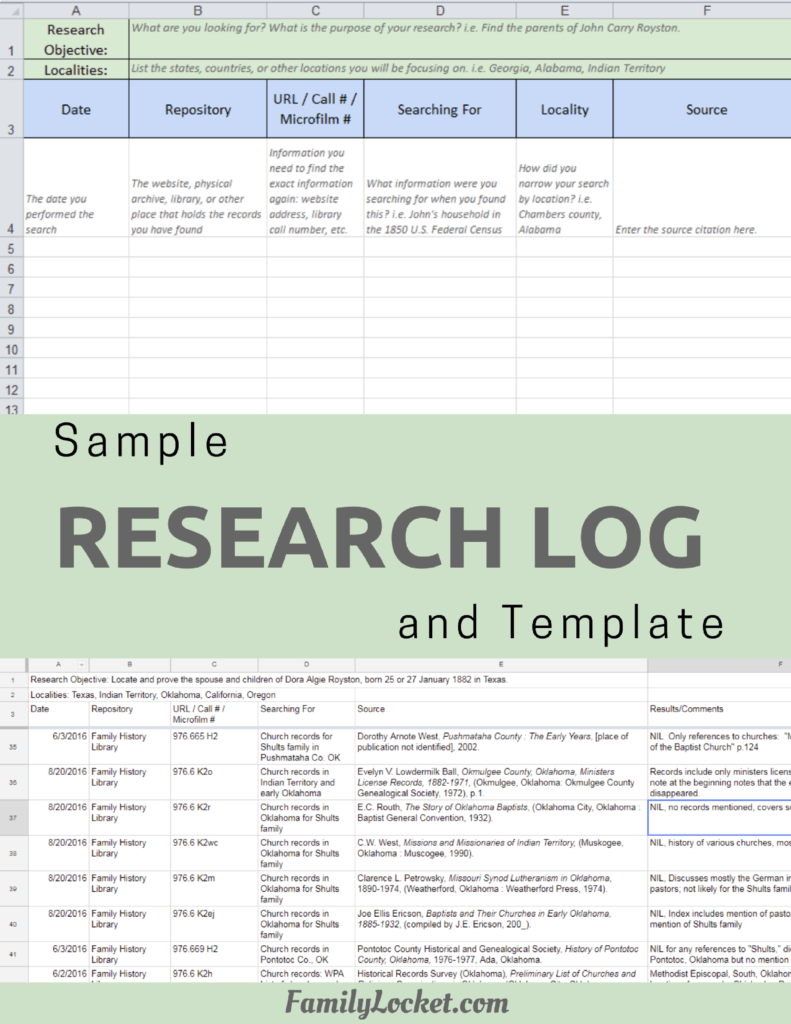
Airtable Research Logs Quick Reference – by Nicole Dyer – https://familylocket.com/product-tag/airtable/
Research Like a Pro: A Genealogist’s Guide book by Diana Elder with Nicole Dyer on Amazon.com – https://amzn.to/2x0ku3d
Research Like a Pro with AI Workbook – Second Edition (eBook) – https://familylocket.com/product/research-like-a-pro-with-ai-workbook-second-edition-ebook/
14-Day Research Like a Pro Challenge Workbook – digital – https://familylocket.com/product/14-day-research-like-a-pro-challenge-workbook-digital-only/ and spiral bound – https://familylocket.com/product/14-day-research-like-a-pro-challenge-workbook-spiral-bound/
Research Like a Pro Webinar Series – monthly case study webinars including documentary evidence and many with DNA evidence – https://familylocket.com/product-category/webinars/
Research Like a Pro eCourse – independent study course – https://familylocket.com/product/research-like-a-pro-e-course/
RLP Study Group – upcoming group and email notification list – https://familylocket.com/services/research-like-a-pro-study-group/
Research Like a Pro Institute Courses – https://familylocket.com/product-category/institute-course/
Research Like a Pro with DNA Resources
Research Like a Pro with DNA: A Genealogist’s Guide to Finding and Confirming Ancestors with DNA Evidence book by Diana Elder, Nicole Dyer, and Robin Wirthlin – https://amzn.to/3gn0hKx
Research Like a Pro with DNA eCourse – independent study course – https://familylocket.com/product/research-like-a-pro-with-dna-ecourse/
RLP with DNA Study Group – upcoming group and email notification list – https://familylocket.com/services/research-like-a-pro-with-dna-study-group/
Thank you
Thanks for listening! We hope that you will share your thoughts about our podcast and help us out by doing the following:
Write a review on iTunes or Apple Podcasts. If you leave a review, we will read it on the podcast and answer any questions that you bring up in your review. Thank you!
Leave a comment in the comment or question in the comment section below.
Share the episode on Twitter, Facebook, or Pinterest.
Subscribe on iTunes or your favorite podcast app.
Sign up for our newsletter to receive notifications of new episodes – https://familylocket.com/sign-up/
Check out this list of genealogy podcasts from Feedspot: Best Genealogy Podcasts – https://blog.feedspot.com/genealogy_podcasts/



Leave a Reply
Thanks for the note!