
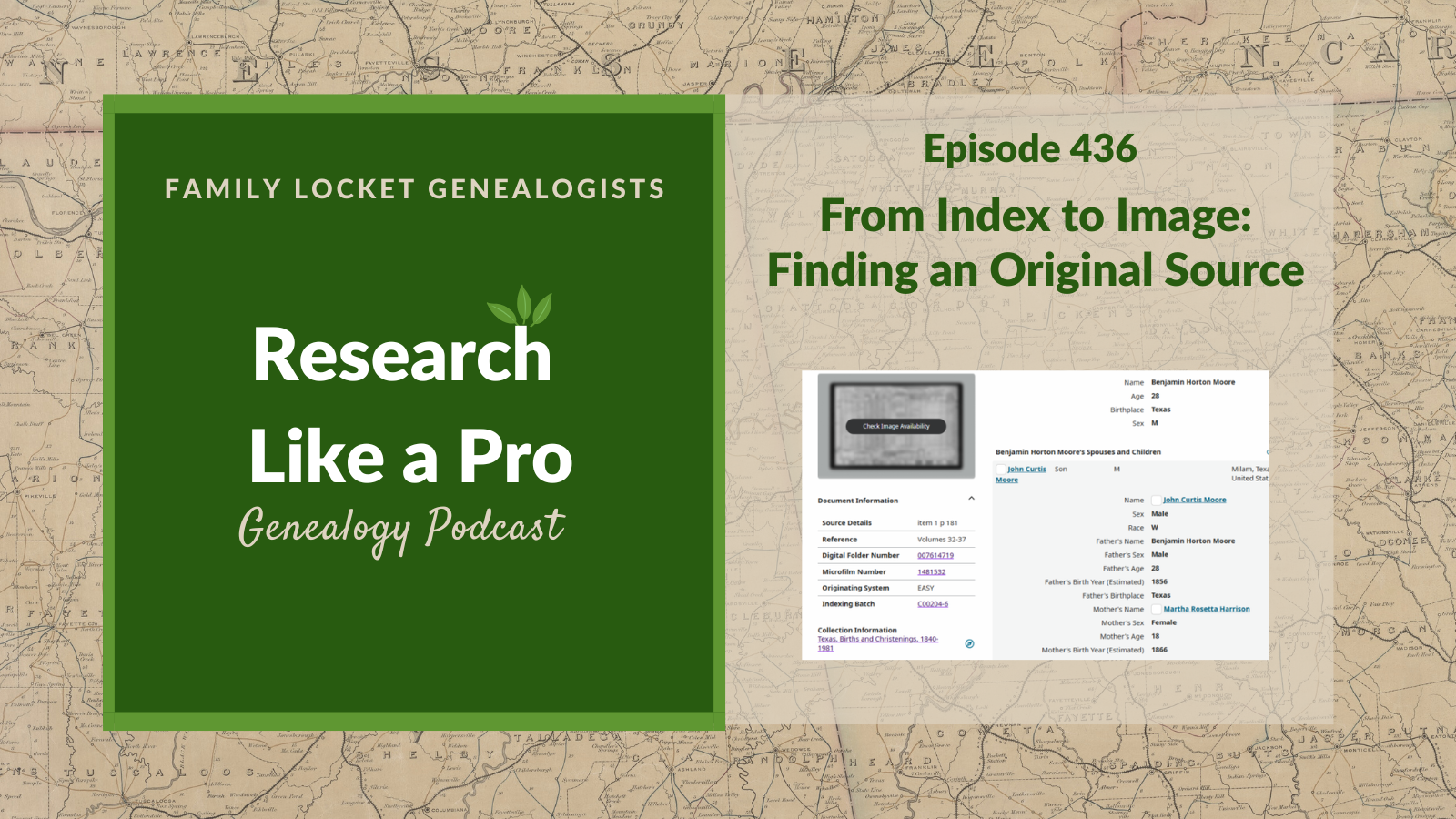
Diana and Nicole discuss the challenges of researching ancestors known only by initials, using Nicole’s search for Benjamin Horton Moore as a practical case study. They explain how to move beyond derivative indexes by locating and examining original records on digitized microfilm. Listeners learn how to interpret subtle clues in index entries, such as certificate numbers, to jump directly to specific images without manual browsing.
Diana and Nicole analyze the details revealed in the delayed birth certificate of John Curtis Moore, which provides direct evidence of Benjamin’s full name and birth details through a signed maternal affidavit. They review indicators showing why delayed certificates are created years after an event, including historical registration laws. Finally, they cover genealogical citation standards, demonstrating how to construct and shorten citations for original records in research projects.
This summary was generated by Google Gemini.
Transcript
Nicole (1s):
This is Research Like a Pro 436: From Index to Image–Finding an Original Source. Welcome to Research Like a Pro a Genealogy Podcast about taking your research to the next level, hosted by Nicole Dyer and Diana Elder accredited genealogy professional.
Nicole (41s):
Diana and Nicole are the mother-daughter team at FamilyLocket.com and the authors of Research Like a Pro A Genealogist’s Guide. With Robin Wirthlin they also co-authored the companion volume, Research Like a Pro with DNA. Join Diana and Nicole as they discuss how to stay organized, make progress in their research and solve difficult cases. Let’s go. Today’s episode is sponsored by newspapers.com. Hi everyone. Welcome to Research Like a Pro.
Diana (49s):
Hi Nicole. How are you doing today?
Nicole (51s):
Hey, I’m doing well. It’s raining here. It’s a beautiful fall day in Arizona. How about you?
Diana (56s):
Well, I’m doing well also And it is a little cloudy. We’re supposed to get rain, but not here yet. So, but something exciting came in the mail this week for me. It was my copy of the new book by Ethan Mollick, Coexistence the Next Phase of AI. So I loved his first book and which was written two years ago. And so of course we all know AI has just jumped ahead by leaps and bounds and so it’s really fun to get his up updated book and I just barely started it, but I know you’ve been listening to it. So what do you think?
Nicole (1m 30s):
Yes. Oh, it’s really fun. I love listening to Ethan Mollick’s books. I listened to his first one, Co-Intelligence, Living and Working with AI, and now reading, listening to Coexistence the Next Phase of AI. It’s interesting to hear his thoughts on Agentic AI and the Jagged Frontier has been a big part of the first half of the book that I’ve been listening to about how AI outperforms humans in some areas, but then can’t do simple tasks that seem obvious to us. And so it makes it so that we have to try and kind of experiment with AI to see what it’s capable of and what it can help us with and, and what it can’t do, and kind of where it fails so that we can use it as an assistant in ways that it’s capable of.
Diana (2m 22s):
Oh, I totally agree. And I’m on the jagged frontier part too. We just introduced that in the part that I’m reading, and I love that because I think sometimes we are so excited because it did something well that we think it is always going to do something well and we might start taking it for granted and quit checking it as much as we, you know, should. I think that’s maybe a danger to, you know, think that it’s a little bit too good. So as genealogists, we have to just keep on our hat for analysis, that’s for sure.
Nicole (2m 53s):
We do. We always have to be checking it. And it’s interesting in in niche, niche areas like genealogy or other specialized fields where AI may not have as much experience as far as what’s in it’s training data, what it can do in genealogy is interesting. It’s very jagged. It can do some things well, it can do other things poorly.
Diana (3m 15s):
Yes.
Nicole (3m 16s):
So we do have to check it out.
Diana (3m 18s):
I, I think it is very jagged. I love that. Well, let’s do some announcements. We are excited about the Research Like a Pro Institute course coming up January 7th, 2027. This is coordinated by Jan Joyce and it’s titled, Merging & Separating Identities: Advanced Techniques to Organize, Analyze, and Solve. So if you’re wondering if this is right for you, it is built for intermediate and advanced genealogists, researchers who have likely already run into several people who share a name, or one person recorded under several different names and want a repeatable process for sorting it out. If you have worked a merging or separating case of your owner for a client, you have a head start, though it’s not required for this course.
Diana (4m 3s):
The course uses Excel, fillable PDFs, AI platforms, and Airtable to apply its techniques. So if you’re familiar with these tools, that will help you. A working knowledge of spreadsheets is also strongly recommended, and having a case of your own in mind can help you apply the techniques as you go, though it isn’t required, but what you do need is the time to complete the pre-course common dataset work. So find out more about it. Go to FamilyLocket website and click on the shop navigation tab with a dropdown and then click on Institute courses and then you can see it and read through the overview as well as each session’s description. Well, coming up we have our Research Like a Pro Webinar Series for November.
Diana (4m 46s):
This will be held Saturday the 21st and it is, A Family for Michael Miller: A Case Study Using Y-DNA and Indirect Evidence. Our presenter is Alice Childs, who we love to have her present for us, such a great researcher and speaker. This is all about Michael Miller and he was born about 1805 in Pennsylvania. A lifelong resident of Adams County, Michael spent the latter part of his adulthood in Cumberland Township. However, records documenting Michael’s birth and Parentage had not been discovered. This case study illustrates the use of systematic candidate elimination along with Y-DNA testing to identify Michael’s father and ancestral family.
Diana (5m 26s):
So that will be great. It’s centered in Pennsylvania. We have pre-1850 census analysis, tax records, wills and estates, court records, and Y-DNA. Alice is an Accredited Genealogist® professional specializing in the US Mid-Atlantic states and is a researcher for us here at FamilyLocket Genealogist. We’re excited about our next Research Like a Pro with DNA study group. This starts in the spring 2027, February 3rd to May 19th. And it will be weekly on Wednesdays with some break weeks and registration opens in a month on December 1st. And if you want to be a peer group leader, go apply.
Diana (6m 6s):
The application is on our website. If you haven’t already, feel free to join our newsletter that comes out every Monday and see what we’re up to with new posts, upcoming lectures, coupon codes, and we are already thinking ahead to RootsTech, which is also coming up in a few months, March 4th-6th and registration is open so you can get your early bird pass right away or just for three days or just one day, And it’ll be online as well, which is free. And I’m giving three talks, Nicole’s giving three talks and we are just excited as always for RootsTech. Such a fun experience in spring, lots of things happening in the spring.
Diana (6m 55s):
We also wanted to just let everybody know that there is another Course Institute course at SLIG, and this is titled“Becoming an Accredited Genealogist® Professional: The Why, the What, the How”. This will be on Thursdays, March 18th to April 29th. So this is such a good opportunity to see what accreditation is all about. It’s led by a team of seasoned professionals including Lisa Stokes, Alice Childs, Karen Kowallis, Jenny Hansen, Bonnie Wade Mucia, Torhild Shirley, and Mindy Taylor. I know every one of those ladies and they are amazing. So even if you don’t want to become accredited, it’s really, really a good course to take just to learn how to be a better researcher.
Diana (7m 39s):
So you can head on over to the SLIG Spring Virtual website and go ahead and register for that as well. Lots of fun things going on, especially in the spring.
Nicole (7m 51s):
Right? It’s just a, a genealogy heyday in the spring. Today we’re talking about finding Benjamin Horton Moore’s full name. And this is a topic I drew from my kinship determination project for certification. And this was from the first generation, so the oldest generation, which is from a descending narrative. So you start with like an older generation, then you go forward one generation and then come forward. So the closest generation was my great-grandmother. So anyway, with this oldest generation in my KDP, it was John Christian Harris and Malissa Welch and one of their daughters, Martha Rosetta Harris, married Benjamin Horton Moore.
Nicole (8m 34s):
So I had planned to include Benjamin’s full name as Martha’s spouse in the child list for this generation. But the trouble was that every source I found recorded him as either BH Moore or Ben H Moore. And his Find a Grave Memorial gave his full name, but the headstone pictured on the memorial reads only BH Moore. So it was just another authored source. And all I had were authored sources, family trees. And so since the headstone itself didn’t support the full name, I wasn’t comfortable citing the memorial as an authored source as my evidence. His name also appeared in two index entries attached to his FamilySearch profile. Both of them were from the Texas, Births and Christenings collection from 1840 to 1981.
Nicole (9m 18s):
And each of those were sources naming Benjamin Horton Moore as the father of John Curtis Moore. That was a good lead, but the source of FamilySearch was an index, so it was a derivative source. So for the KDP, I wanted to find and cite the original record. So this episode we’ll just talk about how I tracked it down and why it’s important to get the original and all the fun things that go along with finding original sources to cite for our evidence for names.
Diana (9m 3s):
Okay, that’s great.
Diana (9m 44s):
And this, we run into this all the time on FamilySearch where we just have an index record. And it, you know, we wanna believe that that’s correct, but we really need to get, the original. Indexes are so good to help us find things. They’re great finding aids, but they are one step removed from the record and Indexers can misread the handwriting, skip the fields, leave out details that change everything about our interpretation. So the genealogy standards teach us to prefer original records and images over derivatives whenever they’re available. So think of an index as that signpost just pointing you to an original source.
Nicole (10m 27s):
Yeah, and we are so thankful for indexes because they help us find the originals. I mean, it would be really hard for me to know that there was a birth record out there for John Curtis Moore that said his father’s full name if I didn’t have that index. But then if I were to just cite the index, I would be citing a less high quality source. So I need to find the original inside that one. So to find the image behind the index, there are a few different steps. The first is to really thoroughly examine the indexed entry, And it showed a blurred thumbnail at FamilySearch with a check image availability button, and clicking that, it opened up the digitized microfilm.
Nicole (11m 15s):
The index was created from film number 7614719, delayed birth certificates from Milam County, Texas. And the film contained 1,801 images and there was no index at the beginning of it. And so I didn’t really fancy the idea of going through 1800 images. The index entry also didn’t link to a specific image, it just linked to the microfilm, all 1800 images in general. So I could have gone image by image, but of course that’s not efficient. Then there were two versions of the index entry, and you’ll see this a lot at FamilySearch where for some reason there are two attachments that refer to the same original source.
Nicole (11m 58s):
So maybe it was like indexed twice, or maybe it was filmed twice. But for whatever reason, this birth record for Benjamin’s son was attached to his sources twice. So looking at both of those versions helped a lot because one of them had a document information section with a little dropdown arrow, and if you don’t click on that dropdown arrow, you might miss the fact that it has a little bit more information there. And I was really hoping that one of these indexed entries would identify the image number. And so the first indexed entry had nothing, it had no page reference, but this other one listed in this little dropdown for document information, it had like four or five different things.
Nicole (12m 45s):
And one of them was source details, “item 1 p 181.” So that was really great and exciting.
Diana (12m 53s):
Oh, that’s great. So when you looked at the certificates on the film, you, the page 181 was actually a certificate number and that every certificate had a number handwritten in that upper right corner, and the images were arranged in numerical order. So interesting, you never know how they’re going to put these images together in a film, right? So then you could just type the number near 181 into the image number box in the upper left corner of the viewer and then adjust from there. So certificate 181 turned out to be image 186. So that was pretty close. And the reason why these image numbers rarely line up is because at the very beginning there’s often a few pages that say, you know, the date they microfilmed it and there’s like a black, you know, beginning black big box.
Diana (13m 40s):
You know, there’s some, there’s some beginning parts of the microfilm before they actually get to the records. And so that’s why you have to go, you know, go forward or backward a little bit. And it doesn’t take as long as going through 1000 images, that’s for sure. So one of the things that you need to do is when you’ve found that image is attach it to the person’s profile. And I always say put a URL in your research log as well, and record a full citation in your research log so you don’t have to search for it ever again. You’ve just got it.
Nicole (14m 17s):
Yes, that part’s so important, especially when you’ve had to browse in a microphone with 1,800 images. So what did the certificate reveal? It was a delayed certificate of birth for John Curtis Moore that was created in 1943. And John was born on February 28th, 1884 in Precinct five of Milam County, Texas. The certificate names his father as Benjamin Horton Moore, a 28-year-old white farmer born in Texas, and his mother is listed as Martha Rosetta Harrison, which it should have been Harris, so that’s funny, age 18, born in Milam County, and John was her first child.
Nicole (14m 57s):
So now that we have the original source, we have a conflict to look at: Harrison or Harris. Martha’s maiden name was typed as Harrison rather than Harris. So perhaps John told the clerk his mother’s surname was Harrison by mistake, or the clerk made a typing error. Who knows? But her given names and her husband’s name point to the fact that it was definitely Martha Rosetta Harris when correlated with all the other sources about the family. Now let’s have a word from our Sponsor. This Thanksgiving, think about what your family will still treasure years from now. Not another gadget, but a story. Give the gift of a Newspapers.com subscription. With over a billion pages of historical newspapers, Newspapers.com lets your loved ones find real pieces of their past: a birth announcement, a wedding write-up, a photograph from a small-town parade.
Nicole (15m 45s):
It’s a wonderful gift for the family historian, and a great way to get a curious teenager or a retired grandparent hooked on family history. The best part? You can explore together, and save, print, or share what you find with relatives near and far. Give a gift that preserves memories and starts conversations around the table. Visit Newspapers.com/FamilyLocket today for 20% off a subscription, for gifting or for yourself. Newspapers.com — discover the past, one story at a time.
Diana (16m 18s):
Okay, so there were several details that show that this certificate was created long after the birth. And we know that Texas didn’t begin statewide birth registration until 1903, so no certificate would’ve been filed in 1884 when he died. And the form reports that 13 of the mother’s children were living, which would be impossible in 1884 for a woman having her first child, but it makes sense if it was 1943. So Benjamin had died in 1938 and Martha was a widow of about 77 when the certificate was created.
Nicole (16m 53s):
Interesting that there were all those clues about the fact that the certificate was created later, while Martha herself appears to have signed the certificate in a shaky hand as Mrs. BH Moore of Burneyville, Oklahoma. With that signature, she certified that John was born alive at 6:00 AM on the date stated. Further down, she is named in Affidavit A, sworn in Love County, Oklahoma, deposing that the facts stated in the foregoing birth certificate were correct. The clerk may have gathered some details from John, so it’s hard to say exactly who supplied each piece of information. However, Martha signed the the certificate and swore to its accuracy.
Nicole (17m 34s):
As Benjamin’s widow, she had firsthand knowledge of his name. Her affidavit therefore supports his full name as primary information and direct evidence. The father’s reported age of 28 also correlates with his estimated birth year of 1856. The error in her own maiden name is a good reminder that even a knowledgeable informant can overlook a typo. That’s why correlating the certificate with the other sources is so important. So at the time I recorded this source, I only needed one citation from it for my KDP, so I didn’t transcribe the entire thing, but I did notice that it did provide the county of birth for Martha Rosetta Harris as Milam County, which was actually another helpful piece of evidence. So for this blog post, I went ahead and uploaded the certificate to Gemini to get a full transcription, and I put the results of that on the blog post that goes along with this episode, but it starts off by saying Texas Department of Health Bureau of Vital Statistics, Certificate of Birth 181.
Nicole (18m 30s):
Then it has the place of birth section. So it shows that John Curtis Moore was born in Texas, in the county of Milam and in the precinct number five. And the full name of the child was John Curtis Moore. He was a male and whether he was a twin or triplet or other was left blank. And then the number in order of birth was also left blank. Legitimate was listed as yes. And the date of birth was 28 February, 1884. Then there was a section for the father. So it had his full name as Benjamin Horton Moore, the residence of at time of birth as Milam County, Texas.
Nicole (19m 10s):
Color or race, white. Age at time of birth, 28 years. Birthplace, Texas. Trade, Profession or kind of work done: farmer. Industry or business in which engaged: farming. The next section is about the mother. So full maiden name was listed as Martha Rosetta Harrison. Residence at time of birth, Milam County, Texas. Color or race, white. Age at time of birth, 18 years. Birthplace, Milam County, Texas. Trade, profession, or kind of work done: housewife. Industry or business in which engaged: housewife. Number of children born to this mother, including this birth, first. Number of children born to this mother, and now living 12.
Nicole (19m 54s):
So that part is interesting because if it were supposed to be recorded exactly at the time as it were, he would’ve still been, you know, it still would’ve been one. But because this was a delayed birth certificate, they put 12. And then the last part here says, I hereby certified to the birth of this child who was born alive at 6:00 AM on the date, stated above signature Mrs. BH Moore address, Burneyville, Oklahoma. Then affidavit A in Love county, Oklahoma. It says, before me on this day appeared Martha Rosetta Moore, known to me to be the person who signed the certificate attached hereto, who on oath Deposes, and says that the facts stated in the foregoing birth certificate of John Curtis Moore are true and correct to the best of her knowledge and belief, and that she was acquainted with the facts at the time of the event.
Nicole (20m 40s):
Then she signed again, Mrs. BH Moore, sworn to and subscribed before me this fourth day of December, 1942. Then we have the notary signature, and it says, my commission expires 2-20-45 Mary Martin McKinney, notary public in and for Love, county, Oklahoma. Then affidavit B, we have another person who went ahead and deposed the same thing. Oh, not the same thing. Let’s read it, before me on this day, appeared, HM Worthen known to me to be the person who signed this affidavit, who on oath Deposes, and says that the facts stated in the foregoing birth certificate of John Curtis Moore are true and correct to the best of his knowledge and belief, and that he is acquainted with the facts and that he is not related to the individual by blood or marriage.
Nicole (21m 29s):
Signed, HM Worthen sworn to and subscribed before me this fourth day of December, 1942. And then Mary’s signature again. And then finally we have the judge’s attestation and signature. The birth certificate of John Curtis Moore here, attached here too was submitted to this court as provided for in HB no. 614, 46th legislator RS 1939. It is the order of this court that this record be accepted by the state registrar for filing in the State Bureau of Vital Statistics. Signed Jeff T. Kemp County Judge Date, January 27th, 1943 of Milam County. Alright, so now that we have the whole thing transcribed, then we can really understand the reason the document was created.
Nicole (22m 15s):
So it’s nice to read the full document and understand that. In the blog post that goes along with this podcast episode you can see page 19 of my KDP, where Benjamin Horton Moore’s full name appeared in the child list of John C and Malissa Harris. And then here’s how I cited the certificate. As you can see in the second half of footnote 220, it starts off with: Texas, delayed birth certificate, Milam County number 181, and then in parentheses the year 1943 because they restarted the numbering every year. John Curtis Moore, citing birth in 1884. So that part of the citation lets you know that it’s a delayed birth certificate and that the birth occurred in 84.
Nicole (22m 56s):
Then that’s the end of the first layer with semicolon punctuating that. And then we have the second layer, which is the digital layer, And it says: image, and then in italics, the publisher, which is FamilySearch, and then in parentheses, the full URL and the access date of December 13th, 2024. John Curtis Moore’s delayed birth certificate cited in footnote 220, supports Martha’s birth location in Milam County, Texas. The certificate is cited again for Benjamin Horton Moore’s full name in footnote 222, where it had been shortened without the URL. When a citation to the same source appears multiple times in the same work, subsequent appearances of that citation may be shortened to exclude unnecessary information.
Nicole (23m 40s):
So you only need to include enough information to help the reader understand which source this is from. And usually that means removing one of the layers of a citation, which was the digital layer in this case. So shortening a citation isn’t required, but for me, I was running up against a page limit, so I needed to remove as much as I could from the footnote section. So I ended up removing a lot of things by shortening all the citations that were repeated, which were a lot of them. So in conclusion, when an index entry says check image availability, don’t stop at the blurry thumbnail. The image may be waiting on an unindexed microfilm. Small details in the index, like a certificate number tucked into the source details field can take you right to it.
Nicole (24m 27s):
Comparing every version of an attached record takes only a minute, and in this case, it saved me from browsing hundreds of images. Best of all, Benjamin Horton Moore’s full name now rests on an original record in my KDP. Well, thanks for listening everyone, and we hope you have a great week. We’ll talk to you later. Bye-bye. Thank you for listening. We hope that something you heard today will help you make progress in your research. If you want to learn more, purchase our books, Research Like a Pro and Research Like a Pro with DNA on Amazon.com and other booksellers. You can also register for our online courses or study groups of the same names. Learn more at FamilyLocket.com/services. To share your progress and ask questions, join our private Facebook group by sending us your book receipt or joining our courses to get updates in your email inbox each Monday, subscribe to our newsletter at FamilyLocket.com/newsletter.
Nicole (25m 14s):
Please subscribe, rate and review our podcast. We read each review and are so thankful for them. We hope you’ll start now to Research Like a Pro.
Links
From Index to Image: Finding an Original Source for Benjamin Horton Moore’s Full Name – https://familylocket.com/from-index-to-image-finding-an-original-source-for-benjamin-horton-moores-full-name/
Sponsor – Newspapers.com
For listeners of this podcast, Newspapers.com is offering new subscribers 20% off a Publisher Extra subscription so you can start exploring today. Just use the code “FamilyLocket” at checkout.
Research Like a Pro Resources
Airtable Universe – Nicole’s Airtable Templates – https://www.airtable.com/universe/creator/usrsBSDhwHyLNnP4O/nicole-dyer
Airtable Research Logs Quick Reference – by Nicole Dyer – https://familylocket.com/product-tag/airtable/
Research Like a Pro: A Genealogist’s Guide book by Diana Elder with Nicole Dyer on Amazon.com – https://amzn.to/2x0ku3d
Research Like a Pro with AI Workbook – Second Edition (eBook) – https://familylocket.com/product/research-like-a-pro-with-ai-workbook-second-edition-ebook/
14-Day Research Like a Pro Challenge Workbook – digital – https://familylocket.com/product/14-day-research-like-a-pro-challenge-workbook-digital-only/ and spiral bound – https://familylocket.com/product/14-day-research-like-a-pro-challenge-workbook-spiral-bound/
Research Like a Pro Webinar Series – monthly case study webinars including documentary evidence and many with DNA evidence – https://familylocket.com/product-category/webinars/
Research Like a Pro eCourse – independent study course – https://familylocket.com/product/research-like-a-pro-e-course/
RLP Study Group – upcoming group and email notification list – https://familylocket.com/services/research-like-a-pro-study-group/
Research Like a Pro Institute Courses – https://familylocket.com/product-category/institute-course/
Research Like a Pro with DNA Resources
Research Like a Pro with DNA: A Genealogist’s Guide to Finding and Confirming Ancestors with DNA Evidence book by Diana Elder, Nicole Dyer, and Robin Wirthlin – https://amzn.to/3gn0hKx
Research Like a Pro with DNA eCourse – independent study course – https://familylocket.com/product/research-like-a-pro-with-dna-ecourse/
RLP with DNA Study Group – upcoming group and email notification list – https://familylocket.com/services/research-like-a-pro-with-dna-study-group/
Thank you
Thanks for listening! We hope that you will share your thoughts about our podcast and help us out by doing the following:
Write a review on iTunes or Apple Podcasts. If you leave a review, we will read it on the podcast and answer any questions that you bring up in your review. Thank you!
Leave a comment in the comment or question in the comment section below.
Share the episode on Twitter, Facebook, or Pinterest.
Subscribe on iTunes or your favorite podcast app.
Sign up for our newsletter to receive notifications of new episodes – https://familylocket.com/sign-up/
Check out this list of genealogy podcasts from Feedspot: Best Genealogy Podcasts – https://blog.feedspot.com/genealogy_podcasts/





Leave a Reply
Thanks for the note!