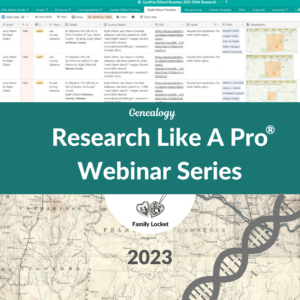
This episode explores the ongoing genealogical project to identify the biological father of Cynthia (Dillard) Royston, an ancestor who remains a mystery after years of research. Diana and Nicole focus on the fifth phase of this investigation, which involves utilizing DNA and documentary evidence to connect Cynthia to potential candidates among the Dillard men who drew lots in the 1832 Georgia Gold Lottery. Diana explains how she organizes this project using Airtable to track timelines...

Naturalization records are some of the most exciting finds for genealogists researching immigrant ancestors. They can tell us where our ancestor was born, when they arrived, and when they became a citizen of the United States. Recently, I found a record of William Henry Kelsey’s citizenship in a Utah County minute book on FamilySearch — and it got me thinking about the complex history of naturalization records in territorial Utah and whether more records might...

Diana and Nicole examine the ongoing research project to identify the biological father of Cynthia (Dillard) Royston. Diana summarizes previous research phases conducted through the Research Like a Pro with DNA study group, which have systematically tested Dillard candidates and narrowed the search using documentary evidence. She explains the genealogical background of Cynthia, who was born about 1815 in Georgia, and details the elimination of various candidates from earlier research phases. The discussion also covers...

One of the best ways to share your research is by writing a case study for publication in a genealogy journal. If it is a peer-reviewed journal, you also benefit from knowing that your research is sound. I recently published my first article in the National Genealogical Society Quarterly (NGSQ) and will share my experience and tips for anyone else interested in publishing. What is a Case Study? Your first question may be, what exactly...

Diana Elder and Nicole Dyer explore the value of writing an ancestor’s military story by correlating multiple sources. Diana uses her father Bob Shults’s World War II Navy records as a case study. She demonstrates how to use AI to cross-reference personal oral histories with official documents like muster rolls and discharge papers. Listeners learn how to build a comprehensive timeline that bridges the gap between limited personal recollections and formal military service records. The...

If you have an ancestor who is still a mystery despite years of research, you’ll relate to my Cynthia (Dillard) Royston project. I am currently working on phase 5 as part of the Research Like a Pro with DNA study group. Each phase has focused on a specific objective and has eliminated many Dillard candidates. Eventually, I hope to have one man left standing, whom documentary and DNA evidence point to as Cynthia’s father. In...

In this episode of the Research Like a Pro Genealogy podcast, hosts Diana and Nicole discuss the features and effectiveness of FamilySearch’s new “Simple Search” tool. They explore how this experiment allows users to search billions of full-text records using natural language queries rather than traditional forms. Diana shares her experience testing the tool with her father’s name, Bobby Gene Shults, demonstrating how the artificial intelligence parses results and helps distinguish between individuals with similar...

All of us see matches such as weehaa02, a cousin of mine, at Ancestry DNA®. Weehaa did not build a tree, nor did she provide any clues on her profile (location, age, surnames), yet I identified her, plus her 3 closest matches in 45 minutes. Figure 1 – Profile Tree View[1] To quickly identify Weehaa, I used the following process: Using Pro Tools, look at the Shared Matches and find at least one Shared Match...

Diana and Nicole discuss how genealogists use artificial intelligence to transcribe handwritten, foreign-language historical documents. They review feedback from a survey regarding experiences with various AI tools, including Transkribus, Gemini, ChatGPT, Claude, and Leo. The researchers report positive experiences, with average accuracy ratings between 7.5 and 8 out of 10. Listeners learn which languages, such as Spanish, German, French, Latin, and Scandinavian, are commonly processed through these tools. The discussion highlights that while AI excels...

If you have an ancestor who is still a mystery despite years of research, you’ll relate to my Cynthia (Dillard) Royston project. I am currently working on phase 5 as part of the Research Like a Pro with DNA study group. Each phase has focused on a specific objective and has eliminated many Dillard candidates. Eventually, I hope to have one man left standing, whom documentary and DNA evidence point to as Cynthia’s father. In...