
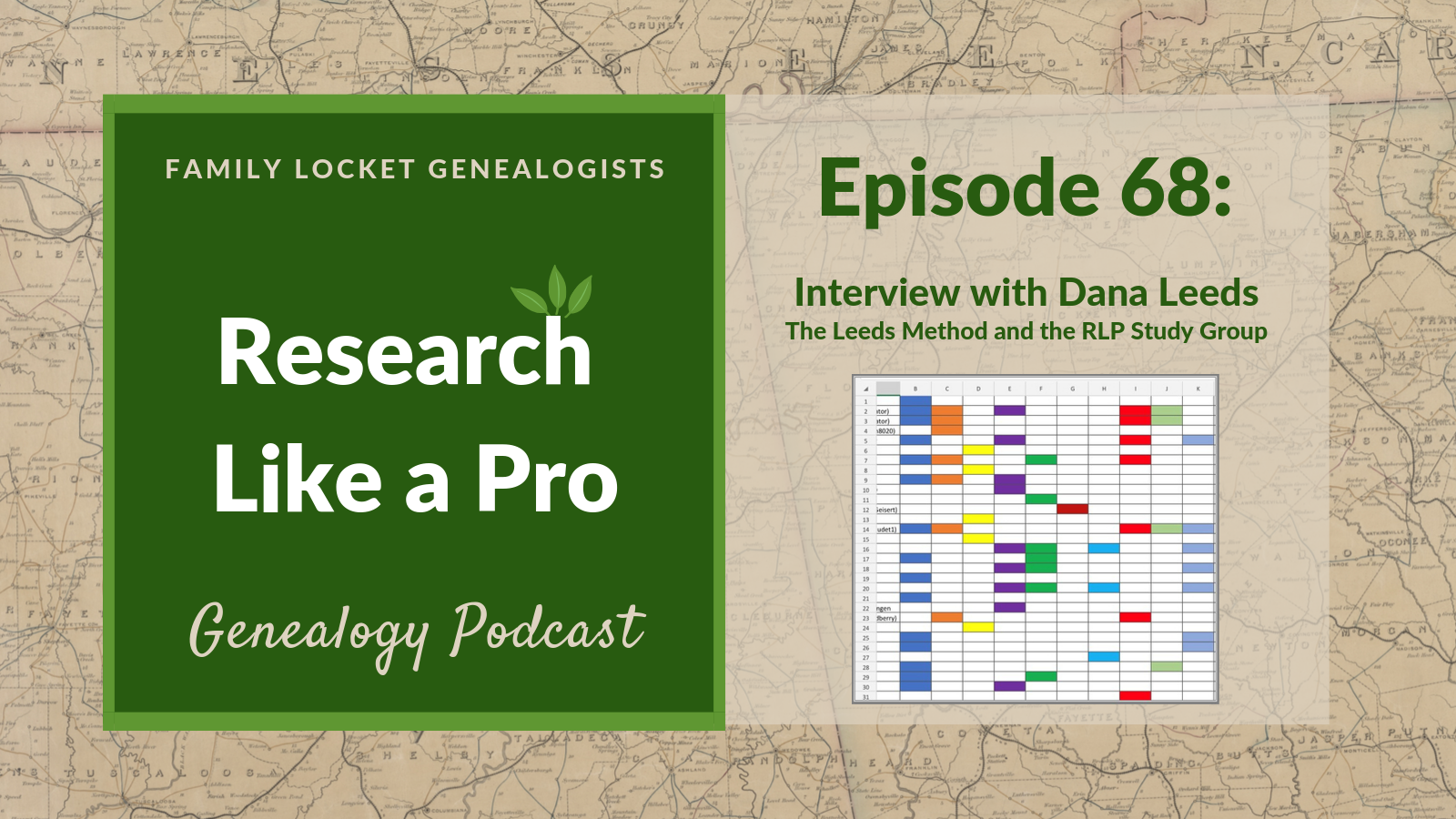
Today’s episode of Research Like a Pro is an interview with Dana Leeds about her method of color clustering DNA Matches. This is called the Leeds Method. When she first shared her method last year, it became an instant success. The Autocluster reports created at Genetic Affairs and the Collins Leeds method are both based on the Leeds Method of color clustering. Listen in to hear all about the Leeds Method and Dana’s experience doing the Research Like a Pro study group.
Transcript
Nicole (1s):
This is Research Like a Pro episode 68 Interview with Dana Leeds. Welcome to Research Like a Pro a Genealogy Podcast about taking your research to the next level, hosted by Nicole Dyer and Diana Elder accredited genealogy professional. Diana and Nicole are the mother-daughter team at FamilyLocket.com and the creators of the Amazon bestselling book, Research Like a Pro a Genealogists Guide. I’m Nicole co-host of the podcast join Diana and me as we discuss how to stay organized, make progress in our research and solve difficult cases. Let’s go.
Nicole (46s):
Hi everyone, welcome to the show. I’m Nicole Dyer co-host of The Research Like a Pro Genealogy Podcast. I’m here with accredited genealogist, Diana Elder. Hi, Diana, how are you?
Diana (56s):
I’m doing great today, thank you.
Nicole (58s):
We’re also here with Dana leads. Hi, Dana. Hi, we’re so glad to have you on our podcast today. Thank you for coming.
Dana Leeds (1m 5s):
Thanks for having me.
Nicole (1m 7s):
Well today, we’re going to be talking with Diana about the Leeds Method that she came up with for clustering our matches. We’re also going to talk about her experience in the Research Like a Pro study group. So we have a lot of fun things to cover before we do that. We have our listener spotlight from KathGirl, and she titled her review, “a great way to learn about research methods in genealogy”. She says, “I found your podcast a few months ago, just as I was starting up genealogy after a 25 year hiatus. It’s helped me a lot on our particular brick wall we’ve been working on for 60 years. Using your methods, I’ve been able to do a timeline on my great-great-grandmother and determined that although she married at least three times, her only child to live to adulthood was my great-grandmother, but we don’t know my great-grandmother’s father.
Nicole (1m 55s):
She refused to tell my grandmother his name. We have a possible last name, but that’s all I have. My grandmother’s generation have all died. So testing them is not possible. There are some great-grandchildren who could possibly be tested. Does it make sense to try DNA for this type of question? Does it make sense for me to be tested for this question?” So that was a great review and a great question from KathGirl. Let’s ask Diana and Dana, what do you guys think?
Diana (2m 21s):
Well, my first thought was absolutely that she should be tested, and then she should get some of the other great-grandchildren tested also because they will have received different pieces of DNA from that great, great grandmother. And absolutely you can find that individual looking at my great-great-grandparents. I have so many matches from all of them. So yes, this is a very solvable research problem with DNA. What are your thoughts, Dana?
Dana Leeds (2m 46s):
Well, I agree. DNA is a great tool to use for this case. Clustering, that we’ll be talking about in a bit, with the Leeds Method is a great tool to help you identify that specific branch and the other cousins who might be related through that unknown great-great-grandfather, I believe, or the parent of the great-great-grandmother and also since you have a possible last name, once you get that list of results, you can search for that possible last name and see if you find a connection that way.
Nicole (3m 14s):
Those are great answers. I think that will be helpful. And I’m excited that our review and spotlight and question had to do with our subject today. So let’s jump into talking about the Leeds Method and color clustering. So why don’t we do kind of some background information about Dana first?
Diana (3m 33s):
Okay. So I was excited to meet Dana in person. It was a year ago in Kansas city and we were at the Association for Professional Genealogists conference. And it was fun because she had signed up for our Research Like a Pro study group for that fall session, but then her Leeds Method was taking off and she was being asked to speak all over the place and she was feeling really busy. So she asked if she could defer to the spring, but at the same time, we were able to meet in Kansas city and then we got to work with her in the spring. So it was so fun. So Dana, can you just tell us a little bit about how you even got started in family history and your background in genealogy?
Dana Leeds (4m 14s):
Sure. I started doing genealogy about 21 years ago when a part of my family was having a family reunion that summer and I had moved out of state and wasn’t going to be able to attend, but in the information packet, it showed that my great-aunt was bringing our family history and I reached out to her and started talking back and forth with her. And she got me excited about family history and I started researching and of course love this fascinating hobby/profession. And then about five or six years ago, I got started with DNA testing. And of course that’s a big part of what I do now is work with DNA.
Diana (4m 51s):
I forgot to even ask, you are in Texas, in what part of Texas are you?
Dana Leeds (4m 55s):
I’m in Houston on the north side in a, basically a suburb called the Woodlands, Texas.
Diana (5m 1s):
So where your ancestors all Texans?
Dana Leeds (5m 3s):
No, I’m actually the first generation to live in Texas. I grew up in Kansas. My dad’s family was from Kansas and then we moved to Oklahoma when I was a young teenager and I moved from Oklahoma after I got married down to Texas with my husband in the oil and gas industry.
Diana (5m 21s):
Oh, interesting. That’s so fun because all of our ancestors on my paternal side come out of Oklahoma and Texas, but Nicole and I have never been there. So there you are living where we need to go and do some research. So how did you come up with the Leeds Method? I think that’s what everybody wants to know. It’s so amazing what’s happened with this and I think we’re also grateful that you did, but how did it come to be?
Dana Leeds (5m 46s):
Last year, I started working with an adoptee who contacted me through a friend and he was one of those surprise adoption cases where he thought his parents were his biological parents and testing proved otherwise. So he was looking for his biological parents. And as I started working with him, I had only worked with a few adoption cases previously. And I didn’t actually know what other people, what tools they used, how they organize their DNA matches to identify biological parents. And in this case match after match, after match kept being from one side of his family. And I was trying to figure out if there were any matches from the other half of his family.
Dana Leeds (6m 27s):
And that’s how I came up with the Leeds Method, was I was trying to separate the two sides of his family. And it ended up, it wasn’t until match number 28, or maybe it was 38, but it was way down the list that we had a match from the other side of the family, but creating this chart in Excel, this spreadsheet, helped me identify the other side of his family. So that’s how it got started.
Nicole (6m 49s):
Wow. That’s a great story. I love that. And how interesting that he had so many matches on one side and close matches. I’ve found that to be the case with my father-in-law, I’ve been working on his DNA results and he has a lot of matches on one side of the family that are really close. And then it’s harder to find that other side. How can people use the Leeds Method to solve their genealogical problems? You mentioned an unknown parentage case. How can people use the Leeds Method for other types of things?
Dana Leeds (7m 19s):
Anyone who’s working on a closer genetic relationship, so back five, six generations can use this method. It helps them to organize their DNA matches and identify what part of their family different DNA matches are from. And it also can help them isolate for a particular brick wall problem or whatever research problem they’re looking for, It can help them isolate so they can work on a specific research problem.
Nicole (7m 44s):
That is great, that we can use the Leeds Method to separate our matches. I think that’s one of the most important building blocks for starting to use DNA in our genealogy research. Without knowing which side of matches on it’s a lot harder to know how to use it. So it’s a wonderful system.
Diana (8m 2s):
And I would second that. I first tried the Leeds Method when I was sitting, waiting for a concert, which sounds kind of funny, but we were in this huge waiting area. And I think I had an hour to go and I’d been hearing so much about Leeds Methods. So I just opened up my phone and I went to your blog and I followed your steps. And I did it in like 15 minutes. It was really so simple and I love the simplicity of it. I think that’s what has made it so popular that it doesn’t take anything really difficult. So Dana, why don’t you lead us through the steps? You know, if you were looking at a brand new, let’s say a client case and you were going to get started, what would you do?
Dana Leeds (8m 41s):
Sure. So to get started with the Leeds Method, you can either use a spreadsheet like Excel, or you can just use paper and pencil or your iPhone or whatever you want to use, but you start by listing some of your matches. And specifically we use second and third cousins or between the range of 400 and 90 centimorgans. So we list those second and third cousins on a spreadsheet. And then we assign a color to the first person on that list. Then we look at that person’s shared matches or they’re in common with. Those are people who matched both you and whichever cousin you’re looking at. And everyone who has a shared match with that original person, so for example, the first person you assigned a red color, all of their shared matches also get that red color.
Dana Leeds (9m 28s):
And then you go back to the highest person on that list, that list of second and third cousins, and the highest person who doesn’t already have a color, gets a new color. So maybe blue. And you open that blue person shared matches, and they all get blue. And you keep repeating that step until everyone on your list of second and third cousins has at least one color and then your initial chart is complete.
Diana (9m 52s):
I love the colors. I think that’s one of my favorite things is that you use color because it’s just fun. And you can actually use those colors to correspond with your Ancestry shared matched dots, right?
Dana Leeds (10m 6s):
Absolutely. You can use the new Ancestry custom groups, those colored dots. And after you’ve created a chart of a Leeds Method chart, then you can use those same colors and assign those dots in Ancestry and you’ll have it right in your program.
Diana (10m 20s):
We had an adoption case and we totally used the Leeds Method and used all the colors that we had identified, and it was so nice to have everything color coordinated, because we could see at a glance, which branch of the family, they came from on Ancestry, on LucidChart and then the Leeds Methods. So I just really applaud you and thank you for coming up with it because it does break it down in a simple way that it’s just wonderful.
Nicole (10m 46s):
So I have a thought or a question. So the first time I tried the Leeds Method, I was using a kit that had a lot of like first cousins once removed. And I think sometimes those can be confused with second cousins. Is that right? Like the number of centimorgans?
Dana Leeds (11m 6s):
Absolutely. So I usually say 400 as the cap on the maximum number, because usually you’re safe to not have any first cousins between 400 and 90. But if you do have any first cousins, particularly first cousins once removed or twice removed, that are in that range. Absolutely, you should ignore them on this initial chart because they can tie two of your colors together and you’ll get one color instead of the two colors. So you’re trying to use real second and third cousins and not those first cousins, but again, if you know who they are, you can leave them out. If you don’t know who they are, because it’s an adoption case. That’s why we use those numbers to try to be as safe as possible to get just second and third cousins.
Nicole (11m 47s):
That’s great. Learning that the first cousins were throwing it off, it really helped me to understand the generations and the differences, but also the centimorgans and just, it was just a really good learning experience for me the first time I tried it, because I really got to understand how things work. So if it’s your first time and you are just learning about DNA, doing the Leeds Method can really help you see a lot more beyond just the clusters, but understand how the centimorgans work and how the relationships work as well. But yeah, I think I ended up just eliminating those first cousins once removed from the initial chart, and then it separated out more nicely into more groups. So now can you tell us what happened after you shared your Leeds Method?
Nicole (12m 30s):
What happened and what kind of took off with the developments and clustering in the genetic genealogy world?
Dana Leeds (12m 36s):
So all this happened back in May of last year, May of 2018 and over the next few weeks and months, I guess I shared it with a couple of close friends who also work with genetic genealogy and they were really interested. So I went to GRIP in July, late July of 2018. And I was in the Advanced Genetic Genealogy course with CeCe Moore as the head person and Blaine Bettinger was the other major teacher. And as I went through this class, I shared it again with a few of my new classmates, new friends I’d met, and they were excited about it too. So I, I kind of got up the nerve on the last day to talk to Blaine who I’d not really met in person before, but I talked to him and he’s awesome.
Dana Leeds (13m 18s):
And I went up to him on the last day, the last morning and shared with him briefly what I had done. And he was really excited and he said, write it up, share it with me and I’ll share it in his Facebook group that it’s got 60,000 members, Genetic Genealogy Tips and Techniques. So I wrote it up and he shared it and it just exploded from there. And it was amazing. The other interesting thing is that I had a few different names, I was trying to name it, and I often just talked about it, I didn’t really give it a name, but Blaine kept calling it the Leeds Method. And he said, when you do the Leeds Method…so that’s how it got its name. I was kind of trying to avoid that.
Dana Leeds (13m 60s):
I was a little embarrassed to have my name stamped on it, but I’m so thankful that he did keep doing that. And now that is known as the Leeds Method.
Nicole (14m 7s):
Oh, wonderful. I’m so glad that you shared it because look at how many people it’s helping and how awesome that Blaine was so instrumental in the growth of this field. And it’s wonderful that he has such a great Facebook group and I’m a member of that too. We love it. So I’ll put a link to that Facebook group in the show notes, if anyone listening wants to join, because it’s a great way to get these kinds of wonderful updates about methods and developments that can help us with our genetic genealogy. So after this got shared within the group and people started doing the method, I know there’ve been a lot of developments with autoclustering and stuff as well. Did you want to say anything about that?
Dana Leeds (14m 44s):
So a man named EJ Blum, call him EJ, he’s from the Netherlands. So EJ had contacted me. He showed me what he was doing. He was automating this method and that method ended up being called Autocluster. So he released that in about December. And I went to speak at the International Genetic Genealogy Conference hosted by CeCe Moore that year in San Diego. And during that time, I also started talking to two guys, John Collins and Rob Warthen of DNAGedcom, and they were also wanting to create an automated tool based on that. So they named that Collins-Leeds Method that’s on DNAGedcom. So both of those tools have automated this technique and they are powerful tools that I use myself.
Dana Leeds (15m 29s):
They’ve also both integrated additional tools. And then there’s a couple of other guys who have also created automated tools based on the Leeds Method. So it is continued to spread and grow both with the traditional Leeds Method and then these automated tools and all of it is great and a great addition to the genetic genealogy community.
Diana (15m 49s):
So do you have any ideas about the future?
Dana Leeds (15m 52s):
I do, I guess. So I talked to the guys behind Autocluster and the Collins-Leeds Method pretty regularly, but sometimes they surprise me and they make a new tool announcement that they hadn’t shared with me before. And they’ve had great tools even in the past few months, especially Autocluster, which is probably has the most additional tools. But I think the biggest thing that people are pushing for, and we’re trying to figure out how plausible it is, is trying to figure out a tool where you can work from multiple testing sites. So if you’ve tested at Ancestry and Family Tree DNA, and 23andMe or whichever sites, that you can take those and create clusters based on all three sites. And I’m not exactly sure if that’s going to work or not, but one of the latest things we’ve been talking about are using surnames and finding the surnames that repeat in a specific cluster.
Dana Leeds (16m 40s):
So maybe it’ll be possible to look at those surnames and in that way, bridge that gap between different testing sites.
Diana (16m 48s):
I think it’s really fun to still look at how far DNA has come and the tools that we have now. It’s amazing what you can do if you just get that basic understanding of DNA inheritance and how to use the tools, there really is so much that we can do. And it’s exciting to think about what might be in the future. So well, is there anything else that you want to share with us about the latest method before we move on?
Dana Leeds (17m 11s):
Sure. So some tips. So we talked about how the initial chart is based on second and third cousins, but Nicole, you mentioned how you had to remove some of those first cousins once removed to be able to have the clusters form as expected, I guess I would say so. After you’ve created that initial chart with second and third cousins, you can definitely add back in those higher matches. So we’re often going to get four grandparent groups when we do the initial charts. So there’s four colors representing the four grandparent groups. And so your first cousins will share two of those groups instead of one or three or four. So they often share too. So another tip is often people are expecting to see four colors because we talk a lot about the four colors and the four grandparents, but not everyone will get four colors.
Dana Leeds (17m 58s):
And to get four colors, you need to have second and third cousins who have actually tested at that specific site for each of those four grandparent lines. So if there’s a specific grandparent and nobody’s tested at the second or third cousin level, you won’t see that fourth group. Also, you need to have populations where your four grandparents aren’t related in the past, because if they’re related in the past, they share common DNA, and again, those two groups could merge instead so you might see three instead of four groups. And some people will show more than four groups. They might show five or six or seven, and sometimes we can combine those and still figure out the four groups from there. Or you might find lots of groups and lots of overlap.
Dana Leeds (18m 41s):
So lots of people with multiple colors. And sometimes that’s the case of what we call pedigree collapse or endogamy, where basically ancestors have inter-married. It can be more like what we call pedigree collapse, where you have instances of first cousins marrying first cousins, particularly in the 1800s or maybe 1700s when it was very acceptable, but that mixes your DNA. Or endogamy like specific populations like the Ashkenazi Jewish populations or island populations, but where there was a limited gene pool because they were only married within that specific group. So again, the DNA is hard to work with then because everybody’s related to each other.
Dana Leeds (19m 22s):
So those are a few of the questions I get the most is why do I not have those four groups? And that’s a few of the reasons why you might not just automatically see four groups.
Diana (19m 33s):
Oh, very interesting. I think that you just have to get in and try it, right? If you don’t get in and start mapping out your matches, trying to figure out some way to make sense of it, you’ll never really make any progress. So would you just suggest that for the true beginner they just go to their Ancestry match list or My Heritage match list?
Dana Leeds (19m 54s):
Absolutely. Just give it a try, go to my website and look at the step-by-step guidelines and try it and see what your results are. And if you have questions, there are additional post on my website. You can reach out to me or you can reach out on again, that Facebook group, Genetic Genealogy Tips and Techniques, where there are a lot of people who have a lot of experience with these charts and give feedback, including myself. And if you’re doing one of the specific automated tools like Genetic Affairs, the Autocluster, or the Collins-Leeds Method, they also have user groups on Facebook. And again, the actual guys who did the programming often are on there basically every day, answering questions and other users who have a lot of experience.
Dana Leeds (20m 34s):
So they can give you feedback on what you’re seeing.
Nicole (20m 36s):
I’m going to add links to those in the show notes so that our listeners can find those user groups and the websites that they need to get started with those auto clusters and the Collins-Leeds Method. So thanks for mentioning those.
Diana (20m 48s):
Great, well, thank you for sharing so much about the Leeds Method. It’s just really fun to get to talk to you about it. So let’s move on and talk about your experience with the Research Like a Pro study group. Why did you want to join the study group? How did you hear about it?
Dana Leeds (21m 3s):
Well, I don’t remember how I first heard about Research Like a Pro, but it was sometime last year and I got a Kindle edition of the Research Like a Pro book, which is how I used to read books. And I was really excited about the process, but I kind of needed that accountability of a group to help me walk through it. And the other thing is so much of my time anymore is spent on genetic genealogy and the Leeds Method and answering questions and doing presentations that that’s primarily what I do is work on DNA. So I wanted that time to work on my own family and a specific problem, and to learn more about how to Research Like a Pro and have those deadlines and get feedback from others. So that’s why I wanted to actually join an online group and be a part of that.
Nicole (21m 47s):
That’s something that I really appreciate about study groups as well, is that accountability. And it gives me a deadline to get things done. So I’m like you in that. Tell us what your objective was for the Research Like a Pro study group. What were you trying to work on?
Dana Leeds (22m 2s):
Okay. So my objective was to identify the father of Lenora Mace Dixon, who was born in September, 1823 in Tennessee, married Matthew J. Dickson on the 5th of January, 1843 in Perry county, Tennessee, and died the 22nd of February, 1909 and Marsh Creek Perry county, Tennessee. So basically to identify the father of this specific ancestor, that was my objective.
Nicole (22m 26s):
Very good. And was she one of your direct line ancestors?
Dana Leeds (22m 31s):
She is my direct, I believe, great-great-grandmother.
Diana (22m 33s):
So the next step after you’ve got your objective, all written out is to go back and look at everything that you had found. So had you been researching this particular ancestor for a long time or was this relatively new research?
Dana Leeds (22m 48s):
So Perry county, Tennessee, we mentioned pedigree collapse when I was talking about the Leeds Method and DNA, so Perry county Tennessee is my little community on my maternal grandmother’s side, where for over a hundred years, well, people are still living there today from this family, so 200 years, but especially throughout the 1800s, all of my family, all of grandma’s family was from that county. And so cousins were marrying cousins. So I have worked on that county and all these relationships because I have many direct ancestors from there. I’ve worked on them since 1998. When I started, this was my first part of the family to work on. And it was my first genealogy trip back in 1999 with my mom and an aunt. So I’d worked in general on Perry county, Tennessee, and I would pull books or look at records and look for all of my family in that specific place.
Dana Leeds (23m 36s):
So I had worked with Lenora, but I hadn’t specifically worked on, I just want to find her father.
Diana (23m 42s):
Interesting. So when you put everything into your timeline and really analyzed it, did you have any surprises?
Dana Leeds (23m 48s):
I don’t think I had any surprises, but it was such a great tool and technique to get everything in one place, everything I had ever gathered about her in one spot and to go into that kind of detail and be able to then have this timeline and look for gaps and analyze each specific piece of evidence I’d found.
Diana (24m 8s):
Yeah, it really makes a difference doesn’t it? Having it all there in a timeline is amazing how it orders your brain and orders the research. I feel like it gets everything out of your brain and onto paper so that your brain is freed up to think about other things.
Dana Leeds (24m 22s):
Right. And it did help me, I guess this could be the surprise, I guess I found, so doing that project, one of the records I had was a Bible and I knew I had to dig through a bunch of stuff to find the actual images. But as I really started analyzing that record for the first time and found when it was published, which was 1878 and she was born in 1823. So it had her birth date in there, but I was able to analyze that, that had happened way before this Bible was made. So of course that was secondary information. Somebody wrote that down at a later time, but I also, through that analysis was able to realize she was still alive. So she was 55 years old at the time.
Dana Leeds (25m 3s):
It helped me understand that information better and how reliable I thought it might be.
Diana (25m 7s):
That is such a great example. And I remember that we all looked at your Bible record and had some varying opinions about that, because that was so interesting and so fun to analyze. And I think so many times when we look at a record, we just take that information at face value and we just say, oh great, there’s the first record, and we don’t stop to think, oh, who gave the information? How reliable is this? So it’s one of my favorite parts of the process too. It’s, it’s just so fun to just get that stuff in order and in that timeline.
Nicole (25m 37s):
Well, after the timeline is the locality guide assignment. So what was your experience with that?
Dana Leeds (25m 44s):
So that was one of my favorite exercises, my favorite parts. Again, I had worked with Perry county I’d started back in 1998, basically working with Perry county records and actually visited in 99. And I thought I knew a lot about it. I had found many, many records, but to actually create that locality guide gave me specifics I didn’t know. So for example, I knew the county had burned, but I hadn’t paid a lot of attention to that. And I knew there were records I couldn’t find, but as I made that guide, I was able to find specifically when it burned, which was 1863 during the Civil War, but then it also burned a second time, which I didn’t write down here, but it was 19 something. But the first burning of the courthouse specifically told me that we’d lost marriage records between certain years and probate records between certain years.
Dana Leeds (26m 32s):
And I had never really keyed in on that, that that’s specifically why I’m not seeing these records. So it kind of all jelled in my mind. And also as part of that process, so just looking for those specific categories, having that kind of checklist, where we were supposed to look for church records, and court records, and military, and tax records, and all the different categories helped me look for things that I had not thought to look for before and find where can I access those records, whether it’s online or in person, or someplace I could write to, but looking for where I could access those records and these record groups was very helpful.
Nicole (27m 8s):
I love that. It’s so fun to look for all the different record groups and it’s so tempting to search them right when you find them, if they’re online and indexed. But that is really interesting also about the courthouse burning twice. I have found that as well with some of the counties, and isn’t it awful to think that they had so much record loss. But it’s amazing the things that we can find for workarounds with that from the state and federal records and other collections that could fill in the gaps. So, cool. Good job on that.
Diana (27m 40s):
So after you had your objective, you’d done your timeline analysis and your locality guide, you were ready to do some research planning, and this is often a step that people don’t take. So I’m just curious, had you done any research planning on projects before and you know, what was your whole experience with this part of the process?
Dana Leeds (27m 59s):
So I had done some research planning in the past, but it was always as a part of some online course, but like Nicole mentioned for the most part, when I see some record or I find something, I usually just jump in and start looking at the index or looking for that specific person, but this was another good practice. And actually going through that locality guide that I’d created for this county, and looking at each category and seeing what were the possible next things I should be looking at to answer that question of who her father was. What records might answer that question? And specifically listing them and not being just online, looking for that next shaky leaf or that next quick hit that quick answer, but being more methodical was really helpful.
Diana (28m 46s):
I agree. And I have found that now, if I sit down to research and I don’t have a research plan, I feel so lost. It’s so easy to just get back in that habit of jumping from website to website, because you don’t know what you’re looking for and you are just hopping around. So yeah, working from a plan is amazing. So I’m glad that made a difference.
Nicole (29m 7s):
Well, next is actually searching your plan. And then as you do that, making source citations and research logs, well, a research log with multiple entries. So tell us about that assignment. How did it go with doing the source citations and the log?
Dana Leeds (29m 23s):
Well, I still find citations really hard, so that was pretty time-consuming to me looking for examples of specific types of records in the citations and just studying Elizabeth Shown Mills’ Evidence Explained and trying to understand what the parts are, how to put it in order, and as Diana taught us also, but creating these citations. But so actually my next part of my personal becoming a better genealogist plan is this summer I’m going to be at GRIP and I’m going to take Tom Jones’ Mastering the Art of Genealogical Documentation. So I’m hoping that is a great place to get me where I’m just more comfortable and I will do it automatically and not fret about it or sweat about it because it’s still kind of scary and trying to figure out exactly what’s supposed to be in that citation.
Nicole (30m 8s):
It was the same way for me too, when I first began trying to keep citations in my research log and it took a lot of time and it took several client projects where I had to really get used to doing citations a lot to finally start feeling comfortable. But I’ve noticed that even if I take a break for a few months and I’m not working on a project or making a lot of citations, it feels like I have to go relearn. So it is something that, you know, when you’re doing it a lot, it feels like a second nature. But then if you take a break, you have to warm back up again almost.
Dana Leeds (30m 40s):
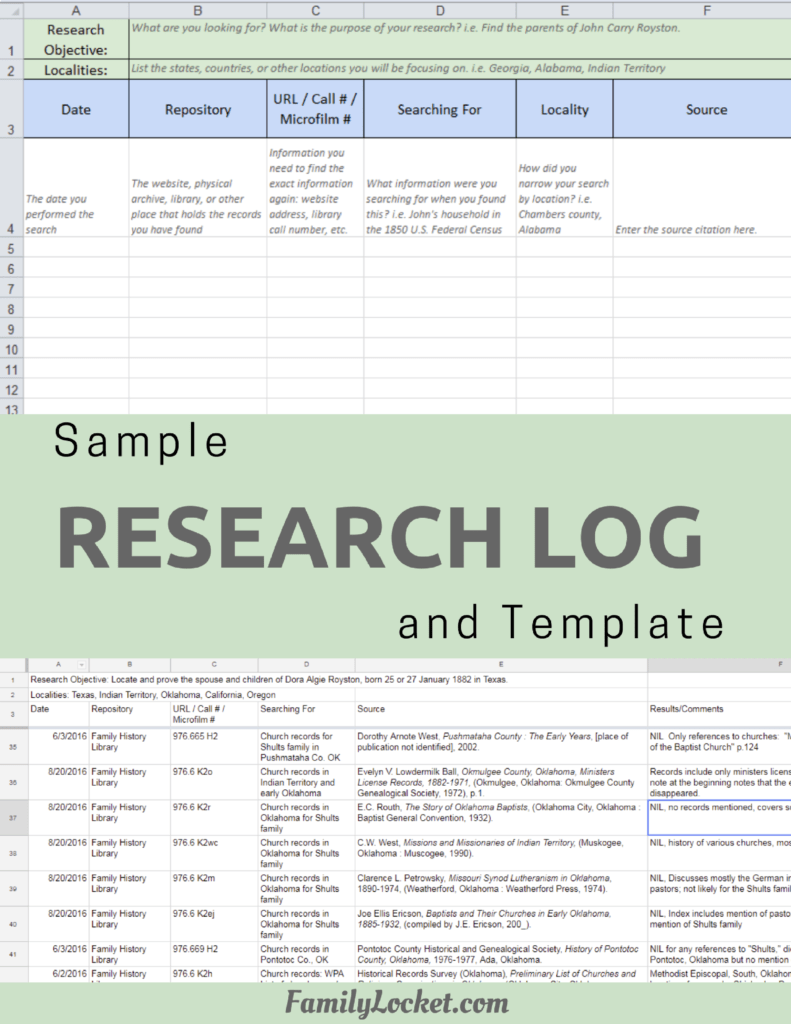
So the second part you were asking about was the research logs. This might’ve been the most important tool that I used. We had specific categories kind of that you talked us through, and then you were able to add additional categories. So I have Excel spreadsheet: I have the date repository, the URL, what specifically I was searching for the locality, which was always Perry county, Tennessee, the year, whatever event took place, and then that dreaded source citation and that very important source citation. My other categories were results, and under results, I was either transcribing or creating the extraction or specific information I found. And then I had a column for FAN club, and this was important on my specific problem because so much of what I was doing was census research.
Dana Leeds (31m 29s):
And it was finding those other people by the surnames or the related surnames that I knew, and seeing how close they were on the page, were they right next to them, were they a few names apart or where they pages apart. But seeing that FAN club that was very helpful. And my last category was the analysis. And I spent so much time here and on this specific page, being able to look at all the census records that I had transcribed or extracted and analyze person by person and place by place and those 1830 and 40 tick marks and trying to figure out who all these tick marks were. But doing that analysis, that was where I spent a lot of my time was just analyzing and comparing the different records and coming up with some results.
Diana (32m 13s):
I love that, and I really can feel your pain working in Tennessee with those early census records. I’ve done so many projects there and done that same analysis going through them and trying to see if this is the same person and the children be in this family and all that. I think that’s so fun that you were working in one of those burn counties, because it helps everyone listening to realize that you actually can research those areas and have some success and make some progress. So I’m so curious because I can’t really remember, it’s been a while since our study group, but what did your research reveal?
Dana Leeds (32m 49s):
So on my research report, I was not able to solve the question, but I did make a lot of progress, and I believe I’ve narrowed it down to two specific families who were in the census and two tick marks at different years. But these two particular people who were listed just as tick marks and I believe Lenora was one of those, I do need to do additional research. Again, most of what I analyzed was just the census records. And I have books on the land records of Perry county, Tennessee. I know I need to dig into those more, just writing up everything was a great exercise. And one of the best things about it of course, is that now at any point, I can just pick that up and read back through it and remember where I was at.
Dana Leeds (33m 31s):
But if you’ll remember when I was going through this class, I was in a lot of pain, I was awaiting neck surgery. I had a disc that was bulging and pinching nerves. And by the end of this, I was getting really close to my surgery date and in a lot of pain. And I didn’t get to spend a lot of time that last few weeks on the research report, but it was still very valuable. And I look forward to picking it up again, hopefully sometime soon, and getting to work on that problem again.
Diana (33m 59s):
Will you just going to need another deadline, right?
Dana Leeds (34m 2s):
True. Another group of accountability.
Diana (34m 4s):
That’s the only time I get to my research is when I do one of these study groups. So I love doing assignments right with everyone else, because then I actually make progress on these hard things. Well, I was just going to say about your Tennessee project, that I have done projects in Tennessee before for clients, and it’s taken four or five projects to get where I need to be. It takes time to work through all the data on those difficult problems though. Like you said, it’s wonderful, now you’ve got your report and I’m sure you had ideas for future research that you can pick it right up. So that’s great. Thanks for sharing all of that with us.
Dana Leeds (34m 38s):
Sure.
Nicole (34m 38s):
Yeah. What were your ideas of future research? What kind of things would you do next on this?
Dana Leeds (34m 45s):
So definitely the land records and looking through those, I was able to find a couple of the land records that mentioned some family relationships. So that was really exciting, but it didn’t specifically answer my question yet, but I went to find all of those. I of course want to add DNA, but this is the problem with DNA again, is this as my county and my family that has the pedigree collapse where everybody’s related to everybody. But that’s specifically something I want to work on further with not just this research project, but also how can we use DNA and the Leeds Method or these automated tools, and identify better the lines on pedigree collapse. And I’m not positive at this point that there’s a good answer or definitely not a simple answer, but it’s something I want to work on.
Dana Leeds (35m 28s):
So adding DNA of course, to the equation, that’s part of it.
Nicole (35m 31s):
Wow. That would be awesome. If there was a way to separate out those lines that have intermarried and in the south where I’m doing a lot of research, it’s the same way. I have found a lot of double cousins on my father-in-law’s kit. They’re in both clusters and I’m thinking that it’s possible, but I can’t wait to see what everybody comes up with. It just seems like every year we get a little bit better and a little bit closer as a community with solving these difficult problems. And it’s crazy to think that just not too long ago, genetics didn’t even know how to use autosomal DNA for genealogy. So, wow. It’s just amazing.
Dana Leeds (36m 10s):
It’s come a long way. And I noticed Blaine Bettinger in the past, oh, in the past month or two, was sharing some of the numbers of matches he had even, maybe it was six or seven years ago, and it’s just incredible the changes. And how they were working kind of in the dark ages and just how much things have changed and how much is out there to work with DNA today.
Nicole (36m 31s):
I agree. I’m really thankful that I have so many tools to try out and every day I can learn something new. Well, Dana, thank you so much for coming on the podcast today. I think our listeners are going to love hearing all of your experiences and you are such an experienced genealogist and a wonderful genetic genealogist. So thank you for all of your comments and your thoughts. And can you tell our listeners a little bit more about where they can go to learn from you and your blog?
Dana Leeds (37m 4s):
Yes. So my blog is pretty simple. It’s just DanaLeeads.com. So DANALEEDS.com. And there’s a tab that’s about the Leeds Method. And then I also, just on the regular blog part, it’s often talking about the Leeds Method, but there’s also articles about just traditional genealogy and other things I’m doing
Nicole (37m 19s):
Wonderful. And are you speaking to any upcoming conferences so we can come and listen to you?
Dana Leeds (37m 25s):
I just finished at the Texas State Conference yesterday, so I’m just home from that. I now have a break. I’ve been teaching quite a bit lately, but my break is till RootsTech. So that’s my next stop. And I will actually be doing workshops on the Leeds Method. This will be the first time for these hands-on workshops and it is offered twice and then also just a presentation on the Leeds Method. So that’s the next place I will be. And then I’m also teaching at GRIP this summer with Blaine Bettinger with the Practical Genetic Genealogy,
Nicole (37m 56s):
That’s fantastic. I can’t wait. I think that a workshop in the Leeds Method will be so beneficial. That’s going to be a really great workshop. And I look forward to seeing you at RootsTech and how fun about GRIP as well. I’ve never been to GRIP, but I’m excited to have my first in-person Institute experience at SLIG coming in January. So wonderful, thank you for telling us about those opportunities to come hear you in person. Well thank you for coming, and Diana, I think we can agree that this was such a fun interview, huh?
Diana (38m 26s):
This was great. It was really fun to get to know Dana in person because being met her at RootsTech as well as when I met her at the APG conference and then to get to work with you, Dana and all through the study group, that was so fun. And we got, see each other in Salt Lake City just last month at the latest APG conference. So it’s fun to kind of be in the same conference circuit and you know, the same circles. So to our Texas friend, we’re so grateful we have you in our lives now.
Nicole (38m 52s):
All right, everybody. Well, we’ll talk to you guys next week and we hope that you have a great week. Bye-bye
Diana (39m 2s):
Bye-bye everyone.
Nicole (38m 58s):
Thank you for listening to Research Like a Pro with Diana Elder, accredited genealogy professional and Nicole Dyer. We hope that something you heard today will help you make progress in your own genealogy research. If you like what you heard, please leave us a review on iTunes or Stitcher or visit our website, FamilyLocket.com to contact us. You can find our book Research Like a Pro a Genealogist’s Guide on Amazon.com and other booksellers. We hope you’ll start now to Research Like a Pro.
Links
Genetic Genealogy Tips and Techniques Facebook group
Genetic Affairs – AutoCluster tool based on the Leeds Method
Genetic Affairs user group on Facebook
DNA Gedcom – website for downloading the DNAGedcom client which does the Collins Leeds Method of clustering
DNA Gedcom user group on Facebook – Collins Leeds Method of clustering
The Leeds Method – explained at Dana’s website
Study Group – more information and email list
Research Like a Pro: A Genealogist’s Guide by Diana Elder with Nicole Dyer on Amazon.com
Thank you
Thanks for listening! We hope that you will share your thoughts about our podcast and help us out by doing the following:
Share an honest review on iTunes or Stitcher. You can easily write a review with Stitcher, without creating an account. Just scroll to the bottom of the page and click “write a review.” You simply provide a nickname and an email address that will not be published. We value your feedback and your ratings really help this podcast reach others. If you leave a review, we will read it on the podcast and answer any questions that you bring up in your review. Thank you!
Leave a comment in the comment or question in the comment section below.
Share the episode on Twitter, Facebook, or Pinterest.
Subscribe on iTunes, Stitcher, Google Play, or your favorite podcast app.
Sign up for our newsletter to receive notifications of new episodes.
Check out this list of genealogy podcasts from Feedspot: Top 20 Genealogy Podcasts


Leave a Reply
Thanks for the note!