
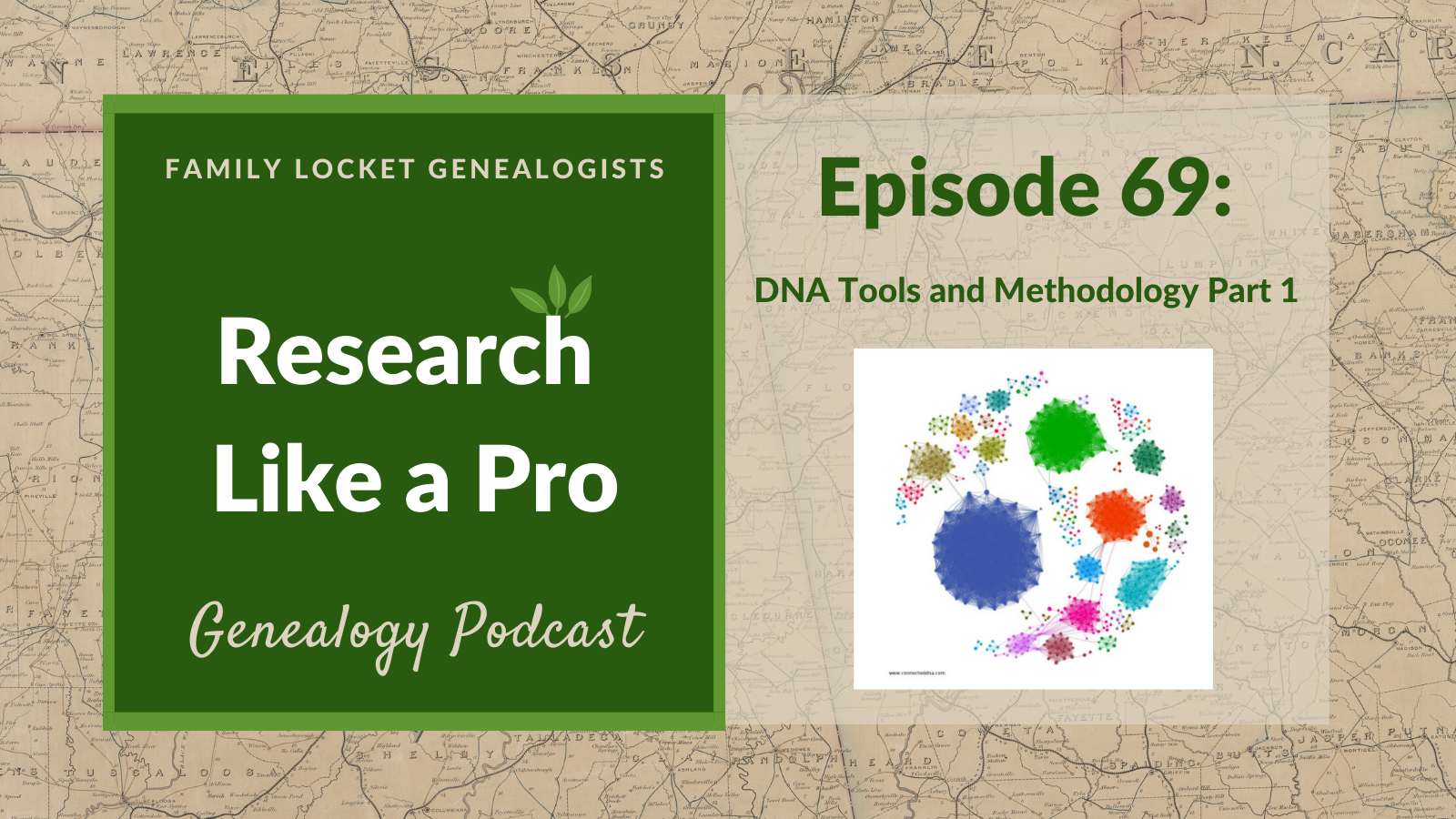
Today’s episode of Research Like a Pro is a discussion with Robin Wirthlin about how to use DNA tools and methodology in your genetic genealogy. This is part 1 of DNA tools, focusing on creating genetic networks, pedigree triangulation, and the What are the Odds tool at DNA Painter. We grouped these together because they are usually the first tools and methods to use. You don’t need segment information or chromosome browsers to use these tools. You can use your AncestryDNA results and create clusters, find where your pedigree intersects with the matches in that cluster, and answer your research question. In recent unknown parentage cases, you can use the descendancy tree builder, What Are The Odds (WATO), at DNA Painter, to see the probabilities that a target person fits within the tree. Using the amount of DNA shared between known people in that tree, you can find out which relationship is more likely. Listen in to hear our discussion about these DNA tools and methods!
Transcript
Nicole (1s):
This is research like a pro episode 69 DNA Tools part one. Welcome to Research Like a Pro a Genealogy Podcast about taking your research to the next level, hosted by Nicole Dyer and Diana Elder accredited genealogy professional. Diana and Nicole are the mother-daughter team at FamilyLocket.com and the creators of the Amazon bestselling book, Research Like a Pro a Genealogists Guide. I’m Nicole co-host of the podcast join Diana and me as we discuss how to stay organized, make progress in our research and solve difficult cases. Let’s go.
Nicole (45s):
Hi everyone, and welcome to the show. I’m Nicole Dyer co-host of The Research Like a Pro Genealogy Podcast. I’m here with accredited genealogist, Diana Elder and genetic genealogist, Robin Wirthlin. Hi, Diana.
Diana (59s):
Hi, Nicole and Robin. Great to be here today.
Nicole (1m 2s):
Hi Robin.
Robin Wirthlin (1m 3s):
Hi, Nicole and Diana. So excited to talk to you today again.
Nicole (1m 8s):
We’re so glad you’re here because today we have a lot to cover about DNA methodology and tools that we can use in our genetic genealogy.
Diana (1m 16s):
Let’s start out with our listener spotlight. And this is from LGlass858, “I love the Family Locket podcasts and Research Like a Pro book. I’m so excited that my study group starts in a week. I can barely wait and decided to listen to every podcast from one to present until it gets started. So many hints on the beginning podcasts that I’m adding to my research plan.” So thank you so much listener LGlass858. We are well into our Research Like a Pro DNA study group, and we are just having a great time. I know I have learned so much and I think everyone in the group has seen a huge increase in their skills working with DNA, so we’re really excited.
Nicole (2m 3s):
Yes. The study group has been really fun. So today we are going to talk about some of the tools that we’ve talked about a lot in the study group. And a couple lessons ago, we had everybody in the study group go and try some of these tools and share their experience with them. And it was a fun exercise, learning what each other learned and discussing and just becoming more aware of what’s available to help us. So we divided the DNA Tools into two episodes. And the first episode of DNA tools today, we will talk about all of the tools that you can do without segment data. So as you know, Ancestry DNA doesn’t provide a chromosome browser or specific segment information.
Nicole (2m 47s):
However, we can use their clustering tools, pedigree triangulation, and other tools to help us really figure out our common ancestor. So we’re going to talk about those things today. And we’ll start with talking about clustering and we’ll talk about some manual methods for creating genetic networks or clustering. And then we’ll talk about some automated methods. Then after we talk all about clustering, we’ll go on to pedigree triangulation, which is the next step after clustering, and really figuring out where all the people in a cluster have a common ancestor where the pedigrees intersect. And then last of all, we wanted to talk about the, What Are The Odds tool or WATO.
Nicole (3m 30s):
So let’s dive in and get started with talking about clustering.
Diana (3m 35s):
Okay. So why would we want to cluster our DNA matches? Well, the goal for all of us with our DNA is to help us make progress in our research. And one of the very first things that we can do with our DNA matches is to separate the people into groups that cluster around ancestral lines. So if you were looking at your match list and you can divide it into groups, you can focus on finding the most recent common ancestor that you share with that cluster of people. And then once that common ancestor or ancestral couple is identified, you can focus your research on one familial line and identify the DNA that you inherited from the common ancestor.
Diana (4m 17s):
So separating matches into groups that are related to you and to each other can be done in a lot of different ways. There are manual methods of grouping into genetic networks on each of the company websites. So a lot of people have got their testing done on Ancestry DNA and on Ancestry it’s called shared matches. And that lets you see who you share with any one person. And that can be one way that you group your matches on Ancestry. At FamilyTree DNA they call it In Common With, and you’ll see an ICW. And when you click on that, then you find all the relatives that you share in common with your specific match.
Diana (4m 60s):
23andMe calls it Relatives in Common. MyHeritage calls it Shared DNA Matches and on GEDMatch the title is People Who Match Both Kits or One of Two Kits. So you’ll see that each DNA company gives you a way to do this grouping of your matches into genetic networks. They each give it a little bit different names. So you’ll have to go to your testing website or to GEDMatch and try it out for each one of these tools. Now, another way to do this is to do it yourself with a spreadsheet and Dana Leeds has created this great method using color coding, and it’s become known as the Leeds Method.
Diana (5m 43s):
And we talked last episode, episode 68, with Dana all about the Leeds Method. So if you missed that episode, you can go back and listen to that and get a really clear picture of how that works. And Dana also talks in that episode about how Ancestry has started the color dot system of organizing your matches and how you can use the Leeds Method with the colored dots. So clustering our matches is probably one of the very first things that we want to do with our DNA. It is not difficult. It’s something that everyone can do using the company tools. And it’s a great way for us to start understanding who everyone is on our match list.
Nicole (6m 22s):
I agree. I think it’s a really good first step to do. And I originally went through manually and put colored dots next to everyone, but I’m now learning about the tools for auto clustering and how that can help you really take a huge leap forward when you’re in the beginning of your process, because they can use these same ideas of grouping into genetic networks and then create the cluster automatically for you. So let’s talk about these auto clustering tools. The first one that came about was Genetic Affairs and the programmer behind that EJ Blum. He created auto cluster, which groups together your DNA matches into clusters of matches that most likely descend from common ancestors.
Nicole (7m 11s):
And if you go and look at Robin’s blog post about 10 Ways to Group Your DNA Matches into Genetic Networks, there’s this visual image of how it works. And you can see all of the colored squares moving and grouping together based on who they share with. So everyone within a cluster, mostly shares with the other people in that cluster. And then by looking at their trees, you can see who the common ancestor for that cluster is or ancestral couple. So Genetic Affairs is a great place to start and you can use auto cluster for Ancestry DNA results, 23andMe and FamilyTree DNA.
Nicole (7m 54s):
So it’s a great resource. And what you do is you go to the Genetic Affairs website and then you log in with your Ancestry credentials, and then it pulls in the DNA matches and then sorts them into a cluster. And you can choose the thresholds that you want for the different centimorgans levels for your chart. So if you just want close matches, you can use higher centimorgans. And if you want smaller, more distant clusters, then you can put in a smaller amount of centimorgans and it’s a range. Let’s talk next about GEDMatch Genesis. If you subscribed to their tier one level, which is about $10 a month, then you can use the Genetic Affairs clustering tools at GEDMatch.
Nicole (8m 37s):
And it’s a collaborative effort between GEDMatch and Genetic Affairs. So those same cluster tools are available there. MyHeritage has also licensed the Genetic Affairs auto cluster approach for their users. And the only thing that’s different about this is that you don’t set the range yourself. It’s just already there for you. So you can’t adjust the range of centimorgans used at the MyHeritage clustering, but it’s still helpful. And the report is emailed to you after it’s finished. So it’s a great way to get started with MyHeritage matches. Now we also have to mention DNA Gedcom. DNA Gedcom is an amazing tool for downloading all of your matches from the testing companies so that you can work with them.
Nicole (9m 23s):
If you purchase a subscription for $5 a month or $50 a year with DNA Gedcom, then you can use more of their tools. And one of those tools is the Collins’ Leeds method. And this is an automated cluster program, similar to what Genetic Affairs does. And it uses the same method that we discussed in previous episode with Dana, Dana Leeds, with finding the shared matches just like Genetic Affairs and it groups them all together. If you’ve had problems with Genetic Affairs timing out, because you have so many matches that it’s trying to cluster, then you might want to try using DNA Gedcom although it takes a long time to download all of your matches from the company after that’s done, then you can run all kinds of reports using the Collins Leeds, clustering method, and it won’t time out because it’s hosted on your own computer.
Robin Wirthlin (10m 19s):
Yeah. If you want to use some more automated methods of grouping your DNA matches together, you can use network graphs from a variety of companies. First of all, is Connected DNA. It will help you visualize your matches in a picture that’s really beautiful. So you order a file that shows a labeled network graph of your matches, and those matches are clustered into color groups. Shelly Crawford of Connected DNA can combine files for full siblings, close family members, or even extended family members. So that’s a great feature when you have multiple people who have tested and you’re really trying to figure out a distant ancestor.
Robin Wirthlin (10m 59s):
It makes good sense to have other people’s DNA accounts be able to work together to identify pieces of DNA that maybe you didn’t inherit, but your cousin did.
Nicole (11m 8s):
Oh, that’s awesome.
Robin Wirthlin (11m 9s):
Yeah. I think it’s neat that you can combine those kits and that they’re really beautiful graphics. It’s really fun to see those and it hyperlinks to Ancestry match pages for every DNA match. So you can go directly from the spreadsheet that’s created to Ancestry for that DNA match.
Nicole (11m 26s):
I think I’m going to have to try that because I have three brothers whose DNA I have, and then I’m trying to find out their second great-grandfather’s parents. And I think that will help.
Robin Wirthlin (11m 37s):
Yeah, it’s definitely a great thing, especially if you don’t have the next older generations information available. And then some really neat things, I thought of you Diana, with your Benjamin Cox research, that it can help you identify the distant matches that are most likely to be relevant for your research. So it basically clusters all these people who have taken a DNA test and it shows that they match around the same family line and possibly on the same segment or area.
Diana (12m 4s):
Okay. So let me just make sure I understand that. So this is Connected DNA. This is a special third-party website. And so would I give them my Ancestry login? How does it work? Just walk me through that a little bit, because I do have two close cousins on that Benjamin Cox line that I have had them share their matches with me, but I would love to have something like this that puts it together in a file or a way that I can see everything between the three of us.
Robin Wirthlin (12m 32s):
Yeah. It’s an amazing feature. I have not actually used this program, but I think it looks fabulous.
Diana (12m 37s):
Okay. So it sounds like I need to learn how to do it, and do it, and then write a blog post about it. And then we can have another podcast all about Connected DNA because I honestly have not tried this and I really can see a great use for it, just like with Nicole and her project. So I did not realize how valuable getting the shared DNA matches from your closer cousins would be in solving problems. My cousin has twice as many matches to my Benjamin Cox on ThruLines than I do, and they are greater in centimorgans. So I had really small segments. She has got larger segments. It’s more valuable than my DNA.
Diana (13m 17s):
She’s one generation closer. So I am starting to just envision how finding these cousins that can help us. And then you think their DNA, if they will allow us using their shared matches, helps to really strengthen our DNA work.
Robin Wirthlin (13m 33s):
It really does strengthen it. I totally agree. Another thing that’s really neat is that Connected DNA identifies the people in that colored cluster that all share a same ancestral line. So I think that’s a neat feature. I haven’t seen that before where the exact DNA matches listed in the cluster.
Nicole (13m 49s):
I was looking at the website for Connected DNA and it looks like what you have to do is provide her with the match and in common with CSV data files for each profile you want to use. And it says down below that you can download it yourself using the DNA Gedcom client. So it sounds like you just download that with DNA Gedcom and then send it to her. And then she creates the PDF for you.
Robin Wirthlin (14m 15s):
That’s a real bonus because then you’re not sharing your Ancestry username and password, and that keeps it more private. It’s a great idea. Another do it yourself program is at DNA, DNA.UK, and it can help you visualize your DNA match relationships easily and quickly in first the likely relationships, and then shows them in a cluster that looks like fireworks or constellations, and it uses Gephi and open source software that helps you create graphs and visualize your data. And then another one is Rootsfinder.com. This program is a comprehensive family tree research and DNA program that helps you connect DNA results with people in your family tree.
Robin Wirthlin (15m 5s):
And you can also import triangulation data from GEDMatch.com to visualize relationship clusters.
Diana (15m 8s):
Wow. So I’m kind of excited to try some of these other programs. I think it’s really interesting in the DNA world, how so many people have used technology to come up with some of these amazing programs for us that, with that said, we can still do so much just on our own by going to the DNA companies and just using the tools that are right there in the company to do those clusterings. So there’s nothing that says we have to do anything complicated. We can do simple things to get started on our clustering. So let’s move on to another concept and that is Pedigree Triangulation. So that might sound kind of scary, triangulation, what does that mean? Well, when triangulation first began being used with genetic genealogy, who was really only with segment triangulation, and this is how genetic genealogists were proving relationships, that with additional tools like we’ve been talking about with the different DNA testing companies and third-party companies, Pedigree Triangulation has become a valid methodology to work with our DNA test results.
Diana (16m 9s):
It is something we can use to solve our brick walls. If we can’t get to segment triangulation, we’re going to be talking all about segment triangulation in our next episode. So for this one, we’re just going to do Pedigree Triangulation. So here I’m going to do a little visualization with everyone listening. So imagine a triangle, the bottom leg of the triangle represents the DNA match between Person A and Person B, both inherited a piece of DNA from a common ancestor who is at the top of the triangle. Those two legs coming down from the common ancestor connects to the two people. And it represents the pedigree lines back to the ancestor.
Diana (16m 51s):
Depending on how close to the DNA match the lines back may be just a generation or two, or they could go back several generations. So again, the triangle has at the top, the common ancestor, and then the bottom two points would be probably you and one of your DNA matches. So it’s just triangulation to people back to their shared ancestor.
Robin Wirthlin (17m 16s):
That’s a good way to visualize it. Diana, I know some people who are new to DNA are wondering how they can get the DNA of their ancestor that died generations ago. And really that’s not what we’re doing. We’re taking other people who are alive today and seeing what kind of DNA we match and how much, and then figuring out which ancestor we inherited that from. And so you just work with living people and that’s great concept of Pedigree Triangulation is that process of determining a group of people that share DNA from a common ancestor and all those people that share that common ancestor. Those are a genetic network.
Robin Wirthlin (17m 57s):
That’s another key term that has used frequently in genetic genealogy. So the original method involves comparing the family trees of people in your DNA match list. And then you hit shared matches or in common with and family tree DNA. And it helps separate those people into familial groups that are either on your maternal side or your paternal side. And in order to use Pedigree Triangulation, you need to have a family tree for you and for your DNA match. And frequently there is no family tree that’s connected to the DNA match. So you may need to build a tree for that person that’s in your match list.
Robin Wirthlin (18m 39s):
You would use obituaries to figure out who the parents are, grandparents, you can use census records and other published genealogies, and really think critically and make sure that those records are truly identifying the links between those generations. And as you built that tree, you can connect up to see who the common ancestor is between you and your DNA match. So that common ancestor is really a place in your pedigree that intersects with the other person’s pedigree. So you’ve got two different charts and you’re trying to figure out how do they connect together? And the person that is on both of those charts or family trees, is that most recent common ancestor.
Diana (19m 23s):
I love that word intersects. I think that really helps visualize how this is all working. And let me just illustrate a little bit with my Benjamin Cox project that I’m currently working on. I have talked a little bit about him, I think in past episodes that he is my proposed, hypothesized, however you want to say it, third great-grandfather and actually, no, he’s the parent of my third great grandmother, Rachel Cox. So he’d be my fourth great-grandfather and with the paper trail, I have linked him and Rachel together because they were in the same county in Texas, the same time, and she fit into the censuses pre 1850. Everything seemed to line up, but I didn’t have anything that specifically said she was his daughter.
Diana (20m 6s):
And when I contacted another genealogist years ago, she said, oh no, she’s not in the family. And so it put me off a little bit. I thought, well, maybe I’m looking at this wrong. Now with DNA and with Ancestry Thrulines, I have discovered that I have got, I think now I’m up to about 72 proposed DNA cousins through Benjamin Cox. And the way Thrulines works is through family trees. So Ancestry is taking user created family trees, and then seeing if I have any matches through DNA to any of those people. And so basically I have a cluster of people to work with now that we all triangulate back to Benjamin Cox.
Diana (20m 49s):
So what is my job? Well, my job is to verify each of those and make sure that we are not actually connecting on a different segment of DNA because that’s entirely possible also. Ancestry doesn’t know for sure that we are really all Cox descendants. One of them could be on a whole different line. So I have to confirm trees and verify those connections. So the more of these DNA cousins, I can confirm the stronger, my proof that Benjamin Cox is my ancestor, as well as everyone else’s. The really neat thing is, like I mentioned before, that I’d have these two cousins share their results with me. Well, one of the cousins is a generation closer and she has 140 matches that come down through Benjamin Cox.
Diana (21m 34s):
And the other cousin has something like 90 and we actually have some of the same matches. And so I’m thinking we are triangulating on segments, which is one of the things I am now working on. It’s really exciting because this technology is doing some of this work for us and finding our common ancestors and helping us do this Pedigree Triangulation. So pretty exciting. Now My Heritage also has something similar. Theirs is called Theory of Family Relativity. And so the technology there is also based on user submitted family trees. And it will also suggest the most recent common ancestor and show a proposed line back to that ancestor from both you and your DNA match.
Diana (22m 21s):
So in that one, I currently have 44 suggestions for common ancestors, you know, different trees that match up and I’m doing a surname search for my Shults line. Rachel Cox married to Shults, and I’m finding some additional matches on My Heritage that are also showing some good connections, some good Pedigree Triangulation. So I think it’s really exciting that the DNA companies are helping us with some of this triangulation. That quite honestly, I don’t know if I ever would have figured out because they have thousands of matches and these matches are smaller segments because they are fourth cousins or beyond, and it would have taken me a lot of work to find them.
Diana (23m 1s):
So if you haven’t looked at ThruLines or the Theory of Relativity, take a look and realize that you do have to do the work to verify the trees and the matches, but they’ve tried to help us out. So it’s pretty cool.
Nicole (23m 12s):
That is really cool. I love that you’re making so many discoveries on our family history. Good job. Well, what about people who don’t have a family tree? How can they do any kind of Pedigree Triangulation? Well, that’s what we’re going to talk about next. A tool called What Are The Odds or WATO, which can help with descendancy tree triangulation, which may not really be a thing. I think I just made that up, but what I like to think of has descended the tree triangulation, basically just looking at a common ancestor and all their descendants, and then making some hypothesis about where a DNA match could fit into that descendancy tree.
Nicole (23m 54s):
So that’s what WATO is designed to do. So from the frequently asked questions on DNA Painter, which is where WATO is, it says, What Are The Odds is designed to help you figure out where someone called the target might fit into a known family tree by using the amount of DNA they share with people in that tree. It provides a simple interface to build the skeletal tree in which you entered the descendants of an individual or couple, you might be researching an unknown parentage case. In which case this tree would include people who share DNA with the target, or you might simply be curious about an unknown match and be looking for a simple way to map out possible relationships based on the amount of DNA your family members share with them.
Nicole (24m 40s):
So I used What Are The Odds for a cousin match on one of the kids I manage, and I’m going to call her Louise. And when I reached out to her, she said, I can’t help you researching whatever ancestor you have because I don’t know my parents, I’m adopted. So she was adopted in the 1940s, and she shared her match list with me and I offered to help her find her parents. And what I did was make some clusters first and see the different family groupings. And I saw that she had kind of these two separate groupings, maternal and paternal. And I didn’t really know which one was maternal and which one was paternal, but I could just tell that there were two clusters.
Nicole (25m 21s):
And the one cluster that I was familiar with was the side that she matched, the kit that I manage on. And so I could tell the common ancestor right away between the kid I manage and between her kit. And so I put that common ancestor that I had figured out into the top of the, What Are The Odds tree. And then I mapped out all the descendants that I could see in the cluster who were her matches. And then I started making the hypotheses about where she could fit into the descendancy tree. So once you start making those hypotheses or guesses about where the target fits in, What Are The Odds tool gives you a probability that they could fit in to that branch or that line based on comparing it with your other hypothesis.
Nicole (26m 4s):
So you have to put in more than one guess. And so you might guess they’re descended from this branch or this side of the family or this person. And then you have three different hypotheses. And then What Are The Odds tool will tell you which hypothesis is more likely than the others, or if they’re all equally likely, it will tell you that, too. And the information for the probabilities comes from the Shared cM Project and the collaboration with the DNA Geek, who has come up with these relationship probabilities. So those probabilities and the amount of shared centimorgans that you enter into the WATO tool come together and help you get the probabilities that a person could fit into the tree in various spots.
Nicole (26m 46s):
So what you have to provide to the WATO tree in order for it, to give you those probabilities are a target person who you don’t know how they fit into the descendancy tree, and then how much DNA they share with known descendants in that tree who are DNA matches to them. So it gives you scores indicating how your hypothesis compare to one another. So from the frequently asked questions at DNA Painter, it says first, any hypothesis that is impossible, given the data gets a score of zero. Then the possible hypotheses are ranked, starting with a score of one. When more than one hypothesis is possible, they are ranked with higher scores being direct comparisons to the score one hypothesis.
Nicole (27m 30s):
So if you have three hypothesis with scores, 100, five and one, the highest is 100 times more likely than the lowest and 20 times more likely than the second place hypothesis. And so it can be really helpful for showing you where to look for the parents of a person with a known parentage. And even though it might be less likely, you still can check into those other possibilities. And this works best with centimorgan ranges that are higher. Once you get into smaller, centimorgans it doesn’t work as well. And also the tool is not meant for endogamous populations because endogamoy and pedigree collapse, if there’s a significant amount of it can really affect the scores.
Nicole (28m 12s):
And there isn’t very good probability data out there right now to figure out how to work with it. So if you have an endogamous population, then just be aware of that. So I wanted to ask you Robin, what you recommend using the, What Are The Odds tree for and what cases would it be useful?
Robin Wirthlin (28m 30s):
It’s really useful in unknown parentage cases. Let’s say you have a large family, and you’re not sure which child of that family you’re descended from. You can place yourself in different locations in this Pedigree chart for What Are The Odds tool. And it can tell you how likely or unlikely you are to be descended from that child of the large family. So I have an example here where we had a really unusual situation and really high matches with everyone in one generation. And so we thought that the target test taker was someone that was in a much lower generation. And anyway, as we worked and worked to work through the numbers and use What Are The Odds tool, we realized that she was actually in a higher generation than we had thought.
Robin Wirthlin (29m 15s):
This also works really well with half relationships because you have all this other comparison data. And if you see that it’s not really likely that you’re able to fit in a certain location in the tree, you can rethink it and then think on half relationships and reorder things and then pull it in again and get a better probability.
Nicole (29m 35s):
Nice. That’s a really good example. And it does ask you about half siblings. So I I’m glad you mentioned that because it seems like a very good way when you’re putting in the DNA match, it says, is this a half relationship? So then it can adjust the probabilities.
Robin Wirthlin (29m 52s):
Oh yes. It says define half relationship.
Nicole (29m 55s):
Right. That is so helpful. Thank you for discussing this great topic today, everyone. And thank you to our listeners. We hope that you’ll be able to go forward and use clustering and Pedigree Triangulation, and the What Are The Odds tool to help you when you don’t have segment data to work with when you just maybe have Ancestry DNA matches and you know, how many centimorgans you share and that’s what you have to work with. So go forward and good luck to you with your Pedigree Triangulation and clustering.
Diana (30m 31s):
All right, bye-bye everyone.
Robin Wirthlin (30m 32s):
Bye everyone and talk to you again soon.
Nicole (30m 36s):
Bye-bye. Thank you for listening to Research Like a Pro with Diana Elder, accredited genealogy professional and Nicole Dyer. We hope that something you heard today will help you make progress in your own genealogy research. If you like what you heard, please leave us a review on iTunes or Stitcher or visit our website, FamilyLocket.com to contact us. You can find our book Research Like a Pro a Genealogist’s Guide on Amazon.com and other booksellers. We hope you’ll start now to Research Like a Pro.
Links
10 Ways to Group Your DNA Matches into Genetic Networks by Robin at Family Locket
Pedigree Triangulation: What is it and How Can it Solve Brick Walls? by Diana at Family Locket
Leeds Method – Dana Leeds’ website
The Leeds Method with Ancestry’s Colored Dots – Dana Leeds’ website
What are the Odds? – FAQ at DNA Painter
Research Like a Pro
Study Group – more information and email list
Research Like a Pro: A Genealogist’s Guide by Diana Elder with Nicole Dyer on Amazon.com
Thank you
Thanks for listening! We hope that you will share your thoughts about our podcast and help us out by doing the following:
Share an honest review on iTunes or Stitcher. You can easily write a review with Stitcher, without creating an account. Just scroll to the bottom of the page and click “write a review.” You simply provide a nickname and an email address that will not be published. We value your feedback and your ratings really help this podcast reach others. If you leave a review, we will read it on the podcast and answer any questions that you bring up in your review. Thank you!
Leave a comment in the comment or question in the comment section below.
Share the episode on Twitter, Facebook, or Pinterest.
Subscribe on iTunes, Stitcher, Google Play, or your favorite podcast app.
Sign up for our newsletter to receive notifications of new episodes.
Check out this list of genealogy podcasts from Feedspot: Top 20 Genealogy Podcasts


Leave a Reply
Thanks for the note!