
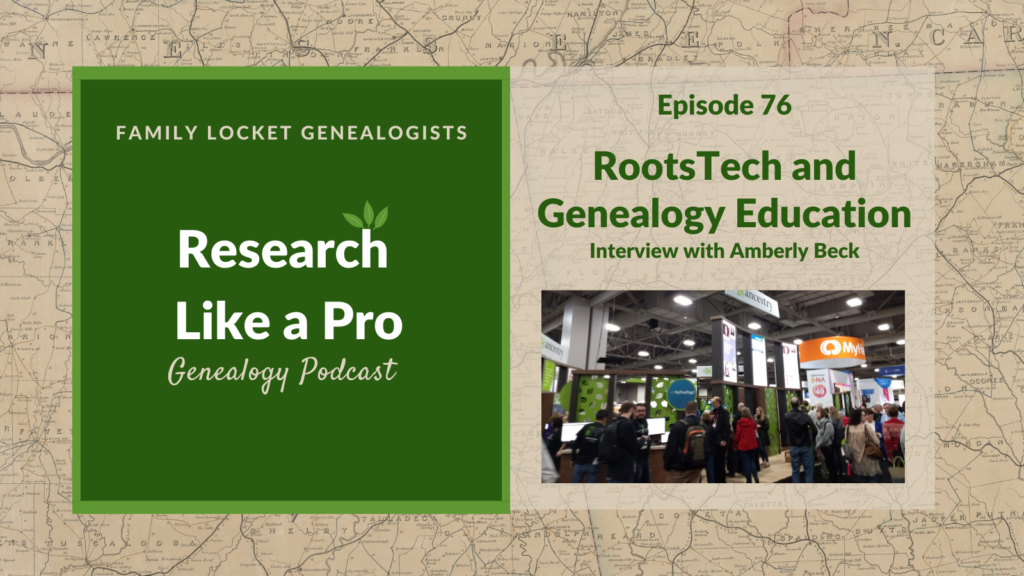
Today’s episode of Research Like a Pro is about genealogy education opportunities, including attending genealogy conferences like RootsTech. Our guest, Amberly Beck, talks about her first experience at RootsTech in Salt Lake City and how Tom Jones’ classes impacted her. She also shares about her experience speaking at RootsTech London and some of the classes she liked there. After recording the episode, Amberly shared a great thought with us. She said, “Sometimes we love researching so much that we don’t want to give up any of our research time to genealogy education. But every minute of research time we give up to learning, especially about genealogy methodology, we gain back ten-fold. We become much more effective and efficient researchers.” Join us for a fun discussion of learning opportunities for genealogists!
Transcript
Nicole (1s):
This is Research Like a Pro episode: 76 RootsTech and Genealogy Education and interview with Amberly Beck. Welcome to Research Like a Pro a Genealogy Podcast about taking your research to the next level, hosted by Nicole Dyer and Diana Elder accredited genealogy professional. Diana and Nicole are the mother-daughter team at FamilyLocket.com and the creators of the Amazon bestselling book, Research Like a Pro a Genealogists Guide. I’m Nicole co-host of the podcast join Diana and me as we discuss how to stay organized, make progress in our research and solve difficult cases.
Nicole (43s):
Let’s go. Hi everyone, and welcome to the show. I’m Nicole Dyer co-host of The Research Like a Pro Genealogy Podcast. I’m here with accredited genealogist, Diana Elder, and our guest Amberly Beck. Hi Diana.
Diana (1m 2s):
Hi Nicole. Hi Amberly.
Amberly Beck (1m 4s):
Hi, Diana and Nicole. I am delighted to join you today. Thank you for inviting me.
Nicole (1m 10s):
We are so glad that you could join us. We’re excited to talk to you about RootsTech and Genealogy Education and all the fun things that we’ve done together in the past. Let’s do our listeners spotlight real quick. It’s from DWH and this listener says, “Great format, very engaging and informative and excellent podcast for genealogists. The topics are extremely helpful and informative. The guests are well chosen and the hosts are both knowledgeable and engaging. I look forward to each new episode.” Thank you for writing to us, DWH and we are happy that you think our guests are well-chosen. We really are excited to talk with our guest today, Amberly.
Nicole (1m 52s):
So let me introduce Amberly. Amberly and I originally met in the blogosphere. She writes thegenealogygirl.blog and shares lots of great posts about her research, photos, and lots of helpful tips we met, I think for the first time in person at RootsTech. And we worked together when I was doing the family history for children blog link up and she messaged a little bit back and forth there and participated. And then we participated in the certification discussion group, which is a study group for learning how to prepare for certification through the Board for Certification of Genealogists.
Nicole (2m 34s):
And then after that, we enjoyed working together so much we continued to study together on Mastering Genealogical Proof and did a study group with that. And now we’re still doing a study on the NGSQ where we read an article every month and talk about it. So I’ve really enjoyed working with Amberly and learning about, you know, increasing learning about genealogy and increasing our knowledge together. I’ve learned a lot from her. So Amberly, tell us a little bit about your professional work that you do in your research for clients.
Amberly Beck (3m 7s):
Yeah. So I do take client research. I love to do that. I’ve had some really interesting experiences with that. And I also work for From Research as one of their genealogy research specialists.
Nicole (3m 23s):
Wonderful. What is their website?
Amberly Beck (3m 25s):
It’s from F R O M fromresearch.com and they provide a really interesting product. It’s a book or it’s just research that is used as loyalty gifts for large corporations, for their wealthy clients who, you know, they don’t know what to buy for them as loyalty gifts so we research their family and they’re presented with this beautiful book. So it’s a really unique and interesting job.
Nicole (3m 58s):
Wow. That is really unique, how neat. And I would love to get a gift like that. I mean, it would be so neat to just have somebody surprise you with,
Amberly Beck (4m 6s):
Well, it’s not a surprise. They find out that they are receiving the gift and then they have to give us lots of information to start with so that we can create something that includes all of their family.
Nicole (4m 18s):
Oh, that really makes sense, because it would really be harder if that had to be a surprise.
Amberly Beck (4m 23s):
yeah.
Diana (4m 24s):
Okay. So I have some questions about that Amberly. I’m so intrigued. Do you ever have to use DNA when you get into a project that maybe there is not a family line to work with?
Amberly Beck (4m 35s):
So I did their first DNA project this fall, and the reason that we included DNA is the person that I was researching for, his mother was adopted. And he was interested in both her line of the people who raised her and then also her genetic family.
Diana (4m 56s):
Oh, that’s so fun. Well, I love that. Well, let’s jump into one of our topics for the day, and that is RootsTech. Nicole, and I love RootsTech and we know that you do too, because we are fellow ambassadors, but I’m just curious, what was your first experience at RootsTech? When did you first go?
Amberly Beck (5m 17s):
So my first in-person RootsTech experience was in 2016.
Diana (5m 23s):
So that is about the same year we started going. Were you an ambassador that year?
Amberly Beck (5m 28s):
I was not. I just attended for the first time by myself. I had been planning to go with a friend, but her mom passed away. So I went by myself, which I’d been nervous to do because I don’t like crowds and I’m pretty introverted. So large gatherings are a little bit tiring for me, but I went anyway and I was so glad I did
Diana (5m 53s):
Was that the year that one of the keynote speakers, the man who wrote his motorcycle down the aisle of the, the whole…were you there for that one?
Amberly Beck (6m 5s):
I was there for that one. It might be that year. I’m not sure though.
Diana (6m 9s):
That was Nicole and my first year, and I remember just going, wow, this is amazing. This was so fun. And we were just blown away by the keynote speakers and the excitement, you know, the music, so much energy there. And then the crowds are, are a little bit to contend with, but you know, how did you do with the crowds and, and your people issues?
Amberly Beck (6m 30s):
You know, it was fine. The energy of RootsTech is really like no other conference I’ve attended and you’re surrounded by other genealogists and family history enthusiasts of all experience and skill levels. So it really feels like being at home, even for those who are really introverted, I felt comfortable right away. I loved all of the energy and excitement. And the thing that’s great is you can feel that all of the people around you have a deep love for their families, their ancestors. So it started out great, but it got even better. When I went to my first class with Tom Jones, that was actually the second session I attended at that RootsTech .
Diana (7m 15s):
Oh my goodness. And what was Tom talking about in that session?
Amberly Beck (7m 19s):
His lecture was titled Inferential Genealogy: Deducing Ancestors’ Identities Indirectly. And that was literally the first time I’d ever heard anyone talk about using indirect evidence. And I was mesmerized. I was writing notes as fast as I could. And every single word of that lecture was exactly what I needed right then. And while I was listening, I just kept thinking about my third great grandmother, Esther BROUILLETTE there are no records for her life that named her parents. And I had built this whole case to prove who they were using indirect evidence, even though I didn’t know what that was. And I thought I was still searching for a document that explicitly named her parents to prove what I already thought I knew.
Amberly Beck (8m 5s):
But as I sat there in Tom’s lecture, I realized that I didn’t need direct evidence to prove identity. And so I couldn’t wait to go back home and revisit all of my work with fresh eyes and a new understanding. And that class totally changed my genealogy life. And not just because I learned that I was already doing some great things, but I learned more about how to move to the next step. And, you know, Tom is an amazing master teacher, but there were two things that he said that really stuck with me. The first one was he talked about his own research life. And he said that that changed when he started reading the NGSQ.
Amberly Beck (8m 50s):
And he said that prior to that he’d been researching for 30 years and those years were mostly a waste, and once he started studying the articles in the NGSQ, everything changed for him. And so I’m sitting there listening to this guy that is telling me all of these things that are just singing right into my soul. And I thought, well, if he’s saying that that’s probably true for me too. And so I didn’t right away join NGS, but I did. And I of course study their articles out of the Q. But the other thing he talked about was attending genealogical institutes and encouraged us to attend them. So I also took his advice on that.
Diana (9m 30s):
Well, I love that you talk about Tom Jones and his whole indirect evidence because working in the south with the kind of research that Nicole and I have, that is what we use all the time. And I have felt similar to that, you know, always searching for that one document that is never going to show up because it was never created in the first place.
Amberly Beck (9m 54s):
Right.
Diana (9m 54s):
And it’s wonderful to know that we can prove our lines using the indirect evidence. And I love that you did a study group on Mastering Genealogical Proof because when I was working on accreditation, that was the book that I worked through and I just did it on my own. You know, I’d read the chapter and answer all the questions, then check my work in the back. But I felt like I learned so much working through that book. So if any of our listeners are intrigued by what we’re talking about here, and you’ve never heard of Mastering Genealogical Proof, which is written by Tom Jones, I highly recommend either doing a study group like Amberly did, or just getting the book and working through it on your own.
Diana (10m 40s):
You’ll learn so much. It’s really is from a master genealogist.
Nicole (10m 46s):
Well, that’s wonderful. I love that you went to that Tom Jones class and had such a great experience. I think we all have those moments in our genealogy lives, where it was a turning point and we just learned something so valuable that it really helped us to propel forward.
Amberly Beck (11m 3s):
So I actually wrote about that first experience on my blog. So I know Nicole will put that link in the show notes, but for your listeners, if they can relate to anything I was saying, they might want to read that. Cause I talk a little bit about my previous experience and how I was ready in that moment. And it might help your listeners consider what a good next step for them might be.
Nicole (11m 28s):
Oh, that’s so great. And I will definitely put that in the, in the show notes so they can go read your article because it is such a great article. I was going to follow up and ask about the rest of the classes at your first RootsTech experience. Did you feel kind of sad that they weren’t as amazing as that second session or did you still enjoy it all?
Amberly Beck (11m 46s):
I did enjoy it all and I actually adjusted my schedule and I went to two more classes that he taught and I bought his book Mastering Genealogical Proof out of the expo hall, but it was everything about that experience was really good. And he of course was the highlight, but there were so many other things that I wanted more information about and I did a good job choosing my classes. So everything about that conference experience was great.
Nicole (12m 15s):
That’s such a good point. I think choosing our classes beforehand is really important at RootsTech because there are so many choices and it’s good to have some backups too. Like you said, cause you might want to change your schedule and adjust things. So you may need to have like second and third choices ready and prepared.
Amberly Beck (12m 34s):
Yes.
Nicole (12m 34s):
So after you had that experience, it sounded like you were ready to go forward and take some of his suggestions. So tell us about how you continued your genealogy education after that.
Amberly Beck (12m 47s):
Well, I attend RootsTech every year. I started going to more local conferences and family history fairs, and I started teaching a lot more. I’m excited this year, I’ve added the National Genealogical Society’s family history conference to my schedule for 2020. And I’m delighted it’s in Salt Lake City because I just live an hour south. So that’s convenient for me, but I actually purchased their recordings from their 2019 conference because of a suggestion you made Nicole, you mentioned that you had done it in 2018 and that really was one of my best educational choices for 2019.
Amberly Beck (13m 27s):
I was a little nervous because I need subtitles for most things, but the quality of the audio is great. It’s nice and clear and plenty loud. And I like to listen to those while I’m on the treadmill. So I’m not giving up any extra time during my day to add that in, but it’s been a great way to learn from people who I otherwise haven’t been able to sit in a class that they taught. I attended SLIG for the first time in 2019, and I loved it. I have a conflict this year, I can’t go on 2020, but I’ll definitely be back in 2021, but I’m looking into the summer Institute schedule because of that.
Amberly Beck (14m 8s):
And I’m hoping to fit one of those in. I’ve also participated in several study groups. Nicole and I did the certification discussion group together. That was started by Jill Morelli, but we attended the course that Carrie Taplin taught. It was excellent. And just what I needed to help me plan my future genealogy education experience, to help me prepare, to submit my portfolio to BCG. And then Nicole, I loved the study group you put together for Tom’s book, Mastering Genealogical Proof. Those chapter exercises were really rigorous. So I was glad to be in a group because it kept me accountable.
Amberly Beck (14m 50s):
I think you probably felt the same way too.
Nicole (14m 53s):
Yes, I loved, I loved our discussions and I think when I started putting that all together, I was very ambitious where I thought we could do like bonus exercises and extra reading. And as we got into it, I realized that there was plenty to read within that small book. And, and sometimes we had to read his articles several times to really grasp what he was saying because in the back there are, you know, in the appendix, he has a couple example articles. And then during the book you analyze those articles. Anyway, we, we had some fun extending our learning to additional articles in the NGSQ that had to do with DNA so that we could add in that element.
Nicole (15m 34s):
But yes, it was very rigorous and I enjoyed it so much.
Amberly Beck (15m 37s):
Me too. I learned so much. And I would say to your listeners, if you can find a study group for that book, do it, but it’s a really brave person that will lead that study group because those exercises at the end of the chapter are challenging. So you may not find a group for that, but it was awesome. And then Nicole and I are currently doing a study group that I put together. We study an NGSQ article every month and I’ve really loved that we’re a tiny group of four and we’re all on the same path working towards certification and we have similar education backgrounds. So we’re really kind of in the same place. So it’s been really beneficial for us.
Amberly Beck (16m 19s):
So studying that is great. I also love of course research and writing. I’ve been taking on far more challenging research problems, both for myself and for clients. And I’m a lot more confident at coming up with good research questions and research plans ever since that Tom Jones class. And that of course leads to amazing genealogy conclusions. I’m a lot busier now than I was when I first started my blog, but I feel like writing my blog posts has allowed me to grow up as a genealogist. When you write for an audience of both people you know and you don’t know, it really forces you to consider every word you use.
Amberly Beck (17m 2s):
You ask yourself more rigorous questions about your writing when you know that others will read what you wrote. So blogging has not only made me a better writer, but also a better genealogical writer. So even though I’m busy, I still try to post regularly on my blog. And of course, one of the amazing outcomes of that is the awesome cousin bait that I’m creating. I love those cousin connections that happened because of my blog, you know, distant cousins that Google someone, end up on my blog page and then they reach out to me. So that’s been amazing.
Nicole (17m 40s):
That is amazing. And you have written so many articles about your family. I think that’s such, like you said, it’s such good practice for writing more you research reports and proof summaries and proof arguments. And just having all that experience with putting your research down in words, how wonderful
Amberly Beck (17m 60s):
Yeah, it’s been great.
Nicole (18m 1s):
What would you recommend for others who want to expand their education?
Amberly Beck (18m 6s):
That is a great question. There are so many genealogy education opportunities out there. So my advice would be to lay a really strong foundation and then build on it in your specific areas of interest and in your areas of weakness, but finding the best next educational experience for you can be tricky. So I would encourage everyone to ask these two questions of other genealogists whenever you can, first, what genealogical educational experience made the biggest impact on you? And then, you know, just listen to what they’re sharing and ask, follow up questions.
Amberly Beck (18m 46s):
And then second ask what was your biggest geological accomplishment this year? And then follow up with what helped you accomplish that? We can learn so much from each other. And those answers will point us to new resources and learning opportunities. But my quick list for everyone of things to consider would be broken down first things for everyone, make good use of free resources like the RootsTech video archive, the FamilySearch Wiki. You can learn a lot from there and then consider some of the things that you would pay for like a Legacy Family Tree Webinar subscription.
Amberly Beck (19m 26s):
Their archive is filled with so many great webinars. And then look into courses like the ones that you and Diana have, your Research Like a Pro courses. And there are also courses offered by NGS. They have a great beginning course that’s free to members and then they have other paid courses that build on that basics course. But for those who are wanting to work towards certification or becoming a professional genealogist, definitely join the National Genealogical Society, read the Q, attend their conference or purchase the recordings regularly, study genealogy reference works and then find study groups to participate in.
Amberly Beck (20m 9s):
And I have to say, I love the BCG Ten Minute Methodology series. That’s a great way to gain some knowledge in a quick little, you know, session on your phone or something, but whatever your listeners choose to do, it’s really important to try to spend some time on Genealogy education at least weekly. And if you’re more serious daily, you know, I mentioned that I like to listen to recordings or watch webinars while I’m on the treadmill. That’s really easy to add to my day, but I also keep issues of the Q on my nightstand and one or two genealogy books I’m studying. And then also like to spend a few minutes on Twitter each day, looking at posts that have the hashtags genealogy or family history, it’s quick, but it, you can learn from genealogists all over the world about different resources and it just sort of expands the opportunities for you.
Amberly Beck (21m 6s):
As you spend a few minutes there, seeing what everyone else is talking about. And of course, it’s just fun to get to know other genealogists from around the world.
Nicole (21m 15s):
I love all of those suggestions. I was typing down most of those, but I could put links in the show notes. So thank you.
Amberly Beck (21m 21s):
You’re welcome.
Nicole (21m 22s):
Really great list.
Diana (21m 24s):
Yeah. Amberly. I love that. You talked about Twitter. I have a Twitter account and I have never thought to really use it for education like that. And I love that. Wow, that’s really fun tip. So you mentioned genealogy reference books and that you have some that are on your stand, or I think you said you have on your stand some issues of the NGSQ and I do that, too. I have found that if I don’t take time every morning to do some Genealogy study, it just doesn’t happen. So I try to do that for 30 minutes in the morning to read a little bit of the Q and to read, right now, I’m reading it through Professional Genealogy, the new, edition because I’m a ProGen mentor and I did the program when it was the old, you know, the first edition of Professional Genealogy.
Diana (22m 11s):
And it’s fun that we’re talking about Tom Jones because I’m reading his chapter right now on evidence analysis. And when you talk about being a wordsmith and having every word count, doesn’t that hold true with his writing and his work. You have to read his writing, very concentratedly, if that’s a word, because every single word is just packed with information and meaning. And I have just loved revisiting evidence analysis through his, through his mind. It’s been really fun. So I wanted to ask, what are some of your favorite genealogy reference books?
Amberly Beck (22m 50s):
So the two that I pick up the most are Mastering Genealogical Proof by Tom Jones and Evidence Explained by Elizabeth Shown Mills. But I also often grabbed both additions of Professional Genealogy that you mentioned, and those are edited by Elizabeth Shown Mills, and the Genealogy Standards Manual, the new Second Edition that’s published by the BCG. I have several others that I love and I’m just starting to delve into more and more often, but there are so many great reference books out there. So just don’t stop buying those. But I also have to give a shout out to those genealogy society publications for our areas of interest.
Amberly Beck (23m 32s):
I have a few that were put together by the Kankakee Valley Genealogical Society in Illinois that I pull off my shelf constantly. So get to know the local societies that exist now in the areas where your ancestors once lived.
Diana (23m 49s):
I agree with that. In fact, it’s kind of funny because I’m working on a project in England right now, and I just went to a genealogy Christmas party for the company that I contract with. And we all had to bring our favorite book and wrap it up, you know, and did a little gift exchange. And so the books that I stole, because this was one of those parties where you can steal books, it was, it was the English Bible, they call it, for Genealogy Reference. And I didn’t have a reference book on England. And I thought, this is perfect. Even though it’s not my area of accreditation, I don’t do a ton of English research. I do do English research and I didn’t have a reference book. So now I do.
Diana (24m 31s):
So I totally agree that we can pick up these reference books whenever we’re working on a project that has us stumped, or maybe if it’s an area that is our brick wall locality. In fact, I wrote a little bit about one of the reference books that I discovered on Indian Territory, Chickasaw Nation Indian Territory, which is where all my paternal ancestors were. And I was so stumped about how to research in this area. And then I found this woman who had written a book about it, and I ordered the book and that’s one of my go-to books when I’m researching my family. You know, I pick it up and look and see what Nova had to say. The author was Nova Lemons, and I’m so grateful for those kinds of books that are just little known that are perfect for whatever you’re working in.
Diana (25m 17s):
So thank you for that. Great tip.
Nicole (25m 20s):
What is the book about England called? Now I’m so curious.
Diana (25m 23s):
It is called Ancestral Trails and the author is Mark D Herber and he goes into great detail on all the different kinds of records. So I know civil registration and I know about Parish church records, but what I don’t know so much about are the ins and outs of the court system in England and the probates because they go back hundreds and hundreds of years, you know, it’s so much different than our United States research where we don’t have that much going way back. So I’ve, I’m really excited to have this. My research project right now is 20th century, so I won’t be needing to delve into, you know, stuff in the 1600s, but Nicole, as we work in England going back on those lines maybe we can get really good at our English research.
Nicole (26m 13s):
Great idea, because you know, I’ve been thinking about various options for what I can do for my certification case study. And one of the ideas that I have is English research in the 17 and 1800s. So maybe I’ll need to borrow the book.
Diana (26m 29s):
You are welcome to borrow the book.
Nicole (26m 31s):
I still haven’t chosen my case study. Have you done that yet Amberly?
Amberly Beck (26m 35s):
I had one picked out, but then unfortunately I found a piece of direct evidence, so that one’s gone and I need to find a new one, dang it.
Nicole (26m 46s):
What you always hope for as a genealogist is piece of direct evidence, but then you’re like, oh no, I can’t use this.
Amberly Beck (26m 55s):
exactly.
Diana (26m 55s):
So explain that for those of us who haven’t done certification or don’t know as much about it. So one of your parts of your portfolio, you need a case study with indirect evidence? I’m kind of inferring here.
Amberly Beck (27m 8s):
Yes, exactly. So you can also do a case study that is two pieces of conflicting direct evidence. And then you work through and you’re able to conclude, you know, what’s correct about a person, but that’s a little bit more difficult to find a good case like that. So most people choose to build a case using indirect evidence. And I had a great one. And then I found actually two pieces of direct evidence in really unusual places. I was digging deep into this ancestor siblings. One of them wrote an autobiography and he named her in that. And then another sibling put together a collection of written family group sheets, that type of thing and he named her in that, which isn’t a super strong source, but I now I have direct evidence.
Amberly Beck (27m 57s):
So I’ve got to pick a new case study.
Diana (28m 1s):
That’s so funny because usually you’d be so excited to have found some evidence and you’re like, dang, I didn’t want to find that.
Amberly Beck (28m 10s):
Right.
Nicole (28m 10s):
Good job doing your reasonably exhaustive research.
Amberly Beck (28m 15s):
Thanks, Nicole.
Nicole (28m 16s):
Well, let’s bring this full circle and go back to RootsTech, which is how we started our episode today. And you recently attended RootsTech London. So we wanted to ask you all about that. So how was it, what did you teach here?
Amberly Beck (28m 29s):
Yeah, well, was so great. My presentation was titled, After the Scan: Online Preservation Your Family Can Find, and I loved it. It went really well.
Nicole (28m 40s):
So did you feel like RootsTech London was kind of a smaller group? I didn’t hear like the information on how many people attended and stuff, but I’m guessing that was smaller.
Amberly Beck (28m 52s):
It was smaller. I think the total attendees was just under 10,000. A lot of those were on Saturday, on the family discovery day, but the venue was really cool. It’s the Excel center in London and it has three floors that they utilized mostly the first and the third, but in the Salt Palace for the RootsTech hosted in the US that we’re used to, you know, it’s a really big venue that spreads way out. So you have to walk sometimes a long way to get from one class to another that you would like to attend. But the Excel center, all of the classrooms are concentrated they’re right together on the third floor.
Amberly Beck (29m 33s):
So it didn’t take as much time to transition because the classes were just side-by-side. So it was great. Then you just right for the number of people that attended.
Nicole (29m 43s):
Wow. That sounds really great. And 10,000 doesn’t sound small at all.
Amberly Beck (29m 48s):
No, it was good.
Nicole (29m 49s):
That was wonderful. So what are some of the classes you attended?
Amberly Beck (29m 53s):
Well, I try to attend a class, every class session. There were a couple that it didn’t work out for me, but there were three that really had an impact on me. The first one was Robert Anderson’s class called Tools for Testing Genealogical Proofs. That one is actually available as part of the virtual pass. So your listeners could choose to access that if they wanted to. And then Diahan Southard’s Ask the Wife a DNA Research Strategy and Jonny Perl’s, Inferred Matching Techniques for Chromosome Mapping. So each of those three classes had some strategies or information that was relevant to my current project.
Amberly Beck (30m 33s):
So those three were the ones that really stood out to me.
Nicole (30m 37s):
Those sound like really good classes and how great that one of them is available on the virtual pass. I’ll have to put a link in the show notes so people can go check it out.
Amberly Beck (30m 46s):
Yeah. He also talked about his book and that was sort of a key focus in that class. So I’ll make sure I send you a link to that specific book whose title I can’t think of right now, but I ordered it and I’m really excited. It’s one of my next ones to study.
Nicole (31m 0s):
Oh, great. Yeah. Send me the link to that. I will. So, I heard that there was a very exciting keynote there. Donny Osmond. Was he your favorite or was there somebody else that you liked more?
Amberly Beck (31m 15s):
Oh, that is a funny question. So Donny was on Saturday and I actually was running late and I, I couldn’t sit with my friends, but I went over to the section for ambassadors and speakers and I, you have to show your badge. And I just said, are there any seats left? And he walked me to the front row and I felt so guilty because some of my friends behind me like grew up, they had posters of Donny on their walls and I didn’t, I’m too young. So I’m sitting front row and I know they’re like all these women, six or eight rows behind me that would die to sit there. It was great though. I did love Donny, but my favorite was hands down, Kadeena Cox.
Amberly Beck (31m 55s):
I went into that keynote knowing almost nothing about her. So I didn’t have any expectations, but she was completely delightful. So personable and authentic. She doesn’t present like that regularly. So it felt like she was really inviting us into her story in such a personal way. She is remarkable, but also so down to earth and cheerful, I just could not help, but love her.
Nicole (32m 19s):
Oh wonderful. Thank you for sharing so that we can all now go watch these good recommendations.
Diana (32m 26s):
Well, I, I had to go watch the entire keynote of Donny Osmond because I grew up with him. I was one of those women probably who would have liked to be on the front row. Actually I didn’t have any posters in my room. That was a little bit before my time, but I was intrigued with that and I had not heard of the other people. So now I want to go watch the one that you just recommended, Kadeena, is that right?
Amberly Beck (32m 54s):
Yes.
Diana (32m 54s):
Okay. So fun. Well, RootsTech London. Oh my goodness. We really wanted to go. So maybe if they do it again, we can go next time because Nicole and I both did study abroad there and London is like our second home and we love it there, but it didn’t work out this year. So thanks for sharing.
Amberly Beck (33m 10s):
Sure.
Diana (33m 11s):
Now I am just noticing that I believe you’re teaching the same class at RootsTech 2020 in Salt Lake City that you did in London. Is that correct?
Amberly Beck (33m 18s):
Yes. So I’ve taught it twice. I have I’m teaching it this Sunday at the BYU Family History Library, and then I’ll teach it again at a local family history fair. So RootsTech in February will be my fifth time delivering that presentation and I’m really fond of it. I love it. I am the current steward of the photo collections of both of my grandmothers. My collection is massive. I have an entire closet full of photos, albums, journals, and then a big wall sized bookshelf that’s also full. I will be scanning for the rest of my life, but because of that, I have learned a lot of things the hard way, because I, you know, I’m trying to make these precious items available to the family I know, and the family I don’t know that are connected to the people in the photos.
Amberly Beck (34m 11s):
And so I’ve learned a lot over the years and I love that class because I do two things really in there. I share the things I’ve learned the hard way, but I ask a lot of questions for the participants to consider, to help them really think through what are their sharing objectives. And then to help them learn, to assess the strengths and limitations of the various websites that they might choose to use to preserve those items. Because the worst thing is to put all of your eggs in one basket. If you only use one online service for your preservation preservation, and then it goes out of business, or maybe it’s a subscription service, and when you pass away, nobody continues to pay for it.
Amberly Beck (34m 56s):
You’ve just spent years of your life on something that nobody can ever access again. So we talk about the different website options and how to decide which one is best for you and choose more than one. So it’s a really natural class for me to teach. And I’m so excited to be able to share all of that hard earned knowledge at RootsTech again.
Diana (35m 18s):
Well, I’m looking at your blog here and I’m seeing that you are teaching that on Wednesday morning. So you are first thing in the morning at 9:30 AM first day of the conference. And I don’t believe that we have a conflict, so I am going to be there because I would love to hear your entire presentation. I think we all have got those photos and we just wonder if we’re doing enough to share those and preserve them. So I’m excited to come learn from you and, oh great. Maybe we’ll have to have your return as a guest and share your ideas after the conference. I would love that that would be really fun to do an entire episode kind of based on your topic of preserving photos, because we haven’t really done a lot with that on the podcast yet, and I’m sure our listeners would love that.
Amberly Beck (36m 5s):
That would be great. I would love it.
Nicole (36m 6s):
Oh, fun. Well, this has been a really great chat with you, Amberly, thank you for sharing with us, all of your advice and all of your experiences with RootsTech and Genealogy Education. And I think everyone’s going to be excited to go and take a fresh look at their next steps for learning and going to conferences and doing study groups and things. So thank you for your interview today.
Amberly Beck (36m 32s):
Thanks for having me.
Nicole (36m 35s):
All right, everybody. We’ll talk to you guys again next week and we hope that you have a great week. Bye-bye.
Diana (36m 43s):
Bye-Bye everyone.
Amberly Beck (36m 47s):
Bye.
Nicole (36m 47s):
Thank you for listening to research like a pro with Diana elder accredited genealogy professional and Nicole Dyer. We hope that something you heard today will help you make progress in your own genealogy research. If you like what you heard, please leave us a review on iTunes or Stitcher or visit our website@familylocket.com to contact us. You can find our book research like a pro a genealogist guide on amazon.com and other booksellers. We hope you’ll start now to research like a pro.
Links
The Genealogy Girl – Amberly’s website and blog
How RootsTech and Thomas W. Jones Changed My Life by Amberly Beck at The Genealogy Girl
Certification Discussion Group – Sign up for next group
National Genealogical Society Quarterly (NGSQ)
NGS Family History Conference Audio Recordings
Books
– Mastering Genealogical Proof by Thomas W. Jones, affiliate link to Amazon
– Evidence Explained by Elizabeth Shown Mills, affiliate link to Amazon
– Genealogy Standards, 2nd Edition by the Board for Certification of Genealogists, affiliate link to Amazon
– Elements of Genealogical Analysis by Robert Anderson at American Ancestors
– Ancestral Trails. The Complete Guide to British Genealogy and Family History, Second Edition, by Mark Herber, affiliate link to Amazon
Saving Precious Memories, One Photo at a Time – How I Do It by Amberly Beck at the Genealogy Girl
BCG “Ten Minute Methodology” Series at Board for Certification of Genealogists
– Amberly’s Twitter @genealogygirl_
RootsTech London Virtual Pass – includes the lecture “Tools for testing genealogical proofs” by Robert Anderson at RootsTech.org
Donny Osmond Keynote – RootsTech London
Kadeena Cox and Steve Rockwood keynote – RootsTech London – at RootsTech.org
3 Facts about Kadeena Cox British Paralympian currently training for Tokyo 2020, at RootsTech.org
Study Group – more information and email list
Research Like a Pro: A Genealogist’s Guide by Diana Elder with Nicole Dyer on Amazon.com
Thank you
Thanks for listening! We hope that you will share your thoughts about our podcast and help us out by doing the following:
Share an honest review on iTunes or Stitcher. You can easily write a review with Stitcher, without creating an account. Just scroll to the bottom of the page and click “write a review.” You simply provide a nickname and an email address that will not be published. We value your feedback and your ratings really help this podcast reach others. If you leave a review, we will read it on the podcast and answer any questions that you bring up in your review. Thank you!
Leave a comment in the comment or question in the comment section below.
Share the episode on Twitter, Facebook, or Pinterest.
Subscribe on iTunes, Stitcher, Google Play, or your favorite podcast app.
Sign up for our newsletter to receive notifications of new episodes.
Check out this list of genealogy podcasts from Feedspot: Top 20 Genealogy Podcasts


Leave a Reply
Thanks for the note!