
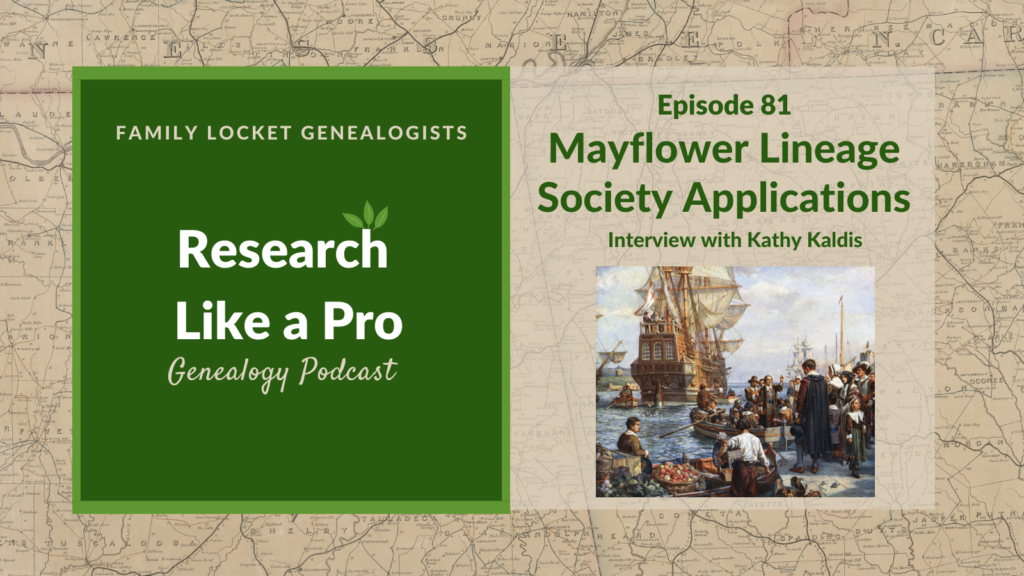
Today’s episode of Research Like a Pro is about how to prepare a lineage society application for the General Society of Mayflower Descendants. Kathy Kaldis is a professional genealogist and an expert on submitting successful Mayflower Society applications. She guides us through the process of working with state societies to prove your lineage to a Mayflower passenger. Listen in for her great advice!
Transcript
Nicole (4s):
Welcome to Research Like a Pro a Genealogy Podcast about taking your research to the next level, hosted by Nicole Dyer and Diana Elder accredited genealogy professional. Diana and Nicole are the mother-daughter team at FamilyLocket.com and the creators of the Amazon bestselling book, Research Like a Pro a Genealogists Guide. I’m Nicole co-host of the podcast join Diana and me as we discuss how to stay organized, make progress in our research and solve difficult cases. Let’s go. Hi everyone, and welcome to the show. I’m Nicole Dyer co-host of The Research Like a Pro Genealogy Podcast.
Nicole (46s):
I’m here with Accredited Genealogist, Diana Elder, and our guest Kathy Kaldis. Hi, Diana.
Diana (53s):
Hi Nicole. Hi, Kathy. Exciting to have you on the show today.
Kathy Kaldis (57s):
Thank you so much for having me and thank you so much to both of you and Nicole for everything that you did to prepare for this.
Diana (1m 4s):
So let me give a little introduction of Kathy and why we’re talking about the Mayflower Lineage Society. So I am a mentor for the ProGen study group number 44, and Kathy is in one of my groups. And last month we were having this great discussion on lineage societies and how has professional genealogists we can help clients prepare those applications, or we could prepare those for ourselves. And it became very evident really soon into the conversation that Kathy was an expert on this topic. And we basically ended up just asking her questions throughout our whole hour long session. So I contacted Kathy and asked her if she would like to come on our podcast and talk about lineage societies.
Diana (1m 47s):
So this is an exciting year, the 400th anniversary of the founding of Plymouth colony, and looking at the website for the Society of Mayflower Descendants. They have a lot of exciting things happening and planned. And Kathy, what do you know about some of the commemoration things that are going to go on this year?
Kathy Kaldis (2m 8s):
So in honor, of the 400th anniversary, what’s really amazing is that every year there is an annual meeting and it’s called a Continental Congress for these lineage societies. And so they are having their own Congress at Plymouth in September of 2020. And it is amazing because all of the people who have actually become a member of the lineage society will honor their ancestors, right in Plymouth Harbor, and also along the coast. So it goes all the way from Cape Cod to Boston, there will be activities, including extended areas in New England. So it’s a fabulous time to be a Mayflower descendant.
Diana (2m 50s):
Well, great. And so we are hoping since we’re doing this podcast in January, that anyone has been kind of thinking about it we’ll have time to possibly join the society. Is there time for someone starting right now?
Kathy Kaldis (3m 3s):
I do want to preface and all of these opinions are of my own experiences, I do not speak on behalf of any of the societies whatsoever. It’s just, this is from my own experience. That should be put out there. Its a challenge. If you have everything all set and ready to go, and your state society is still accepting applications, because remember there’s a high volume of a backlog, and there are people that are just trying to still catch up. But if an application through your state society was to reach Plymouth right now, today, you’re looking at a minimum seven month, wait for an application to be reviewed and verified.
Kathy Kaldis (3m 49s):
The verification process is the process in which the genealogists who are at the society approve your application. They go through all of the documentation compiled, they review it. They still have to do their due diligence. So if they have any questions, they will still do a little bit of a lookup. They do not do the actual research, but they do what they need in order to say, yes, I am satisfied that this is a verified line, or I still have questions. So it is about a seven month wait for that process to take place.
Diana (4m 22s):
So if someone isn’t quite ready to submit, maybe this would just be a great year for them to get all their ducks in a row and get ready to submit. Even if they don’t get it done by all the commemoration events, they could at least have a focus on doing that for this year, kind of as their own personal commemoration, getting their lineage proven back to the Mayflower.
Kathy Kaldis (4m 43s):
Absolutely. There is time, because remember the first Thanksgiving wasn’t when they got there. So there are events from September all the way until the 2021 Thanksgiving. So it’s still going on.
Diana (4m 59s):
Oh, that’s really good to know. So if we don’t get it done by September of 2020, then there’s that whole next year to get involved and do something.
Kathy Kaldis (5m 8s):
Absolutely. So, and all is not lost because some people are only just finding out now that they might even have a Mayflower connection, thanks in part to the DNA and all of the other, you know, Ancestry trees, or FamilySearch trees that are guiding them.
Nicole (5m 26s):
So neat. I’m really excited because I’ve been working on my application for the Mayflower Society and we’re pretty close. So maybe I could get mine done in time for the commemoration,
Kathy Kaldis (5m 36s):
Possibly. It all depends on when your state society can send it to the general society in Plymouth. So definitely make the state society and the representative, whether it’s a historian, a genealogist, or just a volunteer, make them your new best friend.
Nicole (5m 53s):
That’s great advice. I love it. So how did you become interested the Mayflower Society?
Kathy Kaldis (5m 59s):
So I grew up on Cape Cod. I am from Yarmouth, Massachusetts, and the Mayflower story is something that you live every day. It is all around you, whether it’s in the locations around Cape Cod, your friends who constantly would say, well, I’m a 10th generation Cape Codder, or I’m a 14th generation Mayflower descendant. So it is local history living and staring you in the face every day. And as much as I love the history, my parents always told me, oh, you’re Irish, you’re Scottish, you have no Mayflower connection. Well, little did I know when I was an adult, I became a genealogist. I did my genealogy and I go back to the founders of Yarmouth.
Kathy Kaldis (6m 43s):
I go back to all these early Cape Cod families, my name connections hook into the Henry Samson line. And when I found my first Mayflower passenger, I think the world like knew it at that time because I was jumping for joy. This is the beautiful thing about Genealogy. When you personally through your ancestors, find a personal connection to something that’s bigger than just your everyday life. Wow.
Diana (7m 13s):
I agree with that. And how neat that you actually found that connection to Yarmouth and the Mayflower, that’s so neat.
Kathy Kaldis (7m 21s):
Yeah, it was an amazing time because when I moved to Cape Cod, we were an outsider. We were from like the other side of the bridge. And even though I had summered down there my whole entire life, this was an amazing turn that made it personal. And instead of me just saying, well, I grew up on Cape Cod, I also consider myself a Cape Codder now that I know that I have all of these roots. And it’s a very special thing. When you realize you get that personal connection, when you didn’t know it.
Diana (7m 53s):
That is so great. Well, first, anyone listening and thinking, oh, I wonder if I’ve maybe got some connections there or maybe someone already knows or perhaps thinks they have a connection through those trees that you were talking about. What’s the first step they should take?
Kathy Kaldis (8m 11s):
The first step is to really reach out to representatives from the Mayflower Society. So when you join the Mayflower Society, you don’t just send your papers to Plymouth. You join through a state society. So you really need to make them your new best friends, because they will take your line, they will compare it with other previously verified applications, and they’re going to tell you, you only need to do the work between you and your grandparent, you and maybe your fourth great-grandparent. You’re going to knock off some generations. Why do all the work, if you don’t have to? The other thing is, is they’ll also be honest to say, all right, you’ve got a couple of paths here.
Kathy Kaldis (8m 55s):
One of these paths is going to go through New York, which is a very challenging area to obtain records. One of these areas also goes through Massachusetts. While there’s a much higher probability of records being available in Massachusetts, then New York state, around the Revolutionary War to Civil War timeframe. So what we try to do is we try to also navigate the best possible pathway, which will give you the best success and the easiest verification and approval. It’s also where you can talk to people who know what lineage societies are. Lineage work is very different, with a lot of the other elements of genealogy. It’s not just proving that your ancestors were born, married or died.
Kathy Kaldis (9m 41s):
It’s proving that they are the son or daughter of a mother or father. And sometimes that is the most difficult thing to prove.
Diana (9m 50s):
Well, I agree with that because we work in the south and a lot of times there is no documentation for those generational linkages and it’s, you know, indirect evidence that we are working with. So I guess my question for that is what, if you do not have any piece of paper that directly states that generational link?
Kathy Kaldis (10m 13s):
Oh, I’m so glad you asked that question. So the Mayflower Society, accepts proof arguments. Proof arguments is where you have a theory. You have a hypothesis, you use the genealogical proof standard to actually work through your process. And you gather evidence and you link one piece of evidence to the other, through logic, and you have to be able to justify why you think X is true. There are some societies, lineage society such as DAR where literally everything has to connect using direct evidence, they do not take circumstantial and they do not take sometimes negative evidence.
Kathy Kaldis (10m 53s):
It all depends. The lineage societies are all different, so they all have different standards. What’s wonderful is that the Mayflower, as long as the evidence is there to support your theory and also the conflicting evidence has been resolved or explained, you can actually use indirect evidence. You can use negative evidence, but you want to work with someone that understands what the Mayflower Society will accept and what they won’t accept. You actually have to say, here’s my theory, and here’s how the evidence supports this. It’s not just because I’m telling you, so you really want to work with someone that understands what they will accept.
Diana (11m 34s):
So when you talk about the proof argument, can you write up a formal proof argument complete with source citations? Is that how you do it in a narrative format or is it better to do it in an outline? You know, what do they prefer looking at?
Kathy Kaldis (11m 48s):
So, I think it depends on the situation. You do have to do source citations, but you don’t have to have the narrative. There was one proof argument I did that was a challenging one because there was nothing telling me the connection to this person. But when I looked at his life as a whole, and I looked, wait a minute, there’s a relationship with this person and that person that we can kind of see, see through other ways like geography, this proof argument was probably almost an inch and a half thick, but with the logic and the order was really important because if you, if you change the order, the logic didn’t work, it showed not only one person, but it showed the whole family.
Kathy Kaldis (12m 30s):
You can also use name patterns. That can be part of the proof argument. I just did one that it was just basically a clarity of this woman who had many marriages. So I’m like, I just needed to do a bullet as to her timeline with the source citations being the marriage records. But the marriage records didn’t have parents, so it didn’t have other identifiable ways, but I had to do it kind of through just a weaving of her timeline. And that was a simple half a page sort of statement.
Diana (12m 60s):
Wow, that’s so interesting. So what I understand is that each situation is going to be unique, which is why you really need to work with your state person, whatever, are they called registrars, is that the terminology?
Kathy Kaldis (13m 15s):
In Mayflower they’re actually called Historian, State Historians. Now Massachusetts does have paid genealogists, and I believe that there’s two or three other states that do. Mostly, they are running on volunteers. Sometimes the volunteers are just members that have stepped up into this position. Sometimes they’re members who have also been genealogists. So definitely you need to reach out and talk with them. And if there’s a point where you’ve reached beyond their level of expertise, always ask, is there a person that you recommend? Because chances are, they will recommend someone that can get the job done for you.
Diana (13m 57s):
That’s a really good point because so often we do just our own genealogy and we don’t have experience in different locations or at different types of methodologies. And so reaching out to someone else is such a good piece of advice.
Kathy Kaldis (14m 13s):
Right. And there’s a lot of people like me that we do take on clients for this. You’ve also got to be careful though, because some of the professional genealogists that take on clients, they are not familiar with the standards. So just because someone does say they’re a professional, it doesn’t mean that they necessarily have the expertise in what the general society will accept and not accept. I’ve actually seen some applications where they’ve worked with a professional genealogist, the professional genealogist will send them everything under the sun. There’ll be like an encyclopedia. That’s like two inches thick. We don’t need anything beyond what’s necessary. So you also want to really understand that they understand the process.
Diana (14m 56s):
Well, and I think that was interesting that we had an entire session on lineage societies for our ProGen study group, because for anyone not understanding what that is, ProGen is a group of people that come together that are interested in becoming professional genealogists. And Elizabeth Shown Mills has edited a book called Professional Genealogy. And one of the chapters is lineage societies because of this very thing. So as a professional, if you’re going to say that you can do lineage society applications, you really need to know how to do them. And I love that you brought that up, that not everyone really may be as qualified to do that as they might think.
Kathy Kaldis (15m 38s):
Yes. And actually I know the author of that chapter very well. She’s a member of my DAR chapter. And it’s interesting because you can’t use the genealogy process and guidelines for one lineage society to the other. I’ve done many, many years worth of DAR applications and when I switched from DAR to Mayflower, it was as if I was going from English to French, to Swahili, because the standards were so different where I came in and I was like, well, the DAR has this. And they’re like, yep, nope, not so fast. So it was a little bit of a switch. So they all have different rules. They all have different vocabulary.
Kathy Kaldis (16m 19s):
They all have different ways in which they even use the evidence.
Diana (16m 23s):
That’s one of the big takeaways I took from our session where you discussed all of this, that each one is so specific and your job is to really look in to see exactly what they want and give them what they want.
Kathy Kaldis (16m 35s):
Exactly. And the other thing too, is some people also don’t understand, so when the Mayflower Society you’ve got historians or genealogists, in the DAR world, you have registrars or volunteer genealogists. We’re working with the applicant. We are compiling the application packet or the proof packet. However, we are not the judge/jury of this application. It is the genealogist for the respective lineage society that actually is the one that makes any and all decisions. So we can do our best to interpret the guidelines, but just as we’re doing our best to interpret the guidelines, the genealogist for the society, they’re also interpreting it to the best of their ability.
Nicole (17m 22s):
A really interesting point. So what do you do for your state society, or do you work for the general society?
Kathy Kaldis (17m 28s):
I used to work for the state society and I was a genealogist. So what I would do is I would do the intake. So someone would send in a preliminary form. I would then draft their application. I would do as much as I could do looking at previously verified applications. And then for the documents that either was beyond the scope of what I could physically get as far as legally or financially, we were not allowed to purchase the records, obviously. So if it was something that had to be purchased like a contemporary record that was put on the applicant, if there was something that was also a challenge where more documentation needed to really be provided, even though I could definitely do that, it was beyond the scope of the work we did through the society because we just have to keep processing papers right now because of the workflow.
Kathy Kaldis (18m 23s):
So then I would actually write an email to people to say, well, here’s where the challenge is. Here’s what really is probably going to happen, a proof argument, or I really need you to look at these probate records or land records. I would give them resources to different libraries. So I try to at least guide them. So that was what I did once it was as complete as possible. I would send that to the historian. He would then package it, put it on special archival paper that they require, do all the signatures, dues payments, make sure everything was all in order. He would then physically or mail them down to Plymouth. Plymouth would then process it on their end.
Kathy Kaldis (19m 3s):
Once they process it on their end the application goes through the verification process down in Plymouth.
Nicole (19m 9s):
Very cool. That’s neat that you got to work there. So what are some of the common pitfalls that you saw with applications that were not approved?
Kathy Kaldis (19m 19s):
There’s probably top three. I would say the first is people listened to the stories and then they think they’re done or they find that there’s an online tree somewhere and they’re like, okay, I’m a member. They also think that they’ve sent in their preliminary application or they’ve done something through what’s called a, a member lineage match. And what that does is that’s a little preliminary run that they do with your line, and then they send you the best applications to work from and they think that they’re done that they’ve applied. They have not applied until the application packet has been fully documented and proven, sent a Plymouth, and you get a lovely, beautiful membership certificate in the mail.
Kathy Kaldis (20m 3s):
So I think that’s part of the biggest thing is they’re not understanding the process. So what I would do is again, go back to the state society and make sure that you make them the new best friend. They will work with you to make sure that you’re understanding the process. The next involves documentation, which is family trees, online hints, Autosomal DNA matches, none of those constitute proof. So as much as you send in your line and some people will send in all their family trees to say, okay, here’s my proof, that isn’t what we need. We need vital records, probate records, land records, tax records, census records, wills.
Kathy Kaldis (20m 45s):
So work with your historian or genealogist. The final and probably the most important is that so many people just worry about the birth, the death of the marriage, they forget about the proving the linkage. And that can be the toughest thing. How do you know that that person is the son or daughter of Parent A or Parent B? So those are probably the three biggest things, not completing the process, the documentation process, and then also the linkages of the generation.
Nicole (21m 17s):
That was really good advice.
Diana (21m 18s):
So you mentioned a little bit about DNA and I know we talked a little bit about this in the study group. Do you think that there’s any possibility in the future that they will accept DNA proof?
Kathy Kaldis (21m 31s):
So for the Mayflower Society, they do not accept autosomal because autosomal just says you have matches. It doesn’t say you have a match on your Campbell line or your Howes line. It just says that yes, someone that has a similar surname has a match with you. However, it can be an important clue for when you do try to resolve problems right now, you cannot use it as a proof by itself, but it means that something’s there. The other thing that happens with DNA that I have encountered, it happens on the scholarly level. When I worked at NEHGS, we were trying to prove some of these challenging lines, that based on the evidence we were like, we knew that there was a strong possibility that these were Mayflower families, or could there be another child or could this child that has the same surname actually have been connected to these Mayflower passengers.
Kathy Kaldis (22m 27s):
And there were a few research cases that I know we were like, if we could somehow do a DNA study, it has to be through the Y-DNA. But I know that on the scholarly level that they were working on trying to prove some of these lines through using DNA and Y DNA, the scholarly level has a higher rate of success when it comes to being able to use it. Because it’s usually put into some sort of a journal article. When there’s an article that goes through a whole proof argument with not only documentation, but a DNA study. I don’t know the success, whether or not they’ll take it because things were still in process.
Kathy Kaldis (23m 10s):
However, the level of acceptance within societies are changing. So I think in the next few years you might see a nice change, but as of right now, it’s more on the scholarly level where DNA is really becoming useful. And that’s only been my experience. There is probably some success stories, but I have not seen it and I don’t want to speak until I know for sure that things have happened.
Diana (23m 34s):
That’s really interesting. I had no idea that there were some scholarly studies out there. So it sounds to me like if we can just work on our own understanding of DNA, improving family lines, that somewhere down the road, we can possibly use that to link into some of these societies. For my four generation project for ICAPGen, I used Y DNA to connect to my fourth generation. And Y DNA of course is a little bit different because you’re looking specifically at those surnames. And that can be a little bit more clear cut, but I agree with you that in the future DNA is going to be huge in proving some of these lines.
Kathy Kaldis (24m 16s):
And the thing is, is for a Mayflower, even the Revolutionary War for DAR you were on the outside of what autosomal can really do. So most of this has to be done through either Y or mitochondrial. I am not a DNA expert at all. Most of my experience has been working with the documents, but it’s a fascinating thing. When I see someone that has a surname, let’s just say, if they come to us and they say, well, according to my Y DNA, I’ve got some Soule connections. I would refer them to his gen, or I would refer them to other entities.
Kathy Kaldis (24m 60s):
It’s not a thing I deal with, but to me it gets my mind going.
Diana (25m 7s):
Well, Nicole, you are learning about using DNA and the genealogy standards. So what are your thoughts about using DNA for society applications?
Nicole (25m 17s):
Oh, it seems like they’re just so far back that it wouldn’t make sense to you as autosomal DNA, but it does seem like mitochondrial and Y DNA could be a really useful part of an application in the future. So that’s something that you want to prove through DNA, then those tests will be the most useful ones.
Kathy Kaldis (25m 35s):
Yeah. I just think it’s really fascinating that someone through one of the first families of Cape Cod ended up just proving, using Y DNA, a connection with one of the families up in Nova Scotia. And there had always been a theory that this person was connected to one of these early settlers of Yarmouth, Massachusetts, and no one could actually prove it because the documents weren’t there. But this gentleman just did a huge DNA study with many participants and science in that case has taken over. So it would be really interesting, but for the most part, lineage societies do rely on documentation as of today, there’s speculation in the future for many societies, but it’s the here and now that really people have to work
Diana (26m 21s):
Well. I think it’s been fun to talk about DNA because I think that’s on a lot of people’s minds, but you know, as you say right now, we can’t really use that. So we need to focus on the documentation and using traditional Genealogy. So we’ve talked a lot about a lot of different things today, and you’ve given us so much information and food for thought. Can you just give us some specific keys to success for someone that just is thinking, okay, I want to do this, this sounds like something that would be really fulfilling and interesting.
Kathy Kaldis (26m 55s):
Definitely communication with your state societies and the representatives. Communication is an absolute must. I also would rather that something be over proved than under proved. I would so much rather take stuff away that I might not need than to sit there at the table, scratching our heads going, I don’t have this information. Communication also is where you could whittle that down, but definitely expand and look at everything because you never know what might or might not be accepted by the society. Also listen, and don’t argue. It’s really amazing because some people will try to argue their stance.
Kathy Kaldis (27m 38s):
Well, I’m telling you, this is true, so you need to make sure it’s true. We can’t work that way. We want to help you and guide you. So I know that you might want a William Brewster, but the William Brewster line is probably not provable, if it’s even valid, but you know, your Henry Sampson over here, this, this line is a possibility. So definitely have some flexibility in your plan. If all you want to do is be a member, have flexibility and really have fun with it. This is you honoring your ancestor. Your ancestor did something quite amazing in its time. This is how I start many of my lectures, where I look around a room and I’m like, you know, there were about a hundred plus of you here in this room.
Kathy Kaldis (28m 22s):
Can you imagine all of you sitting on a ship for three months at sea, going to Cape Cod in the worst time of the year, with no travel agent, not even knowing that there’s anything there for you, cause it’s all just land. Not even having food, shelter, living on a boat for three months, doing the living, the dying, the cooking, the cleaning, doing everyday human things, doing things like birthing babies, caring for the sick, caring for children on a ship while trying to keep away from the crew. They did something absolutely extraordinary that many other people followed after that. And I just look across the room and I go, you know, there’s a hundred plus of you here.
Kathy Kaldis (29m 6s):
And everyone did this all in a ship smaller than the size of this room. And the looks on people’s faces are like, wow.
Diana (29m 13s):
Wow. That was great. Thank you for giving us that perspective on what it was like for those original Mayflower passengers. Holy cow, that is always mind boggling. And I would hope that maybe there will be some new documentaries, or films, or books coming out this year so that we can better immerse ourselves in this important event and learn more.
Kathy Kaldis (29m 37s):
Yes. And definitely keep an eye out for the major societies. They all are doing things. I know NEHGS, there’s a bunch of scholarly work that they’re always doing. The other thing is all of these societies, they are looking for articles. So if you’ve done work, work with the editors of some of these journals, they’re always looking for articles. And apply. It’s nice to see when people do a lot of work and then they get their certificate and how proud they are.
Nicole (30m 8s):
That’s wonderful. I can’t wait to prove our Dyer lineage back to our Mayflower, passenger. And I want to add my children to the junior members so they can get the benefits of that. So it looks fun.
Kathy Kaldis (30m 21s):
Absolutely. It is a great time to honor whether it’s your Mayflower passenger, your early colonial war, your Jamestown passenger, your revolutionary war, civil war, you know how they say, there’s an app for that? Well, there’s a lineage society for that. And it’s a great way to honor. And having those certificates is such a lovely, lovely thing.
Diana (30m 46s):
Well, as part of the study group, when we were doing the discussion, I learned that there was a first settlers of Indian territory that we actually can apply for because all of my paternal lines were there at the appropriate time. And so I’ve started working on that. So I had never thought that there was a possibility I could connect to something. And now I’ve got one I’m starting with one that’s a little bit easier. And then Nicole has a line that we believe we can tie into for DAR. So, you know, it’s kind of fun to think of a new way to use our genealogy and these lineage societies are kind of neat.
Kathy Kaldis (31m 24s):
Yes. And the thing is, it’s really amazing when you realize that your ancestor did something and his or her participation made that piece of history come true.
Nicole (31m 36s):
Wow. Oh, that is so wonderful. Thank you so much, Kathy, for teaching us about the lineage society applications, we have had a fun time with you today. So thank you.
Kathy Kaldis (31m 46s):
Thank you so much for having me. And I look forward to seeing both of you both in ProGen, also through the Salt Lake Institute of Genealogy, where we’re this lovely community. And it’s fascinating when we get to meet new people all over.
Nicole (31m 59s):
It is wonderful. Isn’t it? And we are recording this just right before the Salt Lake Institute of Genealogy begins. So it’s going to be a fun week next week. I look forward to it.
Kathy Kaldis (32m 11s):
Yes, absolutely. Well, thank you so much.
Nicole (32m 13s):
Well, thank you everyone for listening and we will talk to you again next week. Bye bye.
Diana (32m 27s):
Bye. Bye. Everyone
Nicole (32m 18s):
Thank you for listening. We hope that something you heard today will help you make progress in your research. If you want to learn more, purchase our book Research Like a Pro a Genealogist Guide on Amazon.com and other booksellers. You can also register for our Research Like a Pro online course or join our next Study Group. Learn more at FamilyLocket.com. To share your progress and ask questions join our private Facebook group by sending us your book receipt or joining our eCourse or Study Group. If you like what you heard and would like to support this podcast, please subscribe, rate, and review. We hope you’ll start now to Research Like a Pro.
Links
General Society of Mayflower Descendants – lineage society
Mayflower Quarterly Magazine – Mayflower Society publication
Professional Genealogy by Elizabeth Shown Mills (author, editor) – affiliate link to Amazon
Professional Genealogy: Preparation, Practice & Standards by Elizabeth Shown Mills (author, editor) – affiliate link to Amazon
Daughters of the American Revolution (DAR) – lineage society
ProGen Study Groups – Encouraging professional and aspiring genealogists
Cape Cod Genealogical Society Publications
Study Group – more information and email list
Research Like a Pro: A Genealogist’s Guide by Diana Elder with Nicole Dyer on Amazon.com
Thank you
Thanks for listening! We hope that you will share your thoughts about our podcast and help us out by doing the following:
Share an honest review on iTunes or Stitcher. You can easily write a review with Stitcher, without creating an account. Just scroll to the bottom of the page and click “write a review.” You simply provide a nickname and an email address that will not be published. We value your feedback and your ratings really help this podcast reach others. If you leave a review, we will read it on the podcast and answer any questions that you bring up in your review. Thank you!
Leave a comment in the comment or question in the comment section below.
Share the episode on Twitter, Facebook, or Pinterest.
Subscribe on iTunes, Stitcher, Google Play, or your favorite podcast app.
Sign up for our newsletter to receive notifications of new episodes.
Check out this list of genealogy podcasts from Feedspot: Top 20 Genealogy Podcasts


Leave a Reply
Thanks for the note!