
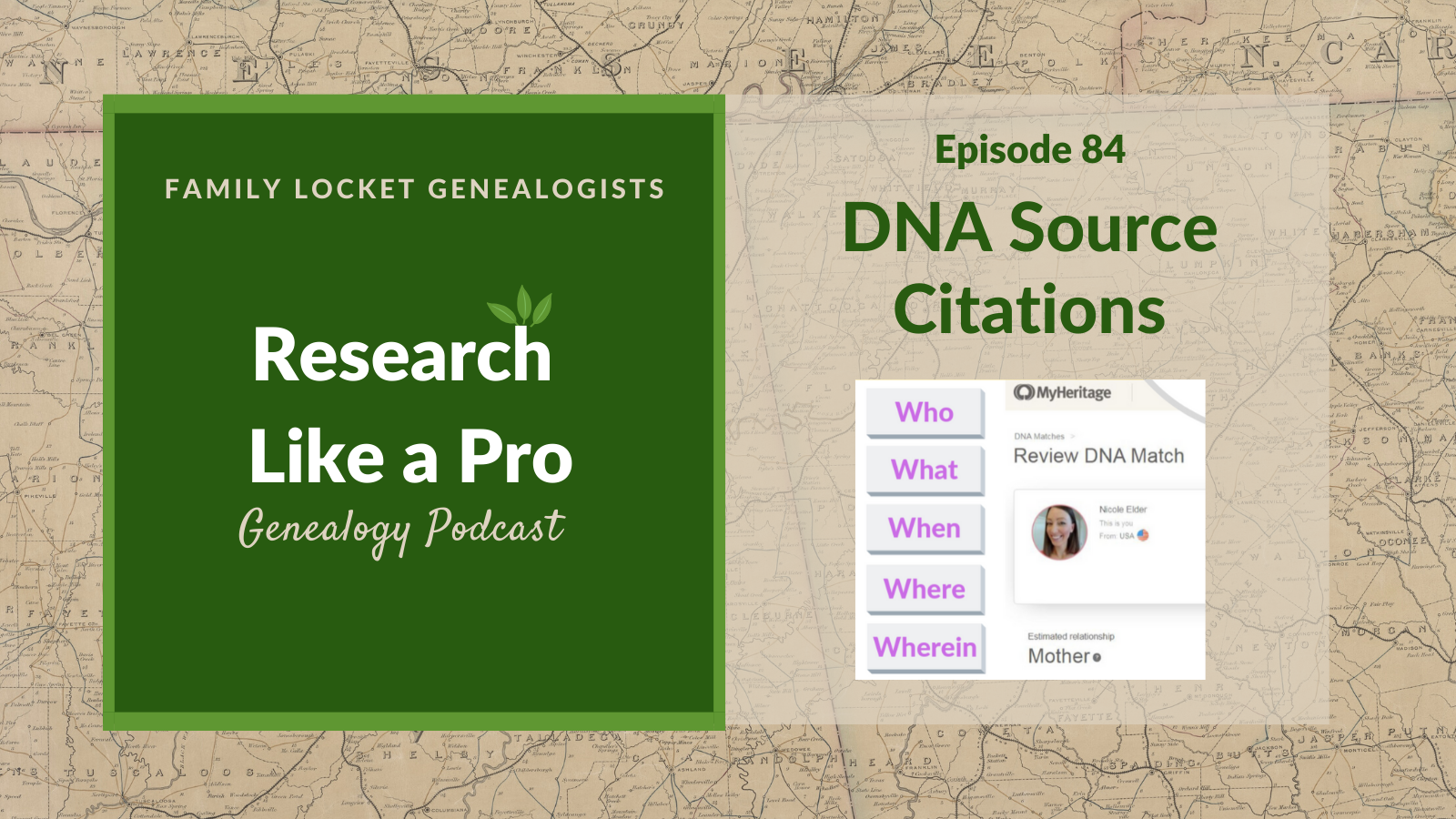
Today’s episode of Research Like a Pro is about how to create DNA source citations. We will discuss the importance of citing and saving DNA information, the citation elements described in Genealogy Standard #5, and how to cite DNA matches and tools using this formula. We give several examples of what each element could be, from the DNA testing company name, to the details about an mtDNA haplogroup. Join us to learn about how to create citations in your DNA research.
Transcript
Nicole (1s):
Research Like a Pro 84: DNA Source Citations. Welcome to Research Like a Pro a Genealogy Podcast about taking your research to the next level, hosted by Nicole Dyer and Diana Elder accredited genealogy professional. Diana and Nicole are the mother-daughter team at FamilyLocket.com and the creators of the Amazon bestselling book, Research Like a Pro a Genealogists Guide. I’m Nicole co-host of the podcast join Diana and me as we discuss how to stay organized, make progress in our research and solve difficult cases. Let’s go.
Nicole (45s):
Hi Everyone, and welcome to Research Like a Pro, I’m Nicole Dyer co-host of the podcast, and I’m happy to be here today with Diana Elder and Robin Wirthlin, hello.
Robin Wirthlin (56s):
Hello.
Diana (57s):
Hi Nicole. Hi Robin.
Nicole (59s):
Well, today, our subject is one that you may have thought about before. It’s about making source citations for DNA sources and DNA information. So if you’ve ever felt frustrated while writing citations, you are not alone. I remember being frustrated when I was first starting to learn how to make source citations, and there’s a learning curve. So we’re going to try to help you out with that today by talking about a simplified formula for citations, and hopefully this can lift some of the frustration.
Robin Wirthlin (1m 29s):
That’s great. I remember someone in the, one of the classes said, I hate citations. I’ve never liked them and never will. You know, that’s okay if you don’t like citations, that the point is that we want to streamline it and make it easier for you to write the citations because they are important to show where you got the information from. So in a previous blog post that was called DNA Sources, Information and Evidence Sorting it All Out. I wrote that you are a source. You share your DNA with a testing company, the DNA testing company, then extracts DNA from the saliva or the cheek swab that you sent back. And then that DNA goes through the process of being extracted and genotyped, which identifies the genetic variants that you have.
Robin Wirthlin (2m 18s):
So then the company has that information and it compares your DNA information to the DNA information from others in their database. And it gives you a report in the form of a DNA match list or an ethnicity ethnicity report, a chromosome browser, a cluster report, mitochondrial DNA, or Y DNA haplogroups and many other reports. So as we cite that information that’s included in the report, we need to follow what Elizabeth Shown Mills says, which is site what you see. So we can’t actually see our DNA, but we can see the output or the reports from the DNA testing company or what is shown in the use of the DNA analysis tools.
Robin Wirthlin (3m 4s):
So since the reports are what we see, that is what we cite. Diana, you are great at giving the formula for creating citations. Will you go over that for us now?
Diana (3m 16s):
Sure. And I love that there’s a formula because it makes it so much more simple. Now I just want to stay that this comes from Genealogy Standards by the Board for the Certification of Genealogists, and they have a standard format in standard number five to follow when creating source citations. And I love that these are questions, you know, they’re the five W questions. So the first one is who, and this is where we’re thinking about who created the source. So this can be a person it’s an agency of business like government and office, a religious body. It’s whoever created that source or authored it or produced it or edited, whoever was responsible for it.
Diana (4m 1s):
Then the second W is the what, and this would be the sources, title, or name. Sometimes we have sources that are not titled. So then we want to have a clear item, specific description so that we know exactly what the source is all about. The third thing is when, when was the source created, published last modified or accessed, and sometimes we don’t have a clear cut date. And so we can use the date of the event, it reports, or we can use both. Then we have the fourth, W which is where, if it’s unpublished, this is where the source physically live, where repository it’s in, where you can actually see this source.
Diana (4m 47s):
If it’s something published like a book or a microfilm, newspaper, CD rom, that’s where it was published. And if it’s online, then we want to have a stable URL and an access point where we can actually see that source. And then our fifth W is the wherein, and this is where we go specific. So where within the source, can we find the information? We need a page number and image number, a sequence, number, something that once we are to the source, we can find that exact piece of information that we are citing. So Nicole, when we come to DNA, how does this all relate?
Nicole (5m 26s):
So I’m going to be sharing some ideas from the table that Robin made in her blog post at Family Locket called DNA Citations. So typically for a DNA citation where you’re citing a match, the, who is going to be the company where you and the match tested. So it’ll be like 23andMe or Ancestry DNA. It could be DNA painter, if you are citing a chromosome map that you’ve created. So that’s typically who you would put for the who part of the formula. And now let’s go to what, what is just describing what you are citing.
Nicole (6m 6s):
So what is it, is it a database report? Is it an ethnicity estimate? Is it a DNA match? Is it a haplogroup? Is it a segment triangulation? Is it a tree at what are the odds showing the probability of certain hypothesis? So just describe what it is for the, what, and now for the when, it would be when that report or other result was accessed. So did you view that cousin match on a certain date, just put accessed 16, September, 2019 or something like that. Or when did you create the one-to-one comparison at GEDMatch and so forth.
Nicole (6m 51s):
Then for the where, you’re going to put where the source is now, where is it located? And this is going to be the URL of the DNA testing company or the DNA analysis tool that you’re citing. So if you’re citing a match at 23andMe, then you’ll just put HTTPS://www.23and me.com. And that’s the URL where the testing company resides and that’s where the match is. And usually the person reading this information won’t have access to the database unless they are the test taker, but it is still important to show where that analysis took place.
Nicole (7m 31s):
So if you’re using a DNA analysis tool, then you’d put their URL. So that’s all you do for the where. And then for where in, this would be the details, like where in the item is the information you used within that source. This could be details about the match like predicted third to fourth, cousin sharing 166 centimorgans across 10 segments with SC managed by RC, or it could be the chromosome information if you’re doing a chromosome browser citation could say chromosome browser triangulated, 18.5 centimorgan match between RO, BG and NG on chromosome four.
Nicole (8m 16s):
So those would all be just the initials of the people you could put in their full names, depending on the privacy and the permissions that you have. Another example that you could put in for the wherein would be the haplogroup. So you could put mtDNA haplogroup H3g. So just think of the wherein as the details about the match.
Robin Wirthlin (8m 37s):
Like you mentioned that one of the key things is that we really need to have permission in order to include the names of living people in the published report. If you don’t have their express permission, then you need to use initials or use a pseudonym because you want to protect the privacy of other people, just like you’d want yours protected.
Nicole (8m 58s):
Yes, that’s so tricky because we’re giving these reports to clients privately, typically. So it’s fine in that case to put the whole name of the match, because the client already has access to the testing database. But if we’re going to publish that report and post it on, like FamilySearch, a public place or Ancestry where anybody can go read it, then we do need to take those precautions and make the names of the matches private, unless we’ve got their permission to share them.
Robin Wirthlin (9m 25s):
You’re so, right. So I think using these rules and these guidelines will really help you to be able to create your citations in a really simple and easy way. There are some DNA citation templates out there from DNA-central.com, Knox trail ancestry by Brent Chadwick has 18 citation templates, courtesy of Angie Bush, and you’ll also get other commonly used genealogical source templates from there. The most important thing is that we do include the citations. I heard a story last week at SLIG of a woman who donated 12 boxes of research that was scanned.
Robin Wirthlin (10m 9s):
And in all of that, she didn’t include one source citation. So while she’s done perhaps excellent work, there’s no way to go back and verify it or retrace her steps or evaluate the quality of the sources that she has looked at. So it was really a tragedy and the lady was deceased and it’s heartbreaking that she spent so much of her time collecting the information, but no one can go back and learn more because there’s no source citations.
Nicole (10m 41s):
Wow, that’s really interesting. And so she scanned a bunch of boxes of documents or research?
Robin Wirthlin (10m 48s):
Her son donated that the research and it was scanned. As he was growing up she spent a lot of time with her genealogy and not as much with her kids and it was her life’s work and then no source citations. So it’s really heartbreaking.
Diana (11m 5s):
And I see this a lot with my client work, a client will give me a whole file of all the documents that they’ve used and very seldom do those come with a source citation. And so I’m trying to go back and find the original source of that document so I can create a source citation. And sometimes I just have to say it’s in the files at the client. So I love it when a client gives me work and they have scribbled on the back where this document actually came from, because we really can’t have valid research unless somebody can follow our footsteps and go right back to it. So, you know, we really didn’t talk a lot at the beginning of this episode about why we do want to do source citations for DNA sources.
Diana (11m 48s):
And that’s something I wanted to bring up that some of these sources that we’re using, like these cousin matches, those may disappear over the years. We’ve heard of instances where people, all of a sudden decide to take down their DNA results. And so what if you have a really key match and then that person decides to take down their DNA results and no one can go back and repeat the process to see that. Well, if you’ve created a really good source citation with all the details, then that at least gives you something, you know, as opposed to never being able to access that again, even better would be if you’d taken a screenshot and then have that citation attached to it.
Diana (12m 31s):
So let me just read a couple of examples of citations, and I know this is such exciting stuff to listen to a source citation, but I think it would be helpful for someone to actually hear what you put in a citation. Now we’ve kind of gone through it. I will read through this complete with punctuation so that you can hear what a DNA Source Citations sounds like. MyHeritage, in quotes is the title, “Review DNA Match for Robin Wirthlin, MyHeritage, and then we have the URL in parentheses, so (HTTPS://www.my heritage.com/dna/match access 10 September, 2019) So that whole part there, the URL and the access date is within parentheses because it’s publication information, that is when you access to it and where on the internet it was accessed.
Diana (13m 37s):
And then we have another comma separating the next portion, estimated second cousin, once removed relationship with private sharing, 2.3% DNA 165.7 centimorgans across eight shared segments, largest segment 51.1 centimorgans, DNA managed by private, most recent common ancestor, J E Taylor and M A Ollerton. Okay. So this is one that you created Robin, and I’m so impressed with that citation because that gives a boatload of information.
Diana (14m 20s):
I know exactly where you tested at, MyHeritage. I know when you accessed the match, in September of 2019, and I have all sorts of information about the shared centimorgans and the matches and the segments, as well as the most recent common ancestor. So that really was a very informative source citation. So good job, Robin.
Robin Wirthlin (14m 44s):
Thanks.
Diana (14m 44s):
Now, let me read through another one. This one is for Genetic Affairs, so this would be a third-party tool, and you also created this one, and it says Genetic Affairs, and then in quotes you have made up a title. So it’s “auto cluster visualization for Robin Worthen” and then Genetic Affairs, the name of the website is in italics, and then again in parentheses the actual URL and the access date of 13, September, 2019, and then another comma, and then the details. So in this case, the details are 23andMe data showing five members in cluster eight and then comma, most recent common ancestor E Taylor and W.
Diana (15m 29s):
A. Spafford, and then a period to end it. I really like how you put the most recent common ancestor in parentheses as that extra information in these citations. I think that’s so helpful. Good job.
Robin Wirthlin (15m 42s):
Thanks. Yeah, you can look at it and go straight to what you’re working on, so I like that.
Diana (15m 49s):
I’m kind of thinking of likening this to source citations for a census. I know when I first started doing genealogy way back when my source citations that I entered into my genealogy program went something like this Ancestry.com 1870 census, which is not very good. You know, there’s no description there and now, you know, I have the household number and I have the actual county and the city, and so much more information. Well, so I look at one of these that you did for instance, this Genetic Affairs citation and how much better that you put all the detail, rather than just saying something like Genetic Affairs. You know, you could just be really simple and put that, but that’s not going to be very helpful for someone down the road looking at this, and especially if you’re putting it in a report or something.
Diana (16m 41s):
So all these details, I think make a really big difference in creating our citations.
Nicole (16m 45s):
I agree. And I think when I first started making citations, it was tricky to know how much detail I was supposed to include. And where did those details fit within the formula of who, what, when, where, and wherein, but I liked the idea that the wherein is where we put the details about the match. And I think that’s also where it kind of comes down to our creativity a little bit with thinking outside the box about what we should include, that would be helpful in the citation and not just trying to hurry and get the citation over with, but, you know, being thoughtful about the details that are really relevant and how, like, how did you create that auto cluster visualization and whatever other details might be helpful to you?
Nicole (17m 30s):
So I think it’s fun to consider that quote that Diana always uses in her citation presentations is that from Elizabeth Shown Mills, that citation is an art, not a science.
Diana (17m 44s):
That is exactly right. And as soon as I teach that, people noticeably relax a little bit. I think when we think we have to have something absolutely perfect it makes us so stressed. Instead if we can just use the formula to look at our citations and think, okay, do I have this element? Do I have this element? Okay, I’ve got them all there. Oh, it’s looking great. Then we can take a lot of the pressure off ourselves. So one of the things that I always recommend is to create our own citation templates. We can use others. And Robin has given us some great ideas of where to get started, finding those on DNA-Central and the Knox Trail Ancestry by Brent Chadwick. But I also am really a proponent of creating our own because when we create our own citation templates, we’re putting things together in a way that makes sense for our brain.
Diana (18m 34s):
And it will help us as we go forward to know exactly what to put in our citation. So I like to create a spreadsheet. And then when I have done a really good citation, I like to put that into my spreadsheet. So that next time I am doing a client project or project for myself and I come to Genetic Affairs, I can go. I remember I created a great citation on that and I can go get that copy and paste and change the relevant information. So I really liked the idea of creating a good citation once and then reusing it over and over. And sometimes we get better. Sometimes we want to change our template a little bit when we decide we need to add something to it, but at least it gives us something to start with.
Robin Wirthlin (19m 19s):
And I think it saves a lot of mental energy too. You put in the time already to create it, go back and, and use it and it’ll make your life easier. And it won’t be as stressful as you’re thinking about citations.
Nicole (19m 36s):
I love my templates. That’s one of the greatest things I’ve learned from you, mom, is to keep track of all the citations that I spent time making so that I can reuse them again and not have to review all the details of how to do it again. It saves me a lot of time. All right, well, we have gone over lots of good details for making DNA source citations and I thought at the very end of this episode today, maybe we should just briefly discuss how the editors of the NGSQ have been using DNA citations and the writers too. I know it’s kind of a group effort coming up with how they’re going to do the citations and conserve enough space, but also have sufficient verifiable data within the journal.
Nicole (20m 23s):
So if you have read the March, 2019 quarterly, there’s an article in there called A Family for Mary Jones Hobbs Clark of Carroll County, Arkansas by Melinda Daffin Henningfield. And she has a case where there was a courthouse fire that destroyed county records and the people she was researching were poor, landless, and illiterate. So she was able to use DNA evidence to connect to the parents of Mary. So I thought would be fun to just kind of look in the citations here and see how it’s been done and just discuss those.
Nicole (21m 6s):
So one of the things that she does is she has citations to the trees that she has created on Ancestry for all of her test takers. And so what she has are individual URLs linking to the trees. So what do you guys think of that?
Diana (21m 23s):
Well, I like to cite those trees and if they’re public, they’re on Ancestry for anyone to see, then people can actually go and trace your footsteps a little bit with citing a tree, whereas they can’t look at DNA shared matches, but if it’s a public tree, then absolutely that’s a great thing to cite.
Nicole (21m 45s):
Right. Another thing that she did was she states in one of her footnotes that living test takers and their living ancestors are anonymized for privacy. So I thought that was interesting. And then she says that the trees that she’s citing are all created by herself. So the author of the article created these trees to show that she has documented each of their lines of ascent, which follows one of the genealogy standards about needing to show documentation for each parent child link back to the common ancestor. So she has gone and created a separate pedigree for each of her test takers and is citing them. I personally think they did that because it would take too much space to put all of those into the article.
Diana (22m 29s):
Interesting. I do like seeing how the NGSQ both about putting these things into an article because the space is limited. So that’s a really good idea to go and look at some of those articles and see how those cases are, are handled.
Nicole (22m 46s):
She has a lot of citations, two informational articles about DNA, and I saw Wiki and different articles online. Like for example, one by Roberta Estes just explaining certain concepts. So that’s another thing that we’ll probably need to do in our writing is explained to our audience who may not be experts at DNA, some information that they could go learn more about the concepts. And just to show where we got that information, if we’re sharing statistics about a certain percentage of third cousins will show up as a DNA match and that kind of thing.
Diana (23m 20s):
Absolutely. And I use definitions a lot from the [?] Wiki or from the books that Blaine Bettinger has written because it’s so helpful to have someone else’s words, the client doesn’t have to just take my words, but I am quoting an expert in the field. And so I actually save in document my little explanations of things and where I’ve taken quotes and have the citation all ready to go, because I find that I’m reusing some of those same educational things for clients over and over and over in project. So why not just have it all ready to go and not have to reinvent the wheel every time,
Robin Wirthlin (23m 59s):
One point that was made repeatedly at the class I took last week at SLIG, which was Project Management Essentials for Genealogical Research was that there are tools online that can help you to recall some templates that you’ve saved. You can do that in Gmail. You can do it with another program called text expander. And it’s a way to access things that you’ve already spent a lot of hard work and time and energy on creating. And then if you can cut and paste that you can paste it into, use it in another setting, then that saves you time and you’re more efficient.
Nicole (24m 40s):
Oh, that’s great. You know, I actually do use the templates on Gmail to save a lot of common responses that I’d write sometimes.
Diana (24m 47s):
Oh, okay now I know that when you respond to my emails, it’s just the template. Good idea.
Nicole (24m 59s):
Well, lastly, in this article, the way that the test takers are cited is just by having like a simple citation to GEDMatch and then in the chart, she just has all of the test takers’ kit numbers. So I thought that was really interesting too. Instead of doing separate source citations for each test taker, she’s just put their kit numbers and then you can go and look them up on GEDMatch yourself. Obviously that’s the best for a sufficient verifiable data to meet that standard is to have kit numbers on GEDMatch where anyone can go and check the research and see that it shows what she was saying it showed. So that’s always the challenge with these articles. If you ever want to do a case study, that’s published is getting your test takers to transfer to a public database like that.
Nicole (25m 45s):
All right. Well, thank you ladies for discussing citations with us today, that was an enlightening talk. And I hope everybody listening will go and try making the citation for a DNA match if you haven’t done that before and be sure to check our examples and the table that Robin made with all the formula who, what, when, where on our blog post, DNA Citations. All right. Have a great week. We’ll talk to you again next week.
Diana (26m 13s):
Bye-bye everyone.
Robin Wirthlin (26m 14s):
Goodbye.
Nicole (26m 10s):
Thank you for listening to Research Like a Pro with Diana Elder, accredited genealogy professional and Nicole Dyer. We hope that something you heard today will help you make progress in your own genealogy research. If you like what you heard, please leave us a review on iTunes or Stitcher or visit our website, FamilyLocket.com to contact us. You can find our book Research Like a Pro a Genealogist’s Guide on Amazon.com and other booksellers. We hope you’ll start now to Research Like a Pro.
Links
DNA Source Citations by Robin at Family Locket – includes the table with the 5 elements and examples for each
DNA Sources, Information, and Evidence: Sorting it All Out – post by Robin at Family Locket
Genealogy Standards 2nd Edition – affiliate link to Amazon
QuickSheet: Citing Genetic Sources for History Research: Evidence Style – affiliate link to Amazon; available on Kindle – a bit outdated
RLP 61- Analyzing Your Sources in a DNA Research Project
DNA Central – Blaine Bettinger’s subscription website; includes DNA Citation templates
Knox Trail Ances-Tree by Brent Chadwick – 18 DNA citation templates courtesy of Angie Bush
National Genealogical Society Quarterly (NGSQ)
Melinda Daffin Henningfield, “A Family for Mary (Jones) Hobbs Clark of Carroll County, Arkansas,” National Genealogical Society Quarterly 107 (March 2019): 5-30.
Study Group – more information and email list
Research Like a Pro: A Genealogist’s Guide by Diana Elder with Nicole Dyer on Amazon.com
Thank you
Thanks for listening! We hope that you will share your thoughts about our podcast and help us out by doing the following:
Share an honest review on iTunes or Stitcher. You can easily write a review with Stitcher, without creating an account. Just scroll to the bottom of the page and click “write a review.” You simply provide a nickname and an email address that will not be published. We value your feedback and your ratings really help this podcast reach others. If you leave a review, we will read it on the podcast and answer any questions that you bring up in your review. Thank you!
Leave a comment in the comment or question in the comment section below.
Share the episode on Twitter, Facebook, or Pinterest.
Subscribe on iTunes, Stitcher, Google Play, or your favorite podcast app.
Sign up for our newsletter to receive notifications of new episodes.
Check out this list of genealogy podcasts from Feedspot: Top 20 Genealogy Podcasts




2 Comments
Leave your reply.