
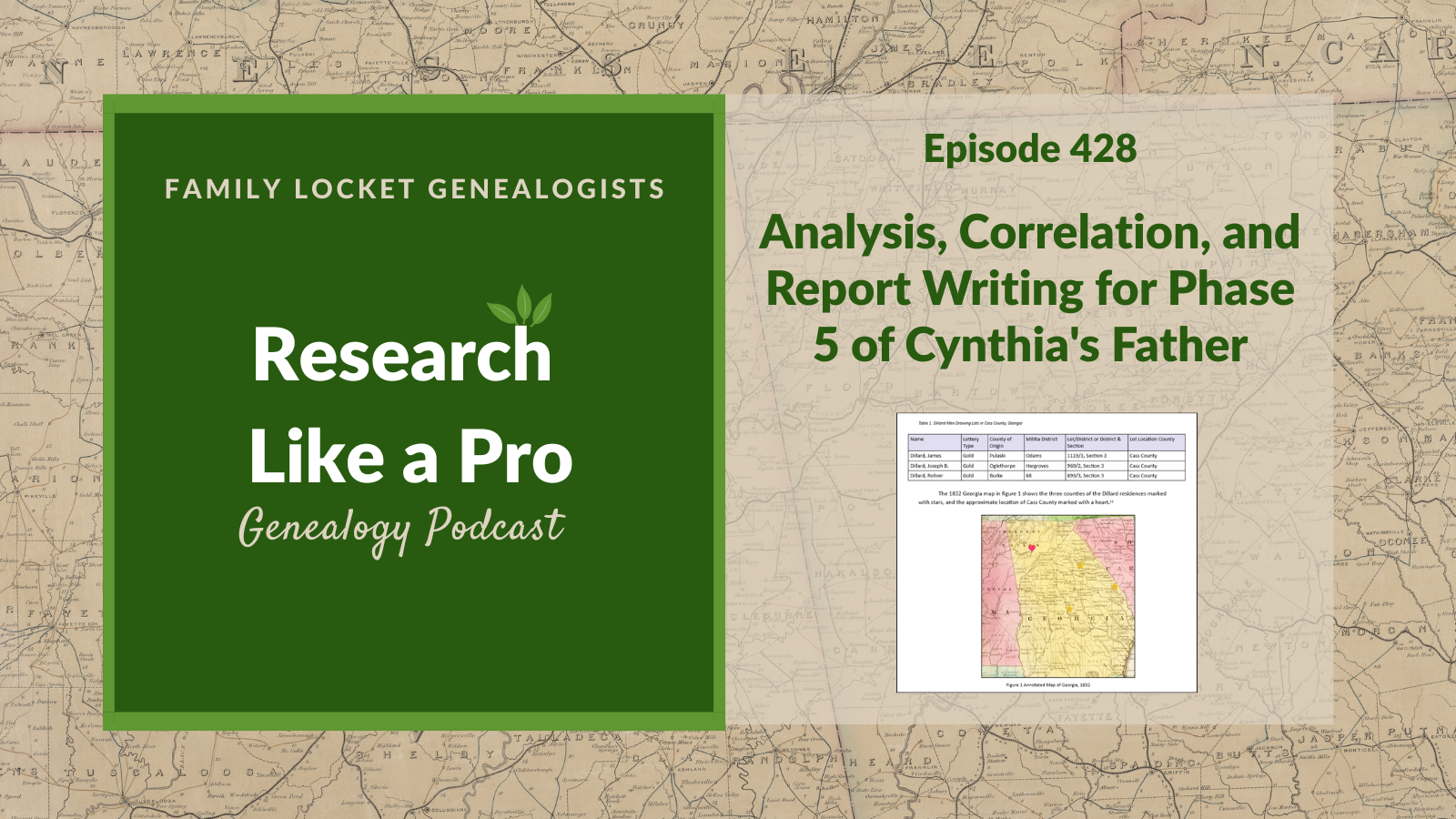
In this episode, Nicole and Diana discuss Phase 5, Part 5 of Diana’s ongoing research project to identify the biological father of Cynthia (Dillard) Royston. Diana evaluates three specific candidates who drew land in Cass County, Georgia, during the 1832 Gold Lottery: James Dillard of Pulaski County, Joseph B. Dillard of Oglethorpe County, and Tolliver Dillard of Burke County. Nicole outlines the project scope and historical context, highlighting significant record destruction caused by courthouse fires in Cass and Burke counties. Diana explains how she organizes her research report using her Airtable log entries. She eliminates James Dillard because 1830 census records show he was single at the time, and she rules out Joseph B. Dillard because he was only thirteen years old when Cynthia was born. Tolliver Dillard becomes the primary candidate based on census placeholder analysis, tax digests, headright grants, and land lottery draws that align with Cynthia’s timeline.
The hosts also examine genetic evidence to support the documentary findings. Diana re-annotates an autosomal DNA network graph, demonstrating that matches across multiple branches of Cynthia’s descendants share DNA with descendants of Elijah Dillard, pointing to a sibling relationship. She also explains her Y-DNA testing initiative, which recruits male Dillard descendants to trace Elijah’s patriline and compare results against the Dillard Surname Project. Listeners learn how to correlate indirect evidence in burned counties, structure a comprehensive research report, use AI tools to assist in drafting report summaries, and integrate autosomal and Y-DNA evidence to solve complex genealogical brick walls.
This summary was generated by Google Gemini.
Transcript
Nicole (1s):
This is Research Like a Pro Episode 428: Analysis, Correlation, and Report Writing for Phase five of Cynthia’s Father. Welcome to Research Like a Pro a Genealogy Podcast about taking your research to the next level, hosted by Nicole Dyer and Diana Elder accredited genealogy professional. Diana and Nicole are the mother-daughter team at FamilyLocket.com and the authors of Research Like a Pro A Genealogist’s Guide. With Robin Wirthlin they also co-authored the companion volume, Research Like a Pro with DNA. Join Diana and Nicole as they discuss how to stay organized, make progress in their research and solve difficult cases.
Nicole (42s):
Let’s go. Today’s episode is sponsored by newspapers.com. Welcome to Research Like a Pro. Hi everybody. And Hi mom.
Diana (50s):
Hi Nicole. How are you doing today?
Nicole (53s):
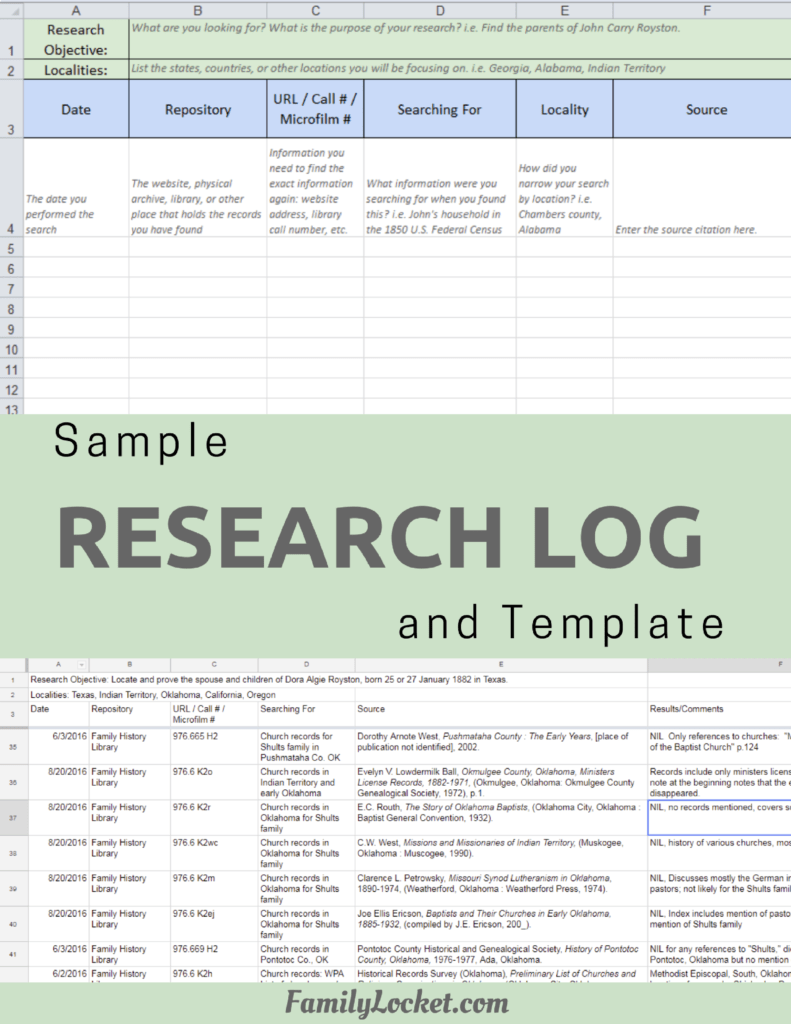
Hey, I’m doing well and I’m feeling like I have some momentum on my case study. I’ve been working on it a little bit for my portfolio for certification and I’ve been just kind of adding the sources into my Airtable base research log and just kind of like getting some momentum by working on some easy things. You know, it’s hard when you feel like you haven’t worked on something for a while to get back into it. So I’ve just been kind of like looking at what I have and transcribing some original documents that I hadn’t transcribed yet and thinking about what, what I need to do to make this easier to get working on. And so part of that was realizing that I was using one of my older Airtable bases and that I wanted to use my latest one.
Nicole (1m 36s):
And so just kind of like transferring some of the data to be in the format that I like it currently for research logging and just making it easier on myself.
Diana (1m 47s):
Well that all goes back to the getting things done method, right? What is the next action that you need to do? And sometimes it’s just something simple like that you’re doing your next actions.
Nicole (1m 57s):
Yeah, true.
Diana (1m 58s):
Getting you going. I know often if I’ve got something I’m kind of procrastinating or it’s a big task, I have to stop and think, okay, what is the small simple thing I can do to get going on this?
Nicole (2m 8s):
Yeah.
Diana (2m 9s):
And then it gets easier. I totally agree with that. Well, let’s do some announcements, we have our Research Like a Pro Webinar Series coming up on Tuesday, October 20th at 11:00 AM Mountain Time. And the title of this is When DNA Reveals Hidden Identities: Investigating Whether Minnie James Was Born Fannie Tattoon. Our presenter is Yvonne Fenster. She is an accredited genealogist, she is a nurse and she has a PhD. So the description for this webinar reads, Could Fannie Tattoon and Minnie James be the same person?
Diana (2m 49s):
This investigation examines a compelling hypothesis that emerged when DNA matches revealed shared ancestry through both Gilbert Tattoon (Fannie’s father) and James H. Clayton (Minnie’s husband)—connecting two seemingly unrelated Connecticut families. With Fannie vanishing from records after childhood and Minnie appearing as an adult without prior documentation, the analysis draws on genetic data, Connecticut records, and other documents to determine whether they are separate individuals or one woman who changed her identity after being orphaned. Well, the topics are Connecticut, Dana Leeds Method, Misattributed Parentage, Identity Research, Name Change Investigation, Orphaned Children, DNA Analysis, Disappearing Ancestors, Vital Records, Social Security Records, Church Records, BanyanDNA, Comparative Timeline Analysis, African American Research, City Directories, maps and Fan Club.
Diana (3m 50s):
So that is going to be so exciting and jam packed with amazing records and analysis. Let’s learn a little bit about Yvonne. She is a professional Genealogist accredited through ICAPGen in the upper South region of the United States: Virginia, West Virginia, Tennessee, Kentucky, North Carolina. She brings expertise in DNA analysis, particularly in cases involving cousin marriages, and YDNA research, which helps break through genealogical brick walls. Yvonne is a graduate of the Research Like a Pro and Research Like a Pro with DNA study groups and has subsequently served as a mentor for both study groups. She holds an Associate of Science in Nursing from Onondaga Community College, a Bachelor of Science in Biology from Bridgewater State College, and a Doctor of Philosophy in Neuroscience and Physiology from the State University of New York at Upstate Medical University in Syracuse, and Postdoctoral training at Cornell University in Ithaca.
Diana (4m 52s):
When not uncovering family histories, Yvonne enjoys quilting, cooking, and spending time with her grandchildren and husband. So we are excited to hear from Yvonne and we also love working with her as she is on our team at FamilyLocket Genealogists. So our next Research Like a Pro of DNA study group, begins February, 2027 and registration begins in December of 2026. Please join our newsletter if you haven’t yet. It comes out every Monday and it has new posts, upcoming lectures and coupon codes, upcoming conferences. We’re almost ready for the APG Professional Management Conference, which is coming up on October 14th through 17th where I will be talking about Easy CRM tools, managing client projects and contractors with Google Sheets and Airtable, and then hosting a panel From Concept to Classroom: Genealogists share how they build courses that teach and inspire.
Diana (5m 56s):
Nicole has a panel session as well, Find your Voice: Podcasting as a Path to Community, Clients and Credibility, and a workshop, Airtable Meets AI: Smarter Transcription and Research Logging. So lots of neat things coming up.
Nicole (6m 12s):
Yes, and speaking of neat things coming up, registration is officially open for our next Research Like a Pro Institute course on Merging and Separating Identities, which begins in January, 2027. So the website and all the course information went live this month, so we’re excited.
Diana (6m 33s):
Wonderful. I knew it was in the works and it’s so nice to have the dates on the calendar at last.
Nicole (6m 38s):
Yeah, it is. And this one sold out last year, so we wanted our podcast listeners to hear about it first and have a chance to look it up and look it over before the spots fill up.
Diana (6m 47s):
To learn more, head to the FamilyLocket website and hover over the shop tab in the navigation menu. Choose Institute courses from the dropdown and you’ll find it there. Click through for an overview of the course along with the description of each session.
Nicole (7m 3s):
It will be fun. I’m looking forward to talking about merging and separating in Airtable again. And of course all the other instructors will have a lot of great topics to discuss.
Diana (7m 14s):
Absolutely.
Nicole (7m 14s):
Alright, today we’re talking about Cynthia Dillard again, and this has been a series about phase five of Diana’s research on this, and she did it during the Research Like a Pro with DNA study group earlier this year. And today we’ll talk about Analysis, Correlation and Writing the Report. So we’ve talked about the objective, the timeline and locality research, research planning, and the research logging source citations. So now we’re going to kind of pull everything together.
Diana (7m 46s):
All right, well let’s just review quickly the objective so everyone can remember what this project was all about. And I’ve had this overall objective for many years, which was to discover Cynthia’s biological father. So my objective has got her birth date, which is an estimate of 1815 in Georgia, and then her actual death date, which I really do have of August 2nd, 1882 in Collin County, Texas. Cynthia, married Thomas B. Royston in about 1833 or 1834, possibly in Cass County, Georgia. So for phase five of this project, I actually broke up the objective into two parts.
Diana (8m 30s):
One is documentary and one is DNA. So for the documentary research objective, I wanted to seek connections between Cynthia Dillard Royston and three men who drew lots in Cass County, Georgia in the 1832 Gold Lottery: James Dillard of Pulaski County, Odams District; Joseph B. Dillard of Oglethorpe County, Hargroves District, and Tolliver Dillard of Burke County, 68 District. And then for the genetic genealogy portion, I put down Further analyze the DNA network graph for additional Dillard connections and seek additional DNA evidence through Y-DNA testing and expanding DNA coverage for Cynthia’s genome.
Nicole (9m 11s):
Okay, great.
Diana (9m 12s):
So you know, we’re talking this time about the research report and about the findings. So you know in a report that just goes right at the beginning, the objective so that anytime anybody is reading it, whether it’s yourself or your client or family members, they know exactly what this project was all about.
Nicole (9m 33s):
So important to put that first, and then next in the report comes some of the limitations, or another way to say that would be the scope and the parameters. And so that section explains scope, parameters and limitations. And in that section, Mom, you noted that research was limited to online records and was bounded by the timeframe of the Research Like a Pro with DNA study group. And so kind of limited in the dates or timeframe that you would be working on it. And then also it noted that Cass, now Bartow County, sustained record loss in the 1864 courthouse fire and that an 1856 fire in Burke counties destroyed most county records.
Nicole (10m 16s):
And those are significant limitations. It’s good to put that up front so that the reader remembers what we had to work with. Then for the genetic portion of the report, Mom, you explained that you used only your key test takers’ DNA at Ancestry and that you viewed new matches for this project. So you’re not using, you know, a lot of other test kits at different sites, just focusing on Ancestry DNA.
Diana (10m 44s):
Absolutely. Okay. So next in the report is the result summary. And this is where we can preview the research. And I like this because you can do a quick glance through and see what was found. And also if I’m going back and looking at past reports, I can read this to remember what I found. I use this all the time. So helpful. So when I write this, I always like to use active verbs, which will strengthen the writing. And then I used to do a long list of statements, just basically go through the report and just list everything out. But now I do a limited list of bullet points and have each one center on one subject.
Diana (11m 26s):
And this is a section that I typically have artificial intelligence help me write based on my report. So in this case, I used Claude Opus 5 High for Complex Tasks, because I wanted the AI to take its time in reading my report and pulling out the accurate facts and analysis from my findings. And I was very pleased with the result. Claude AI used good active verbs like eliminated, identified, reconstructed, confirmed, strengthened and launched. But I was really careful to make sure it did not have any incorrect assumptions thrown in there. So I carefully read bullet point and found no errors.
Diana (12m 6s):
So for example, here’s one that I used: eliminated James Dillard of Pulaski County as a candidate for Cynthia’s father. Born about 1795 in South Carolina, James was still living in the household of his father, Philip Dillard in 1830 with no wife or daughter of an age to be Cynthia. He married Sarah about 1834 and his eldest child was born about 1835 after Cynthia’s own marriage to Thomas Beverly Royston. So you can see there, I just did all in one a little statement that was just about this one man. So I have found that method too. It worked really, really well.
Nicole (12m 46s):
Okay, great. Let’s talk about the background section of the report now. This had three parts. First, a project overview establishing Cynthia’s identity that she was born about 1815 in Georgia and died on August 2nd in 1882 in Collin County, Texas. And that her maiden name was known only from the death certificates of three of her 14 children. And then the next section of the background was a summary of phases one through four, so that a new reader didn’t have to go read four prior reports to follow this report. So phase one disproved George W Dillard, when the Mahoney family Bible revealed that the 1815 born Dillard female was Mariah Dillard and not Cynthia.
Nicole (13m 28s):
Phase two eliminated 10 more candidates. Phase three introduced the DNA and the Elijah Dillard hypothesis. Phase four narrowed to Cass County and eliminated the Cass County Dillard households. And then the third section of the background information was an explanation of the 1832 Georgia Gold Lottery, how it ran concurrently with the Cherokee land lottery, why gold lots were 40 acres instead of 160, who qualified and who was excluded. And then she built the table of the three Cass County drawers with their counties of origin, militia districts and lot numbers an annotated in 1832 map of Georgia with stars at Pulaski, Oglethorpe and Burke and a heart at Cass County.
Nicole (14m 10s):
And seeing those three counties scattered across the state with Cass far up in the northwest corner kind of reframed the question, what would bring a man from Burke county on the South Carolina border into Cherokee territory?
Diana (14m 24s):
Yeah, I love to put maps in my research reports, it’s just so nice to visualize. And I also love tables, you know, all those different things that can break up the narrative are very, very helpful. So next, after writing out that background area, I next have a section called Findings and Analysis. And because I had broken the subjective into two parts, genetic evidence and documentary, I tackled the documentary first. And it was really nice because I’d used Airtable as my research log and I’d entered each person as I was sorting them. You know, I’m going after three men. And so I grouped it by person and then I sorted it chronologically.
Diana (15m 5s):
So each man already had his own timeline right there and the grouping became the section structure directly. So I had the records right there in chronological order, I could see all the different result summaries. So first I wrote about James, then Joseph, and then Tolliver. And then at the end of each section I wrote a summary of my analysis. You know, since I’m working with three different men, I thought, I don’t want to get confused about what’s going on for each man. So you know, I go through the records and then do a summary. So for James Dillard of Pulaski County, I wrote records for James were readily available.
Diana (15m 49s):
And soon into the research it became apparent that he was not Cynthia’s father. James’ father, Philip Dillard’s 1828 will named five children, James, among them. When I transcribed Philip’s 1830 household line by line and assigned each tick mark to a named person, James likely appeared as the male age 39 with no wife beside him. And the female age 10 to 14 was almost certainly his sister Rebecca and not a daughter. He married Sarah about 1834 and his oldest child, Wilmington, was born about 1835 after Cynthia’s own marriage. Born about 1795 in South Carolina, he was old enough to be Cynthia’s father, but his timeline showed he was a single man until his 1834 marriage and could not have been the father of Cynthia who was born about 1815.
Diana (16m 39s):
So James was ruled out
Nicole (16m 42s):
Nice. So James was ruled out because he wasn’t married yet, but I guess he could have still been her father, which would’ve just been like illegitimate or something.
Diana (16m 51s):
Right. And she probably in that case, would not have carried the Dillard surname.
Nicole (16m 54s):
Good point. Yeah.
Diana (16m 56s):
So he just seemed very unlikely, just there was nothing that showed he would’ve been the father and nothing that showed that she could have even come from this family because I also thought maybe she could have been a sister.
Nicole (17m 9s):
Oh, okay.
Diana (17m 9s):
You know, I, I wasn’t ruling out that she could just be somehow associated with this family, but because his father’s will named the children and there was the sister that was the age Cynthia would’ve been, this family just did not show me any reason to think that it would’ve been Cynthia’s family.
Nicole (17m 31s):
Yeah.
Diana (17m 31s):
All right, so next, Joseph B Dillard of Oglethorpe, he was eliminated based on age. So remember when I saw the land lotteries, I didn’t have any idea how old any of these men were, but when I researched him, I found that he and Elizabeth Baldwin took out a license on August 11th, 1830 and married the next day. And he was born about 1803 in Virginia. He was a newly married man of about 29 when he drew his lot in 1832. And he would’ve been only 13 when Cynthia was born. And he has a will in 1878, that names his five children and none is Cynthia. It was pretty quick to rule him out.
Nicole (18m 11s):
Okay, yeah. So that wasn’t too difficult then?
Diana (18m 14s):
Nope. But then we come to Tolliver and you know, in the records for the land lottery it looked like it was Rolliver, but it absolutely was Tolliver all the records were for Tolliver and this one was in the area that had the burned county. And so of course now it’s going to take more work to try to nail him down. And so I, in the report, he had the most paragraphs because I had a lot more talk about with him. So I subdivided his section into census records, his family, which was parents, wives and children, head right Land grants, tax records, land records, death, and then the summary.
Diana (18m 58s):
So as we mentioned, Burke Counties burned in 1856, so nearly everything I used was created in another jurisdiction. So you know, just a call out to researching other jurisdictions when you have burned counties. So there was a newspaper notice from the Augusta Chronicle and it was from 1815 and it named Tolliver and William Dillard as administering Thomas Dillard’s estate. And then an 1826 notice naming Tolliver and Don Dillard as executives for Elizabeth Dillard. So you know, putting those two together, Thomas and Elizabeth were probably his parents. Then there is a Bibb County deed, so a different county in which Phoebe, wife of Tolliver relinquishes dower.
Diana (19m 43s):
So I love dower rights being relinquished. And that was 1834. And then in still another county, Jefferson County, there’s a marriage of Tolliver to Mrs. Penelope Hudson on June 6th, 1837. So I had two wives mentioned in records, which was great. And then there were state records for his head right warrants, that’s, that’s his land, you know that original land of over a thousand acres across eight Burke counties warrants between 1815 and 1836. So you know, I had newspapers, I had two other counties and the state records when there was nothing in the actual Burke counties that I should have had, but it burned.
Diana (20m 30s):
Then I worked on the census and I wanted to see if the 1820 and 1830 censuses for Tolliver, it had a placeholder for a female who could be Cynthia. And remember I also have this male Elijah Dillard who could be her brother through genetic evidence. So I transcribed each household and bolded my hypotheses in a, you know, showed a placeholder for Cynthia. There was a female under 10 in 1820 and for Elijah a male under 10. So that was cool to see that. And then for 1830 there was a female age, 15 to 19, right where Cynthia should be, but there wasn’t a male there.
Diana (21m 14s):
So if Elijah is part of this family, he was gone. And then by 1840 there is no female that would be, you know, Cynthia 10 years later, whoever that female was in 1830. So if it is Cynthia, that is to be expected because in 1840 she was married and she was over in Alabama, DeKalb County with Thomas, Beverly Royston.
Nicole (21m 38s):
It fits, then.
Diana (21m 40s):
It does fit. And you know, it was nice to put that all right into the report. I like to do that in bullet points and show where she could fit So I don’t forget about that. And then I went to tax records and they had 1855 to 1859. And that was really interesting because the 1850 and 1860 census show a Tolliver Jr. So it looks like we’ve got a son and he’s holding the real estate, but the tax records were really clear that Tolliver Senior was paying the tax and he retained ownership until he died in 1861. And Tolliver Jr only paid the poll tax until 1857.
Diana (22m 23s):
So, you know, I love tax records as you know. And So I built a whole table of these tax records with the acres, the land value, enslaved people, debts, and taxable totals and you know, it was just really easy to see from that table a bit of a discrepancy. So that was really nice. And there was a clerical error in the actual tax number being recorded. So all along he’s being taxed for 1,494 acres and then all of a sudden in one year, 1855 it’s 2,494. And so obviously, you know, he didn’t get an extra thousand acres one year and then the next year he lost it all, which is probably an error.
Diana (23m 7s):
And then I had found eight Head Right Warrants and I found those through FamilySearch’s, full text search. And as I was looking at those I thought, I wonder if AI could help me to do this. And so I opened each of them up, they were on FamilySearch and then I opened up Claude in Chrome on my browser and, and created, you know, a grouping there and I asked Claude in Chrome to just go ahead and transcribe all those and summarize those. And it was great. It worked on that for maybe, I don’t know, 20 minutes while I did something else. And then I was able to take those and put them right into my Airtable research log. So it was a kind of a fun little experiment to see if Claude in Chrome could do that.
Diana (23m 50s):
And it did, did a really good job. So that was neat.
Nicole (23m 54s):
That is neat. Good job.
Diana (23m 55s):
Yeah, ’cause I just had ’em all, they were all open there. I just opened each tab really quickly and told it to go to work.
Nicole (24m 1s):
Yeah, so that’s the browser extension for those of you aren’t, who aren’t aware Claude in Chrome.
Diana (24m 6s):
Exactly. And you do have to have a paid plan to use that. But I’ve had a paid plan for Claude from the beginning because I just use that every day. There’s so many things I do with it. So this section, as you could see, had a lot more research. If there had been surviving County records, maybe I would’ve really quickly either ruled Cynthia in or ruled her out, but I didn’t have it. So I had to do all this extra research. So my summary of evidence was more involved. So what I put was that the Census records show a likely birth year of 1780 to 1785 and a possible birthplace in Georgia for Tolliver Dillard Sr, three records named three different wives, and 1834 land record named Phoebe Dillard.
Diana (24m 53s):
An 1837 newspaper and marriage record reveals Mrs. Penelope Hudson as the next wife and Tolliver’s 1841 will names Rebecca, his wife. Toliver resided consistently in Burke county, Georgia, which had record loss destroying records before 1856. All records for him prior to that time were from another jurisdiction or recorded later in Burke County. His 1832 land lottery drawn in Cass County ties him to Cynthia Dillard. She likely met Thomas Beverly Royston in this area by 1834, which also experienced record loss. The dearth of records during this era in both Burke and Cass County could account for the lack of evidence of a direct connection.
Diana (25m 34s):
No record precludes Cynthia from being Tolliver’s daughter as the early census enumerations include placeholders for a female born about 1815. DNA research will need to provide a connection. So that’s how I summed up that entire section of Tolliver after I had, you know, written out all the evidence.
Nicole (25m 51s):
Wow, that is a lot of evidence and you did a lot of work on Tolliver, but ultimately it seems like you were able to eliminate two and find one potential candidate. So that’s exciting.
Diana (26m 4s):
Yeah, the interesting thing is I, I did a research project a few years ago where I was trying to find all the candidates based on the 1820 census and I somehow missed Tolliver. For some reason he was not part of that project and I’m not sure why, if the census just didn’t pull him up, I don’t know, you know, the search for him. Because he certainly did have a placeholder that could have been Cynthia. So anyway, I was glad to finally dig into Tolliver. I love that name.
Nicole (26m 37s):
It was great time. Okay, well let’s, let’s talk about the DNA part of the report. So you had kind of divided it and so in the next part was the DNA background information to kind of set the stage for the DNA findings. So in the background section you explained the three types of testing, mitochondrial DNA. Y-DNA and autosomal DNA, even though this phase only is two types. And Victor Parker, Cynthia’s great grandson, inherited about 12.5% of his autosomal DNA from Cynthia and up to 6.25% from each of her parents. And he has over 63,000 matches at Ancestry DNA. So that was a good thing to include in the background information ’cause he’s the main test taker being used here.
Nicole (27m 20s):
This section also reiterated the previous work that had been done with the Gephi network graph to find Elijah Dillard as a possible brother of Cynthia. And it used several visuals to illustrate the clusters in this section. The most important one showed the peach cluster that it identified Elijah Dillard as a common ancestor for many of those matches. And with the aqua cluster common ancestor being Robert C Royston, Cynthia’s son, which is our ancestor, and the blue cluster common ancestor being Richard A Royston, also Cynthia’s son. So we can clearly see connections between Cynthia’s descendants and each cluster that had descendants of Elijah Dillard.
Nicole (28m 0s):
So that was the DNA background information which really helped set the stage for the future findings that would be coming next in the report.
Diana (28m 8s):
Right. It was fun to go back and look at that again and just remember, you know that project where I identified Elijah as the ancestor of that peach cluster.
Nicole (28m 19s):
Yeah. Well let’s have a quick word from our Sponsor. Are you ready to take your family history of research beyond names and dates? Newspapers.com is a game changer for Genealogists of every level. With access to over a billion pages of historical newspapers, you can uncover rich untold stories about your ancestors you won’t find anywhere else. Maybe it’s a detailed obituary revealing an extended family you never knew about, a local story highlighting your great-grandmother’s role in the community, or a photo that that brings her to life in a way names and dates never could. Newspapers captured the everyday details, announcements, achievements, challenges, that paint a fuller picture of who your ancestors were and what their world was like. It’s the social history behind the names on your family tree.
Nicole (29m 1s):
Searching is simple and intuitive. Explore by name, location, or date to unearth your own hidden gems. Visit newspapers.com/FamilyLocket today for 20% off a subscription and start turning your family tree into a family story.
Diana (29m 15s):
Okay, so let’s talk about the DNA findings and analysis. So there were three things that I wanted to cover. First was that network graph and I had never annotated all the clusters. I had found the one with Elijah, but I wanted to go through and figure out exactly who was the most recent common ancestor of each one of those clusters. And what I found was that the paternal Royston and Dillard matches concentrated in the upper right and then for Victor’s other matches, they were Parker and Thomas matches and they were down in the lower left. So it was really good to just get that all figured out.
Diana (29m 58s):
And this wasn’t even his full network graph, this was just basically sub clustered on the Royston lines. And so, you know, even though it was sub cluster on the Royston lines, there were still matches that were connecting to, you know, his first cousins that would be going back on the same lines, those Parker and Thomas lines. So I got rid of all those and then only the Elijah Dillard, as far as I could tell, was a cluster that reached back further on the Dillard line. I was hoping in doing that I would find another group of Dillards, but nope, everybody was just what I already knew. So it was good to do that but it didn’t really help me with anything else.
Diana (30m 40s):
And then I wanted to see if that cluster, that peach cluster could be explained by some of other, another line of Victor’s. And I had new matches that had come in since this original analysis and they came from more of Cynthia’s children, her oldest son Ulysses and Richard A. Royston plus a couple more through Sarah Royston Parker. And they all share DNA with an Elijah descendant as well. I named him Josiah4. So because those are coming through Cynthia and not on Victor Parker’s line or his maternal ancestry, this shared Dillard ancestor couple is the best explanation.
Diana (31m 23s):
You know, I wanted to make sure I was really analyzing that correctly. And they all shared, you know, 20 to 29 centimorgans, which would fit just fine with third cousin once removed, third cousin twice removed, third cousin third removed relationships that the sibling connection would predict. So I just needed to verify that for my own peace of mind to make sure I wasn’t drawing a conclusion that wasn’t correct. So I felt good about that. And then the last thing I wanted do is really work on YDNA and see if I could find some candidate male Dillard descendants coming through Elijah’s sons, Josiah and James Monroe.
Diana (32m 3s):
So I created a project page that I published on FamilyLocket and explained the study and I sent out letters to six candidates hoping that one of them would contact me. And so as of right now, none of them have written back. They’ve had the letters for about a month. One was returned because the person no longer lived there, some nice people in Oregon returned it. So the next step will probably be to try calling on the phone, doing a cold call or trying some emails, you know, to see if any of those work or sending another letter, see what happens.
Nicole (32m 39s):
Yeah, good job making that page at FamilyLocket so that anyone who is interested in helping can read that and see that it’s a legit project and good job also on verifying kind of the findings of your Elijah Dillard cluster with more descendants of Cynthia to see if they’re all sharing with that cluster. So that seems like it was successful too.
Diana (33m 3s):
Yeah, and that was a good step. You know, new DNA matches come in all the time and with the Ancestry Pro tools where you can look at shared matches and really identify who people are, that’s very, very helpful. So that was a new tool that came in after, you know, I had done this initial work several years ago.
Nicole (33m 24s):
Yeah, yeah. Well hopefully you can keep thinking of creative ways to get more people to test from that Elijah Dillard Descendancy, since you’ve kind of closed up the project. Now sometimes it’s tricky to like continue that effort over time since you’re not actively working on it, but you still want people to like help with that goal. So it’s kind of tricky to like maybe just spend time once a month coming back to some of these DNA goals and think, okay, what could, what else could I do to push this forward?
Diana (33m 53s):
I know, it, it is true that you finish up the project and then you move on to something else. So I had that exact same thought that I don’t wanna forget about those possibles out there.
Nicole (34m 2s):
Right. Yeah, it’s kind of like, okay, what else? Who else could I reach out to on Facebook or something or find more descendants of these men who who I tried sending letters to and they didn’t answer. So
Diana (34m 14s):
Exactly.
Nicole (34m 15s):
So it, it’s one of those things where we’re always kind of working and hoping and I just had someone share their Ancestry DNA results with me and it had been like two or three years since I’d asked. So you just, you never know when that breakthrough is gonna come and then it’s time to work on that again and see what you can discover.
Diana (34m 31s):
Absolutely.
Nicole (34m 32s):
But it’s so nice that those times to be able to come back to a report that you’ve written and see what progress you had made in that effort that you put in, in concentrated, you know, time in three months where you’d tried really hard to get a lot of answers and then taking a break, getting another DNA test taker, then being able to come back to it, reread the report and then push the project forward. So
Diana (34m 55s):
Thank goodness for reports. Otherwise we would forget all the good things that we did.
Nicole (34m 58s):
Yeah, we’d repeat a lot of things and we wouldn’t make as much headway.
Diana (35m 4s):
Right.
Nicole (35m 4s):
Well that brings us to the conclusion section of the report, which is an opportunity to reiterate the preliminary conclusions that have been mentioned throughout the report in both the documentary and DNA sections and just kind of bring everything together. And so Mom, you used Claude, your AI assistant, again for this section using only your report. And so Claude can read your report and then help you summarize some of the conclusions you had already mentioned in different parts of the report. So the bullet points were very similar to the results summary but did accurately sum up the research and then the final paragraph pulls everything together. It says, taken together the documentary and genetic evidence now converge on a single working hypothesis that Cynthia Dillard Royston and Elijah Dillard were siblings and that their father was possibly a Dillard with a documented presence in Cass County in the early 1830s.
Nicole (35m 57s):
Tolliver Dillard of Burke Counties is the only candidate examined to date who satisfies both conditions and who no record excludes. The hypothesis remains unproven, no record named Cynthia as his daughter and the autosomal DNA evidence, while consistent does not by itself identify the shared ancestral couple. Y-DNA results from a male Dillard descendant of Elijah compared against the Dillard surname project offer the most direct means of testing whether Elijah’s patriline traces to Tolliver’s Burke county family. So that’s a really nice paragraph. AI did a good job making that succinct and clear and kind of just reviewing the conclusions you had come to throughout the report.
Diana (36m 39s):
Right. I really like having AI help with the summary and I read it really carefully because I again don’t always like the way it does it the first time. Maybe some, it is too simplified and I want a little bit more information. So I really work with the AI to get it how I want it, but it’s nice to have it do the majority of the writing in the summary. This is very helpful. And then the last section is future research suggestions. And this is where we put in any part of the research plan that we didn’t get done. So there were a few things I didn’t have time to do and one was to recruit new autosomal DNA testers on Ancestry.
Diana (37m 19s):
So that goes into future research and I also noted to complete the Y-DNA testing and I wanted to recruit a tester from Tolliver’s proven male line through his son Tolliver, Jr and see if I could research Tolliver’s proposed father and brothers. There were several mentioned in the newspaper articles. I could also work on Phoebe, his wife’s identity and death date. You know, maybe she was the mother of Cynthia if he was the father. And then I could also go back to my previous phase four and look at some other county lottery winners from neighboring counties. So I have a lot of ideas, which is the beauty of writing things up and having the future research ideas.
Diana (38m 2s):
I made good progress and I’m hopeful that someday I can get that Y-DNA to work for me and give me some more clarity. It was exciting to have discovered Tolliver Dillard as a possibility for Cynthia’s father. And you know, again, we might have some negative evidence there with record loss in Burke and Cass Counties because those could have had the records that just simply connected them without having to go to all this work, right? So DNA will probably have to be the final proof. One of the tricky things was I have not found a lot of DNA, or any Dillard DNA, beyond that Elijah Dillard. And I am wondering, there are just not very many descendants of Tolliver.
Diana (38m 44s):
I did not see anybody beyond just that Tolliver Jr, like in the census records. And so, you know, perhaps he’s got some daughters or some other sons out there, but there, but their identity has been lost and nobody knows who they are. So, you know, that could be the case too. Anyway, at the end of the report or at the end of the blog post, if you’re interested in reading the report, I have posted it there and you can go read it if you’d like.
Nicole (39m 11s):
Yeah. So in the 1820 and 1830 census that you analyzed, did Tolliver have other potential children or just a couple?
Diana (39m 19s):
Well, just he didn’t have a lot. Yeah, I can’t remember exactly now how many, there’s maybe a possibility of like a couple more, but it wasn’t like there were lots and lots of children.
Nicole (39m 29s):
Oh, I’m looking at it now. Okay. It looks like, okay, in 1820 he had one male under 10, which could have been Elijah, right? One male, 26 through 44, which was the Dad of Tolliver, and then one, two females under 10, so maybe there’s a sister out there
Diana (39m 48s):
Maybe.
Nicole (39m 48s):
And then the same thing for 1830, there were only five people. So basically we’re looking at two adults and three children. And if Elijah had descendants that match Cynthia, and then there was another sister, they wouldn’t have the Dillard surname. So you, you’re probably having to look for like an unknown surname.
Diana (40m 10s):
Right. Because we only know about Cynthia’s surname because she had 14 children and three of them lived long enough to tell us her surname. So you know, if there were marriage records there in Burke county that were destroyed, then that gets really tricky to figure out a female surname.
Nicole (40m 26s):
Yes. And then if Tolliver didn’t end up like Tolliver Junior, if he didn’t end up having any kids,
Diana (40m 32s):
Right.
Nicole (40m 32s):
You said there was a Tolliver Junior, right?
Diana (40m 35s):
Yes. Yes they are in the census together. Tolliver senior and junior, just the two.
Nicole (40m 40s):
Yeah. Interesting. He must have been a lot older and it sounds like he had three wives. So, and that’s another problem because you have half relationships which share less DNA,
Diana (40m 50s):
Right.
Nicole (40m 50s):
So if all the kids were from like, you know, if Elijah was from one and, or maybe Elijah and Cynthia were from the same mother and that’s why you’re finding the shared DNA with them. But then maybe Tolliver and the other sister were from different moms so they have less shared DNA. Yeah, that could make it harder. Well this has been so fun. I think it’s so great to hear the progress that you’ve made and just kind of thinking about the potential for how to solve this difficult case with the record loss. And you’ve done such a good job eliminating candidates and finding potential new avenues to find new candidates. So good job and thanks for sharing your research report. It’s always fun to read that and it’s beautifully formatted with all of your nice headers and beautiful tables and images and just a really good example of how to format a report so that it’s readable and helpful.
Nicole (41m 45s):
So good job.
Diana (41m 46s):
Well thank you very much. I do love writing up the report. It’s so fun to put everything into the report and make it legible, you know, for myself and for others. So I, I am one of those people that like writing reports, it’s just fun for me. So hopefully everybody can take a look and see if give you some ideas.
Nicole (42m 8s):
Alright, well thanks everyone for listening today and we will talk to you again next week. Bye-bye.
Diana (42m 15s):
Bye-bye.
Nicole (42m 14s):
Thank you for listening. We hope that something you heard today will help you make progress in your research. If you want to learn more, purchase our books, Research Like a Pro and Research Like a Pro with DNA on Amazon.com and other booksellers. You can also register for our online courses or study groups of the same names. Learn more at FamilyLocket.com/services. To share your progress and ask questions, join our private Facebook group by sending us your book receipt or joining our courses to get updates in your email inbox each Monday, subscribe to our newsletter at FamilyLocket.com/newsletter. Please subscribe, rate and review our podcast. We read each review and are so thankful for them. We hope you’ll start now to Research Like a Pro.
Links
Finding a Father for Cynthia: Phase 5 – Part 5: Report Writing – Analysis & Correlation – https://familylocket.com/finding-a-father-for-cynthia-phase-5-part-5-report-writing-analysis-correlation/
Report: Cynthia Dillard Father Candidate Phase 5 August 2026 – https://familylocket.com/wp-content/uploads/2026/08/Cynthia-Dillard-Father-Candidate-Phase-5-Report-August-2026.pdf
Sponsor – Newspapers.com
For listeners of this podcast, Newspapers.com is offering new subscribers 20% off a Publisher Extra subscription so you can start exploring today. Just use the code “FamilyLocket” at checkout.
Research Like a Pro Resources
Airtable Universe – Nicole’s Airtable Templates – https://www.airtable.com/universe/creator/usrsBSDhwHyLNnP4O/nicole-dyer
Airtable Research Logs Quick Reference – by Nicole Dyer – https://familylocket.com/product-tag/airtable/
Research Like a Pro: A Genealogist’s Guide book by Diana Elder with Nicole Dyer on Amazon.com – https://amzn.to/2x0ku3d
Research Like a Pro with AI Workbook – Second Edition (eBook) – https://familylocket.com/product/research-like-a-pro-with-ai-workbook-second-edition-ebook/
14-Day Research Like a Pro Challenge Workbook – digital – https://familylocket.com/product/14-day-research-like-a-pro-challenge-workbook-digital-only/ and spiral bound – https://familylocket.com/product/14-day-research-like-a-pro-challenge-workbook-spiral-bound/
Research Like a Pro Webinar Series – monthly case study webinars including documentary evidence and many with DNA evidence – https://familylocket.com/product-category/webinars/
Research Like a Pro eCourse – independent study course – https://familylocket.com/product/research-like-a-pro-e-course/
RLP Study Group – upcoming group and email notification list – https://familylocket.com/services/research-like-a-pro-study-group/
Research Like a Pro Institute Courses – https://familylocket.com/product-category/institute-course/
Research Like a Pro with DNA Resources
Research Like a Pro with DNA: A Genealogist’s Guide to Finding and Confirming Ancestors with DNA Evidence book by Diana Elder, Nicole Dyer, and Robin Wirthlin – https://amzn.to/3gn0hKx
Research Like a Pro with DNA eCourse – independent study course – https://familylocket.com/product/research-like-a-pro-with-dna-ecourse/
RLP with DNA Study Group – upcoming group and email notification list – https://familylocket.com/services/research-like-a-pro-with-dna-study-group/
Thank you
Thanks for listening! We hope that you will share your thoughts about our podcast and help us out by doing the following:
Write a review on iTunes or Apple Podcasts. If you leave a review, we will read it on the podcast and answer any questions that you bring up in your review. Thank you!
Leave a comment in the comment or question in the comment section below.
Share the episode on Twitter, Facebook, or Pinterest.
Subscribe on iTunes or your favorite podcast app.
Sign up for our newsletter to receive notifications of new episodes – https://familylocket.com/sign-up/
Check out this list of genealogy podcasts from Feedspot: Best Genealogy Podcasts – https://blog.feedspot.com/genealogy_podcasts/



Leave a Reply
Thanks for the note!