
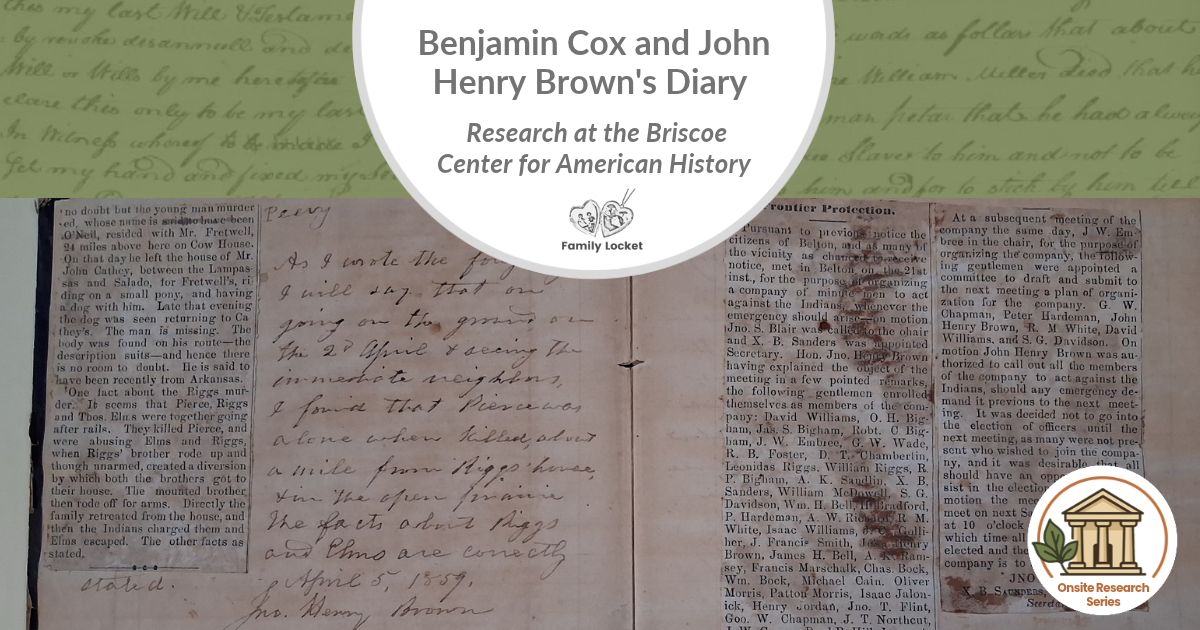
If an ancestor didn’t leave a diary or letters that could be found in a manuscript collection, perhaps an associate did. This is the case with my ancestor, Benjamin Cox, Texas Ranger. In my recent Texas research trip, I tracked down the diary of John Henry Brown, which proved to be a treasure trove of information and also had a surprise entry for Benjamin. In this post, I’ll detail my steps in finding, imaging, and transcribing the diary.
Finding the Diary – Follow the Clues
Whenever we see an authored source, like a county history or family story, that provides details about an ancestor, we can seek the author’s source. In Benjamin Cox’s case, I located a county history of Bell County, Texas, by George W. Tyler. The history had a few mentions of Benjamin who was named as an officer in the Independent Blues, a Bell County volunteer ranger unit led by Major John Henry Brown. I was intrigued by this footnote found on page 187. 1
Data obtained from the private journal of the late Major John Henry Brown, a copy of which was furnished to the author by his daughters, Misses Lizzie C. Brown and Marion T. Brown, of Dallas, July 28, 1921. Also verbal statements to the author by Captain J. Swan Bigham, Lieutenant William S. Riggs, and others.
I wanted to see the original diary, hoping that I could glean additional information about Benjamin Cox that it might hold. But how to find the diary? A simple Google search for John Henry Brown led me to the Texas Archival Resources Online (TARO) website, a catalog of major archival repositories in Texas.
A collection titled “John Henry Brown Family Papers, 1691-1951” seemed promising. The abstract states:
Correspondence and notes relating to Texas history comprise the bulk of the John Henry Brown family papers. Materials document the life, career, and historical writings of journalist, politician, and historian John Henry Brown, as well as other family members, from 1691-1951.
The website noted the repository as the Dolph Briscoe Center for American History at the University of Texas at Austin. The webpage also had collection details that gave a biographical note for “John Henry Brown (1820-1895), pioneer historian, newspaper editor, soldier, and legislator.” An important statement put Brown in Belton, Bell County, Texas, during the same time as Benjamin Cox.
Brown moved to Belton in 1858, where he was appointed to a committee to study problems with placing Indians on reservations, and he became captain of two military companies formed in 1859 to enforce the committee’s recommendations. He also took on editorial duties again, this time for the Belton Democrat. He edited the Democrat until 1861, when he became a delegate to the Secession Convention, where he chaired the committee that prepared the articles of secession.
Browsing the large collection for a mention of a diary or Bell County, I found two entries of interest to review at the Briscoe Center in Austin.
- Bell County Independent Blurs [Blues] Box 2E51 [SRH1230005885]
- Diaries and journal of John Henry Brown, 1869, 1870, 1888, 1893 2E49 [SRH1230005918]
Researching at the Briscoe Center
Since I knew the Briscoe Center in Austin held these collections, I requested them through a form on their website. The first step was to create a login, then choose a date for viewing the folders. Reaching out to the repository and making an appointment is key so they have the materials ready. Since we were on a tight schedule, I made sure to take care of this.
When Nicole and I arrived at the University of Texas, we located the Briscoe Center and registered at the front desk. As in most archives, we put all of our belongings in a locker except for our laptops and cell phones. The center also had blank paper and pencils available for taking notes.
The archivist brought out the two collections, and we each started going through the folders. I found a small diary right away that John Henry Brown kept during his years in Bell County. While there, he served as editor of The Belton Independent and much of the diary consisted of news clippings about the Comanche raid of March 1859 on some settlers in the county. The clippings were still legible despite being almost 160 years old!2
-
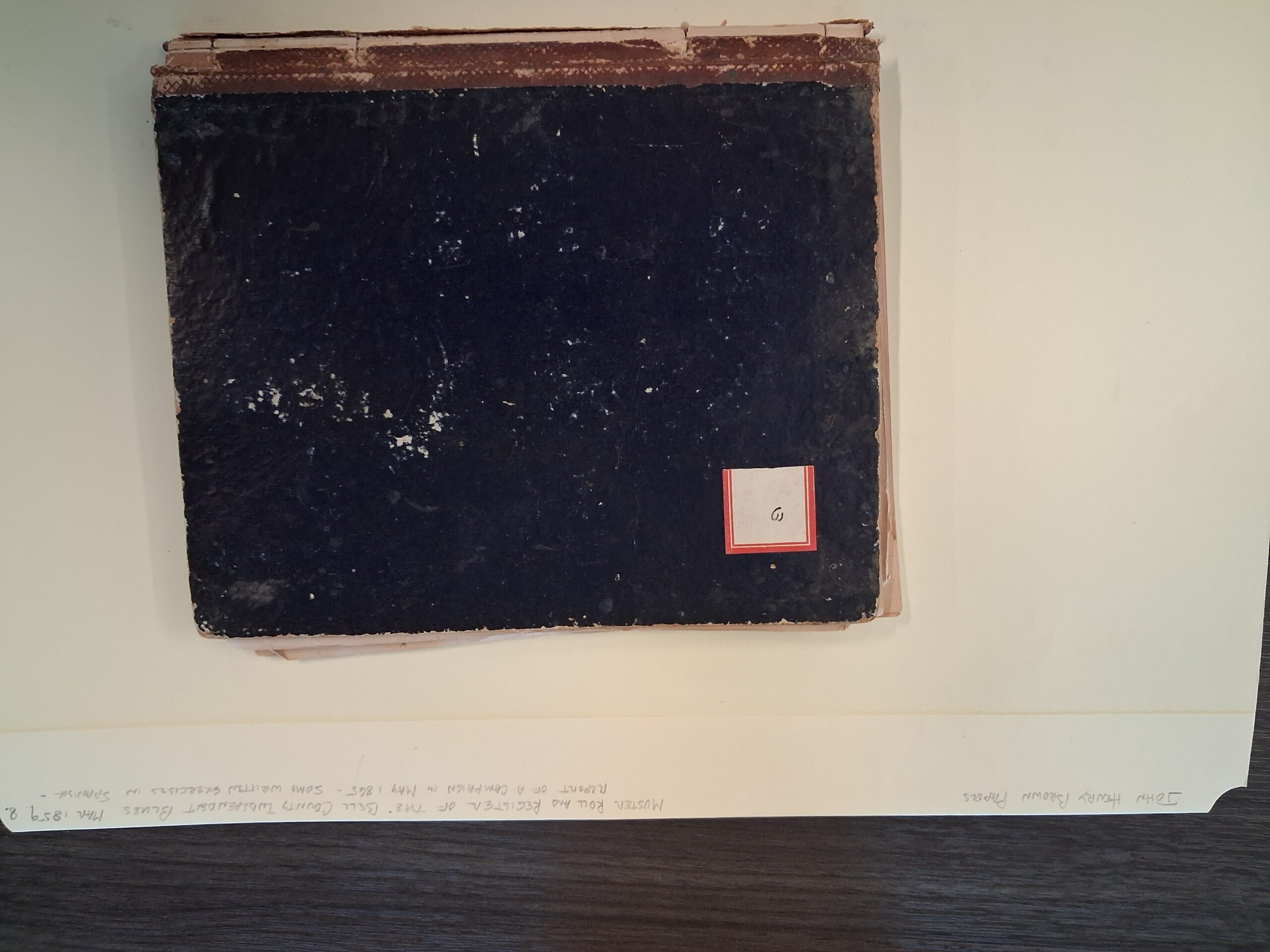
- John Henry Brown Diary Cover
-
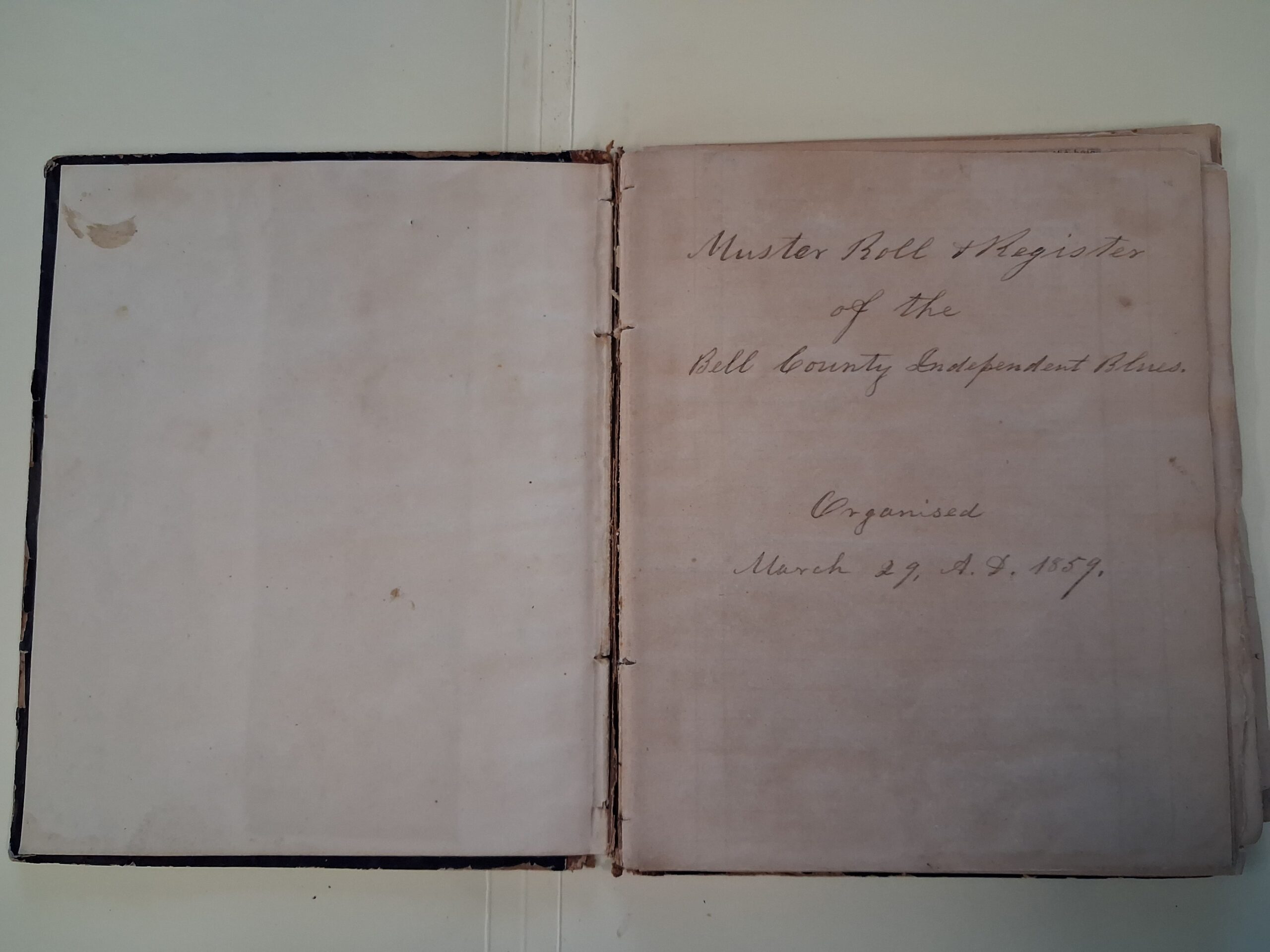
- John Henry Brown Diary Front Matter
Some of the clippings had additional notes written next to them, including one article that noted it was from a neighboring newspaper, the Waco Southerner, run on 11 May 1859 and printed on the 1st page.
Another clipping had the following written:
As I wrote the foregoing, I will say that on going on the ground on the 2nd April & seeing the immediate neighbors, I found that Pierce was alone when killed, about a mile from Riggs’ house, & in the open prairie. The facts about Riggs and Elms are correctly stated.
April 5, 1859
Jno Henry Brown.
See rr W.D.’s article further back for continuation of the above narrative.
A substantial portion of the diary was about the Comanche raid and the Independent Blues organized to deal with the threat. Brown listed men in the company, a distribution of pistols, and scouting companies. He used the news clippings to tell the story, however.
The diary also had several pages written in Spanish and French that turned out to be learning exercises. Brown must have been studying these languages at the time and used the diary for practice in writing. He also had drafts of essays he was working on with no connection to the Independent Blues.
Benjamin Cox in the Diary
As I went through the diary, taking pictures of each page with my cell phone, I came across a news clipping that was Benjamin Cox’ account of a scouting expedition. This treasure was published in The Belton Independent. Whether he wrote it himself or dictated it for John Henry Brown is unknown. Either way, it gives insight into the area where Benjamin lived and what his service entailed. The text reads:
Bell County Scouts.
Scout No. 1, left April 26th and traveled to Jackson’s houses, on Lampasas—found them deserted. Jack Pope’s mule got away here and he returned home in hunt of it. We then went up the waters of Cowhouse to Langford’s Cove—crossed over the mountains to Lampasas side— up the Lampasas 10 or 12 miles— thence across to Bennett’s creek and up it to its head—then N. E. to head of Lampasas, passing several miles through a bad shin-oak thicket—thence down the Lampasas several miles and recrossed the mountains to the waters of Cowhouse, where we fell in with the Scouts, who had seen no recent Indian sign. Thence we traveled over the Beehouse creek—thence to Cottonwood, Table Rock and House creeks—and thence on the 8th day home. We found no late sign of Indians. Game was plenty; we killed several deer, one on a run, and found plenty of bee trees and one bee rock consequently fared sumptuously on venison and honey.
BENJAMIN COX, 3rd Lieut.
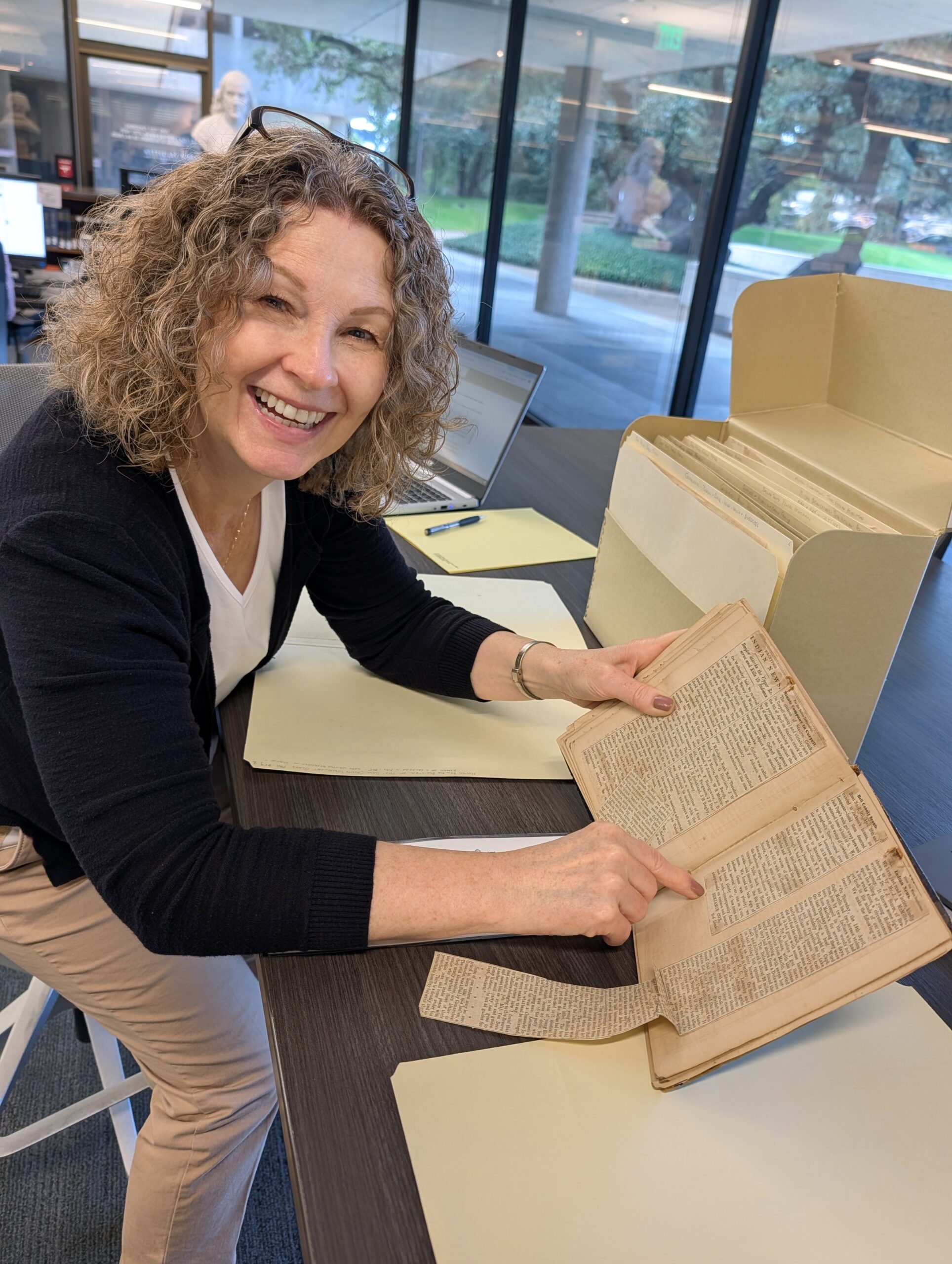
Diana at the Briscoe Center, University of Texas, Benjamin Cox Clipping in the John Henry Brown Diary
Transcribing the Diary
With so many pages that included news clippings, handwritten Spanish and French exercises, and essays, I decided to set up a ChatGPT project in Codex so AI could work with the images. First, I thought through what I wanted the AI to do. When using my phone to capture images of the diary, the file names came in as the date and another number series: 20260929_133459.jpg. For my genealogy files, I wanted to have the images numbered chronologically and then a description of that image.
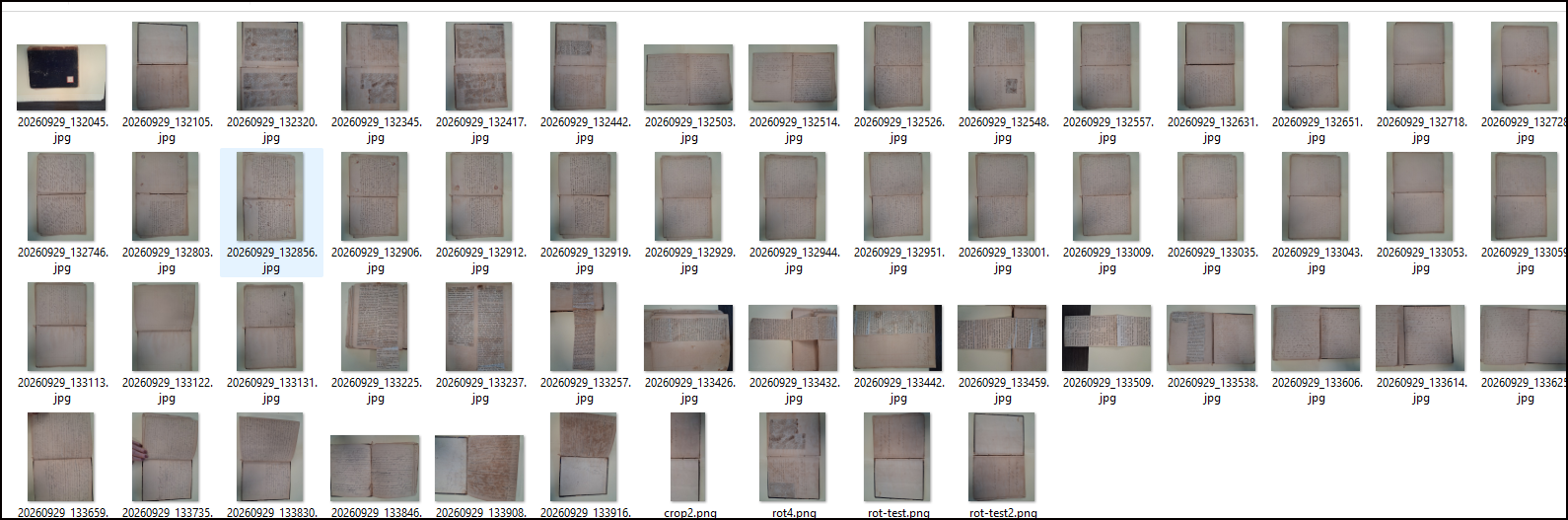
Original Brown Diary Images from Phone Capture
I also wanted the AI to transcribe each image and clearly separate the right page from the left page if it was a two-page spread, and rotate the images if necessary. I have specific rules for transcription, such as preserving line breaks and putting illegible words in square brackets. I also wanted a summary or abstract for each image. I created a file of the images, then gave these instructions and access to the file to ChatGPT’s Luna to create a prompt for Claude Opus. Opus was then tasked with creating a comprehensive plan for Luna to fulfill. Both AI tools had access to the documents, but Opus did the planning and prepared all of the tasks for Luna to fulfill.
Why did I choose these models? ChatGPT Luna is fast and efficient for organizing, renaming, and transcribing, but Claude Opus is good at the complex reasoning needed to create the specific plan to guide the agents.
Luna created a comprehensive prompt that included the following core instructions. Each had many more details to govern the AI’s work than shown here.
- Sequential labeling
- Spread organization
- Inspect and record page layout before transcribing
- Verbatim transcription rules
- Abstract/Summary
- Uncertain or incomplete readings
- Required Output format
I then gave this prompt to Claude Opus to create the plan. Because I gave Codex access to the Brown Diary file folder, it created new folders for the renamed images, transcriptions, and translations. It added several documents to the project, including the prompt, progress, final review, etc. Each image had its own document that included the transcription and abstract.
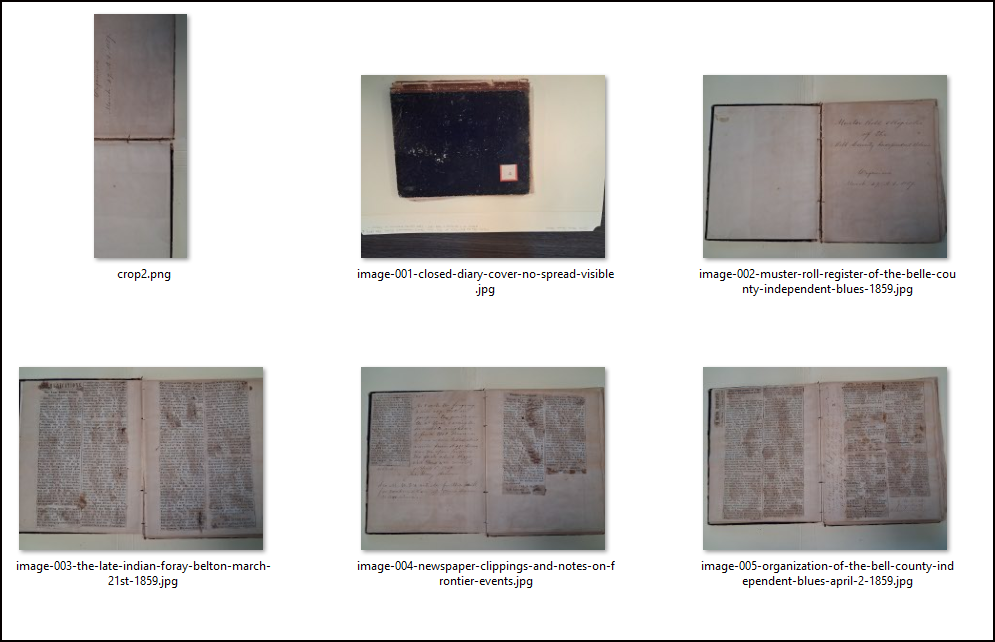
Brown Diary Images Renamed
As the AI worked through the project, I added several additional instructions as needed. For instance, in checking the transcriptions, I noticed that for anything handwritten, the AI didn’t transcribe it. I told it to redo all those, and then it successfully transcribed them.
Rather than opening each image and transcription document separately, I asked the AI to show the image and its transcription side by side for my review. Interestingly, when I corrected the transcription in Codex, the AI automatically updated that image’s transcription document. The image below shows the side-by-side editor Codex created for the Benjamin Cox news clipping. Notice the chat on the side where I work with the AI to make changes.
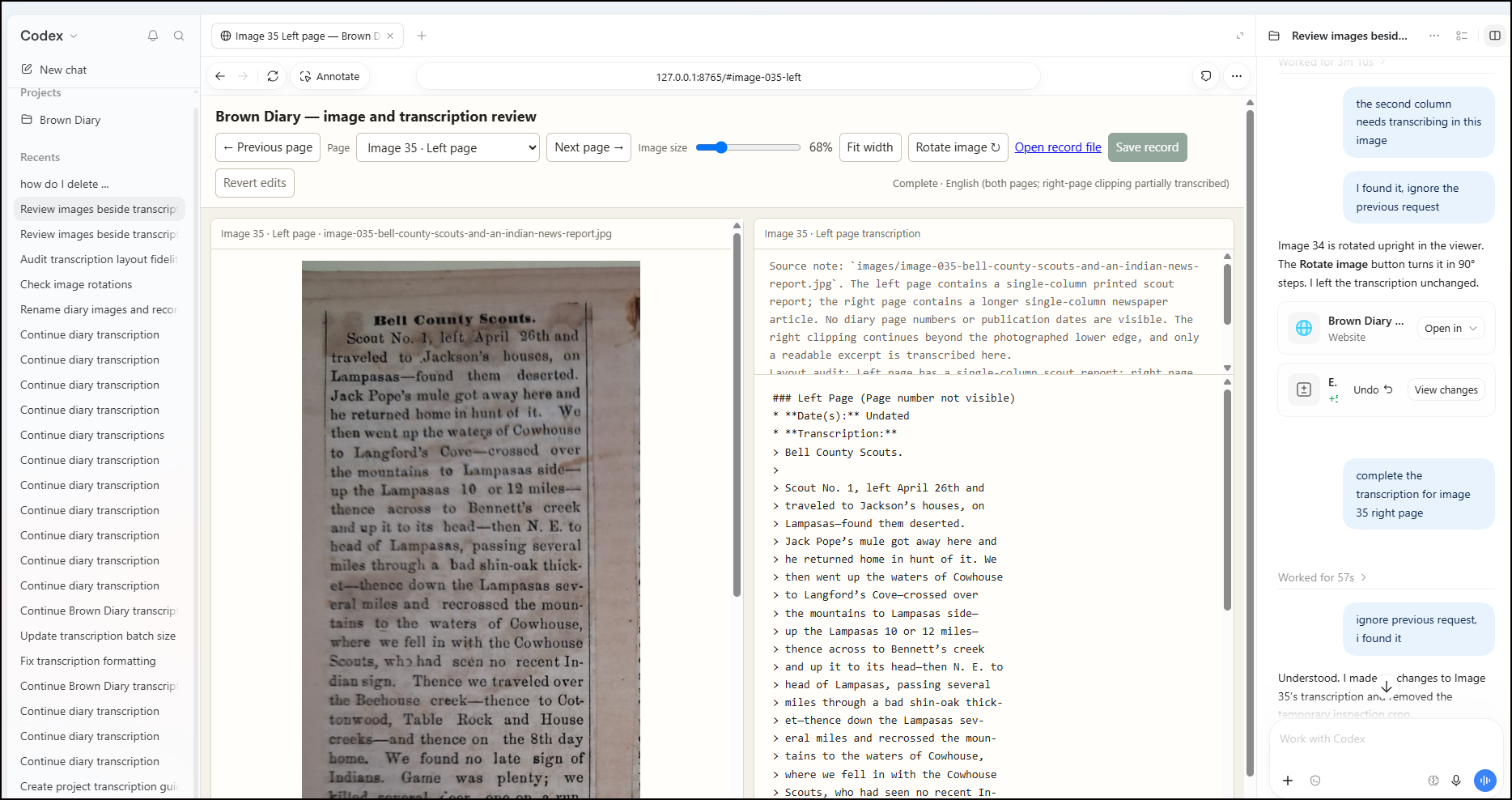
Brown Diary Project in ChatGPT Codex
What’s Next
Now that the diary is transcribed, my next step in the Benjamin Cox Texas Ranger project is to use all of the information from my Texas trip to write a source-cited narrative for this era in his life. My onsite research yielded new county histories, the original muster roll, and the John Henry Brown diary – each found at a different Texas repository. Going beyond online sources is imperative to more fully understand an ancestor’s actions and document their life.
Best of luck in all your genealogical endeavors!
Additional posts in this series:
Research at the Milam County Genealogical Society Research Center: Assessing County Histories
Sources
- George W. Tyler, The History of Bell County, edited by Charles W. Ramsdell (San Antonio, Texas : The Naylor Company, 1936); digitized book, Ancestry (https://www.ancestry.com/imageviewer/collections/28182/images/dvm_LocHist012131-00113-1 : accessed 25 October 2026).
- Benjamin Cox, 3rd Lieut. “Bell County Scouts,” The Belton Independent, Bell County, Texas, 26 April 1859, news clipping; John Henry Brown Diary, Bell County Independent Blurs [Blues], 1859, John Henry Brown Family Papers, Box 2E51 [SRH1230005885]; Dolph Briscoe Center for American History, The University of Texas at Austin.










Leave a Reply
Thanks for the note!