
In this episode, Diana and Nicole discuss Phase 5, Part 3 of the search for Cynthia (Dillard) Royston’s biological father. They review the known facts about Cynthia’s life using census, tax, and estate records, as well as death certificates of her children. Diana presents her hypothesis focusing on three Dillard men who drew lots in the 1832 Gold Lottery in Cass County, Georgia: James Dillard, Joseph B. Dillard, and Roliver Dillard. She explains how they previously eliminated thirteen other Dillard candidates. They also explain how DNA evidence identifies Elijah Dillard as Cynthia’s probable biological brother, which helps narrow down their shared father’s location in Georgia by 1814.
The hosts outline their prioritized research strategy, dividing it into documentary research and DNA analysis. For documentary evidence, they plan to survey online trees, analyze censuses, search probate records, and look through Georgia newspapers. For DNA, they focus on using Ancestry Pro Tools, analyzing network graphs, and finding the most recent common ancestor through custom clustering. Listeners will learn how to build a methodical research plan that keeps research focused. They will also learn how to write a hypothesis, prioritize a wide range of source records, and combine traditional paper trails with DNA tools to overcome tough genealogical brick walls.
This summary was generated by Google Gemini.
Transcript
Nicole (1s):
This is Research Like a Pro, Episode 425: Research Planning for Phase 5 of Cynthia’s father. Welcome to Research Like a Pro a Genealogy Podcast about taking your research to the next level, hosted by Nicole Dyer and Diana Elder accredited genealogy professional. Diana and Nicole are the mother-daughter team at FamilyLocket.com and the authors of Research Like a Pro A Genealogist’s Guide. With Robin Wirthlin they also co-authored the companion volume, Research Like a Pro with DNA. Join Diana and Nicole as they discuss how to stay organized, make progress in their research and solve difficult cases. Let’s go.
Nicole (41s):
This episode is sponsored by Newspapers.com. Hi everyone. Welcome to Research Like a Pro.
Diana (47s):
Hi Nicole. How are you doing today?
Nicole (50s):
Hi mom. I’m doing well. How are you?
Diana (53s):
I’m doing well, as well.
Nicole (55s):
And what have you been doing lately? Anything interesting?
Diana (59s):
Yes, I have been doing something interesting. We have here at FamilyLocket Genealogist, a client who’s interested in getting into the Order of the Cincinnati, which is a lineage society. And you have to have an ancestor who died during the revolution, the American Revolution, and was on the continental line was one of the soldiers, or one of the officers actually. And so we had traced to this particular gentleman, but he had apparently been discounted by the society several years ago because his service was only found in an interview in the Draper Manuscripts about someone who remembered him being there.
Diana (1m 42s):
So it was an interview many, many years later. It was not contemporary and the society decided that they were no longer going to qualify that ancestor. Well, we found another record and found that there is a muster roll with this ancestor on it in the Draper Manuscripts. And I actually was able to track it down. Those have been microfilmed, the collection, this is the Battle of Kings Mountain, which was in North Carolina, that portion of Draper has been kind of put into a group and it was microfilmed and it was up at microfilm only at the FamilySearch library in Salt Lake City. And So I had one of our researchers pull that and have images of that.
Diana (2m 26s):
And the interesting thing is, I mean, I feel like we’re going, let’s keep digging here, that the original is at Duke University and they’re in the manuscript collection of the leading officer and his relative, I guess, who was a governor. So they have his papers there and apparently this comes from that collection. So we may be doing some onsite research in Duke manuscript collection to find this original roster, if the image and the copy from Draper doesn’t work. So anyway, it’s just been kind of an interesting little side, a deep dive into trying to find something for this person to prove that we can use for society.
Diana (3m 9s):
So yeah, I just, it was fun working with the Draper Manuscripts and you just had to use the calendar. There are people that done calendars of them, which means they’ve basically done an index, and then I found the specific collection and found it on the FamilySearch catalog and found the microfilm number. So anyway, that was fun tracking that down.
Nicole (3m 29s):
That is fun. It’s always interesting to learn about these different collections and how to access them and how they can how with certain goals. So good job.
Diana (3m 36s):
Right. You know, we should probably do a episode on the Draper Manuscripts, maybe after we go to Wisconsin next year for NGS and have actually used the full collection there. But you know, Draper was a man, Lyman Draper, he canvassed the south, kind of the Midwest area, getting stories and interviews and getting as much information as he could about settling of the West. It’s an amazing collection, but not all of it is very accessible, let’s just put it that way. It can be a lot to search through, so.
Nicole (4m 7s):
Oh, okay. Well for announcements we have our next webinar and the Research, Like a Pro Webinar Series is September 19th and it will be presented by Jill Nock, an Accredited Genealogist on our team at FamilyLocket. And she’ll be presenting, Wanted: Bert Beckett – Solving Identity Through DNA and Records. And this is about how family stories can be our best leads, but how much truth do they have? This presentation follows the case of “Bert Fred Beckett” a supposed outlaw who rode with the Jesse James gang and later changed his name. Strategic DNA analysis combined with traditional records cracked a century-old identity mystery. This takes place in Missouri and Oklahoma and uses AncestryDNA, census records, death certificates, marriage records, court records, and the Leeds Method.
Nicole (4m 49s):
Jill Nock is accredited in the upper U.S. South and has five decades of research experience, so it’ll be great to hear from her. Also, our next Research Like a Pro study group, has just begun at the time this episode comes out. And so it’s going to be a great study group and if you are wanting to join the next study group, we’ll look forward to seeing you in the spring and that will be the Research Like a Pro with DNA study group. Alright, so lastly, if you want to see us at an upcoming conference, we’ll be there virtually at the APG Professional Management Conference October 14th through 17th. And Diana will be talking about easy CRM tools, managing client projects with Google Sheets and Airtable, and a panel about teaching and building courses.
Nicole (5m 35s):
My talks are about podcasting and Airtable with AI transcription and research logging. So hopefully we’ll see you there.
Diana (5m 43s):
All right, well let’s dive into our topic for today. And that is part three of our Finding a Father for Cynthia Dillard series. And this time we’re talking about research planning. So if you have been following my research on Cynthia, you’ll know that she is my brick wall, or one of them. And I’ve probably done the most research trying to figure out who her father is than any of my other women. But I hope eventually to have one man left standing and all the documentary and DNA evidence will point to him as her father. So in this podcast episode, we are just going to talk about a research plan. So why do we need a plan?
Diana (6m 25s):
Well, this is something I never used to do, and it is now one of my favorite parts of the research process because it focuses us in on what we really need to do. So we have that focus objective and then we can prioritize all the different ways our research could go. And so this is how we make progress. And it’s actually easier the more experience you have with researching because you have an idea of what kind of records will give you the information you need. But I’ve also found that it’s really, really helpful to have an open mind for new research avenues because as you’re doing your locality research, you might find something you had never even thought of to research.
Diana (7m 7s):
And you know, we always have to be open to new, new ways of doing this. So let’s go over my objectives just so we have that back on top of our brains. And so our overall objective is, Through DNA and documentary evidence, discover Cynthia (Dillard) Royston’s biological father. Cynthia was born about 1815 in Georgia and died on 2 August 1882 in Collin County, Texas. Cynthia married Thomas B. Royston about 1833 or 1834, possibly in Cass County, Georgia. So that’s my overall objective that is governing all of these different phases. And now I’m on phase five, and this is a documentary research objective.
Diana (7m 49s):
I split it into two. So for the documents we’re going to, seek connections between Cynthia and three men who drew lots in the 1832 Gold Lottery in Cass County, Georgia: James Dillard of Pulaski County, Odams District; Joseph B. Dillard of Oglethorpe County, Hargroves District; and Roliver, who turns out to be Toliver, Dillard of Burke County, 68 District. So that’s what I’m doing for the documentary portion. Now what about DNA? So I have another objective for the DNA portion, and I don’t always separate ’em out, but I did this time. So that reads, Further analyze the DNA network graph for additional Dillard connections, and seek additional DNA evidence through Y-DNA testing and by expanding DNA coverage of Cynthia’s genome.
Nicole (8m 34s):
Those are great objectives and that’s a lot to work on. Well, let’s see what you did with that at the start of the project. The next step is to create a summary of known facts. So you’ve created the timeline for the ancestor, and then you take the relevant facts and put them into a summary. And this is really an important part of Research Planning, whether it’s a narrative table or a bullet bulleted list, you’re kind, kind of bringing to the forefront of your mind all of the most relevant details and clues from the timeline that will help you and guide you as you make your plan for what to research. So this case, you chose a table to show what you knew about Cynthia. So that was fun. You used each census of her life to provide both birth and residence information.
Nicole (9m 17s):
And then you did additional key facts from the children’s death certificates. So did you also do a summary of known facts about the other guys or did you just do summary of known facts about Cynthia?
Diana (9m 31s):
I did the summary of known facts about Cynthia and I also did, well in my timeline, I had Elijah Dillard, who I believe is her brother, but I didn’t put that into the summary of known facts because I wasn’t really working from that. And as far as the other three, the James, Joseph and Tolliver Dillard, no, I really didn’t know anything about them aside from the fact that they had this lottery. And
Nicole (9m 58s):
Got it.
Diana (9m 59s):
So I decided just to go forward with, you know, how are we gonna learn more about them and not put them into a summary.
Nicole (10m 7s):
Yeah. Okay. So the summary of known facts, I’ll just go through it really quickly then. So from the census years, we have four or five birth estimates. So 1850 census says 1815 is Cynthia’s birth year in Georgia. The 1860 census says 1816 in Georgia. The 1870s census says 1817 in Georgia, which is ironic that she gets one year younger, every time. Yep. And then 1880 census says 1818 in Georgia. So her birth was about 1815 to 1818. And then we have some negative searches for marriage records from 1833 to 1844 in Georgia or Alabama.
Nicole (10m 50s):
So we don’t have any marriage record located, but we can estimate it from the birth of her oldest child, Mary, who was born in May of 1834. So probably about one year prior to that is when they got married. And then we have her residence in 1840 in DeKalb County, Alabama. And then 1842 Thomas, her husband, Thomas Royston paid poll tax in Chambers County, Alabama. Then they lived in Chambers County in 1850, 1860. And then her husband died in 1868, and that’s when his estate packet was administered. Then in 1868, Cynthia appeared in court in Chambers County to petition for the probate listing, 11 living children as heirs.
Nicole (11m 32s):
Then in 1870, she still lived in Chambers County as a widow, head of household. And then by 1875, the estate was still going on, the administration of the estate, and she was living in Texas at that point in about February to March of 1875. Then in 1880, she’s enumerated in Collin County, Texas, and she’s living in her, one of her son’s households. And then she died in 1882. And that was mentioned in her husband’s estate pocket, which was still continuing on, I guess.
Diana (12m 8s):
Yes, yes.
Nicole (12m 8s):
That’s crazy.
Diana (12m 10s):
Well, she was named the Executrix, and so apparently there was a bit of land still there that hadn’t been taken care of, the original estate. And so there was an administrator who wanted to take over and get that land sold. So it’s kind of funny because when he comes into the picture, they had to get, well, there’s one son left in Alabama and he apparently writes all of his siblings in Texas and says, you need to go to court and say you don’t want this gentleman to take over. And so they do that, but it all arrives too late and this other gentleman takes over as the administrator.
Diana (12m 50s):
But it’s really interesting. I mean, it is pretty dramatic all the things that go on in this estate file and it’s all filed in his estate. So I really loved going through the whole file. I believe there’s over 50 pages in it and just so many interesting things. And so just on one of those papers it says that Cynthia Royston departed this life in the state of Texas on or about the second day of August, 1882. And I, you know, Texas at this time is they are not issuing death certificates. And I don’t think we have any of our Texas ancestors in an actual cemetery, but I can think of.
Nicole (13m 30s):
It’s so true.
Diana (13m 31s):
Yeah. They all died there and we don’t know where they are. My dad always said, oh, they just buried ’em in the backyard or in the field. And I think that’s absolutely right because none of them have turned up anywhere or you know, of course they could be in a cemetery and then there was this no marker, it’s disintegrated or whatever.
Nicole (13m 48s):
Right.
Diana (13m 48s):
You know. But anyway, so this was really exciting when I was transcribing the probate file and found her death data, I was like, yay, this is so great. So just, you know, a shout out to transcribing every page in a probate file.
Nicole (14m 4s):
Yeah, that is just really neat that it has her death date on or about the second day of August, 1882. It’s just interesting how, like you said, in our family in Texas, there just really are not a lot of cemetery records for them.
Diana (14m 21s):
I know we have a dearth of headstones.
Nicole (14m 23s):
It’s just that time period of the 1880s that were, people were not well off enough, they were at least the Harris family, Melissa’s husband’s family, they were moving all around within Texas and they weren’t, I don’t think they, there was like a depression in the seventies. I don’t think they had the means to buy a headstone. And so it wasn’t until the next generation, their children all had headstones like dying in the 1900s. But those that died in Texas in the 1870s and 1880s in our family just don’t seem to have had headstones.
Diana (15m 1s):
Nope.
Nicole (15m 1s):
At all. They’re buried in the backyard or didn’t like at the cemetery with the wooden cross that weathered away, whatever it was.
Diana (15m 9s):
Exactly.
Nicole (15m 9s):
Oh, and her husband, he lived into the 1910s and his headstone when I went to visit it had completely worn away. I could find the place where it was, ’cause a relative drew a map, but they used like concrete and the concrete just wore away. It didn’t last.
Diana (15m 24s):
Yes. And so often with those cemeteries, if you can find a book where someone back in the day, you know, like 1930 or 50, 60, you know, when they could actually read the headstones. Sometimes those books are the only record that you have of what was originally written on that, or if it’s in family papers, you know, like we had a family map drawn. But that’s the case with Thomas Beverly Royston, Cynthia’s husband who dies in Chambers County, Alabama. I’ve been to the cemetery and seen where his headstone is and you can’t read it now. You can read his name barely, but you can’t read the information about how old he was. But there is a book that they did in the 1970s where they went through and transcribed every headstone in this little tiny Baptist cemetery.
Diana (16m 9s):
And so sometimes that’s the best evidence you have, and it’s better than the headstone that’s worn away.
Nicole (16m 16s):
Wow. Yeah. Oh, now I remember, the Martha Hoosier Harris has a headstone in Milam County, Texas, and she is the mother of Melissa Welch’s husband, John C. Harris. So, oh, that’s a one 1890 headstone in Texas that we have. And it says, Martha wife of JB Harris died 1890, 69 years. And So I guess
Diana (16m 42s):
We have one
Nicole (16m 42s):
To get one for her. This one also looks like it was made of concrete, but it must not be. It must be some other type of stone.
Diana (16m 49s):
Okay, well we are headed to Milam, Texas next month.
Nicole (16m 52s):
Can’t wait.
Diana (16m 53s):
We have to go visit the cemetery.
Nicole (16m 54s):
Yeah, we’re gonna go to Milam County. Let’s do this. It’ll be fun. After I did all that research for my KDP to see the place where they lived.
Diana (17m 4s):
Yes.
Nicole (17m 4s):
Well, we’re not off track at all at this point. Let’s see, where were we? Okay, we were going through the summary of known facts and we ended with Cynthia’s death in Texas without a headstone. Now the other part of your summary of known facts comes from the children’s death certificates, basically evidence of her maiden name. And this is super important because without this we wouldn’t know she was a Dillard. So we have three of those 11 children had death certificates that named their mother. And so Adeline Spears died in 1920 in Montag County, Texas, and it names her mother’s maiden name is Dillard, born in Florida. And the informant was Cynthia’s daughter, M.C. Lovelady, which was one of Adeline’s sisters, I guess.
Diana (17m 48s):
Mariah Catherine.
Nicole (17m 49s):
Okay. And then the death certificate of the son R or Robert Royston, I’m guessing,
Diana (17m 55s):
I think it was Richard.
Nicole (17m 57s):
Richard Royston. It names his mother as Miss Cynthia Dillard, born in Alabama, and the informant was Mrs. Luther Lockley, which would’ve been a granddaughter of Cynthia. And that was a death certificate in 1928 in Wise County, Texas. And then the last one is the death certificate of Cynthia’s daughter, Martha Ann Hogge. And it names your mother as Cynthia Dillard, born in Alabama, and the informant was a grandson, Charles Hogge. And she died in 1935 in Texas, in Ellis County. So those are all really consistent that her name was Cynthia Dillard.
Diana (18m 31s):
Right. I was so excited when I got those. And this is back in the day when you had to write away, you had to actually write a letter and request the death certificates. And so they came in the mail and I opened them up and it was just so exciting when I first figured out it was Dillard because nobody knew that. None of the, none of the researchers knew that. And so that was really neat.
Nicole (18m 52s):
Did you order all 11 death certificates?
Diana (18m 54s):
Oh, these are the only three that that have death certificates.
Nicole (18m 59s):
Mm.
Diana (19m 0s):
These are the youngest children. And so that’s why, or it just so happens that they actually lived long enough to have a death certificate. All the other children died before, like our ancestor Robert C Royston. He dies in 1915 in Arkansas and does not have a death certificate. And all the other children, same scenario. I tried finding one for all of them, only three. And luckily she had 14 children. And of those 14, three have a death certificate ’cause they lived long enough into the 20th century. So this family’s just been so fun to research. There’s so many interesting things to talk about with them. Well, let’s get to the hypothesis. So writing hypothesis is so fun. Here’s where you get to write what you think might have occurred based on everything you’ve already learned, the timeline, your intuition, your knowledge of historical context.
Diana (19m 49s):
And I had already done four phases on the objective. So I had a lot of things to consider. So just like in the objective, I put in my hypothesis that her father could have been one of those three Dillard men who won gold lottery lots in Cass County, Georgia. I don’t know if any of them are, but it’s my hypothesis. It could be one. So we have James, Joseph, and Toliver, and then I have a section called Geographic Alignment. You know, if we’re gonna make a research pen, we better know a little bit about the locality and where the records might be. Just get that really clear in our mind. So I wrote that Thomas B. Royston had moved to Cass County by June 26th, 1833 when he received his commission as a 1st Lieutenant and served as deputy sheriff there in 1834.
Diana (20m 35s):
He and Cynthia likely married about 1833 or 34 based on the birth of their oldest child, Mary, who was born on May 4th, 1834 or 1835. It’s always fun when you have these discrepancies, right? The couple resided in the area until at least 1835 when Thomas still had letters at the post office in Cassville. So my hypothesis is that if she married Thomas in Cass County, her Dillard family likely was there as well. And those three gold lottery winners had won land in Cass County beginning in 1832. So it seemed like it was a good convergence of, you know, what was happening with Thomas and Cynthia as well as these Dillards perhaps having a reason to be in Cass County.
Diana (21m 20s):
So then I did a simple profile about her father based on everything I knew. So prior research had established that her father was born before 1795, likely in Virginia, she was on the 1880 census, and so we have that information from that, and that he was in Georgia during the 1820s and 1830s, and that he would be on a census in those years with a child who could be Cynthia under 10 in 1820, and in 1830, about 15. And then I hypothesized that a lottery participant from any of those counties of origin, Pulaski, Oglethorpe, or Burke, could fit this profile if the census and other records confirm a Virginia birth and appropriate household composition.
Diana (22m 5s):
So as you can see, I had a lot of different ideas here that were going to govern my research to see if I actually was on the right track or not. Alright, let’s take a break and have a word from our Sponsor. Are you ready to take your family history research beyond names and dates? If so, Newspapers.com is a game-changer for genealogists of all levels. With access to over a billion pages of historical newspapers, you can uncover rich, untold stories about your ancestors that you won’t find anywhere else. Imagine discovering a detailed obituary that reveals the extended family, or a local news story that highlights your great-grandmother’s role in the community. Maybe you’ll come across a photo capturing a moment in your ancestor’s life—something that brings their story vividly to life.
Diana (22m 53s):
Newspapers captured the everyday details—announcements, happenings, achievements, and challenges—that paint a fuller picture of who your ancestors were and what their world was like. These primary sources reveal the social history behind the names on your family tree and help you connect with your past in a personal, meaningful way. Searching is simple and intuitive, letting you explore by name, location, or date to unearth those hidden gems. Ready to enrich your research with stories you won’t find in traditional records? Visit Newspapers.com/FamilyLocket today and get 20% off a subscription. Start turning your family tree into a family story. Use promo code FamilyLocket for a 20% discount on your subscription.
Nicole (23m 32s):
Alright, well let’s talk about the second part of the hypothesis, which was the elimination of other candidates. So Three previous research phases systematically eliminated thirteen other Dillard candidates from the 1820 Georgia census, including George W. Dillard (disproven by the Mahone Family Bible), Arthur Dillard (eliminated by his will), Edmund Dillard (daughter identified as Lucy Ann), so there wasn’t space for another daughter named Cynthia, and the John Dillard family of Cass County (heirs documented in deeds and the family originated in North Carolina, not Virginia).
Nicole (24m 21s):
Also, Elizabeth Dillard of Cass County was eliminated based on her South Carolina origins and distinct migration pattern. Then the DNA evidence as part of the hypothesis is that the DNA analysis identified Elijah Dillard, who was born about 1814 to 1816 in Georgia and died in 1886 in Pike County, Alabama, as Cynthia’s probable biological brother through clustered matches that descend from two of Elijah’s sons, Josiah and James Monroe Dillard. If Elijah is Cynthia’s brother, their shared father would’ve had to be in Georgia by at least 1814. A gold lottery winner who relocated to Cass County from elsewhere in Georgia may have been raising children in central or eastern Georgia during the 1810s before acquiring land in Cass County in 1832. Finally, lost records create an opportunity, and this is the last part of the hypothesis here, that the earliest deed books for Cass County (later Bartow County) are missing, which explains why no Dillard land transactions from the early to mid-1830s have surfaced.
Nicole (25m 21s):
However, records from the counties of origin (Pulaski, Oglethorpe, and Burke) may contain census, tax, probate, and deed records that reveal household composition, Virginia origins, and migration patterns consistent with Cynthia’s known facts. So this hypothesis is great because it kind of explains an idea for why we might not, might not have been able to find some of the clues that would’ve pointed to the right father for Cynthia and Elijah with the missing books in Cass County. But then gives some hope for things that we can still research in those counties of origin. So kind of guiding the research plan to these counties, Pawlowski, Oglethorpe and Burke to see what we can find.
Diana (25m 47s):
Right, and I was so excited to find new counties to research in. When you have a county that’s burned, then you’re always hopeful that then other counties will be good. So for my next part of the research plan, what we do is we come up with a list of sources and we call this identified sources. So because I’m adding DNA to it, I did both documentary records and DNA analysis or methodology. So this step, you look through your locality guide and choose the record collections that could provide evidence. And this is a chance to include every record you think could shed light. This isn’t prioritizing yet, this is just putting everything in there. It’s like a big brainstorming session.
Diana (26m 29s):
So I had not previously researched these three Dillard men from the gold lottery records. So I just made a list of all the record types that I knew would help me in Georgia. And then I found FamilySearch record collections where I could use full text search to find them quickly. Since I had three men, you know, I typically don’t like to tackle that much, but I thought, okay, we’ve got full text search I and I just need to identify them. I think I can do a quick rule them in or rule them out. So some of my ideas for this were to look at online trees, you know, that’s always a good place to start. Ancestry, FamilySearch and Wiki Tree. Then look for those 1820 and 1830 censuses to try to get an idea if Cynthia’s even in the household, you know?
Diana (27m 10s):
And if they’re old enough to be a father. I could look for Tax Digests in those counties during those same years, 1820s and 1830s to establish their residency and economic standing. It’s just kind of get a picture of these men and then of course probate, Estate and Will Records, could name their children or heirs and could really help to figure out who their family is. Marriage records could be helpful. Land records, of course we always love land records, and the newspapers, so you know, it was kind of wide open what I could do with these three men since I hadn’t researched them before. Now For DNA I had a lot of different ideas for DNA as well, and one was to find a Y-DNA tester through Elijah Dillard’s male line descendants.
Diana (27m 58s):
So because through autosomal DNAI, I think he is a very probable brother, I could at least get something with a Dillard surname line, hopefully. Another idea I had was to get additional autosomal DNA testers from Elijah’s descendants and have them share their results on Ancestry and try to just get more evidence for that cluster that shows their connection. And I could use Pro Tools to kind of figure out some of those people that I hadn’t been able to figure out before. And I could use the new custom clusters on Ancestry, looking for a key DNA match between the Roystons and Elijah Dillard to maybe, you know, get some new information that way.
Diana (28m 40s):
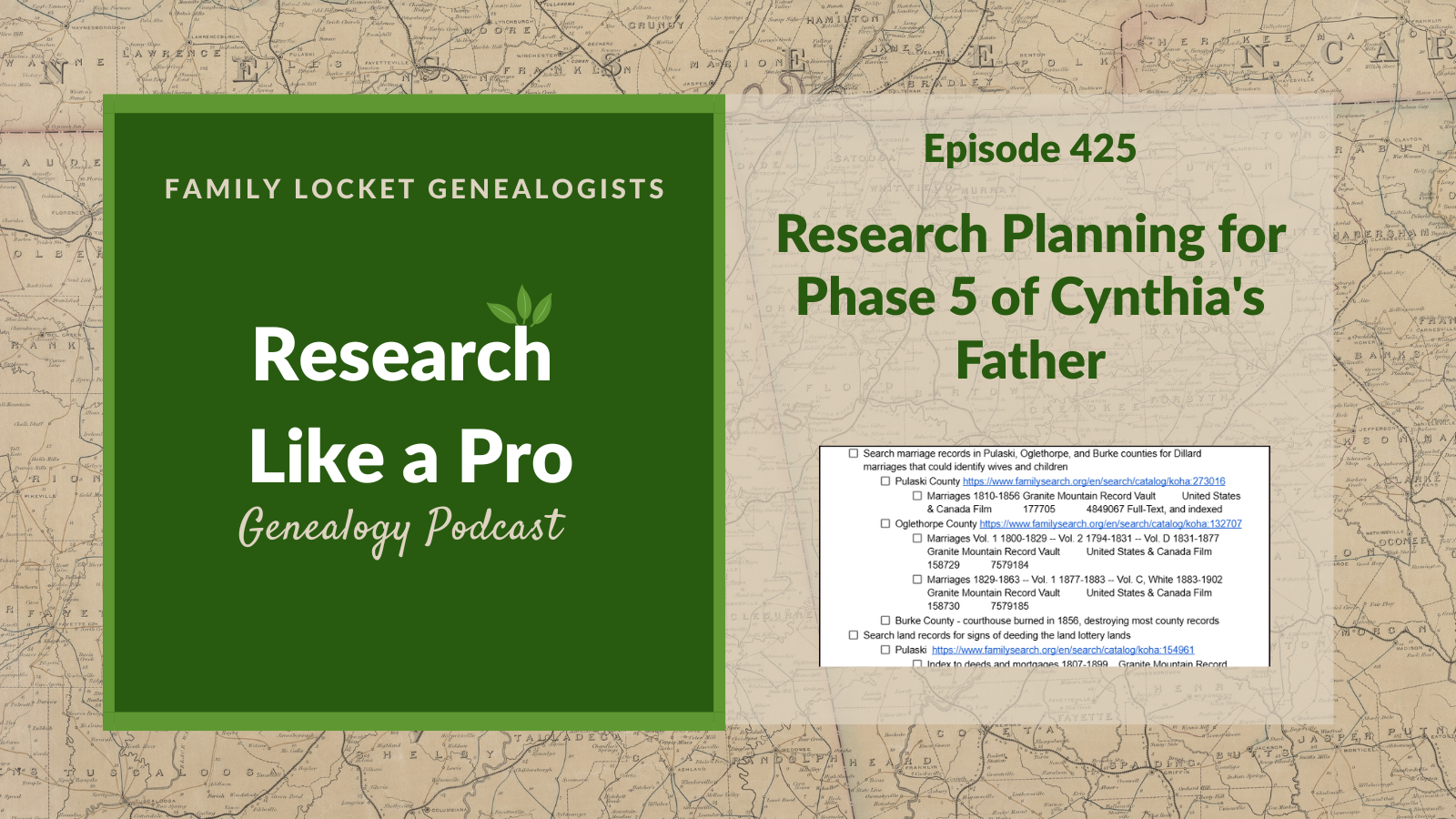
And then I had a key test taker and I thought I could really explore that person and try to find more matches. So I had a lot of different ideas and I had to prioritize because obviously I couldn’t do everything there. So in the blog post that I wrote that goes along with this, I did a screenshot of my project document where I have this all written out and I like to use bullet points, but instead of bullets, I use the little checkbox. This is on Google Docs so that when I complete the research I can check it off. And I just like doing that, it helps me keep track of where I am.
Diana (29m 20s):
I also put live links to the actual collection. So as I’m working through my plan, I can just go and click on the catalog page, these were pretty much all FamilySearch, and just be really efficient with my research.
Nicole (29m 35s):
Wow, that’s a lot of great ideas for researching. So the next step is then create your prioritized research strategy. And so although you found many resources in FamilySearch to review, you needed to decide which ones to start with. And since you were covering three men in three counties, you didn’t want your list to be too extensive, so you chose the most likely to give you good information. So that makes sense. So for the documentary research, you chose to do a genealogical survey of online trees, which I actually really like that you put this first because this really gives you kind of a heads up on what other researchers have found. And then you don’t have to like repeat things that have already been done and you can just review what someone else thinks is right and then decide if that’s right or not, and then, and then go from there.
Nicole (30m 23s):
So that’s really smart. So you decided to review Ancestry Trees, FamilySearch and Wiki tree. The next step you decided on was to locate these men on the 1820 and 1830 censuses in their counties of origin and examine household composition for females of the right age to be Cynthia born about 1815, she’d be in either the female 10 to 15 or 16 to 25 category. And this part of your research plan really shows how important the summary of known facts was because in there we have all of the possible dates of her birth from all the sources that mention when she was born or how old she was at a certain time, those census years. And so now we know we need to look in both of those age categories for 10 to 15 or 16 to 25 for the 1820 and 1830 censuses.
Nicole (31m 10s):
And so that’s just really important to know that otherwise you’d look at the census and wonder, what can I get from this? The next step you decided on was to search probate estate and will records in their counties of origin and in Cass/Bartow County for any naming of children or heirs. So this is kind of one of those steps where you want to see if you can eliminate the candidate by figuring out all those children. You know, if they had a census with like five children as tick marks and one of them was the right age to be Cynthia, then you look in their probate records and see that there’s all those children, males and females that are listed in the will. Then it kind of makes you want to eliminate that candidate because it doesn’t look like there’s a place for a daughter named Cynthia.
Nicole (31m 52s):
So that’s another good one. Then your fourth idea for documentary was Georgia newspapers for all three men, maybe there was news of them being in Cass County, just the fact that they actually went there instead of just, you know, sending an agent for the land that they drew from the land lottery or gold lottery. So it’s just a good idea to check those newspapers. Part of that reasonably exhaustive research and where you’ve already found some newspapers mentioning Thomas B Royston, it seems like a logical thing for Georgia research when you have a burned county to check those newspapers.
Diana (32m 25s):
Exactly, yes, it’s so helpful to have newspapers because so many counties, their records did not survive. But man, those, those newspapers went way back really, really good.
Nicole (32m 35s):
Yeah. And then if those searches proved fruitless, you could always return to your list of identified sources and choose more options. And you can use that list for future research suggestions. If one of the Dillard men seems to be a good candidate to explore in the next phase, then you have some more ideas for what to do next.
Diana (32m 53s):
Right. Well, after getting the documentary research plan prioritized, I had to decide what to do with DNA. So I decided to first of all, focus on the network graph that I had done years ago and see if I could identify more of the clusters. I had figured out Cynthia and Elijah, but there were all these other clusters for my test taker and I wanted to just make sure I wasn’t missing anything. And then I decided to try the custom clusters on Ancestry and then look for the Y-DNA. And so it was really helpful to, to have eliminated some things and just get down what seemed to be the most productive, what would be the best.
Diana (33m 38s):
So I had a lot of different ideas. You know, sometimes when you’re working through your plan, you change it and that’s okay. You know, sometimes you think, wow, this is taking too long, I wanna do something else. Because you look at the microfilm and it’s browse only and you just don’t have time to do that. So I think it’s always good to realize your research plan can be a bit fluid and you can go back to your list of sources and choose something else if what you prioritize isn’t panning out so well. Well, the great thing about having a research plan is you have specific actionable items that you can work on whenever you sit down to research. So my research gets interrupted all the time because of other work I need to do, or travel, or just other commitments.
Diana (34m 22s):
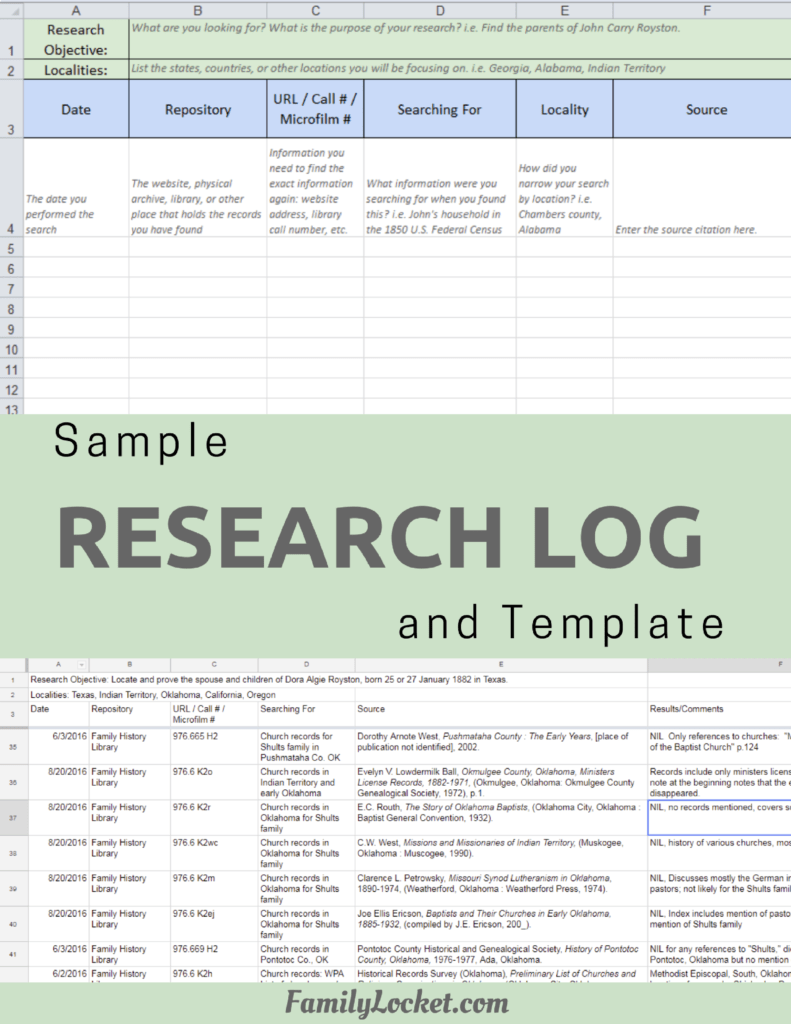
And so when you have an hour or two to sit down and research, you can pull up your plan, see what’s next on the list, and then pull out your research log and get going. So in the next episode we’ll talk all about tracking the research and doing the citations and keeping the research log and more of what I discovered.
Nicole (34m 44s):
Well, fantastic. This was so good to review your research plan and to think about how important the different steps of Research Planning are. So thanks for helping us review that, and it’ll be fun to see what happened next in your research project.
Diana (34m 59s):
Absolutely.
Nicole (34m 60s):
Thanks everybody for listening, and we’ll talk to you again next week. Bye-bye.
Diana (35m 5s):
Bye-bye.
Nicole (35m 4s):
Thank you for listening. We hope that something you heard today will help you make progress in your research. If you want to learn more, purchase our books, Research Like a Pro and Research Like a Pro with DNA on Amazon.com and other booksellers. You can also register for our online courses or study groups of the same names. Learn more at FamilyLocket.com/services. To share your progress and ask questions, join our private Facebook group by sending us your book receipt or joining our courses to get updates in your email inbox each Monday, subscribe to our newsletter at FamilyLocket.com/newsletter. Please subscribe, rate and review our podcast. We read each review and are so thankful for them. We hope you’ll start now to Research Like a Pro.
Links
Finding a Father for Cynthia: Phase 5 – Part 3: Research Planning – https://familylocket.com/finding-a-father-for-cynthia-phase-5-part-3-research-planning/
Sponsor – Newspapers.com
For listeners of this podcast, Newspapers.com is offering new subscribers 20% off a Publisher Extra subscription so you can start exploring today. Just use the code “FamilyLocket” at checkout.
Research Like a Pro Resources
Airtable Universe – Nicole’s Airtable Templates – https://www.airtable.com/universe/creator/usrsBSDhwHyLNnP4O/nicole-dyer
Airtable Research Logs Quick Reference – by Nicole Dyer – https://familylocket.com/product-tag/airtable/
Research Like a Pro: A Genealogist’s Guide book by Diana Elder with Nicole Dyer on Amazon.com – https://amzn.to/2x0ku3d
Research Like a Pro with AI Workbook – Second Edition (eBook) – https://familylocket.com/product/research-like-a-pro-with-ai-workbook-second-edition-ebook/
14-Day Research Like a Pro Challenge Workbook – digital – https://familylocket.com/product/14-day-research-like-a-pro-challenge-workbook-digital-only/ and spiral bound – https://familylocket.com/product/14-day-research-like-a-pro-challenge-workbook-spiral-bound/
Research Like a Pro Webinar Series – monthly case study webinars including documentary evidence and many with DNA evidence – https://familylocket.com/product-category/webinars/
Research Like a Pro eCourse – independent study course – https://familylocket.com/product/research-like-a-pro-e-course/
RLP Study Group – upcoming group and email notification list – https://familylocket.com/services/research-like-a-pro-study-group/
Research Like a Pro Institute Courses – https://familylocket.com/product-category/institute-course/
Research Like a Pro with DNA Resources
Research Like a Pro with DNA: A Genealogist’s Guide to Finding and Confirming Ancestors with DNA Evidence book by Diana Elder, Nicole Dyer, and Robin Wirthlin – https://amzn.to/3gn0hKx
Research Like a Pro with DNA eCourse – independent study course – https://familylocket.com/product/research-like-a-pro-with-dna-ecourse/
RLP with DNA Study Group – upcoming group and email notification list – https://familylocket.com/services/research-like-a-pro-with-dna-study-group/
Thank you
Thanks for listening! We hope that you will share your thoughts about our podcast and help us out by doing the following:
Write a review on iTunes or Apple Podcasts. If you leave a review, we will read it on the podcast and answer any questions that you bring up in your review. Thank you!
Leave a comment in the comment or question in the comment section below.
Share the episode on Twitter, Facebook, or Pinterest.
Subscribe on iTunes or your favorite podcast app.
Sign up for our newsletter to receive notifications of new episodes – https://familylocket.com/sign-up/
Check out this list of genealogy podcasts from Feedspot: Best Genealogy Podcasts – https://blog.feedspot.com/genealogy_podcasts/



1 Comment
Leave your reply.