
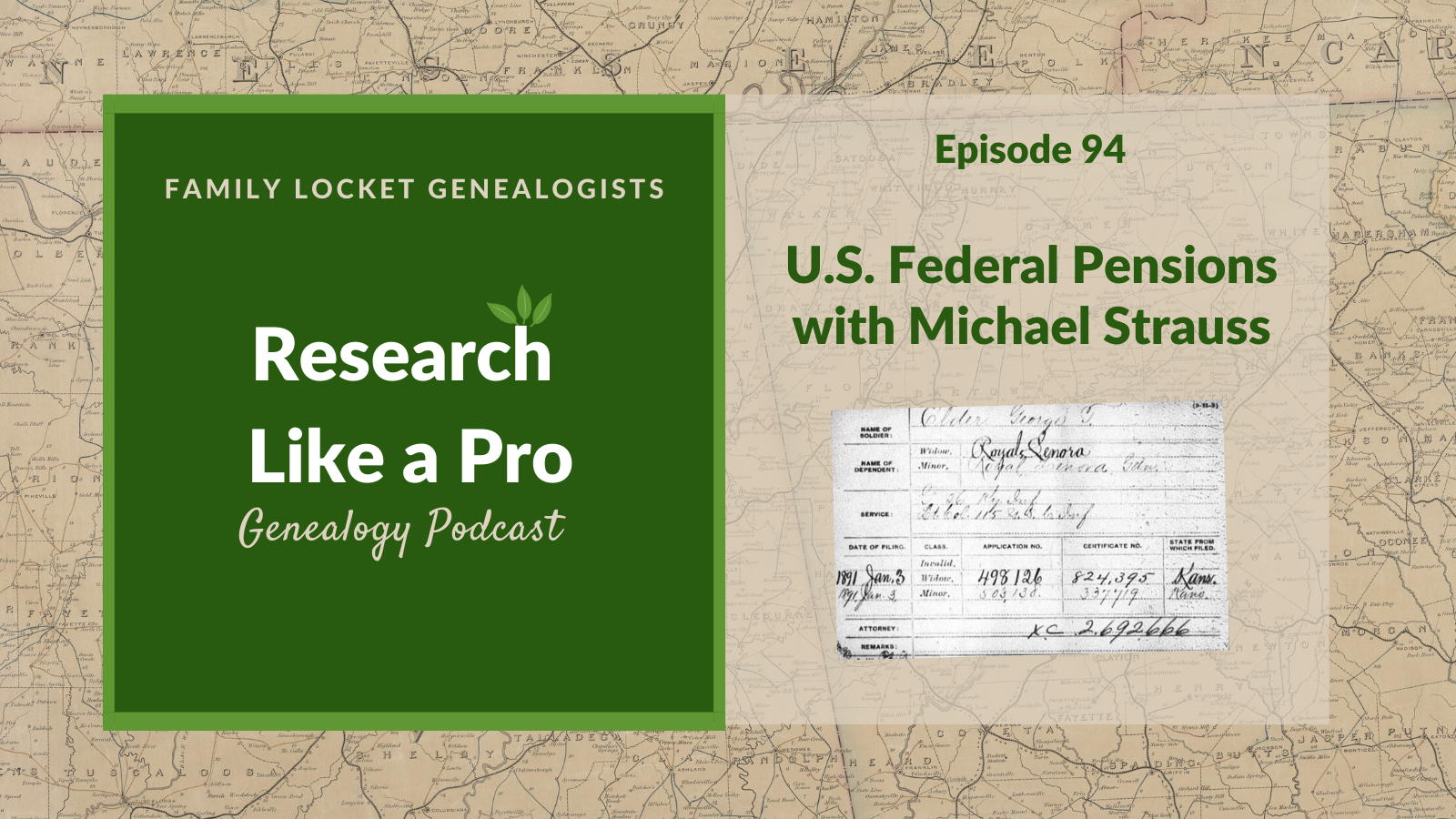
Today’s episode of Research Like a Pro is about pensions given to soldiers of various U.S. conflicts. Our guest, Michael Strauss, AG, discusses each war, the kind of pension records that are available to veterans and survivors, and where to find them. Join us as we talk with Michael about this substantial federal record group.
Transcript
Nicole (1s):
This is Research Like a Pro episode 94: U.S. Federal Pensions with Michael Strauss. Welcome to Research Like a Pro a Genealogy Podcast about taking your research to the next level, hosted by Nicole Dyer and Diana Elder accredited genealogy professional. Diana and Nicole are the mother-daughter team at FamilyLocket.com and the creators of the Amazon bestselling book, Research Like a Pro a Genealogists Guide. I’m Nicole co-host of the podcast join Diana and me as we discuss how to stay organized, make progress in our research and solve difficult cases.
Nicole (41s):
Let’s go. Hi everyone, and welcome to the show. I’m Nicole Dyer co-host of Research Like a Pro, and I’m here with accredited genealogist, Diana Elder. Hi, Diana, how are you?
Diana (54s):
I am great. Nicole. So fun to be here today, again on the podcast. And we are really excited because we’ve got one of our favorite guests with us, Michael Strauss. How are you doing Michael?
Michael Strauss (1m 6s):
Oh, I’m good. Thank you for having me back, Nicole and Diana, I appreciate it.
Diana (1m 9s):
We love talking to you about military records and today we’re going to be talking all about the Federal Pensions, which I think our listeners will love because pensions have such a wealth of information, but they can be a little tricky to track down and figure out how to actually get your hands on the information. So let’s just jump right into pensions. Can you tell us about the different kinds of pensions? I mean, I know I’ve used Civil War Pensions and Revolutionary War and War of 1812 pensions, but I have a feeling that there’s more than that, that I should be thinking of, for sure.
Michael Strauss (1m 46s):
Diana, the pensions themselves date back to the earliest years that we are a United States. So the subject of pensions actually was first discussed and voted on by the Continental Congress. And of course afterwards, we become a country. And as the wars progress in our individual country’s history, we see pensions as a means to pay soldiers for their military service. So that’s really where it comes from. In reality, though, pensions do exist even during the colonial era prior to the start of our United States. And those of course would be at a very different location. They’re not Federal, this was before we are a United States.
Michael Strauss (2m 28s):
And because of that, you would have to seek out your information at the state level.
Diana (2m 33s):
Oh, my word, I had no idea. Would those be for something like the French and Indian wars, some of those conflicts within the states, I’m curious?
Michael Strauss (2m 44s):
Yes, absolutely. So those would include the French and Indian war and the earlier colonial wars. So the colonial war period, really covers from about 1630 to the eve of the American Revolution, which is Lord Dunmore’s War of 1774. And as such, most of these military conflicts had some sort of offering to the men to compensate them for their military service. And you need to get a little creative when it comes to looking at them in the state records, cause they might not be listed under the word “pension”. They might show up under a different type of heading. I’ll just give you just a real quick example. I give a lecture on the colonial wars and one of the wars that I talk about is the King Philip’s war.
Michael Strauss (3m 29s):
Now King Philip’s war was fought between 1675 and 1678. It was a hundred years before the American revolution even occurred. I have a copy that I use from my lecture of a petition that was filed in the general court in Boston. And it was to petition of a Richard Rust. He said that he was a soldier and he was poor, He was from Weymouth Mass, and it told me what command he was under, It gave me the name of his captain. And it said that he received a gunshot wound in his belly and that he was carrying a bullet for about six weeks. And he was having that cut out by a doctor. And he was asking for 40 shillings that doesn’t say pension on the header.
Michael Strauss (4m 15s):
But if you really think about it, that really sounds to me like he was requesting monetary compensation or a pension from the Commonwealth of Massachusetts, just as an example.
Diana (4m 26s):
That is really interesting. Those kinds of records when you get them and you’re reading through them, your mouth just kind of hangs open because you can’t believe this man carried a bullet in his belly for six weeks. He must have had such an iron constitution. What a fun story.
Michael Strauss (4m 41s):
And it’s in the original writing as well.
Diana (4m 43s):
Even better. So those are on the state level.
Michael Strauss (4m 46s):
They are.
Diana (4m 47s):
Okay. So let’s jump forward then to the beginning at the United States and having a centralized government that could start issuing pensions, just give us a little brief history of how they evolve.
Michael Strauss (5m 2s):
Well, as I mentioned, this was initially voted on by the Continental Congress, at least at the national level, and with the new government in place, these payments were authorized through the 1789 legislation that really were passed over the years during these multiple wars where it started. So each war is going to have specific pension laws that are going to deal directly with that war. So if you’re looking at the American Revolution, for an example, you’re going to have multiple acts passed by Congress as the pensioneers became older. They obviously made changes to the laws as far as who could apply. Maybe the time period for Military Service was lowered or they allowed for widows to apply where previously they may not have.
Michael Strauss (5m 49s):
So each war’s going to vary. So the Revolution, the War of 1812, the Mexican American War, the Civil War, all of these wars as they go on in succession are going to have their own individual acts that are passed by Congress in the statutes at large. And these, I would recommend highly for any of your listeners to be able to read them, to know exactly how your ancestor came to apply for the pension and why.
Diana (6m 16s):
I think that’s a really good point. Sometimes those statutes at large seem a little intimidating, but it’s really interesting to read those. I’m working on an Indian Territory presentation right now. And I was looking at some of the statutes and acts that were passed in regards to that. And it’s fun to just read the actual document and understand what happened because Congress came up with this act. We have hindsight and we can see all the ramifications of what they pass, but when they passed it, they just had a vision of what that would help. But sometimes other things happen that maybe they weren’t envisioning.
Diana (6m 56s):
Just like our current Congress, right? They pass an act and we don’t quite know, or they don’t quite know, what’s going to happen in the future. So I’m so curious about how these pensions started. I mean, I know they did have the acts and they had the statutes. Do you think it was because soldiers were petitioning were held and it seems like sometimes these pensions weren’t granted until long after the war was over.
Michael Strauss (7m 22s):
Well, that certainly was true for the war of 1812 and the Mexican American War. Those pension acts that were national acts for both those wars occurred decades after the end of the war. With rare exception, you may have been able to apply if you were wounded during the war, but if it was just an, a circumstance where you hadn’t been disabled or wounded, you pretty much had to wait for that pension law to be passed. And again, it may have taken decades.
Diana (7m 50s):
Yeah. Let’s just go through each war. Cause they’re each different route where their records are held and some of the specifics with each one. So tell us just a little bit about the Revolutionary War.
Michael Strauss (7m 60s):
So I will talk about the Revolution first. I did want to make one other note that might be important for your listeners to know about our government, and this probably comes as no shock to you or them. Our government has had multiple occasions where records have been burned and/or destroyed. In episode 82, which was the first episode you had me on for, we talked about the service records and you remember, of course the fire of 1973 that destroyed all the service files connected to the 20th century. Well, we also had fires in 1800 and 1814 that were part of a war department. And with that, unfortunately, a lot of records were lost during the Revolutionary War time period.
Michael Strauss (8m 41s):
And because of that, the Revolutionary War records had to be reconstructed from other sources. They took into account the Interior Department, which was related to bounty land. They took into treasury office because the men obviously received money. So you could follow the money trail. So that’s just something we should begin this with. Just, I want your listeners to think about that, that there are underlying issues when it comes to looking at the records, but that doesn’t mean that the records are not searchable. So with the Revolution, there are multiple acts starting as early as 1776, going to 1878. If you can imagine an act as late as 1878 for the American Revolution.
Michael Strauss (9m 23s):
I don’t know if you knew this, but the last surviving widow of the American Revolution, her name was Esther Damon. Esther Damon lived to 1906, and she married a Revolutionary War soldier in 1835. He was 75 and she was 21. So I mean, we’re talking a huge age difference and this couple had a son. And what just amazes me is that when she died, the newspapers around the country carried her story, you know how she was the last surviving widow of a veteran. So it says that it closes out The Pension list of the Revolution. And clearly she was an applicant under that last act of 1878.
Michael Strauss (10m 4s):
And it really makes it pretty neat.
Diana (10m 6s):
That makes me wonder why they even pass that last act of 1878. They must’ve realized that there were still widows alive. I’m guessing there weren’t really any soldiers still alive because they would be like 120, but the widows. Yes, that’s a great story.
Michael Strauss (10m 23s):
Absolutely. So when it comes to these acts, as each was passed, there were some acts that were more amenable to the veterans. They were just easier for the veterans to apply under. So the 1818 act and the 1832 act were probably the ones that were the best suited for veterans to have their pensions approved or their widows to have their pensions approved. Now, these pensions, as you can imagine, are those that are housed in the National Archives. So they are available in person at the National Archives, but what’s nice is these pensions have been digitized and they’re available in multiple online sources.
Michael Strauss (11m 3s):
So Fold3 has a number of these online. The Ancestry website has quite a few, FamilySearch also has a number of these pensions that have been digitized and placed online. So if you really believe that you have a pensioner from the Revolution, it’s going to be pretty easy to be able to know that for certain. The first step is always determine service. The next step, which is gradual, is to determine if there’s a pension.
Diana (11m 31s):
So, you mentioned the three big places to look for the records. I am guessing that not one of them has a complete collection, or am I wrong? Would we have to go to all three if we’re not finding the record in one?
Michael Strauss (11m 47s):
Well, it depends again on the time period and the specific war. So we know for certain that the colonial era is going to be held at the individual state. So when you begin the federal era with the Revolution, all those wars up to 1902, roughly, which would be the Philippine Insurrection, you’re looking at pensions for the most part that are going to be held in the National Archives in Washington, DC. You can either access those directly from Washington or in cases like the Revolutionary War records, they’ve been digitized and can be accessed online. Now there is, of course, the civil war era, which we haven’t discussed yet, but the Confederate side is obviously not going to have their pensions held in the Federal custody.
Michael Strauss (12m 30s):
You’re going to have to go to the individual states for those where the veteran had applied. And we’ll get more into that later. Then comes the years after the Philippine Insurrection, the records for the pensions are not called pensions anymore, they’re called claim files. And those records are held at the National Personnel Record Center in St. Louis. And then beyond that, they’re held in the custody of the Veterans Administration. So you have a lot of places to search again, dependent on the war and the period of time.
Diana (13m 4s):
Okay. So we have our work cut out for ourselves, but if we really learn about the records, learn where they’re housed and then do our due diligence and searching for them, we should be able to come up with some good results.
Michael Strauss (13m 20s):
Absolutely.
Diana (13m 21s):
So I’m just want to ask a couple more questions about the Revolutionary War Pension. We mentioned, widow’s pensions. What did they award a pension for? Was it just for service? Did they have to be disabled? What were some of the qualifications?
Michael Strauss (13m 36s):
Okay. So what you’re referring to are, what information is found on the index card? So the index cards for the Revolutionary War, the War of 1812, and the Mexican American War pretty much looked very similar. So with the Revolutionary War, you’re going to see letters used on the application card. And there’s going to be a letter W which would stand for widow, s is for survivor, R is a rejected file, which I find are ones that actually contain the most Genealogy information because the applicant is…they apply, it’s rejected, they apply again, it’s rejected. You know, those are a wealth of genealogy information. And then you will often times see another abbreviation, which is BLWT, which is Bounty Land Warrant.
Michael Strauss (14m 24s):
So when you look at these card indexes, you’re going to see different letters, different numbers, because the men or the widows could not only apply for the pension, but in a lot of cases, they could apply for bounty land because the government was rich in land, but they were poor in cash. So the different types of pensions really boil down to three different types. You’ve got disability or invalid pensions based on physical disabilities that they sustained in service. There was a service pension, they served, they were awarded a pension. And then of course the widow’s pension granted to the women whose husbands had been killed or the veteran was dead and the widows survived. So those are your basic tier types of pensions.
Diana (15m 8s):
I feel like when I’ve looked on Fold3 you see at the index card, then if you scroll to the next images, you see the actual pension information, the application, am I thinking that right? I haven’t looked at these for a while.
Michael Strauss (15m 21s):
You are thinking, correct. So when you look at Fold3 and you see that index card, that’s the beginning of the file. And then every page that’s been digitized after that is really what’s inside the file page after page of record.
Diana (15m 34s):
I am just so thrilled that we have that now, because I know when I first started researching, you would just see the index card. And I think as beginning genealogists, we don’t always realize that there’s more to that. You know, we look at that and we say, oh, if they got a pension, great. We don’t realize there’s a whole application behind that, that’s going to give us the information we want. So for anyone listening, if you’ve just been looking at those cards, you need to go look at the complete file because that’s where the good stuff is.
Michael Strauss (16m 2s):
Absolutely. And then more importantly, if it makes reference to a bounty land file, that’s your next step, because likely that the soldier did not settle on the land and probably sold the land. So that would create another file altogether in record group 49, which is the land entry case files.
Nicole (16m 19s):
Oh, what a good tip to go forward and find the bounty land after you find the pension.
Michael Strauss (16m 26s):
And one other record you may want to also search, especially with the Revolution, I know it’s not related to our topic here, but if the veteran did live that long and they did apply for a later pension act, as late as 1840s, you may want to consider looking on the 1840 United States census, because they did have an, a question regarding pensioneers and/or their widows that had survived and their ages.
Nicole (16m 50s):
Oh, great. That’s good to know. When you mentioned that people who had a pension application that was rejected, that has a lot of good information in there that reminded me of a pension application that I’ve seen for one of my husband’s ancestors. And I have had the question, how much of that information can I assume is somewhat reliable? have you found that a lot of rejected applications contain false information that the applicant was making up in order to get a pension?
Michael Strauss (17m 20s):
No, I have not. In my experience found that the pensioner that was applying or the widow lied, I think it was maybe more of a question of not understanding the questions and maybe not understanding what it was that they were required to submit, or maybe not understanding the law and knowing that they could not apply.
Nicole (17m 41s):
That makes sense. Maybe they were hoping that their circumstances would apply to the act, but maybe they just didn’t.
Michael Strauss (17m 48s):
Yeah, we as descendants read the pension laws, but how many of our ancestors actually read the acts as they were passed?
Nicole (17m 56s):
Good point. Thank you. So, can you tell us now a little bit more about the war of 1812 and the pension acts that started because of that conflict?
Michael Strauss (18m 6s):
Okay. So the war of 1812 is our next major war. Now there is a period of time in between, which you did kind of go over. It was the Old War period. So the Old War period covers the end of the American revolution. So 1784 up to the Eve of the war of 1812. And it ends in 1811. Now, if you cannot find someone in the Revolution, the War of 1812, or the Mexican War, those wars up to the Civil War, and you’ve checked all three of those wars’ pensions, you may also want to consider looking at the Old Wars Pension Index. It is a separate index and what’s nice is it covers all those war periods.
Michael Strauss (18m 52s):
It doesn’t cover any one specific war. So maybe your family member may have been missed in one, but they were picked up in that Old War index. So just know that you need to search that as well. But as far as the war of 1812, that’s going to be a little different than the Revolution. The General Index to those pensions were essentially two acts the act of 1871, the act of 1878. Now that’s a lot of years after the end of the war of 1812, you’re talking 60 years after the end of the war before the government made these pensions available at the national level for veterans and or their widows.
Michael Strauss (19m 37s):
I had one of my ancestors who was a war of 1812 veteran, and he was one of my brick wall problems. I had never been able to find his death date. This man was born about 1790, died sometime around 1840. And I looked for close to 35 years, looking for his death date. Could not find it. I checked everything I could think of. Every possible local record. And when I found out he was a war of 1812 veteran, I had a little bit of a feeling that, Hey, maybe I can finally figure this out. Well, then I was thrown to the ground when I found out he had to have lived to 1871 to get a pension and, or his widow, both veteran and widow were dead before 1871.
Michael Strauss (20m 21s):
The veteran’s wife did live to 1866, and she applied for bounty land. And because of that, it referred to his military service and it gave me that needed death date that I had been seeking all those years, that I did not find anywhere else. So this is really why you need to look at both pensions and the bounty lands. They are so important together.
Nicole (20m 48s):
That’s really interesting. Now it’s making me think that before there were pensions, the government just kind of had the substitute of bounty land, kind of think of it in that way so that I always remember to check both.
Michael Strauss (20m 59s):
Absolutely. And what’s also nice about the pensions from the War of 1812 is those have been digitized for free on Fold3. So if you have a paid account, you can access them normally, but if you don’t have a paid account, you’ll be able to still access the war of 1812 pensions for nothing, because they intend on keeping them free for all patrons to be able to access. I know they’re not through the alphabet yet. I believe they’re nearing the very end of the alphabet. So around the letter T or something like that right now, I don’t know the exact letter, but it’s closing up on finishing the whole process.
Nicole (21m 36s):
Oh, great. I did a research project a couple years ago for Rowden family. So I think it’s time to go back and check the war of 1812 Pension.
Michael Strauss (21m 44s):
Oh yeah. They’ve been totally updated. I mean, there’s a lot more than what was available when you probably last looked.
Nicole (21m 50s):
Great news.
Diana (21m 51s):
Well, I always look with my surname of Royston whenever I’m looking at a record set because its pretty unusual, whenever I see that name, it’s usually my family. So I just decided while you two were talking to look at war of 1812 service pensions on Fold3 and found a John T Royston and a Sarah Royston, so I know they are at least through the Rs, and this is a service pension. So really interesting. And I love that you can see these actual images. They’ve done such a beautiful job of digitizing these with the color. They’re just amazing. So this one was rejected, which is interesting. And now I’m curious to go see if I couldn’t figure out why it was rejected.
Diana (22m 32s):
Wow. Thanks for reminding us of these records. I think sometimes we forget about the different places we can go check for records, new things, come up all the time. And if we’re not actively researching a family, we may forget to go back. Everybody listening, you can go check your family for a pension records because there’s probably more out there now. So let’s go to the Mexican war. This is when that was kind of a short war, but I think it left a lot of records. Am I correct?
Michael Strauss (22m 59s):
The war was a about nine months. So it wasn’t a very long war. It was our first war in which we’re actually in another country outside of our United States, like the previous War of 1812. This one also passed pension acts for veterans and/or widows, but it took a very long time again, decades. So the very first act passed by Congress nationally was January 29th, 1887. And again, I would encourage you to be looking them up and reading the actual act to know exactly how the veteran came to apply. There were additional acts, of course, in 1893, 1900, 1908. Again, these were more or less supplementary acts, but they were really based on the original act of 1887.
Michael Strauss (23m 44s):
And like the previous wars, they’re going to include a lot of the same information. There’s going to be a General Index. There’s going to be the remarried widows type of indices. And you’re going to be able to search the Old Wars as well. Again, if you find them in any of those acts, whether it’s the original or the supplementary acts or the Old War act, you’re going to be able to get that original pension at the National Archives in Washington, DC.
Diana (24m 9s):
Okay. So we keep talking about the acts and the statutes. For our listeners, where do you go to find the originals?
Michael Strauss (24m 15s):
Okay. So how I would recommend you do it is I would type the words, in a Google search, statutes at large library of Congress. Your first hit will be a website through the library of Congress where you can search each individual acts of Congress based on different years that they were passed. You can go year by year by year, session by session and read them all.
Diana (24m 40s):
So there you go. If you have nothing else to do, you can read all the statutes at large. And if you need some bedtime reading material to put you to sleep, that probably would be great too, right?
Michael Strauss (24m 48s):
I was just going to say that as well. If I, if that doesn’t put you to sleep, I don’t know what does.
Diana (24m 53s):
I read some of those, they’re not always easy to understand, but you know, if you’re focusing in on a specific act, you can certainly get some really good backgrounds. So yeah.
Michael Strauss (25m 2s):
Don’t read it while you’re drowsy. That’s all I can ask.
Diana (25m 8s):
I really liked the Mexican War records. I did a project with the soldier who had a great pension file from that, but I have to say it by the end of going through, I don’t even know, maybe 30 pages, I had heard more about his physical problems that I wanted to know, because they over, and over, and over, state the disabilities that they incurred. And sometimes its pretty graphic.
Michael Strauss (25m 29s):
I’m just curious, was that soldier, by chance, a part of the Mormon Battalion?
Diana (25m 33s):
No.
Michael Strauss (25m 34s):
Okay. Because the only ones that are digitized online right now are the Mormon Battalion ones, at least en masse.
Diana (25m 40s):
Right, this one came from the National Archives. I believe it was a client project and the client had ordered it. So it was up to me to wade through it and get all the pertinent information out. But it was absolutely fascinating.
Michael Strauss (25m 50s):
Yeah they are.
Diana (25m 51s):
That’s really good to know about the Mormon Battalion. So is that also on Fold3 or is that in a different place?
Michael Strauss (25m 57s):
They’ve been digitized on Fold3, and again, it’s limited, because it’s limited to that specific group of veterans.
Diana (26m 3s):
Okay, that’s good to know. We actually have an ancestor on my husband’s side that was on that. So that would be fun to go look at that. Nicole, have we looked at that?
Nicole (26m 15s):
Yes, I have.
Diana (26m 15s):
Okay. I should have known you might have.
Nicole (26m 18s):
Yes. It’s Daniel Henry. And it was an interesting record.
Diana (26m 21s):
Well, let’s move on to Civil War. And I think this is probably the pension set that most of our listeners will have had some experience with. I just know a lot of people that have used the Civil War Pensions, but let’s just talk a little bit about them.
Michael Strauss (26m 37s):
Absolutely. So the Civil War of course is going to be, like the previous wars, are going to be multiple acts. This one is very similar to the Revolution that more than 10 different acts were passed. And probably the one that was most amenable to the veterans was the act of 1890. So if you were a federal soldier or sailor or Marine or a member of the revenue cutter service, which is a forerunner of the coast guard, you’re going to likely apply and get approved under the veterans act of 1890. 1890 is not by happenstance. I believe that it is centered on the fact that our sitting president at that time was Benjamin Harrison and Benjamin Harrison was a veteran of the Civil War himself.
Michael Strauss (27m 22s):
He was a general in the American Civil War and he absolutely loved veterans. Well, of course, he’s a veteran too. And his wife, Caroline Harrison was instrumental in the organization of the DAR. I think she may have even have served as one of their very first presidents in the 1890s. So both husband and wife had a claim, had a stake in these veterans and making sure that they were taken care of. There is a downside to that, that the amount of money that was generated and spent by the treasury to support these veterans, doggone near bankrupt the United States. I mean, it was a lot of money that was spent to make sure these veterans received compensation that was due them.
Michael Strauss (28m 7s):
And that might go to explain why there are so many acts, but they contain a wealth of information. And I haven’t even gotten into the actual indices and how they even work.
Diana (28m 19s):
I think that’s interesting that they did those pensions so early because 1890 that’s just 25 years after the civil war ended. So the men were relatively young, still, you know, they could be in their forties and fifties. And so there would of course be so many of them. And I had no idea that it almost bankrupted the country. So did those next acts further restrict who could get a pension? Is that why they passed those?
Michael Strauss (28m 45s):
No. No, I don’t think so. I think they were more or less just addendums to the original older acts and they just made slight changes to the application process. I think that was more what it was centered on.
Diana (28m 59s):
Okay. Yes. And those pensions can be so long. I’ve seen some they’re over a hundred pages and they do provide amazing information. I know one client project I had and going through the file, we discovered that the man had had four marriages. The client only knew about one. And he detailed exactly where they were living and the dates of the marriages and the women. And that really was not available in other places, just because of the situation. So the pensions are so valuable. So let’s talk about how you actually find out if your ancestor had a pension and then how to get it.
Michael Strauss (29m 37s):
So with the Civil War you’re talking about, what’s called the General Index to the pensions. So this General covers 1861 to 1934. Now there are two series of indexes, but the one that’s probably most familiar is the alphabetical listing. This is the same one that was digitized and placed on Ancestry. So when you look at the index cards for that General Index on Ancestry, you’re going to have an application and, or a certificate number. There’s going to be multiple headings. There’s the invalid, there’s the widow, minor children could apply for their parent. And there was a heading for other, so a guardian, or someone else who had a vested interest in the veteran who legally was entitled, could also apply.
Michael Strauss (30m 28s):
Now that’s the alphabetical index. Now, just to throw a little bit of a monkey wrench into this for us, so what if you, Nicole or Diana, were at the National Archives, pulling a Civil War Pension, and you pulled up those set of numbers from a soldier that served whatever regiment they served in. What would you do if you could not read one of those numbers, maybe there was a smudge on the piece of paper. You cannot go to the archives and say, well, look, I have a number here, but I’m guessing at it. Could you pull a hundred files for me? Because I don’t know what the correct number is. So do you have any recourse, because the archives won’t do that.
Diana (31m 9s):
Have no idea. What do you do?
Michael Strauss (31m 11s):
So what you can do is you can look at another set of indexes that cover the same exact group of soldiers. So the Fold3 has this index online and digitized. This pension index is not done alphabetically, but it’s done by organization. If you know the regiment, you can find the soldier and the cards are almost identical. Now the only additional question that was asked on the organizational index, if it was filled out at all, was the date of death. They asked when the veteran died on the card index, but the cards look almost identical. I mean, they’re the same size.
Michael Strauss (31m 53s):
They contain the same information, but it’s done by organization. So everyone from a particular regimen. So everyone who was in Company A was alphabetical within that company. And so on down the line, until I ended the Companies, and then started with the 94th Pennsylvania, and then the 95th Pennsylvania. And so on.
Diana (32m 13s):
No idea that these were two separate indexes.
Michael Strauss (32m 16s):
Yes.
Diana (32m 17s):
That is so interesting.
Michael Strauss (32m 17s):
But they point to the same record.
Diana (32m 20s):
Right. So one thing I wanted to point out to our listeners, as you may not have a Fold3 membership, but keep watch, because typically Fold3 will open up their records on significant dates for military. It seems like Veterans Day, Memorial Day, they will say, okay, you know, these records are available for everyone for a week. And so then you can quickly do a bunch of searching or you can go to your local FamilyHistoryCenter whenever those open up, and those will have Fold3 memberships, or you can just do the free two week trial and do a bunch of searching them. So, you know, there’s some ways to get around without having a subscription. But if you want to do military work Fold3 is so valuable.
Diana (33m 2s):
I don’t think I could do my research without it. So, so grateful that a website came up with doing all military because that’s great for us. And I’m sure you were absolutely thrilled when Fold3 came on. Am I guessing that right?
Michael Strauss (33m 14s):
You are guessing that absolutely right. I totally love Fold3. Right.
Diana (33m 19s):
Great. Well, we’ve hit the major wars, but I know there’s the Spanish American War. Is it similar to the ones we’ve talked about
Michael Strauss (33m 27s):
It is. Before we leave the Civil War, it probably would be a good idea, if we just have a few words about the Confederate side during the American Civil War. So Confederate soldiers were equally entitled to pensions, but they would have come from the state in which the veteran resided at the time of their application, most people believe that the pensioneers for the Confederate side had to have been obtained from the state in which the soldiers served. That was not the case. So you really need to focus in on the state where the veteran resided,
Diana (34m 2s):
I can’t believe I almost skipped over Confederate pensions because I found so many in my family. Well an interesting story I have about that is I have, my Robert Royston who served in Alabama and I could never find any records for him because he was at the very tail end of the war. But his widow applied in Oklahoma where they had been living. She has a 42 page pension with amazing information from that. Oklahoma has put all of their Confederate pensions online. So just do a Google search and you’ll find those. And they are beautifully digitized as PDFs. But an interesting thing about Robert was they were living in Arkansas in 1910 and that’s the census that has a column for whether a veteran of the Union or the Confederate army.
Diana (34m 51s):
Well he had the little C in there. But then someone else later had put a great big check mark over that. And so we didn’t even really notice that for several years when I went back and checked, I saw that every single one of those men who had put the C had a big check mark, and I think they were doing account to see how many pensioners were still alive, that would be able to collect the pension because it was not even an issue till 1915.
Michael Strauss (35m 18s):
Yeah. I’m really glad that you mentioned Oklahoma because of all the states that had Confederate pensions, Oklahoma was the only one that physically wasn’t a state at the time of the war. Oklahoma didn’t exist. It was just a territory. Other states, not all of them existed during the course of the war. So lots of changes happen, people moved. And I think that’s what really made this more readily available for these Confederate veterans years after the end of the war.
Diana (35m 50s):
Yeah, really interesting. And for the Confederacy where there aren’t as many records towards the end, they really are a wealth of information and can really answer some of the questions that you might’ve had about your ancestors. So highly recommend looking for those kind of Federal Pensions. And you may have to try a few different states if you don’t know exactly where the ancestor ended up or the widow, you know, several years later. No, I think we finished Civil War. Civil War is always huge, but briefly just tell us a little bit about the Spanish American war and what kind of pensions were issued there.
Michael Strauss (36m 24s):
Okay. So with the Spanish American war, it’s going to be the same index that you’re going to use for the Civil War, because it covers 1861 to 1934. It’s going to take into account a number of veterans that were from the Spanish American War as well. Now, how you will be able to distinguish a Spanish American War veteran who applied for a pension from a Civil War veteran, because the same units will often be reused for multiple wars. The corner of the card will often have War with Spain printed on the card index. So you will know you’re looking at a Spanish American War veteran.
Michael Strauss (37m 6s):
Now the only thing that you need to know additionally with this war is if you look at the bottom of the cards and you see a numerical reference that has the letters X, as in x-ray, C, like in Charles, and that a series of numbers, or just the letter C and a series of numbers, it’s likely that that pensioner probably applied later in life. And because of that, those records may be held at the personnel record center in St. Louis. So you’re going to see veterans from those two wars have records, not in Washington, but in St. Louis, Missouri.
Nicole (37m 46s):
So glad you mentioned that because this was a point of confusion for me a few years back when I was researching our ancestor’s brother, George T Elder, and he was in the Kentucky infantry and I had his index card and I tried to order his application for a pension from NARA and they sent me back a letter that said, this isn’t here, It’s at St. Louis. There’s an X C at the bottom. And I was pretty surprised because I didn’t know that.
Michael Strauss (38m 12s):
Yep. And the cutoff date for the XCs are roughly in the mid 1920s. So a veteran for the Spanish American war, wasn’t really all that old at that time. Now Civil War veteran would be considerably older, but a Spanish American war veteran could very easily have his in St. Louis.
Nicole (38m 29s):
So tell us more about St. Louis and why there are some records there and leading into what happened with Veterans Affairs Department and World War I.
Michael Strauss (38m 38s):
Okay. So the Veterans Affairs or the Veterans Administration, it was founded in 1921 when Congress created the Veterans Bureau. And this was a used to file for benefits. Later in 1930, President Hoover, he would combine the Veterans Bureau with the Veterans Bureau of Pensions and the Home for Disabled Veterans would all be thrown into kind of one umbrella called the Veterans Administration. And later in 1989, this was called the Department of Veterans Affairs. So it’s morphed over the years. Because of that, a lot of records were moved from NARA inWashington, and are now in the custody of the National Personnel Records Center in St.
Michael Strauss (39m 20s):
Louis, Missouri. So how you can tell, if you have Spanish American War veteran or a Civil War veteran who lived really long and applied later in life, you’ll want to look at the index to the claims that are housed in St. Louis that cover 1917 to 1940. Thankfully those have been digitized and they’re on FamilySearch. They are no place else that I know of, but FamilySearch and the originals are at St. Louis.
Diana (39m 52s):
Fantastic. I’m going to have to go look into that. Thank you.
Michael Strauss (39m 56s):
Yeah, that’s the first series of indexes. The second series of index covers more or less the second World War veterans. And this index goes to 1970. The problem is we don’t have access to that. The Archives in St. Louis has to do the search for us. You’re talking about veterans who are possibly still alive.
Nicole (40m 15s):
Right.
Diana (40m 15s):
I have had that same question with the World War II pensions. If I remember right, when I did a little research for a client a while back, it had to be someone who was closest to the soldier, like the next of kin. Is that still how that is working that had to do the requesting for the records?
Michael Strauss (40m 34s):
I think what you’re thinking about is the service record, the OMP file. So that certainly is true with that. And the Archives, of course, isn’t just going to hand out claim files and Pension Files to anyone but immediate family. I mean, you certainly have to prove your relationship to the deceased before you can get that. But when you look at these cards, what’s going to be critical is to know, one, is the veteran dead and two, are you connected to that veteran, and if you are, and it’s held in St. Louis, which it’s likely to be there, then at that point, you can contact their offices and request that file.
Diana (41m 10s):
So that would go for World War II, as well as the Korean War and Vietnam War?
Michael Strauss (41m 16s):
Right, well, St. Louis is going to have not only World War I, World , Korea, and Vietnam, they’re also going to have that period of time, which was the Mexican Punitive Expedition, the year proceeding the start of World War I. That was that little incident that we had with Poncho Via where John Pershing crossed the border with an army of about 10,000 men and in pursuit a Poncho Via, with whom he never caught. And this immediately proceeded our years of fighting in the first world war. So all those years would be covered in these claim indexes. That should be in the custody of the National Personnel Records Center in St.
Michael Strauss (42m 2s):
Louis, the later wars, Vietnam and Korea. You’re going to beginning into a little bit of a gray area here because they may not even have them in St. Louis, because the veterans are even younger. So those might be in the custody of the actual Veterans Administration, because they haven’t been a session. They are, they’re not archived.
Diana (42m 22s):
Interesting. Okay. Wonderful information that you’ve given us here. Thank you so much for coming on and talking about all of these pensions. I’ve just kind of want to go do all my searching on military records. Now, after talking about this and see what else I can find. So what’s a resource if you really want to learn more about military record?.
Michael Strauss (42m 40s):
Well, there are certainly a lot of books and articles that have been written about these multiple wars. The National Archives could probably offer you a really good to start to help you kind of navigate through this a little bit better. Craig Scott did a book on Revolutionary War Pension, and he also did one on treasury records. I’m familiar with his, a number of other individuals, Trevor Plant’s written a couple of articles related to service records and how they work in line with pensions. So there’s a lot of places for you really to start to try to obtain a little bit more genealogy education from home before you actually delve into those records.
Diana (43m 22s):
So I think you’re right that on the National Archives website, they try to give a lot of information about the record. So that might be a place that’s just like you say, free from home. Yeah. Just to go, try to do a little research there.
Michael Strauss (43m 34s):
Its Prologue magazine, that’s the magazine that was published by the Archives. So their past issues for the most part are online. If they’re not digitized, they’ve copied and pasted the text and you can search for any particular subject of interest to you.
Diana (43m 48s):
I think that’s a good point. I think one of the things that we tend to not want to do as beginning genealogists is to learn more about the records themselves. We just want to get the record and take those dates and names and places off of them. But to really understand them, we have got to research the records themselves, which is why it’s been so great to have you teaching us about The Pension records and then the service records before. So I think next in line, we’re going to talk about bounty land records in another episode, is that right?
Michael Strauss (44m 19s):
That will be fine. We’ll work out a time and we’ll go from there.
Nicole (44m 23s):
Thank you so much for teaching us today and I just wanted to say that I’m going to put a link to the prologue magazine in the show notes for everybody.
Michael Strauss (44m 31s):
Excellent. That’s a good idea.
Diana (44m 32s):
Well, I think we’ve kept you long enough. This has been so fun and so full of information. Thank you again for coming on and we hope all of our listeners can go do some searching and find something new about your military ancestors this week.
Michael Strauss (44m 49s):
Thank you.
Nicole (44m 50s):
All right, bye bye everyone.
Diana (44m 50s):
Bye bye.
Nicole (44m 51s):
Thank you for listening. We hope that something you heard today will help you make progress in your research. If you want to learn more, purchase our book Research Like a Pro a Genealogist Guide on Amazon.com and other booksellers. You can also register for our Research Like a Pro online course or join our next Study Group. Learn more at FamilyLocket.com. To share your progress and ask questions join our private Facebook group by sending us your book receipt or joining our eCourse or Study Group. If you like what you heard and would like to support this podcast, please subscribe, rate, and review. We hope you’ll start now to Research Like a Pro.
Links
Prologue Magazine – National Archives Publication
Genealogy Research Network – website of Michael Strauss, includes his lectures, speaking schedule, and contact form, or reach via email – mlstrauss@genealogyresearchnetwork.com
RLP 82: Military Service Records with Michael Strauss
—–
Pension resources:
U.S., Revolutionary War Pension and Bounty-Land Warrant Application Files, 1800-1900 at Ancestry
American Revolutionary War Rejected Pensions at Ancestry
U.S., The Pension Roll of 1835 at Ancestry
United States Revolutionary War Pension Payment Ledgers, 1818-1872 at FamilySearch
War of 1812 Pension Application Files Index, 1812-1815 FREE at Fold3
War of 1812 Pension Files FREE at Fold3
United States Old War Pension Index, 1815-1926 at FamilySearch
United States Mexican War Pension Index, 1887-1926 at FamilySearch
United States Remarried Widows Index to Pension Applications, 1887-1942 at FamilySearch
Mormon Battalion Pension Files at Fold3
U.S., Civil War Pension Index: General Index to Pension Files, 1861-1934 (Union) at Fold3
Civil War Pensions Index organized by military unit (Union) at Fold3
United States Veterans Administration Pension Payment Cards, 1907-1933 at FamilySearch
United States, Veterans Administration Master Index, 1917-1940
Veterans Administration – for Korean War and Vietnam War
—-
Study Group – more information and email list
Research Like a Pro: A Genealogist’s Guide by Diana Elder with Nicole Dyer on Amazon.com
Thank you
Thanks for listening! We hope that you will share your thoughts about our podcast and help us out by doing the following:
Share an honest review on iTunes or Stitcher. You can easily write a review with Stitcher, without creating an account. Just scroll to the bottom of the page and click “write a review.” You simply provide a nickname and an email address that will not be published. We value your feedback and your ratings really help this podcast reach others. If you leave a review, we will read it on the podcast and answer any questions that you bring up in your review. Thank you!
Leave a comment in the comment or question in the comment section below.
Share the episode on Twitter, Facebook, or Pinterest.
Subscribe on iTunes, Stitcher, Google Play, or your favorite podcast app.
Sign up for our newsletter to receive notifications of new episodes.
Check out this list of genealogy podcasts from Feedspot: Top 20 Genealogy Podcasts









Leave a Reply
Thanks for the note!