
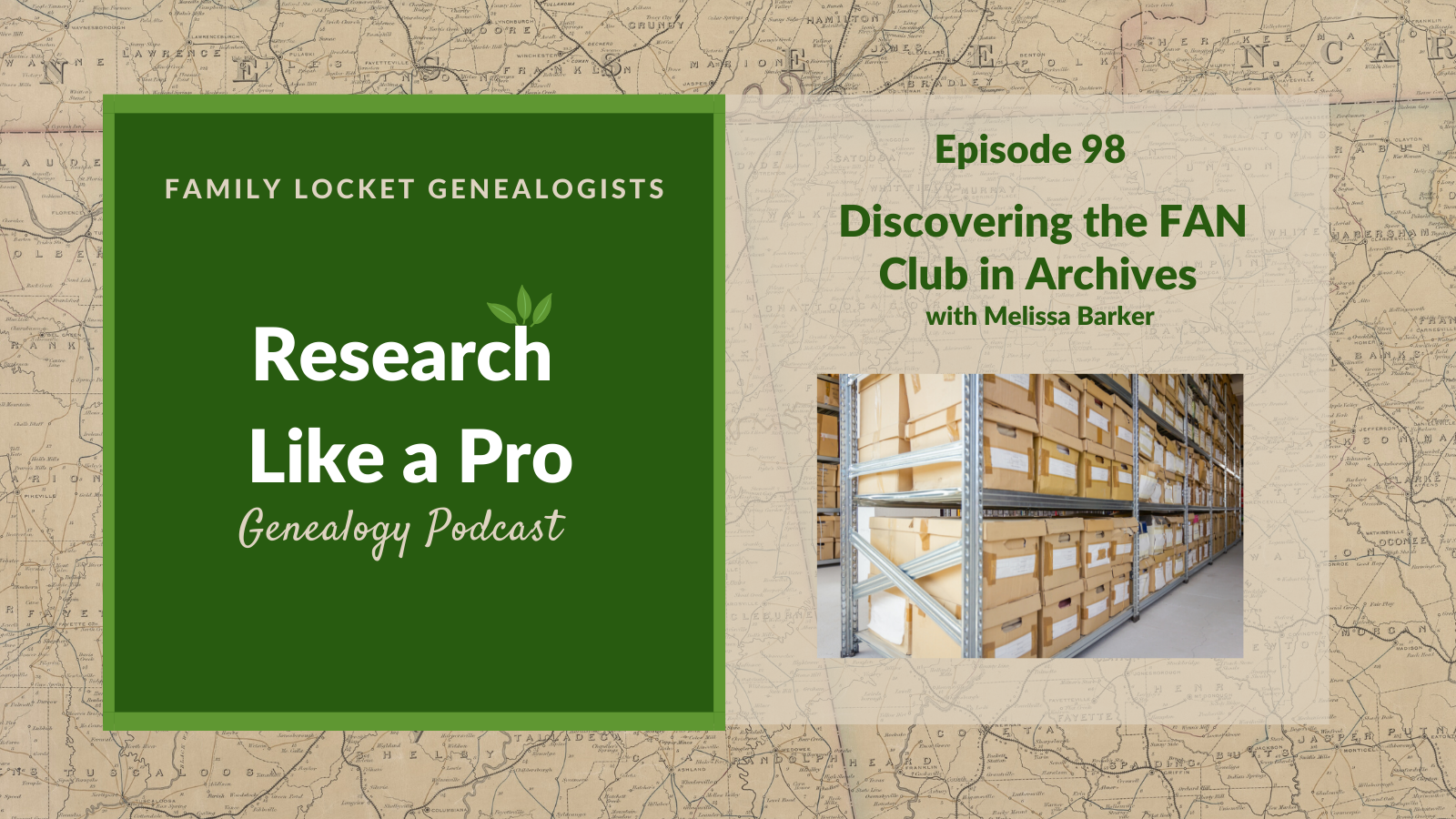
Today’s episode of Research Like a Pro is about finding records for the friends, associates, and neighbors of your ancestors in archives. Melissa Barker, the Archive Lady, teaches us all about archives. Tune in to learn more about different types and levels of archives, what you might find there, and best practices for using them.
Transcript
Nicole (1s):
This is Research Like a Pro episode 98, Discovering the FAN Club in Archives with Melissa Barker. Welcome to Research Like a Pro a Genealogy Podcast about taking your research to the next level, hosted by Nicole Dyer and Diana Elder accredited genealogy professional. Diana and Nicole are the mother-daughter team at FamilyLocket.com and the creators of the Amazon bestselling book, Research Like a Pro a Genealogists Guide. I’m Nicole co-host of the podcast join Diana and me as we discuss how to stay organized, make progress in our research and solve difficult cases.
Nicole (41s):
Let’s go, Hi everyone and welcome to the show. I’m Nicole Dyer, co-host of Research Like a Pro, and I’m here with accredited genealogist, Diana Elder, and our guest today, Melissa. Hi Diana.
Diana (56s):
Hi Nicole. Hi, Melissa.
Melissa Barker (58s):
Hi Diana.
Nicole (60s):
So today we are talking with Melissa Barker about Discovering the FAN Club in Archives. And as you know, we’ve had Melissa on the podcast before, and she is an archivist.
Diana (1m 12s):
So it’s been a while since we had you on Melissa. I think it was about a year ago. We had two episodes with you. So for any of our listeners, go back and see if there are some things in those previous podcasts that you’d like to listen to, because I think archives are the next level of research that often we haven’t yet worked on, may sound a little scary, and it’s really great with you, Melissa, cause you demystify it and help us understand what’s there and why we’d even want to go into them. So before we get into talking about the FAN club and archives, just kind of review for us what you do as an archivist. You know, what’s your background.
Melissa Barker (1m 49s):
I work as the certified archives manager at the Houston county, Tennessee Archives as a county archivist. But what I do on a daily basis is for the most part, I manage and preserve county government records, but I also manage and preserve historical and genealogical records that are donated to our archives. My background is actually Genealogy. I’ve been doing genealogy since 1990. In 2004 I took my avid hobby that I loved very much and became a professional genealogist with expertise in Tennessee records. And then in 2010, I got a phone call from our local librarian who wanted to know if I’d like to be part of a group of people who had gotten permission from our county mayor to organize and clean up the county records vault.
Melissa Barker (2m 34s):
At the time I almost said no, because I thought, you know, I’m kind of got a lot on my plate and I don’t, I think I need something else, but I said, yes. And so there were six of us that got together in August of 2010 to do this work on the county vault. And what has precipitated us doing this was there was a local lady who was doing her genealogy research and writing a book about her family because her grandfather had actually been murdered in 1921 in the streets of our county. And she could go to the library and see the court records on microfilm, but she wanted to see the actual records like all of us want to do. And so someone had sent her to the basement of the courthouse where the county records vault was and said, that’s probably where you’re going to find them.
Melissa Barker (3m 19s):
And at that time, the records vault was not locked. It was just open for anybody and everybody to go in. So she got down there and she opened the door and she found that it was so packed full, that she couldn’t even go in and it was packed to the door and all the way to the ceiling. So she was the one who kind of put up the call to do something about this. So the, on that August day in 2010, we worked on the vault till about lunch. And as we were sitting there eating our lunch, we all really decided that we needed a county archive because our records were in very bad shape. We had found torn boxes, records on the floor, old Christmas decorations in there, all kinds of different things that were in and amongst our oldest county records dating back to 1871.
Melissa Barker (4m 4s):
And so everyone agreed we needed a county archive and then someone made the suggestion that we needed someone to head this up, to start this project. And of course we all sat on our hands. We all have plenty to do. And then they all looked at me and said, Melissa, you do genealogy research. You need to head this up. And I told them, I’m not an archivist, but they encouraged me and they pushed me. And so what I did at the age of 42 is I went back to school for three years and got my certified archives managers certificate. And I was instrumental in starting the county archives here in Houston county, Tennessee. And we started from scratch. And so that’s kind of where I came from and where I am today.
Melissa Barker (4m 45s):
And we have been an archive now for 10 years.
Diana (4m 48s):
And I would imagine that vault is pretty cleaned down now.
Melissa Barker (4m 52s):
It’s beautiful. It’s taken us several years, but we have finally got it to where you can actually walk around in there.
Diana (5m 2s):
Oh, how wonderful that you’ve taken that on and what a wonderful resource for anyone researching in those records. That’s so neat to get the backstory. I think we just take it for granted so many times, these archives. So thank you for that review of your background. I kind of forgotten some of that.
Melissa Barker (5m 18s):
Yeah. I like to say that our archives was formed in 2010 because of a murder in 1921. And I think you’ll find that a lot of our archives, especially like county archives or historical societies that have archives, they have a really neat story that helped them to get started.
Nicole (5m 35s):
Wow, that’s so neat. Thank you for sharing. So today our topic is about the FAN club. So we’ve talked to the past few weeks about the FAN principle that Elizabeth Shown Mills coined, and it just refers to researching the friends, family associates, and neighbors of our research subject. When we’re doing that, we shouldn’t forget the archives as a resource and a place where records about the FAN club might be helped.
Diana (5m 58s):
I think this is really a fascinating idea because we can get frustrated because there’s no record for our ancestor, but there probably WILL be records for someone in that FAN club in the archives. So just a little definition of archives, defined by the Society of American archivists as an organization that collects the records of individuals, families, or other organizations. Often we might think of that just as a government archive, like for a county or a state, but really it’s just an organization that accepts and collects everything. Government, historical genealogical documents, records, memorabilia, artifacts, anything that is collecting that is considered an archive.
Diana (6m 45s):
So really I’m thinking we can have family archives. Is that right, Melissa? We can have our own little collections.
Melissa Barker (6m 52s):
Absolutely. Any person who’s a genealogist, a family historian, that has any type of family records, you have an archive and I’m always talking about genealogists, also being the home archivist. We are archivist in our own, right because we are collecting and preserving records about our family. And sometimes we actually get other records that may not belong to our family, but that we somehow like maybe bought at an antique store or at a yard sale. And we just couldn’t pass it up. I know people that do this. And so yeah, we as genealogists collect these things and we have our own little archive.
Nicole (7m 32s):
Love that. Can I ask you, what are some of the other types of archives that we might find useful in our FAN club research?
Melissa Barker (7m 39s):
Well, I’ve already just talked about a county archive, an example of that, and believe me, there are tons of archives out there. I like to say that there’s an archive for everything, but after county archives, I would say we kind of go to the next level and that is State Archives in the United States. People may not know that all 50 US states have a State Archive and every one of those State Archives have a website. So these State Archives are phenomenal places to find records. Another place that I consider an archive, and is an archive, are historical and genealogical societies. Now, not every historical and genealogical society has a building with records in it, for instance, my local historical society they just meet every month and have a speaker.
Melissa Barker (8m 24s):
But when you have a historical society or a genealogical society that collects and preserves records, they are a type of archive. And also don’t forget local public libraries, they’re not just for checking out books. They also could have reference works on the shelves that are geological in nature. And they could also have actual documents, many times in a library they’re called special collections or manuscript collections. And they have those in our local public libraries. Some of the types of archives that many genealogists maybe don’t think about are university and colleges, their library and archives on their campuses. Now they also include records and things about the college and their students and alumni, but they also have records that have been donated from the local community.
Melissa Barker (9m 13s):
So it’s important for us not to forget those types of archives and then last, but not least, museums. I actually came to the idea of museums being a type of archive kind of late. If you think about it, when you go to a museum and you’re walking through the exhibits and displays, you can see that they have documents on display. They have photographs on display, maybe an old letter. And museums do have back fill the shelves with boxes of records. And so it’s also a great place for genealogists to check out in the local area where your ancestors live to just see if maybe they may have some records about your family.
Diana (9m 52s):
Wow. That’s a really great list and kind of eye-opening to think of all the different places where an archive might be held and especially to consider that they may not actually have the title archive in them. So where do you start? You know, do you just walk into the archive and asked for them to tell you about your ancestor? I mean, you know, that’s what we would like to do, right? Just give me everything on my ancestor, but I’m pretty sure that that would not go over well. So what do we do to get started?
Melissa Barker (10m 21s):
I would highly encourage you not to walk into an archives and ask for everything for your Smith family, because I don’t think you’re going to get much of a response, but one of the first things I teach genealogists about researching in Archives is to get local. When you’re researching in a particular area, do a cursory inventory of what kinds of repositories and archives are in that area. Ask yourself the question, where are the records? And when you go from that question, you’ll be surprised how many different places you’re going to find where the records are. That may be the local courthouse that may be a historical society, a county archive, or maybe even a museum.
Melissa Barker (11m 3s):
So that’s really the first step is just trying to figure out where are the records. And then when you get to these places or you’re contacting them by email or telephone, you need to make sure that your request or what you’re looking for is as specific as possible. This will actually help you to be more successful. Because as you can imagine, these archivists librarians, museum curators, they are busy. They’re working with other researchers as well. And so if you can keep your request to a specific request, then they can better help you talk to the archivist, the librarians and the clerks at the courthouse, talk to them about the records.
Melissa Barker (11m 46s):
Maybe they don’t have what you’re looking for at their facility, but they know maybe where the records could be located. And one thing that I always teach genealogists to do is to contact the local Chamber of Commerce, the local historical society. Talk to these people who live in the area, try to find out some of the older members of the community who have lived there, their whole lives and contact them. Talk to them about where the records are located, because there’s probably going to be records that are not nicely and neatly put in folders and boxes and ready for research. But they’re stored in other areas of the community, in an old building, in an attic, in the basement of the courthouse but somebody knows where they’re located.
Nicole (12m 30s):
So Melissa, if I were to call up the archivist of the county I was interested in and try to talk with them on the phone, would they make time for me right then, or would they want to set up an appointment? Or, I’m worried about bothering them…
Melissa Barker (12m 43s):
Yes. I understand that question. It all depends on the archive because they’re all different. So if you call them up on the phone, don’t be dismayed if they say, hey, could you please just send us an email with your request? That way they can get to it at their timing. But maybe they can help you on the phone, they take down your name and your request, and then they’ll get back with you. But many times they will ask you to drop them an email or send it through their website, through their contact form. And when you do that, like I said, be specific and thank them for their help. But most importantly, you may have to be patient. Like I said, these archivists are working with many different requests and so they promise they’ll get to yours, but give them a little bit of time.
Melissa Barker (13m 27s):
Even in my own research, my family are from up north, I live in the south and so I do a lot of emailing. I do a lot of phone calling myself and I usually give a repository a week or two to try to get back with me. And if I haven’t heard back with them, I will just send them a gentle email saying, Hey, where are you with my request? Just wondering to see if maybe this is something you’re going to be able to get to soon and just be very patient because they actually have not only the requests that are coming in from phone calls and emails, but then they have patrons that are also walking in the door. And then on top of that, they have their day to day operations of the archive.
Nicole (14m 7s):
Yes, they do sound busy. So what would you recommend if I’ve looked at the local level and they’re not there, are there different levels for archives like there are for government records?
Melissa Barker (14m 18s):
Absolutely. If you have canvas the local area and you can’t seem to find what you’re looking for, every county does not have a county archive and they don’t necessarily either appreciate, or they don’t have room maybe for their records. And so what will happen is, is that they will have transferred these records to a state archive at the state Capitol. Usually like in Tennessee, we have the Tennessee State Library and Archives. They have records on their campus from every single county in the state of Tennessee. I’ve actually found records for Houston county that are at the state state level when you would think they would be at the county level. But at some point in the past, because we didn’t have an archive here, they were sent to the state level.
Melissa Barker (15m 0s):
And then once you get past the state level, then you want to go on to the federal level. The US National Archives is a fantastic place that maybe some of the records that mentioned your ancestors have made it to that level. Just taking it step by step and making sure you’ve covered all of your bases is a great piece of advice for researchers, whether you’re just beginning or you’ve been doing this for some time.
Diana (15m 26s):
Well, as you’ve been talking about all these different archives, it really made me remember the great website ArchiveGrid where you can just put in any location and then you’ll get a little pin symbol on a map showing all the archives around that location. And I think that is so valuable because if you’re planning a trip somewhere using ArchiveGrid is a fabulous tool for finding out where all those different archives and collections are. So a really easy way to find that is just to Google it, or it’s also on the homepage of the FamilySearch catalog so you can get to it that way. Also, I think it’s just fun to play around a little bit with that and see what kind of archives are just out there for your different locations.
Melissa Barker (16m 12s):
Yes, ArchiveGrid is a fantastic website. Another great thing about ArchiveGrid is its actually a website that archives contribute information to. They either will contribute maybe an index of their finding aids from their manuscript collections, maybe they have contributed links to online indexes or digitized records on their website. And so not only can you find archives, but you might be able to be pointed to records that they have available.
Diana (16m 38s):
I have noticed that I’m working in Dutchess county, New York right now, and a little specific town called Pawling (P A W L I N G) there is a little archive in that town and I was blown away with the description on ArchiveGrid about all the different things that could be there. So I wish I just lived right there and I could go pop in and search through it, but, and we live far away. We have to be a little more creative. Right?
Melissa Barker (17m 4s):
Absolutely.
Diana (17m 4s):
So now that we’ve kind of talked about what archives are, where we find them, what they could be. Let’s talk about the kind of specific records and what those are and how we can use those in our FAN club research. So can you tell us a little bit about manuscript collections? I think we hear that term a lot and not know exactly what that means.
Melissa Barker (17m 25s):
Yeah and it’s one of those terms, one of those phrases that I don’t know that genealogists understand exactly what it means and what all it encompasses. And so this is kind of a visual that I like to give people to try to understand what a manuscript collection is. Think about all of the geology records that you have at your home, whether that is documents or diaries or scrapbooks, grandma’s quilt, the family Bible, anything that have to do a family history or family heirlooms in your mind, take all of that stuff and put it all in boxes. Take those boxes out to your car, put them in the trunk and then drive your car down to the local archive and donate all of that stuff.
Melissa Barker (18m 6s):
That is a manuscript collection. Its a folder by folder, box by box, collection of records. And these records are almost always donated to the local archive or the state archive. And they could include literally just about anything. They could be donated by individuals, or donated by local business, or even like a local organization. And so manuscript collections for me are one of the most under-used record collections in the genealogy world. I think that’s why I’m constantly talking about them. When genealogists walk into my archive the first thing I want to say to them is have you looked at our manuscript collection index to see if there’s anything there?
Melissa Barker (18m 50s):
And usually in an index you’re going to see titles that say John Smith papers, and it gives a date range, or it will say the garden club collection of records, things like that. Each collection could be a box worth of records, or it could be 200 boxes worth of records. So it’s important when you’re working with manuscript collections that you read the finding aid. The finding aid is like a roadmap to the collection itself. The archivists produces a finding aid as they process the collection and they list all kinds of information about the collection, but the most important part that genealogists want to get to is the contents listing.
Melissa Barker (19m 31s):
The contents listing of a manuscript collection in the finding aid is that folder by folder box by box listing of what’s exactly in the collection.
Nicole (19m 41s):
So I have a poor ancestor who didn’t leave behind a lot of records, but he associated with some other business owners that I’ve found in deeds. And I’m thinking it would be a good idea to go and look for them in the manuscripts, because I haven’t really pursued this avenue before, but it sounds like there could be some manuscript collections that include the records of these businesses that my ancestor used and so maybe it would mention him and I just need to find a repository or an archive that might have those. Although are the finding aids usually available online or is that something you have to go to the archives in order to read?
Melissa Barker (20m 17s):
Oh, it all depends on the archives. Some archives now are putting their finding aids on their website or they’re putting them on ArchiveGrid. This is a perfect example of the FAN club, the friends, associates, and neighbors. If you can’t find a manuscript collection that pertains to your family or is about your family, I would highly encourage you to seek out manuscript collections that deal with their neighbors, people that maybe you have seen that they lived near in the census. See if they have a manuscript collection that contains a diary or a scrapbook or something that might mention your family member. I always like to bring up, several years ago the show Who Do You Think You Are? I believe it was season two, I could be wrong on that, they had Tim McGraw, the country music singer on, and they showed him a diary that was written by a 16 year old George Washington, the president of our country.
Melissa Barker (21m 12s):
And in that diary, George Washington mentions Tim McGraw’s ancestor. Only one time. And the reason he was mentioned was because he was a neighbor of George Washington’s. And so this is why we should always have our eyes wide open. When we’re looking at any kind of a record source for the neighbors, for the associates, maybe they shopped at a particular mercantile that mercantile kept a ledger of accounts. And in that ledger of accounts, your ancestor’s listed and it lists all the different things that they purchased. So that’s why it’s important for us to look at all different ways, to try to find our ancestors
Diana (21m 48s):
Wow. So many things to think about. I love that. So the next thing that I want to talk about is the term vertical files. Whenever I hear vertical files, I just think of a file cabinet that’s standing up straight and I don’t even know where I got that picture in my head, but explain to us what is a vertical file and what is going to be in there.
Melissa Barker (22m 10s):
Oh, vertical files they’re fantastic. Vertical files are like a box of chocolates, you never know what you’re going to get. You don’t. They’re like a hodgepodge of records that have been collected and organized. And you’re right, they are usually found in filing cabinets. Vertical files are bits and pieces of records that are not large enough to make into a manuscript collection, organized by surname or an organization name or a subject name. And in this vertical files, you literally could find just about anything. You could find a receipt in there from a local store that’s mentioned your ancestor.
Melissa Barker (22m 49s):
Many archives put their photographs in their vertical files. Many times when genealogists donate family group sheets, or family histories to an archive, they go to the vertical files. So it’s important that when you go to a repository or when you’re in contact with an archive, ask them about their vertical files index. You may not see the word vertical files. You may see them named subject files. And also you may see them called morgue files. Almost always there’s an index either online or on the in-house computer at the archive. Just go through the index, look for your surnames. Maybe they have information in the vertical files about a particular one room school house. This is to me, one of the best record sources that is not talked about enough.
Nicole (23m 32s):
How neat. So when people come into your archive and asked to look at the vertical files, do you let them just go back and rifle through them and look at them?
Melissa Barker (23m 40s):
No, usually in an archive setting, we will hand you the index and that will list, you know, all of the different files that are available. And then you let us know which ones you might be interested in. And we go pull those files and we’ll bring them to you because many times it’s vertical files or behind closed doors. They’re back in the records area, not out in the front where we usually sit to do our research.
Nicole (24m 2s):
That makes perfect sense. Thank you for explaining that. What else can we find about diaries and journals that you mentioned before in archives?
Melissa Barker (24m 10s):
Diaries and journals are fabulous. I wish I had some of my own family records. I don’t, but diaries and journals can tell you so much about where your ancestors lived. But if you don’t find one that they actually wrote, don’t discount this type of record, I would suggest that you read diaries and journals from those who lived in the area and the same time period that your ancestors lived. Because if you think about it, they went through the same local events. Maybe that there was a flood, maybe there was a tornado or hurricane. Maybe there was a fire that burnt the courthouse down and it was written about in a diary, maybe there was the Civil War, or maybe it was during World War II And someone here was writing about what it was like here during that time.
Melissa Barker (24m 56s):
And so even if you don’t find a diary that your own ancestor wrote, you can envision what they were going through. And I’m one of these researchers that I don’t just want to know the dates and places of my ancestors. I want to tell their whole story. I like to always say that I want to know what they had for breakfast. I don’t think I’ll find that out for most of my ancestors, but I can maybe find out what the community was like, that they lived in.
Diana (25m 22s):
You know what? We are one of those lucky people. We have a journal of our, I think it’s my second or third great-grandfather, his name was William Henry Kelsey. And he joined the Church of Jesus Christ of Latter Day Saints in England in 1848, I believe. And then he proceeded to walk all around Southern England and into London and Kent and over those areas. And he kept a daily journal and the original is at the Brigham Young University, Special Collections. It’s so fun. I have a transcription of it and I had them digitize it. So I have the actual images of it now. And as we’ve been talking about the FAN club, I just keep thinking about all the people he names in that journal, because every single place that he stopped at for the night, he would record a little bit about that family.
Diana (26m 12s):
He’s got a huge list of associates, but then I’m thinking, those people who have descendants now probably have no idea that their ancestors are in this journal of this missionary for so long ago. So that’s such a great idea to just check out all of the journals and diaries that might be in that area ’cause you never know if your person’s going to be mentioned. And I am assuming the same thing with correspondence. We’ve got people writing letters back and forth. Are these typical things that might be in an archive if someone has a collection of letters and such?
Melissa Barker (26m 46s):
Oh, absolutely. Yes. Old letters and even postcards are a fantastic find in archives. Most of the time you’re going to find this type of record in the manuscript collection. I have seen manuscript collections that were 10 boxes of nothing but correspondence. And so if you’re lucky enough to have an ancestor that was prolific in letter writing and it was saved and it was donated, then you would really find a gold mine. But again, just like I was talking about when it comes to diaries and journals and even manuscript collections, when it comes to the FAN club and other people’s correspondence in the community, they may talk about your ancestor or again, they may talk about events or goings on in the community.
Melissa Barker (27m 30s):
And so it’s important for us to seek out these types of records as well. They would be very easy to find when you’re looking at the finding aid, because many times in a finding aid, it’ll say, box one, file seven, correspondence, 1821 to 1835. If you know your ancestors who lived in the area during a particular time period, then you can ask the archivist to pull that particular file. And you could read through this correspondence, maybe even hoping to get a glimpse of your ancestor’s name, but even if you don’t, you could read about what was going on with that person in that community and get a true sense of how your ancestor lived.
Nicole (28m 10s):
Yes, that historical context is so valuable. And I’ve been thinking about it a lot as I’ve been preparing for my certification portfolio. And that’s really the main thing that I need to work on for the Kinship Determination is incorporating a lot of the historical context. So I love the idea of reading through the correspondence from the time period that’s applicable. Do you know on the finding aids and the descriptions, do they ever index some of the names included in the letter or is it more just the person who wrote it and the person who it’s to?
Melissa Barker (28m 40s):
It depends on the archives. It depends on what they have in place as far as their guidelines. One of the things that I do, and I think it’s because I’m also a genealogist, in my finding aids I get pretty specific about what’s in each folder. In most finding aids that I’ve seen for most archives, they just have a reference of correspondence and give the dates. That’s why it’s important to know when your ancestors were living in a particular area that will help you narrow down your search when you’re looking at these types of records.
Nicole (29m 13s):
So what about just loose records that aren’t really correspondence or fall into one of these other categories?
Melissa Barker (29m 21s):
Loose records are fantastic records. It’s something that we should all be looking for. We do a lot of research in the bound volumes, whether those are will books, marriage books, court minute books, there’s those big, heavy books that are brought to us. And we look through, well, many times these types of records have what are called loose papers associated with them for the court minute books. Many times they have loose court records associated with them, and these will be archived separately of course, from the bound volumes. They will be in file folders and inboxes, and they will accompany the information that is in the bound volume. For instance, if you have a court case and you read about it in the minute books, if there are loose papers associated with that court case, I can guarantee you what’s in the minute books is not the whole story.
Melissa Barker (30m 11s):
So what you need to do is you need to ask the archivist, do you have any loose records associated with this court case? And if they do, they will have things in there, like the original subpoenas, original affidavit’s witness statements, things like that that was not recorded in the bound volumes. Another example of a loose paper are probate records. When we find a will in a will book, of course it’s handwritten in the book, but then when you ask about loose papers associated with that will then the archivist will show you the probate packets and in a probate packet could be all kinds of things. I’ve seen probate packets be hundreds of pages in length and include things like statements from family members.
Melissa Barker (30m 55s):
And they could have receipts. It could have accounting where the administrative, the state kept up with all of the money aspect of the estate. And so loose records are a great way to add information to what you find in the bound volumes.
Nicole (31m 12s):
Thank you. That’s so important to remember. I looked at some probate packets before and they had a lot of pages. One that I looked at had 26 pages and it had a lot of people mentioned in it. All right, well, what about scrapbooks? Can we find those at archives and how can they help us?
Melissa Barker (31m 31s):
Oh, absolutely. Anyone who knows me knows I absolutely love scrapbooks. I love to do research in them and I love to process them in the archives. Scrapbooks are one of a kind unique record sources because they’re individual, an individual put these together. No scrapbook is the same as another scrapbook. That’s what I really kind of like about it for me, scrapbooks are kind of like a time capsule. Well, when you open a scrapbook, you just never know what you’re going to find in that scrapbook. There are different kinds of scrapbooks. There are people that put scrapbooks together that were just strictly newspaper clippings. They just clipped obituaries, marriage announcements, engagement, announcements, local events, things like that, and pasted those into a scrapbook.
Melissa Barker (32m 15s):
And then there are ones when people put things in their scrapbooks and then they’d put little notes beside the stuff they put into their scrapbooks to explain what they did on that day, why they collected this and put it in the scrapbook. We have a scrapbook in the Houston county, Tennessee archives that is one of my absolute favorites. It’s a lady by the name of Evelyn Ellis and she kept a scrapbook in the 1930s. And she literally pasted everything into her scrapbook. There is a baby Ruth candy bar wrapper in this scrapbook. And it is about three times as big as the wrappers that we have today and she puts a little journal in there and she’s gives the date and it was 1939.
Melissa Barker (32m 55s):
And she says, remember this day when I went to church and we had the ice cream supper, she has a little ticket that is from the grand Ole Opry in Nashville, Tennessee from 1939. And she journals a little bit about going to the grand Ole Opry on the particular day. And so if you were to find this scrapbook in the archives, and it was your ancestor who did the scrap book, it would be a true treasure.
Diana (33m 19s):
I’m just kind of chuckling because I am a scrapbooker, and I have thought who’s ever going to want my scrapbooks. So Nicole, you can’t throw in my scrapbooks. They need to be kept in the family archive.
Nicole (33m 29s):
I will of course.
Melissa Barker (33m 31s):
They need to make donated, yes.
Diana (33m 32s):
Oh, that’s so fun. My grandmother was a scrapbooker as was my mother. So it’s a family tradition and it was really fun when I got my grandmother’s scrapbook and that’s just in our family archive, but she had three sons in World War II and so she had a lot of memorabilia from World War II and the original cover of the magazine when they raised the flag on Iwo Jima. And just some neat things that just kind of took you right back to that era. I think if someone has a collection of stuff from a family member and they don’t know what to do with it, then they certainly could donate it to an archive because it sounds like an archive will take just about anything.
Melissa Barker (34m 10s):
It is true, but you know, I always have to caution people that you need to contact the archive you’re looking to donate to. Find out if they’ll even take the materials because many of our archives are full. You know, they just don’t have the room to take donations. And I have people look at me kind of strange because one of the things that I do as an archivist and also as a genealogist is I collect things that are produced today. For instance, a graduation commencement announcement, a program to the local play, different things like that. And I collect those at my archives and in my family archive. But you think about it, you’re collecting today because it’s going to be history tomorrow, and a hundred years. Don’t we wish that a hundred years ago our ancestors kept those types of things for us to have today.
Melissa Barker (34m 54s):
Well, I like to look forward and think a hundred years from now. I’m hoping that my descendants or the local citizens, if I collect these things for my archive or my home archive, they’re going to appreciate the fact that I did that.
Diana (35m 8s):
I think they will. I think that’s wonderful. Well, let’s talk a little bit about school records. I think those are another really fun thing that we may not have thought about.
Melissa Barker (35m 19s):
School records are an interesting type of record because they may be, may not have been saved as much as some of the other ones. They tend to not survive, but if they do, they can be a wonderful resource for genealogists. They’re also a great resource for your ancestors that even didn’t go to school. It’s hard to believe that, but our local school board donated a lot of their records that they had in storage. They didn’t know what they had and they asked if I wanted it, and I said, yes, I do. I found that they dated back all the way from the late 1800s to the 1960s and 70s. And my husband’s family is all from here. And so I was able to find some records, just some invoices and receipts, where his grandfather did some work at the one-room school house where my husband’s mother, his daughter, went to school.
Melissa Barker (36m 6s):
And this was before his daughter was actually born. And he actually built the cabinets for the home economic class, because he was a carpenter. This gentlemen, my husband’s grandfather, did not go to school, but he’s records, these records of him doing this work are in school records. And it was very interesting because my mother-in-law did not know that he had built the cabinets in the home economic class where she went to school.
Diana (36m 31s):
That’s a fun story. So interesting. Just another example of how you just never know what is in there. So we could look for school records and then something that I think is an interesting thing, especially in today’s world, is thinking about the politics of our ancestors and how they voted and are some of those things kept in the archives?
Melissa Barker (36m 51s):
They could be, it depends on what was preserved. You know what, ask about them. That’s the main thing is ask at repositories, do you have these kinds of records? And if they don’t, then that’s okay, but you need to ask or else you’re not going to know.
Nicole (37m 8s):
Can you tell us now about photographs? I’m guessing that archives will keep photographs from the past.
Melissa Barker (37m 14s):
Absolutely. Photographs I would have to say is probably that one collection that almost all archives like to collect and have on hand. The reason being is because it actually attracts researchers. One thing to keep in mind about archives is that we are constantly taking a statistics of who is visiting our archives. Who’s calling us, who’s emailing us and we’re keeping these statistics because we report to those that fund us. And if we can’t show that our archives are being used for what it’s supposed to be used for, sometimes our funding will get cut. One thing that we know as archivists that family historians want to see is photographs. And so you’re probably most likely going to find that most archives have a pretty healthy photograph collection.
Melissa Barker (37m 59s):
And these collections are usually part of a manuscript collection. Sometimes you’re going to find an archive that will put photographs in vertical files. And then in some archives, you’re going to find that they’ll take it all of their photographs that they have and put them in one collection. So you need to be aware of that and figure out how to find these photographs. They’re usually going to be divided up by surname and they’re going to be divided up by local buildings, schools, churches, and things like that. And there should be an index. One thing to keep in mind though, is that all archives have a part of their photograph collection of unknown photographs. These are photographs that have been donated that they have no idea who they are or what the building is.
Melissa Barker (38m 43s):
And so that’s how they document them and inventory them is “unknowns”. It’s important to check out those unknowns, especially if you have photographs of your ancestors, if you already have a photograph of your ancestor, and you’re looking in that area at that repository, I would highly encourage you to ask the archivist, Hey, can I look at your unknown photographs and just look through them and see if maybe you can’t identify some for the archives. We would love you if you could identify some of these unknown photographs. Also look at the archives website because photographs are such a draw for researchers. Many archives now are putting forth a big effort to get their photographs digitized and on their website.
Nicole (39m 28s):
That’s such a good idea. So if I find a photograph in an archive and I want to share it or publish it are most of those in the public domain, or would the archive hold copyright to that? What do you think?
Melissa Barker (39m 41s):
I think it will depend on the archive. Many times you can get written permission to allow you to publish a photograph. Sometimes you may have to pay a fee to do that, or they’ll just require you to say that you found it in this particular archive. So it’s always a good idea to talk to the archivist about what you’re going to do with the photo.
Nicole (40m 0s):
Thank you. I love that of the answer is always that it depends on the archives and it makes sense because they’re all different.
Melissa Barker (40m 9s):
Absolutely.
Diana (40m 9s):
Well, all of these different things that we’ve talked about really can apply to the FAN club. And as you were talking about the photographs, I was thinking that even if you don’t have ancestors in the photographs, how fun to get, to see what the people that they associated with looked like, you know, what are the buildings look like? Were the roads just dirt roads? Was there just one store in town? You know, those kinds of things can be so neat in putting our ancestors in their place of time. So I’m so glad to know that there’s so many photographs in the archives for our very last little thought here. You’ve mentioned a lot of times that archivists are always working really hard to try to process items that have been donated.
Diana (40m 53s):
We walk into the archives and we see things neatly on shelves. And I’m guessing that there’s probably some things that are not processed yet sitting in boxes in the back. So can we ever view those things?
Melissa Barker (41m 6s):
I hate to say it, but it also depends on the archives. You know, and it’s true. If any of you ever go to a library, you know, libraries are all different. Historical societies are different. And so all of our archives, while they have wonderful records and they’re there to help, they have their own rules, regulations, and guidelines. And so when it comes to unprocessed records, I sometimes get myself in trouble with other archivists when I talk about this, because there are probably more archives than not that don’t allow researchers to look at their unprocessed records. Now what they have done is cursory inventory of what has come into our archives. That way, at least we have on our own books, what we have, but they sit on the shelves until they can get to them.
Melissa Barker (41m 51s):
Now they may sit on those shelves for a very, very long time. But what I tell genealogists about unprocessed records, is if you don’t ask, you don’t get. And so there’s nothing wrong with asking, asking the archivist, do you have a list of those kinds of records? And so just be nice to the archivist, show how serious you are about your research. And if they say no, that’s okay. Another thing about asking about those records is you’re showing interest. And if you’re going to show interest in a particular collection of records that may move those records up to the top of the list to get processed. And so there’s always some good things coming out of asking for unprocessed records.
Diana (42m 35s):
I think that I want to go visit an archive and do some digging. Sounds really fun. I am just so appreciative that you would come on podcast today and share your wealth of knowledge. I think we learn the best when we just hear example after example of the types of things that could be found and so those have been so great.
Nicole (42m 55s):
Thank you, Melissa.
Melissa Barker (42m 56s):
Well, thank you so much. I love talking about archives. I always say, I like to tear down that curtain that is hiding the archive behind it and show genealogists that, Hey, these records are there and they’re available and we should be seeking them out.
Nicole (43m 9s):
Wonderful. Well, we will do some more archive research and we’ll report back to you the next time we have you on the podcast.
Melissa Barker (43m 17s):
Awesome.
Nicole (43m 17s):
Alrighty. Well, thanks for coming and to all our listeners, we will talk to you again next week. Bye-bye
Diana (43m 25s):
Goodbye, everyone. Thanks for listening.
Nicole (43m 25s):
Thank you for listening. We hope that something you heard today will help you make progress in your research. If you want to learn more, purchase our book Research Like a Pro a Genealogist Guide on Amazon.com and other booksellers. You can also register for our Research Like a Pro online course or join our next Study Group. Learn more at FamilyLocket.com. To share your progress and ask questions join our private Facebook group by sending us your book receipt or joining our eCourse or Study Group. If you like what you heard and would like to support this podcast, please subscribe, rate, and review. We hope you’ll start now to Research Like a Pro.
Links
What Your Ancestor’s Neighbors Can Tell You – handout by Melissa Barker
RLP 55 – It’s Not All Online: Researching in Archives with Melissa Barker – previous podcast episode with Melsisa
RLP 56 – Researching in Libraries and Archives: The Do’s and Don’ts with Melissa Barker – previous podcast episode with Melsisa
Archive Grid – “ArchiveGrid includes over 5 million records describing archival materials, bringing together information about historical documents, personal papers, family histories, and more. With over 1,000 different archival institutions represented, ArchiveGrid helps researchers looking for primary source materials held in archives, libraries, museums and historical societies.”
Study Group – more information and email list
Research Like a Pro: A Genealogist’s Guide by Diana Elder with Nicole Dyer on Amazon.com
Thank you
Thanks for listening! We hope that you will share your thoughts about our podcast and help us out by doing the following:
Share an honest review on iTunes or Stitcher. You can easily write a review with Stitcher, without creating an account. Just scroll to the bottom of the page and click “write a review.” You simply provide a nickname and an email address that will not be published. We value your feedback and your ratings really help this podcast reach others. If you leave a review, we will read it on the podcast and answer any questions that you bring up in your review. Thank you!
Leave a comment in the comment or question in the comment section below.
Share the episode on Twitter, Facebook, or Pinterest.
Subscribe on iTunes, Stitcher, Google Play, or your favorite podcast app.
Sign up for our newsletter to receive notifications of new episodes.
Check out this list of genealogy podcasts from Feedspot: Top 20 Genealogy Podcasts


Leave a Reply
Thanks for the note!