
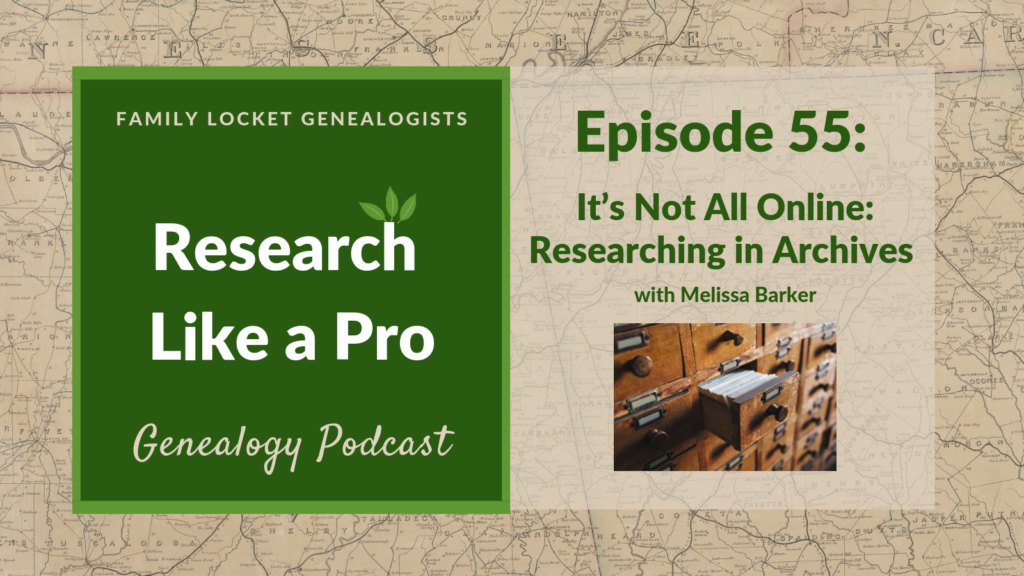
Today’s episode of Research Like a Pro is about finding records in archives. Maybe you have already exhausted all the online records and are ready to find those additional records that haven’t been digitized yet. In repositories like courthouses and archives, you may be able to find unique and relatively unknown records. Join us as we talk with Melissa Barker, the Archive Lady, about how to find records like manuscript collections, voting records, photographs, school records, loose records, and more.
Transcript
Nicole (0s):
This is Research Like a Pro, Episode 55: It’s Not All Online, Researching in Archives with Melissa Barker. Welcome to Research Like a Pro a Genealogy Podcast about taking your research to the next level, hosted by Nicole Dyer and Diana Elder accredited genealogy professional. Diana and Nicole are the mother-daughter team at FamilyLocket.com and the creators of the Amazon bestselling book, Research Like a Pro a Genealogists Guide. I’m Nicole co-host of the podcast join Diana and me as we discuss how to stay organized, make progress in our research and solve difficult cases.
Nicole (41s):
Let’s go. Hi everyone and welcome to the show. I’m Nicole Dyer, co-host of The Research Like a Pro Genealogy Podcast. I’m here with accredited genealogist, Diana Elder. Hi Diana, How are you?
Diana (56s):
I’m Doing well, Thank you.
Nicole (59s):
Today we get to interview Melissa Barker, the Archive Lady, about researching in the archives. But first we have our listener spotlight. Our review today is from Someone In Need on Apple podcasts and the title of the review is, “Binge Listening: I stumbled across this podcast and I’m totally loving it. I have been researching for about 20 years and with every episode I am learning something new. I have purchased the book and enrolled in the e-course.” I thought that was so funny that they named themselves Someone In Need. So, thank you for leaving that review Someone In Need.
Diana (1m 33s):
I love that they’re binge listening. I do that too when I find a podcast I love. I just wanna keep listening and listening. It’s a good way to get my house clean because then I have to just keep doing something while I’m listening. So I am right there with everyone who loves to find podcasts and listen and we’re so glad you’re finding us. So today we are talking about a subject that we are really excited about and that is researching in the archives. And we have a special guest. We have Melissa Barker who is known throughout the genealogy community as the Archive Lady. So welcome Melissa. We’re so excited to have you here today.
Melissa Barker (2m 8s):
I’m excited to be here. Diane and Nicole, Thank you so much for having me.
Diana (2m 12s):
Can we talk first of all about how you came to be known as the Archive Lady and why you’re so passionate about researching in archives?
Melissa Barker (2m 21s):
Sure. I’ve actually been a genealogist for 29 years. In 2004 I took my avid hobby and turned it into a profession and became a professional genealogist. I still do that kind of on the side a little bit for Tennessee and Kentucky research. I don’t get to take as many clients right now as I used to be able to. But in 2010 I was contacted by our local librarian. She explained to me that there were a group of people getting together to clean out the records vault in the courthouse. There was a lady locally, who is a good friend of mine now, she was writing a book about a murder that had happened in downtown Erin is where our major city is in Houston County, Tennessee.
Melissa Barker (3m 2s):
It happened in 1921. She could see the court records on microfilm, but like a lot of us family historians and Genealogists, she wanted to see the actual court records. So she was told to go to the basement of the courthouse and look in the vault. Our courthouse was built in 1956. It was built with a records vault in the basement. At that time that records vault was open for anyone and everyone to walk into and pilfer through. So she went to the vault, opened the door, and the whole place was full. She couldn’t even get into it. It was stacked to the ceiling into the door. So she kind of put out a call into the historical community asking for volunteers to help. She got permission from the county mayor to just clean it out and organize it.
Melissa Barker (3m 44s):
So in August of 2010, there were six of us, including myself, who met at the courthouse and all we were gonna do was clean out and organize the vault. So we started pulling out boxes of very old records. Our county records date back to 1871. We found old Christmas decorations. We found unspent ammunition, but we found all kinds of things in that vault. So it got to be about lunchtime. And we went to lunch and we started talking about we needed an archive in our county and everyone was in agreement that we needed to save our historical records. And so they said we need someone to head this up. And of course everyone sat on their hands, did nothing. And everyone turned to me and said, Melissa, you are the genealogist, you need to head this up.
Melissa Barker (4m 28s):
And I thought, I don’t know anything about working in an archives or being an archivist. So at the age of 42, I went back to school. I went to school and received my certified archives management and started our county archives from scratch. And so a couple of years after starting the county archives as a genealogist, I figured out that being on the other side in the archives was a bit different. And I thought, you know what? People need to know about our archives, not just ours here, but all the small county archives, historical societies, genealogical societies, all of those places that store and preserve records. And so I started the Archive Lady to educate not only genealogy community, but anyone who would listen about records preservation and researching in archives.
Melissa Barker (5m 20s):
Because as a genealogist and even as a professional genealogist, I honestly did not realize the amount of records that were not online, not microfilmed sitting in archives. So that’s what I wanted to do. And so since about 2015 I have been the Archive Lady and I have been trying to educate, teach I lecture, I write, I kind of do it all to educate those about our wonderful archives in the records they hold.
Diana (5m 47s):
Oh wow. That is so great. That’s really fun you started in 2015 ’cause I think that’s when FamilyLocket began too, Is that right Nicole? I think that’s the year we started writing.
Nicole (5m 58s):
Yeah, it was.
Diana (5m 59s):
Yeah. Well I can second your thought there about all the information in archives that we don’t know about because I visited the Utah Archives last summer. I was invited to present there and the director just gave me a sneak peek behind the doors and I saw this room that was about four stories high and they needed forklifts to get everything out. And he said just a fraction of this was digitized. And so that really opened my eyes to the things that are not online. So I’m really excited that you’re going to really help all of our readers understand that no, everything’s not on Ancestry and FamilySearch, that there are other things we can find to solve our family history mysteries.
Nicole (6m 40s):
Yes, that is so true. And I think we do get caught in the idea that almost everything we need is online. There’s not that much else that we need. Once we start digging into those other records, I think we’re just really surprised what we find. So Melissa, you mentioned your website and I just wanted to mention it again for all of our listeners. You can find a link to it in the show notes as well, but it’s called AGenealogistInTheArchives.blogspot.com. So make sure you check that out because Melissa has lots of great articles there. Alright Melissa, so what is considered an archive and what are the different types we might expect to visit?
Melissa Barker (7m 23s):
An archive is any place that collects and preserves historical or genealogical records. And it may not even have the word archive in the name of the place or even on the building. One of the things that I teach genealogists is to ask the question, where are the records? Wherever you find the records, that’s an archive. There’s all kinds of different types of archives. You could be searching in records at a county or a local archive like where I work and where I’m the archivist. There are also state archives. I call those mega archives. Those are at the state level. And believe it or not, many people don’t know that all 50 US states have a state archives and all 50 state archives have a website.
Melissa Barker (8m 7s):
And so they are a true resource. Many our local historical societies and genealogical societies have archives. They actually collect and preserve records. My actual local historical society does not. They are just a group that meets every month and has a speaker. But we’re lucky that we have our county archives. And then places like universities and colleges, many people don’t think about those as having archives. But several of our campuses at our colleges and universities have more than one library, more than one archive, and they collect genealogical and historical records too. And then one of the last ones I would like to talk about that I actually discovered as being an archive rather late are museums.
Melissa Barker (8m 52s):
Many of us go to museums and we walk through and we ooh and awe over the displays and exhibits. But I want you to think about the things that you see that are on displaying on exhibit. You might see an old letter, you might see an old document. Well guess what? That’s not probably the only one. Museums have back rooms like archives with shelves with boxes of more records. So it’s always great to talk to a museum curator, ask them what else they might have.
Diana (9m 20s):
That’s really interesting about museums and that made me think about our little museum where I grew up in Cassia County, Idaho. My grandfather actually had a cabin that he had reassembled, you know, in the mid 1900s and we donated that upon his death to that museum. I am just thinking that I had never even thought that that museum might have other records that could be local, that could have more information about my grandfather. That’s a great idea to see if they have additional letters or documents. And it may not all be on display ’cause they don’t have room for everything to display, right?
Melissa Barker (9m 60s):
Absolutely. I like to say about museums is that they have back rooms and they have front rooms. The front room is where the exhibits displays are and the back rooms are really where they store and they preserve everything that they have. They may not let you actually do research or see some of the stuff in the back rooms, but it never hurts to talk to them and ask them about what else they might have.
Diana (10m 23s):
Wow, okay. So now we need to just figure out where we start. So for someone that is pretty intrigued with this whole idea of searching in an archive, what’s the best way to get started with this?
Melissa Barker (10m 36s):
Best way to get started if you are been doing genealogy for a small amount of time, you’re just getting started or maybe you’re even a feel like you’re a little seasoned at it, but maybe you’re not using archives to the best of what you could ask the question, where are the records? And start as local as you can either at the county level and you can even delve a little bit further and go to the city level, especially in some of our larger counties, larger communities get down and narrow down to what is in the area, what county archive, what historical society, is there a museum, is there a religious denomination archive?
Melissa Barker (11m 16s):
Is there a college you know near there or university? So we wanna get local start local level. There’s Genealogists to do is to contact the chamber of commerce. Ask them about what types of historical groups or archives they might have in the city. If they don’t know, one of the other things that I do is I tell genealogists to ask about who, find out who maybe is the oldest person in the area. You can do that by just calling City Hall, calling the historical society. Some of the elderly people in the community will know about the history, but they will also know where their records are. They may not be able to help you do your research, but they will know, you know, I know those records are stored over in this building or I know this group has these records, because they have probably been born there, have grown up there, have lived there their entire lives and can help you find the records.
Melissa Barker (12m 10s):
So that’s how we need to start is asking the question, where are the records? And then once you find out where the records are, then you can start the actual research.
Nicole (12m 20s):
I love that idea to talk to the oldest people in the area. That’s so wise, just finding the people with the most experience with that region and really picking their brain about where the records could be. Good tip.
Melissa Barker (12m 33s):
Yeah. ’cause you know, sometimes when we go to the house and we walk into the county court clerk’s office or one of the offices in the courthouse and we ask about records, we have to remember they are there to do the day-to-day business of today. And I’m not gonna say all of them are, you know, are in this predicament, but many of them don’t know about old, old records where they’re at, where they’re kept if they have them, they’re busy handling and helping people that walk in their door today. And so I tend to move away from those kind. Granted, there are some that are very knowledgeable and they even have the records in their office, but if you get the answer of, well I just don’t know where those records are, or maybe where they don’t exist anymore, keep delving and asking questions in the community and I bet you you’re gonna find some records.
Nicole (13m 23s):
What a great tip. That makes so much sense that the county clerk, the person who handles the day-to-day things, may not know where the records are. And I think as genealogists calling the clerk or talking to them might seem daunting, but just getting inside of their head and thinking what do they do day to day? And realizing that since this isn’t something they might not think about all the time, cut them some slack and if they don’t know the answer, we can keep looking. Good idea. Then if we look and we talk to a lot of people, but we can’t find the records at the local level, what else can we do? Where else can we look?
Melissa Barker (13m 58s):
If you have, you know, scoured the local level and you’re just, if you’re coming up empty, my next suggestion is to go to what I call the next level. And the next level is what I mentioned a minute ago. State archives, many times our local county governments, our local record holders have transferred those records to the state level. There could be many reasons for this maybe because at the local level they just didn’t have the room for them, they didn’t see the importance of them and so they transferred them to the state archives. This is also a very important point to keep in mind when you encounter an area that has a burned courthouse or record loss or some sort of story of, well those records were destroyed, the courthouse was burned during the Civil War.
Melissa Barker (14m 47s):
Don’t take that as a 100% complete truth. These records could have been transferred to the state archives. Our state archives contain a lot of the local records. And so that’s where I point people when it comes to going to the next level and looking for records.
Diana (15m 6s):
I think that’s really interesting and I love that you said to just keep asking and keep looking because I hear so many people that talk about those burned counties and they just give up. They think that they are stuck, that’s a brick wall that they can never break down. And just realizing that the county courthouse burning is not the end of the world, that those records could be other places is so helpful and gives so much hope to people that we’re afraid that they could never find anything else. So let’s talk about the kind of records that are actually at the archives because I have a feeling that there might be some things that we’d be surprised at that are in the archives.
Melissa Barker (15m 49s):
It’s interesting when it comes to archives and the records that they hold, each and every archive is different. They’re unique in what they hold. I wish I could say that across the board you’re gonna find these particular records at an archive, but you really need to investigate each and every archive wherever you’re doing research because they’re gonna hold different things. And because it’s based on what was saved, also it’s based on who’s donated, what many archives have have been donated records, things that have been found in an old barn or found in grandma’s attic and have been donated. One of my favorite collections of records to not only do research in but to also process as an archivist are manuscript collections.
Melissa Barker (16m 33s):
Now when genealogists hear manuscript collections, they kind of get intimidated and they’re not sure how to handle these collections, but I’m telling you to me, they are on the top of my list when I do genealogy research. So I explained manuscript collections to genealogists this way: imagine in your mind all of the genealogy records that you have in your possession as you’ve been doing your genealogy research. Think about the documents and the photographs and the diaries, scrapbooks, femera, artifacts, anything. And you take all of that and put it in boxes. And then you take those boxes and put them in the trunk of your car and you drive down to the local archive and you hand them over. That is a manuscript collection.
Melissa Barker (17m 14s):
So you think about what could be in manuscript collections and it’s literally anything, these are fantastic records, but when you’re working with management collections, you wanna get a hold of the finding aid to a collection that is the box by box, folder by folder description of what is in the collection. And that’s gonna help you determine if there is something in a particular collection that you want to delve into. So manuscript collections are very important. Vertical files are also a type of record in archives that I find Genealogists either don’t know about or they are a little intimidated by. I describe vertical files as kind of like a hodgepodge of records. It’s kind of like what Forrest Gump said, it’s like a box of chocolates you never know what you’re going to get.
Melissa Barker (18m 1s):
So vertical files are usually housed in the archives, in filing cabinets, in file folders. They’re usually separated out by subject name or surname. And there should be an index that the archivist can give to you before you decide what it is that you want to look for and, and they contain just about anything. I have people that walk into my archive with a couple of newspaper clippings, a family group sheet and a photograph, and they say, do you want this? And of course we’ll take it. And usually they end up in the vertical files. But some other things you can find in an archive are things like scrapbooks. I absolutely love scrapbooks. I’ve been known to travel miles to go look at scrapbooks. They are unique, one of a kind types of records that literally anything can be found in them.
Melissa Barker (18m 47s):
You can find voting records, photographs. Many of our archives have photograph collections, but one of the collections I would really encourage you to look for are loose records. Loose records are a gold mine. Many of us do research in what are called bound volumes, bound volumes of marriage records, bound volumes of court, minute books, things like that. Many genealogists don’t realize that there are loose records associated with these bound volumes. So what are loose records? It’s literally loose papers. They come in packets or sometimes they’re called like in the probate, they, they’re called probate case packets. These are what I call the accompanying documents or working papers of a court case of a probate.
Melissa Barker (19m 34s):
And they are archived separately, of course from the bound volumes. So when you’re doing research, you find a last willing testament in a bound volume ask the archivist, do you have any loose probate records that go along with this? And you might be surprised what you find.
Diana (19m 52s):
That’s really interesting. So when people walk into your archive, you’ll take just about anything. Is that correct?
Melissa Barker (19m 59s):
You know, in my archive I can say yes. In many other archives that they have to curtail what they take. They have certain regulations that they follow, what they take, what they won’t take, because of room. You know, we don’t have infinite room to store things, but in my case, I live in a county where I am the only place that records are being stored and preserved. We do not have a museum, we do not have a historical society that actively collects records. So I’m it. And so when someone walks into my door, I’m pretty sure gonna say yes no matter what it is. And a case in point, this really puts an exclamation point on you as genealogists finding homes for your records when you’re no longer here.
Melissa Barker (20m 43s):
I had two ladies walk into my archive and they were carrying two big boxes full of three ring binders. They were sisters and they proceeded to tell me that their mother was at the moment at the nursing home and they were cleaning out her house and they said, we are on our way to the landfill to throw these boxes away, but someone told us to come by here and ask you if maybe you would like to have it. So I looked in the boxes and what I found were about 23 ring binders and this was this woman’s 50 years of genealogy research and her daughters were on the way to throw it away. So when I got to looking at this and some of the surnames and things, I thought none of this has anything to do with my area.
Melissa Barker (21m 27s):
But I knew if I let those boxes walk out the door where they were going. And so I took the boxes and I said, yes, we’ll take it. And so, and then we started the process of trying to find an archive where they belonged. And so archives do that. But it’s very important to realize that archives hold lots of different records and they hold, each archive is different in what they have. So that’s why it’s important as genealogists to investigate each and every archive. Don’t think, well they’re not gonna have this ’cause this archive didn’t have it. We all have something different.
Diana (22m 3s):
Lots of food for thought here. So I am just thinking of some of those different record types that you talked about that you have. And I agree that those terms, manuscript collections and vertical files can sound kind of intimidating to genealogists, but the way you’ve explained it makes so much sense. They’re just collections of things and we’ve got to try to figure out, you know, where our family’s collections could be. So this is also making me think that even though our family perhaps lived in a certain county, the collections for them may not be in that county if the genealogists in the family live somewhere else and donated them to a different archive.
Diana (22m 44s):
Have you seen that happen where things don’t end up where you think they might?
Melissa Barker (22m 48s):
Absolutely. And you know, and it can be difficult, you know, I, I understand it can be very difficult for genealogists to locate some of those records, but you have to follow the timeline. You have to pay attention to where your ancestors not only lived, but where they went to school, who they interacted with, who they supported, like for if they sent money to help with the school or to donate money to other organizations. And the reason I say this is because sometimes you might find your ancestors records at their alma mater, maybe they donated their papers as they’re called to their university where they went to school, maybe, you know, they ended up with a family member like these two sisters that came into my archive.
Melissa Barker (23m 35s):
And the family member doesn’t live anywhere near where the family was established. And so they’re given to a local state archives, they’re given to a local university or a local county archive. So it’s important to follow where they went, who they interacted with and what were their interests, what was your ancestors’ interests. And you might just find the records there. One of the things too, and many of us know about the neighbors and the associates and people that your ancestor interacted with and maybe your ancestor was mentioned in some of their records. And I’m reminded of a ‘Who Do You Think You Are?’ episode with Tim McGraw, the country music singer.
Melissa Barker (24m 17s):
They found his ancestor in George Washington’s diary because he was George Washington’s neighbor and he was only mentioned once in the diary because George Washington’s so famous and they have, you know, transcribed everything that he ever did. That’s where they found him was in the diary. And so that’s what I try to teach genealogists. We have to think outside the box, we have to look at records that we don’t realize that we, our ancestors are gonna be in there. And they are, it makes it harder and it’s a little more tedious. But when you get to the point that I have in some of my ancestors where you have really searched everywhere or you feel like you have, you kind of have to take that radar and make it go out a little bit further and and look for further places where your ancestors could be mentioned.
Nicole (24m 60s):
Wow, that is so cool. I love that story. So one of the questions that I have is, it seems like archives and things don’t always give everyone access to all of their records. So why are some of the records behind closed doors and is there a secret to be able to access them?
Melissa Barker (25m 17s):
A lot of times they’re behind closed doors for good reason. Believe it or not, there are people out there that are trying to steal documents and to take things from our archives because some of our documents are worth money, especially if they have certain people’s signatures on them. And so they are behind closed doors. That’s why it’s difficult when I talk to genealogists, I say, I talk about manuscript collections, vertical files, and they say, well I don’t ever see that. That’s because they’re behind closed doors. So get to know the archivist, get to know the museum curator, get to know the historical society members. Do that by email. Do that, you know in person, get to know them. Let them know that you’re serious about your research.
Melissa Barker (25m 58s):
Let them know what you’re looking for. You know, don’t ask for everything for the Smith family, but be real specific with your request of what you’re looking for. And you know, ask them specific questions like I’ve been talking about specific types of sources and record collections. If you use the terminology like manuscript collection, vertical files, loose papers, things like that, the archivists will pick up on that and they will realize that you’re serious, that you know what you’re talking about and they will be there to help you. Archivists, we want to help, we have to know what you’re looking for, but remember that we’re working with you and we’re working with probably 10 other people that are either in the building at the time, sending emails on the phone.
Melissa Barker (26m 43s):
And so our time is precious, but we are there to help you. Maybe we can’t help you on the day you’re there or the day that you actually call or email, but we will get back with you. And so not seeing them in the research room where you’re sitting and doing your research, not seeing the records doesn’t mean that they’re not there. Believe me, they are there. And so, like I said, strike that up, the conversation with the archivist. Don’t be afraid to talk to them about what you’re looking for. Ask them maybe for a tour of their back stacks, the back room, you may not always get it, but you know, talk to them and ask them for a tour. Call ahead and maybe even make an appointment for the tour.
Melissa Barker (27m 25s):
I actually, even though I’m an archivist, I did this recently, we were going to be vacationing in Fort Worth, Texas and there is a US National Archives satellite office in Fort Worth. So I contacted them and I said, Hey, I would love to take a tour facility and they did grant me a little more of a professional courtesy because I am an archivist, but I was able to go behind closed doors and look at their facility, the records and the giant, giant rooms that they have of records. So call ahead and make an appointment and do a tour of the facility because if you do that, the archivist will be more relaxed and you’ll get to see some things that you didn’t know that they had and then you can start doing research in those records.
Diana (28m 11s):
Really great advice. And I think it is seeing a visual of the back, you know, what’s behind the doors really opens your eyes. I know it did me when I was privileged to see the Utah archives and I will just second that about the archivists who are so incredibly helpful. I have been to so many different archives and repositories where people have just bent over backwards. People like you, you know, to see what I needed and to help me out. I think it’s one of the really fulfilling things of being a genealogist or family historian is working with other people like this that also love digging into the past. And it’s so fun to make those connections with people.
Diana (28m 51s):
So let’s kind of switch from the onsite archives and talk about online archives. Things that we can actually do from our home computers, because a lot of us don’t live in the area where we’re researching. Like here I am in Utah and I am researching in Kentucky and Tennessee where you are, or Texas or Alabama. And you know, I, I don’t necessarily have time to go to the archive tomorrow or the ability to do that, but I still wanna get some research done. So what can we do online? Is there anything we can do?
Melissa Barker (29m 24s):
I am not able to travel either because I work full time and my ancestors are from Ohio and West Virginia and up north. So over the last 29 years I have written a lot of emails. I’ve actually written a lot of regular letters and put them in envelopes, put a stamp on it, then put it in the mail. But I can tell you that to this day and time, many of our archives are well versed in receiving emails and phone calls, go to their website, see if they have a website. One of the things about our archives today that many genealogists do not realize is that we have to work for our funding each and every year that we get from either our local county governments, the state or federal governments.
Melissa Barker (30m 9s):
In order to do that, we keep statistics. How many people have visited our facility? How many people have called requested records, how many have emailed and things like that. How many have visited our website? And so we keep the statistics to show the people who are funding us that our archives are being used. And so going to their website see that they have one and many of them do now and they’re also putting up indexes of their records and a lot of their archives are actually starting to digitize some of their records. And a lot of ’em are starting with their photograph collections because it’s something visual that people will see and attract them. My husband says that when it comes to computers, I’m click happy.
Melissa Barker (30m 51s):
But I give everyone permission that when you get on an archives website to be click happy because for some reason archives don’t make it that easy to find things on their website. I’m not sure why that is. Maybe it’s because we’re, you know, so used to working with actual papers or something, but get click, happy, click on everything. It’s usually these archives websites are kind of like an onion. You’re going to have to peel the layers away to get down to where you’re actually finding the records, the digitized records or finding and finding aids to help you. So the, the websites are great. Many of our archives now are being represented in social media.
Melissa Barker (31m 32s):
They have Facebook pages, Twitter accounts, flicker accounts, Instagram accounts, and they’re sharing their documents and photographs on there to attract researchers.
Diana (31m 44s):
Wow. I had no idea that we could help support archives by doing that, by emailing and calling and clicking.
Melissa Barker (31m 52s):
Absolutely. You know, I was mentioning, you know, I have not traveled but maybe once or twice to the homeland where my ancestors are from in Ohio, West Virginia. I have been able successfully to do much of my research from Tennessee. That’s because I’ve been diligent in searching websites. I’ve been diligent in contacting archivists, librarians and historical society members and, and you know, starting a relationship with them, with communication and talking with them about what they have. Can they help me? Things like that. And I’ll tell you something else that archivists do that many genealogists may not realize unless it’s happened to you, is that when a, a researcher comes into my archives and they have spent a few hours, maybe even a day with me and I get to know them, I usually ask them to tell me the surnames that they’re researching if I don’t already know, they haven’t already told me.
Melissa Barker (32m 43s):
And we keep a list and sometimes it just stays in my brain of those surnames and the people that have been there. And as we are processing records, a name will usually jump off the page at me and I’ll say, wait a minute, there was someone just here that was doing research on this surname. I’ll go look for them. And I’ve been known to contact them by email or phone and say, Hey, we just run across these records, are you interested? So that’s why it’s important to, to start a relationship with those that are operating our archives, you know, because once they get to know you and they get to know, especially if you have a family, I have a family that was in a particular county in Ohio that stayed there for well over a hundred years.
Melissa Barker (33m 25s):
And so the records there are very, very big. And so I work with them a lot and they’ve gotten to know me and so now it’s almost to the point now where they’re calling me or emailing me to tell me about records that they’ve just gotten or they’ve just processed instead of the other way around. Which is wonderful.
Diana (33m 45s):
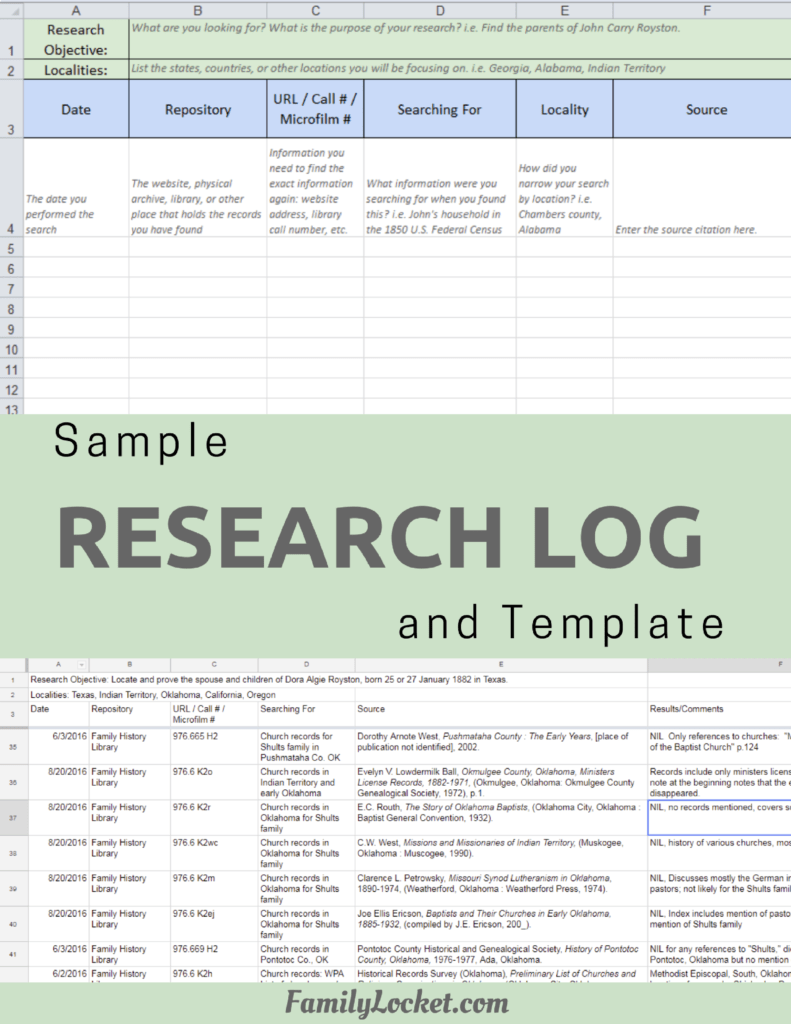
Wow, that is so neat. Well, I just had a thought here as we’ve been discussing this whole idea of archives and contacting them that it’s really, really important for us to log in our research log when we have made these contacts. Because if we don’t write it down, I, I mean other people might be better with their memories than me, but if I don’t take note of the date and the specific archive, you know, the address, the phone number, the name of the person, I’m onto a different project and I’ve completely forgotten, you know what I did. And so I just wanna put a plug into making sure we’re keeping that information in our research log and putting this in our research plans to do archive research.
Diana (34m 27s):
It’s, we’ve gotta actually think about it, make a plan for it. It’s not gonna happen unless we put some effort into searching archives.
Melissa Barker (34m 35s):
And that’s a very good point. And even in my own research, I keep a correspondence log where I write down, you know, who I contacted their contact, how I contacted them, whether it was email or phone, what I requested. And I keep that in the front of my folder and if I go back and I look, wait a minute, I haven’t heard from them in a couple of weeks or so, I contact them again because, you know, as arch, as an archivist, I know we get busy working with so many different people, we may not get back to the researcher in a timely manner. It’s okay to drop us another email, pick up the phone again and say, Hey, you know, do you remember I asked about this? Or whatever. And so then maybe that will remind them that, oh yes, I need to do it for that.
Melissa Barker (35m 16s):
So it happens, but it’s always good to do a gentle reminder.
Diana (35m 20s):
Well thanks for giving us permission to ask again, because sometimes I don’t wanna bug people. So I’m a little leery of the repeated asking, but you just gave me permission to keep bugging people about these things.
Melissa Barker (35m 30s):
Absolutely. ’cause I do it and I’m an archivist, so it’s okay.
Nicole (35m 34s):
Oh well this was such a fun episode, Melissa. I really love all the things that I learned from you. Is there any word of wisdom that you want to leave us with today?
Melissa Barker (35m 44s):
The word of wisdom I would leave with all researchers and genealogists is to not give up. But I know how many of you know Russ Worthington, cousin Russ, but he always says he doesn’t have any brick walls. And so I had brick walls for a lot of years until I met him. And now I don’t have brick walls, I have challenges. And so I tell people all the time, don’t give up because there are records constantly being donated to all of our many archives. There are still things being found in attics and basements and old buildings and and family papers that once they’re donated and processed in an archive, they become available to researchers. And that could be where your answer is or something is digitized and put online and there’s your answer or something to help you.
Melissa Barker (36m 32s):
But don’t give up, continue to search.
Nicole (36m 35s):
Great advice. I think I love a challenge. So telling myself that I have a brick wall is kind of a, a motivator. But I like the idea that we should just, you know, consider it a challenge and not give up. I think you’re right that a lot of times if we think a problem is not solvable, we will just give up. But I think you’re right that, that there are so many records becoming available as time goes on that we should always revisit those difficult challenges. Great advice. Thank you so much.
Melissa Barker (37m 4s):
Oh, Thank you so much for having me. It is just been, I love talking about archives and so this has been wonderful.
Nicole (37m 12s):
Alright, everyone, thanks for listening today and we will talk to you guys again next week.
Diana (37m 20s):
All right, bye-bye everyone.
Melissa Barker (37m 21s):
Thank you. Bye-bye.
Nicole (37m 49s):
Thank you for listening to Research Like a Pro with Diana Elder, accredited genealogy professional and Nicole Dyer. We hope that something you heard today will help you make progress in your own genealogy research. If you like what you heard, please leave us a review on iTunes or Stitcher or visit our website, FamilyLocket.com to contact us. You can find our book Research Like a Pro a Genealogist’s Guide on Amazon.com and other booksellers. We hope you’ll start now to Research Like a Pro.
Links
A Genealogist in the Archives Blog
http://agenealogistinthearchives.blogspot.com/
Melissa Barker’s Legacy Family Tree Webinar Presenter Page for Webinar and QuickGuides
https://familytreewebinars.com/melissabarker
The Archive Lady on Facebook
https://www.facebook.com/TheArchiveLady/
Melissa Barker on Twitter
https://twitter.com/TNArchivist
Melissa Barker, Certified Archives Manager and Professional Genealogist
Specializing in Tennessee and Kentucky Research and Takes Clients
E-Mail: melissabarker20@hotmail.com
Study Group – more information and email list
Research Like a Pro: A Genealogist’s Guide by Diana Elder with Nicole Dyer on Amazon.com
Thank you
Thanks for listening! We hope that you will share your thoughts about our podcast and help us out by doing the following:
Share an honest review on iTunes or Stitcher. You can easily write a review with Stitcher, without creating an account. Just scroll to the bottom of the page and click “write a review.” You simply provide a nickname and an email address that will not be published. We value your feedback and your ratings really help this podcast reach others. If you leave a review, we will read it on the podcast and answer any questions that you bring up in your review. Thank you!
Leave a comment in the comment or question in the comment section below.
Share the episode on Twitter, Facebook, or Pinterest.
Subscribe on iTunes, Stitcher, Google Play, or your favorite podcast app.
Sign up for our newsletter to receive notifications of new episodes.
Check out this list of genealogy podcasts from Feedspot: Top 20 Genealogy Podcasts


Leave a Reply
Thanks for the note!