
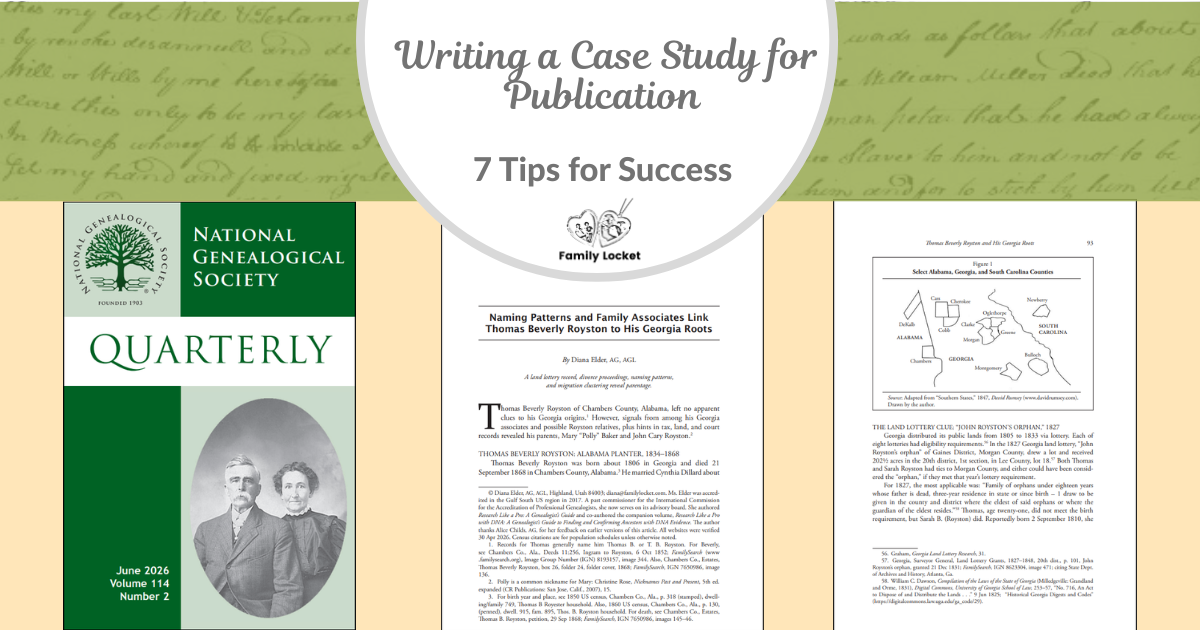
One of the best ways to share your research is by writing a case study for publication in a genealogy journal. If it is a peer-reviewed journal, you also benefit from knowing that your research is sound. I recently published my first article in the National Genealogical Society Quarterly (NGSQ) and will share my experience and tips for anyone else interested in publishing.
What is a Case Study?
Your first question may be, what exactly is a case study? How does it differ from a research report, a proof argument, a genealogy, or an ancestor profile that you may write? First, let’s briefly define each of those terms.
A research report discusses a specific research phase with a focused objective. Several research reports may eventually provide enough material to use in a case study.
A proof argument is similar to a case study in that you’re presenting completed research. The research question could not be answered with direct evidence, but rather, needed conflict resolution and correlation of indirect evidence. A case study will often mirror a proof argument in this sense.
A genealogy provides a succinct listing of an ancestor and their descendants, with sources attached as footnotes. There may not be any correlation of indirect evidence or conflict resolution.
An ancestor profile could also be called a history, narrative, etc. This type of writing tells an ancestor’s story using source citations and historical context. Correlation of evidence and conflict resolution are still needed, but the focus is often more about bringing in the interesting contextual details that bring the story to life.
A case study leads the reader through the methodology that was used to solve a specific genealogical problem. The case study is built around a research question – usually of identity or relationship. Only relevant evidence is presented – clearly and concisely.
What all forms of sound genealogical writing have in common is documentation. Each statement is backed with a source citation, and the footnotes may include as much text as the narrative in providing details about the source.
The Value of Studying a Case Study
The first time I read a case study in the NGSQ, I was unprepared for the amount of information provided in just one paragraph. I had never read anything like it and was expecting more of a story. Now, after reading many case studies and writing one of my own, I appreciate the sheer amount of research that is covered in just a few pages.
For most of us, we have many brick wall ancestors who have been a challenge to research. Reading a case study with a similar problem may unlock some research paths forward to solving the case. For example, you may grapple with record loss, merged identities, name changes, and more. Each NGSQ case study is selected specifically because it solves a difficult research conundrum.
In genealogy, we don’t know what we don’t know. A well-researched case study can open our eyes to new sources and repositories for our research location. Seeing how another genealogist solved a migration problem from Virginia to Tennessee would help us in our own research. Many journals now have online archives of past articles that you can peruse for case studies similar to your research problem.
Where to Find Case Studies
Genealogy societies have been publishing journals for decades. Those journals will hold genealogies, abstracts, and often a case study in the journal’s focus. Here are five to know about:
- National Genealogical Society Quarterly (NGSQ) — One of the premier U.S. genealogy journals, especially valuable for methodology, proof arguments, case studies, and solving difficult identity problems. Published since 1912.
NGSQ – National Genealogical Society - The New England Historical and Genealogical Register — Published since 1847, making it the oldest major genealogical journal in the United States. Particularly strong for colonial New England, immigrant origins, and documented multi-generation genealogies.
The Register – American Ancestors - The American Genealogist (TAG) — Founded in 1922 and famous for meticulously documented solutions to difficult genealogical problems. Particularly strong for early American and colonial genealogy. Publication resumed in 2025.
The American Genealogist - The New York Genealogical and Biographical Record — Published since 1870 and one of the principal peer-reviewed genealogy journals in the U.S. Essential for New York families, but also an excellent model for scholarly genealogical writing.
NYG&B Record - The Genealogist — American Society of Genealogists — A highly prestigious scholarly journal specializing in compiled genealogies, difficult proof problems, and lengthy in-depth studies. Published by the American Society of Genealogists.
The Genealogist – ASG
Regional journals also may provide case studies and are excellent for studying a specific region’s methodology and sources. Here is a sampling:
- Magazine of Virginia Genealogy — Virginia
Published quarterly by the Virginia Genealogical Society. Particularly strong for pre-1850 Virginia, burned-county problems, migrations, unpublished records, and documented family reconstructions.
Magazine of Virginia Genealogy – Virginia Genealogical Society - North Carolina Genealogical Society Journal — North Carolina
Published since 1975. Contains genealogical studies as well as abstracts and transcriptions of otherwise difficult-to-access North Carolina records.
North Carolina Genealogical Society Journal - The Maine Genealogist — Maine
A scholarly quarterly from the Maine Genealogical Society. Especially good for proof problems involving Maine families, hard-to-find records, methodology, and connections between Maine and neighboring New England/Canadian families.
The Maine Genealogist – Maine Genealogical Society - The Connecticut Nutmegger — Connecticut
Published by the Connecticut Society of Genealogists. A long-running source for Connecticut families, genealogical case studies, source material, and compiled research.
The Connecticut Nutmegger - Ohio Genealogical Society Quarterly — Ohio
Particularly valuable for Ohio pioneer families, church records, Bible records, military material, cemeteries, courts, newspapers, and family histories. Its predecessor began publication in 1961; the OGSQ title dates from 2003.
Ohio Genealogical Society Quarterly
Additionally, Elizabeth Shown Mills has posted many of her case studies on her website, Historic Pathways. The Board for Certification of Genealogists website also has several case studies posted from submitted portfolios.
Writing the Case Study
Writing my case study was invaluable on many levels. I started researching the Royston family early in my foray into genealogy – likely because the surname was less common than others on my family tree like Harris or Welch. I used the Royston family for my 4-generation Accreditation project in 2015. I assembled enough evidence in that report to prove the parents of Thomas Beverly Royston (1806-1868) were Mary “Polly” Baker Cessna Royston and John Cary Royston. However, the research was presented in a report format, and a case study would require a different treatment of the material.
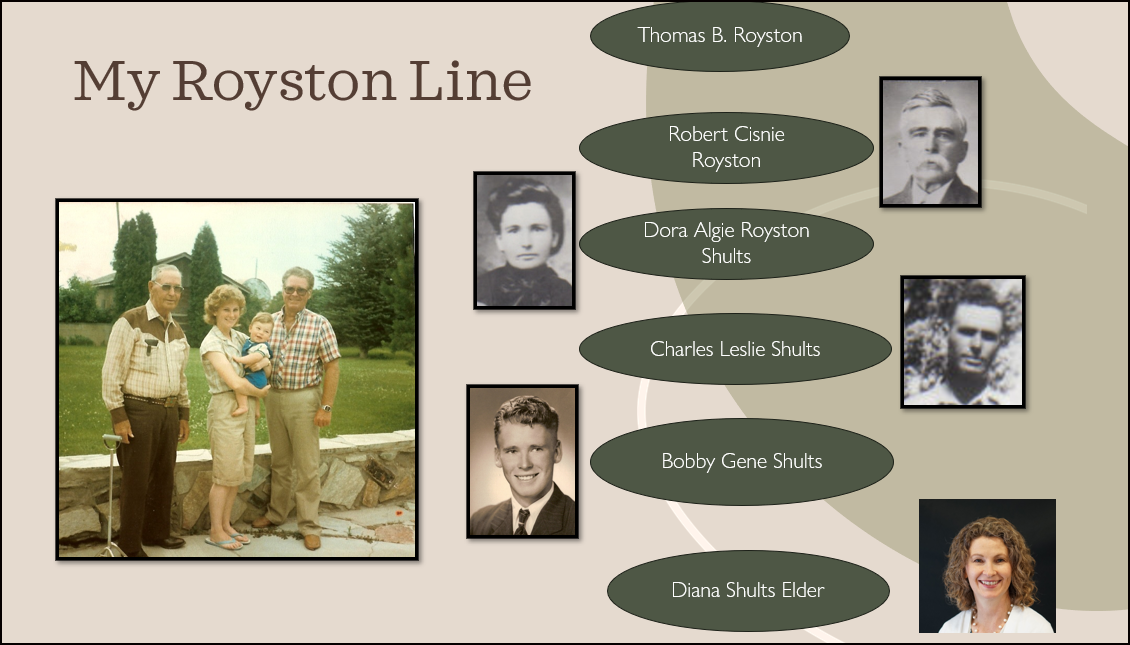
My 4-Generation Project started with Dora Algie Royston and moved back on the Royston line.
I chose the NGSQ as my journal of choice for submitting my article because it included interesting record types such as the Georgia land lotteries and included the cluster research methodology, which can be applied in any situation. With its focus on methodology, this seemed like a good fit. Plus, I knew the NGSQ provided rigorous peer review if a case study was accepted.
I started by reviewing the “Guidelines for Writers” found on the NGSQ website. The article provides an excellent overview of what types of articles are a good fit and clearly defines the expectations:
- Use of original records
- Teaching value for readers
- Thorough documentation
The article also provides guidelines for the actual submissions, such as word count, citations, headings, etc.
One of my first actions was to read several NGSQ articles based in the southeast U.S. to see if there were any record groups I had missed in my research in Georgia and Alabama. I also looked at organizing the methodology and enhancements to see how other authors handled maps, tables, etc.
Once I had a handle on what was required and had studied several articles in the research locality for my article, I got started with reviewing the portion of my 4-generation project I wanted to use. I worked to make the writing more concise. Knowing that the source citations needed to be in the NGSQ format, I revisited each of my original sources and revised them using the citations from the most recent articles as examples. Working with my colleague, Alice Childs, who was also working on a case study, was especially helpful. We met monthly to discuss our articles and peer-reviewed each other’s writing. The monthly meeting gave me an incentive to work regularly on the case study.
Peer Review and the Editing Process
 Once I felt like the case study was ready, I submitted it per the guidelines and received an email that the editors would review it to determine if it was ready for peer review. Within a few days, I received an email that my submission had been sent for peer review. Almost five months later, I received critiques from three reviewers who had carefully read the article and provided their expert feedback.
Reviewing the critiques, I found suggestions for additional research, corrections to citations, organization, improved reasoning, and more. I took the next six months to work through the suggestions. The additional research suggestions opened up an entire new locality to research, and I found many more records to shore up the conclusion. I had done the original research using microfilm at the FamilySearch Library. When FamilySearch’s full-text search came out, I had used that as well. However, I had not revisited full-text search, and many more records had been added since my initial review. Those records were very important to the case study!
My case was used for the Advanced Practicum through the Salt Lake Institute of Genealogy, and getting it ready for the students to use was excellent motivation to rework the manuscript. Once that was completed, I did a lot of proofing, then sent the article back to the NGSQ editors. A few weeks later, I received word that the article would be published. I signed the contract, then waited another three months for the editing process to begin. Over the next few weeks, I worked with my editor to clarify writing and research. She encouraged additional research on a couple of points. Although the research had negative results, it helped with the reasonably exhaustive research that needs to go into a case study.
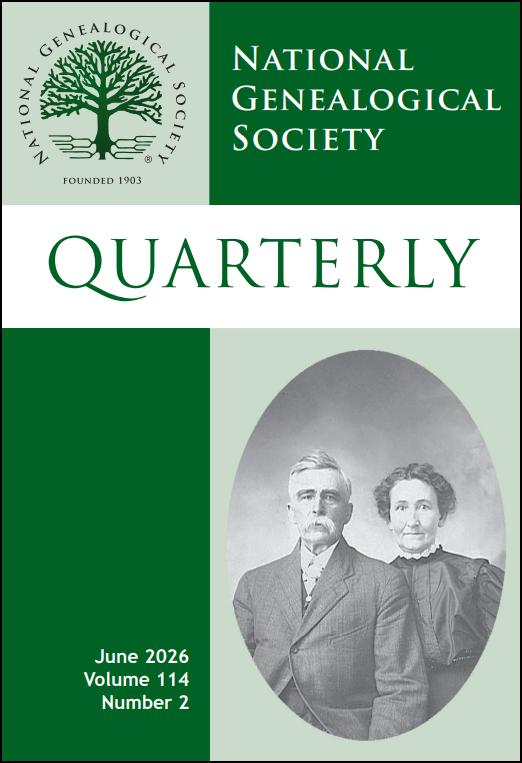
The next step was for the proofreaders to comb through the article looking for anything we had missed. We had indeed missed a few things! I was very grateful for many eyes on the article when my own couldn’t see what was in front of me. My editor asked if I had a photo that could go on the front cover of the journal, and I sent her my photo of Robert C. Royston and Isabella Weatherford. Robert was the son of Thomas B. Royston, the subject of my case study. I also sent a brief biography of the couple’s lives that appears in the “Portraits of the Past” section.
Seeing the final publication both online and in my print copy was so exciting. I learned a great deal from the process and am considering which case study I’d like to work on next. If you’d like to read it, you can find it on the National Genealogical Society website. The title is “Naming Patterns and Family Associates Link Thomas Beverly Royston to His Georgia Roots”
Tips for Publishing a Case Study
- Choose the right journal for your article. Read several articles and consider which would be a good fit based on the locality and methodology.
- Carefully study the guidelines for the journal and strive to meet each one.
- Study the Genealogical Proof Standard (GPS) and consider if you’ve met each requirement.
- Write and edit your writing until you feel confident in your case study.
- Enlist a fellow genealogist(s) to provide peer review before submission. We all need additional sets of eyes on our research and writing.
- Don’t give up! When critiques come back, take your time in reviewing them and incorporating their suggestions.
- Be patient with yourself and consider this a learning opportunity as well as an opportunity to publish your research.
Best of luck in all your genealogical endeavors!







2 Comments
Leave your reply.