
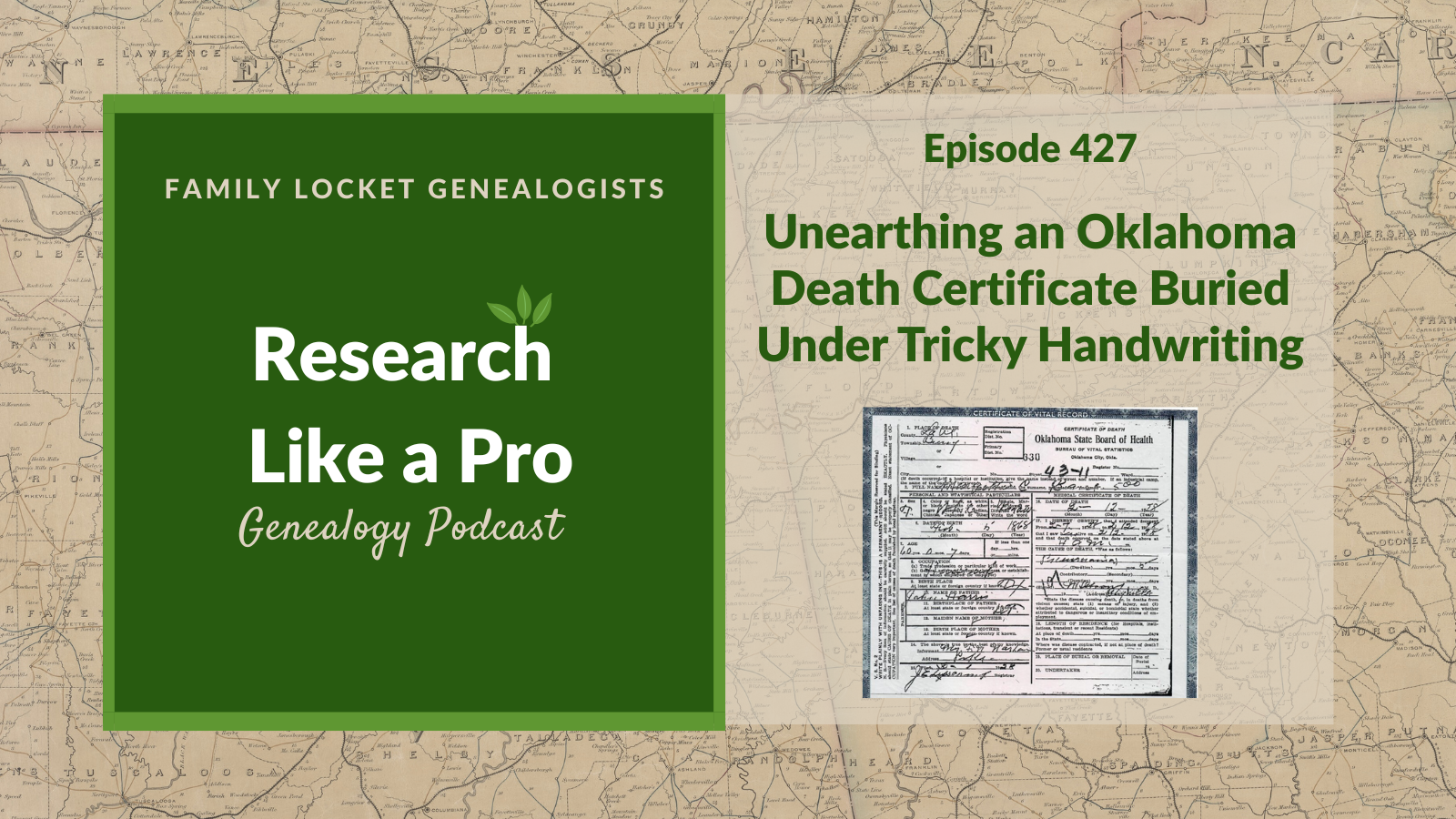
In this episode, Diana and Nicole discuss a challenging search for an Oklahoma death certificate. Nicole shares her experience trying to find the 1928 death record for Margaret Cinderella (Harris) Bone to complete her Kinship Determination Project. Despite knowing Margaret’s birth date, death date, and county, Nicole’s initial searches on the OK2Explore database fail. She explains how she eventually finds the record by removing the name entirely and searching only by gender, county, and the month and year of death. The index lists the name as “Margotte C. Bane” due to an indexing error. Diana and Nicole analyze the physical certificate to show how cramped forms and overlapping cursive handwriting lead to these indexing mistakes.
Listeners learn valuable strategies for overcoming difficult database searches. Nicole and Diana outline several practical lessons, such as reading database search tips and using wildcards like asterisks. They explain why researchers should not assume that databases use phonetic matching. Listeners also learn how to use name-free searches with basic demographic details to bypass transcription errors. Finally, they explain how to analyze date discrepancies between headstones, family Bibles, and official records.
This summary was generated by Google Gemini.
Transcript
Nicole (1s):
This is Research Like a Pro, Episode 427, Unearthing an Oklahoma Death Certificate Buried Under Tricky Handwriting. Welcome to Research Like a Pro a Genealogy Podcast about taking your research to the next level. Hosted by Nicole Dyer and Diana Elder accredited Genealogist professional. Diana and Nicole are the mother daughter team at FamilyLocket dot com and the authors of Research Like a Pro, A Genealogist guide with Robin Wirthlin. They also co-authored the Companion Volume Research Like a Pro with DNA. Join Diana and Nicole as they discuss how to stay organized, make progress in their research, and solve difficult cases. Let’s go.
Nicole (42s):
Today’s episode is sponsored by newspapers.com. Hi everyone. Welcome to Research Like a Pro.
Diana (48s):
Hi Nicole. How are you doing today?
Nicole (50s):
I’m doing well. And How are you doing with the study group? What project are you gonna do?
Diana (54s):
I’m going to do a project on Mary Baker.
Nicole (58s):
Oh.
Diana (59s):
She was the wife of John Kerry Royston and the mother of Thomas Beverly Royston. And I haven’t researched her beyond just her time in Georgia, but I have her maiden name and her father’s name from a record there in Georgia, so I wanna trace her back to Virginia and see if I can find more about her origins. So it’ll be fun. Brand new project, brand new research on a subject that I have known about for many, many years. Just have not worked on her family. So I’m kind of excited to do something new and different.
Nicole (1m 28s):
Yeah. How did you discover her maiden name was Baker?
Diana (1m 31s):
Basically it’s a deed, and it says it’s a record that is about her husband, Samuel Cessna, and it’s a Rights in Reversion to a couple of enslaved people that were deeded to her by her father, Robert Baker.
Nicole (1m 52s):
Oh.
Diana (1m 53s):
And so it’s one of those things where she has received property, but now she’s married and there’s all sorts of things that go on legally because a woman’s property was always supposed to become the husband’s at that time. And so they would deed it with special things saying, you know, that this is her property, doesn’t go to her husband.
Nicole (2m 13s):
So it was a trust or something.
Diana (2m 15s):
Called a Right in Reversion. And so it was a tricky record to decipher, and I remember when I was working on it, giving it to a couple of attorney friends and having, they really didn’t know, so I had to figure out what that meant ’cause it was confusing wording for me. So I’m excited to tackle that because we also have the name of her guardian, Thomas Baldwin, and there are Baldwins and Bakers there. So I’m just so curious. There’s a lot of clues there with real names that I can track. So I’m kind of excited to work on that. But I’m just at the objective stage, just chose that as my objective, you know, there’s always all my other family and things I could continue with like Sarah or Cynthia Dillard or Clemsy Cline, any of those lines, but I just decided to take care of Mary Baker, see what I could find.
Nicole (3m 7s):
So is Thomas B Royston named after her guardian, Thomas Baldwin?
Diana (3m 12s):
Well, he’s named Beverly is his middle name.
Nicole (3m 14s):
Oh, that’s not it then.
Diana (3m 16s):
No, but his sister is Sarah Baldwin.
Nicole (3m 20s):
Oh, that’s where I heard it.
Diana (3m 21s):
Okay. And then Baldwin comes into the middle name of one of his children,
Nicole (3m 25s):
Charles Baldwin Royston, who died in the Civil War, I remember researching him.
Diana (3m 28s):
Yeah. Yeah. So Baldwin is, you know, it’s a guardian there, it could be that her mother was a Baldwin.
Nicole (3m 34s):
Yeah, I was wondering if it’s a family, you know, relationship.
Diana (3m 37s):
There’s some connection there.
Nicole (3m 38s):
That’s cool.
Diana (3m 39s):
So I’ve got Baldwin, Beverly and Bakers.
Nicole (3m 42s):
So we think Mary Baker’s father was Robert Baker, and potentially he was married to Baldwin.
Diana (3m 49s):
That’s what I am thinking. And so I’m excited to go check that out. And there were a lot of Beverlys, that name is very prominent in Virginia. Remember when I was doing the research in Gloucester County on the Roystons, Beverly was, yeah, there’s just like the Roystons there was a Beverly who received a lot of land and was prominent there in the area. So there’s all sorts of things to think about with this case.
Nicole (4m 16s):
Well, you have a lot of leads, a lot of clues that will be great for full text research. I think this is gonna be really neat.
Diana (4m 22s):
Yes. And I honestly, I have not even studied Green County and Oglethorpe County, Georgia for those surnames. I’ve seen a popup here and there, but I’ve never really identified the guardian, Thomas Baldwin. I haven’t identified any of the other Bakers there. So the research might start right there in Georgia, which of course that’s where we always start, where we know they were to look up other records and see if I can get a real handle on these people that are mentioned with her.
Nicole (4m 50s):
Yeah.
Diana (4m 51s):
And then start moving back. So anyway, it’ll be fun. I’m excited.
Nicole (4m 55s):
Well that’s a great choice for your research project and it’s going to be all documentary, or DNA, too?
Diana (5m 0s):
Documentary.
Nicole (5m 1s):
It’s always a good way to start a new project, just get a good documentary foundation.
Diana (5m 5s):
Yes. And I do have a lot of DNA matches going back to the Royston kind of that line, the Royston-Baker. And so it’ll be fun to put DNA with that in later project.
Nicole (5m 18s):
Wow. That will be. Well let’s talk about our announcements today. In our Research Like a Pro Webinar Series, we will have the next lecture on Saturday, September 19th from Jill Nock, an accredited Genealogist on our team here at FamilyLocket. And it’s titled, Wanted: Burt Beckett Solving Identity through DNA and Records. And this is about how family stories can be our best leads, but how much truth do they have? This will follow the case of “Bert Fred Beckett”, a supposed outlaw who rode with the Jesse James gang and later changed his name. Strategic DNA analysis combined with traditional records cracked a century-old identity mystery.
Nicole (6m 0s):
So this will be fun, and it will cover Missouri, Oklahoma, Ancestry, censuses, death certificates, marriage records, court records, the Leeds Method, and AncestryDNA. The next study group will be the DNA study group beginning in February, so if you’d like to join us for Research Like a Pro with DNA, get ready to register for that beginning in December. Be sure to join our newsletter that comes out every Monday to get updates about any new content that we have coming out, any sales, and any new courses we’re launching for our upcoming courses. We’re still looking forward to the Association of Professional Genealogists Professional Management Conference, PMC, on October 14th through the 17th. And that’ll be fun.
Nicole (6m 41s):
We’re both, it’s a virtual conference this year, sometimes this conference is in person, we’ve gone to it in Salt Lake City before, but this year it is virtual. So that really makes it nice for anybody who wants to log in and watch. And we’re gonna both be doing one panel and one class. My class is actually a workshop. So our panels are about teaching genealogy classes and courses and podcasting. And then mom is teaching about managing client projects with Google Sheets and Airtable. And I’m talking about using Airtable to do smarter transcription and research logging. So that’ll be my workshop. And those are virtual, again. So like I said, it should be easy for anyone who wants to, to come to this conference this year.
Nicole (7m 22s):
You don’t have to pay for lodging, you don’t have to get a flight, you can just go online. So mom, did you know that we just opened up the website and information to register for our Institute course to learn about how to better merge and separate identities ?
Diana (7m 37s):
Oh, that’s exciting. I knew it was coming up and it’s great to have it scheduled.
Nicole (7m 42s):
Agreed. And it sold out last year, so we wanted our podcast listeners to hear about it early so they would have the chance to check it out.
Diana (7m 48s):
So for anyone wanting to find out more about it, you can go to FamilyLocket, the website, and click on the shop and the navigation tab with a dropdown list and click on Institute courses, and you’ll see it and you can click through to read the overview as well as each session’s description.
Nicole (8m 7s):
Yeah, we’re excited to do Merging and Separating Identities again in the Research Like a Pro Institute. It was so successful last time and it’s just such a unique, helpful course for anyone doing intermediate to advanced genealogy research and encountering all these people of the same name or whatever your identity case is.
Diana (8m 28s):
Right. I sat in on several of the sessions, especially at the beginning, and I had a project I was working on with my John Cline and then I ran out of time. So I’m gonna pick that back up and see if I can make some more progress on that.
Nicole (8m 42s):
Perfect.
Diana (8m 42s):
So it’ll be fun. I’m excited about that.
Nicole (8m 45s):
Hey.
Diana (8m 45s):
Well let’s get to our topic. About a year and a half ago while working on her kinship determination project for the Board for Certification of Genealogists, Nicole needed a death certificate for a sister of our ancestor who was the subject of the middle generation of the study. So we knew her name, we’d known her name for so long, and we knew when she died, and the county, and you know, sometimes you just, it’s difficult to find those death certificates. So what was exciting was that an index just completely obscured this person’s identity who we thought was already pinned down.
Diana (9m 27s):
So this is all about Margaret Cinderella Harris Bone, and she’s a sister of our ancestor, Dock Harris. And this is a reminder that indexes are made by humans and humans make mistakes.
Nicole (9m 45s):
Yeah, that’s so funny that, that you said it’s exciting that the index obscured her. But it was exciting because we found her, I mean I found her eventually. So it was like exciting that there was an index, but then you just have to know how to search the index. And so we’ll, we’ll go through all of the different things I learned from this experience.
Diana (10m 5s):
It was mostly exciting that you actually figured it out, let’s put it that way.
Nicole (10m 9s):
Okay. I found the death certificate. Well, I was confident about the basics. So Margaret Cinderella Bone was born on February 5th in 1868 because, I love the Harris family because they have a Bible. Their family Bible is just such a precious piece of evidence, multiple pieces of evidence. I mean it has the births and some of the deaths, some of the marriages. And it has full names and full birth dates. So it’s really, really cool. So that birthday was from the family Bible, and she died in Love County, Oklahoma on February 11th, 1928 according to her headstone.
Nicole (10m 50s):
And I’ve been to the cemetery where her headstone is. So, and I have clear pictures of it and everything. So that’s clearly what it says on her headstone. So her maiden name is Harris, so Margaret Cinderella Harris, and her married name is Bone. And actually on her headstone it just reads M C Bone. But I had like a map drawn by one of her grandchildren that showed exactly where she was buried in relation to her father, which his headstone is now illegible and broken and like half buried, but I know where it is thanks to the map. Anyway, that was a tangent. So I had her full name, I had her birthdate, I had her death date, I know the county she died, I expected the index search to be straightforward, and it really just wasn’t.
Nicole (11m 34s):
And so it was frustrating at first.
Diana (11m 38s):
Yes, it is. When the indexes says not show you and when you know something should be there. So you were using the OK2Explore Oklahoma State Vital Records Index and there’s a database called Search. Well there’s the index is called Search Death Records and it’s searching their database. And I love that you were trying all the different variations that you could think of, because sometimes these indexes and these searches, you have to be spot on with what you search for. They don’t spread out and and give you all the variations. It’s not in its knowledge apparently or however they program it. So you were trying Margaret Cinderella Bone, Margaret Bone, Margaret C Bone, M* Bone, because that would take in anybody with a different name, you know, like Mary or Martha, whatever, C Bone, just the surname Bone narrowed to a death year of 1928, and just the death date of 11 February, 1928 with nothing else.
Diana (12m 37s):
Wow. Those are so many good search terms. Good job thinking of all those. But unfortunately it didn’t work and that index would not find her even when searching by the death date. So you know, good job ordering the death certificates for several of the siblings and you received those. But where was Margaret’s? So gave up for a while, and I think we all do this, we just sometimes have to let it go and then come back later And you just kept thinking there’s a certificate out there, I know there is, it’s in the index, but what did we not, what did I not think to try? And so you came back.
Nicole (13m 16s):
So this time I gave up trying to out guess the spelling of her name and instead I stripped my search down to the bare facts I was certain of. I knew she was a female, so I put in female, I knew the county, and this time I took away the death day and I only searched for the month and the year. This way I was looking for anyone who was a female dying in the county in that month. And since, you know, the death date I had on the headstone was 11 February, I figured, you know, what if it was 21 February or what if it was 12 February, something different and then that would give me the chance to find her.
Nicole (13m 56s):
And so searching for nothing but her gender, county, death month and death year finally turned up the record and it was indexed as Margotte C Bane with the death date of February 12th, rather than February 11th, as her headstone stated. So I was so close when I searched with just the death date.
Diana (14m 21s):
Yes.
Nicole (14m 21s):
But then of course the death date was off by one. And I put in the, the day and and often when we have specifics like that, we want to use them. But it’s often better to just use something more general like February rather than 11 February, or even just 1928, you know, females that died in 1928. And sometimes it’ll come back and the database will say there’s too many results, you need to narrow it more. And so it’s tricky, but, but yeah, I was surprised that there was just like something in every field was a little bit off or little bit different than what was expected. So every time I had searched for Bone, I had, I hadn’t tried any permutations of the surname Bone. And so that was making it really hard for me to find her.
Nicole (15m 3s):
I should have done a B with an asterisk for one of my searches, you know? And so I just didn’t come up until I finally made a broad enough search. Once I looked at the way it was indexed, it made a lot of sense, and it explained why I couldn’t find it earlier. Many online indexes use some form of phonetic matching like Sound X or a similar algorithm that’s supposed to catch minor spelling variants like this. But sometimes when you have a state index like this, it’s not very fancy. It doesn’t have, you know, algorithms to help with with phonetic matching. So it just only took what exactly what you put in and it wanted something much closer to an exact string match.
Nicole (15m 46s):
And Bane was just different enough from Bone that none of my searches ever crossed paths with it.
Diana (15m 51s):
Oh my goodness. So interesting.
Nicole (15m 54s):
But looking at the search tips on the search page now with 2020 hindsight, I realized that I could have found this with a simple asterisk search, M* and B* with the year of 1928. This has been such a good lesson to keep trying and to use the search tips that the database provides. I was just in a hurry and thought I knew best and didn’t read the search tips. And this particular site spells it out plainly, only exact matches will be returned and an asterisk can be used as a wild card in any field. So had I read those tips before I started searching, instead of after I’d already found the record, I could have found it sooner.
Nicole (16m 35s):
So it’s a good reminder to always check for any search tips or help links before diving into an index, especially when you haven’t used before or that isn’t working well for you.
Diana (16m 46s):
I love that. And I love this example. This is so interesting and I just had the thought that, would it be helpful if you had put like the search parameters or the search tips, you know, copied and pasted that into an AI model and then given it your information and said, okay, provide me with all the different ways I could search this. I bet AI would do a good job on giving you all the variations.
Nicole (17m 14s):
Right. Or even what’s the most efficient search I could do? Because when I thought about it, you know, when I read the search tips and thought about it, I realized the most efficient search I could have done was M* B* 1928. I know that would’ve brought it out. But that’s not always the case. I mean, you never know. Like she could have been going by Cinderella, and some of her descendants say she went by Callie, like on her Find a Grave memorial. So I was trying to try all different things. But yeah, I think sometimes a broad search that we can then narrow or try different things like giving us an order, like AI could definitely give us some ideas in like what order we can do things in. For me, I think the biggest problem was just a general sense of like, rush.
Nicole (17m 56s):
I didn’t slow down to read.
Diana (17m 58s):
Yeah.
Nicole (17m 58s):
You know, it’s like when you’re in school and the teacher gives you a handout and they you like, hurry start on it and they’re like, no everyone stop. Put your pencils down, read the instructions,
Diana (18m 11s):
And you don’t wanna do that.
Nicole (18m 12s):
Yeah, ’cause you’re ready to get started. You’re so eager you think you know what to do.
Diana (18m 17s):
Oh, so interesting. Well let’s take a break and have a word from our Sponsor. Are you ready to take your family history research beyond names and dates? If so, Newspapers.com is a game-changer for genealogists of all levels. With access to over a billion pages of historical newspapers, you can uncover rich, untold stories about your ancestors that you won’t find anywhere else. Imagine discovering a detailed obituary that reveals the extended family, or a local news story that highlights your great-grandmother’s role in the community. Maybe you’ll come across a photo capturing a moment in your ancestor’s life—something that brings their story vividly to life. Newspapers captured the everyday details—announcements, happenings, achievements, and challenges—that paint a fuller picture of who your ancestors were and what their world was like.
Diana (19m 4s):
These primary sources reveal the social history behind the names on your family tree and help you connect with your past in a personal, meaningful way. Searching is simple and intuitive, letting you explore by name, location, or date to unearth those hidden gems. Ready to enrich your research with stories you won’t find in traditional records? Visit Newspapers.com/FamilyLocket today and get 20% off a subscription. Start turning your family tree into a family story.
Nicole (19m 30s):
Well I ordered the death certificate right away for Margotte C. Bane and it arrived in December, just in time. I was able to incorporate it into my KDP, the Kinship Determination Project for my certification portfolio, before turning the project in on the last possible minute. The deadline for the pilot program on December 31st, 2024. And it wasn’t even the last thing I received. There was something I received on that day, I think that I incorporated. It’s just funny how like as you get into the research, you realize there’s records you still need to order. You know, I thought I had everything, but then, oh I don’t have that. Oh no. Like I need to get this in one week.
Nicole (20m 10s):
And amazingly everything came right before I turned it in. So once I had this certificate in hand, I really understood the indexers confusion for Margaret Bone. And the name was tricky to read. In fact, it’s the only Oklahoma death certificate that I ordered from the 1920s. All of her siblings were younger, so they died later in the thirties and forties and fifties. So hers was the earliest one and the rest of my certificates were from 1931 or later. And sometime after Margaret’s death in ’28, they used a slightly revised form with more generous space for writing the name, race, and marital status.
Nicole (20m 54s):
This 1928 form seems to have been designed with almost no room at all for the clerk to actually write. Which makes me think that it maybe wasn’t the actual form that they were supposed to use. Like maybe this was just an example. But then they ran out and they needed to use this paper. It just didn’t look right. It looked like there was no space for writing. And so instead of writing in a blank space, the clerk was writing on directly on top of the printed instructional text that said full name of decedent, if an unnamed child, the surname, proceeded by “unnamed”. So it just didn’t seem like this was actually a, a death certificate to fill out, but maybe like a, an instructional form or something.
Nicole (21m 35s):
So it was really hard to read the handwritten text because it was written on top of printed text.
Diana (21m 43s):
Hmm, interesting.
Nicole (21m 44s):
And that pre-printed text overlapped with the handwritten text, they’re all competing for the same few inches of space. So the result does look like Margotte C Bone, not Bane, but it is genuinely difficult to be certain since the loops of the cursive letters tangle with the printed words underneath them. And then box four, color or race, and box five, marital status, have the same problem. The clerk had to write “white” and “widow” crammed into the same narrow line as half a dozen pre-printed options: (“white, black, mulatto,” “Single, Married, Widowed or Divorced. Write the word”). So it kind of seems like these are instructions and not an actual form. And so there wasn’t any room to write these things. Even the informant’s address and the physician’s signature are abbreviated and squeezed into tight quarters.
Nicole (22m 27s):
So it’s no wonder that a leader indexer working from a scan or microfilm copy misread the O as an A. It was not very easy to read. But once I had worked through it line by line, I was able to learn a lot about Margaret. So the top said, i. Certificate of Death, Oklahoma State Board of Health, Bureau of Vital Statistics – Certificate No. 330, place of death was Love County within the county. It was in Burney Township and her full name is Margotte, although I thought it could have been instead of an M-A-R-G-O-T-T-E, I thought it might’ve been M-A-R-G-E-T-T-E like Margette.
Nicole (23m 7s):
But who knows why they didn’t just write Margaret like the normal spelling. Maybe the informant insisted on that spelling. And then the middle initial C was clear and then Bane or Bone, which I thought it looked more like Bone, personally. The sex was female; color: white; marital status: widow; date of birth: five February, 1868, which was really great to see that it matched, I believe that matches the family bible. Let me see, going back up. Yep, matched the family Bible. So that was really nice to see that line up the two different places where it said her birthdate. So her age was 60 years, zero months and seven days. And occupation was housewife, birthplace: Texas;
Nicole (23m 50s):
Father: John Harris; birthplace of father: not known; mother maiden name and birthplace left blank. Which was kind of disappointing, because I wanted more data points on Malissa Welch and her name, because you know some people called her Lizzie or Elizabeth or whatever. Well, the informant was FM Markham. And it was filed in March, on March 1st, 1928 by the registrar JE Lyscamp. The date of death was 12 February, 1928 at 4:00 AM And I almost wonder since the headstone said 11 February, if the family just kind of considered her as dying in the night since it was at 4:00 AM and that’s why they thought it was 11 February, who knows?
Nicole (24m 40s):
And the attending physicians care February 7th, 1928 through February 12th, 1928 and the cause of death, pneumonia, duration five days, and then signed M and I couldn’t read the surname of the doctor but maybe Derony or something like that. So the age at death, 60 years, zero months, and seven days combined with the stated birth date of five February, 1868 neatly confirms the 12th February, 1928 death date on a certificate. So like I said, it matches the birth date in the Bible, which strengthens my confidence that the certificate’s death date is correct also. But it really just relies on whether or not the doctor was correct and I think he probably was.
Nicole (25m 23s):
And the headstone’s February 11th date is the one that’s probably an error, probably a family member got that carved a week or month after her death or something. And so it’s usually based on family recollection rather than the official record. So it’s not unusual. And you’ll see small discrepancies like this on death certificates versus headstones all the time.
Diana (25m 44s):
Absolutely. I have that same case with Dora “Algie” Royston where it’s off. And so we do see this. It’s annoying, isn’t it? But how great to actually have the certificate. That’s so awesome. Luckily you got this before the deadline for your Kinship Determination Paper was due and you were able to to add it to the child list and cite it properly in the source notes. And it all came together in the final document. These are just four, the first four of the ten children that you had to document for John and Melissa Harris. How, our ancestors have these big families, and when you’re doing something like this, I had the same thing with my four generation project.
Diana (26m 25s):
You have to document all the children. You’re like, oh man, there’s so many children have to worry about.
Nicole (26m 31s):
Yeah, here were a lot.
Diana (26m 33s):
So it’s fun to look at the image that you put in the blog post, from straight from your KDP and what it looked like. So good job putting it in the format that’s required. So it says Child list of John and Malissa Harris, the children of John C Harris and Malissa Welch were, and then you’ve got in capitals Martha Rosetta Harris and then you’ve got her birth and her death and her marriage. And after each one of those vital facts you have got a citation. So you had to prove each fact. And then you’ve got Margaret Cinderella Harris, James Whitmore Harris, and Millie Jane Harris.
Diana (27m 13s):
And I’m assuming that that goes on to the next page to have all the rest of them, right?
Nicole (27m 17s):
Yeah, just the first four of it in this screenshot. But there were 10 children that I documented and it was really gratifying to be able to find all of the death certificates for each child. And another child, I should write another blog post about this, but Millie, we never knew she got married, but when I went to Love County, actually it was after I got back, I realized, I think I used that same OK2Explore death index. Oh, I can’t remember how exactly I figured it out, but somehow I figured out that she got married and I think it was through that index for the marriage records. And then I emailed the court clerk who was the office in the courthouse that held the marriage records and she looked it up and found it for me and sent me a picture of her marriage, which we had never known she had gotten married, and she was an interesting daughter.
Nicole (28m 6s):
We don’t know that much about her, but she died soon after her marriage. So yeah, I learned a lot about the Harris family. It was really neat and just so, it was so fun to gather each of their vital facts in there, and to be able to have their birth dates from the Bible records, and then order the death certificates from Oklahoma using that index. It was just super neat.
Diana (28m 31s):
Right. That Bible record was really key, wasn’t it? To give us some good information.
Nicole (28m 35s):
Yeah, it was nice. I mean in a KDP you don’t have to have the exact birth dates. I mean I, if I didn’t have the Bible, I could have just put in my best estimate based on the census records and cited those, like you don’t have to prove an exact thing on a KDP, you just have to put down what the evidence shows and do reasonably exhaustive research. It’s tricky though with the siblings because I don’t know that the goal is to do reasonably exhaustive research on all the siblings, but to check the main sources. And I think a death certificate is definitely a main source that you would need to show you covered.
Diana (29m 6s):
Right.
Nicole (29m 6s):
So, I mean, the reasonably exhaustive research I think would be focused on the main couple of that generation and not all 10 of their siblings. But it is hard when you’re working on a portfolio to like know, how much research do I do on all of these siblings? So it was nice to have that, okay, I’m just gonna do the birth, the death, and the marriage and the spouse’s name. And like documenting all of that took a lot of documenting, like that’s a lot of citations, but
Diana (29m 33s):
That is a lot of citations.
Nicole (29m 36s):
Doable, you know.
Diana (29m 37s):
Yeah. Well the nice thing was you had a format for how you were doing them so you could just hopefully plug in the information. Sometimes you do have to adjust your citation ’cause it’s from a different county or a different state and it looks a little different. But sometimes if you’re just doing the same thing over and over the same type of record, it’s easier to do the citations so.
Nicole (29m 58s):
It is, yeah, once you’re doing the 12th death certificate from Oklahoma it gets a little faster.
Diana (30m 6s):
Exactly. Exactly. Well that’s so neat. I’m so glad you found out more about Millie. I remember this was of course, one of the very first families that we had started researching. My dad had given me all of his records and his mom was Ettie Belle Harris. And so this was, you know, pretty close to home for him. And Dock Harris was his grandfather and his quest had always been what is Dock’s real name?
Nicole (30m 33s):
Oh yeah.
Diana (30m 33s):
And of course it took a really long time. And finally you found a record that said it was Claude. Remember that even?
Nicole (30m 40s):
Yes. That was another shocking thing for me and you both, I think in this research. Yeah. Not that any of these things were that shocking, but when you think, you know a family so well, to find out that like Millie was actually married to Frederick Duvet, you know, before she died and to find out that Dock Harris’ actual name was Claude.
Diana (31m 0s):
Claude. Yeah. So odd. Yeah, it it is funny. So it just goes to show that your research is never really quite done. You might think you’ve done reasonably exhaustive research, but often there is something else out there and we just don’t know about it.
Nicole (31m 17s):
Yeah, it’s so funny because we actually had these letters in our possession the whole time, but just had kind of skipped over it just because it didn’t make sense. You know what I mean? But then once I had put everything together, because I had found this World War II, and we have a podcast episode all about this if you wanna listen in three episode 346, but there was a World War II draft registration card, which was the only source out of Dock’s entire life that I found that had a different name other than Dock. And it said Claude and it had his exact birthdate of December 29th, 1886 in Milam County, Texas.
Nicole (31m 58s):
His physical description matched, but his residence was a mystery, he was living in Diamond, Missouri and it was in 1942 when he was living at the state hospital in Oklahoma for mental illness. So it didn’t really make a lot of sense, but I did scour his medical records and found that he was either paroled or had escaped the hospital in April of 1942. So then it did start to come together with this World War II draft registration that maybe he had been paroled for a few months and wasn’t living in the hospital. And so then it makes sense that he would’ve registered for the draft in Missouri under his name Claude. Like it was just all so strange, but it made sense.
Diana (32m 39s):
Yeah,
Nicole (32m 39s):
And that made sense. Then when we read the, there was a letter that your dad had written to someone in the family, I guess it was to his dad and his dad wrote back and said, Mr. Harris’s first name was Claude. I don’t know where he got the DH from. Yeah, because sometimes he would go by Dock and sometimes he would go by DH. And so anyway, then another letter said that Bob’s brother, your dad’s brother, your uncle Claude Houston Shults was named after both of his parents’ fathers, both of his grandpas. So Houston was one grandpa and Claude was the other. So now we know Dock’s name was Claude and it’s still is hard to remember that because we’ve always known him as Dock Harris.
Diana (33m 20s):
But it is funny that those clue were just right there and we just discounted them.
Nicole (33m 26s):
Yeah,
Diana (33m 26s):
Yeah. ’cause we had no other reason to doubt them.
Nicole (33m 27s):
Well, didn’t make sense because Claude isn’t the same as DH.
Diana (33m 31s):
Nope. Yeah. Well good job figuring that all out. That was great. I’m so glad that you chose to do your KDP on the Harrises. Me too. Dig deeply into them.
Nicole (33m 42s):
It was super, just a super special experience to feel closer to that side of the family and to like understand their experiences and, and all the hard things they went through. And the depression was a really hard time. But I think even just living in Texas during the, the late 18 hundreds was also kind of a depress a depression for a while. And there was, there was a lot of poverty, but you know, it was neat to see the family make it through that time and find their ways to survive and thrive.
Diana (34m 10s):
That’s neat.
Nicole (34m 11s):
Well, let’s just go over some lessons for researchers. Going back to what we learned from this index search for Margaret Cinderella Harris Bones death certificate. So this taught me a few things we’re sharing. Don’t assume the index uses phonetic matching. Like we have an Ancestry and FamilySearch. Many people search a name once or twice and then conclude the record doesn’t exist and move on. Some indexes use Sound X algorithms that can catch spelling variants, but plenty of others don’t, especially smaller state or county level databases. So be sure to read and use the search tips associated with the database, if any. And then the next tip is try searching with no name at all. Sometimes it was not legible enough to be a next correctly.
Nicole (34m 51s):
And when you’re confident about the place and the date and the sex of the person, you can just leave the name fields blank and filter only by those demographic and geographic details, which can flush out a difficult entry. The next tip is to expect small discrepancies between derivative sources and originals. Once we see a lot of these discrepancies, we start to realize there’s always one letter off and everything. It just seems like there’s always a year or a day off the a different month. Like there’s just discrepancies. So family memory or transcription causes this to be different. So allow wiggle room in your search terms, give a range instead of an exact day.
Nicole (35m 33s):
Next tip, even common names can be spelled in uncommon ways. I thought Margaret wasn’t unusual, but it was definitely spelled in an interesting way on this death certificate. M-A-R-G-O-T-T-E. I don’t know if that’s the French version or what it was
Diana (35m 48s):
Not.
Nicole (35m 48s):
So a name you’d never think to second guess might show up in the original record and in the index, looking nothing like what you expected. And finally, don’t underestimate how much the quality of the original source can affect the legibility and accuracy. Cramped or poorly designed forms faded or smudged ink, low quality microfilm or digital scans and weird or hard handwriting that varies from one click to the next can all stand between you and an accurate reading of record when any of these factors come into play, especially when handwriting overlaps with pre-printed text as it did here, which I don’t know how common that actually is. Transcription errors become far more likely no matter how careful the original clerk or later indexer were.
Nicole (36m 30s):
It’s worth remembering that every record passes through several hands and processes before it reaches us. And each step is an opportunity for something to get lost or garbled along the way.
Diana (36m 41s):
Those are such great tips. Well, I’m so glad that you didn’t let that first round of failed searches and the search, even though we knew all about Margaret Cinderella, Harris Bone’s death basically from her headstone, and it wasn’t a critical piece of evidence. It’s just so gratifying to be able to fill out a record for a family member and to actually get the documentation. And this is great because you were able to get it for every child of John c Harris getting all those consistent death certificates and figuring it all out. It all came together with Jade’s despair before your deadline, which has been a while.
Diana (37m 23s):
It was December 31st, 2024 that you had to get all of this in.
Nicole (37m 25s):
Yeah. So don’t remind me how far, how long it took me to do the second half, but I’m gonna get it done by June 11th, 2027. Don’t you worry.
Diana (37m 35s):
Oh, it’s okay. You know, we, we do a lot of other things besides this and I am the first to admit that it can take a long time to put together all this work. I know my case study that I just got published in the NGSQ, I think I worked on that for three years. So yeah, don’t feel bad.
Nicole (37m 57s):
I can do this.
Diana (37m 58s):
I certainly understand how it just takes time.
Nicole (38m 0s):
At least my research report is done. I just have to do the case study.
Diana (38m 5s):
There you go. Well, thanks everybody for listening. It’s been fun to talk through trying to find a death certificate that was right there, hiding in plain sight. Well actually not really plain sight, but
Nicole (38m 17s):
Garbled in plain sight.
Diana (38m 18s):
It was obscured by the search engine. So hopefully it’s given you some tips and maybe you’ve even thought about some record that you wanna go try searching again because I think those search tips will work for any large collection. We just don’t know how things were written down and and how they were indexed, and we’ve got to be so creative in trying to do our variations for searching. So thanks for listening and we will talk to you next time. Bye-bye.
Nicole (38m 47s):
Bye-bye. Thank you for listening. We hope that something you heard today will help you make progress in your research. If you want to learn more, purchase our books, Research Like a Pro and Research Like a Pro with DNA on Amazon.com and other booksellers. You can also register for our online courses or study groups of the same names. Learn more at FamilyLocket.com/services. To share your progress and ask questions, join our private Facebook group by sending us your book receipt or joining our courses to get updates in your email inbox each Monday, subscribe to our newsletter at FamilyLocket.com/newsletter. Please subscribe, rate and review our podcast. We read each review and are so thankful for them. We hope you’ll start now to Research Like a Pro.
Links
Unearthing an Oklahoma Death Certificate Buried Under Tricky Handwriting – https://familylocket.com/unearthing-an-oklahoma-death-certificate-buried-under-tricky-handwriting/
Other Harris episode: RLP 346: The Mystery of Claude “Dock” Harris’ Nickname – https://familylocket.com/rlp-346-the-mystery-of-claude-dock-harris-nickname/
Sponsor – Newspapers.com
For listeners of this podcast, Newspapers.com is offering new subscribers 20% off a Publisher Extra subscription so you can start exploring today. Just use the code “FamilyLocket” at checkout.
Research Like a Pro Resources
Airtable Universe – Nicole’s Airtable Templates – https://www.airtable.com/universe/creator/usrsBSDhwHyLNnP4O/nicole-dyer
Airtable Research Logs Quick Reference – by Nicole Dyer – https://familylocket.com/product-tag/airtable/
Research Like a Pro: A Genealogist’s Guide book by Diana Elder with Nicole Dyer on Amazon.com – https://amzn.to/2x0ku3d
Research Like a Pro with AI Workbook – Second Edition (eBook) – https://familylocket.com/product/research-like-a-pro-with-ai-workbook-second-edition-ebook/
14-Day Research Like a Pro Challenge Workbook – digital – https://familylocket.com/product/14-day-research-like-a-pro-challenge-workbook-digital-only/ and spiral bound – https://familylocket.com/product/14-day-research-like-a-pro-challenge-workbook-spiral-bound/
Research Like a Pro Webinar Series – monthly case study webinars including documentary evidence and many with DNA evidence – https://familylocket.com/product-category/webinars/
Research Like a Pro eCourse – independent study course – https://familylocket.com/product/research-like-a-pro-e-course/
RLP Study Group – upcoming group and email notification list – https://familylocket.com/services/research-like-a-pro-study-group/
Research Like a Pro Institute Courses – https://familylocket.com/product-category/institute-course/
Research Like a Pro with DNA Resources
Research Like a Pro with DNA: A Genealogist’s Guide to Finding and Confirming Ancestors with DNA Evidence book by Diana Elder, Nicole Dyer, and Robin Wirthlin – https://amzn.to/3gn0hKx
Research Like a Pro with DNA eCourse – independent study course – https://familylocket.com/product/research-like-a-pro-with-dna-ecourse/
RLP with DNA Study Group – upcoming group and email notification list – https://familylocket.com/services/research-like-a-pro-with-dna-study-group/
Thank you
Thanks for listening! We hope that you will share your thoughts about our podcast and help us out by doing the following:
Write a review on iTunes or Apple Podcasts. If you leave a review, we will read it on the podcast and answer any questions that you bring up in your review. Thank you!
Leave a comment in the comment or question in the comment section below.
Share the episode on Twitter, Facebook, or Pinterest.
Subscribe on iTunes or your favorite podcast app.
Sign up for our newsletter to receive notifications of new episodes – https://familylocket.com/sign-up/
Check out this list of genealogy podcasts from Feedspot: Best Genealogy Podcasts – https://blog.feedspot.com/genealogy_podcasts/



Leave a Reply
Thanks for the note!