
Newspapers contain multiple pieces of information we can use as evidence in our research. Articles add context, provide residence details, can establish relationships, and more. In my recent case study on Thomas Beverly Royston, newspaper articles offered important clues that led to a new research location and provided a plausible answer to a census conundrum.
The following was written by Claude Opus 5 High based on a project I created. The project knowledge includes my case study, two research logs, and two timelines. I verified every claim and every word – editing where necssary for accuracy.
Thomas Beverly Royston died in Chambers County, Alabama, on 21 September 1868, leaving a will, a fifteen-year probate, and a headstone that says only that he was “about 62 years of age.” Not one Alabama record names his parents. Alabama did not require death registration until 1908, and no church record filled the gap.
The answer was in Georgia — and a surprising amount of the connective tissue came from newspapers.
The NGSQ case study that resulted, “Naming Patterns and Family Associates Link Thomas Beverly Royston to His Georgia Roots,” rests on land lottery grants, a divorce petition, tax digests, and guardian bonds. But eleven newspaper notices did work that no other record type could do. They filled the 1830–1840 census gap, explained an anomalous household, tracked an associate across four counties, and supplied the one document that spelled out a middle name in full.
Here is how each notice earned its place, and how they correlated with everything else.
1. Newspapers filled the gap between censuses
Thomas B. Royston did not head a household anywhere in Georgia in 1830. He had no deed in DeKalb County, Alabama. Between his 1831 Morgan County tax entry and his 1837 DeKalb County land application, the paper trail thins to almost nothing — exactly the years when his marriage took place and his first child was born.
Two notices anchored him:
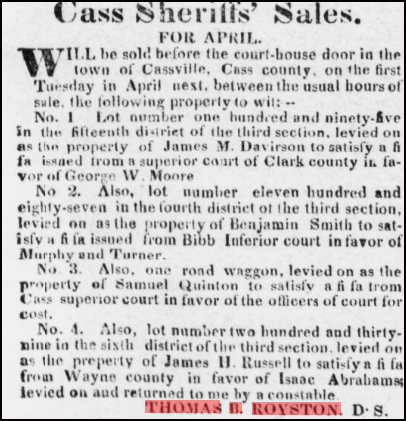
- “Cass Sheriff’s Sales for April,” Cherokee Intelligencer (Edahwah, Ga.), 8 Mar 1834, p. 4, col. 1 — Thomas B. Royston signed as D.S., deputy sheriff of Cass County.
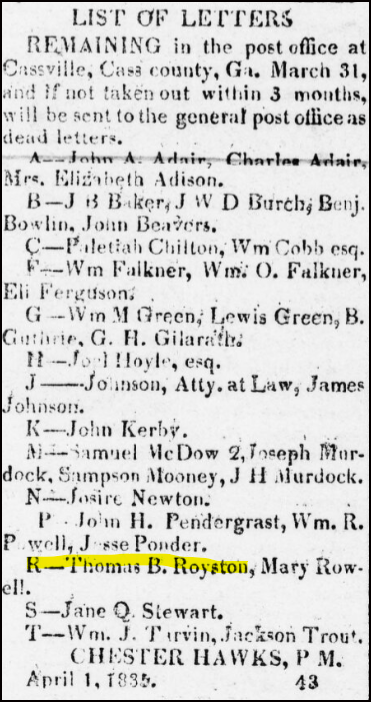
- “List of Letters,” Cassville (Ga.) Gazette, 14 Apr 1835, p. 4, col. 4 — Thomas B. Royston had unclaimed mail at the Cassville post office.
Each notice does double duty: it places him in a specific county on a specific date, and the first one names an office. Correlated with his 26 June 1833 commission as first lieutenant in Cass County, from the Georgia Adjutant General’s military records, the sheriff’s sale confirms that Thomas was not merely passing through the new Cherokee-land counties. He was holding local office there.
The correlation that mattered most: Cass County marriage records do not begin until 1836. Thomas married Cynthia Dillard about 1833 or 1834, and no marriage record has ever surfaced. The sheriff’s-sale notice provides a possible reason. It places him in the one county where the marriage most likely occurred during the exact window when that county was not yet recording marriages. A newspaper notice explained a negative search result — always worth more than another empty database query.
2. A hotel ad explained a census household
The 1830 census for Clarke County, Georgia, shows John Dawson heading a household stuffed with young men aged fifteen to nineteen, seven more aged twenty to twenty-nine, and ten enslaved people. As a family, it makes no sense.
Two ads in the Athenian resolved it:
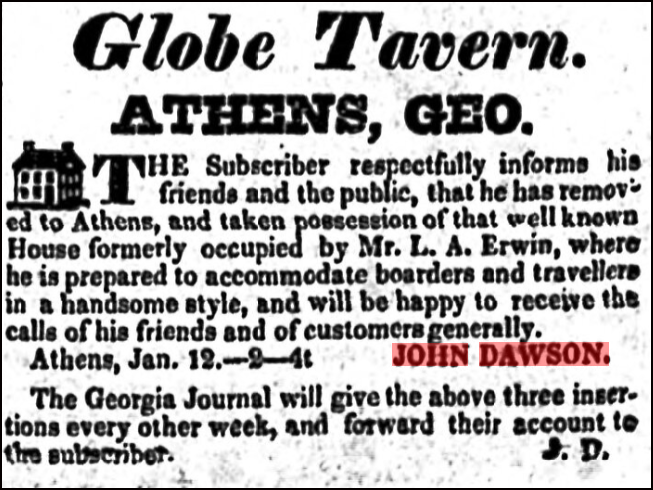
- “Globe Tavern. Athens, Geo.,” Athenian (Athens, Ga.), 26 Jan 1830, p. 4, col. 5. Dawson announced he had removed to Athens, taken the house formerly occupied by Mr. L. A. Erwin, and was prepared to accommodate boarders and travelers “in a handsome style.”
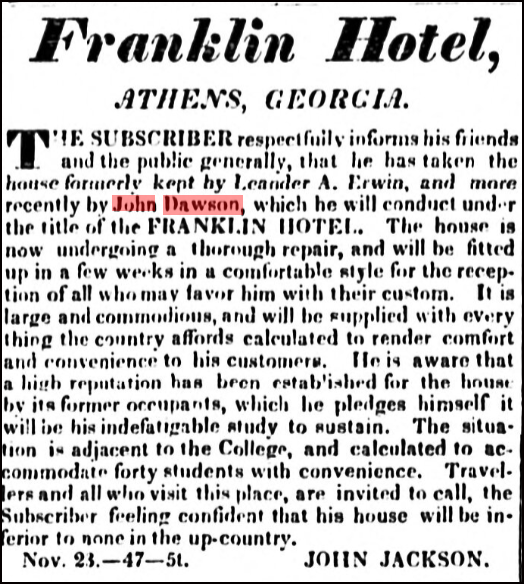
- “Franklin Hotel,” Athenian, 23 Nov 1830, p. 3, col. 4. John Jackson announced he had taken the house formerly kept by Leander A. Erwin and more recently by John Dawson. The situation, he wrote, was adjacent to the College and calculated to accommodate forty students.
Dawson was running a student boarding house next to the University of Georgia. The census household is not a family; it is a lodging register. And that opens a real possibility worth stating as a possibility rather than a fact: Thomas B. Royston and the Irwins may have been living under that roof in 1830, which would explain why Thomas appears in Clarke and Morgan County records that year without heading a household in either.
Jackson’s ad is the more useful of the two, and it never mentions the research subject’s family at all. A successor’s advertisement is a departure record. It tells you when your subject left a place, often more precisely than anything else available.
3. Ads tracked an associate across four counties
Dawson mattered because he married Elizabeth “Betsey” Cessna — probably a daughter of Samuel Cessna and Mary Baker, and therefore Thomas’s half-sister. No marriage record survives. The case for the relationship is built on association, and Dawson advertised constantly, which makes him unusually easy to follow throughout Georgia. See the blog post, “No Marriage Record, No Problem: Proving the Marriage of John Dawson and Elizabeth “Betsy” Cessna,” for the full discussion.
| Date | Notice | Place |
|---|---|---|
| 7 Dec 1827 | “Madison Hotel,” Athenian | Madison, Morgan Co. |
| 26 Jan 1830 | “Globe Tavern,” Athenian | Athens, Clarke Co. |
| 23 Aug 1832 | “Sanfordville Inn,” Georgia Journal (Milledgeville) | Cherokee gold region |
| 13 Apr 1833 | “Cherokee Post Offices,” Southern Banner (Athens) | Sandfordville, Cass Co. |
| 10 Aug 1833 | “Allatooney Hotel,” Western Herald (Auraria) | Allatoona Gold Mines, Cass Co. |
| 29 Mar 1839 | Business directory and candidacy notice, Georgia Pioneer (Cassville) | Cassville, Cass Co. |
| 2 Apr 1841 | “Cass Sheriff Sales,” Georgia Pioneer | Cass Co. |
| 11 Jul 1842 | “In Bankruptcy — John Dawson,” Daily Georgian (Savannah) | Cass Co. |
Read straight through, that is a migration route: Morgan to Clarke to the Cherokee gold counties, with Dawson arriving in the gold region by 1832 and moving his post office from Sanfordville to Allatoona in 1833. It parallels the movements of Mary Cessna, Robert Cessna, David and Sarah (Royston) Irwin, and Thomas B. Royston himself. Shared migration across four counties over fifteen years is not coincidence, and it is far stronger evidence when each stop is independently dated.
The 1841 and 1842 notices close the loop in an unexpected way. The Georgia Pioneer sheriff’s sale reports John Dawson’s execution against Richmond Baker; the Daily Georgian bankruptcy notice names Dawson of Cass County, merchant, of the late firms of Dawson, Douthit & Co., Dawson & Sloan, and Patterson & Dawson. The following year, a Cass County sheriff’s deed conveyed the bankrupt Dawson’s property to David Irwin. The newspaper explains why the deed exists — and the deed corroborates the newspaper. Neither record alone tells the story.
4. A 1916 obituary confirmed a naming pattern
The naming-pattern argument is simple once you see it side by side. Thomas named children Robert Cisnie, Thomas B., and Mary Elizabeth Royston. Sarah (Royston) Irwin named children Robert Cessne, Thomas Beverly, and Mary Elizabeth Irwin. Both honored the Cessna half-siblings and their mother, Mary.
But Sarah’s son appears in most records as Thomas B. Irwin. A death notice supplied the rest:
“Mr. Thomas B. Irwin Crosses Great Divide,” The Marietta (Ga.) Journal, 14 Jan 1916, p. 1, col. 1 — names him Thomas Beverly Irwin and identifies his father as Hon. David Irwin, deceased.
Middle names are the load-bearing element in a naming-pattern argument, and initials are exactly what most records give you. Obituaries and death notices are among the few sources that routinely spell them out. Without this one, the Thomas Beverly parallel would have remained an inference about the letter B.
5. An “In Memoriam” notice tightened a marriage date
“In Memoriam,” LaFayette (Ala.) Sun, 29 Dec 1915, p. 8, col. 2, supports an 1835 birth for Mary Elizabeth (Royston) Slagle, Thomas and Cynthia’s eldest child. Her gravestone and the 1850 census suggest 1834/1835 and a birthplace of Alabama. Working backward from the eldest child’s birth puts the marriage in 1833 or 1834 — which is what sent the search to Cass County in the first place, and back to the sheriff’s-sale notice in section 1.
6. Newspaper abstracts documented a negative
Not every newspaper source produces a find. Pauline Gandrud and Lucille Craddock’s Marriage, Death and Legal Notices From Early Alabama Newspapers, 1819–1893 was searched for a Dillard–Royston marriage with no result. A published abstract volume is a legitimate way to document a broad negative search across a state’s newspaper run, and it belongs in the citation right alongside the positive finds.
What this case suggests about newspaper research
Search the FAN club harder than you search the ancestor. Thomas B. Royston generated two useful notices. John Dawson generated eight. The associate who advertised was the one who mapped the migration.
Expect the same notice in several papers. The Cass sheriff’s sales ran in the Cherokee Intelligencer on 8 March 1834 and again in the Miners Recorder and Spy in the West on 29 March 1834. Dawson’s Allatooney ad closed by asking the editors of the Georgia Journal, Columbus Enquirer, Augusta Chronicle, and Macon Messenger to run it twice monthly for six months. Two consequences follow. If one paper’s run is damaged or missing, look for the reprint. And never infer residence from the newspaper’s place of publication — Dawson lived in Cass County and advertised in Milledgeville, Auraria, and Athens.
“List of Letters” columns point forward as well as backward. Thomas B. Royston appeared in the Cassville list in April 1835. In December 1841, a Thomas Royston appeared in the list of letters held at Columbus, Muscogee County — the logical post office for a man about to settle in Chambers County, Alabama, just across the Chattahoochee. Unclaimed mail can mark the moment someone is between addresses.
Search around bad OCR. This family’s names came through as Royester, Roylston, Sepna, Sissan, Gisum, and Javin across various indexes. Full-text search only returns what the software thinks it read. Build a variant list before concluding a search was negative, and browse the run when the stakes are high.
Capture the full transcription while you are looking at the image. Volume, number, page, column, and paragraph — plus the text itself. Six months later, the ad that seemed like background color turns out to be the document that explains a census household.
Nearly all of the Georgia notices here came from Georgia Historic Newspapers, the Digital Library of Georgia’s free archive, which now offers well over half a million issues spanning 1763 forward (https://gahistoricnewspapers.galileo.usg.edu). The Savannah bankruptcy notice came from a FamilySearch film image. Neither cost a subscription.
Newspapers rarely prove parentage on their own. In this case not one notice says whose son Thomas was. What they did was place people in counties on dates, explain an odd household, follow a family network through four migrations, and spell out one middle name — and that was enough to hold the rest of the evidence together.
Based on Diana Elder, “Naming Patterns and Family Associates Link Thomas Beverly Royston to His Georgia Roots,” National Genealogical Society Quarterly 114 (June 2026).
Best of luck in all your genealogical endeavors!








Leave a Reply
Thanks for the note!