
Guest post by Colleen S. Kennedy
What if you woke up one day and discovered another country already considers you one of its citizens? That is exactly what happened to me — and our Research Like a Pro (RLP) genealogy skills give us a real advantage in applying for Canadian citizenship.
DISCLAIMER: I am an amateur genetic genealogist, not a lawyer or immigration consultant. Nothing in this post constitutes legal or immigration advice. Canadian citizenship law is complex and eligibility depends on your specific family history. Please consult “Check if you may be a citizen” at Canada.ca.
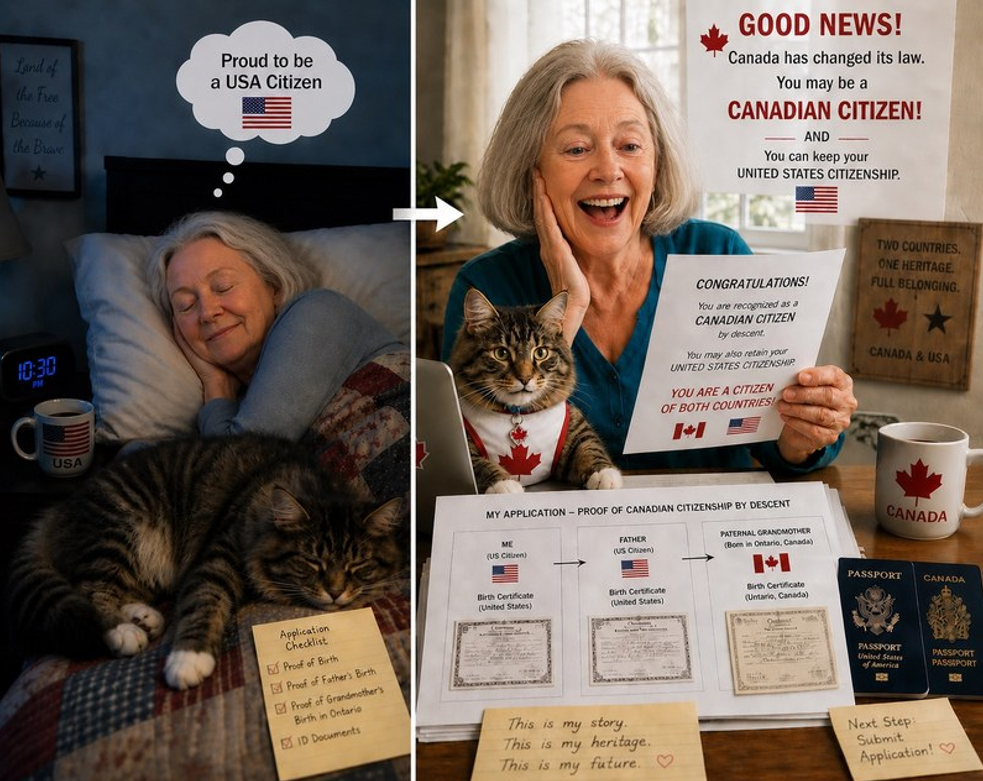
From sleeping on it to celebrating it — with Ziggy supervising every step of my application. Photo by Colleen Kennedy & ChatGPT.
I was quietly pursuing my own genealogical research when a headline in a national newspaper caught my attention. Canada had amended its citizenship law, and people with Canadian ancestry around the world might already be citizens without knowing it.1 While the change affects anyone who can trace Canadian ancestry regardless of where they live, the numbers are staggering among Americans alone: millions of us are potentially eligible, owing to nearly two centuries of Canadian immigration into the United States. Suddenly, the research I had been doing for its own sake took on an entirely different dimension.
The Canadian law is called Bill C-3. There are various scenarios that may apply to you; this post addresses specifically the case where “citizenship may have been restored or given to people who were born outside Canada in the second generation or later before December 15, 2025.”2 If that describes you, the government says you are automatically a Canadian citizen. All you need to do is apply for a certificate to prove it.
What Does Canadian Citizenship Mean for Americans?
Before diving into the research process, it helps to know what you are actually getting, and what you are not giving up. Both the United States and Canada recognize dual citizenship.3 Claiming Canadian citizenship by descent will not affect your U.S. citizenship, your voting rights, or your legal status. You do not have to renounce one to hold the other, and citizens by descent under Bill C-3 are not required to take an oath of allegiance to Canada.
As a dual U.S.–Canada citizen you would gain the right to live and work in Canada without a visa or work permit, access Canadian healthcare once you establish provincial residency, study or have your children study at domestic tuition rates, and hold a Canadian passport — currently valid for visa-free travel to more than 180 countries. On the tax side, Canada taxes based on residency, not citizenship: if you continue to live in the United States you will not owe Canadian income tax. For a full breakdown of rights, benefits, and practical considerations, see this article from immigration.ca — note that it is from a Canadian immigration law firm, not an official government source: Canadian Citizenship by Descent for Americans.
The skills we practice every day in our RLP genealogy work are exactly the skills this process requires. I want to share how I have been completing my application in hopes that it will help you do the same.
Please bear in mind that not every Canadian will view this wave of new citizenship claims warmly. Canada’s citizenship carries deep meaning to those who have built their lives there, and the concerns of existing citizens deserve respect. I am approaching this process with genuine humility, as a person seeking to document a legal right and to honor my Canadian heritage.
My Story: The Research Problem Hidden Inside the Legal Question
I had been researching my Canadian born paternal grandparents for years. My grandfather, Anthony William Kennedy, was born in New Brunswick. My grandmother, Martha Jane Kitchen, was born in Ontario. Both were potential anchor ancestors for a citizenship claim. I only needed one.
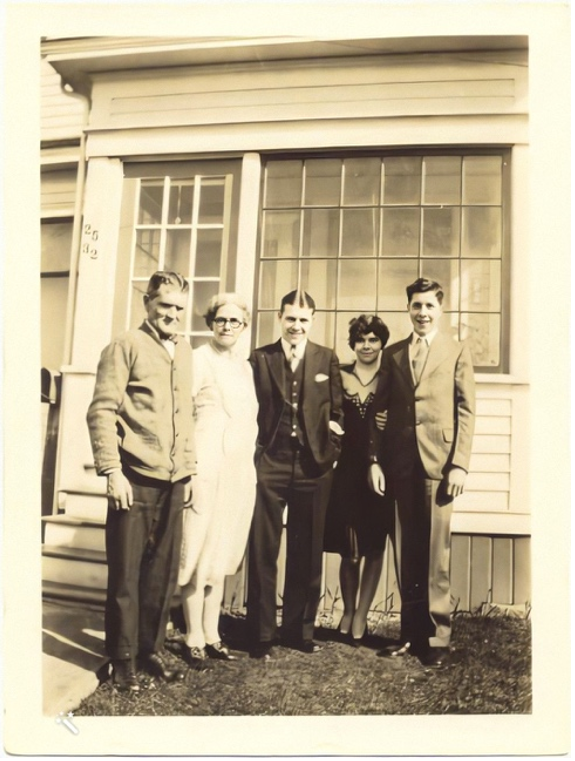
L to R — Anthony Kennedy, Martha Kitchen Kennedy & Their Children — Martin, Winnie, and Charles Kennedy (my father)
To apply for a Canadian citizenship certificate, Immigration, Refugees and Citizenship Canada (IRCC) requires you to build a documentary chain: records connecting you, through every generation, to your most recent Canadian ancestor. When I assessed what I had for each grandparent, the choice became clear almost immediately, not for legal reasons, but for evidentiary ones. Those of us trained in the RLP method to analyze sources will immediately understand my choice.
Grandfather — Anthony Kennedy: His Canadian birth in 1868 is supported by a notarized affidavit signed by his sister in New Brunswick in 1948, in which she cited family records documenting her older brother’s birth. As genealogical evidence this is meaningful — a sibling making a sworn statement. Even though it is an original record, it conveys secondary information: what family records said about a birth documented long after the fact that she did not witness. The underlying records she referenced are not in hand, and no birth or baptismal record exists for my grandfather despite exhaustive searching. Perhaps I could have mounted a convincing case with the affidavit and the 1891 Canadian census showing both my grandfather and his sister listed with their family, but why risk it?
Grandmother — Martha Kitchen: Her birth in Ontario is documented in a civil birth registration entry, a contemporaneous record completed within days of her birth by a government official, with her father as the stated informant. The document names her, her birthplace, and her parents. When you only need one grandparent and one has a demonstrably stronger evidentiary chain, the RLP researcher’s choice is clear. I chose Martha.
The documents connecting my grandmother to me are the kinds of records we work with every day: her Ontario birth registration, my father’s birth and death certificates naming Martha as his mother and noting her Canadian birthplace, her death certificate confirming Ontario, a marriage return bridging her maiden name to the Kennedy surname, and my own birth certificate. Each document does specific work in the chain.
One complication required explanation. My grandmother’s family surname was “Kitchen” in Canada, as shown on her birth registration, but changed to “Kitching” when the family moved to Oregon. I had a faded 1881 census and a clearly legible Canadian marriage registration for Martha’s parents recording her father’s name as Kitchen. The 1900 U.S. census showed the family as Kitching, consistent with Martha’s Washington State marriage certificate, death certificate, and my father’s records. The record choice was easy. I set aside the faded 1881 census and used the marriage registration alongside the later U.S. records. This is exactly what we would do in any research report: document the name variation, show consistent identifying details across records, and explain the pattern.
The Genealogist’s Twist: Reading What IRCC Actually Asks For
When you sit down with the official IRCC document checklist, form CIT 0014, you quickly discover that it is not always straightforward to interpret. Some requirements are highly specific. Others are genuinely open-ended. This is where being RLP trained genealogists gives us a real advantage.
Consider just some of the photograph requirements alone. The checklist is precise: citizenship photographs must be in color, of a specific size, taken within the last six months, with the applicant’s name, the photographer’s studio or full name and address, and your name and date printed on the back, etc.4
Then, look at the evidentiary requirements for someone in my situation — born outside Canada to a Canadian parent who was also born outside Canada. IRCC’s Scenario 3 in form CIT 0014 asks for, among other things:
“proof that at least one of your parents … is a Canadian citizen, such as: parent’s provincial/territorial birth certificate, or parent’s Canadian citizenship/naturalization certificate … or your parent’s country specific birth certificate displaying the name of your Canadian grandparent(s) AND proof that at least one of your grandparents is a Canadian citizen, or any other evidence that your parent is a Canadian citizen.”5
Read that carefully. The checklist is asking you to prove that your parent is a Canadian citizen, and one acceptable way is your parent’s birth certificate showing your grandparent’s name, combined with proof that the grandparent was Canadian. For a grandchild applying under Bill C-3, you may be building a three-generation evidentiary chain just to satisfy a single checkbox. What counts as “any other evidence” that a grandparent was Canadian? That language is genuinely open-ended, exactly the kind of judgment call we make every day. Most applicants have no training in that kind of analysis. We do.
Community Groups: Helpful, With One Important Caveat
Two online communities have become active hubs for people navigating Bill C-3: the r/Canadiancitizenship subreddit and the Canadian Citizenship by Descent Facebook Group (22,000+ members). Both sites assist with:
- Obtaining and completing appropriate forms and guides pertaining to the Canadian Certificate of Citizenship Application.
- Locating appropriate documents in free libraries and archives (FamilySearch, Library and Archives Canada, etc.) and on subscription sites such as Ancestry. Critiquing each other’s documents and case upon request.
- Preparing the packet for submission including duplicating documents in color, shipping options (some that save a lot of money), and completing the requisite customs declaration form.
- Supporting members while they wait to receive the Acknowledgement of Receipt (AOR) letter, confirming IRCC has received the application and deems it to be complete and ready to be processed. Lastly, celebrating with one another as members receive their long-awaited Canadian Certificate of Citizenship.
One caveat: the most reliable guidance comes from people whose applications have been approved. Someone with a pending application does not yet know if her/his checklist interpretation was correct. Read community advice the way a trained researcher reads any source: ask what the person actually knows, and how they know it. Hopefully, the IRCC will communicate more information about acceptable forms of documentation to submit.
A Boom for Genealogy — and an Opportunity for Our Community
Bill C-3 is already driving a surge of interest in genealogical research that our community is uniquely positioned to support. Thousands of people are searching for grandparents and great-grandparents they have never researched, many with no idea where to begin, and this is often their first encounter with genealogy itself. Whether it is pointing someone toward FamilySearch, explaining what a provincial vital records office does, or helping someone understand what “long-form birth certificate” means on form CIT 0014, the knowledge we take for granted is genuinely valuable right now. Consider it an invitation for random acts of genealogy kindness.
Practical Tips for Getting Started
- Start with the official IRCC guidance. The Government of Canada’s page on the 2025 citizenship rule changes explains the law, how to count generations, and next steps.
- Download form CIT 0014. Identify your scenario and read it more than once. Notice which requirements are specific and which are open-ended.
- Assess your evidentiary chain. Who is your Canadian anchor ancestor? What documents do you have? Where are the gaps? A cover letter and simple family tree diagram showing your relationship to your anchor ancestor will help IRCC follow your chain.
- Pay attention to format requirements. Color reproductions, precise photo dimensions, photographer’s name and address on the back, certified translations. These are non-negotiable.
- Order records early. Provincial vital statistics offices, Library and Archives Canada, and U.S. state registries all have different timelines. IRCC processing is currently running approximately 10–11 months.6
- Consider professional guidance. For complex situations such as missing records, naturalization in another country, or multi-generational chains consult a Regulated Canadian Immigration Consultant (RCIC) or immigration lawyer.
- Cite your documents. A well-cited packet signals care and thoroughness. All those hours learning to cite our sources come in handy here.
Conclusion
I grew up twenty minutes from the Canadian border, where I went on Sunday drives with my grandfather and family. Canada was just across a ditch on Boundary Road in Whatcom County, Washington. Both Anthony William Kennedy, born in New Brunswick, and Martha Jane Kitchen, born in Ontario, were Canadians who crossed that border and built their lives in Washington State. I will not be applying through Anthony. His sister’s affidavit tells me something real and valuable about his origins, and I am glad to have it in the family archive. But Martha’s civil birth registration, recorded in Ontario nearly 150 years ago, is the stronger evidentiary foundation.
And yet Anthony is here too, in this story. Both of my grandparents were Canadian. Both of them are why this application exists. The citizenship certificate I am now seeking will bear Martha’s name in the chain of proof, but it honors them both.
If you have Canadian heritage and wish to apply for a citizenship certificate, I wish you success. You may find that the research you have already done is further along than you think, and that the skills you have spent years building are exactly what this moment calls for.
Footnotes
- CIC News, “Seven Types of Documents Americans Are Using to Prove Their Canadian Citizenship by Descent,” CIC News (https://www.cicnews.com/2026/04/seven-types-of-documents-americans-are-using-to-prove-their-canadian-citizenship-by-descent-0473846.html : accessed 6 May 2026).
- Government of Canada, “Change to Citizenship Rules in 2025,” Immigration, Refugees and Citizenship Canada, Canada.ca (https://www.canada.ca/en/immigration-refugees-citizenship/services/canadian-citizenship/act-changes/rules-2025.html : accessed 6 May 2026).
- Immigration.ca, “Canadian Citizenship by Descent for Americans,” immigration.ca (https://immigration.ca/canadian-citizenship-by-descent-for-americans/ : accessed 8 May 2026). Note: immigration.ca is a Canadian immigration law firm, not an official government source.
- Immigration, Refugees and Citizenship Canada, “Guide for Paper Applications for a Citizenship Certificate for Adults and Minors (Proof of Citizenship) under Section 3 (CIT 0001),” Canada.ca (https://www.canada.ca/en/immigration-refugees-citizenship/services/application/application-forms-guides/guide-0001-application-citizenship-certificate-adults-minors-proof-citizenship-section-3.html : accessed 6 May 2026), Step 1, Photographs section.
- Immigration, Refugees and Citizenship Canada, “Document Checklist: Application for a Citizenship Certificate (Proof of Citizenship),” CIT 0014 (12-2025) E (https://www.canada.ca/content/dam/ircc/documents/pdf/english/kits/forms/cit0014/01-12-2025/cit0014e.pdf : accessed 6 May 2026), Scenario 3.
- Immigration News Canada, “New Canadian Citizenship by Descent Processing Timelines in 2026,” immigrationnewscanada.ca (https://immigrationnewscanada.ca/americans-claim-canadian-citizenship-2026/ : accessed 6 May 2026).
Resources
- Government of Canada — Change to citizenship rules in 2025 — ca — citizenship rule changes 2025
- IRCC — Document Checklist CIT 0014 (PDF) — ca — CIT 0014 checklist
- IRCC — Apply for a citizenship certificate — ca — proof of citizenship — apply
- Library and Archives Canada — Citizenship and Naturalization Records — bac-lac.gc.ca — citizenship and naturalization
- LAC — Naturalization Lists 1915–1951 (free searchable database) — bac-lac.gc.ca — naturalized records 1915–1951
- Reddit — r/Canadiancitizenship — com/r/Canadiancitizenship
- Facebook — Canadian Citizenship by Descent — com/groups/501813032715040
- ca — Canadian Citizenship by Descent for Americans (law firm, not official) — immigration.ca — citizenship by descent for Americans
Author’s note: This post was revised with editorial assistance from Claude, an AI assistant developed by Anthropic.










4 Comments
Leave your reply.