
On this episode of Research Like a Pro, Diana and Nicole discuss how to transform unsuccessful searching into powerful proof by distinguishing between negative search results and negative evidence. Diana mentions that she is reading an article from the National Genealogical Society Quarterly about a DNA cluster that links two distant lines of descent. Diana shares that a search that yields “nothing” may be exactly the evidence a genealogist needs, drawing from her presentation at RootsTech 2026 on this topic. She uses her research on Henderson Weatherford as a case study for understanding the value of recording negative searches.
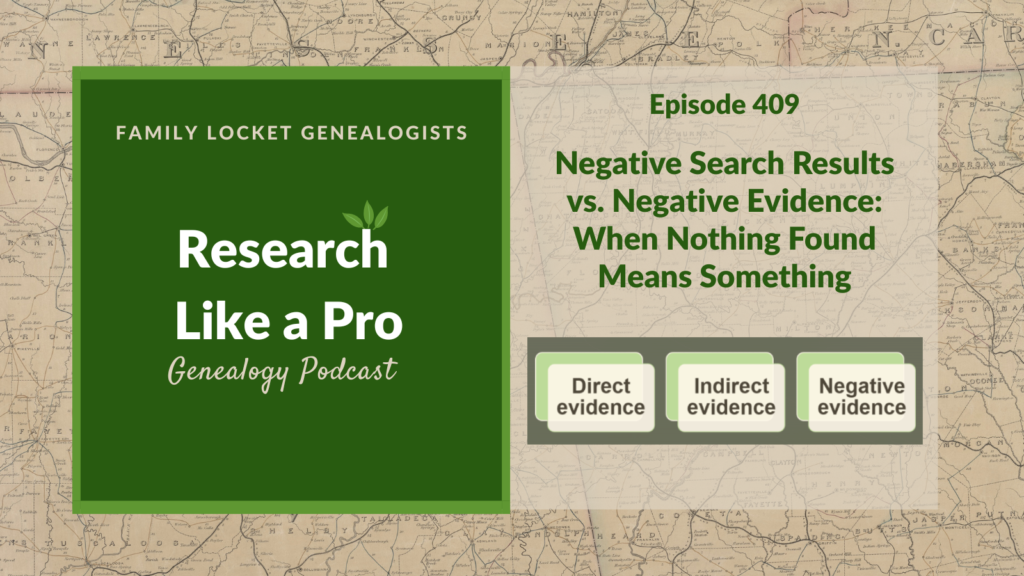
Nicole then defines the three foundations of sound genealogical analysis. Direct evidence directly answers a research question, such as a death certificate stating a date of death. Indirect evidence requires combining multiple pieces of information to reason one’s way to a conclusion. Negative evidence is a form of indirect evidence inferred from the absence of information that should exist under specific circumstances. Nicole clarifies that a negative search result is simply a logged research outcome, whereas negative evidence is only created after ruling out common causes for finding nothing, such as record loss, incomplete databases, or indexing errors. Diana then walks listeners through the seven steps of the Research Like a Pro process for systematically assembling negative evidence, which include defining a focused objective, conducting a locality study, citing every search, and writing a reasoned conclusion. Nicole notes that this process often requires several research phases to gather sufficient evidence, as in the Weatherford research. Listeners learn that when negative evidence is built through systematic, well-documented research, it is a legitimate and powerful form of proof.
This summary was generated by Google Gemini.
Transcript
Nicole (1s):
This is Research Like a Pro episode 409: Negative Search Results vs. Negative Evidence: When Nothing Found Means Something. Welcome to Research Like a Pro a Genealogy Podcast about taking your research to the next level, hosted by Nicole Dyer and Diana Elder accredited genealogy professional. Diana and Nicole are the mother-daughter team at FamilyLocket.com and the authors of Research Like a Pro A Genealogist’s Guide. With Robin Wirthlin they also co-authored the companion volume, Research Like a Pro with DNA. Join Diana and Nicole as they discuss how to stay organized, make progress in their research and solve difficult cases.
Nicole (41s):
Let’s go. Today’s episode is sponsored by Newspapers.com. Hi everyone, welcome to Research Like a Pro.
Diana (48s):
Hi Nicole. How are you doing today?
Nicole (51s):
I’m great. How are you? What are you doing?
Diana (53s):
I am doing well. I’ve had some fun reading and studying Darcie Hind Posz’s latest article in the National Genealogical Society Quarterly has got a fun title. It’s called, “New Jersey Pickels and a North Carolina Bückel: A DNA Cluster Links Two Distant Lines of Descent”. So this was in the March, 2025 editions, so a year ago, but our little NGSQ study group studied it for this month and this one has DNA. It was so interesting to read about how this is a good case study for the term “walking the cluster back”
Diana (1m 35s):
where you were trying to find how, what are the most common recent ancestral couple on all these people who are sharing a specific amount of DNA within a cluster. And so we were able to learn how this went all the way back to the early 1700s and the common ancestral couple was identified as Balthazar Pickle and Anna Ava Mueller, and these were Palatine Germans who married 1678 in Bad Durkheim, Germany. So this was really neat. It actually utilized segment triangulation on chromosome one and Darcie had used multiple test takers from both the Pickle and the Kuntz lines.
Diana (2m 22s):
So this started with Jan Alpert, who is one of our colleagues, and she had, I am guessing that she had a cluster that was unknown. Her ancestry is all Midwest and New England and this cluster was all from North Carolina with an unknown surname of Kuntz. And so she commissioned this research with Darcie who figured it out. So this is one, as always, you always have to marry DNA with the documents. And in this one she was able to find documentary evidence that showed that there was a George Kuntz who married a daughter of Michael Pickle and went back to this Hans Michel Bickel.
Diana (3m 8s):
So this was really a fun article and so interesting. It has really good diagrams about all the people and the test takers and the pedigrees trying to understand how they all connect. So if anyone is looking for a good DNA case study, especially one that is successful in using DNA for further back than we usually do, you know, we don’t have many articles or case studies that are going that far back into the 1700s, so that was really neat to study.
Nicole (3m 40s):
That’s great to see DNA being so useful at that distance. Cool.
Diana (3m 45s):
Yeah.
Nicole (3m 45s):
Well coming up soon we have our next Research Like a Pro webinar, Where Was Fannie Cliett Born? Examining a Family Story, by Amy Pittman. And Amy is one of our Research Like a Pro graduates from our study group. She’s a great genealogist and I’m excited to hear her talk. She’s done a lot of really great work and her webinar will focus on kind of the family story that Fannie was born on the line between Alabama and Georgia. And then she’ll use land, census and military records to reconstruct the movements of Fannie’s parents. So it’ll be really cool to see what she does, especially because Cherokee County suffered severe record loss. So she uses federal land patents and the FAN club to help figure out the family story, whether it was true or not.
Nicole (4m 32s):
The next study group will be August, 2026. So if you’d like to join Research Like a Pro, you can get ready to register coming up in May. And then if you wanna be a peer group leader, just let us know or apply on our website. And then if you want to get our weekly Monday newsletter by email, then you can sign up and then we send that out each Monday with new blog posts, our new podcast episodes, any coupons that we have going on and things like that. We are looking forward to the National Genealogical Society Conference on May 27th through the 30th in Fort Wayne, Indiana. And we’ll be visiting the Allen County Public Library. It’s gonna be so cool. The theme is America at 250 and RootsTech also had a little focus on America at 250.
Nicole (5m 17s):
So it’s just exciting that in 2026 we get to focus on the 250th anniversary of the United States of America and think about how our genealogy is impacted by all the ancestors that came before us in our country. So it’ll be really fun and Diana’s talking about court records and two talks in then I’ll be talking about AI and my DNA case study with Barsheba Tharp and then a practical workshop on early handwriting. So it should be fun.
Diana (5m 50s):
We’re excited. I’m excited for the theme. NGS always says really good, exciting things with the theme. So I am expecting big things. I think it’ll be really fun. Well, for our topic today, we are going to talk about the lecture that I did for RootsTech 2026, which was titled Negative Search Results vs Negative Evidence: When Nothing Found Means Something. So I had put this under the advanced professional track because it is a case study and a little bit more complicated, but it is so valuable and honestly all genealogists need to understand the value of recording negative searches and then using those in conclusions that may become Negative Evidence.
Diana (6m 34s):
And so this is one of those things that’s part of the Genealogical Proof Standard, reasonably exhaustive research. But if we are doing that, we’re inevitably going to have negative search results. So what really helps us, is starting to understand the difference between a dead end and a meaningful absence. And my lecture was all about the difference of taking what seems like maybe a failure of the research and turning it into proof. And luckily this was recorded so if you missed it you can watch the recording which is there on RootsTech. So just look for my name, Diana Elder and you’ll find Negative Search Results vs Negative Evidence and you can check out the syllabus as well as watch the recording.
Nicole (7m 20s):
That’s perfect. I think being able to watch those free webinars on RootsTech is such a great benefit. Well let’s talk about the key terms to understand for Negative Evidence. So there’s three types of evidence that form the foundation of genealogical analysis. And so it’s important to get these definitions right because then it changes how you document, how you reason and how you report your findings. So of course, first of all, we have direct evidence and we all hope to find direct evidence, especially as beginning genealogists. We’re always looking for that source that directly answers your question without requiring any extra clues or reasoning where for example, a death certificate says March 14th, 1892 for the date of death.
Nicole (8m 2s):
So now you have the date of death for your person. You have direct evidence for when they died. So the record answers the question, but indirect evidence would be a little different, right? It doesn’t directly say the answer to your question. Instead you must reason your way to a conclusion by combining multiple pieces of evidence and multiple clues. So for example, a woman listed on the 1850 census with no stated relationship to the head of household, that is indirect evidence about their relationship. And so if her marriage record also notes that the ceremony took place at that man’s home and she later named a child after him, then those combined details build of reasonable conclusion that he was her father, even though no single record says so outright.
Nicole (8m 46s):
So you can kind of put together these clues. Okay, so she’s a child in his household in 1850, she got married in his home and she named a child after him probably the father. Negative Evidence is a form of indirect evidence, and it’s drawn from the absence of information that should exist under specific circumstances. As Elizabeth Shown Mills has defined it, it is an inference drawn from a silence in the records, from an absence of information or situation that should exist under given circumstances. And for validity, the negative must be developed into a positive through additional research and supporting evidence.
Nicole (9m 28s):
So a practical example of that is a man who appeared consistently in county tax lists for 12 years, but then he suddenly vanishes from the records. That absence, once you understand how tax list worked and have confirmed the records are complete for those years, is evidence that something significant changed. He may have died, he may have moved away, or he may have aged out of being taxable. So that is just kind of a, an overview of the three types of evidence: direct evidence, indirect evidence, and negative evidence, that will help us understand more about Negative Evidence.
Diana (10m 6s):
Right, well now let’s have a word from our Sponsor. As flowers bloom and the days get warmer, why not breathe new life into our family history research. Newspapers.com is the perfect companion for Genealogists at any level looking to go beyond names and dates. With access to over a billion pages of historical newspapers, you can uncover fascinating stories about your ancestors that don’t show up in typical records. Picture finding a heartfelt obituary that introduces extended family, a local news article showcase casing your great-grandmother’s community role, or even a photo that captures a special moment from long ago. Little treasures that make their stories blossom before your eyes.
Diana (10m 46s):
Newspapers are packed with the everyday moments, announcements, celebrations, challenges that bring color and depth to the lives of those who came before you. These rich primary sources help you connect with your family’s past in a way that feels personal and meaningful. The search is easy and intuitive whether you’re looking by name, place, or time period, letting you uncover these hidden gems at your own pace, ready to brighten your research with stories that go beyond the usual. Visit newspapers.com/FamilyLocket today and enjoy 20% off a subscription. Let spring be the season you turn your family tree into a lively family story.
Nicole (11m 23s):
Alright, now let’s talk about the difference between a negative Evidence and a negative Search result. Well, a negative search result simply means you searched a source and you found no relevant record. It is a research outcome that must be logged and evaluated, but on its own it is not evidence. Only after corroborating multiple negative searches and ruling out record loss, incomplete databases, indexing errors, can those absences be assembled into Negative Evidence. So why you might find nothing, there are a few different causes for negative searches. There’s a few that are really common. Before treating an absence as meaningful, we have to rule out these common reasons why a record might might not surface in your search.
Nicole (12m 8s):
And the first is record loss. A catalog entry that reads, “Virginia Wills 1740 to 1850”, does not mean every county and every year is present. Fires, floods, courthouse disasters are common in Virginia and in American genealogical research. So before concluding that a record never existed, investigate and figure out the history of the record collection and know any gaps that affect your specific time and place. Another common cause of a negative search is an incomplete database. So a database labeled, “Georgia Marriages 1750 to 1800”, may include only a few of the counties in Georgia. New records are added to online databases all the time.
Nicole (12m 51s):
Always note the date of your search in your research log so that you, or a future researcher, can revisit the source as coverage improves. And another reason for a negative search could be transcription or indexing errors. A surname indexed as “Howard” may have been written as “Howards,” “Hoord,” or “Heward” in the original. Try every phonetic and spelling variant you can construct, use wild card searches where available, and browse the original images directly when possible and document your search terms in your research log. Hopefully this helps you to have less negative search results, but you still will probably have several negative search results throughout your research.
Nicole (13m 33s):
And it’s just important to note those in your research log.
Diana (13m 37s):
Well, how do we assemble Negative Evidence? This is where we have to have a really good research process. It doesn’t mean we just have a bunch of negative searches, but we built this systematically through a disciplined research process. And this is where the Research Like a Pro process comes into play. So first of all, we have that defined focus research objective, and we’re trying to focus in on one unknown, say a death date, migration route, parent-child relationship. And then this way our research plan is manageable and we can actually defend our conclusions. So after we do the objective, we analyze what we already know.
Diana (14m 18s):
And this is the timeline analysis step where we are just taking all the known facts from the research subject and we’re noting everything into our timeline. The names of the associates–neighbors, business partners, extended family members, witnesses–those are especially helpful in a case of Negative Evidence. These are the people that might be key to helping you figure out what in the world is going on. So these people may leave records that shed light on the ancestor when our ancestors’ own records are just not there. Now we also conduct a thorough locality study, and that is the third step.
Diana (14m 60s):
Our reasonably exhaustive research requires us to know what records existed, what has survived, where are those records. So we study geography, legal history, record keeping practices of the place and time period. And we really have to have a good idea of what sources should exist from all of those previous steps. We write our research plan and in this step we list all the sources that could answer the objective and then we prioritize those by how available they are, how easy to access or how probable they will be to answer our question. So that written plan really keeps us on track and make sure that we are looking for all the sources beyond just obvious ones.
Diana (15m 44s):
You know, sometimes we always go to the same databases, and it helps us to think outside the box perhaps. And then as we’re researching, we want to create a citation for each search. And this is where it’s really important to do the citations for even the negative ones. So we, if we’re going to write a conclusion, we need to have something that says we searched and did not find it. So for instance, we might say something like “Maryland Records, Somerset Parish, Somerset County, 1650 – 1825, negative search for Ballards between 1666 and 1866”, or so forth. So we want to make sure we have those cited, and where do we keep that citation?
Diana (16m 26s):
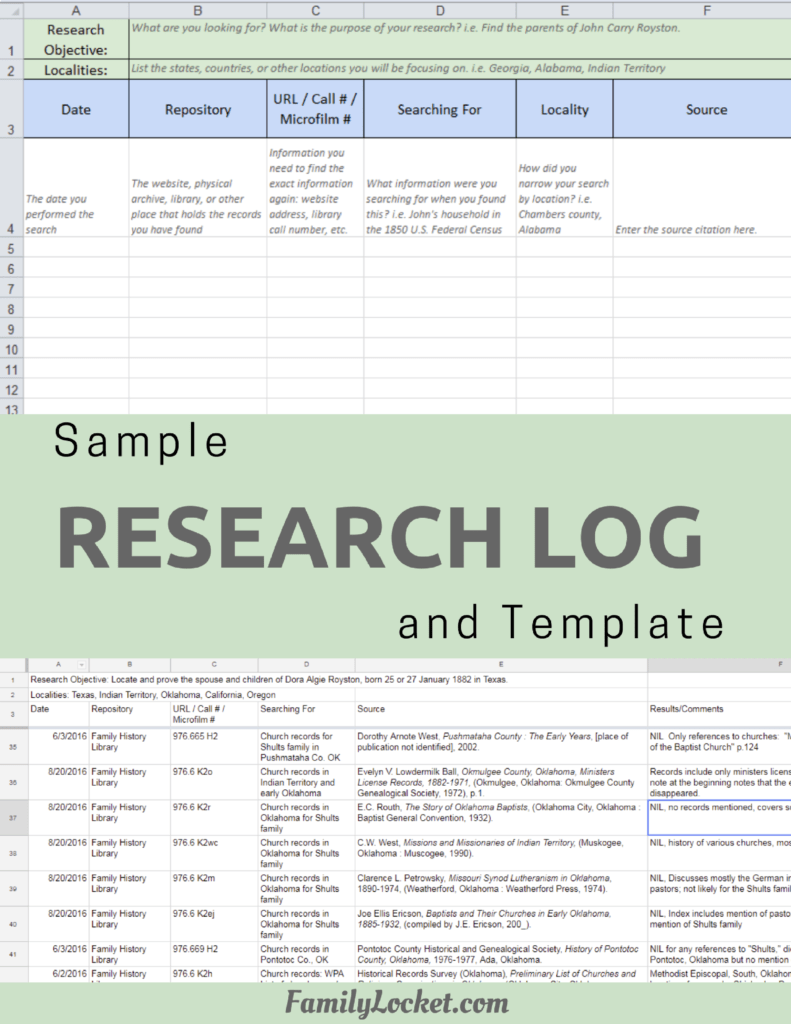
Well, in our detailed research log where we’re going to record the search, the source search terms, the date, the outcome, and this is really helpful to have this down so we know that we have searched something and if it was negative, that’s fine. We know we’ve done it, we don’t have to redo that search. So this will really be helpful as we are writing up our research. So one of the things we might want to note is if our ancestor is not in the index or in the record, but there’s someone of the same surname or a lot of other people of the same surname, you know, we want to put those kind of notes into our results column.
Diana (17m 6s):
It might help us understand, you know, maybe the family is still there but our person has moved on, or maybe nobody’s there, of that surname. Those are the types of details you can put into your research log, especially if you have a negative search. So it can help you understand maybe what’s going on. And then finally we write a reasoned conclusion. And after we’ve exhausted our research plan, we go back through, we look at all of our findings, both positive and negative. And if we have sufficient Negative Evidence, then we can write a conclusion that explains what we searched, what we found or didn’t find and what that means. And that will help us to understand our research as a whole.
Nicole (17m 46s):
Those are some great steps And I think it’s really helpful to consider that we can really keep with that detailed research log so that when we get to the time to write, we’ll have all the different findings, the positive ones and the negative ones, and then we’re ready to write a conclusion. One thing to note though is that it may take several research phases to gather enough Negative Evidence to support a conclusion. And in the Weatherford example, there were three research projects that contributed to the body of evidence. So we’re gonna go over these three research objectives, each with several negative searches that eventually became Negative Evidence to provide a probable father for Henderson Weatherford.
Nicole (18m 27s):
So here’s the first one, research candidates for the father of Henderson Weatherford, who was born about 1815 in Tennessee and died after 1860 in Dallas County, Texas. Henderson met married Clemsy Cline in about 1838 in Izard County, Arkansas. So that was the first research phase. And then the second phase had this objective determine when and where Henderson Weatherford died. He was born about 1815 in Tennessee and died between 1860 and 1870 in Texas or Missouri. Henderson married Clemsy Cline in 1838 and Izard. And then the last objective for the third phase of this research was using DNA and documentary evidence test.
Nicole (19m 9s):
The hypothesis that William Weatherford of Izard County, Arkansas is the father of Henderson. Weatherford William was born about 1780 to 1790 and was present in the 1830 census of Izard County. Henderson was born about 1815 in Tennessee and died in 1862 in Dallas County and married Clemsy Cline in 1838 in Izard County.
Diana (19m 31s):
Alright, so those were the three phases that I worked on and I was able to come to a conclusion about Henderson Weatherford. So how do we come to a conclusion that’s based on Negative Evidence? Well, we have to do more than just say, oh, I couldn’t find him. We have to demonstrate that we searched the right sources, we understood their strengths and limitations, and then account for alternative explanations. So we should have a strong written conclusion that identifies our research objective clearly, and we can summarize the sources we searched and our parameters that we used. We can acknowledge there were known gaps in the record set so we, we can explain record loss or incomplete databases indexing issues, and we can explain why the absence of a record is meaningful given the historical context.
Diana (20m 24s):
So for instance, if you cannot find a marriage record for your couple, and then you discover that all the marriage records were lost for a period of time when they likely would’ve recorded their marriage, that can really help you understand why you’re not finding the record. You just have to do that extra step of researching and then you can state your conclusion with appropriate confidence. And we always use qualifiers. We can’t always say this is absolutely true because what if a new document turns up? But we can use the most reasonable interpretation of the available evidence and say almost certainly, or probably, you know, using those qualifiers helps anybody reading it to understand this is our best assessment based on what we know.
Diana (21m 11s):
And what if we have not yet reached a reasonable exhaustive research? Well, we can document what has been done and what gaps remain and what additional searches we need to make. So this will help us when we’re doing that next phase and we’ll make sure we don’t duplicate any of our efforts. We’ll just keep moving forward on this case. So writing this fully cited report for each phase is so helpful, especially when we feel like we are doing lots of negative searches. So really we have to think of Negative Evidence as not just a failed search, but when we really assemble it through systematic, well documented research, it is legitimate and sometimes it’s a powerful form of proof.
Diana (22m 0s):
So the key is really understanding the records, their limitations, documenting, following the process and then doing some really good careful reasoning from the evidence or the absence of the evidence. So in my case study, it was fun to just show how I was able to prove that Henderson Weatherford was not connected to a family that everyone assumed he was, through some things that I did find, but a lot of Negative Evidence as well. So the next time you’re working on a research project and you feel like you are just getting negative after negative stop and think about why it should exist and confirm you’ve searched appropriately.
Diana (22m 44s):
And then if you really truly decided there is just no record for that ancestor in that place, think about what that’s absence might be telling you about your ancestors’ life.
Nicole (22m 55s):
I love that. That’s so cool. And of course if you want to see the full case study, you can watch the RootsTech recording, right?
Diana (23m 4s):
Absolutely. It’s out there.
Nicole (23m 5s):
Yeah, that gave me some ideas for my George Welch research. You know, he’s been missing from the 1860 census, as far as I can tell, for a long time and I and his wife as well, Lucinda, so I’d love to find them or just know where they lived at that time. And I think they might have been going through Mississippi because they’re in 1850 in Alabama and then in 1870 in Texas. And I think George died in that time period, too. So there’s a lot of things the Negative Evidence is telling me, and I hope to fill in the gaps, but it may not, you know, I may not ever find it ’cause they were in the middle of migrating westward in a very tumultuous time in the 1860s during the Civil War.
Nicole (23m 46s):
So there’s a lot of possibilities of things I could find him in. But like you said, sometimes you just might not find anything and that can tell you also about their life. Like what if he died in 1851? I’m never gonna find anything else after the 1850 census, so just never know.
Diana (24m 1s):
Right.
Nicole (24m 1s):
Well, this was fun to think about Negative Evidence and dive into that a little bit deeper and hopefully these definitions and examples were helpful for you as you’re uncovering negative searches and then making that into Negative Evidence. So have a great time working with your Negative Evidence and we will talk to you again next week. Bye-bye.
Diana (24m 22s):
Bye-bye.
Nicole (24m 57s):
Thank you for listening to Research Like a Pro with Diana Elder, accredited genealogy professional and Nicole Dyer. We hope that something you heard today will help you make progress in your own genealogy research. If you like what you heard, please leave us a review on iTunes or Stitcher or visit our website, FamilyLocket.com to contact us. You can find our book Research Like a Pro a Genealogist’s Guide on Amazon.com and other booksellers. We hope you’ll start now to Research Like a Pro.
Links
Negative Search Results vs. Negative Evidence: When Nothing Found Means Something – https://familylocket.com/negative-search-results-vs-negative-evidence-when-nothing-found-means-something/
Diana’s negative evidence RootsTech Talk – https://www.familysearch.org/en/rootstech/session/when-nothing-found-means-something-negative-search-results-vs-negative-evidence
Sponsor – Newspapers.com
For listeners of this podcast, Newspapers.com is offering new subscribers 20% off a Publisher Extra subscription so you can start exploring today. Just use the code “FamilyLocket” at checkout.
Research Like a Pro Resources
Airtable Universe – Nicole’s Airtable Templates – https://www.airtable.com/universe/creator/usrsBSDhwHyLNnP4O/nicole-dyer
Airtable Research Logs Quick Reference – by Nicole Dyer – https://familylocket.com/product-tag/airtable/
Research Like a Pro: A Genealogist’s Guide book by Diana Elder with Nicole Dyer on Amazon.com – https://amzn.to/2x0ku3d
14-Day Research Like a Pro Challenge Workbook – digital – https://familylocket.com/product/14-day-research-like-a-pro-challenge-workbook-digital-only/ and spiral bound – https://familylocket.com/product/14-day-research-like-a-pro-challenge-workbook-spiral-bound/
Research Like a Pro Webinar Series – monthly case study webinars including documentary evidence and many with DNA evidence – https://familylocket.com/product-category/webinars/
Research Like a Pro eCourse – independent study course – https://familylocket.com/product/research-like-a-pro-e-course/
RLP Study Group – upcoming group and email notification list – https://familylocket.com/services/research-like-a-pro-study-group/
Research Like a Pro Institute Courses – https://familylocket.com/product-category/institute-course/
Research Like a Pro with DNA Resources
Research Like a Pro with DNA: A Genealogist’s Guide to Finding and Confirming Ancestors with DNA Evidence book by Diana Elder, Nicole Dyer, and Robin Wirthlin – https://amzn.to/3gn0hKx
Research Like a Pro with DNA eCourse – independent study course – https://familylocket.com/product/research-like-a-pro-with-dna-ecourse/
RLP with DNA Study Group – upcoming group and email notification list – https://familylocket.com/services/research-like-a-pro-with-dna-study-group/
Thank you
Thanks for listening! We hope that you will share your thoughts about our podcast and help us out by doing the following:
Write a review on iTunes or Apple Podcasts. If you leave a review, we will read it on the podcast and answer any questions that you bring up in your review. Thank you!
Leave a comment in the comment or question in the comment section below.
Share the episode on Twitter, Facebook, or Pinterest.
Subscribe on iTunes or your favorite podcast app.
Sign up for our newsletter to receive notifications of new episodes – https://familylocket.com/sign-up/
Check out this list of genealogy podcasts from Feedspot: Best Genealogy Podcasts – https://blog.feedspot.com/genealogy_podcasts/




Leave a Reply
Thanks for the note!