
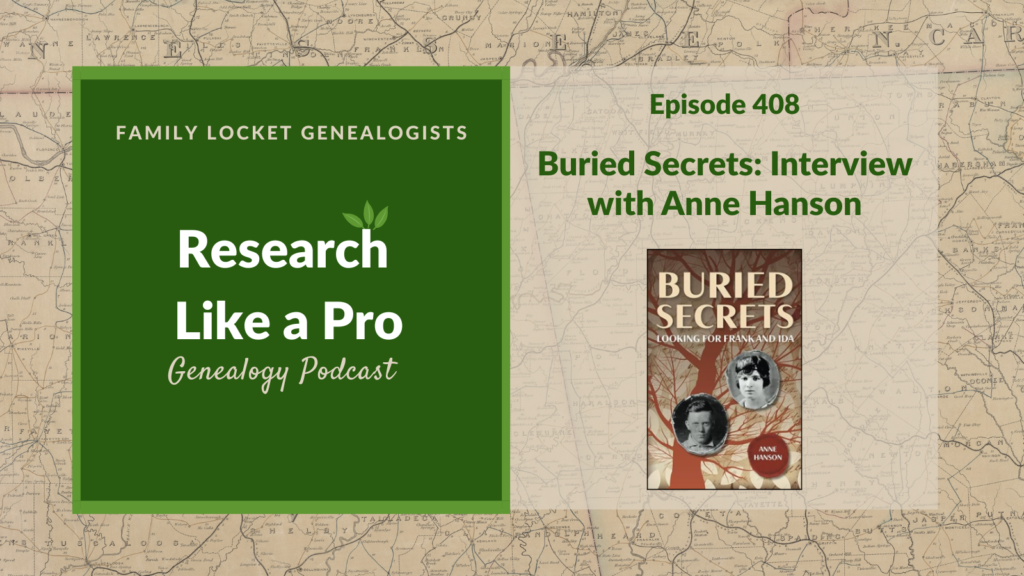
This episode of Research Like a Pro features an illuminating interview with author and genealogist Anne Hanson. Anne is the author of Buried Secrets: Looking for Frank and Ida, a deeply personal family history that uncovers the hidden past of her paternal grandparents. A lifelong genealogist and writer, Anne specializes in researching ordinary lives in the United States, the United Kingdom, and Sweden, with a special interest in the late 19th and first half of the 20th centuries.
Diana interviews Anne about her process of turning private family research into a published book. Anne shares how she decided when and how to include “Imagining the past” sections that blend fact-based research with imagined reconstructions. The host asks Anne about the emotional experience of writing about her grandparents, knowing their story had been deliberately hidden, and which scene or revelation in Buried Secrets was the hardest for her to write emotionally. Anne discusses how uncovering painful family secrets changes the view of our ancestors. The discussion also covers the research strategy or source that gave Anne the biggest breakthrough in solving the mystery of Frank and Ida’s true identities. Diana asks Anne to reflect on the role her father’s curiosity played in the research and how their relationship evolved through the shared genealogical journey. Listeners learn practical and emotional advice for overcoming “brick wall” ancestors and gain insight into how to balance meticulous genealogy with compelling storytelling. Anne closes by revealing her next research goal: finding her great-uncle Willard.
This summary was generated by Google Gemini.
Transcript
Nicole (0s):
This is Research Like a Pro episode 408: Buried Secrets – Interview with Ann Hanson. Welcome to Research Like a Pro a Genealogy Podcast about taking your research to the next level, hosted by Nicole Dyer and Diana Elder accredited genealogy professional. Diana and Nicole are the mother-daughter team at FamilyLocket.com and the authors of Research Like a Pro A Genealogist’s Guide. With Robin Wirthlin they also co-authored the companion volume, Research Like a Pro with DNA. Join Diana and Nicole as they discuss how to stay organized, make progress in their research and solve difficult cases. Let’s go.
Nicole (42s):
Today’s episode is sponsored by Newspapers.com. Hi everyone. Welcome to Research Like a Pro.
Diana (47s):
Hi Nicole. How are you doing today?
Nicole (50s):
Hey, I’m doing well and I’ve been analyzing a lot of clusters from ancestry custom clusters, just trying to figure out how they work, and I probably have mentioned this on the podcast before, but it’s been so interesting to figure out common ancestors for each cluster and see how it works and it’s really valuable. It’s such a great tool. I’m so glad we have it now.
Diana (1m 14s):
Oh, that’s great. And I’m glad you’ve been recording some videos about that and kind of teaching everyone what you’re learning because it really is just a matter of trial and error. I think we’re finding how best to use them.
Nicole (1m 29s):
Yeah, I definitely learned some things that work and things that don’t. Like one thing that didn’t work was adding a sidekick match under 20 centimorgans. Well, actually I tried two. I tried a sidekick match that was really low, like 8 centimorgans, and that did nothing to change the clustering for me. Then I added a sidekick match that was a little bit less than 20, but only like 17 centimorgans, and that changed the clustering, so that did have an effect on it. So probably that one smaller match had a very smaller set of shared matches that were like identical to the main test taker that I chose for the clusters. So that’s probably why. But it was interesting to try a bunch of different things and, and a funny thing that I learned is that you really have to know the test taker’s tree to not get confused, because I was using a third or fourth cousin who was one generation closer than you are to the Welch family, and I really didn’t know that much about her other ancestors except for the one we had in common.
Nicole (2m 29s):
And so when I did the clustering, I found this cluster that all went back to the Ellis family. I was like, whoa, this is a new cluster. I didn’t know how are these Ellis related to the Welchs? And they’re just a different ancestral couple in her tree on the same kind of branch, but a collateral line. So it was a good learning experience for me to do a pedigree analysis of the test taker first before trying to figure out who the common ancestors of all the clusters are.
Diana (2m 57s):
Oh, that’s a good lesson to learn and a good lesson for all of us. That’s a tricky thing when looking at someone else’s DNA because you don’t know their tree like you know your own.
Nicole (3m 6s):
Yes.
Diana (3m 6s):
You may not know their tree at all.
Nicole (3m 8s):
Well, the tricky thing with her results are that she hasn’t connected them to a tree at all, and I’m just a viewer, so I can’t connect them to a tree. And so I can’t see, there’s no common ancestor hints, there’s no Thrulines, there’s no dots to work with. It’s just, I’m just looking at the matches like, and that’s all I can see. So it really highlighted to me also the value and the benefit of having a tree connected and seeing the common ancestor hints and being able to use the colored dots. So.
Diana (3m 42s):
All those tools that Ancestry gives us. Yeah,
Nicole (3m 45s):
Yeah. That I’m used to. And they’re really helpful. Anyway, so after all the analysis, I did find one cluster that led me to a match that was really helpful, and it’s this Margaret Welch who married a Benjamin Mauldin, and I think I mentioned this before, but the Mauldin surname is connected to the Welch and the Keaton family through Lucinda Keaton’s sister Sally Reeves who married a, a son of Frances Mauldin, who’s a woman in, in South Carolina. So it’s been cool to see this name appear again. And as I’ve looked at your matches and other people’s matches, I’ve found multiple people who descend from this couple, Margaret Welch and Benjamin Mauldin, multiple descendants are matching your DNA and the other Welch descendants who have shared with me.
Nicole (4m 32s):
So I, I found a a little cluster who descend from this woman, and she’s a potential sister to George Welch. So it’s just another lead that could be helpful. So I’m excited that I have that. I’m not spending too much time on it this study group, because I’m trying to finish my research report for my certification portfolio. So my goal was just to do a little bit, write about it and then, you know, have it be like the next phase we’ll continue in another future research session, but it was fun to find that.
Diana (5m 3s):
Oh, good job. That’s really awesome that you’re making some progress on that Welch line.
Nicole (5m 9s):
Yeah, I feel like with the Welchs and the Dillards, we’re both just chipping away at these big brick walls, but then someday we’re gonna figure it out and it’s gonna be a party.
Diana (5m 16s):
Yes, indeed. I totally agree with that. I’ll plan the party if I can just figure it out.
Nicole (5m 22s):
Right. We’re getting so many clues and like the resources that we have now compared to what we had when we started with these families are just really expanding the evidence pool. It’s exciting.
Diana (5m 34s):
Yeah, agreed.
Nicole (5m 36s):
Well, for announcements, our webinar for the month of May is going to be by Amy Pittman, and the title is,Where Was Fannie Cliett Born? Examining a Family Story. And the subject is, Family tradition maintains that Fannie Cliett was born “on the line” between Alabama and Georgia in 1838. Using land, census, and military records, this project reconstructs the movements of Fannie’s parents from Floyd County, Georgia, into Cherokee County, Alabama, just before her birth. Although Cherokee County suffered severe record loss, federal land patents and the FAN club hint that the family story was based on truth.
Nicole (6m 16s):
So that’s neat that she’s going to be sharing about those federal land patents. She’ll talk about deeds, Confederate compiled military service records, FAN club research, family lore and more. And Amy is based in Birmingham, Alabama. She’s completed courses at the Institute of Genealogy and Historical Research, IGHR, and she’s done our study groups at here, Research Like a Pro, and she’s taken courses at the National Genealogical Society, and she’s worked with a lot of different record types, naturalization, census, land, military probate, tax court, church, university records, newspapers, manuscript collections, and she specializes in research within the Southeast.
Nicole (6m 57s):
So we look forward to that. And if you haven’t registered for our 2026 Research Like a Pro Webinar Series, we encourage you to do so so that you can watch this webinar and the previously recorded ones. And our next study group is in August of 2026. So if you want to be a peer group leader, let us know. And we have an application on our website, or you can just email us one of your research reports as a work sample. And then you get to have complimentary registration. Join our newsletter that comes out every Monday, and then you’ll get notifications of our new content and any upcoming conferences that we’ll be at so we can meet you and any coupon codes that we’re sharing.
Nicole (7m 38s):
We will be attending the National Genealogical Society Conference on May 27th through the 30th in Fort Wayne, Indiana. And this is home to the Genealogy Center at the Allen County Public Library. So we’ll be doing a tour there and we’ll be giving a couple talks. And so we hope that we’ll see a lot of you there. I know that a lot of people don’t travel to be at the conferences in person, but there is a virtual registration situation. The virtual option is for those who are not able to attend in person. So if you don’t wanna make the trip, you can receive access to the session recordings, which will include the audio and the slides in the Whova app.
Nicole (8m 18s):
And those are gonna be available 48 to 72 hours after the sessions occur. They’re not gonna be live streaming any of the sessions, and there’s no option to purchase individual sessions, but you can sign up for the full conference, and if you’re a member, that’s $447. So you’ll save on the travel and on the housing, and you’ll just be able to watch all the sessions. So it will be the slides and the audio, so you won’t see the presenter’s faces, but that’s fine. You just probably mostly care about seeing the slides. So yeah, everyone who’s thinking about signing up, hopefully that information is helpful too. And you can learn more at the National Genealogical Society Conferences website, https://conference.ngsgenealogy.org/2026registration/ and I’ll put that link in the show notes in case you’re wondering where to see more information about the virtual option.
Diana (9m 14s):
We are so excited to have Anne Hanson here. Hi Anne.
Ann Hanson (9m 20s):
Hi, Diana. How are you?
Diana (9m 22s):
I am so good. We are going to be talking all about Anne’s book, Buried Secrets, but let me just read a little bit of her bio before we get started. Looking for Frank and Ida, a deeply personal family history that uncovers the hidden past of her paternal grandparents. A lifelong genealogist and writer, she has spent decades researching ordinary lives in the United States, the United Kingdom, and Sweden, with a special interest in the late 19th and the first half of the 20th centuries. Anne’s work combines meticulous research, historical context, and compelling storytelling to bring family mysteries to life.
Diana (10m 4s):
She has written for the Boston Globe, numerous newspapers, corporate publications, and American Ancestors magazine, and she enjoys sharing her research journey through talks, interviews, and podcasts. So it is so fun to read that and to just see that you are a writer. You have written your entire life, it sounds like.
Ann Hanson (10m 26s):
I have written my entire adult life. And of course, during high school and college, I was the queen of the late papers, but, but yes, I, I have been writing my entire life.
Diana (10m 41s):
So when you had this family history mystery come about, it was pretty natural for you then to, to put it into a book?
Ann Hanson (10m 50s):
Well, you know, what first got it started, you know, I made all of these discoveries and both my dad and I were just like, Oh my goodness, we can’t believe this. But my dad was actually the first to say that I should write a book. You know, my findings were really shocking and painful for him. But he accepted and embraced the truth because I had given him answers that he had longed for his entire life. We both thought that we had an amazing story that illuminates human nature and celebrates the achievements of ordinary people.
Ann Hanson (11m 30s):
You know, my grandpa Frank was a carpenter, by the way. You know, my dad was just full of respect and awe for what his parents managed to accomplish, despite lots of adversity. And then he also just knew I could write, he knew I’d been writing forever, and he just thought this would be a great project for me. So it would be an opportunity for me to, you know, use my talents to tell our shared story.
Diana (11m 58s):
That’s really neat. I love that your dad really was your cheerleader. And despite it being painful for him, he still wanted the story out there. And I think that’s so important. Often in our genealogy and maybe even especially with DNA, we discover things that, man, it’s not what we expected.
Ann Hanson (12m 19s):
It’s hard. It can be hard. Yeah.
Diana (12m 21s):
It can be hard. And the beauty of writing it is that you were able to tell it from your perspective and to add a lot of compassion and understanding and context to why everything happened as it happened. And that’s really important as a writer. We have, we have that opportunity.
Ann Hanson (12m 41s):
Yes, we have the opportunity, and we have the responsibility, which I took very seriously in terms of trying to understand my grandparents. You know, I did as much research, you know, into the times that they lived and the places that they lived as possible. I also just wanna back up and say, you know, in terms of being this, being a, like a shared project between me and my dad, you know, the truth was so hard for him, but he did embrace it. He actually kept a draft. He used to lie on the couch during the day and read. He was a huge reader, and he actually kept a draft of my book by this couch, and he would read and reread it, and in this draft he would make little notes or little questions of things that he wanted to ask me, or points that he wanted to make sure I understood were important that he wanted me to emphasize.
Ann Hanson (13m 40s):
So yeah, my, my dad was totally my, my partner in this book, and he lived to find out the truth, which I’m very happy about. He unfortunately did not live to see this book, you know, be published, but, but he did learn the truth, which I am forever grateful for.
Diana (13m 60s):
Oh my goodness. Yes, for sure. So in the book, Buried Secrets, you have a really interesting way of portraying the story, and you have these imagined reconstructions where you have turned it into a story. And of course, you don’t know what might have happened in the scene between your grandparents, but you have some narration in there, you’ve got some dialogue in there, some description. So how did you decide when and how to include those imagining the past sections?
Ann Hanson (14m 35s):
Well, it really evolved organically. You know, typically I was inspired to create them when my research indicated that certain, that a certain scene had almost certainly occurred, but I didn’t have enough verifiable details to include it in the strictly nonfiction narrative. The first imagined scenes that I wrote were based on photographs from my grandparents’ photo collection, which had been hidden away for years, and which ultimately proved to be key in solving the mystery. So like for example, in, there’s an imagined scene in the prologue of my book, and it portrays my grandfather’s driving up and down a suburban lane in 1955, taking photos of a little ranch house from inside of the car with the windows closed.
Ann Hanson (15m 33s):
I know this happened because I have the photographs, I actually have other research, I have information on the ranch house. I have information from a newly found family member. So I had a lot of information telling me this had happened. So I was inspired to, you know, to write this scene, you know, trying to present, you know, a suspenseful and I hope emotionally compelling scene based on these real events. And, you know, as the book took shape, I saw more and more opportunities for these imagine scenes.
Ann Hanson (16m 13s):
So, you know, one of the big gifts of this project was the discovery that I enjoyed creative writing, like I’ve been writing my entire life. But I was, I always thought of myself as strictly a nonfiction writer. Like I wasn’t, you know, I had been a journalist, I’d been a corporate newsletter writer, you know, I wasn’t wired to make things up, but I found that I loved writing these imagined scenes. But in order to write them, actually, I should say by the way, they are clearly demarcated in the book, it’s always very clear what is my first person narrative and, you know, you know, factual, factually based narrative versus what is the imagined scenes.
Ann Hanson (16m 59s):
But in these imagined scenes, I found that that, you know, they had to be based on real events from my grandparents’ lives. So I ended up researching these scenes, if anything, even more than I did my first person narrative.
Diana (17m 15s):
Okay. There are a lot of good lessons in there for us as historians or family historians in writing, because I loved the imagining the past sections. I thought it brought your grandparents to life. And of course, everybody loves a story, and
Ann Hanson (17m 33s):
Yes. Yeah,
Diana (17m 34s):
that’s what it was
Ann Hanson (17m 36s):
I know, it’s funny. It, it was so much fun writing these imagined scenes. Yes. It’s, it did unlock this creativity that I hadn’t even even known was there. And, you know, through my dad’s stories, I mean, he and I started doing interviews before the big discoveries, and we kept on doing these interviews and conversations. You know, I, we’d be sitting around his house just sort of chatting, and all of a sudden we’re talking about his parents and talking about the past. So I felt like I had, I mean, I knew my grandfather quite well, and we were close, I don’t remember my grandmother, but through my dad’s stories, I just felt like I came to know her just in a very visceral, heartfelt way.
Ann Hanson (18m 21s):
So I just really wanted to honor her character and, you know, sort of tell her story as much as possible via the emotions that she must have felt.
Diana (18m 33s):
Right. I think that is really wise, and it is interesting how you can start to get a feel for an ancestor through all of those things and start to imagine how they would have talked, how they would’ve felt about a situation. And you just, it is an amazing thing. I, I’ve done something similar with my dad’s stories, and I wrote a whole series called The Adventures of Cowboy Bob. He grew up in Texas and Oklahoma and just had these amazing stories, and I just felt like I knew what, what would’ve happened, and so I could really connect because I had done something similar and thought it was so fun. Yeah.
Ann Hanson (19m 12s):
And one thing that really helped, I mean, I was so lucky to have a treasure trove of letters. My dad went off to graduate school in 1952, and his mom wrote him at least every week. And I have those letters now, and through this treasure trove of letters, not that I only just learn about her and her emotions and her life, but I learned like how she expressed herself, like the kind of language that she used. And so this helped me to try to recreate things in her voice. But yeah, so you’ve done this, so, you know, you, if you just gather so much information about a person, it can be so rewarding to try to recreate their experiences.
Diana (20m 3s):
Oh, I agree. And that’s so neat that you had the letters, because people do have a way of speaking or writing, expressing themselves, it’s really unique. And so that could really help to ground that in something real. Well, can we give just a little bit of background to the book and the story? Just tell us where this took place and just a little bit of background. I know we’re not going to give away the secret to the book, but let’s just give a little bit of background.
Ann Hanson (20m 34s):
Well, the background of the story is my dad grew up in Akron, Ohio in a working class neighborhood. You know, my grandfather was a carpenter, you know, they, they had four young boys during the worst period of the Great Depression. You know, my, my grandfather was totally out of work for several years, but they still, he and my grandmother together always managed to find a way to take care of those boys. My grandfather actually would scavenge like wood, and he’d build bird houses, and he would sell them on the corner for like a dime or something like that.
Ann Hanson (21m 14s):
But their biggest thing was their focus on education. Like their boys were gonna go to school, they were going to go to college. But the thing that was strange about my grandparents was they were extremely secretive about their past. And, you know, my dad was a very thoughtful and observant child, and the neighborhood they lived in had a lot of Italian families. So all the kids that my dad played with had lots of extended family. They had grandparents, aunts and uncles and cousins. Whereas my, my dad didn’t have any, if he asked my grandparents, they always said they were from Brooklyn, New York, but they refused to talk about their families and their past.
Ann Hanson (21m 58s):
If my dad asked about the families back in Brooklyn, they would just shut him down saying, they’re all dead, they’re gone. So it was taboo to ask about the past. The other thing was that my dad, he was the sensitive and thoughtful child, and he saw that my grandmother was just always kind of nervous and anxious, and he just didn’t understand why. So he just sort of grew up thinking there was something off, but he didn’t know what it was. So as soon as my sisters and I were old enough, and we were in a high school and college beginning in the late 1970s, my dad began asking us to research his parents’ family history.
Ann Hanson (22m 46s):
And we had a little bit more information now, because an aunt who had married into the family, Aunt Virginia, she thought it was crazy how little information the Hanson boys had on their family history. So she somehow managed to sit Frank and Ida down for a family history interview in 1953, and she made a family tree based on the information they provided. And so she began, you know, she was a librarian, so she began researching their family tree, but she could never verify a single supposed fact in that family tree.
Ann Hanson (23m 30s):
And so my sisters and I started on this beginning in the late 1970s, and one of my uncles started researching. And so from the late seventies through the late nineties, we all were researching the Hanson family tree, and we could not validate any of these supposed facts in our family tree. So by the year 2000, everyone had given up except me and my dad. Well, actually the year 2000 was a hard year because my dad’s two favorite brothers both died quite abruptly and was very painful for my dad.
Ann Hanson (24m 10s):
But one of the widows cleaned house and sent my dad a box of Hanson memorabilia, which included Frank and Ida’s photo collection that hadn’t seen the light of day in the 50 years. And so there was a whole bunch of photos that no one had ever seen, and one little photo, it took a lot of work and a lot of research, but one little photo ended up providing the tiny clue that broke open the whole case. And so once I had this one verifiable fact, all of a sudden all of my research, I started finding real people real places.
Ann Hanson (24m 57s):
I mean, it’s amazing researching real people, how much more rewarding it is.
Diana (25m 3s):
Yeah, by 2000 things were starting to be online. Yeah,
Ann Hanson (25m 7s):
I mean, we didn’t have, you know, social media yet. We didn’t have any reliable DNA, but yes, things started to be online by the year 2000, my dad got this box of pictures in the year 2000. He was actually so depressed about his brothers, it took me two years to get him to let me see those pictures. So I got them in 2002. And I have to say, especially in 2002, all genealogy search sites were not created equal. And so the sites that I first used, based on the information in these photos, did not actually give me any results.
Ann Hanson (25m 48s):
But then I signed up for Heritage Quest, and they had great indexing and Heritage Quest census records ultimately ended up giving me the information I needed to break the case, so to speak. But then the story continues. You know, I found my grandparents’ real past, and I located, you know, my grandparents had always said their families were all dead, they were all gone. And that was absolutely not true. My grandparents left behind families, many of whom had just missed them and mourned them. And I found these families they had left behind. Some were thrilled to see me, some wanted nothing to do with me.
Ann Hanson (26m 31s):
And you know, some were in between, but I did actually make some wonderful connections. And I ended up through lots and lots of research and, you know, doing interviews with my newly found family and researching every single source you can imagine. I mean, I know you’ve, you, you talk with your listeners a lot about all the different sources you can use, whether it’s probate records or court records, or school records, military, you name it. I used all of those records and I was able to come up with a pretty clear picture of the problems that my grandparents faced when they were young people and the steps that they took to leave their lives behind and recreate themselves.
Diana (27m 27s):
I think it’s really interesting that when you wrote the book, you write it like a bit of a mystery. And did you decide right at the beginning that you were going to structure the book as a mystery story? Or did it just naturally evolve as you started writing?
Ann Hanson (27m 44s):
Well, I consciously structured Buried Secrets as a mystery, although, to back up a little bit, when I first decided to write the book, I had absolutely no idea what I was getting into. You know, I knew how to write, you know, I’d been a reporter, the corporate newsletter writer. But when you’re doing that kind of writing, you just quickly research your story. You write it up, and of course you leave your feelings out of it, and then you move on. So the whole thing takes a couple of days or a week tops. But, you know, I had done, you know, all these interviews with my dad, and he was a fantastic interviewee, you know, his stories were full of detail and color and sounds and scents.
Ann Hanson (28m 29s):
And so my first very amateurish attempts at writing this book were kind of just like writing a memoir. And it was essentially transcriptions of these interviews tied together with bits of narrative. But then I buckled down and began to write seriously, and I became involved with Grub Street, which is a wonderful writing center in Boston, and I learned how to write book length narrative nonfiction. And I learned how to use the techniques of fiction such as foreshadowing and suspense to tell my story.
Ann Hanson (29m 11s):
It was after beginning classes at Grub Street that I made the decision that a mystery was going to be the best way to tell my story.
Diana (29m 22s):
Okay. That is really good to know that sometimes you need to learn how to write a certain type of writing.
Ann Hanson (29m 28s):
Oh my gosh. Just because you’ve been a, you know, a really good reporter doesn’t mean you know how to write a book. You have to learn.
Diana (29m 35s):
I love that, that, you know, a lot of us want to write something like this and maybe feel intimidated, but I love the idea to take a class and learn some techniques.
Ann Hanson (29m 47s):
Yeah. And you know, most adult education centers have some sort of class on memoir and writing, and I have to say, I’ll put in a little plug for Grub Street, it’s GRUB, they actually have online classes now too, as well as in-person classes. So any of your listeners who are thinking, well, maybe I’d like to write up something on my family, but you know, I don’t know how to write a book, where do I begin? You know, taking a class, whether it’s at Grub Street or someplace else, can be a great way to just start writing and to get feedback, you know, getting feedback from people. Sometimes it hurts, you know, you know, my very first versions of the book, you know, it was like bits of interviews tied together with narrative.
Ann Hanson (30m 35s):
And, you know, people in the classes would say, well, you know, why are, why am I reading this interview? And I was, and I would be like, oh, you don’t like this, but you know, you, you just have to put your ego aside and listen to what the feedback you’re getting.
Diana (30m 51s):
That’s such good advice. Yes. Feedback can be very painful.
Ann Hanson (30m 55s):
It can be painful. And, and you also need to learn when to listen to the feedback and when to stick to your guns. That is,
Diana (31m 5s):
I agree.
Ann Hanson (31m 6s):
Sometimes it’s, it’s not clear.
Diana (31m 7s):
I agree. Because you have a gut feeling, it’s your book.
Ann Hanson (31m 10s):
It is my book
Diana (31m 11s):
When it comes down to it. Yeah. Well, let’s talk a little bit about the emotional side of this. So you talked about it being really difficult for your dad, you know, as a generation removed was it as difficult for you? How did you feel about these things you were uncovering?
Ann Hanson (31m 29s):
I never was upset or angry at what I uncovered. I was shocked at times. You know, I had already come to know my grandmother through my dad, and of course I knew my grandfather, so it was shocking at times. But I kind of feel like if you’re looking for the truth, you have to be prepared for whatever you may find. And, and I know my, my dad always said, truth is best. It was certainly not what I expected. What I think was actually a little bit harder for me, and this goes, comes back to learning how to write a book, especially a book about personal experiences, writing about my own emotions was probably the hardest part for me.
Ann Hanson (32m 17s):
You know, as a journalist, you are trained to keep your feelings outta the narrative. So I had to learn to write about my feelings in a way that was authentic and also that was comfortable for me. You know, there was a lot of examples, you know, like high school and college were tough times for me because my parents got divorced and it, it was difficult. But, you know, I don’t like to dwell on it, but I needed to include that in the book because it illuminates how my relationships, both with my dad and with my grandpa, Frank, were bright, positive beacons of comfort during some difficult times.
Ann Hanson (33m 4s):
So, yeah. But the former journalist had to learn how to share her feelings.
Diana (33m 9s):
Hmm. Yeah. That is so interesting. And I, I think it really comes through the closeness with your dad in the book, because you include so much about him and his cheering you on.
Ann Hanson (33m 21s):
Oh, he, oh, it’s so funny, you know, you know, in the draft of the book that he read, so I included some scenes where I show him becoming really, like, quite emotional. He never questioned it. He always accepted whatever I wrote, although it could not have been easy, you know, he had like kind of what in his book would be a meltdown. You know, other people would just say, oh, he was a little upset. But in my dad’s world, it would be a meltdown. And I, I write a chapter just showing him being really upset. His only comment to me was, the book is a little bit more about me than I expected.
Ann Hanson (34m 2s):
So yeah, I mean, in a way, you know, the book is a love letter to my dad as well as to my grandparents.
Diana (34m 9s):
And that really comes through. It really shows your relationship and just this desire to know, I thought it was just fascinating. Let’s take a minute and have a word from our Sponsor and then we will continue. As flowers bloom and the days get warmer, why not breathe new life into our family history research. Newspapers.com is the perfect companion for Genealogists at any level looking to go beyond names and dates. With access to over a billion pages of historical newspapers, you can uncover fascinating stories about your ancestors that don’t show up in typical records. Picture finding a heartfelt obituary that introduces extended family, a local news article showcase casing your great-grandmother’s community role, or even a photo that captures a special moment from long ago.
Diana (34m 58s):
Little treasures that make their stories blossom before your eyes. Newspapers are packed with the everyday moments, announcements, celebrations, challenges that bring color and depth to the lives of those who came before you. These rich primary sources help you connect with your family’s past in a way that feels personal and meaningful. The search is easy and intuitive whether you’re looking by name, place, or time period, letting you uncover these hidden gems at your own pace, ready to brighten your research with stories that go beyond the usual. Visit newspapers.com/FamilyLocket today and enjoy 20% off a subscription. Let spring be the season you turn your family tree into a lively family story.
Diana (35m 40s):
All right, so let’s turn a little bit to this idea of research, because you talked about how there was one photo that was really the key. And a lot of us have brick wall ancestors like this. Maybe they’re not all hiding a big secret, but they’re just hard to find. So what do you do when you get stuck?
Ann Hanson (36m 3s):
Well, you could look at it on a practical level or on an emotional level. On a practical level, I would say, have you plumbed each and every primary source? Have you bugged all of your relatives to let you see old family papers and photographs? You know, one person might think, oh, it’s, you know, one, your aunt might think, oh, it’s just a box of old stuff, mean, you know, it’s not important. You know, you wanna see those papers. You never know what, what might be hidden in them. I’d also say, you know, if you’re stuck, have you validated all of the research that has been done thus far?
Ann Hanson (36m 44s):
Have you validated the information that’s passed down in family stories and genealogy? You know, on an emotional level, you know, if you’re really stuck, it may be because the information you were given is either untrue or incomplete. In terms of it being untrue, you know, my Aunt Virginia, the one who did this big genealogical interview in 1953, you know, she married into the family, she managed to sit my grandparents down for that genealogical interview. And then for another 40 years she researched based on this fictitious family tree.
Ann Hanson (37m 30s):
But she, emotionally, she just was never able to make the leap to consider the possibility that Frank and Ida had lied to her. Whereas, you know, once I had been researching for five years and I couldn’t validate any of this tree, I began saying, you know, I think my grandfather changed his last name. There’s no other reason why we can’t validate anything that they told us. And once you kind of get past that emotional hump of accepting that the information you have is either untrue or incomplete, this has the potential practical benefit of helping you, you know, refocus your research or expand, like where you’re researching or expand your sources.
Ann Hanson (38m 27s):
So that would probably be, you know, the best advice I could give.
Diana (38m 30s):
I think that’s really wise. We get so stuck in our heads about what we think happened, and sometimes we just need to let go and think of another possibility. So that is so interesting.
Ann Hanson (38m 43s):
I think there’s a Sherlock Holmes quote, I’m just paraphrasing it now, but it’s something to the effect that once you eliminate all of the possibilities that cannot be true, then what is left has to be true. Something like that. I’m not saying it quite right.
Diana (39m 4s):
Yeah. Yeah. I, I think I remember that one. I don’t know how it, how it actually goes either, but I, I understand the idea. Well, let’s talk about what is next. You know, you finished this and you mentioned that your next goal is to find great-uncle Willard. Now is Willard on the mom or dad’s side?
Ann Hanson (39m 22s):
Willard is actually on my dad’s side, and he was a bit of a, I don’t know, he has quite a checkered history. He had a first marriage and then he and his wife separated and he went off to the military and she went back to live with her parents. She was still married to him, and then she died, which people were in the habit of dying very young in the early 20th century, its really quite heartbreaking. So then a few years later, he marries again. He marries a, a, a young woman 10 years younger than him. And his trail goes cold after 1919 in Springfield, Massachusetts.
Ann Hanson (40m 9s):
His wife in the 1920 census, she ends up in Boston, Massachusetts, working as a domestic, living in a household just as a boarder. But she’s still married to Willard. And then she actually ends up going to New York City, and also dying a few years later. She’s buried alone, she’s still married to Willard. Family stories, which may or may not be true, say that he went to Germany. There’s a lot of different stories hinting that he went to Germany. So, I don’t know if this is true, but I know I started researching this a couple years ago and then I just had some higher priorities.
Ann Hanson (40m 56s):
But, but to research in Germany, I think my best course of action will be to work with a German Genealogist ’cause there is, you know, the language barrier. And Germany also has, of my understanding, has a lot of rules and regulations about what types of in information you can access and how so, yeah, I, I wanna get back in touch with this German Genealogist who had, you know, sent me this big form that I had to fill out. And I had said, okay, I’ll just put this off for later. Of course, the other problem could be, you know, so much was destroyed in Germany during World War II. I just have to cross my fingers that any records of Willard’s arrival in Germany or his experiences in Germany, assuming he was there, I have to hope that they weren’t destroyed.
Diana (41m 51s):
Yes.
Ann Hanson (41m 52s):
But yeah, he has quite the twisted path and you know, what happened with his wives? I mean, it’s kind of, but yeah, so I would love to, to find out what happened to Willard.
Diana (42m 4s):
Isn’t that interesting? Out of all our ancestors, you’ve got this one guy who takes off and then we, we always have that one person that we just are so curious about.
Ann Hanson (42m 13s):
Yeah.
Diana (42m 13s):
Where did they go? What happened to them? And the German records is an extra little bit of a twist.
Ann Hanson (42m 20s):
Yes. But yeah, people’s, we, we do become fascinated with, with this person whose trail, whose path is so hard to research. But then again, going back to my comments earlier about your received wisdom versus what may actually be true. Did Willard really go to Germany? I mean, a lot of family stories say that he did, but I don’t know whether he did. And this is also where now that DNA is widely available and much more reliable, you know, more and more people are getting tested every day. So the bigger the database of DNA that you have the most more reliable it is.
Ann Hanson (43m 5s):
So I also plan to use DNA as much as possible, especially in the eventuality that Willard did not go to Germany.
Diana (43m 15s):
Well, there you go. Opening up your mind to a different possibility.
Ann Hanson (43m 20s):
Exactly. Exactly.
Diana (43m 20s):
I love that. Well, that is really fun. Well, I think that our listeners will be fascinated to take a peek at Buried Secrets. And I love all the different ideas you gave us about writing and connecting to our ancestors. You know, kind of as a final thought here, how has this really changed, you know, changed you uncovering and sharing everything in the book?
Ann Hanson (43m 47s):
Well, in terms of my personal identity, you know, I always knew that the parents were, above all, educated. But a big thing that has changed for me is my understanding of how we got here. So, you know, through this experience, I came to really feel and to internalize how we came from working class people. You know, my grandfather was a carpenter. Before I had known this, but I hadn’t really embraced it. So I developed a great respect for people in the skilled trades, you know, such as my grandfather.
Ann Hanson (44m 29s):
Yeah. So in terms of my family legacy, I learned that when my grandparents created their own new identities, they really altered all of our destinies. And I think learning how they, through like great overcoming obstacles, like my, their relentless insistent on education, overcoming pain, they created the life that became possible for me and my sisters and my cousins. So I think I, I have come to have a huge appreciation for the sacrifices that they made for me and my cousins and for the generations that followed.
Ann Hanson (45m 16s):
And I think I just came to have a, a greater understanding of how, and so many families, You know, parents sacrifice for their children so they can have a better life. I mean, we all know that, but it’s just to, in my own personal experience, to feel that made it very real for me.
Diana (45m 39s):
Oh, I love that. Well, the more you research someone, the more you love them, the more you connect with them, the more you understand them. I think that’s something that we really enjoy as Genealogists is this connection to ancestors. And you certainly did get that connection in all of your, how many years did you research this family?
Ann Hanson (46m 0s):
Well, let’s see, I started in 19, was it 78 or 79 when I was in college. And, well, you know what, I’d have to say, you know, writing the writing Buried Secrets was an iterative process over the course of 15 years. So I would research, write, revise, then research again, then write again, then revise again. So I would say my research wasn’t totally done until 2019. So, oh my goodness, is that 50 years? Is that, oh, maybe. Maybe 40 years. It was really 40 years, a really long time.
Ann Hanson (46m 41s):
But I think the other thing you were talking about how we just become, I mean, you develop a love for our ancestors. That’s one of the reasons I think we’ve become so obsessed with uncovering all these little details because we want to feel like their lives sort of like in living color to understand the little details that made up their day-to-day lives or that were behind their decisions, but behind the path that they followed. So yeah, I, I think as Genealogists, we research an ancestor, we come to inhabit their lives with them or we try to, anyway,
Diana (47m 23s):
I like that word, inhabit their lives with them. Well, and I think your 40 years of research gives hope to everyone. You know, many of us have been researching our people that long.
Ann Hanson (47m 33s):
Yes, yes. Yeah. Because it’s okay. Yeah, it’s okay. You asked me earlier, I’m gonna jump back. A piece of practical advice I would give is do keyword searches on the newspaper sites, not just, you know, Newspapers.com is a wonderful source and I know they were in your advertisement, and there’s also the Library of Congress has this wonderful source of Chronicling America and they have many, many historical newspapers there that are available through both Newspapers.com and Chronicling America. I had some fantastic finds that really helped me fill in a lot of the blanks of my grandparents’ secret histories.
Diana (48m 21s):
That’s a really good tip because you are researching in the 20th century when there are a lot of newspapers.
Ann Hanson (48m 27s):
Yeah.
Diana (48m 27s):
And you get a lot of little details there. And it’s tricky because those newspapers are scattered amongst a lot of different website,
Ann Hanson (48m 35s):
A lot of different sources. Yeah. So you have to use all of the sources. Mewspaper.com is a great source. The Chronicling America is a great source. You might still need to go to your local library and see what newspapers, you know, many local libraries on microfilm or a microfiche have local newspapers. And if you’re a patient enough to sit at that machine and just go through newspaper after newspaper, you know, in addition to lots of reports on the weather and who had some friends for tea who went off to the war, you sometimes can find amazing pieces of information on our ancestors.
Diana (49m 22s):
Well, and even if you don’t find your ancestor, you get a sense of their community, what was happening in their area.
Ann Hanson (49m 27s):
Of their time, absolutely. Yeah.
Diana (49m 27s):
And if you’re writing about them, that really helps you put yourself in their story and their place.
Ann Hanson (49m 35s):
Absolutely. I know in, in, in writing my imagined scenes, I mean, I immersed myself, there are these wonderful books, I’m sure you’ve seen them, its called Images of America, and it’s like, you know, giving, there are all these like local history where there’s all these pictures from local communities and then there’s narration that kind of tells the stories of these communities. And through these Images of America books and through so many other sources. Yeah, I just tried to immerse myself in the world my grandparents lived in so that I could tell their true stories in a compelling way.
Ann Hanson (50m 15s):
And also for the imagined scenes, I, I tried to make these scenes as realistic as possible based on all of these sources, including these newspapers.
Diana (50m 28s):
Love that. Well, I love the hint about Images of America, and we will put a link to that in the show notes because that is something that could really help a lot of our listeners. I’m just looking at some of them and their national parks, different places such as Savannah, Georgia. Just really fun. Thanks for that tip. I actually had not heard of those before, so
Ann Hanson (50m 50s):
Oh yeah, they, they are great books. That’s great. And funny a little aside is my mom was, was very involved in her, her local history society for years, and she actually edited a bunch of these books, so it’s really kind of fun.
Diana (51m 5s):
That’s neat. Well, Anne, we’ve just been such a delight to talk about your book and writing, and hopefully it’s given some of our listeners who are hoping to write a family history book of their own, some ideas of how they can do it, and to know that it, you know, you just can get started and it can take 15 years of research and writing.
Ann Hanson (51m 22s):
It can take 15 years research and writing, but if you really want to do it, you can do it. You just have to start wherever you are.
Diana (51m 32s):
Take some classes, get started, learn and go. Well,
Ann Hanson (51m 36s):
Exactly.
Diana (51m 36s):
Thanks so much for being here. It has just been a delight, and thanks everyone for listening, and we will talk to you next time. Bye-bye. Okay,
Ann Hanson (51m 46s):
Bye-bye.
Nicole (51m 45s):
Thank you for listening. We hope that something you heard today will help you make progress in your research. If you want to learn more, purchase our books, Research Like a Pro and Research Like a Pro with DNA on Amazon.com and other booksellers. You can also register for our online courses or study groups of the same names. Learn more at FamilyLocket.com/services. To share your progress and ask questions, join our private Facebook group by sending us your book receipt or joining our courses to get updates in your email inbox each Monday, subscribe to our newsletter at FamilyLocket.com/newsletter. Please subscribe, rate and review our podcast. We read each review and are so thankful for them. We hope you’ll start now to Research Like a Pro.
Links
Buried Secrets book on Amazon – https://amzn.to/4vVviv2 (affiliate link)
Anne’s website – https://annehanson.com/
Excerpt from the book – https://annehanson.com/chapter-to-read/
Grub Street: Center for Creative Writing – https://grubstreet.org/
Sponsor – Newspapers.com
For listeners of this podcast, Newspapers.com is offering new subscribers 20% off a Publisher Extra subscription so you can start exploring today. Just use the code “FamilyLocket” at checkout.
Research Like a Pro Resources
Airtable Universe – Nicole’s Airtable Templates – https://www.airtable.com/universe/creator/usrsBSDhwHyLNnP4O/nicole-dyer
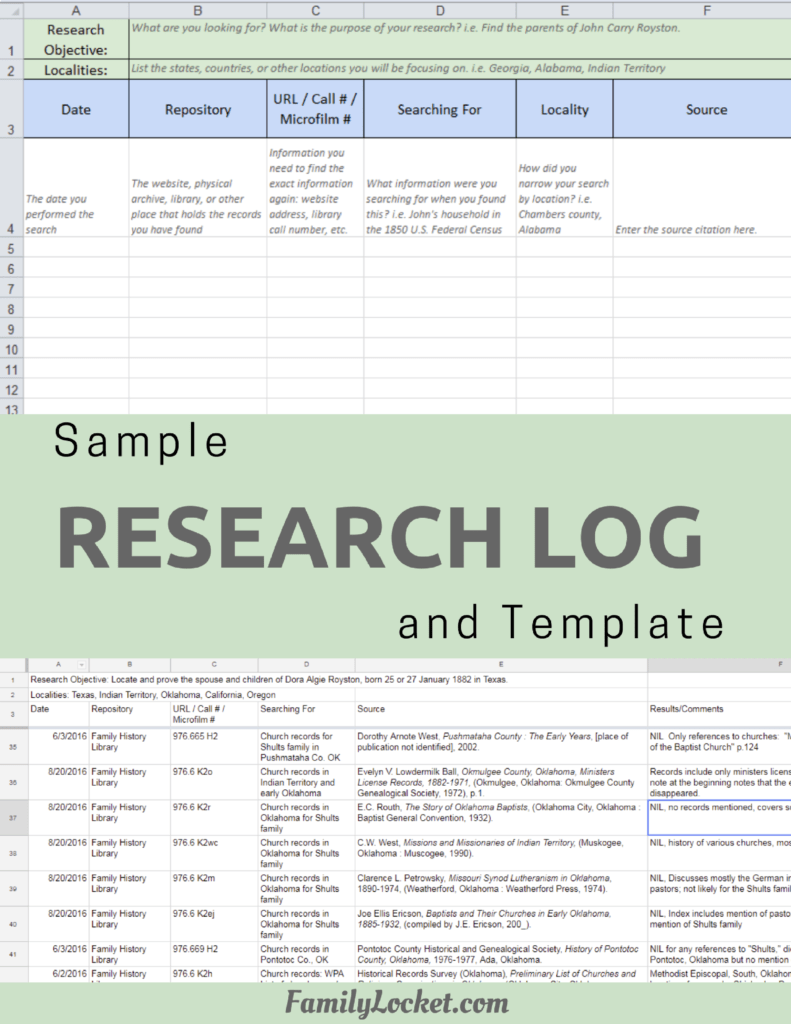
Airtable Research Logs Quick Reference – by Nicole Dyer – https://familylocket.com/product-tag/airtable/
Research Like a Pro: A Genealogist’s Guide book by Diana Elder with Nicole Dyer on Amazon.com – https://amzn.to/2x0ku3d
Research Like a Pro with AI Workbook – Second Edition (eBook) – https://familylocket.com/product/research-like-a-pro-with-ai-workbook-second-edition-ebook/
14-Day Research Like a Pro Challenge Workbook – digital – https://familylocket.com/product/14-day-research-like-a-pro-challenge-workbook-digital-only/ and spiral bound – https://familylocket.com/product/14-day-research-like-a-pro-challenge-workbook-spiral-bound/
Research Like a Pro Webinar Series – monthly case study webinars including documentary evidence and many with DNA evidence – https://familylocket.com/product-category/webinars/
Research Like a Pro eCourse – independent study course – https://familylocket.com/product/research-like-a-pro-e-course/
RLP Study Group – upcoming group and email notification list – https://familylocket.com/services/research-like-a-pro-study-group/
Research Like a Pro Institute Courses – https://familylocket.com/product-category/institute-course/
Research Like a Pro with DNA Resources
Research Like a Pro with DNA: A Genealogist’s Guide to Finding and Confirming Ancestors with DNA Evidence book by Diana Elder, Nicole Dyer, and Robin Wirthlin – https://amzn.to/3gn0hKx
Research Like a Pro with DNA eCourse – independent study course – https://familylocket.com/product/research-like-a-pro-with-dna-ecourse/
RLP with DNA Study Group – upcoming group and email notification list – https://familylocket.com/services/research-like-a-pro-with-dna-study-group/
Thank you
Thanks for listening! We hope that you will share your thoughts about our podcast and help us out by doing the following:
Write a review on iTunes or Apple Podcasts. If you leave a review, we will read it on the podcast and answer any questions that you bring up in your review. Thank you!
Leave a comment in the comment or question in the comment section below.
Share the episode on Twitter, Facebook, or Pinterest.
Subscribe on iTunes or your favorite podcast app.
Sign up for our newsletter to receive notifications of new episodes – https://familylocket.com/sign-up/
Check out this list of genealogy podcasts from Feedspot: Best Genealogy Podcasts – https://blog.feedspot.com/genealogy_podcasts/


Leave a Reply
Thanks for the note!