
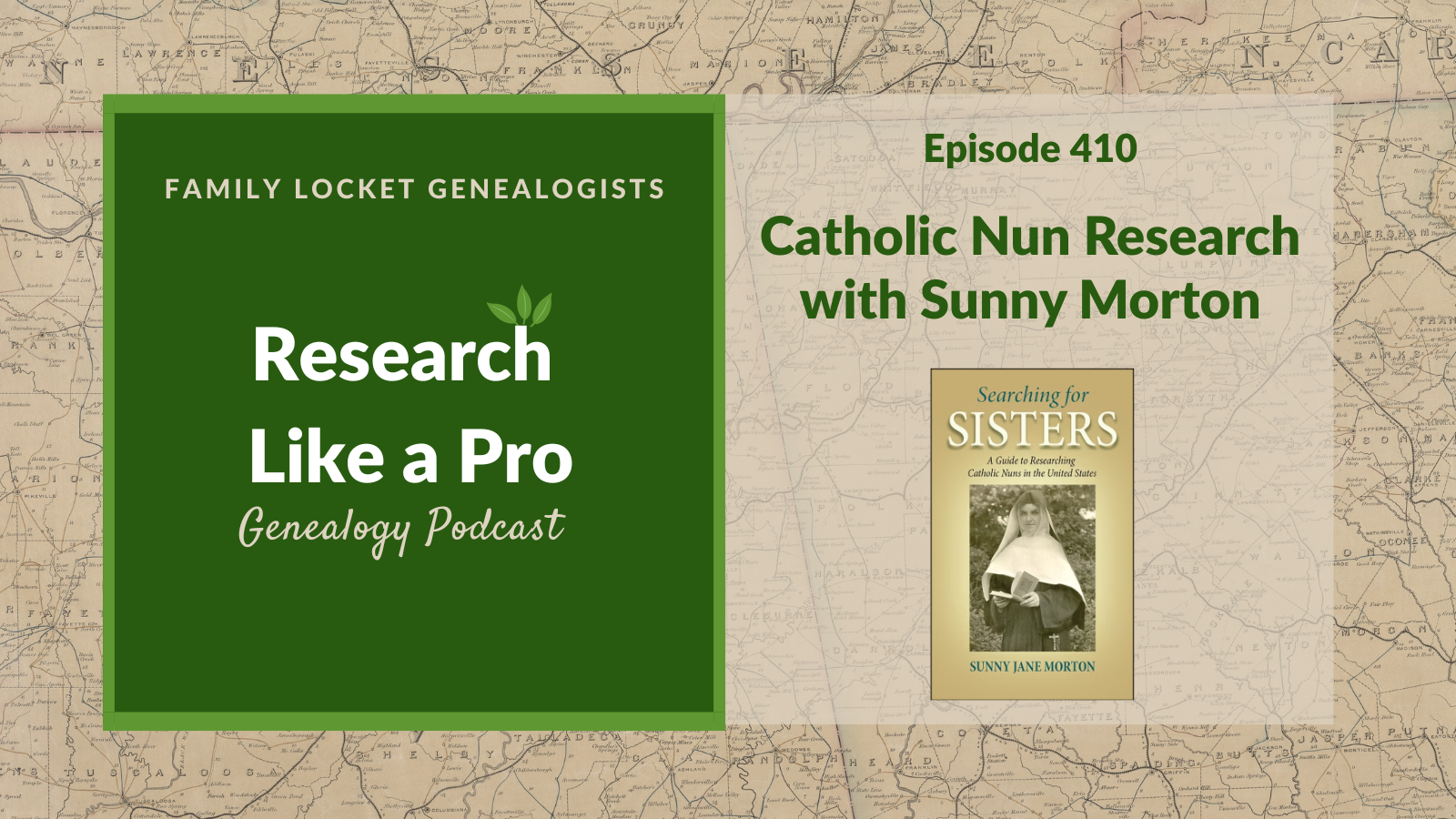
This episode of the Research Like a Pro Genealogy podcast features guest Sunny Morton. Sunny is a genealogy educator, writer, and editor who specializes in US records, particularly those of religious denominations. She is the author of Searching for Sisters: A Guide to Researching Catholic Nuns in the United States.
The discussion begins with the motivation behind writing the book, Searching for Sisters. Then, Sunny shares what the religious life was like for Catholic sisters and nuns. The episode covers practical research steps, including how a researcher can discover which institute a woman may have joined. The conversation addresses what types of records researchers might find in a religious archive. They also discuss publicly available records that can help researchers learn about the lives of sisters and nuns. Finally, the episode addresses how to best tell a sister’s story and includes an example. Listeners learn essential strategies for researching the lives of Catholic nuns in the United States.
This summary was generated by Google Gemini.
Transcript
Nicole (1s):
This is Research Like a Pro, episode 410: Catholic Nun Research with Sunny Morton. Welcome to Research Like a Pro a Genealogy Podcast about taking your research to the next level, hosted by Nicole Dyer and Diana Elder accredited genealogy professional. Diana and Nicole are the mother-daughter team at FamilyLocket.com and the authors of Research Like a Pro A Genealogist’s Guide. With Robin Wirthlin they also co-authored the companion volume, Research Like a Pro with DNA. Join Diana and Nicole as they discuss how to stay organized, make progress in their research and solve difficult cases.
Nicole (40s):
Let’s go. Today’s episode is sponsored by Newspapers.com. Hi everyone, and welcome to Research Like a Pro.
Diana (49s):
Hi Nicole. How are you doing today?
Nicole (52s):
Hey, I am doing well and having a lot of fun working on my study group project about the Welch family. How about you?
Diana (60s):
I have been working on my study group project as well on the Dillard family. So I’ve been researching these three Dillard men, James, Joseph, and Tolliver, which Tolliver is my favorite because I love that name. So fun. And also because there’s not multiple people of the same name. There’s a lot of James’, there’s only one Joseph, and then there’s this Tolliver. So I’m just trying to decide if any of those are likely candidates for Cynthia and just working through my research plan.
Nicole (1m 30s):
Yeah, that’s great. Well, one of these days you’re gonna figure out Cynthia’s father. So I have full faith in you.
Diana (1m 36s):
I really wish she had named a son Tolliver, because then I could make a good connection.
Nicole (1m 40s):
That would be nice, but it could be Uncle Tolliver, I guess.
Diana (1m 43s):
Yes, it could be.
Nicole (1m 45s):
But it is nice when you see those naming patterns emerge.
Diana (1m 48s):
Right? And unfortunately all of her sons are just very generic names. Richard, Robert, Ulysses, you know, after General Ulysses S. Grant, and you know, nothing that’s super, super indicative of a name. However, we do have a Leonidas that I haven’t quite figured out yet. So Cynthia, such a mystery.
Nicole (2m 10s):
Yeah, that that Leonidas. That’s a good name. Well, for our announcements today, we have the next webinar in our Research Like a Pro Webinar Series coming up on June 16th by Barb Groth. And it’s called Geography, Negative Evidence and Autosomal DNA – Reveal a Child Bride’s Father. And this will be about a Georgia and Texas, same name individual case. So it’s Mildred was first located in Newton, Texas when she married Cornelius Kelly in 1900. And no direct evidence ties her to either the date and place of her birth or the name of her father, but negative and indirect evidence combined with DNA autosomal matches prove that Mildred Katherine Kelly, born in 1882 was the daughter of William Wilton Beasley.
Nicole (3m 0s):
So that will cover legal context, probate records, negative census searches, voter registration, tax rolls, and Ancestry DNA matches. Barb Growth is an Accredited Genealogist® in the Great Lakes region and a graduate of ProGen and our Research Like a Pro study group. So we’re excited to have her. Our next Research Like a Pro Study Group begins August, 2026, so we hope you’ll join us and begin thinking about if you want to be a peer group leader for that and get free registration. And if you have not joined our newsletter that comes out every Monday, you should sign up so that you can get notices about any new blog posts and podcast episodes and coupon codes and things like that.
Nicole (3m 42s):
We hope we will see you guys at the National Genealogical Society Conference coming up on May 27th through 30th in Fort Wayne, Indiana. And the theme is America at 250 and we’re both speaking about several topics. We’re excited to be there. And also our guest today, Sunny, will be there and she’ll be giving a keynote. So we’re just really looking forward to the National Genealogists Society Conference coming right up,
Diana (4m 9s):
Right all of a sudden, here it is. Well, let’s talk about Sunny. Hi Sunny. We’re so happy to have you on the podcast today.
Sunny Morton (4m 17s):
Hi, it’s great to be here.
Diana (4m 19s):
Let me just give a little bio for anyone who’s not familiar with Sunny’s work. She is a genealogy educator, writer and editor, and she is currently editing the National Genealogical Society’s NGS magazine and she’s a contributing editor at Family Tree Magazine. She specializes in US records, particularly those of religious denominations. She’s co-author of the NGS award-winning book, How to Find Your Family History in US Church Records with Harold Henderson CG, and author of Searching for Sisters, A Guide to Researching Catholic Nuns in the United States. As someone with a special interest in personal narrative and story craft she also teaches family history, storytelling, and informal writing with resources such as Story of My Life, A Workbook for Preserving Your Legacy.
Diana (5m 10s):
She’s a returning instructor at the GRIP Genealogy Institute and you can find her at www.SunnyMorton.com. So Sunny, you’re so amazing with all the different things that you do, and it’s just so neat to be able to have you on and talk about your newest book, Searching for Sisters. So that’s what we’re gonna talk all about today. And first of all, I just wanna know, why did you feel the need to write this book?
Sunny Morton (5m 41s):
Well, I have to say there, there were a couple of related reasons, and I think a lot of us end up being driven by our own case studies. And this was one of mine I learned through my own experience searching for a Catholic sister on my family tree that records about sisters can be really rich in genealogical and biographical information, both about the sisters themselves and then even about their family members. But as I learned to my everlasting chagrin, these records can be really difficult to find. And then even once you find them, even if they’re really rich genealogical resources, they can also be full of obscure terminology and concepts because they’re about Catholic religious life, which just, it’s is, it’s its own thing and there’s just, there’s a lot that goes into it.
Sunny Morton (6m 35s):
So there’s a steep learning curve, and I had to teach myself and I decided that as I was learning about it myself, that we could really use a breadcrumb trail for both Genealogists and historians to lead us to better understand these mostly hidden communities of religious women.
Diana (6m 54s):
Oh, I love that. And as so often is the case, it’s our own research that leads us to learning more and gives us that real impetus to just dive deep, which is what you did. I don’t think I’ve seen another resource on searching, you know, the Catholic nuns, the the sisters that I can think of.
Sunny Morton (7m 15s):
There really isn’t that, that’s really why I did it. I was looking around because I needed help. I, I needed to understand what I was finding. I needed to try to find the right, like which, which order did this sister belong to? Where are her records? How do I even figure out which order she belonged to? What are the records and resources that can help me answer these questions? And I just had to stumble around myself and try to find these answers. I am not Catholic myself. And so I had to, and even as a, an expert in religious records in the United States, there was a lot for me to learn, even with a really good understanding of Catholic sacramental records and things.
Sunny Morton (7m 56s):
This, this is not just Catholic sacramental records, this is a whole different topic. So this really was a deep dive, but so that this, this required a whole new level of understanding and like you said, there just really wasn’t anything out there to help me do it. So once I figured it out, I just laid it out for everybody else.
Diana (8m 15s):
Well, And I really appreciated the fact that in the book you do lay it out and you explain so much about the context about what, what was happening with these women. You know, even this whole idea of how to call them women, and you decided to use the term it wasn’t just nuns or sisters, it was Women Religious
Sunny Morton (8m 37s):
Women Religious,
Diana (8m 38s):
Yeah, Women Religious. I was like, oh, that’s an interesting term I had never heard of. So
Sunny Morton (8m 42s):
Yeah. And that that’s the term that’s used today collectively to describe Catholic nuns and sisters. They’re known as Women Religious, and so that doesn’t even sound grammatical to some people. You kind of have to wrap your head around it. But that, that’s the term that’s used. But yeah, that describes both nuns and sisters and then you’re like, wait, you’re saying nuns and sisters, there’s a difference. And then so you kind of have to go into that. And then so there’s at almost every turn there’s another terminology to describe.
Nicole (9m 17s):
Exactly. Love that. I think it’s really helpful to just have a book that you can read instead of having to go figure it out for yourself. And that was such a gift that you created for all the other researchers that will follow after you.
Sunny Morton (9m 30s):
Well, I have to say that I was very careful about, well, let’s making, let’s make sure that I figured it out right so that I’m not leading everyone astray. So that as I wrote the book, I involved several other archivists and Sisters, Catholic Sisters, I, you know, I asked, I had a lot of advanced readers read the book, make sure I got the terminology right, make sure I got the, the records categorized right by visiting the archives myself and by having others look at them so that I, I’m making sure that like, let’s, let’s make sure that I’m doing this right. And then also with my methodology, I invited others to do case studies and I, I asked others to like, can you follow my processes here and make sure that they’re working for you?
Sunny Morton (10m 16s):
And that so that I can, I can make sure that what I’m telling everybody is, is actually right.
Nicole (10m 23s):
That’s a genius thing to do. Can I ask, what is the relationship to you, your case study, that originally got you into looking at the nuns? Is this someone in your family?
Sunny Morton (10m 36s):
Yeah, so this was a, a woman who showed up. So it’s actually like an ex-brother-in-law. But this was like a a a brother-in-law that I felt a, a connection to. This is somebody that my mom remembers knowing and that she tells about, she’s like, oh, you’re looking at this, the story of, you’re looking at the life of Henry Fox. He was a, a man that my aunt divorced. And so he was not even technically part of the family. I’m putting that in air quotes still by the time kind of the, the generations all sifted out. But she’s like, I always really cared about him because I felt like he did stick around in the neighborhood and she’s like, he’s, he would come over it and sit and rock me.
Sunny Morton (11m 19s):
She’s like, I was a colicky baby and my mom, my poor mom just was really distraught and exhausted. And as any of us who have ever had colicky babies would understand the relief that it would be to just have somebody show up and say, hand me your child and then just sit and rock them and let them scream.
Nicole (11m 41s):
Yes. Amazing.
Sunny Morton (11m 42s):
That’s what this man did. So that when I came across Henry Fox and I’m like, I don’t care if they divorced, I would like to know more about him and trace his lineage.
Nicole (11m 49s):
nice.
Sunny Morton (11m 49s):
I’m like, that’s what I can give back to him. So that’s what I did was look at his life and his life was kind of a mystery. His, I figured out who his parents were, but his parents divorced when he was about eight years old. And it said he was an only child and then I could find nothing about his parents after that. And then in his obituary it said he was survived by Sister Mary Barchella, that he was the brother of Sister Mary Barchella. And the way that it put it, it was very clear that that was a religious name.
Nicole (12m 18s):
Okay.
Sunny Morton (12m 18s):
I’m like, what? How is it that he ended up having a sister? And, but I didn’t know ’cause it was a religious name, I didn’t know whether it was through his mom or his dad because there was no surname there. I don’t know her birth name. Like I, there’s, there was a lot I didn’t know, but I knew that she was Sister Mary Barchella of Waterloo, Iowa.
Nicole (12m 36s):
Oh my gosh. So you have a mystery starting point with no,
Sunny Morton (12m 39s):
Exactly, I had name really just the religious name. So I, I had her religious name and I had her location in 1961 when he passed away. So from there then I needed to figure out, well what communities of religious were in Waterloo, Iowa in 1961? Can I figure out which one she belonged to? Once I figure out which one she belonged to can, like, can I connect the dots and can they tell me what her birth identity was, and can I confirm her parents’ names, and then find out what happened to one of those, to one of Henry’s parents at least. Did they, one of his parents have another family, remarry and have more kids? And that’s what the, the answer was for me. Like that’s, she was the, the collateral relative basically that broke through that brick wall.
Nicole (13m 23s):
Oh, wonderful. It sounds like a Genealogist dream. It’s like
Sunny Morton (13m 28s):
Really was these, these sisters, and you know, I have to say that I think sometimes too many people are quick to dismiss any relatives on their tree that are known to not have had any children and say, well, why would I research them? Why would I spend any time on them? Well, their lives mattered, didn’t they? Like first of all, let’s, let’s look at them as real people and let’s document them and give them the respect that their lives mattered and they lived. And then let’s also look at their value as a collateral relative and, and what researching their life might teach us also about the rest of the family. And I would have to say that from the records I’ve seen at these content archives, a lot of Women Religious are really valuable collateral resources.
Sunny Morton (14m 17s):
I’m telling you, they have so much to offer.
Nicole (14m 20s):
Well that’s great because usually women don’t have a lot of records created about them and so if there’s an abundance of records for these women, then it makes sense that they would have information about their family and information that might help us break through those brick walls and figure out more about the parents and siblings. And, And I totally agree that every person, despite whether or not they had children, is worth researching. And I’ve often felt drawn to documenting the lives of collateral relatives, siblings of my ancestors who didn’t have children just and knowing that no one else else is probably going to seek out their life story.
Sunny Morton (14m 58s):
Yeah, absolutely.
Nicole (14m 58s):
Well, can you tell us more about the religious life for women? What was it like for these sisters and nuns?
Sunny Morton (15m 5s):
Sure. So this is a way of life that has been chosen by thousands of women. It was more common in the past than it is today, but it would, this would be chosen through a really careful formal process of discernment and the woman would choose. So you didn’t just kind of, well, I’m just gonna be a nun and I’ll show up at my parish on Sunday and I’ll help with whatever needs to be helped with. That’s not really you’re, you’re not just sort of a generic Sister. You actually choose one of, in the United States at least, hundreds of different religious orders or communities to belong to. And you belonged to that community so that you’re not just, as I said, a generic Sister.
Sunny Morton (15m 46s):
You belong to that community and you might hear them, these communities might, you might hear them also called convents, monasteries, congregations. Today, more broadly, we call them institutes. But you would choose one and very carefully. And then after a trial period that it might have lasted several months, several years, where the woman might make a series of temporary vows while they’re sort of on a trial with this community, then she would make permanent vows for a lifetime commitment to that particular institute and its rule or way of life according to its foundress.
Sunny Morton (16m 26s):
And then it’s, they would follow that and they have a great loyalty to both their faith and the rule of the, the foundress. And each of these institutes has its own purpose or reason for being. And that may change over time. Maybe originally their, their mission was to serve the destitute or the disabled, or they provided education, and maybe in recent decades they’ve changed to more of a social justice or an environmental ministry or maybe their ministry has always primarily just been to pray for the world. So come some congregations are more engaged or interactive with the people they serve.
Sunny Morton (17m 8s):
While some of them are more withdrawn from the world, a word that you might have heard traditionally would be cloistered. So there’s a lot of variety historically, and today, with what religious life looks like. And a lot of that is dependent on how the community or the, the institute, defines its own way of life, it’s its rule, but it’s that that’s kind of in a nutshell that’s kind of what religious life looks like.
Nicole (17m 37s):
Thank you, that was really helpful. And it made me think of, you know, various times where I’ve seen Sisters and nuns portrayed in media shows, things like that. And one of my favorite is the nuns who were midwives and seeing them doing that valuable service for the community. But of course we also think of those who are cloistered as well, who do go off and, and pray for the world and in their own little area. It’s interesting how different it can be depending on the institution.
Sunny Morton (18m 13s):
Yeah, yeah, for sure.
Diana (18m 15s):
Well that brings us to our next question. If there are so many institutes out there, how do we ever discover which one that this woman may have joined?
Sunny Morton (18m 27s):
Well that’s the million dollar question, isn’t it?
Diana (18m 29s):
Yes.
Sunny Morton (18m 29s):
It’s to find the records about a sister and to learn what her life’s work would’ve been like you do need to discover what institute she joined and think about that institute as her chosen family, right? That’s really what her family group looks like. She’ll show up with them in census records, she’ll be buried around them, fingers crossed, any records created and kept by the institute itself, she’s gonna be in. So to, in general, to answer your question, and the long answer to that question of course is laid out in my book, there’s lots of answers to that question, but within the past couple of generations, especially look to any living memory in the family. Does any anyone remember a relative joining religious, religious life?
Sunny Morton (19m 12s):
And if so, does anyone remember anything about the order? So do they remember anything about the name of it? And so sometimes there might be clues to the name and so maybe they remember the name Franciscan or Benedictine. And these might be clues that might not be the be the whole name of it, but that describes a type of order, the, the rule that they followed. But it might be, you know, the Benedictine’s a Erie, Pennsylvania or it might be the Sisters of St. Francis of, you know, of a certain that there might be a longer name that goes with that. So that might be part of the answer.
Sunny Morton (19m 52s):
As far as the, do they remember anything about the location and the location that they might remember their relative being? That might be the Mother house or the headquarters of it, or it might be a satellite location where they had a ministry, maybe if they were in education for example, maybe they ran schools in four or five different locations around the United States or even internationally. And so maybe figuring out where, if your family memory holds a clue to where the sister was missioned, then that can be a clue to what institute it might have been. And even the type of work they did. We’ve mentioned a couple things. So healthcare, education, those, those were two really common types of ministries.
Sunny Morton (20m 35s):
And then for sisters who are more cloistered, prayer would be another type of ministry. But orphanages and other types of, of ministries like that were also the kind of thing that you would see in the United States. And then the, the, all of those clues put together, and we’re used to these kinds of fragmented clues as genealogists, we get these kinds of fragmented clues all the time, but all of these can help distinguish between other orders that might have been operating in the same place at the same time. And then the last thing that I would look at when you’re looking at your own family archives and living memory is any pictures of her in her religious dress.
Sunny Morton (21m 19s):
Because those habits are unique, habits would be, you know, what she was wearing. Those would be unique to her religious order. So any knowledgeable archivist from that order would be able to look at it and say, oh yeah, she’s one of ours. Right? And even they might be able to say, and oh, she was a postulant at the time, meaning she was in a particular phase of her profession of joining the order. So all of those clues can be really helpful. So if you can discover those through your family archives or family memory, those can be really helpful.
Diana (21m 57s):
That’s really interesting because that’s often what we say to people who are starting their genealogy is look at the family archive, you know.
Sunny Morton (22m 5s):
Oh, that’s why I’m starting you there. Start with your own family clues. So, and it it, you know, it’s more likely that you’re gonna have a sister on your family tree within the past hundred years than the past 200 years. Now I have, I found sisters on my family tree 200 years ago, but I, it’s more, more likely that you’re gonna find them within the past a hundred years or so just because of the sheer number of sisters there were a hundred years ago.
Diana (22m 28s):
And that’s another thing that you talk about in your book is how many there were. I was shocked because you say in your introduction, there were an estimated 350,000 who have served the people in the US and that was a lot
Sunny Morton (22m 45s):
Yeah, that was a lot by 1990. That’s a lot of women that were doing this kind of work and making these kinds of life choices to spend their entire lives this way. And that’s a lot of Catholic families that were involved in having maybe even just two or three in each Catholic family. But that that adds up.
Diana (23m 4s):
Absolutely. Well now let’s have a word from our Sponsor. As flowers bloom and the days get warmer, why not breathe new life into our family history research.
Diana (24m 29s):
Newspapers.com is the perfect companion for Genealogists at any level looking to go beyond names and dates. With access to over a billion pages of historical newspapers, you can uncover fascinating stories about your ancestors that don’t show up in typical records. Picture finding a heartfelt obituary that introduces extended family, a local news article showcase casing your great-grandmother’s community role, or even a photo that captures a special moment from long ago. Little treasures that make their stories blossom before your eyes. Newspapers are packed with the everyday moments, announcements, celebrations, challenges that bring color and depth to the lives of those who came before you. These rich primary sources help you connect with your family’s past in a way that feels personal and meaningful. The search is easy and intuitive whether you’re looking by name, place, or time period, letting you uncover these hidden gems at your own pace, ready to brighten your research with stories that go beyond the usual. Visit newspapers.com/FamilyLocket today and enjoy 20% off a subscription. Let spring be the season you turn your family tree into a lively family story.
Nicole (24m 30s):
Alright, Sunny, let’s talk about these archives that hold records about sisters and nuns. So what type of records might be in one of these archives?
Sunny Morton (24m 41s):
Great question. And I visited, to answer this question, I visited a dozen or more of these archives in person so I could really get close up and look at a lot of them and characterize them for everyone in this book. And what I found was, at least for 20th century sisters, which, the bulk of them were at least alive during the 20th century, you would often find a personnel file and in their personnel file would be some sort of, there would be administrative paperwork with what you might describe as an intake form, social history form, biographical form, something like that with all of her personal details on it.
Sunny Morton (25m 23s):
So her basic genealogical details, basic educational details, and then often that would also end up including information about whatever additional education that she received once she joined her order, and then her career and assignments once she was involved with the orders. And she might be sent to lots of different places. So her assignments over the years and then her personnel file would expand from there. There would be often be documentation that might have been sent in from her family. So if she received letters from her families, sometimes newspaper clippings, obituaries, mass cards from other relatives that were sent to her, she would hold onto those during her lifetime of course.
Sunny Morton (26m 10s):
But eventually once she was deceased, her personal effects would be returned to the archive and that would go into her personal file. So those things that she received from her family would then go into her file along with her will or any other wills that would’ve mentioned her, from, if she was the beneficiary of one during her lifetime. So anything pertaining to her own estate, if she was an immigrant, as many were during, at least during the 1800s, anything about her naturalization and immigration. And then a lot of them did travel internationally so if there was was a passport application that could be there. Any photographs of her, any news clippings about her and her ministry that those often ended up in her personnel file.
Sunny Morton (26m 58s):
If there, if they did oral histories, if there’s a transcript, then those might have dropped an either an oral history of her or that mentioned her, then those often would end up in her personnel file. And then also, if you kind of think about these layers of records that might be there, those would be the records about her. Now often there might be, not in her file, but ’cause they wouldn’t fit, but if she did any artwork or scholarly research, and there were a lot of sisters who returned to school, so they wrote thesis or dissertations or scholarly articles, those would also be in the archive. Lots of artwork on the wall, lots of creative works of different kinds that were in and about the the Mother house on the walls and decorating different parts of the building, stained glass and paintings and all kinds of beautiful things.
Sunny Morton (27m 50s):
And then you have records about the order itself. They would keep scrapbooks diaries or convent annuals or chronicles that, that would just detail the life of the, of the order from a on a day-to-day or basis or special events. And sometimes individual sisters would be named. And sometimes it’s more just about the community life and what’s going on in their everyday life together and in their ministries. And then speaking of their ministries, records about those they served. And these are gonna be more rare and it kind of also depends on the kind of ministries that they did, and the any sensitivities or confidentiality relating to those records.
Sunny Morton (28m 34s):
So whether those records are still extant and whether they’re available may vary widely. These are, they’re more rare, but occasionally there are still records for any academies that they had or that they ran themselves. Not the parish schools that would’ve been run by the parish or, or the diocese owned by them. But any academies that the sisters themselves owned or hospitals, especially older ones, if they, now, if they sold off the hospital, then often the records went with them. But I have seen ledgers for hospitals or other kinds of records that did stick around with the, with the archive, with the sisters, even records pertaining to orphanages and things like that.
Sunny Morton (29m 18s):
But again, especially once we get to more recent decades, those might have been sent along to organizations that became affiliated with Catholic charities. And those, it may have been covered by state law depending on adoptions and other kinds of laws that may apply to those kinds of records. So those, those again, that they get to be a little bit more, a more rare, but those occasionally do survive. So there’s different kinds of records that exist, but there are, they are very rich records. And I actually wish that every community that has had a convent in its midst knew about these archives because these, these communities kept beautiful records about the, the people and the communities around them, so the local community, and they looked at their local community through a very particular kinds of kind of lens and they kept the history and it’s, it’s often a history that nobody sees, but it’s there and it’s often untapped.
Nicole (30m 31s):
Definitely sounds untapped. And it sounds like it’s very rich. I mean the description you gave of the personnel files and the cards that they received from their family over their life, it’s just incredible that those were kept and that there’s artwork and diaries and even records of their own work that they did in academies and other various things. It just sounds like there’s so much available in these archives that most people haven’t been aware of.
Sunny Morton (30m 57s):
Right. Now, that’s, you know, that’s best case scenario. Of course we all as genealogists know that there are cases where we’re gonna be disappointed. There’s not gonna be an archive or, or a collection there for us to work from or, or there’s not gonna be records for the sisters that we’re looking for. But these are situations that I have seen for myself where their record trail is that rich.
Diana (31m 21s):
I think another item to keep in mind is that not only are the sisters in these records, but other people in the community, and you do discuss that a bit in the book about how in the earlier days, say in Maryland, there were enslaved people in the records, Native Americans were sometimes part of the schools. And so not only do you find it sisters, but you can find all sorts of other people mentioned. And those might be people you’re trying to research that you had no idea that you could find information like that in a religious archive.
Sunny Morton (31m 57s):
Yes, that’s absolutely true. And a lot of the people that, that are examples that you just mentioned, themselves may not have been Catholic at all. Right, right. And so it might not even be on your radar to look in Catholic resources. And even if you think of it, you might think of the Catholic parish, but you, it might not be on your radar at all that there was a Catholic convent in town. But just to be the idea that we should probably try to really be aware of all of the institutions that may have been around our families, what was in the neighborhood was, can we look at local maps? Can we look at those census records and see like, oh, down the street or around the corner there, I see several sisters showing up in a row on this census record there was a convent there, or I can see on this, this Sandborn map or I can see on this other, this plat map, that there was a little convent there.
Sunny Morton (32m 51s):
So what, what records might have been generated there that could help me, could help illuminate the neighborhood.
Diana (32m 58s):
So interesting. Well, we’ve talked a lot about the records that are in these religious archives, but there are also publicly available records. You mentioned the census. What other kind of records could help us learn about the lives of sisters and nuns?
Sunny Morton (33m 13s):
So, good question. The answer is the same in many cases as it is for other people. City directories, vital records, right now I’m extracting parents’ names from Pennsylvania death records of St. Benedictine sisters to more fully identify them. But one of my favorites is newspapers. And you were talking about the rich record wealth available at Newspapers.com and so let me talk you through a couple, a couple of the kinds of things you might see sisters appearing in the newspaper, because they, they do appear, and especially if you are trying to figure out, you know, what happened to this woman? Did she, I have a suspicion, maybe she did become a sister, or I know she became a sister, but I’m not sure which institute she joined.
Sunny Morton (33m 58s):
So if you have some questions about that, you could look for her. I have found many times in newspapers, including on Newspapers.com, vow ceremonies reported both in Catholic newspapers and in local just secular newspapers where if you search for phrase such as, ceremony of reception, receive the habit, take the white veil, postulant, just the word postulant, or the even the word convent. Some of these are all words that would show up in a nice lengthy newspaper article about a vow ceremony where you might have three or 4, to 35 young women all at the same time who are involved in vow ceremonies where they are joining a particular order.
Sunny Morton (34m 51s):
And the vow ceremony is key because often the newspaper will list their birth or baptismal names and their new religious names within the context of them joining this order. So they’re gonna name the order. So that gives you the connection that you need to, to link their birth identity with their religious identity and the name of their order, and even the timing of when they join the order. So that that is key. And finding that in the newspapers that it wasn’t always reported, but it was often reported. Now, another time that you might find sisters is in their, with their ministries.
Sunny Morton (35m 32s):
With Sister Mary Berchella, who is my relative, I did find her, she was part of an order that did hospital ministries and she appeared under her religious name doing hospital work. She was reported a few times, one time even with a picture. So sometimes she might appear, appear with her name sometimes just with the name of her order. I did a short study of an order that is local to, in my city. I just wanted to learn more. It’s just a very small order. And I searched for the name of their order, the Sisters of St. Joseph of St. Mark. And then I also just searched by, just by their post-nominals because they’re unusual post-nominals. And that’s another clue that you can use if you come across the post-nominals of the order.
Sunny Morton (36m 16s):
Sometimes post-nominals were shared across different groups. And so that’s not always exclusive, but they can be, can learn more about their ministries in the newspapers. And then their own obituaries in the newspapers will sometimes show up. And I’ve seen that happen in the newspapers a lot. They’ll, they’ll report the deaths of sisters, but their relatives’ obituaries is a really great way to discover the service of sisters that you didn’t even know about in your family. The great aunts and the cousins who are identified in the obituaries of your relatives sometimes with their religious name, with their location, and maybe even the name of their order or with their post-nominals in a way that gives you clues to what order they might have joined.
Diana (37m 5s):
You have given us so many interesting ideas. And now I wish I had some Catholic families, actually, my husband’s got Catholic families clear back in Maryland in the 1700s and they moved out to Kentucky in the 1800s. I’m, I’m just gonna have to track some of them and see if there’s something to be found because this is just so fascinating. And I love the idea that we can find these little clues in things like newspapers or the census that would let us know there is a religious sister, a sister religious, a Woman Religious, whatever, right? Whatever. So that is really neat to think about.
Nicole (37m 48s):
Well, you’ve given us a little glimpse into what we can find, but how can we best tell their stories? So let’s say we’re working on something about a sister maybe can you share an example too?
Sunny Morton (38m 1s):
So that’s a good question because this is a way of life that many of us just don’t know a lot about. And there are some of us that might find this choice a little baffling or puzzling because we don’t know a lot about it. And we might have to try to think about, especially earlier choices, historical choices in the context of their times when women had many fewer life paths available to them where they could really feel like they were making a difference in the world. So I, one piece of advice many sisters and sister archivists I’ve talked to have said that they really don’t distinguish between their own personal history and that of their order or institute.
Sunny Morton (38m 42s):
So if you, when you’re telling a sister’s story, I would include something of the order’s mission or ministry during the sister’s time. What kind of work did they do? What kind of impact did they have because they, that’s considered a really important part of a sister’s identity. And then the other thing, and this will seem like a very familiar concept to genealogists, if she herself didn’t leave a record that articulates her sense of purpose or history, perhaps look to another member of her order who did. In much the way the, that you’d look to someone on the same migration trail to help tell another family member story kind of in a surrogate voice to capture what that might have been like.
Sunny Morton (39m 24s):
The other thing I think I would add is to make sure that you’re recording, once you learn both names, make sure both of those names are recorded properly in any sort of public tree that you might share any sort of family tree so that her full identity is known. Just the same way that you would share her full identity in terms of her maiden name and her married surname. Share her birth identity plus her religious identity because that’s her chosen identity. Whichever one you choose to share as her alternate name, just make sure that that’s part of in her tree, first of all, it’s very practical because it unlocks hints if you’re doing that on a genealogy website that has record hinting on it.
Sunny Morton (40m 7s):
So that will unlock the hints for that particular name. But I, I just think that also helps tell the world that that is part of an important part of her identity and who she was.
Nicole (40m 19s):
That makes so much sense that her identity and her personal history would be so intertwined with the institution’s history and their ministry and their work at the time. And I think that’s so natural to want to include that. And it also reminds me of how important it is to include that for other ancestors who, who weren’t part of a, a ministry, but the institutions that they were part of. And the history and the context is such a valuable piece to include and, and where a sister has devoted her life or a nun has devoted her life to doing this ministry. It would seem like including that information would be just so important.
Sunny Morton (40m 59s):
Yes.
Diana (40m 59s):
Well, Sunny, this has been such a fun discussion And I am just thrilled that you have written this book and it’s a great resource and I’m thrilled that our listeners can get a little glimpse into the book and all the information that you’ve been sharing with us. And maybe there will be some sister out there who is discovered thanks to this. And I know that’s your hope, that we’ll be able to tell the stories of these often hidden women, and we don’t want to ever have anyone in our family tree who doesn’t have a story told her who is lost. And so this might be a way that those of us that can find someone, could discover them and get them up to date in our tree and tell their story.
Diana (41m 45s):
So we just so appreciate you coming and discussing this with us.
Sunny Morton (41m 49s):
Well, Thank you so much for having me.
Diana (41m 52s):
We hope everyone listening will be able to learn something from this and we will talk to you next time. Bye-bye.
Nicole (42m 2s):
Bye everyone. Thank you for listening. We hope that something you heard today will help you make progress in your research. If you want to learn more, purchase our books, Research Like a Pro and Research Like a Pro with DNA on Amazon.com and other booksellers. You can also register for our online courses or study groups of the same names. Learn more at FamilyLocket.com/services. To share your progress and ask questions, join our private Facebook group by sending us your book receipt or joining our courses to get updates in your email inbox each Monday, subscribe to our newsletter at FamilyLocket.com/newsletter. Please subscribe, rate and review our podcast. We read each review and are so thankful for them. We hope you’ll start now to Research Like a Pro.
Links
Sunny’s website – https://www.sunnymorton.com/
Sunny’s book: Searching for Sisters: A Guide to Researching Catholic Nuns in the United States – https://genealogical.com/store/searching-for-sisters-a-guide-to-researching-catholic-nuns-in-the-united-states/ – Use promocode Church26 to take 15% off
Review of “Searching for Sisters: A Guide to Researching Catholic Nuns in the United States: and Author Interview – https://familylocket.com/review-of-searching-for-sisters-a-guide-to-researching-catholic-nuns-in-the-united-states-and-author-interview/
Sponsor – Newspapers.com
For listeners of this podcast, Newspapers.com is offering new subscribers 20% off a Publisher Extra subscription so you can start exploring today. Just use the code “FamilyLocket” at checkout.
Research Like a Pro Resources
Airtable Universe – Nicole’s Airtable Templates – https://www.airtable.com/universe/creator/usrsBSDhwHyLNnP4O/nicole-dyer
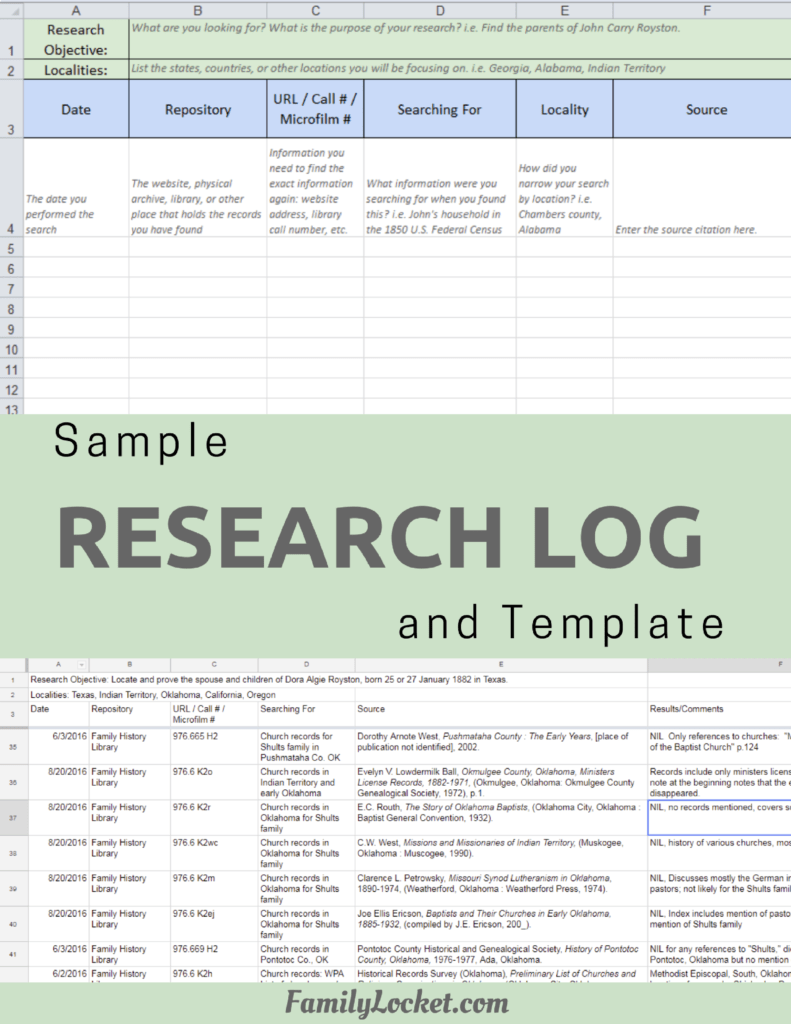
Airtable Research Logs Quick Reference – by Nicole Dyer – https://familylocket.com/product-tag/airtable/
Research Like a Pro: A Genealogist’s Guide book by Diana Elder with Nicole Dyer on Amazon.com – https://amzn.to/2x0ku3d
Research Like a Pro with AI Workbook – Second Edition (eBook) – https://familylocket.com/product/research-like-a-pro-with-ai-workbook-second-edition-ebook/
14-Day Research Like a Pro Challenge Workbook – digital – https://familylocket.com/product/14-day-research-like-a-pro-challenge-workbook-digital-only/ and spiral bound – https://familylocket.com/product/14-day-research-like-a-pro-challenge-workbook-spiral-bound/
Research Like a Pro Webinar Series – monthly case study webinars including documentary evidence and many with DNA evidence – https://familylocket.com/product-category/webinars/
Research Like a Pro eCourse – independent study course – https://familylocket.com/product/research-like-a-pro-e-course/
RLP Study Group – upcoming group and email notification list – https://familylocket.com/services/research-like-a-pro-study-group/
Research Like a Pro Institute Courses – https://familylocket.com/product-category/institute-course/
Research Like a Pro with DNA Resources
Research Like a Pro with DNA: A Genealogist’s Guide to Finding and Confirming Ancestors with DNA Evidence book by Diana Elder, Nicole Dyer, and Robin Wirthlin – https://amzn.to/3gn0hKx
Research Like a Pro with DNA eCourse – independent study course – https://familylocket.com/product/research-like-a-pro-with-dna-ecourse/
RLP with DNA Study Group – upcoming group and email notification list – https://familylocket.com/services/research-like-a-pro-with-dna-study-group/
Thank you
Thanks for listening! We hope that you will share your thoughts about our podcast and help us out by doing the following:
Write a review on iTunes or Apple Podcasts. If you leave a review, we will read it on the podcast and answer any questions that you bring up in your review. Thank you!
Leave a comment in the comment or question in the comment section below.
Share the episode on Twitter, Facebook, or Pinterest.
Subscribe on iTunes or your favorite podcast app.
Sign up for our newsletter to receive notifications of new episodes – https://familylocket.com/sign-up/
Check out this list of genealogy podcasts from Feedspot: Best Genealogy Podcasts – https://blog.feedspot.com/genealogy_podcasts/


Leave a Reply
Thanks for the note!