
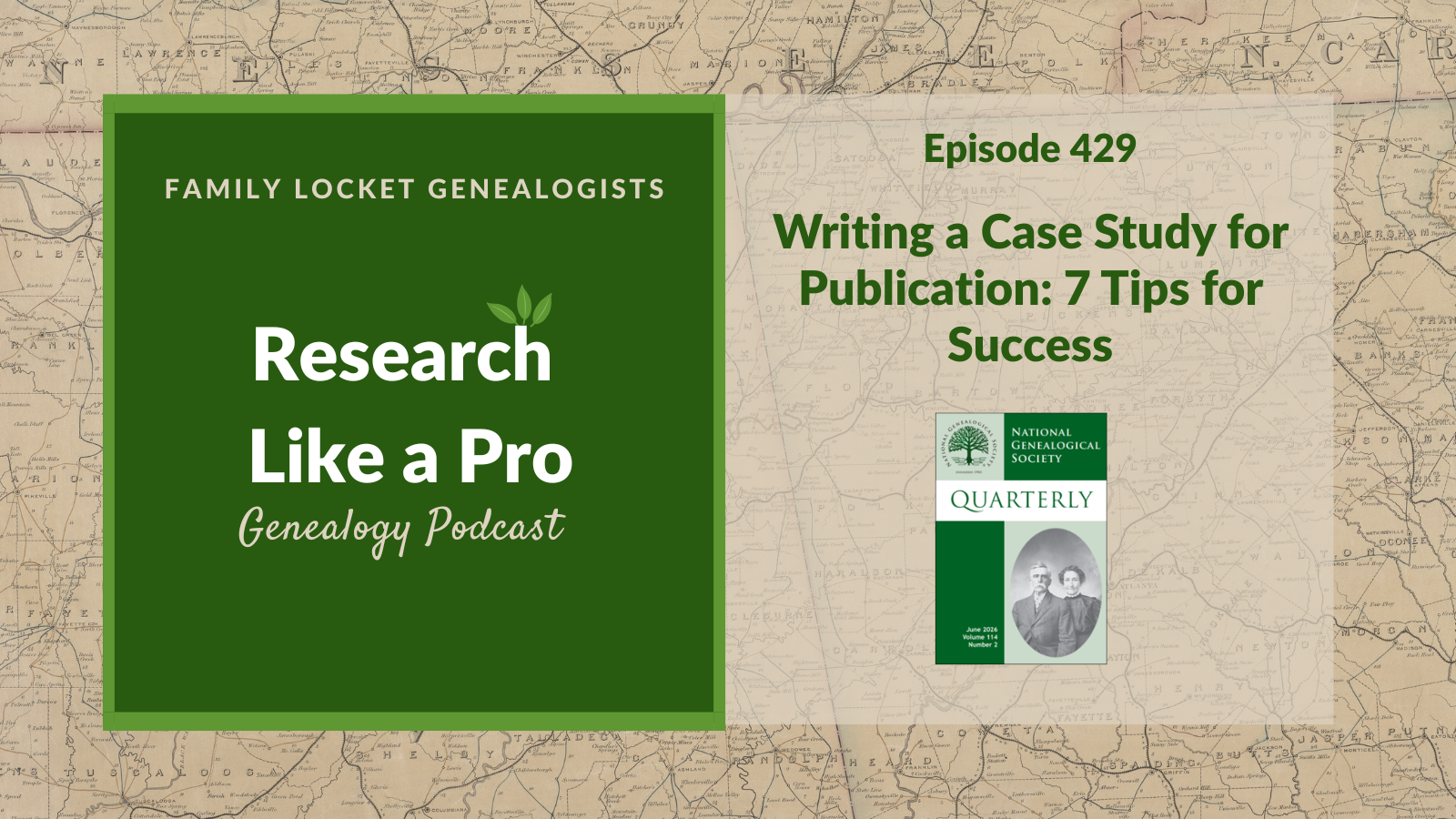
In this episode of the Research Like a Pro Genealogy podcast, host Nicole Dyer and co-host Diana Elder discuss how to write and publish a genealogical case study. Nicole defines a case study as a methodology-driven piece built around a specific research question, distinguishing it from research reports, proof arguments, genealogies, and ancestor profiles. She highlights major national and regional publications where researchers can find exemplary case studies, including the National Genealogical Society Quarterly (NGSQ), The American Genealogist, and state society journals. Diana explains how studying published case studies helps genealogists break through brick walls, discover new repositories, and master complex research strategies. Listeners learn the essential components of sound genealogical writing, including rigorous source citations and evidence correlation.
Diana shares her personal journey of researching, writing, and publishing her article on Thomas Beverly Royston in the NGSQ. She outlines her step-by-step process, from reviewing submission guidelines and updating source citations to collaborating with a peer-review partner. Nicole and Diana describe the complete submission lifecycle, including peer-review critiques, conducting additional record searches, proofreading, and preparing cover photos for publication. Listeners learn practical strategies for publishing their own work, such as selecting the right journal, aligning research with the Genealogical Proof Standard, seeking peer feedback, and exercising patience through the revision process.
This summary was generated by Google Gemini.
Links
Transcript
Nicole (1s):
This is Research Like a Pro, Episode 429: Writing a Case Study for Publication – 7 Tips for Success. Welcome to Research Like a Pro a Genealogy Podcast about taking your research to the next level, hosted by Nicole Dyer and Diana Elder accredited genealogy professional. Diana and Nicole are the mother-daughter team at FamilyLocket.com and the authors of Research Like a Pro A Genealogist’s Guide. With Robin Wirthlin they also co-authored the companion volume, Research Like a Pro with DNA. Join Diana and Nicole as they discuss how to stay organized, make progress in their research and solve difficult cases.
Nicole (41s):
Let’s go. Today’s episode is sponsored by Newspapers.com. Welcome to Research Like a Pro. Hi, Mom.
Diana (50s):
Hi, Nicole. How’s it going?
Nicole (52s):
It’s going well. How are you? What’s happening?
Diana (56s):
Well, I’m having fun working on a new research project for the study group. And I am tackling Mary Baker, who also known as Polly Cessna. She’s got so many different names. So I’ve been really having fun doing the timeline and analyzing the sources and really nailing down everything I know about her. And I just wrote my case study and she was part of it. But now I want to try to figure out her family: her dad, her mom, siblings, uncles, aunts, all that good stuff.
Nicole (1m 29s):
Great. So Mary, Baker, you think is her maiden name.
Diana (1m 34s):
Right. Because I have got a deed and it talks about Robert Baker, who willed her two enslaved females. So she was a young woman at the time. And pretty much the only reason I can think of that she would be mentioned somebody’s will was if he was a father or if he was an uncle with no other descendants, you know, something like that. So anyway, he’s my clue. Got to tackle Robert Baker and see who is he and how does he connect to Polly? I call her Polly half the time or Mary half the time. For so long, we just knew her as Polly Cessna, because we had that marriage record of her and John Royston. But in the record, she is both Mary and Polly.
Diana (2m 15s):
So her real name was Mary.
Nicole (2m 18s):
Okay. I’m excited to see what happens. It’s so funny how when we have two different names for an ancestor, we just call them whatever we feel like in the moment. It seems like for so long, we called her Polly Cessna.
Diana (2m 29s):
I know.
Nicole (2m 30s):
And then to learn that, I mean, one of the things genealogists learn, pretty early on is that Polly is a nickname for Mary. Such a common one, right?
Diana (2m 41s):
Yes.
Nicole (2m 42s):
But it’s just funny to find it in a record as Polly and then realize that, oh, this is Mary in this other record. Oh, it’s the same person.
Diana (2m 50s):
Oh, and in her divorce petition, she names herself as both Polly and Mary. She uses the same name in the same document.
Nicole (2m 57s):
Isn’t that gratifying to find a document like that that just confirms what you thought?
Diana (3m 1s):
Yep. It was pretty obvious that’s what was going on, but it’s very clearly the same person. So that was fun.
Nicole (3m 9s):
Well, let’s do our announcements. The next webinar in our Research Like a Pro webinar series is going to be on October 20th: When DNA Reveals Hidden Identities: Investigating Whether Minnie James Was Born Fannie Tattoon. And the presenter is Yvonne Fenster, Accredited Genealogist, RN, and PhD. And she’ll talk about how Fanny Tattoon and Minnie James could be the same person, and her investigation examined a compelling hypothesis that emerged when DNA matches revealed shared ancestry through both Gilbert Tattoon (Fannie’s father) and James H. Clayton (Minnie’s husband)—connecting two seemingly unrelated Connecticut families.
Nicole (3m 48s):
With Fanny vanishing from records after childhood and Minnie appearing as an adult without prior documentation, the analysis draws on genetic data, Connecticut records, and other documents to determine whether they are separate individuals or one woman who changed her identity after being orphaned. So she will talk about the Leeds Method, Misattributed Parentage, name change, orphans, and a lot of DNA analysis, including Banyan DNA. Yvonne is a professional genealogist accredited in the Upper South region of the United States, including Virginia, West Virginia, Tennessee, Kentucky, and North Carolina. And she has a great expertise in DNA. So we’re excited to have her.
Nicole (4m 29s):
It’ll be a fun webinar, and if you haven’t registered yet, you can still do so, and you’ll have access to all the previous recordings from each month of 2026, as well as the future Zoom meetings. Also, the next Research Like a Pro with DNA Study Group will be in February of 2027, and registration will open in December. Join our newsletter that comes out every Monday to see new blog posts, new podcast episodes, upcoming lectures, and coupon codes. Also, we’ll see you at the Association of Professional Genealogists, PMC, Professional Management Conference. That’s October 14th through 17th, virtually. Both of us will be giving lectures there, so we hope to see you there. Also, registration is open for our Institute course on Merging and Separating Identities, and the website and all the course information went live.
Nicole (5m 14s):
To see the information for that, just go to the Family Locket website, hover over the shop tab in the menu and click Institute Courses, and then you’ll find it there. So you can click there. The course begins in January, 2027, and you can register now.
Diana (5m 29s):
Well, let’s get to our topic. We are going to talk today all about writing a case study for publication. And why would you want to do this? Well, it is a wonderful way to share your research. And especially if you are writing it in a peer-reviewed journal, you get peer review and you get the benefit of knowing that your research is sound. So I recently published my first article in the National Genealogical Society Quarterly, we often just say NGSQ. I am going to share experience and tips for anyone else interested in publishing as we go through this podcast.
Nicole (6m 7s):
All right. Well, let’s talk about what is a case study? So you might be wondering, well, what do they mean by case study? And how does it differ from a research report, a proof argument, a genealogy, or an ancestor profile or biography or anything that you might write having to do with your research? So first, let’s define all of those. A research report discusses a specific research phase with a focused objective. Several reports may eventually provide enough material to use in a case study. A proof argument is similar to a case study. in that you are presenting completed research. The research question could not be answered with direct evidence, but rather needed conflict resolution and correlation of indirect evidence.
Nicole (6m 51s):
And so you had to write a proof argument rather than just like a proof statement or proof summary, which usually is shorter like a paragraph. Then a case study will often mirror a proof argument in this sense. They’re very similar. A genealogy provides a succinct listing of an ancestor and their descendants with sources attached as footnotes. And there may not be any correlation of indirect evidence or conflict resolution depending on how good your evidence is, and it could include that as well, but it’s just usually about an ancestor and all their descendants and the evidence you have about them and including some biographies.
Nicole (7m 34s):
An ancestor profile could also be called like a history or a narrative, a story, a biography. This type of writing tells an ancestor’s story using source citations and historical context. Correlation of evidence and conflict resolution are sometimes still needed, but the focus is often more on bringing in that interesting contextual detail that brings the story to life. A case study leads the reader through the methodology that was used to solve a specific genealogical problem. The case study is built around a research question, usually of identity or relationship. Only relevant evidence is presented, and it’s done so clearly and concisely.
Nicole (8m 14s):
So what all forms of sound genealogical writing have in common is documentation. Each statement is backed with the source citation, and the footnotes may include as much text as the narrative in providing details about the source. So you’ll see a lot of footnote area on these types of well-documented genealogical writing samples.
Diana (8m 33s):
Right. Sometimes the footnotes take up more of the page than the narrative. So why would you want to study case studies? Well, the first time I read a case study in NGSQ, I was unprepared for the amount of information provided in just one paragraph that had so many footnotes attached to it. I had never read anything like it, and I was expecting more of a story. Now, after I’ve read so many case studies and written one of my own, I am… appreciate the sheer amount of research that is covered in just a few pages. We all have brick wall ancestors who’ve been challenging to research so when you read a case study with a similar problem it can unlock some research paths forward to solving the case.
Diana (9m 18s):
For example you may be grappling with record loss, merged identities, name changes, and more. Each NGSQ case study is selected specifically because it solves a difficult research conundrum. In genealogy, we simply don’t know what we don’t know. A well-researched case study can open our eyes to new sources and repositories for our research location. Seeing how another genealogist solved a migration problem from Virginia to Tennessee would help us in our own research. Many of these journals now have online archives of past articles that you can peruse for case studies similar to your research problem.
Nicole (9m 56s):
Well, we mentioned the NGSQ, but where can we find case studies to read and study? While genealogy societies have been publishing journals for decades, those journals will hold genealogies, abstracts, and often a case study in the journal’s focus. So here are five to know about: the National Genealogical Society Quarterly, NGSQ, one of the premier U.S. genealogy journals especially valuable for methodology, proof arguments, case studies, and solving difficult identity problems, it’s been published since 1912. Next is the New England Historical and Genealogical Register, often called The Register, published since 1847, making it the oldest major genealogical journal in the U.S.
Nicole (10m 41s):
It’s particularly strong for Colonial New England, immigrant origins, and documented multi-generation genealogies. You can find this at the American Ancestors website. The American Genealogist T-A-G, or TAG, was founded in 1922 and famous for meticulously documented solutions to difficult genealogical problems. It’s particularly strong for early American and colonial genealogy, and it recently resumed publication in 2025 after a break. Also, the New York Genealogical and Biographical Record, this has been published since 1870.
Nicole (11m 22s):
And one of the principal peer-reviewed genealogy journals in the U.S., it’s essential for New York families, but also an excellent model for scholarly genealogical writing. So you might hear this one called The Record or the NYGNB Record. Then we have The Genealogist, published by the American Society of Genealogists. It’s a highly prestigious scholarly journal specializing in compiled genealogies, difficult proof problems, and lengthy in-depth studies. And so you’ll see that titled The Genealogist. You can also see regional journals that may provide case studies and are excellent for studying a specific region’s methodology and sources.
Nicole (12m 5s):
So for example, we have the Magazine of Virginia Genealogy published by Virginia Genealogical Society, the North Carolina Genealogical Society’s Journal, the Maine Genealogist by Maine Genealogical Society, the Connecticut Nutmegger, published by the Connecticut Society of Genealogists, and the Ohio Genealogical Society Quarterly, which is really valuable for Ohio pioneer families and church records. Also, Elizabeth Shown Mills has posted many of her case studies on her website, Historic Pathways. And the Board for Certification of Genealogists website has several case studies posted from submitted portfolios. So there’s several ways to find and read them.
Nicole (12m 47s):
And these last two are online for free. So if you don’t want to subscribe to a journal and you just want to see some examples, go to Historic Pathways to see Elizabeth Shown Mills and also the Board for Certification of Genealogists work samples.
Diana (13m 3s):
All right. Well, thanks for taking us through those. I think it’s really valuable to study these case studies, especially if it’s an area that you are researching, like North Carolina or Virginia. The neat thing about the NGSQ, National Genealogical Society, is it covers case studies from all over the country, the United States. Plus it also often has cases that take you back to Germany or Norway or France, you know, other locations as well. So it’s really neat. Well, when I started writing my case study, I had no idea what I was going to learn and it was invaluable on so many levels.
Diana (13m 45s):
Nicole, you and I had started researching this family early into our work in genealogy. And I think I started with the Roystons because the surname was less common. We had others on the family tree that were very common, like Harris or Welch and I figured, sort of correctly, that any Royston would be connected to us. I found out that there was another Royston branch out of Maryland we were not related to. But the Virginia Roystons, yes, they are all connected. And I used this family for my four-generation accreditation project in 2015. I had assembled enough evidence in that report to prove the parents of Thomas Beverly Royston, who was born 1806, died 1868, that they were Mary Polly Baker Cessna Royston and John Kerry Royston.
Diana (14m 34s):
But this research was in a report format, and a case study is just a different treatment of the same material. I did choose the NGSQ as my journal of choice because it included interesting record types such as Georgia land lotteries and included a cluster research methodology, which can be applied in any situation. And the journal has a focus on methodology, so this sounded like a good fit. Plus, I knew the NGSQ provided rigorous peer review if a case study was accepted. So I started by reviewing the guidelines for writers that are found on the NGSQ website. And I think you’ll find every journal will publish something like that, telling you exactly what you need to do.
Diana (15m 18s):
And the article gives you such a good overview of what kind of articles are a good fit and it clearly defines the expectations. They want articles that are using original records, that have teaching value for readers, and thorough documentation. And then they also give guidelines for the actual submissions, such as word count, citations, heading, etc. So one of my very first actions, because we do want to tackle something from the beginning, so I decided to read several articles based in the Southeast U.S. to see if there were any record groups I had missed in my research in Georgia and Alabama. And I also looked at organizing the methodology and enhancements to see how other authors handled maps and tables.
Diana (16m 5s):
So once I had a handle what was required and I’d studied the articles, I got started reviewing my four-generation project, the part I wanted to use, and I started working on making that writing more concise. I knew I needed to change up the format on my source citations, so I went to each of my original sources and revised them using the citations from the most recent articles as examples, which was very time consuming, but it was, it was great. It was a good exercise. I also worked with my colleague, Alice Childs, who was working on a case study. And that was probably the best thing that I did. We met every month to discuss our articles and we peer reviewed each other’s writing and it gave me an incentive to work regularly on the case study because I knew I was meeting with Alice I had to get something done.
Diana (16m 54s):
Let’s take a minute and have a word from our sponsor. Ready to take your family history research beyond names and dates? Newspapers.com is a game-changer for genealogists of every level. With access to over a billion pages of historical newspapers, you can uncover rich, untold stories about your ancestors you won’t find anywhere else.Maybe it’s a detailed obituary that reveals the extended family you never knew about, a local news story that highlights your great-grandmother’s role in the community, or a photo that brings her to life in a way names and dates never could. Newspapers captured the everyday details—announcements, happenings, achievements, challenges—that paint a fuller picture of who your ancestors were and what their world was like.
Diana (17m 35s):
It’s the social history behind the names on your family tree. Searching is simple and intuitive: explore by name, location, or date to unearth your own hidden gems. Visit Newspapers.com/FamilyLocket today for 20% off a subscription and start turning your family tree into a family story.
Nicole (17m 54s):
All right. Let’s talk now about the peer review and editing process. So once Diana felt like the case study was ready, she submitted it per the guidelines and received an email that the editors would review it to determine if it was ready for peer review. And I remember how exciting that email was to get. I guess, what was that email like to get?
Diana (18m 16s):
Well, that was exciting because it wasn’t turned down out of hand, but it didn’t come with a contract. That was not saying we are definitely going to publish. That just means we look at this. It seems like a good fit. We’ll send it off for peer review.
Nicole (18m 29s):
Okay. So it wasn’t like a done deal, but it wasn’t a rejection.
Diana (18m 34s):
Exactly. It was in between. Yep.
Nicole (18m 36s):
Well, within a few days, you got an email that your submission had been sent out for peer review. And then almost five months later, you got critiques back from three reviewers who had carefully read the article and provided their expert feedback. So that must have been exciting, but scary at the same time, right?
Diana (18m 56s):
Yes, it was. It was a lot of feedback. You know, you work so hard and you think you’ve got it all perfect. And then you get back pages and pages of feedback and you realize you have some more work to do.
Nicole (19m 9s):
Yeah. So you reviewed the critiques, you found all the suggestions for additional research, corrections to citations, organization, improved reasoning, and more. And then you took the next six months to work through the suggestions. That is a long time. And the additional research suggestions opened up an entire new locality to research. And it’s so cool that you found all these extra records to shore up the conclusion. Interestingly enough, you had done the original research using microfilm back at the FamilySearch library before all the digitization started and now with FamilySearch’s full-text search, you could use that to find even more. And so you had not used full-text search on this case study yet.
Nicole (19m 52s):
And so you found so many more records that have been digitized and indexed in that way since your initial research. And those records you found were very important to the case study.
Diana (20m 3s):
Right. The tricky thing with full text search, when it first came out, I put in Thomas Beverly Royston and it didn’t pull up anything new, but you know, with FamilySearch, they’re continually adding records to that. And so I just had not gone back and tried it again. And so in the years that went by, there had been a lot more, a lot more locations that were added to it. So that was really neat.
Nicole (20m 29s):
Yeah, that is really neat. What else is cool is that you use this case for the advanced practicum in SLIG, the Salt Lake Institute of Genealogy. And getting that ready for the students to work through was excellent motivation to rework the manuscript. And so once that was completed, you did a lot of proofing and then sent the article back to the editors at the NGSQ. A few weeks later, you got word that the article would be published and you signed the contract and then waited another three months for the editing process to begin. And over the next few weeks, you worked with the editor to clarify the writing and the research. And the editor encouraged additional research on a couple of points.
Nicole (21m 11s):
Although the research had negative results, it did help with the reasonably exhaustive research that needs to go into a case study.
Diana (21m 21s):
It was interesting to do that, too, because my editor had noticed that one of the people in the case study was, her father was a minister in South Carolina, and she correctly thought that there should be actual church records. So I reached out to this area in South Carolina and I got an email response really quickly from a woman who had done so much work on this family and she said, yes, there would have been records, but they all burned in a fire in 1976. Isn’t that so interesting? So just like one more little piece, one more burned records story, but just one more little piece that I had not even thought about.
Diana (22m 3s):
And that’s the value of having someone else’s eyes on your research.
Nicole (22m 8s):
So valuable. Well, the next step for the proofreaders was to comb through the article looking for anything they had missed. They had indeed missed a few things. And so you were really grateful for many eyes on the article when you couldn’t see those little mistakes. It’s so funny how sometimes our eyes skip over them after we’ve worked on something for so long. Then the editors asked if you had a photo that could go on the front cover of the journal. And so that was really fun. And you sent in that photo that we have of Robert C. Royston and his wife, Isabella Weatherford, which is just such a beautiful portrait of the two of them. Robert was the son of Thomas B. Royston, the subject of the case study.
Nicole (22m 50s):
And so you also sent in a brief biography of the couple’s lives that appears in the Portraits of the Past section of the journal. And then seeing the final publication online was so exciting, and then seeing the print copy as well. I was so excited to see it in the mail coming to me, opening that up and seeing our ancestors on the front and seeing my mom’s name in print. It was so cool, mom. So it’s so cool to see all the things you learned from this process.
Diana (23m 19s):
Oh, yeah.
Nicole (23m 21s):
And I’m sure you’re thinking of what case study you can do next, right?
Diana (23m 25s):
Absolutely. I do have a couple ideas. So I am excited to do another one. I just, I loved it. I love the whole process. And, you know, my main tip is to give yourself plenty of time because it is time consuming and it takes time to go through the whole process, but so worth it. So let’s do some tips if you’re interested in publishing a case study. So I would first of all say, choose the right journal for your article. There are so many good journals out there. And then go and read several of them, and consider which would be a good fit based on the locality and methodology. Then carefully study the guidelines. Try to meet each one.
Diana (24m 7s):
Study the genealogical proof standard, we call that the GPS, and really see if you think you’ve met each requirement. Write and edit your writing until you feel confident in your case study, and then have someone else give you some peer review before submission. We all need additional sets of eyes on our research and writing. And then don’t give up. When critiques come back, take your time in reviewing them and incorporating their suggestions. And then be patient with yourself and consider this a learning opportunity, as well as an opportunity to publish your research. So, you know, you can’t beat yourself up for things that you miss. You just realize that none of us are perfect and we just keep doing the best that we can with our research and move forward.
Diana (24m 51s):
So it is such a great learning opportunity.
Nicole (24m 54s):
Well, if you’d like to read Diana’s article, you can find it on the National Genealogical Society website. The title is Naming Patterns and Family Associates Link Thomas Beverly Royston to His Georgia Roots. You have to just be a member of NGS and then you can read the online archives of the NGSQ. All right. Well, this has been so fun to talk about writing a case study. I hope some of you out there listening will think about writing a case study as well, getting it published in one of these journals we mentioned or the journal that works best for you that’s in your area and have a chance to turn your research into a published legacy for everyone to read and to turn back to when they want to learn more about that family and learn from your methodology.
Nicole (25m 38s):
All right, everyone. Thanks for listening and we’ll talk to you again next week. Bye-bye.
Diana (25m 44s):
Bye-bye.
Nicole (25m 44s):
Thank you for listening. We hope that something you heard today will help you make progress in your research. If you want to learn more, purchase our books, Research Like a Pro and Research Like a Pro with DNA on Amazon.com and other booksellers. You can also register for our online courses or study groups of the same names. Learn more at FamilyLocket.com/services. To share your progress and ask questions, join our private Facebook group by sending us your book receipt or joining our courses to get updates in your email inbox each Monday, subscribe to our newsletter at FamilyLocket.com/newsletter. Please subscribe, rate and review our podcast. We read each review and are so thankful for them. We hope you’ll start now to Research Like a Pro.
Writing a Case Study for Publication: 7 Tips for Success – https://familylocket.com/writing-a-case-study-for-publication-7-tips-for-success/
Sponsor – Newspapers.com
For listeners of this podcast, Newspapers.com is offering new subscribers 20% off a Publisher Extra subscription so you can start exploring today. Just use the code “FamilyLocket” at checkout.
Research Like a Pro Resources
Airtable Universe – Nicole’s Airtable Templates – https://www.airtable.com/universe/creator/usrsBSDhwHyLNnP4O/nicole-dyer
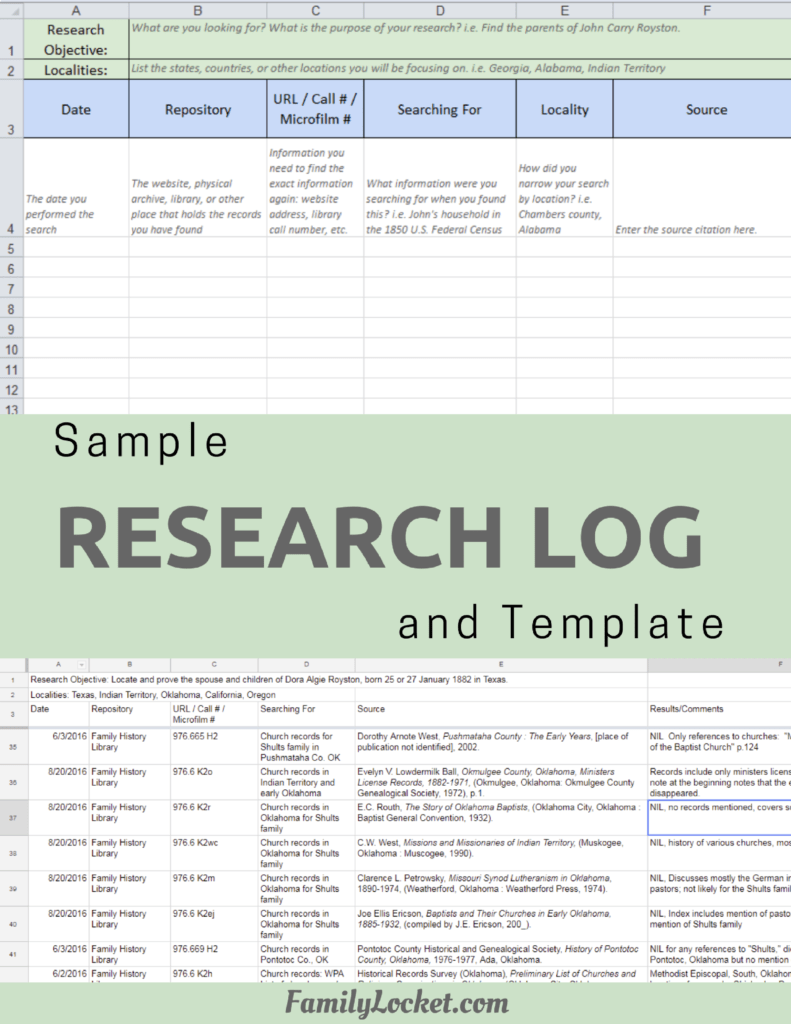
Airtable Research Logs Quick Reference – by Nicole Dyer – https://familylocket.com/product-tag/airtable/
Research Like a Pro: A Genealogist’s Guide book by Diana Elder with Nicole Dyer on Amazon.com – https://amzn.to/2x0ku3d
Research Like a Pro with AI Workbook – Second Edition (eBook) – https://familylocket.com/product/research-like-a-pro-with-ai-workbook-second-edition-ebook/
14-Day Research Like a Pro Challenge Workbook – digital – https://familylocket.com/product/14-day-research-like-a-pro-challenge-workbook-digital-only/ and spiral bound – https://familylocket.com/product/14-day-research-like-a-pro-challenge-workbook-spiral-bound/
Research Like a Pro Webinar Series – monthly case study webinars including documentary evidence and many with DNA evidence – https://familylocket.com/product-category/webinars/
Research Like a Pro eCourse – independent study course – https://familylocket.com/product/research-like-a-pro-e-course/
RLP Study Group – upcoming group and email notification list – https://familylocket.com/services/research-like-a-pro-study-group/
Research Like a Pro Institute Courses – https://familylocket.com/product-category/institute-course/
Research Like a Pro with DNA Resources
Research Like a Pro with DNA: A Genealogist’s Guide to Finding and Confirming Ancestors with DNA Evidence book by Diana Elder, Nicole Dyer, and Robin Wirthlin – https://amzn.to/3gn0hKx
Research Like a Pro with DNA eCourse – independent study course – https://familylocket.com/product/research-like-a-pro-with-dna-ecourse/
RLP with DNA Study Group – upcoming group and email notification list – https://familylocket.com/services/research-like-a-pro-with-dna-study-group/
Thank you
Thanks for listening! We hope that you will share your thoughts about our podcast and help us out by doing the following:
Write a review on iTunes or Apple Podcasts. If you leave a review, we will read it on the podcast and answer any questions that you bring up in your review. Thank you!
Leave a comment in the comment or question in the comment section below.
Share the episode on Twitter, Facebook, or Pinterest.
Subscribe on iTunes or your favorite podcast app.
Sign up for our newsletter to receive notifications of new episodes – https://familylocket.com/sign-up/
Check out this list of genealogy podcasts from Feedspot: Best Genealogy Podcasts – https://blog.feedspot.com/genealogy_podcasts/


Leave a Reply
Thanks for the note!