
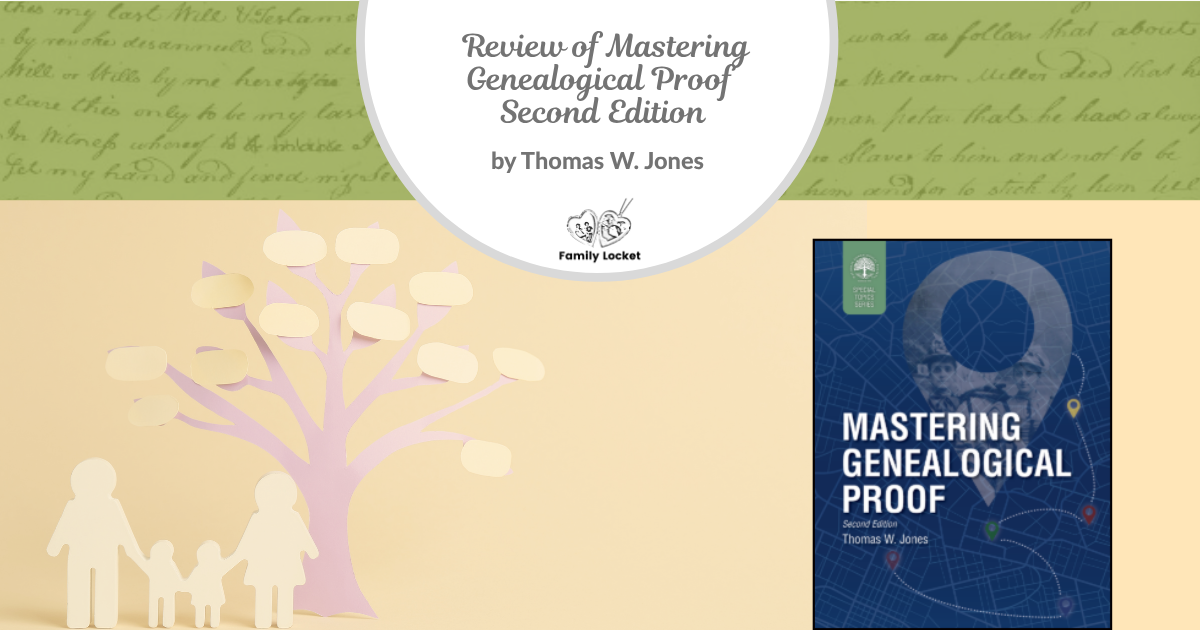
One of my favorite genealogical mentors is Thomas W. Jones. I first heard him speak at RootsTech 2016 on source citations and most recently enjoyed his lectures at the National Genealogical Society in Fort Wayne, Indiana. His courses, articles, and books have educated numerous genealogists on sound methodology and standards.
I had the privilege of purchasing his latest book, Mastering Genealogical Proof, Second Edition, at the conference he graciously signed it for me. This book is a must-read and must-study for all family historians working to do good genealogy.
As part of my accreditation preparation over ten years ago, I purchased the first edition of Mastering Genealogical Proof and studied it thoroughly. Although I had been researching my family for over 15 years, many concepts of proving an ancestral line were new to me. Intuitively, I knew we should document our research, but I didn’t know how to resolve conflicting evidence or create clear, accurate source citations, among other things. Working through the workbook using the case studies and questions taught me a great deal and put me on the path to becoming an Accredited Genealogist researcher. Whether you’re interested in credentialing or simply want to learn how to do better genealogy, Mastering Genealogical Proof will help you reach your goals.
We’re reading Mastering Genealogical Proof, 2nd Edition for our fall offering on the Family Locket Book Club at Goodreads. We read a variety of books – fiction and nonfiction. Autumn is back-to-school time, and working through Jone’s book is an excellent way to sharpen our skills.
The Genealogical Proof Standard
The first edition of Mastering Genealogical Proof was published in 2013, and the genealogical field has seen many changes in the past several years: DNA, Artificial Intelligence, Full-Text Search, and more. What hasn’t changed is the need for solid, standards-based research methodology. The workbook covers each element of the genealogical proof standard in depth.
Reasonably Exhaustive Research
Source Citations
Analysis and Correlation
Resolving Conflicting Evidence
The Written Conclusion
Chapter one is titled “Genealogy’s Standard of Proof,” and provides an overview of why we need a standard. Jones writes:
To be useful, the genealogist’s reconstruction of past relationships must be accurate. Genealogists strive to portray their research subject’s unique identities, relationships, and life events as well as the people involved at the time understood them. If a genealogist’s conclusion does not achieve that degree of accuracy, the research has not achieved its purpose, and the conclusion is meaningless. (Chapter 1, page 1)
Imagine how much better the genealogy world would be if each online tree was reasonably accurate. In our haste to construct our trees, often relying on past research or website hints, we introduce many errors. As I’ve slowed down and tackled my tough research problems using the GPS I’ve been able to prove many relationships, construct unique identities and learn about my ancestors.
Using the Workbook
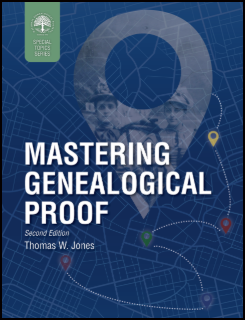 Two proof arguments previously published in the National Genealogical Society Quarterly are included as Appendix A and Appendix B. At the end of each chapter, Jones provides several exercises based on the articles that help you practice the concepts taught in that chapter.
For example, genealogists often struggle with creating source citations, and after learning about the who, what, when, where is, and where in questions, the exercises help you to evaluate several citations from the proof arguments. Jones includes the answers so you can check your reasoning.
A helpful addition to the 2nd edition is a full index. A source list of additional books and articles gives us a solid reading list to learn more about any given concept. A companion volume to Mastering Genealogical Proof is Genealogy Standards, Second Edition published by the Board for Certification of Genealogists. If you’re assembling a library, I highly recommend both. Gaining research skills takes practice but every small step yields big dividends.
Best of luck in all your genealogical standards!



Leave a Reply
Thanks for the note!