
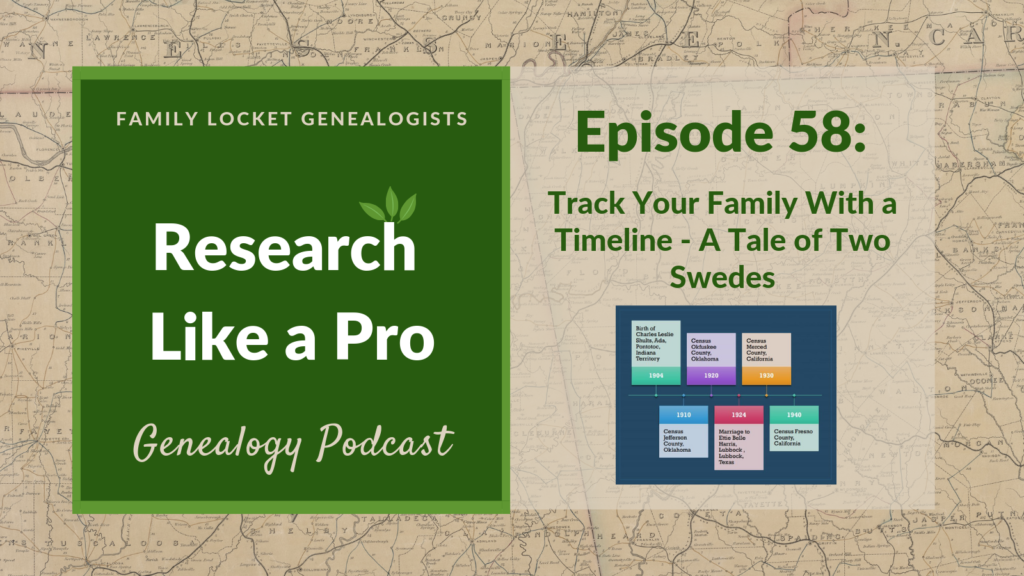
Today’s episode of Research Like a Pro is about how to use timelines to help you get started with your research project. As you gather all the sources about your objective that you already have and put them in a timeline, you’ll notice holes, make connections, have ideas for your research plan, and may even discover that you already have the answer. We talk about different ways to make timelines and recommend our favorite method. We also discuss Diana’s case study of separating two Swedish men of the same name in Massachusetts and how a timeline was invaluable for coming to the correct conclusion.
Transcript
Nicole (0s):
This is Research Like a Pro, Episode 58: Track Your Family with a Timeline. Welcome to Research Like a Pro a Genealogy Podcast about taking your research to the next level, hosted by Nicole Dyer and Diana Elder accredited genealogy professional. Diana and Nicole are the mother-daughter team at FamilyLocket.com and the creators of the Amazon bestselling book, Research Like a Pro a Genealogists Guide. I’m Nicole co-host of the podcast join Diana and me as we discuss how to stay organized, make progress in our research and solve difficult cases. Let’s go.
Nicole (45s):
Hi everyone, welcome to the show today. I’m Nicole Dyer co-host of The Research Like a Pro Genealogy Podcast. I’m here with accredited genealogist, Diana Elder. Hi Diana.
Diana (55s):
Hi Nicole. I’m excited to be here again today on the podcast after a big genealogy conference. There’s always so much catch up work to do. So this has been a catch up week for me, but it’s been fun. Teaching at conference is great and then it’s great to come home and get back into the research and doing the other things that I like to do like podcasting.
Nicole (1m 18s):
Yeah, we enjoyed being at the BYU Family History Conference last week. Alright, well today we’re talking about timelines. Before we do, I have the one minute case study. When I was preparing for my, one of my lectures last week, I made a fun discovery about somebody on dad’s side of the family. And this is a branch of the family that had been heavily researched before. The main ancestor was William Henry and he migrated to Utah and had a large batch of descendants, but his siblings that didn’t move to Utah, one other sister moved to Utah and the other ones didn’t.
Nicole (2m 2s):
And the ones that stayed behind, they didn’t have very many descendants and one line completely died out. But there was this one half sister who I couldn’t really find out very much about her descendants. So I decided to research her family and her descendants, her children. One of the most helpful things for this research project was a memory that had been attached to one of her sisters in FamilySearch. And it was a narrative that a descendant of the family had written and it had a bunch of letters transcribed from that sister, Rachel Henry.
Nicole (2m 44s):
And in the letter she mentions her sister Mary a lot and that was the one that I was researching, Mary. And a lot of the details of Mary’s life were incorrect in FamilySearch. She had been listed with a death date of 1850, but as I was reading through all of her sister Rachel’s letters that mentioned Mary, Rachel mentions Mary being alive in the 1860s and well into the decade, 1867, I believe was the last time she was mentioned. So this authored source that had transcriptions of letters that I didn’t have access to was the most helpful source that I used because it helped me figure out that she didn’t die in 1850, that she had another child after 1850.
Nicole (3m 26s):
And it helped me figure out her residence because the letters that Rachel wrote mentioned, where should I send my letters to Mary at, she still living in this same county in West Virginia and so forth. So I searched within that county and sure enough found her cemetery record, her gravestone, and it had her death date on it, which was not until 1880 or so. So never overlooked those authored sources that may be attached to your research subjects, relatives in trees like FamilySearch’s, family tree was very helpful.
Diana (4m 5s):
Well that’s a perfect case study because today we’re talking about timelines and that’s step two of the Research Like a Pro process to take everything that’s out there and put it into a timeline. That is perfect because we have to gather up everything from all the online trees, and what’s in our notes, what’s in our files, because for that very reason, so great example. Well for our news for the day, we have got currently our Research Like a Pro with DNA study group registration open and this will be a 10 week course starting in September. We are really excited because we’ve been doing the regular Research Like a Pro study group now for a couple of years and we’re developing a whole new course adding in DNA and we are super excited to start this group.
Diana (4m 52s):
We have had a lot of people wondering when we’re going to do the regular ones. So going forward we will do the regular Research Like a Pro study group in the spring and then the Research Like a Pro with DNA study group in the fall. And then of course we’ll be turning the DNA study group into an E-course that would be available anytime. So you can go on to FamilyLocket and see if there are any spots available. Right now we have a few spots left in the afternoon and a few more in the evening, but we are recording this about 10 days before this podcast airs. So by the time you hear this, I don’t know if there will be anything left, but if there’s something left, we are going to give you guys a coupon code.
Diana (5m 37s):
The price is $275. If you enter the coupon code ‘podcast’, you will get 10% off of that. So if there’s a few spots open, we encourage you to sign up and see if you can make some progress with learning what to do with your DNA results.
Nicole (5m 53s):
Yes, we’re really excited and we hope that you’ll join us. We’ve got a lot of wonderful people signed up and as you know, one of the best parts of the study group is the peer review and reading other people’s research and then getting feedback from them for ideas for your own project. We hope that if that’s something that helps you and motivates you to get your assignments done, that you’ll sign up. All right, for today’s listener spotlight, we have a review from Tea Cozy on Apple Podcasts. She says, “Just being an expert in a field does not mean you can effectively teach it. Diana, a former teacher, and Nicole both have genealogy expertise and the skills to teach it a rare combination. They organize and present the research process in a way that is easy to understand and implement.”
Nicole (6m 37s):
Thank you. I just have to say thank you to Tea Cozy, we really appreciate you leaving that review and letting us know your thoughts about our podcast and it is fun that you pointed out that Diana and I are both former teachers and we really enjoy teaching. I think that’s why we like doing the podcast and why we enjoy teaching at conferences, that it’s just part of what we enjoy doing. It’s kind of who we are, we’re teachers. So thank you and we hope that everyone listening will go and leave us a review so that we can also spotlight you on the podcast coming soon. Alright, today’s subject is timelines and Diana mentioned that we talk about timelines in the second portion of the Research Like a Pro process.
Nicole (7m 21s):
That’s kind of the second step where you gather up everything that you know and put it into a timeline and kind of analyze everything that you have in your timeline and all of your sources that have given you the data for your timeline. So let’s talk about why timelines are so useful in genealogy research.
Diana (7m 39s):
As I was thinking about this, I came up with several different things that timelines can help us with. One of them is separating men of the same name. This is the age old problem that we have two men, the same name in the same area born about the same time and their records are all mixed up. I hear this from so many people and they just are so confused about how to separate them out. So a timeline is perfect and later on in this podcast I’m gonna share a really fun case study about how I totally used the timeline to figure out two very similar men. So what about tracking migrations? You know, if you have ancestors like I do who ended up in California, but the family lines all started on the east coast, then you’re gonna have some significant migrations between either individuals or families.
Diana (8m 28s):
And you know, when somebody lives in an area just for 10 years between censuses, you may think there is nothing there that you really need to go look at. But there could be children that were born and died there. There could be land records left, there could be so many things that open up the research and if we don’t really know exactly where our people were all along the way, how are we gonna know where to research them? Another reason to use a timeline is it really points out the holes in your research. You may think you’ve really got your ancestor nailed down and then you do your timeline and you realize, oh, I’m missing a couple census years, or I really didn’t have a good marriage source record.
Diana (9m 8s):
And you can then give yourself some really great future research suggestions or go do another project. You can also see if there’s a discrepancy because sometimes you didn’t even notice that there was something in the research that doesn’t make sense. Timelines will point out those holes, it’ll point out those discrepancies. Now let’s say that you are starting to work on a new family line or you just made a connection and you’re looking at a cousin’s online tree, or maybe you found a published genealogy with your family in it and you’re really not sure how much accuracy is in that tree or published genealogy.
Diana (9m 50s):
So a really great way to kind of look at that and evaluate it is to put everything into a timeline and see if it makes sense. I do this with all my client projects because I am not familiar with these families. So I take everything that the client has given me, you know, past research projects, whatever I can find online on the family, and I put it all into that timeline and it really helps me to wrap my mind around the family and to make connections and see what I need to do to further the research so you can do the same thing. And then another thing that’s really fun is it helps you compare your ancestors’ life events to historical events. Sometimes we look at our records and we completely skip over the fact that our ancestor could have fought in the Civil War or that they perhaps were involved in the flu pandemic, you know, of the early 1900s.
Diana (10m 42s):
And when we see these things on a timeline, we can think, oh, maybe this explains this. Or there could be military records, or there could be other types of records we should look at. And then finally, you know, kind of our end all goal for our genealogy and family history is to actually write something about our ancestor to perhaps write a little history about them. Often those are just done chronologically and so you’ll have to have a timeline to see if you’ve really got all the years of your ancestors’ life covered. So you could really have good preparation, do a good outline for a history that you are doing. So many reasons to use a timeline, and I know a lot of you listening probably already do a form of a timeline.
Diana (11m 24s):
We’re just hoping to give you some new ideas about what you could add to that or if you haven’t done it, some ideas about how you actually could create a timeline. So Nicole, give us some ideas about where we can actually create a timeline.
Nicole (11m 38s):
A lot of online family trees and genealogy programs can create you a timeline. Off the top of my head, FamilySearch, Ancestry, Ancestral Quest, I know Roots Magic can do it. They can all generate a timeline for an individual, adding in historical events and adding the birth dates of siblings and parents and death dates and things. So this can be a beginning timeline that you can use. You can also just make a bulleted list and that sometimes is a simple way to get started with a timeline. Another way to do it is to create a table in your word processor. Whether you use Google Docs or Word or Pages or whatever you use for your word processing, you can just create a table and put the year in one column and then the event and then the other column.
Nicole (12m 27s):
We prefer to make our timelines with a spreadsheet because it allows you to sort the columns and add unlimited information in each column in each row. Spreadsheets are our tool of choice. We have a template for creating our timelines that we just use every time that we have set up so we can just copy it and make a new timeline every time we start a new project project. You can also just go into like PowerPoint or another type of program that allows you to create visual aids and create a chart or a mind map. And this can let you be more creative, you know, with adding shapes and different photos.
Nicole (13m 8s):
That makes me think of Twil. Also, if you haven’t used Twil, it was a program I was introduced to at RootsTech, which was eventually acquired by Find My Past. So you can go to twil.com and you can create a free timeline there. And what it does is it brings in all of your information from FamilySearch and your family Tree. So one part of Twil is your family tree, and then the other part is timeline. So you can click on any person within Twil and then it will generate a timeline and you can add to that. And what it is is an interactive timeline which allows you to add photos and a lot more fun things beyond what you can do in a spreadsheet. For our difficult research projects, we really recommend using a spreadsheet and putting all of the events that you can think of from the person’s sources and data into that spreadsheet.
Nicole (13m 57s):
And as you do that, then you’ll start to see what records you might be missing. And it’s just amazing how creating the timeline yourself really helps you to see and understand your ancestors’ life so much better and make connections. It’s the synthesis process of creating something that makes your brain make connections and helps you come up with ideas for research and holes that you may need to fill.
Diana (14m 25s):
Right. Well let’s talk about what you can include in that timeline. So if you’re doing a spreadsheet like Nicole talked about, then I have some specific columns that I really like and that I’ve included in the timeline analysis template. So I’m just gonna kind of go through those and maybe explain why it would be important. I always like to have that research objective there at the top, whether it’s in my research report or the timeline or the research log because it keeps me focused. And then I like to have a column for the date because this is the timeline. So I liked to have things lined up by the date and then I like a separate column for the locality, so I can just see very easily at a glance where people were at a certain time.
Diana (15m 10s):
I have a column for event descriptions, so where you’d put in birth, marriage, death, residence, you know, whatever you want to call your events. The names of the individuals. And then I have the source citation column there. I always tell people when they’re just starting the Research Like a Pro process and they’re doing this second assignment that you don’t have to do a complete source citation yet because we haven’t got to that yet. That’s further down the road. So you could simply put something in, you know, 1850 census in the place and then you can come back when you’ve tackled source citations and put your better source citation in there. But just put something about where you’re getting the information from.
Diana (15m 51s):
I really like to include a link to the records in my timeline. I always go back and look at sources over and over and over. We can never get everything out of them the first time because we don’t have them in context. We’re not comparing them with other records and so we often just need to go back and having the link in your timeline is super helpful. And then I like a column for comments and questions because as Nicole said, as we are putting this in ourselves, that’s getting our brains going. Our thought process starts working and these questions start coming up, you know, this doesn’t make sense or what about this? And if we get those written down, put into our actual timeline, put it on paper or on our document, then we get it out of our head and it frees our mind for thinking of more questions and comments.
Diana (16m 40s):
If we don’t write it down, then that’s still buzzing around in our head and our head fills up and then we can’t think anymore. So I have to get everything out so I can think. Now we also want to put ideas for future research, which kind of goes along with the questions and comments, but maybe we have a specific idea, you know, go get this census, or look on Find a Grave, or look for the land record and we can certainly put those in. I also have a column for evidence analysis because, especially if you’re just starting to do the Research Like a Pro process, you maybe haven’t really learned how to analyze all your records or you haven’t analyzed records.
Diana (17m 20s):
And it helps you to think about how good is the evidence coming out of this record or this information Having to do some simple analysis right there on the timeline kind of forces you to think more about the record. Now we have all been hearing about the important FAN club for our ancestors and especially on brick wall problems. We really have to reach out to the FANs, the friends, associates and neighbors, to figure out some of our hard problems. And so this is a perfect place to list all of those FAN club members. You know, you’re, you’re recording a will and so that gives you a column to put the witnesses and the executor administrator.
Diana (18m 1s):
It’s a great place because that will help you just looking up and down that column to see if there’s a pattern. Is there the same person appearing in all these different documents? That’s an important member of your ancestor’s FAN club. So I love that column. And then finally, this isn’t a column but just kind of an overall thing is you can color code, and that’s part of the fun of a spreadsheet also. And I’ve done projects where I’ve been separating men at the same name and as it becomes clear that one record is for a certain John Smith, that entire line can become blue and then records for the second John Smith can become yellow or red or whatever. They can help you to start sorting them out right there within your timeline.
Diana (18m 43s):
So there’s all sorts of really fun ways to do that. I’ve also seen people where they color code it by event and all the residences are green, all the births are blue to help you kind of sort things out. It’s just a little way to put some creativity and fun into your research project. And you know, when we’re dealing with some of these dates and places, we need a little fun, right Nicole? Little color.
Nicole (19m 6s):
Yep. Formatting is fun. After you’ve got all these things in your timeline and you start adding things in, it’s a good time to really analyze each record and each source for reliability and decide if it is an original source, a derivative source or an authored source. And then if it is showing you that you have a lot of derivative sources, that will be a good hint to you that during your research planning phase you can go and find the originals of those. Or sometimes you might know right where to find them right away. And you can do that during the timeline phase and just go find the original record right?
Nicole (19m 48s):
Then you can also analyze each piece of information to see if it’s a primary or eyewitness piece of information or secondary information or if it’s undetermined. The way that I like to do this and the timeline is just putting in every data point that you have about a a person. Even if you have multiple things like say you have five different data points for their birthdate, I will put each one in the timeline and then I’ll put which source it comes from and then I can see which one is more reliable because I’ll have a column for what type of information this is and what type of source it is.
Nicole (20m 28s):
So if one piece of information about the birthdate is from a derivative source and it’s secondary information, I might give it less weight to a birthdate that was original and primary information given by the mother of the child, you know, who was actually aware of the date on the person’s date of birth. Other than, you know the child was being born, so they don’t really know their own birthdate from memory, they were just told it, so it’s secondary information for them. So in the timeline I do put all of those conflicting pieces of information and analyze them right there in the timeline so that I can really understand which one is probably more accurate and begin to start the process of resolving that conflicting information.
Nicole (21m 16s):
And then it also gives me more ideas and avenues to research as I see that conflicting information because I might notice that there’s a a certain source that could shed more light on that and could help resolve the conflict. So there are so many elements of usefulness to creating a timeline at the beginning of a research project. And one of them is that you can check the dates for inconsistencies, you can really look through your timeline and say, here’s when the marriage probably occurred, if you don’t have a marriage date because this is before the first child was born, or maybe you have a marriage date that was after one of the children was born. And that may lead you to recognize that there could have been a prior marriage that maybe you didn’t know about.
Nicole (22m 3s):
So just check for all those kinds of inconsistencies, you know, were the parents of appropriate age to be married when the marriage date that you found occurred? So just check for all the things that are possible and not possible. Like was the mother old enough to give birth to that child, or was she too old to give birth to that child? And that kind of thing. The two things we like to analyze our timeline for are the dates, consistency of the dates, and then the reliability of the information and sources. And you can even go through and analyze the evidence that each data point provides you and say, okay, does this piece of information give me direct evidence for my research question or indirect evidence or negative evidence?
Nicole (22m 46s):
As you do that, you can even come up with some ideas of things to search that might provide you more negative evidence or other kinds of evidence. Like perhaps you maybe will hypothesize that a certain person died by 1830 and maybe by searching the 1830 census you can find that if they were not on that census, that will give you negative evidence that they were not alive or they had moved from that area.
Diana (23m 17s):
Okay, great. Well I think that it’s time for case study to show how this actually worked because you know, it’s all well and good to talk about this but does it really work? So the case study is one that I used for the BYU conference last week and I called it the Tale of Two Swedes. This was a client project and the client, when I was done with this project said, I hope that you use this for a presentation sometime. And so I did because it’s such a great, great case study. So I’m just gonna reiterate a little bit of it here. The project was based on the ancestor, a Swede named Berger Gustav Solberg, who was born 31 May, 1895 in Sweden, the son of Jan Frederick Solberg and Anna Pettersdotter, and the last residence found by the client was in Worcester County, Massachusetts 1930.
Nicole (24m 14s):
So when you got this research project, was that the exact objective that the client gave you, they had the full name Berger Gustav Solberg?
Diana (24m 23s):
Yeah, the client was a relative of the descendant of Berger who lives in Sweden. And all she had, I think believe this was her great-grandfather was that he went to the United States and then he disappeared. And he left behind a child, was never married, I believe, and she was just trying to track him and his family had even enlisted the Red Cross in the fifties to search for him and could not find him. And then I guess they declared him legally dead sometime then. So there’s just like this record in Sweden that he’s dead, but only because they couldn’t find him. She had done quite a bit of research. It’s tricky when you’re in another country and trying to research the United States and so had found who she thought was her ancestor ’cause it said Berger Solberg and the 1930 census, and found some city directories and this individual had gone back and forth between Sweden and New York and Massachusetts and Canada.
Diana (25m 20s):
There was a research report that I was going from, and as I was going through it, I just felt completely lost in a mass of facts. So, so many different localities, there were different occupations, he was listed as a laborer, a machinist, an iron worker. The birth years were 1895 or 1899. His birthplace was always farmland. I don’t know how you say that, farmland, Sweden. And I just realized that to make sense of this, it needed to all get into a timeline. So I decided to put everything in order and the very first record was the ship’s passenger list marking the arrival for Berger Solberg. That was in 1920, it was on the 3rd of March, 1920.
Diana (26m 1s):
And so, you know, that went the top of my timeline. So kind of the cool thing about a spreadsheet or doing electronically is that if you discover a record that goes above or below, you know you need to move them around a little bit, you can just cut that entire line and then paste it above or below because sometimes we find a new record and then that needs to be put in the appropriate place. So that first ship’s record was actually really fun. It gave so much information. I was amazed at the ship’s records about how much I learned. For one thing, it clearly stated his parents, so I knew it was the right person. The other interesting thing it said was where he was going, he was going to go to Worcester, Massachusetts, he wasn’t going to stay there, he just was going there to work.
Diana (26m 52s):
It was really fun to learn more about him and it gave some other fun information like who he was going to stay with, and how long he was going to stay there. He was only going to stay there for two years. He didn’t want to become a citizen. And I did a little research on the Swedish population of this city and found that because of the depression in Europe, you know, this is following World War I, that a lot of these Swedish men were coming over to this particular city and they were working in the factories there, the steel plants, and they were skilled machinists in Sweden, but there was just no work because of the war.
Diana (27m 36s):
They were coming over for just a period of time to make their money and then going back to Sweden. Once I understood that, it made so much more sense why he was going back and forth several times across the ocean. I put in the date and I put in the localities for that event, and for each one, you know, of New York arriving in New York. And then I put the key information into the details column. I just like to abstract out as much as I feel is important. It’s kind of like with the research log, if there is something that I transcribe, you know, I can’t fit it all in maybe the little column, then I can put a link to a Google Doc in that column.
Diana (28m 19s):
But in this case, I could pretty much just abstract out the various information I thought was important. Another key record for this was city directories. We have, you know, those 10 years in between Censuses and he wasn’t on the census of 1920 in Massachusetts because he hadn’t arrived there yet, and he was there in 1930, but the city directories had all sorts of information. And so that was really, really helpful. Now, one of the things that I noticed going through and doing a complete city directory search was that the name was a little bit different.
Diana (29m 1s):
So as you’re recording the name in your timeline, you wanna make sure that you’re using the spelling of the name exactly as it is in the record. This can bother us because it’s often not spelled the way we’ve decided our surname or our first name should be spelled. But it’s really important to see if we’ve got those inconsistencies. So when I did this, I discovered that there were all sorts of different names for Berger Solberg. In fact, he was going by Eric Berger Solberg, E Berger, Berger E, Berger Gustav, just plain Berger and all sorts of different spellings.
Diana (29m 43s):
Anything you can imagine that began to raise a question in my mind, is this just one Burger Solberg or do I have two? Because do I have an Eric Berger and a Berger Gustav? And it was two men. And it really wasn’t until I took every city directory put in the timeline, really looked at the names and realized that I had two men. And you might think, well why didn’t you notice this? Or why didn’t the client figure this out? Or previous researcher figured this out, but you really did have to take every single record because often the men just went by Berger and you could not figure it out unless you had put everything together.
Diana (30m 26s):
So both men went back and forth between the same place in Sweden and New York and went on to Worchester in the 1920s. And the only difference was sometimes they had the Berger G, or Gustav, and sometimes the Eric Berger, and Eric Berger was born a little bit later. He was born in 1899. And guess which one was on the 1930 census? It was the second one, the Eric Berger. So why is the significant to the client? Well if the last known place for him was the 1930 census, and that’s not the ancestor, then where did the real, you know, where did the ancestor Gustav Berger Solberg end up if it wasn’t in that 1930 census?
Diana (31m 14s):
So then I had to look at all those ships’ passenger list, and I found one on, it was in 1926, and this one was definitely for the ancestor Berger Gustav Solberg. And guess what? He was going to Canada and he was gonna stay in Canada. It clearly said in the record that his destination was Canada, it was Montreal. He was going to go on the Canadian National Railroad and he was gonna stay there and farm. And to back that up, there is a record in Sweden, and it’s a church record and it’s his immigration record from his church in Sweden saying he’s going to Canada to immigrate.
Nicole (31m 55s):
But there was a fake Berger taking his place, making you get confused. So what was that church record all about? And why didn’t the family back in Sweden know about that?
Diana (32m 5s):
I don’t know that they even found that because once I had made my timeline, then I had a research plan. I think only about half of the city directories had been found. One of the problem was that the previous research had only been done on Ancestry and I have access to the Family History Library. And so I was able to get all the in-between years of the city directories, which were on microfilm, and that really helped. And a couple of the ship’s passenger manifests were difficult to find because they hadn’t been indexed correctly. There were a few key records that I found realizing this pattern of going back and forth.
Diana (32m 48s):
And when I put in the timeline, I saw that he had left New York for Sweden again, but when did he come back? You know, there were things that didn’t make sense. So I just kept searching for additional records with a man going back and forth, or two men going back and forth of such a similar name. It’s really understandable how their identities could be merged. And how many times do we see on a record, an initial and we think, oh, they heard it wrong. You know, Berger G, Berger E, those could very easily get mixed up.
Nicole (33m 19s):
That’s a really good point.
Diana (33m 20s):
And they did use initials a lot, but I found a key record, I believe it was one of the ship’s lists, that said Eric, and then I’m like, I got a different man here. That was a key point.
Nicole (33m 32s):
So that ship passenger list spelled out Eric Berger Solberg. So then you knew there was the Eric Berger and a Gustav Berger. So is Berger a common or an uncommon name for Swedish people?
Diana (33m 46s):
Well, that’s a really good question and I wondered that as I was presenting last week, and I haven’t looked that up yet. So anybody who’s a Swedish researcher, you’ll have to let us know. I am kind of guessing, perhaps it is
Nicole (33m 59s):
A little more common than we might have thought.
Diana (34m 2s):
We always think that our ancestors’ names are so uncommon until we start searching and then we realize, oh, there are a hundred other people with that surname or that first name that we thought was so unusual. So yeah, we have to be so careful.
Nicole (34m 15s):
Interesting. Well, can I put a plugin really quick for the SLIG virtual course about Swedish and Finnish research? Right now, if anybody here listening wants to learn more about Swedish and Finnish research, there is an online course put on by the Salt Lake Institute of Genealogy that’s beginning this fall. I know it’s gonna be wonderful. It’s being taught by Elaine Haselton with who, she’s an accredited genealogist and Jeff Farr and they’re wonderful. So check it out at the SLIG website if that’s something that you are wanting to learn more about, That would be really fun to do a deep dive into just Swedish or finish research.
Nicole (34m 59s):
I love Institutes, they’re so great.
Diana (35m 0s):
Anyway, to kind of wrap up our story about the two Berger Solbergs, I also found that Eric Berger, the alternate one, he said he was just going to stay in the United States seven years. So I decided to look for him in Sweden because I kind of wanted the end of the rest of his story. And I found he got married, he went back to Sweden and was married in the 1930s, so not long after that 1930 census. And it was kind of fun just to wrap him up and figure out what happened to him. He came over, he worked, and then he went back and got married. So in my timeline, you know, I had all the different columns, let’s just kind of review the columns and how I use them.
Diana (35m 42s):
So the date was very important because I had those ships lists about when they left and when they arrived and I put all those dates in to make sure everything made sense. And I had the localities, I had the details, I did source citations because I was looking at all those city directories. I probably had 10 city directories and I needed to know if where I had found each one, if they were on family history library microfilm, I needed to know exactly where I could find it again. And so source citations were super important as they always are. I had the name exactly as it was, which really gave me the clue. I had two different men and I had a place to keep all my questions about.
Diana (36m 22s):
You know, as these questions started to come up about two men, I had my links to records online, I had my evidence analysis and I did the FAN club, and I just have to talk about the FAN club for just a minute because this was really fun. So I discovered that there was kind of an immigration problem. There were a lot of people coming over to the United States after World War I. They put into practice that someone coming over to immigrate had to state who they were going to go live with and have an actual address. So they basically had to have sort of a sponsor. Of course, people are gonna take advantage of those types of things and con men would show up in Europe in these countries and say, you know, for a price you can use my name and my address.
Diana (37m 7s):
The two men in the FAN club for the ancestor Berger Gustav were Carl Holt and a Carl Johansson. The previous research had done a lot of research as you would, you know, because they’re listed as his uncle Carl and his friend Carl. And you would think that would give you great clues, but nothing could link them. It wasn’t until I did some research and it was actually a periodical that explained how people would say, yeah, use my name and address for a price. Or maybe they were just friends and they really did give him the name and address, but that made sense that maybe the FAN club was a little bit more of a made up FAN club, but not an actual FAN club for him. That was kind of fun to do the research and try to figure out the context of that.
Diana (37m 51s):
There’s always something deeper to dig into on these projects.
Nicole (37m 55s):
So you had found an article in, was it a genealogy society periodical or something that talked about the immigration problem with people using random names?
Diana (38m 8s):
Yeah, I did a search on PERSI on Find My Past, and I put in the city, Worcester, Massachusetts, and I put Swedes as a keyword and it brought up a lot of articles and it was so fun. And they were all up at the Family History Library, So I was able to go up and pull those articles and that’s how I learned about all the different Swedish, you know, they had neighborhoods in the city and kind of spelled out where they lived and talked about the immigration. So yeah, a periodical, it didn’t have my specific person in there, but it gave me so much background and context. It really helped put everything together and makes sense.
Nicole (38m 46s):
Well that is so interesting. I was just listening to Elizabeth Shown Mill’s lecture about context at NGS last year, the audio recording of it. And she said that a man told her he was working on his research and he put the whole family together and now all he needed to do was just go research some context. And she said that was kind of backwards because you need to do the context while you’re researching the family or else you’ll put the family together wrong.
Diana (39m 16s):
That is a great point, which is why in our Research Like a Pro process, we say do the timeline, and then what’s step number three? It’s locality, right? And that is the context that’s learning about the place and the time. And then you do the research planning. So I mean, I’m kind of giving you the whole entire project here. I started with the timeline, learned about locality, did the research, put it all together. But yeah, I agree with that. The context makes all the difference.
Nicole (39m 42s):
Yeah, I mean, how else will you be able to understand what the record is really telling you? Because you can read what it says, but often I’ll read a record and just say, what does this mean? And we can’t make it mean anything until we have meaningful context, background information. And that’s I think what she was referring to. Good job on finding those periodicals about the Swedes and Worchester.
Diana (40m 8s):
Yeah, that was fun. And you know, for anybody listening, if you don’t have access to the Family History Library like I do, how do you get those periodical articles? Well, you can order those through inter library loan, that’s really handy. You can get all the information and give it to your library, either your local library or maybe a college library near you. There are ways to get those. It may seem kind of difficult, but you know, it’s worthwhile to track those down. And of course, nowadays there is a lot of information online. So sometimes the easiest way is just to do a Google search and say, what is there out there about Swedes in Massachusetts? And maybe you’ll get lucky and someone has put a great article about that very thing.
Nicole (40m 50s):
Yeah, that’s happened to me a few times. Usually it’s a blogger who’s writing about local history of the town they live in or writing about their own family history and they’ve done some research about the area. So you never know what you might find. Well, we better wrap up this episode. So let’s conclude with five tips for using a timeline to improve your research. So here’s our top five tips from today’s episode. So number one is create a spreadsheet and use Google Sheets or Excel to make your timeline using the appropriate headings. Tip number two, assemble all of your sources that you already know about the family before you start your research project and put it in your timeline.
Nicole (41m 31s):
You might have histories, records, personal knowledge and so forth. Then enter all the information and events and dates into your timeline and color code, the events, if that helps you. Tip number four is analyze the events looking for new research opportunities. And number five, make a list of future research suggestions in your research report or research project document. And that will help you as you’re doing your research plan to know where to look next. So we have a lot of links in the show notes for you to go and learn more about timelines and read more about timeline analysis. So make sure you check that out. And don’t forget to sign up for our Research Like a Pro with DNA study group that’s beginning September 10th and registration is open and if you use the coupon code podcast, you can get 10% off.
Nicole (42m 21s):
So have a great week and we will talk to you guys again next week.
Diana (42m 27s):
All right, bye-bye everyone.
Nicole (42m 55s):
Thank you for listening to Research Like a Pro with Diana Elder, accredited genealogy professional and Nicole Dyer. We hope that something you heard today will help you make progress in your own genealogy research. If you like what you heard, please leave us a review on iTunes or Stitcher or visit our website, FamilyLocket.com to contact us. You can find our book Research Like a Pro a Genealogist’s Guide on Amazon.com and other booksellers. We hope you’ll start now to Research Like a Pro.
Links
A Tale of Two Swedes Presentation– Slides from Diana’s BYU Family History and Genealogy Conference 2019 Presentation
Track Your Family with a Timelineby Diana at Family Locket
Research Like a Pro, Part 2: Analyze Your Sourcesby Diana at Family Locket
Research Like a Pro with DNA Study Group– sign up for our Fall study group
Online Swedish and Finnish Research course(Fall 2019) with the Salt Lake Institute of Genealogy (SLIG)
Elizabeth Shown Mills, Context: A Powerful Tool for Problem Solving, NGS 2019 Conference, Nicole listened to the audio via PlayBack Now.
Research Like a Pro: A Genealogist’s Guideby Diana Elder with Nicole Dyer on Amazon.com – if you purchase our book (which is only $4.99 on Kindle) you get access to all our templates, including our timeline analysis spreadsheet that you can download.
Research Like a Pro eCourse– register
Research Like a Pro Study Group– more information and email list
Thank you
Thanks for listening! We hope that you will share your thoughts about our podcast and help us out by doing the following:
Share an honest review on iTunes or Stitcher. You can easily write a review with Stitcher, without creating an account. Just scroll to the bottom of the page and click “write a review.” You simply provide a nickname and an email address that will not be published. We value your feedback and your ratings really help this podcast reach others. If you leave a review, we will read it on the podcast and answer any questions that you bring up in your review. Thank you!
Leave a comment in the comment or question in the comment section below.
Share the episode on Twitter, Facebook, or Pinterest.
Subscribe on iTunes, Stitcher, Google Play, or your favorite podcast app.
Sign up for our newsletter to receive notifications of new episodes.
Check out this list of genealogy podcasts from Feedspot: Top 20 Genealogy Podcasts




2 Comments
Leave your reply.