
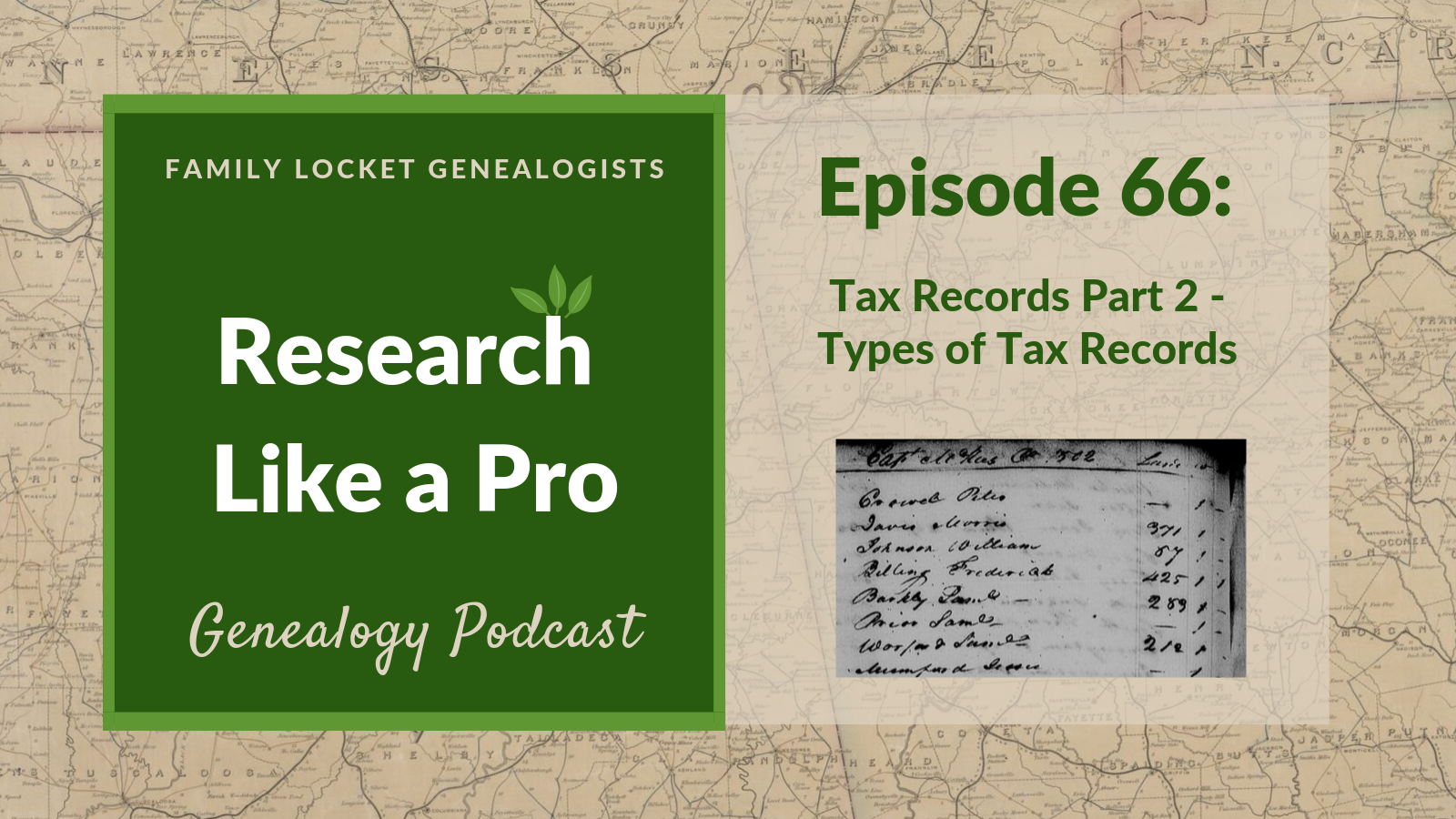
Today’s episode of Research Like a Pro is about U.S. tax records and the various types you might encounter. Each state decided how to tax their citizens a little differently. Colonial Virginia had tithables and quitrents. Later, these were replaced with poll taxes. Most tax records fall into three categories, which we discuss – poll, real property, and personal property. Nicole shares how poll taxes in North Carolina help determine the ages of John Johnson’s sons and separate him from other men of the same name. We also discuss a combined tax record on a preprinted tax form in Cass County, Texas, showing multiple types of taxes being collected for each individual.
Transcript
Nicole (0s):
This is Research Like a Pro Episode number 66: Tax Records Part 2 – Types of Tax Records. Welcome to Research Like a Pro a Genealogy Podcast about taking your research to the next level, hosted by Nicole Dyer and Diana Elder accredited genealogy professional. Diana and Nicole are the mother-daughter team at FamilyLocket.com and the creators of the Amazon bestselling book, Research Like a Pro a Genealogists Guide. I’m Nicole co-host of the podcast join Diana and me as we discuss how to stay organized, make progress in our research and solve difficult cases.
Nicole (41s):
Let’s go. Hi everyone and welcome to the show. I’m Nicole Dyer, co-host of the Research Like a Pro genealogy podcast. Hi Diana, how are you today?
Diana (54s):
I’m doing great. How are you doing?
Nicole (56s):
Feeling good. So today we’re talking about tax records. Again, this episode will focus more on different types of Tax Records. First, let’s do our listener spotlight. We love hearing from all of you, thank you. This one is from LG Price and she says, “What a great genealogy resource. These are great podcasts answering all the tough questions about how to organize and effectively research our genealogy. I can’t say enough about these podcast lessons. I’ve bought the book and already see some improvement in my researching methods thanks to this mother-daughter team.” Thank you so much. I’m so glad that you are seeing improvement in your methods and that’s the best thing we could hear.
Nicole (1m 37s):
Wonderful. I feel pretty lucky that I get to talk to my mom about researching and that’s brought about my greatest improvement in researching is learning from her as she has gone through the process of becoming an Accredited Genealogist and doing client research and now we both get to do professional research together. So it’s wonderful.
Diana (1m 56s):
It is fun and I really love that we’re also working on incorporating DNA with our research because so many of our client projects do have a DNA element and it’s been just so fun learning together and trying to figure out the best way to approach DNA.
Nicole (2m 12s):
Right. That reminds me of an exciting thing that happened yesterday with my DNA research is I got a new relative to take a test and share their results with me and it feels like Christmas when you get that result back and it’s like, okay, I get to link the tree and see all the shared ancestor hits, and it’s two brothers now that I have, so I can compare their DNA and see if one has matches the other doesn’t on this line that I’m trying to figure out.
Diana (2m 38s):
That’s great because the line is far back and so there’s a really high possibility that they will have different matches. So exciting if only we had all day long to work on DNA. That’s what I feel.
Nicole (2m 49s):
I would love that.
Diana (2m 51s):
Well, today we’re going to talk about the types of Tax Records. And this is important because during the colonial period in the United States you may see tax records by different names than just tax records and it’s good to know what those are. One of them could be Quit Rent and these were records of property taxes paid to a proprietor or the crown. We’ll have a link in the show notes where you could read all about Quit Rents. Another type of tax record is Tithables and a Tithable was simply a person who was able to be taxed and this was part of English laws. So it shows up in Colonial Virginia, and there’s a great article we’ll link to also called Tithables at the Library of Virginia.
Diana (3m 36s):
There’s also a lot of different tax types that were in the United States once it became a country. We have the head poll tax, poll is spelled POLL, and it was also known as a head tax or capitation tax ,or basically a tax on each head, or person, regardless of their personal property. If you have a man who was new in a state or in a county, and he maybe didn’t have any land or much property, he would still be taxed because he was just living there. They were taxing on each person and sometimes you’ll see that as a very, very small amount that he would have to pay.
Diana (4m 17s):
And then we also have the real property tax, which was paid by people who owned land, and we have the personal property tax paid by people who own livestock, slaves, carriages, stud horses, and other taxed property. So you might also see tax records such as the Poor Tax, a Road Tax, a Faculty Tax, Inheritance, title or deed, ecclesiastical, business, liquor, federal Tax on aliens, an old Age assistance and more. So interesting that there are so many different types of taxes. And one of the takeaways I had from my advanced southern research class with Mark Lowe earlier this year at SLIG was that we should always go to the end of the tax list and then we get to see those special types.
Diana (5m 9s):
The business taxes or the liquor taxes, they’re all included at the very end of the tax book and your ancestor may very well be listed there and you would not have even thought to check that. So that’s just a tip. Go to the very end and see what else you can find that they were taxing in that specific county. So Nicole, what have you found with taxes? I know you’ve had some really great projects that you’ve used tax records.
Nicole (5m 35s):
Well, I recently used tax records extensively in a client project to identify John Johnson. He lived among several other John Johnsons in Rowan County, North Carolina. And the client wanted to know the father of John and we had a probate record for John, which stated that John was giving his sons part of a legacy from his father Abraham Johnson. So right within his own probate record, he names his father, which is really helpful. However, there were so many John Johnsons and so many Abraham Johnsons that just knowing the name didn’t really establish a definitive link. So I had to first identify which of the John Johnsons in Rowan County was the right one so I could trace him backward in time.
Nicole (6m 18s):
And then hopefully tracing him backward in time would provide evidence to link him to the right Abraham Johnson. So the way I did that was with tax records. So I learned a lot about the value of tax records and how they can be used as evidence through this project.
Diana (6m 32s):
That’s really great. I think that you have to dive in and do a project to just completely understand the value of them. Otherwise you just think, oh, that’s nice. But when you have to use them to really separate out men of the same name or all the different people in a family, then you realize how valuable it is and I always just get a little frustrated or upset when there are no tax list in existence for when I need them. So how did you go about this your John Johnson project?
Nicole (6m 58s):
Well, first I just looked within the FamilySearch catalog and found out that Rowan County had some collections in the catalog there for tax list and they were digitized, some were not, but I focused on the ones that were digitized because there were so many and they weren’t indexed, but they were categorized by year. So I kind of figured out the way that they were organized on the microfilm. And I started with the year that was closest to the probate record for John because I could kind of figure out who his associates were based on the estate file and who his possessions were sold to and who were listed in his list of debts and things. So I kind of had an idea of who he was in that year, but going backward, it got a little hazier.
Nicole (7m 38s):
So I thought I would start with what I knew and move backward. So I found the tax lists for that year and there were about 10 to 15 lists, and each of them were called a company, and the company names were named after the man who was in charge of that company. After looking through all the companies, I found that several of those neighborhood companies had a man named John Johnson. I knew that my John Johnson lived in the Cabin Creek area based on his probate record and a land record that named him and his sons. So I kind of knew where he was. Basically I just put all of the Johns into my research log with their neighbors and started to see patterns. And the first most helpful clue was that on that year right before probate for John, his son Randall was included in the poll tax.
Nicole (8m 24s):
So that right away gave me the big hint that this is the correct John Johnson because Randall Johnson was a unique name, there was only one in the whole county. So then right away, every time I saw a John Johnson next to a Randall, I knew that was my subject. And so Randall went back a few years in the tax records until he was too young to be included in the poll tax. And that was another hint for me because I didn’t have Randall Johnson’s birth year, but because I looked into the laws for North Carolina taxes at that time, I figured out that you had to be 16 years old and older to be taxed. But then that law changed over time and so that in 1801, let’s see, I think I’m mixing up all the laws, but basically the law changed so that males over 21 were taxable.
Nicole (9m 12s):
So by the time Randall was taxed, I could calculate back to say that his birthdate was about 21 years before this tax record.
Diana (9m 21s):
Okay. You’ve got a couple of really good things I just wanna recap here. So first of all, going back to where you talked about the different companies, I wanted to clarify that for anyone listening who has not worked with the tax records. When you go into a microfilm that is for the year and for your county, you may look at that first tax list and think, my person’s not here, not realizing that there are several more tax lists for that county for that year because they have these divisions. And when I first did this, I did that exact same thing. I looked at the very first list, I was disappointed my person wasn’t there, and then I realized there were like 10 more and I needed to look on each one of those for my person.
Diana (10m 3s):
So just know for every year there will be multiple lists because of that division. Sometimes I’ll see them by captain so and so. And you’ll also see a pattern that the same captain did all the tax collecting every year. And you can kind of see a pattern there. And sometimes I’ve seen it with the handwriting, you can just tell for sure because that man has the same handwriting in each of the years. And then the other thing I think that was so interesting with what you were talking about Nicole, were the laws and that the law changed. And so you may find the law for 1784, but then it was different by 1801.
Nicole (10m 38s):
Yeah, that’s a really good point about the laws. And what I did is I found the law books for several years on Google books that were digitized for North Carolina. So then I chose the one that was closest to the years that I needed and read through that one. And you can actually just search through it for tax laws and just type in tax. But it was most helpful to read through the whole entire tax section even though it was really long. It was really key to my evidence that I understand all of the tax laws. So I started at the beginning and read all of the tax laws for North Carolina starting when it began as a state up to the time when I was using the information as evidence. And I know it’s tricky sometimes we’re trying to rush or we want to go quickly and if I hadn’t read all of those laws, I could have made a big mistake in deducing what Randall’s age was.
Nicole (11m 26s):
And of course I had to correlate that with other information that I found, you know, later in his life. And putting it all together, I was able to create a good picture of when Randall was born and where he lived and and all of that. So it is important, like we talked about in the last episode, to correlate your information from tax records with other records.
Diana (11m 44s):
So one thing you can do when you’ve got this figured out is put that in your locality guide. You can have a whole section in your locality guide under the tax laws of the state and have links to those books or online articles. And you can even put a little summary, you know, for this year, this was the tax for this year, this is when it was changed and this was the tax. Because if you’ve gone to all that work to learn about it and use it in a project, you wanna keep that so that next time you come to the same problem, you have it right there in your locality guide. You don’t have to do the research again, you can just remind yourself because we don’t remember these things from project to project. You know, here you are researching in North Carolina and then your next project is Kentucky, right?
Diana (12m 26s):
So we have to, we have to make notes for ourselves and remember these things and our locality guide is perfect.
Nicole (12m 33s):
Right. I love that idea that I could write a paragraph summary about the tax laws in the report. I could copy and paste that to my locality guide and the next time that I’m using taxes in North Carolina, I’ll have that paragraph ready to grab and use it again.
Diana (12m 45s):
Yeah, that’s a great idea. So what did you do next with your project? What else did you find out?
Nicole (12m 50s):
Well, I talked already about finding clues about the age of the person being taxed. So that helped a lot with several of the children because John Johnson had Randall and John and several other children that were taxed. And what helped the most was figuring out the names of John Johnson’s closest neighbors. And some of them were very unusual, like Clement Lanier or Lanier, Lewis Lanier and William Kinney. Another one of the neighbors that I used a lot in helping me identify which John was which was Benjamin Davis because he bought some of the possessions of John at the estate sale after John died.
Nicole (13m 31s):
And then later I came to find out that this Benjamin Davis was a son-in-law to John and had married John’s daughter. So it’s, it was just really helpful already knowing that this Benjamin Davis was a neighbor when I found that marriage record for his daughter, I could say, Oh yeah, of course this would be the son-in-law because he was a close associate of John and the family. So it can really help you paint a bigger picture of the person you’re researching community and their associates.
Diana (13m 60s):
Wow, I love that. I think that is often a missing piece of research. And we hear a lot about the FAN club, the friends, associates, and neighbors and this is a perfect example. By identifying his FAN club from the tax records, you were able to separate him from the other John Johnson’s and then all the other little clues started to make sense, the names of in-laws or who they married. Oh, I love that. It’s so fun. It’s great when it all comes together.
Nicole (14m 29s):
Right. And I did eventually find evidence linking John Johnson back to a probable father, and one of the things that helped was tax records. So let me tell you about that. I was able to trace John Johnson of Cabin Creek back in time until about the time when I think he arrived in Rowan County. And before that first instance of him on the Rowan County tax list, right before that, there was the man who sold him his land on the tax list instead. And so I could kind of see when he moved in. And then I found an Abraham Johnson who was a possible father. I also found three other candidates that could be fathers.
Nicole (15m 9s):
And then I was able to go through each Abraham and look at their son, John, who was listed in their probate, ’cause each of them had a son named John. And I was able to trace each of those Johns, except for one of them disappeared from the tax list in that parent county, whereas the possible Abraham parent lived and he disappeared from that tax list. And then the next year he shows up in the Rowan County tax list. So that was the candidate that I really honed in on as being the correct father for John.
Diana (15m 36s):
Wonderful. Can I just say here that these people lacked imagination. John Johnsons, can we think of a different name? Makes me wonder, like I said in the previous episode, maybe the original settler was John Johnson and that was just such a revered name, they wanted to keep using it. It makes you wonder, doesn’t it? But it does harken back to naming patterns where you named your first son after your father.
Nicole (16m 1s):
Right. And that was actually another really helpful piece of information clinching this case. So to make the case that the Abraham Johnson that I found whose son John left that county and next year showed up in Rowan County, they had named their children a lot of the same names. So I made a table showing all of the names of Abraham Johnson’s children, and then all the names of John Johnson’s children and six of the names matched up. And so I used that as evidence also that this John Johnson was naming his children after his siblings.
Diana (16m 29s):
Great naming patterns are strong evidence, especially in that time period. Really great work on that. That was like your first really big difficult project, if I remember. Is that right?
Nicole (16m 38s):
Right. And I know I spent more hours than I should have, but I just told myself this is a learning opportunity.
Diana (16m 44s):
And that is the fun thing about client work. So if any of our listeners are thinking that you might want to take clients, I highly encourage you to do that. You learn so much from working on somebody else’s genealogy for one thing. It puts you in a whole different area than you often are working in. And different sets of records, like maybe your people were poor and they didn’t leave any probate. That was kind of my case. My poor southern ancestors. I only have one ancestor that left a probate file and nobody else did. But working with clients, I’ve worked with a ton of probate records now. So you get more experience with a lot of different things and it’s a great way to learn and increase your education.
Nicole (17m 24s):
Right. And you know, if you don’t feel qualified yet, like I didn’t quite feel qualified. I told the client, listen, I’m not an Accredited Genealogist, I’m working toward it. And so because of that, I’m only charging such and such amount. I think I charged him like $30 an hour. And so I gave him like a discount. And then I also gave myself extra time to make sure that I really understood all the records I was using and made sure that that I found the best evidence that I could. And then as you gain experience, of course you can increase your rates. And I think one of the important things is to try to really stay within the time constraints that you’re given by the client once you feel like your expertise in that area is up to par.
Diana (18m 5s):
Right. And it’s tricky to do. It all comes with experience, but you learn from every project. Well, let’s go ahead and just talk about one more thing with tax records before we wrap up this episode. Wanted to just talk a little bit about what a typical tax record might look like. And the example that I am going to use is a tax record created by Cass County, Texas in 1855. This is a great example of three kinds of taxes being combined into one record. We have the real property, which is the land, so think real estate, and then we have personal property tax, and then we have a poll tax. And it’s interesting just to see how different people in the community were taxed for different things.
Diana (18m 48s):
And in this case, the ancestor was Moses Isenhour and Moses, well, this is Nicole’s project. So Nicole, I’m gonna actually let you talk about Moses Isenhour. So tell us a little bit about Moses and why you even cared about his taxes in Texas.
Nicole (19m 5s):
All right, So I was trying to find out his kind of his whole life story, but mostly focusing in on where he lived because there was some question about his identity because I found two different Confederate service records in the Civil War for a man named Moses Isenhour. And they looked pretty different to me when one died in the war and then the other one enrolled later. So I knew they were different and I wanted to know which one was referring to our relative. So looking at the tax records and figuring out where he resided really helped because he was in a whole different county in Texas and then he ended up going back to Arkansas and his wife was listed on the tax records instead.
Nicole (19m 43s):
And so when I could see the tax records that he showed up on the list for a while and then it was gone. That really lined up with when he joined up in Arkansas where they had lived, you know, just a couple years before. And then he died. So then she was the only one on the tax list going forward. The other man lived in a different county in Texas, so that’s why I ended up looking at these tax roles for Cass County, Texas. And I thought they were just a really good example of how, you know, later on in the 1800s oftentimes you’ll have a pre-printed tax assessment form like this one. And we’ll link to this in the show notes for you to see in the blog article I wrote about it.
Nicole (20m 24s):
But you can see that there were just different columns and you could be taxed in all these different areas. Personal property included enslaved people, horses, cattle, money at interest, merchandise on hand, miscellaneous property. So you can see that this county was really bringing in a lot of tax revenue from all different types of categories.
Diana (20m 45s):
I really like to track a man’s property. Sometimes it’s fun because they’ll show up in a county and all they’re being taxed for is one horse and then the next year they’re being taxed for a horse and one cow. And you can kind of see from year to year that they start accumulating more property. And that’s kind of fun when that’s your ancestor. And then sometimes the opposite happens, all of a sudden they’re back to one horse and you wonder what happened. They had to sell everything to pay a bill or something. So really looking at all that information can tell a little bit of a story about the people you’re researching. So I think that we’ve pretty well covered some great examples on tax records and how we’ve used them and different things with those.
Diana (21m 28s):
So let’s go ahead and wrap it up. Hopefully everyone is just getting excited about using tax records because they are so helpful for those in-between census years or when you can’t find anybody in the census, you can always go to those tax lists.
Nicole (21m 41s):
Okay, everybody, thanks for listening. We hope you enjoyed learning about the poll taxes with the Johnsons and the combined tax records with the Isenhours, and hopefully you can go and try to find tax records of your own families.
Diana (21m 53s):
All right, bye-bye everyone.
Nicole (21m 54s):
Bye-bye. Thank you for listening to Research Like a Pro with Diana Elder, accredited genealogy professional and Nicole Dyer. We hope that something you heard today will help you make progress in your own genealogy research. If you like what you heard, please leave us a review on iTunes or Stitcher or visit our website, FamilyLocket.com to contact us. You can find our book Research Like a Pro a Genealogist’s Guide on Amazon.com and other booksellers. We hope you’ll start now to Research Like a Pro.
Links
Back to the Basics with Tax Records: Part 2 by Nicole at Family Locket
Tithables at the Library of Virginia
The Genealogist’s Guide to Researching Tax Records, by Carol Cooke Darrow, CG and Susan Winchester, Ph.D., C.P.A. [1] (This is an affiliate link. Thank for your support!)
Study Group – more information and email list
Research Like a Pro: A Genealogist’s Guide by Diana Elder with Nicole Dyer on Amazon.com
Thank you
Thanks for listening! We hope that you will share your thoughts about our podcast and help us out by doing the following:
Share an honest review on iTunes or Stitcher. You can easily write a review with Stitcher, without creating an account. Just scroll to the bottom of the page and click “write a review.” You simply provide a nickname and an email address that will not be published. We value your feedback and your ratings really help this podcast reach others. If you leave a review, we will read it on the podcast and answer any questions that you bring up in your review. Thank you!
Leave a comment in the comment or question in the comment section below.
Share the episode on Twitter, Facebook, or Pinterest.
Subscribe on iTunes, Stitcher, Google Play, or your favorite podcast app.
Sign up for our newsletter to receive notifications of new episodes.
Check out this list of genealogy podcasts from Feedspot: Top 20 Genealogy Podcasts





Leave a Reply
Thanks for the note!