
Today’s episode of Research Like a Pro is about setting up an organizational system that you trust to hold your projects and give you reminders about what needs to be done on any certain day. What good is a filing system or calendar that is never used? Have you tried a new tool but given up when it didn’t meet your needs? This is the time to revisit how you’re organizing your genealogy and make some decisions that will help you feel more productive. We discuss physical filing systems, digital filing systems, genealogy software, reference material, emails, organizing projects, calendars, project lists, and next action lists. We also discuss Evernote, Trello, Google Drive, Google Calendar, and Google Tasks.
Transcript
Nicole (1s):
This is Research Like a Pro episode 77: Getting Things Done Part 3. Welcome to Research Like a Pro a Genealogy Podcast about taking your research to the next level, hosted by Nicole Dyer and Diana Elder accredited genealogy professional. Diana and Nicole are the mother-daughter team at FamilyLocket.com and the creators of the Amazon bestselling book, Research Like a Pro a Genealogists Guide. I’m Nicole co-host of the podcast join Diana and me as we discuss how to stay organized, make progress in our research and solve difficult cases. Let’s go.
Nicole (45s):
Hi everyone, and welcome to the show. I’m Nicole Dyer, co-host of The Research Like a Pro Genealogy Podcast, and I’m here with accredited genealogist, Diana Elder. Hi mom. How are you today?
Diana (56s):
I’m great. Thank you, Nicole.
Nicole (58s):
What have you been working on lately? Tell us about your research projects.
Diana (1m 2s):
Well, I am kind of wrapping up a project right now, which is 20th Century British research and it involves some Egyptian ancestry. So when I first got this client project, I was a little wary of it because I didn’t know what I would be able to find. And what I found is that there really is not a lot on the Egyptian side, but on the British side, I’ve been able to get some really interesting records and I’m waiting for the mail every day, because I’ve ordered from the General Register Office in England, a consular British birth certificate for this man who was born in 1941 in Cairo, Egypt.
Diana (1m 47s):
And this was the middle of World War II and the father was a British soldier. The woman was living in Egypt, she’s half Egyptian, half English, and I’m so interested to get that birth certificate because I think it will give me clues to the father’s service. I can’t look for any service records because I have no idea what unit he was serving in. And his surname is super common. He’s got one of those common names where I put it in the search and you get like thousands and thousands of results. So I’m hoping that birth certificate, when it comes in the mail, will give me his service unit and then I can really try to identify him and work on that line. So I’ve, it’s been really a fun project learning about some different types of records and putting things together and someplace different than I usually work.
Nicole (2m 34s):
That does sound great. It’ll be really interesting to see if the certificates give you the names of the generation before the parents.
Diana (2m 43s):
Yeah. Well, I got a marriage certificate for the Egyptian groom and the British bride that’s coming also. And so I’m really hoping that will give me clues to the Egyptian family, that marriage certificate it’s 1913. I, they had to provide parent names. So I’m hoping that will be on there cause you never know what you’re going to find.
Nicole (3m 6s):
Yes. Those British marriage certificates are great with the parents. Well, usually it just lists the father, right?
Diana (3m 12s):
Yeah. I think it is the father, but I haven’t ordered one for 20th century. Usually I’m getting the ones from the 1800s. So I’m not sure what this will look like. You know, a little bit later
Nicole (3m 23s):
That’s a good point. Well, great. Let’s do our listener spotlight. It’s from Reserve and the title is, Improving My Research Skills. She says, “My mother and I have been researching our family together for the last 10 years. And as most folks do, we’ve hit our share of brick walls. I love The Research Like a Pro process and podcast. It’s really keeping us focused and moving forward with our quest to see what can be found and what else might be out there for resources we haven’t considered. Plus I love listening to this mother-daughter team, reminds me of working with my mother every week. Thank you for your podcast and your process. We are so grateful.” We are so grateful for you listening.
Nicole (4m 3s):
Thank you so much for sharing that. And it’s fun to think about other mother-daughter teams out there doing their research together and enjoying the process. We really have fun talking about our family together, don’t we mom?
Diana (4m 16s):
Yeah, we do. So it’s really amazing how much we’re alike with this love for genealogy and family history and organizing and figuring out processes and studying. So I’m just really glad we’re kindred spirits because it makes it all really fun.
Nicole (4m 34s):
I agree. Sometimes I wonder, because I look so much like dad, if I got from you more of the kind of subtle personality traits like that, of enjoying writing and staying organized and working on things like this. So who knows, maybe we should do as a little chromosome browser experiment and see what those segments line up with. I don’t think they really have a lot of good data though, about personality traits. It’s more about physical traits that they know.
Diana (5m 5s):
I agree. I think it’s more family stories and just knowing people that you can pick those out because I am so much like my dad in a lot of ways, but then I also have so many interests like my maternal grandmother. My grandma Kelsey, loved traveling, she loved reading, she loved learning, she loved music, cultural things, and she was a teacher. She was a teacher and a librarian. And I just think that, and she loved family history. So a lot of those kind of interests and likes I got from her, I think, I think it’s just fascinating thinking about how we inherited different traits and personality things from our ancestors.
Nicole (5m 53s):
And then there’s the whole nature versus nurture debate. Maybe you just learned that from being around her as a child.
Diana (5m 59s):
Maybe I did. She, I was around her until her death, let’s see, I was 13 when she died. So yeah, I don’t know how much of that do we absorb? That’s a good question.
Nicole (6m 9s):
I don’t know, but I do think that a lot more of it is actually genetic a lot more than we think. A lot of the twins studies that they’ve done have shown that twins raised separately, they have the same exact genetics, but they develop some of the same personality traits, which is really, it seems really odd to us because we don’t naturally think that personality develops because of our genetics, but that’s, you know, it’s interesting, it’s a debate. I mean, everybody has their own opinion about where things come from. So it’s an interesting thing to think about. And I have noticed that we have a lot of musical ancestors and then I can see the, the music gene passed down through the family.
Nicole (6m 51s):
And, you know, especially with my sister Elizabeth, and how amazing she is with music and your musical talents. And then we had our several ancestors on grandma’s side that were well accomplished musicians. And then my son Jacob’s been taking piano lessons. And at first I thought this is never going to go anywhere, but he just has the music in him. He loves it. And he he’s learning and developing and growing so quickly that I just wonder if he just, if it’s just part of his genetics to be musical.
Diana (7m 26s):
That’s really fun because all those years when I was teaching piano, I totally could see that in my students, whether they had a music gene or not, because I had students that would sit down and it just came so naturally and so easy to them. And then I had others who could not play a note even after, you know, lesson upon lesson upon lessons. So definitely there’s a gene for music and that aptitude, I can totally testify to that after probably working with over 50 students through the years, so.
Nicole (8m 3s):
Well, Jacob and I have had a lot of fun practicing Christmas songs because we’re recording this before Christmas. I know this comes out afterward, but he has been having so much fun. He’s learned almost every song in his Christmas songs book and each one comes with a duet. So I can sit down and play the duet with him. And it’s just so fun. We can’t wait to get to Utah and show you
Diana (8m 23s):
Oh, great, and I can play the duet with him too. Cause that’s super fun. Duets are great.
Nicole (8m 28s):
Yes, they’re perfect for young students because it makes their playing sound so much fancier.
Diana (8m 33s):
It does. And it really makes them have to stay on beat and count and stay together. So that was one of my favorite things that I did with my students was doing duets with them. So I’m so glad Jacob’s learning. That’s fun to have the next generation.
Nicole (8m 47s):
Well, we better start talking about today’s topic, which is Getting Things Done. We’re on part three now. So part three is all about organization. So can you give us a recap of where we’re at in the process of David Allen’s book, getting things done?
Diana (9m 2s):
Sure. I know it’s been a while since we talked about it on the podcast. So I’ll just kind of give an overview of what we talked about previously. The very first step of getting things done was capturing and that’s where we were to capture all of our family history and genealogy projects, all those things that we have bouncing around in our heads repositories to visit brick wall research, DNA, testing, family histories, interviews, seminars, to attend webinars. So we have all these things that we’re thinking I should do this, I should do that. And we have to get those written down. So that was step number one was capturing.
Diana (9m 44s):
Then step two is to clarify. And in that podcast and episode and chapter in the book of David Allen’s book, it’s all about thinking of your commitment to each project, prioritizing the projects, then choosing the top project to work on because you can only do one project at a time, right? We can’t do multiple things at once. And so when we choose one project, then we brainstorm ideas for that project, organize the steps, then identify the next action needed to make that project a reality. And that whole idea of next actions is key. So instead of thinking of this broad project to feeling overwhelmed, never starting, we just identify a next action, which is something usually should be something very simple that we can actually get accomplished in a day or an hour or what have you.
Diana (10m 36s):
So next actions is a key thing. And then today we are doing the third step, which is organizing. So Nicole, what are we gonna do with organizing today?
Nicole (10m 48s):
Well, we’ve got to set up a system. I think when we get overwhelmed by having a project to do, and we don’t want to start, I think it’s because we don’t really have a system that we trust to help us move through the project. And so I love that he talks about creating this system that you trust to hold your projects and give us reminders about what needs to be done on any certain day. This is where we think about filing systems and calendars and just getting all of these little pieces in place to help us feel more productive.
Diana (11m 28s):
Right. And so let’s start out talking about physical filing systems. This is a question we get a lot on our Facebook group or I get through emails, I’ve done consultations on this. People just don’t know what to do with their documents. And a lot of times we may have set something up, but it’s really not working for us. We’re not using it because we don’t like the way it’s set up. So this is a really good step to evaluate and see if we want to keep using the system we’ve had, or maybe it’s time to make a change into something that’ll work better for our brain, or maybe we’ve never had a system and we really does need to start one. So, you know, just for an example, when I started doing research, I had gone to a class by Joel Crandall on using a locality based filing system.
Diana (12m 16s):
And that made total sense for me. So I organized all my physical files first by surname then location. And that worked well because I’m researching in the south. And sometimes, well, I shouldn’t say sometimes, but most often everybody with the same surname is related. And so I knew that they would be family and I wanted to gather those records as well. And I couldn’t just put them into this, you know, I didn’t know how they relate were related, so just capturing all the records and then putting them into a file by surname and location worked really, really well for me. Now that may not work well for everyone, but for me it made sense.
Diana (12m 56s):
So, you know, my folders are set up with surname first. So for instance, Shults, which has my maiden name. And then I would have, after that, I would have what that folder was all about. So Shults records in Alabama, Chambers county or Oklahoma, Love county, or I have a folder for Shults family group sheets or Shults correspondence. So that is how I’ve set up my physical folders. And for me, that worked really, really well. I know other people use family line, color coded systems or a numbering system, and they love those. So if you still haven’t set up a filing system for your actual papers that you want to keep, do a little bit of Google searching.
Diana (13m 41s):
There are so many different methods out there and really take a look at your papers, think about your situation and decide what you can use that will work for your family history. And you’ll have to decide if you want to use binders or file folders for your physical filing system. I like file folders, but I know a lot of people love their binders. It doesn’t matter just so long as it works for you. And the, what I have done with my file folders is I have a small file cabinet in my office for my working folders. I have three big bins of folders for all my surnames, but I’m obviously not working on all those folders at the same time.
Diana (14m 22s):
I’m usually just working on one surname or one specific location. So I’ll pull those folders out typically about eight to 10 and keep those in my filing cabinet. Then when I’m done on that project, those go back into my master filing boxes in the other room, and then I can pull out a few more folders for the next project. And I love that because the folders I need for that project are right here by me. And I don’t have to keep going in the other room to get what I need. So that’s worked really, really well for my physical filing system.
Nicole (14m 53s):
I like that.
Diana (14m 54s):
What do you do, Nicole for yours?
Nicole (14m 57s):
Well, fight now my files are all in these little file boxes next to my desk and they have stuff on top of them. So if I need to get a file out, it’s kind of a process of taking the stuff off. And so they’re not very accessible. So I don’t really like to go into my folders, which is a problem. And he talks about that in the book that you need, if your papers are not easy to access, you won’t stay organized. So I need to adjust that. I think I’m going to buy myself a Christmas present and just get the same filing cabinet you have. I don’t know, but with my paper files, I really only keep original certificates that I’ve ordered because most of the documents that I have are available online.
Nicole (15m 43s):
And so yeah, if I order something and it comes in the mail, it goes into those file folders, but you have pretty much all the genealogy papers. So I don’t really have a whole lot here, but I did want to ask you, when you say you’re working on just a few surnames at a time, and, and you also mentioned that you just tried to work on one project at a time. How have you found that that helps you? Because I know a lot of times people and I do this too, we tend to try to work on multiple things all at once. Like we’ll have several big projects going. And I, I think the general feeling that I have when I’m doing that is just, I get less motivated to work on it because it does seem like I have so many balls in the air.
Diana (16m 26s):
Oh yeah. I have to focus on just one family line in one location, one project, otherwise it can be super overwhelming and I have multiple client projects also that I’m working on. And so I do the same thing with my client projects. I just work on one, I work on one for two weeks or three weeks, whatever my timeframe is, I get that finished up. And then I start the next one. I, I like to be able to focus. So with my personal family history, I do the same thing. You know, like I had been talking all about the Benjamin Cox project. So right now I have about 10 Cox folders. All my research pertaining to Benjamin Cox is in my little file cabinet.
Diana (17m 8s):
And so when I’m working on that, I just pull those out and I have those available. I have an upcoming project on my family that I want to do in Indian territory with the Shults line, but I haven’t pulled those folders out yet. That’s just on the horizon that I’m going to start in January. So I need to get Benjamin Cox finished up so I can get out my Shults folders and return to that project. But for me, I just have to, I have to just focus on one thing at a time. I can’t, I can’t jump around. I don’t have time to do that. I have to have some focus here.
Nicole (17m 40s):
Right. I think that comes from having multiple other projects for your work. So if your personal work, you just want to have one because you have your client work and then you have your volunteering. And so it makes sense that you would not want to have like five personal projects going on at the same time as all your other projects. So I think that’s such a good piece of advice to look at your, I mean, that’s going back to the Clarify step, really isn’t it? Just being aware of your commitments and, and that’s probably the step that I’m stuck at right now is making sure that I only take on the projects that I can really commit to finishing at that moment in time.
Diana (18m 23s):
Well, and we’re also going to talk about organizing projects a little bit later in this episode and calendaring these projects because we can have them on our mind, but they’re going to still bother us unless we have them put into our calendar. And when we have got a place for them, then we can let go of it. So, you know, you might have all these things on your mind because you haven’t yet decided when you’re going to do them. I figured out how to get them organized into your schedule. So we’ll talk about that.
Nicole (18m 50s):
Yes. Well, let’s keep going then so we can get there. The next thing we were going to talk about is digital filing systems. And we’ve talked about this in the past, but having your genealogy digital files set up on your computer is key and feeling in control of your genealogy research. There are a lot of ways to do this. I keep my files in Google drive and that backs up to my desktop computer or my laptop and my mobile device. So anything that I add from all these computers and devices is synched to the Google drive. And so everything’s up to date, which I love. You can read more about how I use Google drive in my articles that we’ll put in the show notes about organizing research with Google Drive that I taught at RootsTech 2019.
Nicole (19m 36s):
And you’ll be able to see my slides and my syllabus and the podcasts that I shared with the lecture. So you can check those out. But the digital filing system protocol that my mom and I use is just to put surname folders into the main family history folder. So in my Google drive, I have a folder called Family History. And then within that, I have Dyer, Elder, Shults, and all the folders surnames that I’m working on or have worked on in the past. So that’s a little different than the way that we do our physical file system, which is based on locality. So it just is up to you. But within each surname folder, we have each individual with that surname that we’ve researched, and then we put their surname and then comma first name, and then sometimes we’ll put the birth year if there’s multiple people with that same name.
Nicole (20m 29s):
And Diana has this great method where she puts all of her collateral relatives who married into that family within that certain folder, so that we don’t have a lot of surname folders for certain names that we’re not actually mentally thinking of like, oh yes, I’m researching that surname. So that’s kind of how our brains work and the females of course are filed with their maiden names because they could have married several times. So within each of those file folders for those ancestors, cause each ancestor will have their own folder, then we’ll put all of the documents we find for them and we’ll put the year first so that they’re in chronological order.
Nicole (21m 10s):
We’ll put in maps, timelines, research reports, research logs, and everything like that. We like to keep personal copies of all the documents that we find for them, even though they’re attached to the FamilySearch tree and Ancestry tree, because it’s a little bit faster to find them just to review what you have and see what you have on a person instead of waiting for a website to load.
Diana (21m 30s):
So I just want to make a note here that you may feel like you don’t have perfect digital files. And I don’t think any of us do just listening to you, Nicole, go through all those things. I’m thinking of all the work I need to continue to do to scan what I have amassed physically and get it into the digital folders. But again, one of the goals that I have done is when I’m finished working on a specific project, I make sure that all the documents that I’ve used have been scanned and are uploaded to the digital files. So I have not got all three boxes scanned and completely organized, but as I work through each project, I can gradually get there.
Diana (22m 13s):
It’s just, there’s no way I could sit down, It would take me probably a whole year to do that and I’ve got so many other things I’m doing. I can’t do that. So it’s okay to feel like you are doing this gradually. You don’t have to feel like you have to get this all done before you do any more research, but you could do it as you are researching work on a project, then make sure all of the information for that family, that project is digitized and uploaded in your files for that, or are up-to-date. And maybe that will be a way that would be a little bit more accessible to get that organized. Okay. So the next step of getting organized with genealogy, once you have your filing systems down is choosing a software program that will hold your family tree.
Diana (22m 54s):
We talk about this a lot that you may have a tree on FamilySearch or Ancestry, but you really want to have your information on your own computer also because you have more control over it. You can do more with charts and you can make sure that it doesn’t go away in case somebody deletes your ancestor on FamilySearch or Ancestry does something to your tree. Not that that would happen, but you know, we never know. So there are many options available for your own genealogy software and you need to do your own research to decide which one is best for you. I often use the car shopping analogy that we don’t all drive the same car and we don’t purchase the first car we take for a test drive.
Diana (23m 36s):
And the same is true for genealogy software. So research different options and think about what you need in a software program. And I would recommend trying the free version of several of the different programs you can download them and try, maybe have just like a small GEDCOM that you upload to each one and work with looking at how the ancestors are, you know, what you can do with each ancestor’s profile. See if you like working in that particular software. And we have an article on that titled, three Reasons to Have Personal Genealogy Software and How to Choose. And we can put a link to that in the show notes. So if you’ve been thinking about getting genealogy software, yes, you really should do that and look into the options and make that one of your projects that you finally figured that out commit to something and then learn how to use that.
Nicole (24m 27s):
Good tip. I recently downloaded Legacy to try it out because my friend Monique, hi, Monique, she’s listening, she loves it. And so she showed me some of the amazing things that Legacy can do, and it is a really powerful tool. And so I’m almost convinced that I need to switch over to that, but it has some really neat things that you can do to customize how your family tree looks when you’re working in it. And you can have a quick access toolbar with all the links that you want right there. You can really make it your own and make it work for you. So that was something I really liked about Legacy. Now that we’ve talked about getting all of your tools in place, let’s talk about reference material.
Nicole (25m 11s):
So beyond the historical documents that we collect for ancestors and research logs and reports, we also collect reference material as genealogists as we go to conferences, institutes, watch webinars, all of these come with syllabi and we read these maybe once and then we want to keep them for future reference. We also will probably read blog posts and other helpful articles online. So we need a way to keep track of the information. So in David Allen’s book, he talks about setting up a system for reference material. And I really loved this section because it really was eye opening to me to think about how much paper and clutter is this type of thing where we want to keep it, but we don’t really have a system for keeping it organized.
Nicole (25m 58s):
So Diana is really great with using Evernote. She’ll put a conference syllabus in there, she’ll put blog posts in there and she’ll tag them in Evernote so that she can find all of the reference material relating to a certain place or a certain subject. And so that’s a great system that works for her. And I use Google drive to keep all my reference materials. So now whenever I watch a webinar or if I have a syllabus that I want to save, I just have this little button in the top of my Chrome that says save to Google drive. And so I can save PDFs from all over the web to my Google drive.
Nicole (26m 38s):
And then I put that into a folder of syllabi that I can access later. So it just, maybe you need to come up with a system where you put all of your conference syllabis and different blog posts that you use to learn about genealogy research.
Diana (26m 56s):
Yeah. I think that all that reference material can be a huge thing. I used to go to these family history fairs that our Highland state would do. And I think you went to a few of those with me also, and we’d get this entire little booklet of all the syllabus information. It was so very helpful to me when I first started. And I think I still have a bookshelf of those. And actually I think I went through that and clean that out significantly because so much of it was outdated, but we do have so much good information we want to keep, but if it’s just sitting on a shelf and we do not know how to get to it, then it’s not going to do any good. It’s just taking up space. So we’ve got to come up with some kind of a system.
Diana (27m 39s):
Well, let’s talk about email. Email can eat up our time, like crazy looking for email, figuring out what to do with email. And if we miss emails, we can really mess up our lives. Right? So it’s important to organize our email and David Allen has some really great ideas and getting things done. And when I read this suggestion, it literally changed my life because I used to keep all of the emails in my inbox that I needed to do something about. I would look at that inbox and feel so overwhelmed cause I’d have like 10 emails in there. And each one of ’em I knew it was gonna take time, but he recommends having two email folders, one for action and one for waiting.
Diana (28m 27s):
So I put a character and I have done exclamation point, action. And that puts that right at the very top of my sub folders. And anytime I get an email, that means action on my part, I put it over into that folder and then I can have a clean inbox. I can get my inbox to zero every day because I don’t have to keep all the action items in it. And then the other folder that I set up that I love is called waiting. And again, it has an exclamation point waiting, and this is for emails that I’m waiting on someone else. So let’s say, you know, I’ve emailed someone saying, I need you to send me your syllabus information for this conference presentation.
Diana (29m 15s):
Well, I can copy myself on that and then I can put, wait, put it in the waiting folder. And then it reminds me I’m still waiting for that person. I don’t have to keep it in my inbox. It’s over in waiting. I can check that and I can email them back in a week if I haven’t gotten it yet. So I’ve really, really enjoyed having those two sub folders of action and waiting. Now some of the other sub folders that I set up, I have a sub folder for family history. And then under that I have, so when I’m contacting relatives back and forth, I can put them under the appropriate surname that we’re working on research for. I have a sub folder for DNA matches.
Diana (29m 55s):
So, you know, whatever you want to set up, you can do in your sub folders and that can help you to get more organized. I use Gmail and so I can search by topics and by different people. And it really helps me to make sure that I am keeping current with my email, but not having it be totally overwhelming when I open up my inbox each day.
Nicole (30m 20s):
That’s a great tip. I used to do the same thing with keeping all of my action emails into, in my inbox. And it was annoying because I never felt like I could get through it. Like you said, so I’ve done a similar thing. I don’t do the folders, but I use Trello. And so I have different lists in Trello. And so when I go through my email, I just take the actions and put them into my to-do list there. And I have a to do later to do soon doing now and then done, and I can move all the tasks around between those lists, but it’s nice to be able to take those two items out of my email, archive, the email so that I can find it later if I need it, but then put the item that needs to be done somewhere else outside of my email.
Diana (31m 4s):
Right. And I do that too. When I have an action, I put it in my task list. I just use the Google task lists. That’s on my Google calendar and team mail and Google keep, they all go together. So I just use that task list, but I, I love Trello, the idea of using Trello. And I’ve looked at that a little bit. So maybe you should write a blog post about how to use Trello for family history and teach us more about that.
Nicole (31m 27s):
I would love to, it works for me. So I have it open all the time and I like being able to see what things need to be done right away, and then seeing the ones that I can do later. So,
Diana (31m 39s):
Well, I have one more thought about email and with family history and genealogy, sometimes we get emails that have really important family history information, especially if we’re working with a cousin and they’re sharing information with us. So I highly recommend taking those emails that they send and copy and pasting the information, putting it into a Google doc and then filing it in your filing file folder under that person. And you could give it a descriptive name such as 2019, email William Houston, Shults from Nicole Dyer, you know, so that you can find it again, using your, your Google search in your Google drive.
Diana (32m 21s):
But I know that in the past I have remembered that people have emailed me something and I can’t find what I want. So I think that it’s really, really helpful just to get that information out of your email, put it into a document, whether you use Google docs or whether you use word docs or whatever, and then put it in the file folder for that ancestor so that you keep it in a place that you might be able to use it better. Okay. So let’s talk a little bit about calendaring, because once we have filing systems organized, we have our genealogy software figured out we have a system for organizing our reference material.
Diana (33m 1s):
So now we just need to figure out how to actually organize those projects that we captured in clarified in steps one and two. So one of those is a calendar and hopefully everyone listening has got a calendar that works really well. I know a lot of people like their day planners, or they have a wall calendar or maybe use something like Google calendar or another app. So whatever you choose to use is great, but you just have to make sure it works for you. I settled on Google Calendar probably a couple of years ago because I could get it on all my devices. And I’ve so often I’m at a meeting away from my desk, but I can pull out my phone and access my calendar there, which is great.
Diana (33m 43s):
And then it’s always up on my desktop. And every morning when I get up, I check my calendar to make sure I’ve remembered everything I need to get done for that day. And the next day or two kind of looking ahead. And the fun thing about Google Calendar is that you can have different calendars. So you can have a family calendar, a personal account, or a work calendar. You can share it with people. It can be really helpful and you can view it for the day, week, month, year schedule or four days mode. So it’s so flexible and I really do love that. So here’s some ideas to make your calendar work for you, regardless of what kind of a calendar you use, use it for items that need to be scheduled on a specific day, such as an appointment or a webinar or a conference, things that are really specific.
Diana (34m 32s):
And then you can also use it for, to put reminders for you. So let’s say that you have sent an email to a repository and they are supposed to copy a newspaper article and then send it back to you. And they said that you would be getting it in the mail in two weeks. Well, you could put a reminder on your calendar for that two week period. And if it hadn’t come in the mail, then you could check back with them. You could call and say, Hey, it didn’t come. Did you actually mail that? And if you do that, then that will keep things from falling through the cracks. Because if we do a lot of research and we’re contacting a lot of repositories or people to send us information, we may forget to check back.
Diana (35m 12s):
And if they forget, we will not get that information we wanted. And then we can also schedule things that we never seem to get around to. So we’re talking Nicole about those projects that you’ve got a long list of things. And so you could, you could take some time and really schedule out those projects and say, okay, I’m going to do this project in March because that’s going to be a great month to tackle that. Or, you know, July, whatever you can feel like you’ve got these projects calendared, and you may have to change those when the time comes, but at least you can have it down so it can quit bothering you, you know that you’ve got it scheduled for some time in your life.
Nicole (35m 58s):
I think that’s a great idea. And what I’ve noticed is that when I am accountable to someone, then I do much better. So that’s one of my things that I’ve learned about myself. So maybe what I should do, mom, is tell you my plan for when I’m going to do it, and then you can make sure that I do it.
Diana (36m 19s):
Well. Yeah. Or, you know, I, I agree. I think the accountability is huge. So it’s been really good for me doing the blog because I will set myself a schedule for writing blog posts. And by doing that, I have been able to write a lot of different articles that I don’t know if I ever would have got to before. Like when I was writing the series on my dad, his stories, the Adventures of Cowboy Bob, that was so fun because I really wanted to write those stories out and get them in a format and get them out there. And having those scheduled as blog posts helped me get that done.
Diana (36m 60s):
So I think getting these projects out of our head and onto paper onto a schedule can really help us to actually get things done.
Nicole (37m 8s):
Yes. I love my calendar. When you were talking about Google Calendar, I just realized how much I rely on it. And I access it on my phone all the time. I even ask my Google home speaker, what’s on my calendar today. I’m in the kitchen because sometimes if I’m away from my calendar too long, I get nervous that I’m forgetting something I’m like helping the kids with homework and cooking and cleaning in the kitchen. I can just check and make sure that I’m not forgetting a meeting or, or something that I need to be doing. So it’s really helpful to be able to get those things out of my brain and put them in a place that I trust and know that it’s going to take care of me and help remind me for the things that I need to get done.
Nicole (37m 54s):
And sometimes I’ll put in like things on my calendar for exactly what I want to do each hour or each day. Like when I have a block of a couple hours that I’m going to work, I’ll put on, okay, I have one hour to get this thing done and one hour to work on this other thing. And then I just have to get it done within that hour. And I try to make myself do that. And it’s hard because I tend to want to overdo things and spend more time than I need to. So this is something that I’m still working on, but it is a good goal. I think, to try to schedule out how much time you think something should take and then get it done within that time. And I think that’s one of the key ways that we can get things done as the book wants us to.
Nicole (38m 35s):
And that’s just by making, we don’t spend too much time on things that we really could get done faster.
Diana (38m 42s):
Oh, I totally agree. In fact, I, you know, I use my notebook and just write down the things I need to get done for that day. My, my three or four or five things. And I often will put a time limit, I’ll say two hours of client research, one hour on writing a blog post draft, 30 minutes on email. And then I do try to stick to that because you are so right, you can let that time just go and go and go. And before you know it all your morning has gone and you’ve just been doing something you didn’t want to do or spend that much time on.
Nicole (39m 14s):
Right. Usually for me, that’s emails where I was like, oh, I didn’t know I was spending three hours answering emails because it is fun to correspond with people. And, and I think that’s good, but if we have other things we want to do too, then it’s good to set a limit and just say, okay, I don’t have two hours to write really lengthy email responses right now.
Diana (39m 32s):
Yes. I think the key is to keep those email responses a little bit shorter. So we apologize to any of you who’ve written us emails, and if they may have been shorter emails, just know we love you and we would write you really long ones if we could, but we only have so many hours in the day.
Nicole (39m 49s):
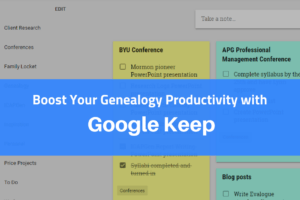
Well, let’s talk about project lists. So to keep on top of our genealogy projects, we need to keep our lists current. And maybe you’re keeping your list in a notebook or word processor, sticky notes. But one of the ways that we like to keep track of our project lists is with Google keep. And I mentioned, I also use Trello and these are very similar tools that are used online and they’re on all your devices. And it’s great to have one place to keep all of your project lists. You might have a list for genealogy research, education, family history projects, writing projects, things like that.
Nicole (40m 30s):
So during research and following a research plan, we don’t want to go off chasing bright, shiny objects. Right? You can put a little note in Google keep when you are attempted to go chase a bright, shiny object to remind you to do that chase later and have it be more intentional. So don’t, don’t deviate from your research plan, but do make a note of it. And you can put it on a sticky note. You can put it in your future research suggestions, or you can just make a note on Google keep. And I have a lot of notes in Google keep that I haven’t gotten to yet, but they’re there for me if I ever want to do it. And sometimes I will go through all my Google keep sticky notes and just archive the ones that I don’t really actually want to do anymore.
Nicole (41m 14s):
And then sometimes I’ll see that I’ve done some and I’ll tick it off and cross it off cause it’s nice you have that option to check the box next to it and it crosses it off for you. I love that about Google keep. In fact, I’ve been using it a lot for my Christmas list for shopping and I’ll put in what I want to maybe get for somebody when I buy it, how much it cost and just have a little of how much you’ve spent on each child already. And that kind of thing.
Diana (41m 40s):
Oh, that cracks me up. That you’re keeping track, but that is you do want to try to keep it even right for each child.
Nicole (41m 46s):
Well, I mean they are so young, but they probably wouldn’t even notice that. I think that’s more of a teenager thing, but I want to make sure that I don’t go over the budget. That’s the big thing.
Diana (41m 57s):
Yeah. Well, those are all great ideas and I love Google keep and I agree that we do have to go through our project lists and keep those current because we can forget about things we wanted to do or maybe they’re just not relevant anymore. So that’s great. The last thing we’re gonna talk about to wrap up this episode is next action lists. And I already kind of talked about this before with calendaring, but this is one of my favorite concepts from Getting Things Done is the next action list because we often just don’t get started. We’re overwhelmed. We don’t even do anything because it seems too big. But if we can determine the next action, it can ease us into the project. And it really energizes us getting, going, having a central list for next actions is helpful in deciding what to do each day.
Diana (42m 44s):
So some days I have to work on specific projects, but other days I can choose what I want to work on. And I like to open up my next action list. I use the task list on Google calendar, and then I can choose from something that I’d like to work on that day. The fun thing about the my test section is like I mentioned, it’s on Google calendar and on Google keep and on my Gmail. So it’s, it’s on all the main things that I keep track of my life on. And you know, I know not everybody listening loves Google and you might have a similar app and whatever you use that can help you get organized, but I encourage you to really experiment and try to think of a way to put into practice.
Diana (43m 30s):
Some of these things we’ve talked about, we’ve talked about having a list for next actions, having a calendar, having a project list, getting organized with a digital filing system, getting your email organized, having software. So we’ve really covered a lot of things in this episode. So we’re, we’re hoping you’re not totally overwhelmed after listening, but you can reference the blog post that I wrote about it. And you can just take one thing and get working on that. It might take you a couple of months to get organized and get some systems in place. But I think the more we get our lives organized with our genealogy and family history, the more we’re going to feel good about what we’re doing and the more we’re going to get done.
Diana (44m 17s):
So any final thoughts, Nicole, as we close out this episode,
Nicole (44m 21s):
I also love all the Google tools, Gmail, Google calendar, Google task list, Google keep. And it is nice to be able to have a system that I trust that I like that that keeps all my tasks together. And I also use Trello. So you’re not going to want to use all the things we use, but hopefully you got some ideas for how you can do these same principles using tools that you like and good luck. We’re still working on it too. So
Diana (44m 51s):
Well how fun Everyone. And you know, this episode is coming out in January. So that’s a great time to get organized, to kind of turn over a new leaf and get some things started that you’ve been wanting to do, so good luck and let us know how it’s going.
Nicole (45m 6s):
Alright, have a great week. Everyone we’ll talk to you next week. Bye
Diana (45m 12s):
Bye-bye.
Nicole (45m 12s):
Thank you for listening to Research Like a Pro with Diana Elder, accredited genealogy professional and Nicole Dyer. We hope that something you heard today will help you make progress in your own genealogy research. If you like what you heard, please leave us a review on iTunes or Stitcher or visit our website, FamilyLocket.com to contact us. You can find our book Research Like a Pro a Genealogist’s Guide on Amazon.com and other booksellers. We hope you’ll start now to Research Like a Pro.
Links
Family History & Getting Things Done Part 3: Organization
Getting Things Done: The Art of Stress-Free Productivity, revised edition by David Allen – affiliate link to Amazon
3 Reasons to Have Personal Genealogy Software and How to Choose by Diana at Family Locket
Google Tasks – Google Support Article
Google Calendar – Google Support Article
Google Drive – Google Support Article
Google Keep – checklist and notes app
Boost your Genealogy Productivity with Google Keep by Diana at Family Locket
Evernote – note taking app
Trello – app to manage projects and stay organized
RLP 71 – Getting Things Done Part 1
RLP 72: Getting Things Done Part 2 – Clarify
Study Group – more information and email list
Research Like a Pro: A Genealogist’s Guide by Diana Elder with Nicole Dyer on Amazon.com
Thank you
Thanks for listening! We hope that you will share your thoughts about our podcast and help us out by doing the following:
Share an honest review on iTunes or Stitcher. You can easily write a review with Stitcher, without creating an account. Just scroll to the bottom of the page and click “write a review.” You simply provide a nickname and an email address that will not be published. We value your feedback and your ratings really help this podcast reach others. If you leave a review, we will read it on the podcast and answer any questions that you bring up in your review. Thank you!
Leave a comment in the comment or question in the comment section below.
Share the episode on Twitter, Facebook, or Pinterest.
Subscribe on iTunes, Stitcher, Google Play, or your favorite podcast app.
Sign up for our newsletter to receive notifications of new episodes.
Check out this list of genealogy podcasts from Feedspot: Top 20 Genealogy Podcasts




2 Comments
Leave your reply.