
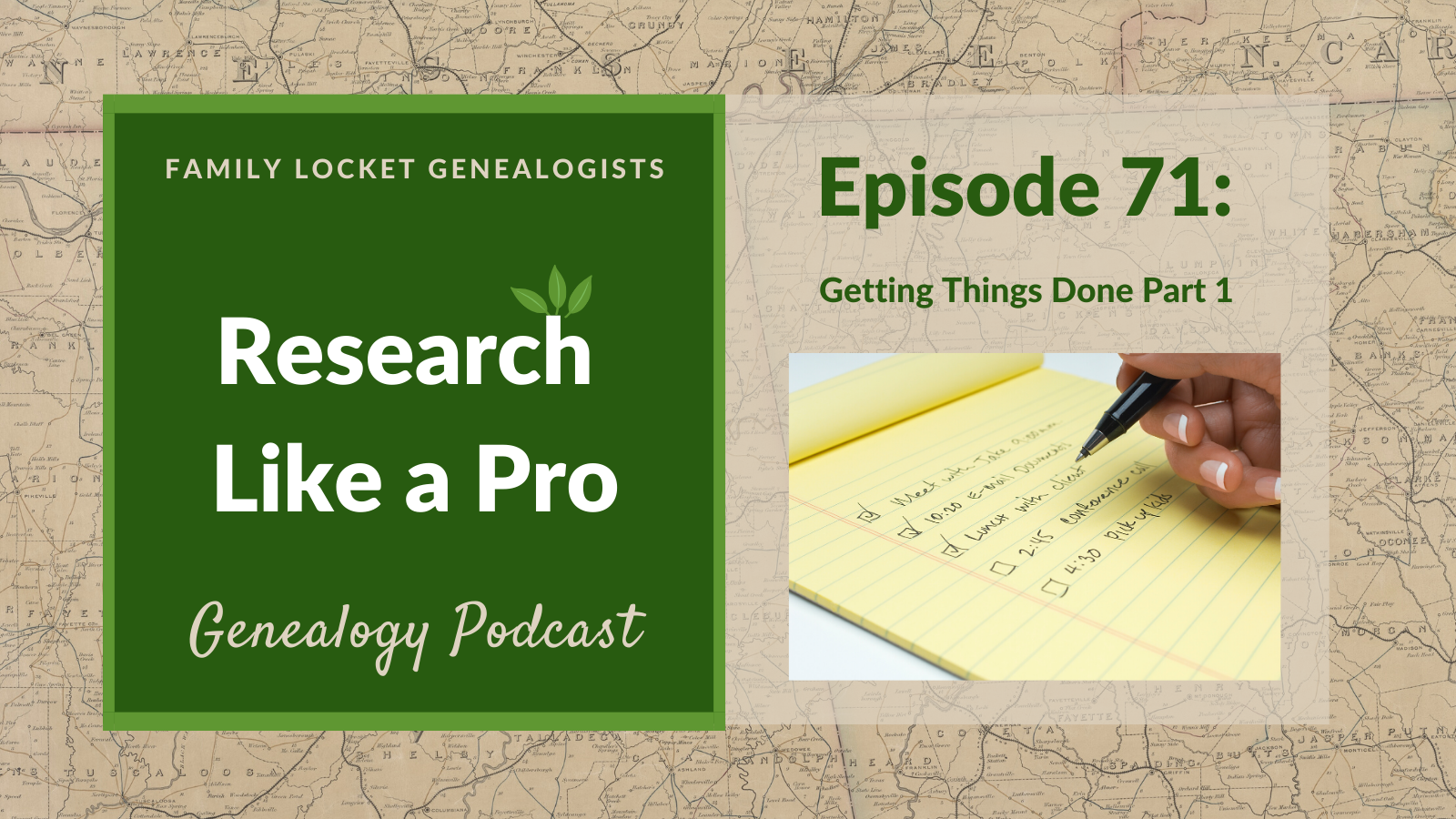
Today’s episode of Research Like a Pro is about David Allen’s book, Getting Things done: the art of stress-free productivity and the applications to family history and genealogy research. We discuss the overview of his program and some examples of capturing, clarifying, and organizing.
Transcript
Nicole (1s):
This is Research Like a Pro episode 71: Getting Things Done part 1. Welcome to Research Like a Pro a Genealogy Podcast about taking your research to the next level, hosted by Nicole Dyer and Diana Elder accredited genealogy professional. Diana and Nicole are the mother-daughter team at FamilyLocket.com and the creators of the Amazon bestselling book, Research Like a Pro a Genealogists Guide. I’m Nicole co-host of the podcast join Diana and me as we discuss how to stay organized, make progress in our research and solve difficult cases. Let’s go.
Nicole (46s):
Hi everyone, and welcome to the show. I’m Nicole Dyer co-host of The Research Like a Pro Genealogy Podcast, and I’m here with Diana Elder, my mother. Hi, how are you today, mom?
Diana (57s):
Hi, Nicole. I am doing well.
Nicole (59s):
So what have you been working on lately?
Diana (1m 1s):
Well, I just finished up a client case that was so fun. This was one that we actually worked a little bit on together and the client wanted to have a specific townland in Ireland for a trip that she’s taking there. So I was able to take the family from Michigan, the immigrants, back to Ireland, and using the Catholic parish records and Griffith’s Valuation find the townland for the client. And so that was really satisfying so that she can go find the specific little place where her ancestors lived. So it was a really fun project.
Nicole (1m 34s):
She’s going to be so happy with that. Well, let’s do our listeners’ spotlight today. It’s from Nancy 61 and the title of her review is, “a truly helpful podcast”. She says, “I have been listening to the Research Like a Pro podcast since shortly after they began. I really love that Diana and Nicole take time to educate listeners on the various types of records, as well as sound genealogy processes. I listen every week, participated in the 14 day Research Like a Pro challenge, and have completed one of their RLP projects. I particularly appreciate relistening to podcasts which cover the areas I’m struggling with at the moment.
Nicole (2m 15s):
For example, I currently need to do some work on finding probate records. So I find listening to the United States probate records podcast again, very helpful. I like the easygoing style that Diana and Nicole have, and especially like the case studies they use to illustrate their topics. I highly recommend this podcast to beginner and seasoned genealogy researchers alike. Keep up the great work.” Thank you, Nancy. And we are so glad that you have been able to complete a Research Like a Pro project. It’s wonderful to complete the whole process and feel like you accomplished something. And I also love listening to podcast episodes over again for my favorite podcasts and so I can relate.
Nicole (3m 1s):
And so thank you for listening and thank you for leaving us a review. It’s great to hear from our listeners and we’d love spotlighting you. Well today, we’re going to talk about a subject that is important for everyone who does genealogy research and it’s getting things done. And whether you research professionally for clients or not, everyone has limited time and we want to use our time in the best way we can, especially when we’re working on multiple genealogy projects. So Diane, tell us about this topic that you have been writing about on the blog.
Diana (3m 40s):
Yes. So, I knew nothing about the book, Getting Things Done: The Art of Stress Free Productivity until one of my book club friends mentioned it. And I think I had been just talking about how overwhelmed I was filling with so many client projects and upcoming conference presentations. And she said, well, do you know about the Getting Things Done method? And I said, no, I’ve never heard of that. So she probably brought over a book, gave it to me so that I could mark it up and read it over and over and introduced me to this wonderful method. So some of our listeners out there may have already heard about the Getting Things Done method. It’s been around since 2001, I believe it’s when David Allen first published the book.
Diana (4m 23s):
And then he came out with a second edition just a few years ago because obviously our world has changed dramatically since 2001. So the technology sections were out of date and the original book, I think he was talking about different kinds of things that we have progressed beyond now. So I’ve been just really enjoying going through it. And as I had been reading, I thought this really, really is applicable to anyone doing family history and genealogy. I work with so many people that are completely overwhelmed because they’ve gotten the big box from their parents of past research, or in some cases they have an entire room full of boxes and they have absolutely no idea where to start or they have just started and they look at their tray and it seems completely full, but none of it is sourced.
Diana (5m 12s):
So there’s so many different scenarios in our family, history and genealogy, where we are feeling a bit overwhelmed and we need to come up with some kind of a plan to feel like we’re making progress. So that is what we’re going to talk about for a few episodes. We’re going to do two back to back and we’ll have a little break and then do some more. So getting things done, let’s just do a little bit of, kind of an overview of the system. I think that I’ve talked a lot on the podcast about some of the things that I’ve dealt with, like my dad’s suitcase and not knowing where to start with all the different papers in there that had never been organized. And you may think that I’m completely organized now, but I just visited my mother up in Idaho and noticed that her family history room is full of a bunch of different papers and albums and even more things that I’m going to inherit and I will need to figure out what to do.
Diana (6m 3s):
So I think that is a never ending process.
Nicole (6m 7s):
It is. We always have new things that we want to try doing new projects that enter our lives. And we just need to constantly reevaluate what we want to do. That’s why I really love this system because he has built a plan for all of that re-evaluation that happens in life. So can you just walk us through the first chapter of getting things done and what that chapter is about and the overview of the system?
Diana (6m 34s):
Yes. So chapter one gives you three objectives that guide the entire approach, and the first objective is capturing. So what this means is that you want to capture all the things that are on your mind, everything that you need to get done. You’ve been thinking about whether it’s really small, whether it’s really big, you need to capture all of that somewhere outside of your head, because if you don’t get it off of your mind and out of your head, then it will just continue weighing you down until you really can’t do anything. You become paralyzed. So you have to capture everything. And then you have to make some decisions about everything that you are letting into your life so you know what to do next.
Diana (7m 19s):
It doesn’t do any good to walk by the garage over and over again, and look at it and say, I’ve got to clean that out. And then, because it sounds like such a huge task, you never do it. So instead of that, you put that down as an action to do or as a project to do. And then the next action would be to perhaps build some shelves because you can’t organize things if you have no place to put them. So you have to think through all these things that are on your mind to think of what the very next action is that you can do. That makes a huge difference. Then you have to curate and coordinate all the content, all the things that you captured. And you’ve got to think about the commitments that you’ve made with yourself and others.
Diana (8m 4s):
We all have different deadlines. We have different things that are prioritized in our life. And we have to think through these different things that are on our mind and make plans for them. So that’s kind of a broad overview of it, but we’ll go into more details and do some really specific applications to genealogy and family history.
Nicole (8m 24s):
Okay. So let me just recap that the three key objectives that guide the approach are capturing, directing yourself to make decisions, and curating and coordinating all of that content. Okay. Let’s dive in. What does this all mean?
Diana (8m 42s):
Okay. So capturing: very first thing to do is to write everything down. And David Allen suggests that you get a piece of paper and you just start writing. This can be total stream of consciousness, whatever comes into your mind, write it down. And this can be anything from, you know, look at my DNA results on MyHeritage, to create that big family history book for a branch of the family, to organize all my files, to convert paper files to digital files, to use DNA painter, to watch a webinar-there’s so many different things that could be in our minds about family history and genealogy.
Diana (9m 23s):
And so we want to just get those out of our heads onto paper. So here’s what my list looks like. Just the sampling from my list. And you’ll notice some of these are big things and some of them are smaller. So here’s a big one. Revisit my earlier research, writing a report or history for each ancestor and verify the generational links. That’s going to take some time, isn’t it? But I do want to do that. Another one of my big tasks is convert my paper files to digital files. Another one is to use DNA Painter, to paint my DNA matches and identify a common ancestor, and then finish the research on Benjamin Cox to solidify him as my fifth great grandfather.
Diana (10m 4s):
So this is just a little random sampling of all the different things in my head about what I want to do with my family history. So that’s the capturing technique.
Nicole (10m 15s):
Well, that’s a pretty good list. I think sometimes when I sit down and make a list, it gets really long because maybe I’m overly ambitious or I just have too many ideas. And sometimes that feels overwhelming to write down everything. You know what I mean?
Diana (10m 32s):
Yeah. And that’s why we have to go on to the next steps, because just having that long list doesn’t really help us get anything done. It just makes us want to put that list away or burn it or something because we don’t want to think about
Nicole (10m 46s):
Right. Yes. I think that is one of the problems. If we only ever get to the first step of the method, like some of us do and just making lists all the time, we start to really hate those lists, right? Like this list is just a huge list of tasks that I never get to finish or check off.
Diana (11m 3s):
Right. So we really need to make the list, get it out of our heads. We can do it on the computer also, if we want to put it into a document. I’ve heard some people have like a little stash of note cards in their wallet or their purse or sticky notes and every time something comes into their head, they write it down and then add it to their list. So that’s an interesting idea. You could carry a small notebook around to write things down. Some of my very best ideas come when I’m out gardening. And I obviously have no paper pencil with me. So then I could come in and write those down. But the point is that we are continually capturing, you know, we do a capture at the very beginning and then we continue to capture as ideas come to us.
Diana (11m 43s):
So let’s talk about next what we do after we’ve got our big list. So the next step, David Allen calls it clarifying. And this is when you try to decide what to do with all those things on your list and you make decisions about what needs to happen next in any given project at any given time. Well, we all know we can’t do every project at once. We have to clarify an order of importance. We have to decide what to do now and what can be done next week or next year, or sometime in the far future. So if you are planning a two week trip to Europe next month, you probably wouldn’t want it to get started on a huge filing project right now, but maybe you can squeeze in a mini research project working 30 minutes a day, especially if you’re trying to find some things that you can do while you are in Europe to visit some ancestor homelands.
Diana (12m 37s):
So take a look at what’s coming up in your life and think about what you can do right now, which one of those projects you could actually get done. Now, you and I, and Nicole, both love deadlines, and we live our life by deadlines, don’t we? So if I want to get something finished, like a book or another type of a actual physical family history product, often I will decide to do that as a gift. For example, if I wanted to do a photo book for a memorable family reunion, I could tie that to being a Christmas gift for my mother, or I could do a set of books for all my family.
Diana (13m 18s):
So do you have any examples of something that you’ve done like that where you’ve had a deadline that you had to get a product finished?
Nicole (13m 25s):
Yes. Your example of creating books for Christmas is a good one, because that is when I created one of my favorite family history books that I made, which was a collection of biographies for ancestors of dad’s side of the family. I had ordered a lot of these special records from the Church of Jesus Christ of Latter Day Saints, which were their original patriarchal blessings. And so I had kind of organized it around these blessings and transcribed each one and then correlated some of the things that they were told in their blessings, you know, about their strengths and gifts and things like that.
Nicole (14m 8s):
With things from their biography that kind of showed a connection. And it was really an interesting project, very kind of spiritual and uplifting. And it was fun, but it was a lot of work and I wanted to finish it in order to order the book for dad and my siblings for Christmas. And so I was working to a deadline and I ended up being a little bit late and the books didn’t come until after Christmas. And there was like a big error on the cover, but I fixed that reordered the books, and then it was done forever. And so I do, I need that deadline because if I don’t have a deadline, I can just, you know, wait until it’s convenient.
Diana (14m 48s):
Yeah. I love that example. And we treasure those books. In fact, I read an entire chapter to my husband as his driving to one of his ancestors home cities in Utah, or it wasn’t a city, It was a little tiny town.
Nicole (15m 2s):
Panguitch
Diana (15m 3s):
Yeah, it was so fun reading the history as we drove through the land and kind of visualize the whole ancestor story. So to recap, we’ve captured our big, long list. Now we are clarifying what to do with all those things and make decisions about what we need to do next and deadlines work well. So part of this process of clarifying is deciding on a next action. And I love the concept of a next action. So I’m going to ask all of our listeners, how often have you procrastinated starting a filing project because you don’t have a filing box or a cabinet?
Diana (15m 44s):
The next action would be to buy some supplies, get a filing box, get a cabinet and some file folders. And then once that is done, your next action would be to decide on your filing system. And once that is done, then you can actually start filing. Sometimes we just don’t think about what the next action is. We just have this big project in front of us and we don’t get started because we haven’t clearly identified the next action thinking of projects in terms of next actions has been revolutionary in my professional work. Often the next action for me is to simply send an email to a client or to choose a design for the PowerPoint presentation that I’m going to present at a conference.
Diana (16m 27s):
And once that step is taken, then I can move forward and start making progress. So rather than letting our feelings of having too much to do overwhelm us, we can clarify and prioritize our projects and determine next actions.
Nicole (16m 40s):
Well, that makes sense, obviously, making a list of the next actions because clearly having a huge project in front of you can feel very overwhelming. So that’s a really great and simple thing to do. And I have been wanting to buy a filing cabinet for a long time, cause I’m really tired of my little file boxes. They’re all full. So I need a better setup. And that was so funny when I came to visit you and you were so excited to show me your new purchase, a filing cabinet.
Diana (17m 11s):
Yes, indeed. Because I was feeling the same thing. I have big file boxes of my genealogy, but they’re in a different room. I don’t have room for them in my current little office. And so I was always having to get up and go out and find the files I needed. So I found this really nifty small file cabinet, and it has a drawer on the top for all sorts of random things and then a nice section for files. So what I do now is I take out the files for a project. Like all of my Cox files currently are there and there’s about 10 or 15 and there’s just enough room for those plus my, some of my other files that I use all the time and when I’m done this project, I’ll go put them back in my main filing and then get out the ones I need for the next ancestor.
Diana (18m 0s):
And that has worked perfectly. I love having them right there. And I also have to admit that I love the way my filing cabinet looks. It was just perfect. So anyway, I’m very happy. Every time I walk into my little office and see everything all organized, it really does make a big difference in our productivity if we have things set up so that we can use them.
Nicole (18m 22s):
Yes it is. So that was clarifying. So we talked about capturing, then we talked about clarifying, which is making the list of next actions, right?
Diana (18m 34s):
Right.
Nicole (18m 34s):
And then the last thing is the curating and the coordinating of all that content. Right?
Diana (18m 40s):
Right. This is where we create some systems that make sense for us so that we can manage our time and our projects without disrupting our entire life. So as genealogists, this could be where we decide what genealogy software we’ll use to track our research. And we might decide what kind of physical or digital filing systems we want to use. This is where we take a look at tools that we’re using that might be outdated. You know, we could be using really outdated genealogy software and we need to decide to update and get something brand new that works really well with how we’re researching now. We all have different organizing needs and approaches. And the important thing is to take the time to choose a system and processes that work for us.
Diana (19m 24s):
For our listeners, Nicole, what is something that they can do to get started right away?
Nicole (19m 29s):
Okay. So if you want to follow us on this journey of getting things done, here is your first task: capture the various family history and genealogy stuff that comes into your world, like projects, things you want to do, and just listed them all out, list out all the research projects you want to do, papers you want to organize, people to interview, education opportunities, books to write. These can be short-term, long-term, big or small. If it comes to mind, just write it down, capture everything in your list, whether on paper or digitally, maybe even carry around a notepad or notebooks so that when you think of things, you can leave yourself a little note.
Nicole (20m 12s):
Maybe you want to put it in a Google doc, so you can access it from your computer and from your phone and iPad, but just start a place, one central place to gather all of your thoughts and get them recorded. And next week we will discuss ideas about clarifying and next actions so that we can really figure out when to do these projects and create lists of what to do next, because those next actions will make it so much easier to get started on the projects instead of feeling overwhelmed by them. So I’m going to do this too. And hopefully with this method and with Diana’s help I can start to get more things done, and you might be laughing because a lot of people say, when do you sleep?
Nicole (20m 56s):
And so I know it seems like I get a lot of things done, but there’s always more on the list. So it would be nice to be able to check off some of those things that I know are within my reach, but maybe I just haven’t got my filing cabinet yet.
Diana (21m 9s):
That’s right. One of the things that David Allen talks a lot about in the book is this idea of having your mind be free and not be constantly stressed and worried about everything you have to get done because you know, you’ve got it identified. You’ve got your things in a system that you can trust and that you’re making progress. And I love that because who wants to walk around just always feeling stressed out about all the things they need to do. You know, it’s a much better feeling to have your mind free and to have creativity working in your brain and in your life and live your life a little bit clutter-free. So I’m excited to, I’m always wanting to do better at this.
Diana (21m 49s):
So it’s kind of fun to be writing about it and implementing it in our family history and genealogy.
Nicole (21m 54s):
That’s a good thought. Because even though maybe I don’t want to do more, maybe I just want to feel less stressed. So that’s a good motivation for implementing the method more in my life. Well, thanks. And I hope all of you listening also enjoy this discussion as much as I did, and we will be talking about this again next week. So have a good week capturing all of your thoughts and let’s clarify next week. We’ll talk to you guys again later. Bye-bye
Diana (22m 22s):
Bye-bye everyone.
Nicole (22m 56s):
Thank you for listening to Research Like a Pro with Diana Elder, accredited genealogy professional and Nicole Dyer. We hope that something you heard today will help you make progress in your own genealogy research. If you like what you heard, please leave us a review on iTunes or Stitcher or visit our website, FamilyLocket.com to contact us. You can find our book Research Like a Pro a Genealogist’s Guide on Amazon.com and other booksellers. We hope you’ll start now to Research Like a Pro.
Links
Family History and Getting Things Done – by Diana at Family Locket
Getting Things Done: The Art of Stress-Free Productivity, revised edition by David Allen – affiliate link to Amazon
Study Group – more information and email list
Research Like a Pro: A Genealogist’s Guide by Diana Elder with Nicole Dyer on Amazon.com
Thank you
Thanks for listening! We hope that you will share your thoughts about our podcast and help us out by doing the following:
Share an honest review on iTunes or Stitcher. You can easily write a review with Stitcher, without creating an account. Just scroll to the bottom of the page and click “write a review.” You simply provide a nickname and an email address that will not be published. We value your feedback and your ratings really help this podcast reach others. If you leave a review, we will read it on the podcast and answer any questions that you bring up in your review. Thank you!
Leave a comment in the comment or question in the comment section below.
Share the episode on Twitter, Facebook, or Pinterest.
Subscribe on iTunes, Stitcher, Google Play, or your favorite podcast app.
Sign up for our newsletter to receive notifications of new episodes.
Check out this list of genealogy podcasts from Feedspot: Top 20 Genealogy Podcasts



Leave a Reply
Thanks for the note!