
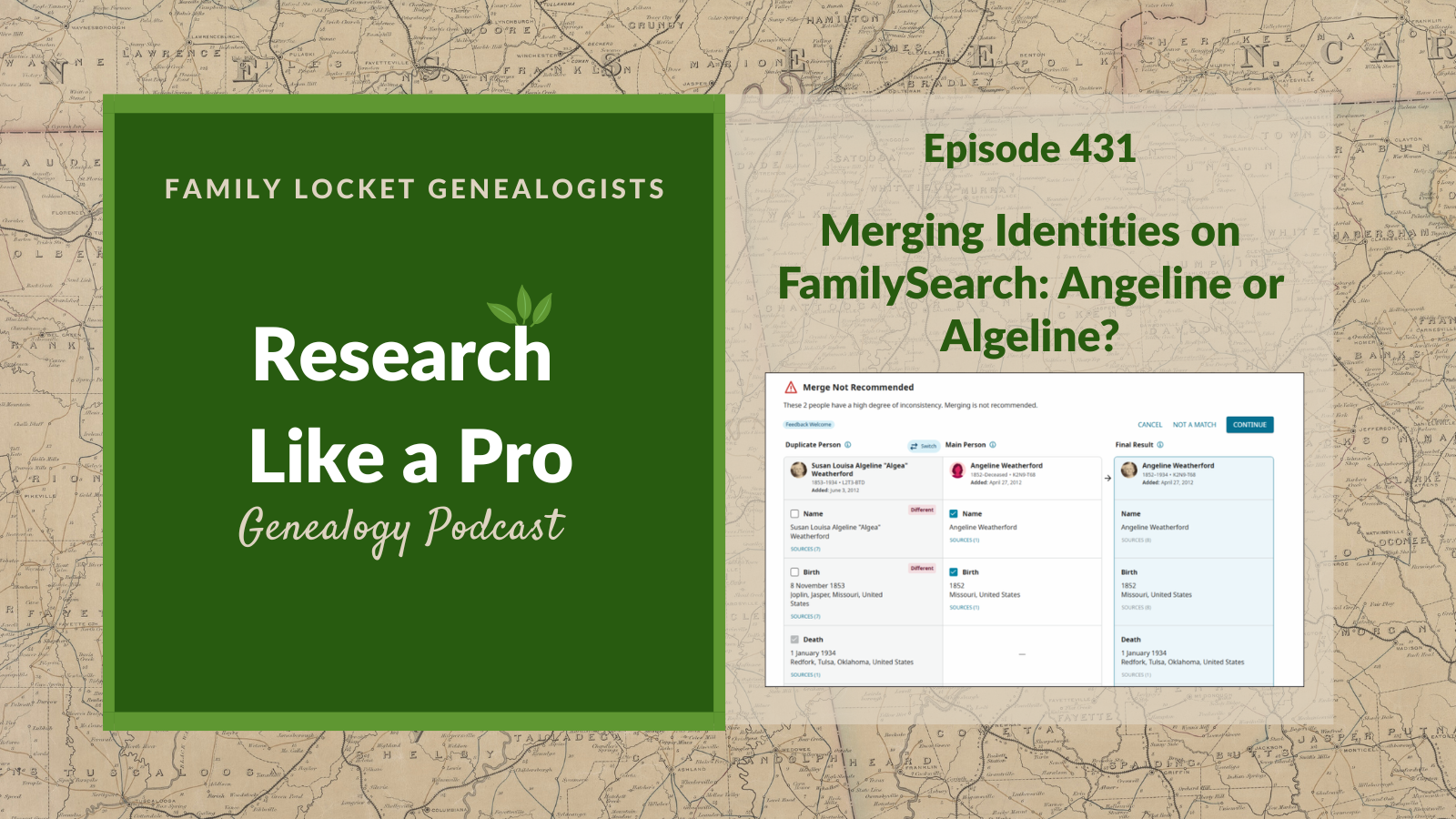
Diana and Nicole open the episode by discussing Nicole’s recent genealogical work at the Dallas Public Library and a Dyer family Bible. They then explore the benefits of adding research to the collaborative FamilySearch Family Tree, highlighting its free access, vast record collections, and permanent archiving. Diana shares a detailed case study illustrating how to merge separate identities on FamilySearch using the example of Angeline Weatherford and Susan Louisa Algeline Weatherford.
Listeners learn how to independently construct research, correlate census and DNA evidence, and navigate the FamilySearch merge tool when algorithms flag a potential mismatch. Diana explains how she connected an 8-year-old girl in an 1860 census with a later adult record through geographic, naming, and genetic connections. Finally, they discuss the necessary clean-up steps after a merge, including removing incorrect sources, adding detailed reasoning statements, and setting alert notes for other researchers.
This summary was generated by Google Gemini.
Transcript
Nicole (0s):
This is Research Like a Pro Episode 431: Merging Identities on FamilySearch Angeline or Algeline. Welcome to Research Like a Pro a Genealogy Podcast about taking your research to the next level, hosted by Nicole Dyer and Diana Elder accredited genealogy professional. Diana and Nicole are the mother-daughter team at FamilyLocket.com and the authors of Research Like a Pro A Genealogist’s Guide. With Robin Wirthlin they also co-authored the companion volume, Research Like a Pro with DNA. Join Diana and Nicole as they discuss how to stay organized, make progress in their research and solve difficult cases.
Nicole (41s):
Let’s go. Today’s episode is sponsored by Newspapers.com. Hi everyone. Welcome to Research Like a Pro.
Diana (48s):
Hi Nicole. How are you doing today?
Nicole (50s):
I’m doing well and we had so much fun on our trip. Should we tell everyone about it?
Diana (55s):
Yes, we’ll just leak it out a little bit at a time ’cause we did so much.
Nicole (1m 1s):
Okay, well then let’s start with the first place we went, which was the Dallas Public Library and you were giving a seminar there for the Dallas Genealogical Society and I snuck upstairs to the genealogy floor and it was so fun. I got a behind the scenes tour from Ari Wilkins who works there and she showed me some of the cool things they have in the main area and then behind the closed area, one of the things I noticed was a family Bible, they have a collection of those, and it said Dyer on it and I was course, of course I was like, oh what is this Dyer Bible? And so after the behind the scenes tour I looked it up in their catalog, and the librarians there have done such a good job with the metadata, and so the entire transcription of the Bible family record pages were on the library catalog.
Nicole (1m 51s):
And so all of the names and dates and the people, and so I just looked up the people in FamilySearch to see if they were any of the Dyers that might be, you know, related to anyone in the Y-DNA surname project that I’m helping as an admin with, or with my Dyers, or with any of the hypothesized Dyers that we think could be related in my brick wall Dyer situation. And it was interesting because none of the names in the family Bible really had a whole lot of information on Ancestry or a FamilySearch in any of the trees. So it looked like an opportunity for someone to go update all that information. So I asked if the Bible has been digitized yet and or if I should do that and they said they’ve already digitized it and they can send the files to me.
Nicole (2m 34s):
So they went ahead and just emailed me all the family record scans of that family Bible. So now I have that and I can go update the family tree on FamilySearch, which I’m excited to do. I just really feel like with my brick wall in the Dyers that I like to learn about all the Dyers in the US in the early 1800s, which is kind of when John Robert Dyer’s parentage is unknown and there are a lot of Dyers out there so it’s challenging, but with the Dyer surname project, it’s just kind of cool to be able to figure out which line is which and who’s related to who and get everything grouped. And of course you have to know the documentary research to go along with it.
Diana (3m 13s):
Oh, that’s so perfect. So could you have found that Dyer bible just by looking at their catalog online?
Nicole (3m 19s):
Yeah, their catalog had all the names from it and all the dates and everything it said on it.
Diana (3m 24s):
Okay.
Nicole (3m 24s):
And then you could have just emailed and said, can I have a scan of that?
Diana (3m 28s):
So you would just need to know that that was a place that you could possibly find something. Oh, isn’t it so interesting these places all over the country that have this type of information? That’s so neat.
Nicole (3m 39s):
It’s, it’s really interesting that just whatever has been donated and I think it’s key that this library has a genealogy center. Anytime there’s a public library that has like a dedicated genealogy floor or anything like that, it makes it more likely that they’re gonna have materials like this. So they also had a lot of books just like you would expect to see at the FamilySearch library, just a lot of family record books, periodicals. I actually looked up all the different Dyer articles and the periodicals and pulled like the American Genealogist and just different things that it’s a little bit hard to see online that you kind of have to be at a library to see.
Nicole (4m 24s):
So it was really fun.
Diana (4m 25s):
Well good job. I did that last year. I didn’t look up the Dyers but I looked up, you know, all of our names there because I was there doing a seminar for the Fort Worth Society and they had said you need to go checkout the, the genealogical part of the Dallas Public Library. So I’m so glad you got to go and do some research there as well. And one thing I was going to mention was you can’t assume that any record that’s been donated to a library is about people say in Texas or Dallas, right? Because I’m sure the people in the Dyer Bible were, where were they from? They probably weren’t from Dallas, but somebody was living there and somehow donated it.
Nicole (5m 6s):
Right. They were not from Texas. Some, one of the branches of the descendants had migrated to Texas, but they started off in, let me see, Boston. So it was kind of like a group from Massachusetts area and then some of them went to Kansas, some stayed in Massachusetts, some went to San Francisco and some went to Texas. So it was just, they kind of just started in in the Boston area and it had several family groupings and the earliest family grouping was starting in the 1700s with William Dyer born August 25th, 1777 and Sally Hart born June 1st, 1782.
Nicole (5m 46s):
So that was just a gold mine right there because the information online about this family didn’t even have Sally’s maiden name, and right away we have her maiden name, and then it has their marriage date of 1806 and then it has their children, William Hart Dyer, Sally Noel Dyer, Maryanne, Sweetzer Dyer. So it has all their middle names and none of their middle names are on the family trees online that I could find. And they’re all beautiful names, you know, like Catherine Klauston Dyer and William Hart Dyer, Eliza Reed Dyer, Susan Smith Dyer, John Adams Dyer. So it kind of helps you see some of them maybe were named after like the president, like John Adams Dyer and then some of them might have been named after like grandparents surnames, like Sweetzer and Reed and Klaus.
Nicole (6m 29s):
So it’s just a wealth of information on an early family. So I just am really excited about this particular page of the family Bible to be able to update the tree with it.
Diana (6m 39s):
That is so neat. And you have an actual source. Do you think it was created at the time of the event or how much later have you you know, done some research on trying to figure that out?
Nicole (6m 50s):
Just initially looking at the hands that wrote in the Bible, there are multiple different hands and the pages, the one with that family on it is older looking like more yellowed. And then some of the later pages are more, they look like an insert, kind of like somebody got some lined paper and wrote, continued writing about their family on it and it’s kind of a lighter gray. So that one looks like an inserted page that doesn’t match the rest of the Bible. So you have like the original family record from the Bible and then the inserted kind of lighter whiter pages. And so you can just really tell a difference in the paper and the hands and the ink even you can really tell.
Nicole (7m 33s):
But all of the page with the 1777 William Dyer, that was all in the same paper, the same ink, in the same hand. So that kind of looks like the original entry and the family record pages.
Diana (7m 45s):
Well that is fascinating and amazing. So good job tracking that down and how great that the library has digitized already and could just send that to you. I think that’s a wonderful find.
Nicole (7m 56s):
Yeah, it’s awesome. And so the last date on that page is probably about when it was written, you know, so like 1824 I think is the latest birth recorded on this page. So I that’s my guess that that the mother wrote this after her youngest child was born maybe.
Diana (8m 18s):
Oh that’s so cool.
Nicole (8m 19s):
Alright, well let’s do our announcements. So the next webinar in our Research Like a Pro Webinar Series is October 20th, Tuesday, and it’ll be presented by Yvonne Fenster, AG, RN PhD. The title is, When DNA Reveals Hidden Identities: Investigating Whether Minnie James Was Born Fannie Tattoon. So this is about whether Fannie Tattoon and Minnie James could be the same person. And the investigation examines a compelling hypothesis that emerged when DNA matches revealed shared ancestry through both Gilbert Tattoon (Fannie’s father) and James H. Clayton (Minnie’s husband)—connecting two seemingly unrelated Connecticut families.
Nicole (8m 59s):
With Fannie vanishing from records after childhood and Minnie appearing as an adult without prior documentation, the analysis draws on genetic data, Connecticut records, and other documents to determine whether they are separate individuals or one woman who changed her identity after being orphaned. This will cover a lot of topics including Connecticut records, Dana Leeds method, misattributed Parentage, identity research, name change investigation, orphan Children, DNA Analysis, disappearing Ancestors, vital records, Social Security Records, church Records, BanyanDNA, comparative timeline analysis, African American Research, City directories, maps and the fan club. Yvonne is a professional Genealogist accredited through ICAPGen in the Upper South region of the US, which includes the states of Virginia, West Virginia, Tennessee, Kentucky, and North Carolina.
Nicole (9m 47s):
She brings expertise in DNA analysis, particularly in cases involving cousin marriages and Y-DNA research, which helps break through genealogical brick walls. Yvonne is a graduate of the Research Like a Pro and Research Like a Pro with DNA study groups and has subsequently served as a mentor for both study groups. She has an Associate of Science in Nursing from Onondaga Community College, a Bachelor of Science and Biology from Bridgewater State College and a Doctor of Philosophy in Neuroscience and Physiology from the State University of New York at Upstate Medical University in Syracuse and Postdoctoral training at Cornell University in Ithaca. When not uncovering family histories, Yvonne enjoys quilting, cooking, and spending time with her grandchildren and husband.
Nicole (10m 28s):
We’re really excited to have Yvonne share with us. She’s one of the researchers here at FamilyLocket Genealogists and she’s an amazing researcher. Our next Research Like a Pro with DNA study group begins February of 2027 and we’re getting to ready to begin the registration in December. So if you’re interested in joining us, get ready to register and if you want to be a peer group leader, please email us. And join our newsletter to receive our emails every Monday with info about new blog posts and upcoming lectures. Also, in just a week we’re going to be doing the Professional Management Conference with APG on October 14th through the 17th. So that’s coming up really soon and we’ll be talking about all kinds of fun things from managing client projects and teaching genealogy classes to podcasting and Airtable.
Nicole (11m 14s):
So we look forward to seeing many of you there at the virtual conference. And for our Research Like a Pro institute, our Merging and Separating Identities Institute course is ready to register. So please sign up if you’d like to join us. You can go to FamilyLocket click Shop and then click Institute courses and then you’ll see it and you’ll be able to register. Registration is open and it begins in January.
Diana (11m 40s):
All right, well thanks for going through all those things. There’s always so many great opportunities for education and I love that these are all online and we can view from the comfort of our home, so neat. Well, today we are going to talk all about how I merged some identities on FamilySearch. And I know a lot of people are a little hesitant about using the Collaborative FamilySearch Family Tree, but it really is a great way to share your research, and even though it is collaborative and you risk someone changing information or merging identities incorrectly, it can also just be such a boon.
Diana (12m 20s):
So one of the problems is that you may accidentally create a duplicate record for a person and then you’ve got two profiles for the same person. So with these challenges, why would you want to use FamilySearch? And it’s ironic we’re talking about the Merging and Separating Identities course because that is basically what we’re talking about here today as well. So some reasons why you might want to use FamilySearch. Well first it’s completely free and you can email the URL of a profile to a family member or fellow researcher. So each person has their own profile with their unique URL and it makes it so easy to share. And then also the reason we all love FamilySearch are the billions of records that they have available for free and you can easily attach these sources to each profile you create.
Diana (13m 11s):
So that makes it easy for another researcher to look at all the sources that back up the details. And then if you have any photos or stories or audios, you can add those to a profile and you can tag each person in the memory So it shows up on their profile page. And then fourth and not last, it’s not going away. The FamilySearch Family Tree will still be here and growing when we are all gone. And this is because of the commitment to family history work by FamilySearch’s Head, the Church of Jesus Christ of Latter Day Saints, who has been involved in genealogy research for over a hundred years. And so I feel like everything I put there will be safe.
Diana (13m 51s):
It’s going to be safeguarded and preserved whether other people might change some things or I’ll need to go fix things up that’s another story. But I think that there are things we can do to make sure that our research stays intact and is good. So I highly recommend it. I try to get all of my research on there and we’re going to talk about what happened with one of my cases.
Nicole (14m 17s):
Alright, great. Well, at the end of our research project, both you and I like to make sure all the sources that we found are added to the ancestor’s profile in FamilySearch and the relationships are updated. We just really like updating the FamilySearch Family Tree. It’s just such a good way to get research that’s been completed out there for other family members or just anyone to find. This can include either creating a new profile for a child or sibling discovered in the research or often merging multiple identities. So today we’re going to talk about some tips that we’ve learned through the years about merging identities and we’ll go through the case of Angeline Weatherford and Susan Louisa Algeline Weatherford, who ends up being the same woman.
Diana (15m 1s):
So first let’s talk about Angeline. And when I first started researching the family of Henderson Weatherford and Clemsy Cline, I only had two census records to go on to fill out the children’s profiles on FamilySearch, the 1850 and 1860 censuses. And Angeline, she only appears on the 1860 census as an 8-year-old girl. So in 1850 we have the family in Morgan County, Missouri with Henderson and Clemsy, age 35 and 30. And then the children are Eliza Jane, Maryanne, John W, Clemsy D, Talitha, and John. And the last two are Clines. And from previous research I had learned that those were almost certainly Clemsy’s niece and nephew.
Diana (15m 47s):
And so the Weatherford children ranged from two to ten, but then by 1860 they’d added some children and one of those was an Angeline. She was age eight, she was born in Missouri and by this time the family had moved to Dallas County, Texas. And then our Isabella Weatherford, my direct ancestor is age two and she is also born in Missouri and that’s the first census that she shows up on. So these two little girls are the last ones in the family by 1860. And so I entered all of those children into the family of Henderson and Clemsy on FamilySearch and really only had that one source for Angeline.
Diana (16m 32s):
And even though I had done some searches for her, really could not find marriages or anything else. I just didn’t know what happened to her.
Nicole (16m 43s):
Alright, well several years later you embarked on an involved research project to determine Clemsy Cline’s father. And this project included DNA and discovered matches coming through a woman named Susan Louisa Algeline Birch Sanders, one of the family trees named her as Algea Weatherford with no parents named. So this was very interesting and you had the idea that perhaps this is Angeline Weatherford. So you started reviewing the sources and found that Algeline’s location in the 1870 census of Union, Benton County, Missouri correlated with her mother, Clemsy, and some of her siblings who were also living in the county or neighboring counties.
Nicole (17m 28s):
Then correlating her birth of 1852 from Census Records and being born in Missouri with the Angeline Weatherford in Henderson and Clemsy’s family it looks like it was the same woman. And so another interesting fact to correlate that our ancestor, Dora Algae Royston was almost certainly named after her Aunt Algeline, her mother’s sister. So we had often wondered about this unusual name. So discovering Algeline made so much sense.
Diana (17m 56s):
Right. That was so exciting when I finally figured that out because we had wondered where does Algae come from? That’s such an unusual name. Well, let’s have a word from our Sponsor: Ready to take your family history research beyond names and dates? Newspapers.com is a game-changer for genealogists of every level. With access to over a billion pages of historical newspapers, you can uncover rich, untold stories about your ancestors you won’t find anywhere else.Maybe it’s a detailed obituary that reveals the extended family you never knew about, a local news story that highlights your great-grandmother’s role in the community, or a photo that brings her to life in a way names and dates never could.
Diana (18m 38s):
Newspapers captured the everyday details—announcements, happenings, achievements, challenges—that paint a fuller picture of who your ancestors were and what their world was like. It’s the social history behind the names on your family tree. Searching is simple and intuitive: explore by name, location, or date to unearth your own hidden gems. Visit Newspapers.com/FamilyLocket today for 20% off a subscription and start turning your family tree into a family story. Well back to Algeline and finding her profile on FamilySearch, I found her and she had parents listed as Green Weatherford and Sarah and there were several sources attached, so I reviewed each one and found several anomalies.
Diana (19m 23s):
Two 1880 censuses were attached as sources and one showed Azareen as a single female in a family. And the other showed SLA Sanders, a married woman in Collin County with her husband Sanders and children Ida, Charles Ingram, and John Ingram. And then the profile for Algeline also showed an 1860 census for a Susan Weatherford age five in the household of Green W Weatherford and Sarah of Franklin County, Missouri. And this appeared to be a different person, altogether. And then finally the 1910 census attached to Algeline was for a widowed Algae Ingram in the household of her son John W.
Diana (20m 6s):
Ingram. And also in the household was a Charlie Weatherford, hired hand age 14, and the family lived in Mayfield Township, Garman County, Oklahoma.
Nicole (20m 15s):
So a lot of information there, hard to pull that apart. But reviewing the family tree, you found that Charlie was likely Charles Weatherford, Algeline’s nephew and the son of Samuel Henderson Weatherford. And he was born in 1896 and he fit the profile of a male age 14 in 1910. Samuel Henderson Weatherford and family lived in the Chickasaw Nation in Indian territory in 1900. That area would become Oklahoma in 1907 with statehood and encompassed Garvin County. Samuel had moved to Texas by 1910 and his son Charlie, likely stayed behind to help his aunt for a time.
Nicole (20m 58s):
So looking at each source, the family connections, the shared locations, and the DNA connections, you felt like you had enough evidence to determine that Algeline belonged in the Henderson Weatherford family, not the Green Weatherford family.
Diana (21m 13s):
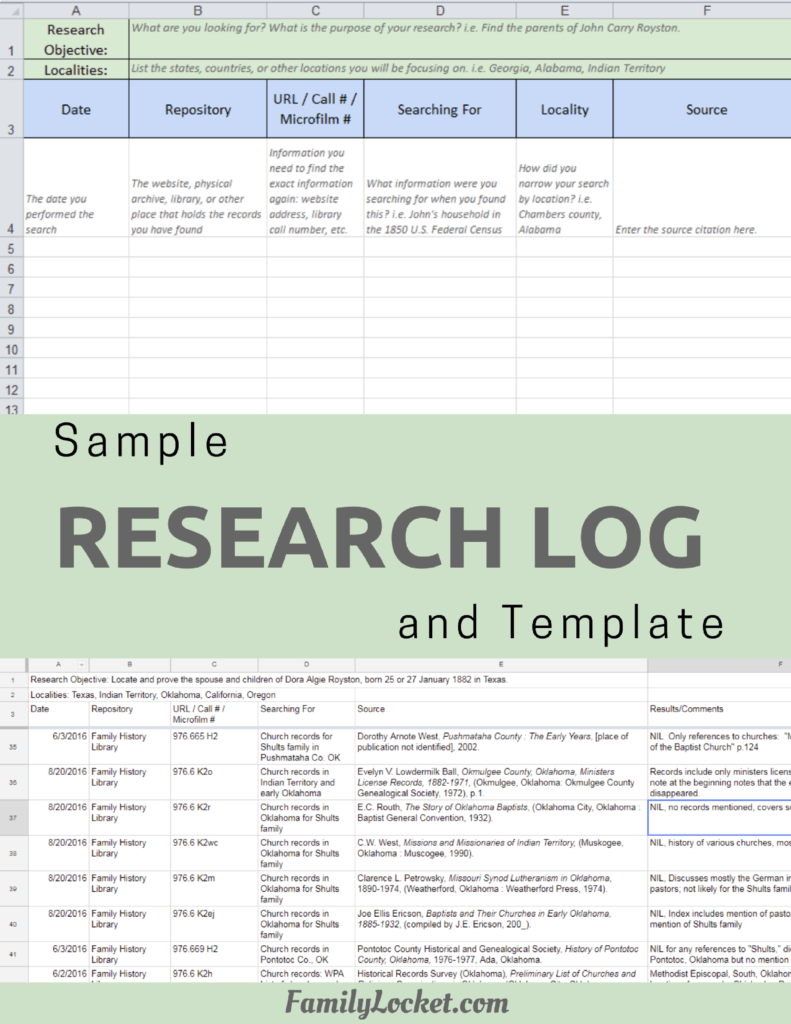
Exactly. So I really had to separate those out before I can even start to do anything on FamilySearch. And I already had an Airtable research log and so I just started adding the sources there so I could look at it really clearly and make make my decision. So the first step if you’re going to merge is to make sure you’ve done your homework and clearly identified the individual with spouses, children, details such as birth, marriage, and death. And you know, you can do this in a lot of places. You could do it in a research log like I did, or you could attach the records to your Ancestry tree or your tree in software such as Roots Magic or Family Tree Maker.
Diana (21m 56s):
And then once you have everything straight in your tree or on paper or a log, then you can start merging. So I use my Ancestry tree to attach the records and adjust relationships. Then I had that set and I could refer back to it as I corrected the profile in FamilySearch and that was really important. Next, we have to note the ID numbers of both the parties and I write these down on paper to make sure I don’t lose track of either person. And then you can click merge by ID under tools on the right side of the page and a screen will appear that lets you compare. So because I have few details for Angeline, the profile I created many years ago, the algorithm thought this was likely not a correct merge, but my research had showed otherwise.
Diana (22m 43s):
I knew better than the algorithm. So I was comfortable with the merge. And this is a nice feature because we do want people to approach this carefully, and I did notice that this looked different than in the past when I had merged. So FamilySearch often will do an update and your view and how you did things in the past don’t always work, but they try to make it pretty self-evident how to work through a process.
Nicole (23m 8s):
Well, once you went ahead with the merge, you had a profile that needed cleaning up: two sets of parents, some incorrect sources, et cetera. So you had to go in and just kind of delete some incorrect census records and add reason statements along with an alert note directing viewers to read research reports that you had written for Clemsy Cline. In FamilySearch, when you click on Collaborate, you can set that alert and basically you just typed in a basic timeline and reason for the merge. So in the show notes, we’ll have a link to the new profile on FamilySearch and the ID number for Susan Louisa Algeline Weatherford.
Nicole (23m 48s):
And you can go see kind of those notes and reason statements and the alert.
Diana (23m 53s):
Right. I am so glad that FamilySearch gave us the opportunity to do that, because before you couldn’t really put something out there to tell someone to stop, take a look, read the sources, read the information, don’t just willy-nilly make a lot of changes to this profile. So I try to put that on all the things that I’ve worked on just because, you know, we’ve worked hard at as researchers in creating accurate profiles. Well the final piece of evidence that was so fun to see was the physical similarity between Algeline and her sister Isabella. So I have such a fun picture of Isabella. It’s taken about 1905 and Algeline is perhaps in the 1920s.
Diana (24m 36s):
She is older, but when I looked at their faces, they just have the same face shape and just so similar in how they they looked. And so it was really neat to see that. So although FamilySearch, you know, would never have suggested this merge, and indeed when I tried it, you know, said this, are you sure this is right? I felt like with all the solid research into all the members of the family and the correlation of the records and the really strong DNA evidence, the migration and shared localities, you know, with the family being in Missouri and then moving out to Oklahoma, the naming patterns with my Dora Algae being named after Algeline, I felt confident that Angeline from the 1860 census was really Algeline.
Diana (25m 23s):
And I’m sure the census taker just thought Algeline is not a name. I’m just gonna call her Angeline.
Nicole (25m 31s):
Or maybe just heard, that’s just what he heard if he wasn’t that good
Diana (25m 34s):
Just heard
Nicole (25m 34s):
hearing.
Diana (25m 34s):
Exactly. You know, we look at those census records and we all know that there are a lot of mistakes in those and this is just another one of those. So you know, if you have a similar case where you suspect that you’ve got something that needs to be fixed up on the FamilySearch tree, I would just highly recommend that you first carefully construct the research independently. So either on your Ancestry tree, on paper, in a research log, however you want to do that, but get all your facts straight, all your sources straight, and then go ahead and make the changes on the the collaborative tree.
Nicole (26m 11s):
Love it. I’m looking at the profile of Susan Louisa Algeline Weatherford, and I’ve read your alert note and it’s so nice. So what were these incorrect people that were attached? So like Azarene, was that a correct one or an incorrect one?
Diana (26m 28s):
Well, I think the thing that caused the problem was that she was known as the Susan Louisa Algeline and in one of the censuses she’s S L A, you know when they would just do initials sometimes?
Nicole (26m 44s):
Oh yeah.
Diana (26m 45s):
And then so someone found a Susan Weatherford and in the household of Green Weatherford. And so I can see the jump, you know, to that, okay, yes, yeah, that, that’s not unreasonable. But with all the information that I had when I really looked at it, I just realized it, it couldn’t be the right parents. So.
Nicole (27m 6s):
And then the fact that she had been married twice was also probably confusing.
Diana (27m 10s):
That was confusing. And I remember as I was doing the DNA work, really the whole thing that led to this was doing DNA and looking for matches. Going back to Clemsy Cline, the mom and I just kept finding this group of matches, but their trees had all these really different names for this woman. And so then I had to track down all of her marriages and all the sources figuring out who she was. And luckily in the census it did have her children with the, the first husband’s name, the Ingram. So we had her in a Sanders household with children named Ingram. And so that helps you say, okay, this, this is the same woman.
Diana (27m 49s):
And she was going by different names in different censuses, which we also see a lot in our research.
Nicole (27m 54s):
Yeah, it’s such a southern thing to have a lot of first names and middle names, you know. And to have even a completely different nickname that doesn’t go with any of your, you know, names. We’ve seen that with so many of our ancestors. Like Claude Dock Harris.
Diana (28m 11s):
Yeah, yeah. Well, and Isabella, her little sister, is named as Talitha, remember she’s Isabella Talitha. And we only see that in one census and never hear of it again. So this family like to use in interesting names, let’s put it that way, but with a mother named Clemsy, I think that’s probably appropriate. And Henderson.
Nicole (28m 30s):
Yeah, we still don’t even know any of the other names of Clemsy, do we?
Diana (28m 34s):
We don’t know.
Nicole (28m 36s):
We don’t know. We just know she was Clemsy.
Diana (28m 39s):
All that we know is that Isabella, our ancestor, named her daughter Clemsy also, and in one of the censuses she’s called Mary. So we kind of think it was Mary Clem. That’s the only clue that we have is from her. You know the, the granddaughter named after the, the mom. So big grandma.
Nicole (28m 59s):
Yeah. Well that’s so fun and it’s so interesting to hear about all of the different sources that you found and how each one had like a little clue that linked you back to this identity that you originally thought was Angeline. But just switching a couple of those letters and making it Algeline, getting rid of the n. And Algeline is just such a unique name. But since we had Dora Algae and you found the Alga Ingram in one of the trees and one of the censuses, it’s just so neat to see all of these clues come together. And maybe I should just read the alert note because this is such a great summary of her life. That would be fun, should I do that?
Diana (29m 36s):
Yeah.
Nicole (29m 37s):
Okay. So what you have called it is Parents for Algeline Weatherford. Algeline weatherford was born about 1852 in Morgan County, Missouri to Henderson Weatherford, and Clemsy Cline. She first appears with a family on the 1860 census of Dallas County, Texas under the name of Angeline. She married James Ingram about 1869 or 70, and the couple resided in Union, Benton County, Missouri, near her older sister, Eliza Flippin and widowed mother, Clemsy in neighboring Camden County. She had two children with James, Charles and John Ingram.
Nicole (30m 19s):
James apparently died after John’s birth in 1872, and she remarried Ira Thomas Sanders. With him she had three more children. The couple resided in Collin County, Texas in 1880, eventually moving north to Chickasaw Nation, Indian Territory/Oklahoma. Her sister, Isabella, followed a similar migration path. Isabella named one of her daughters Dora Algae after her sister. The 1910 census of Garvin County, Oklahoma finds Alga Ingram in the household of her son John W. Ingram, with Charlie Weatherford age 14 as a hired hand. Charlie was likely Algae’s nephew, son of her brother Samuel Henderson Weatherford.
Nicole (30m 59s):
The similar migration path of Missouri to Texas to Oklahoma provides additional evidence of this family’s connections. No record has been found for an Angeline Weatherford. Angeline was in reality Algeline. Additionally, photos of Algeline and Isabella bear a strong resemblance. Genetic connections are also strong with many descendants of Henderson and Clemsy Weatherford sharing autosomal DNA with descendants of Algeline. Please see the reports under Clemsy memories for additional information on the family by Diana S Elder.
Diana (31m 28s):
It was fun writing that out. I think it’s really satisfying when we’ve done the research and we figured something out like this. So just put it all there. You know, the sources are in the source area. This obviously doesn’t have source citations, but people can go look at the sources. But I think this is really digestible for someone just wanting to see, you know, my thinking and how the, the records came together. So I, I really happy I was able to figure it out. It was a super fun little project.
Nicole (31m 57s):
Well, that was great. Thanks for sharing your research with us and the tips on how to merge people in the FamilySearch Family Tree. We hope you guys enjoyed this episode and we’ll talk to you again next week. Bye-bye.
Diana (32m 9s):
Bye-bye.
Nicole (32m 42s):
Thank you for listening. We hope that something you heard today will help you make progress in your research. If you want to learn more, purchase our books, Research Like a Pro and Research Like a Pro with DNA on Amazon.com and other booksellers. You can also register for our online courses or study groups of the same names. Learn more at FamilyLocket.com/services. To share your progress and ask questions, join our private Facebook group by sending us your book receipt or joining our courses to get updates in your email inbox each Monday, subscribe to our newsletter at FamilyLocket.com/newsletter. Please subscribe, rate and review our podcast. We read each review and are so thankful for them. We hope you’ll start now to Research Like a Pro.
Links
Dallas County Public Library – https://www.dallaslibrary.org/research/genealogy
Tips for Merging Identities on FamilySearch: Angeline or Algeline? – https://familylocket.com/tips-for-merging-identities-on-familysearch-angeline-or-algeline/
View Algeline’s FS profile and sources here: Susan Louisa Algeline Weatherford (FamilySearch ID K2N9-T68)
Merging and Separating Institute Course – https://familylocket.com/product/merging-and-separating-identities/
Sponsor – Newspapers.com
For listeners of this podcast, Newspapers.com is offering new subscribers 20% off a Publisher Extra subscription so you can start exploring today. Just use the code “FamilyLocket” at checkout.
Research Like a Pro Resources
Airtable Universe – Nicole’s Airtable Templates – https://www.airtable.com/universe/creator/usrsBSDhwHyLNnP4O/nicole-dyer
Airtable Research Logs Quick Reference – by Nicole Dyer – https://familylocket.com/product-tag/airtable/
Research Like a Pro: A Genealogist’s Guide book by Diana Elder with Nicole Dyer on Amazon.com – https://amzn.to/2x0ku3d
Research Like a Pro with AI Workbook – Second Edition (eBook) – https://familylocket.com/product/research-like-a-pro-with-ai-workbook-second-edition-ebook/
14-Day Research Like a Pro Challenge Workbook – digital – https://familylocket.com/product/14-day-research-like-a-pro-challenge-workbook-digital-only/ and spiral bound – https://familylocket.com/product/14-day-research-like-a-pro-challenge-workbook-spiral-bound/
Research Like a Pro Webinar Series – monthly case study webinars including documentary evidence and many with DNA evidence – https://familylocket.com/product-category/webinars/
Research Like a Pro eCourse – independent study course – https://familylocket.com/product/research-like-a-pro-e-course/
RLP Study Group – upcoming group and email notification list – https://familylocket.com/services/research-like-a-pro-study-group/
Research Like a Pro Institute Courses – https://familylocket.com/product-category/institute-course/
Research Like a Pro with DNA Resources
Research Like a Pro with DNA: A Genealogist’s Guide to Finding and Confirming Ancestors with DNA Evidence book by Diana Elder, Nicole Dyer, and Robin Wirthlin – https://amzn.to/3gn0hKx
Research Like a Pro with DNA eCourse – independent study course – https://familylocket.com/product/research-like-a-pro-with-dna-ecourse/
RLP with DNA Study Group – upcoming group and email notification list – https://familylocket.com/services/research-like-a-pro-with-dna-study-group/
Thank you
Thanks for listening! We hope that you will share your thoughts about our podcast and help us out by doing the following:
Write a review on iTunes or Apple Podcasts. If you leave a review, we will read it on the podcast and answer any questions that you bring up in your review. Thank you!
Leave a comment in the comment or question in the comment section below.
Share the episode on Twitter, Facebook, or Pinterest.
Subscribe on iTunes or your favorite podcast app.
Sign up for our newsletter to receive notifications of new episodes – https://familylocket.com/sign-up/
Check out this list of genealogy podcasts from Feedspot: Best Genealogy Podcasts – https://blog.feedspot.com/genealogy_podcasts/




Leave a Reply
Thanks for the note!