
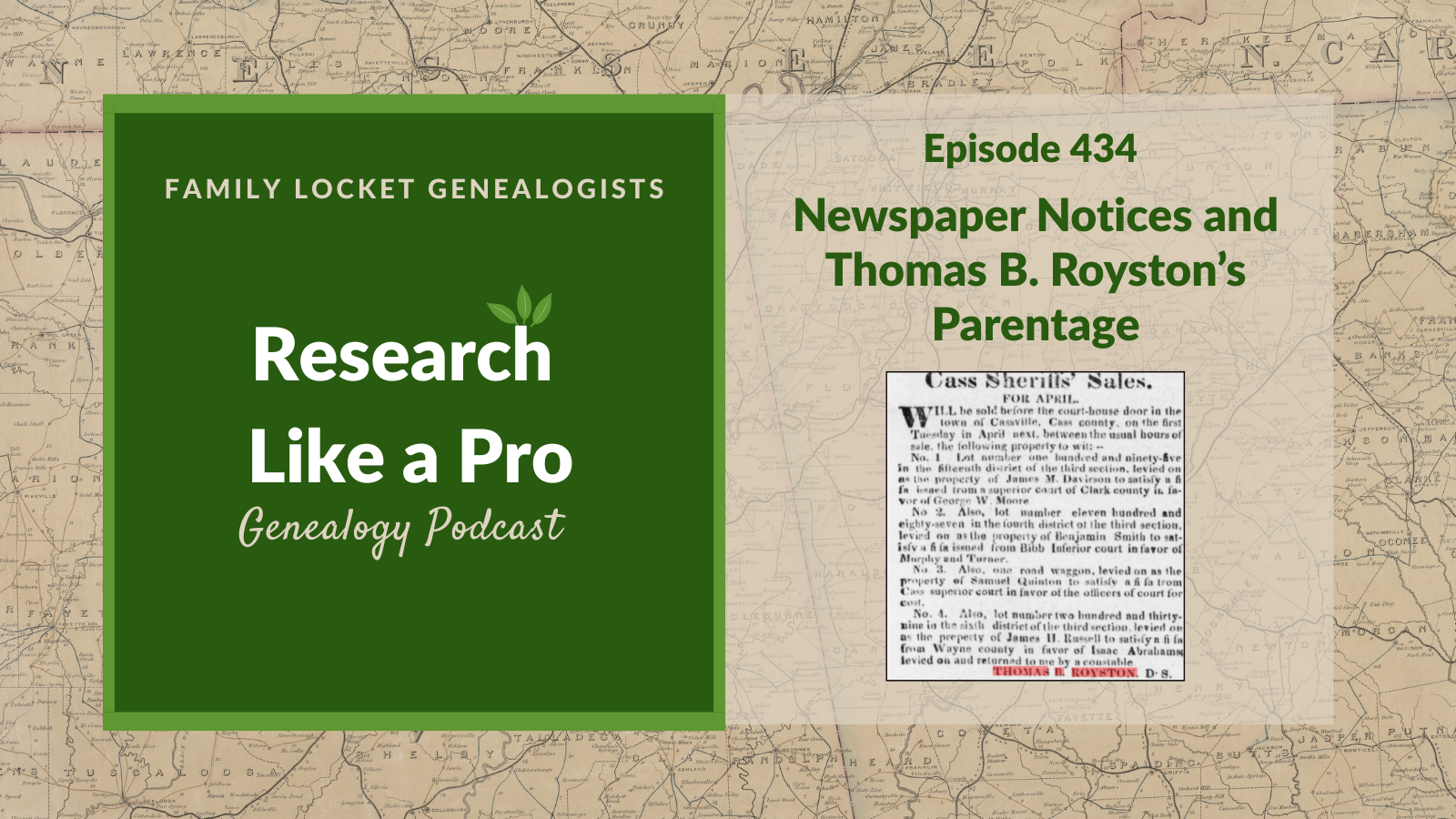
Diana Elder and Nicole Dyer discuss how eleven historical newspaper notices helped prove the parentage and migration of Thomas Beverly Royston in a complex genealogical case study. They examine how records like sheriff’s sales, unclaimed letter lists, and hotel advertisements bridge census gaps between 1830 and 1840, place ancestors in specific counties, and clarify unusual census households by revealing student boarding houses.
Listeners learn how to analyze the FAN club—family, associates, and neighbors—across multiple counties and use indirect evidence such as obituaries and business directories to confirm naming patterns and marriage dates. The hosts demonstrate how newspapers provide crucial contextual clues that hold disparate genealogical evidence together when direct vital records are missing.
This summary was generated by Google Gemini.
Transcript
Nicole (1s):
This is Research Like a Pro, Episode RLP 434: Newspaper Notices and Thomas B. Royston’s Parentage. Welcome to Research Like a Pro a Genealogy Podcast about taking your research to the next level, hosted by Nicole Dyer and Diana Elder accredited genealogy professional. Diana and Nicole are the mother-daughter team at FamilyLocket.com and the authors of Research Like a Pro A Genealogist’s Guide. With Robin Wirthlin they also co-authored the companion volume, Research Like a Pro with DNA. Join Diana and Nicole as they discuss how to stay organized, make progress in their research and solve difficult cases. Let’s go. Today’s episode is sponsored by Newspapers.com.
Nicole (44s):
Hi everyone. Welcome to Research Like a Pro today.
Diana (49s):
Hi Nicole. How are you doing today?
Nicole (51s):
Hey, I am doing well, although my usual microphone stopped working, so I’m using my backup. Hopefully it’s okay.
Diana (57s):
It sounds good to me.
Nicole (60s):
How are you? What are you doing?
Diana (1m 2s):
I’m doing well. So I’ve just been thinking about last week when we did the presentations for the PMC, for the Association of Professional Genealogists, and I was going to ask you, how did your Airtable workshop go?
Nicole (1m 17s):
It was super fun. I was a little bit worried that it would be tricky trying to do a hands-on workshop about Airtable AI features for every level, but the first half was kind of more basic and had some simple hands-on exercises and then the second half was kind of taking it to the next level and had some more advanced exercises. So hopefully everyone got something out of it. But it was fun because, you know, I went over the different ways you can use AI within your research log to help you transcribe documents and summarize them and translate them into another language. We were just kind of playing and practicing with a lot of the things you could do and also talking about, you know, we need to check each transcription for accuracy and we need to, you know, have a little grasp of the foreign language if we’re going to be translating with AI so we can check it and that kind of thing.
Nicole (2m 14s):
And then writing a research report paragraph with AI and changing the model that you, you use within Airtable to transcribe. So all those kind of things. And it was neat to see everyone trying their own documents. And then we had a, a couple of documents that I provided for them to try, so it went well.
Diana (2m 33s):
That’s so neat. Did you give them something to do and then not talk or anything for like a minute or two while they tried it? Or were they supposed to just kind of try it as you were explaining? How did you…
Nicole (2m 44s):
Yeah, I stopped, well, especially in the second half. So in the, in the first half I would stop and then we’d work on it for a minute and then I’d keep going. But in the second half it was just all exercises the whole time. So in two and a half hours you have time to do that.
Diana (2m 59s):
That’s nice because then people could come back and probably ask questions. You had time for questions all the way through.
Nicole (3m 5s):
Yeah, we did that.
Diana (3m 6s):
What a perfect way to teach Airtable, ’cause you do just have to try it. So guided research or guided a workshop where you’re telling ’em what to do and how to do it and showing. That’s so perfect.
Nicole (3m 17s):
Yeah, it was really fun. Well, forA Family for Michael Miller: A Case Study Using Y-DNA and Indirect Evidence, by Alice Childs Accredited Genealogist, one of our friends and associates here at FamilyLocket Genealogists. She also works at BYU in their genealogy center. And so this will be about how Michael Miller was born in 1805 in Pennsylvania, a lifelong resident of Adams County, and he spent the latter part of his adulthood in Cumberland Township. However, records documenting his birth and parentage have not been discovered. This case study illustrates the use of a systematic candidate elimination process along with Y-DNA testing to identify his father and family.
Nicole (4m 6s):
The next research a Pro with DNA study group will be in the spring of 2027 of next year, starting February 3rd, meeting on Wednesdays. So if you’d like to join us, register on December 1st or later, it’s where we will use DNA to find more evidence for our research questions following a step-by-step process. So that’ll be fun. Also, join our email list for updates about any sales, or podcasts episodes, or blog posts that we have coming out, and videos, and our upcoming conferences that we’ll be at: we have RootsTech, and that’s March 4th through 6th in Salt Lake City and online. And make sure you get the early bird tickets. So it’s $99 for a three day pass, and then online is free.
Nicole (4m 52s):
And Mom, you’re giving two talks and, three talks, actually, one about Scattered Clues, Whole Lives: Correlating Evidence for Women, and Analysis and Correlation about research reports, and then Working in Phases for Complex Research Problems. And then I’m gonna talk about Using AI to Find Common Ancestors of DNA Matches and Airtable for Research Logs. And I’ll be on a panel about The Future of AI in Genealogy. And for our Research Like a Pro Institute, we have two courses that you can register for right now. Merging and Separating Identities is back. The coordinator is Jan Joyce, and it’s on Thursdays, January 7th through February 18th from 9:00 AM to 2:30 PM and so I’ll be teaching that again about Airtable.
Nicole (5m 35s):
We have Jan Joyce, of course, the coordinator and instructor, Kristin Britanik, Lynn Nelson, Kim Richardson, and Patti Lee Hobbs. And there’s pre-course work with that that you’ll need to do by January 2nd. So if you register for that, just know that you’re gonna need to work on that probably during the holidays. And then the new Institute course we have coordinated by Jan is called SEARCH: Online and Offline Expert Techniques with a Proven Process. And this is going to be on Tuesdays beginning February 23rd. It lasts seven weeks and it goes from 9:00 AM to 2:00 PM Mountain Time on Tuesdays. And that will be led by Jan as well as two instructors, Kristin Britanik and Kelley Conner Lear.
Nicole (6m 16s):
So to find out more and register, go to the FamilyLocket website, click on “SHOP”, and then go to “INSTITUTE COURSES.” And you can see both of these. And then if you’re interested in becoming an Accredited Genealogist, you should do the Salt Lake Institute of Genealogy Spring Virtual course next year in 2027, “Becoming an Accredited Genealogist® Professional: The Why, the What, the How.” And that’s on Thursdays, March 18th through April 29th. And this will be led by Lisa Stokes, Alice Childs, Karen Kowallis, Jenny Hansen, Bonnie Wade Mucia, Torhild Shirley, and Mindy Taylor. And this is a great course. It’s interactive, it has hands-on practice, peer reviews of your work, personalized mentorship, and will help you navigate the ICAPGen accreditation process.
Nicole (6m 58s):
So registration is open, make sure you head over to the SLIG website to register.
Diana (7m 4s):
Wow, that’s a lot of institutes, a lot of neat things to look forward to and conferences, how exciting, right?
Nicole (7m 9s):
Yeah, it’s fun that Jan is bringing back i. Merging and Separating Identities. It will be the third time she’s done this course and it’s been so well received. I feel like there are always so many cases in our genealogy where we have people of the same name or we don’t even realize we have that, or we have somebody who moves and we have to merge those identities from different places. So it’s just a really good course that’s pretty unique.
Diana (7m 33s):
Yeah, she really looked to see what was the need in the genealogy community and noticed that need and created a course to fill that need, which I think is brilliant.
Nicole (7m 41s):
Yeah. And then the SEARCH course is fun because who doesn’t like to learn more about how to search and find fun things online and offline? So it’s like,
Diana (7m 50s):
I agree. Yeah. That’s so neat.
Nicole (7m 50s):
Very tempting to sign up for all three of those. Well, today’s topic is newspapers and we’re excited to talk about how you’ve used newspapers in the Royston project that you did, and not just obituaries and more modern newspapers, but these are older ones that are kind of challenging. And these can contain multiple pieces of information that we use as evidence. And these articles from old newspapers can add context. They can tell us the residence of individuals, can help establish relationships and more. And so in your recent case study on Thomas Beverly Royston, newspaper articles actually offered some really important clues, especially because you had a lot of burned counties that led to new research locations and provided a plausible answer to a census conundrum.
Nicole (8m 39s):
So can you tell us how you set up the Thomas Beverly Royston project and how this incorporates indirect evidence from newspapers?
Diana (8m 47s):
Well, I was keeping a research log. That’s how I set up my projects. You know, I had a, I already had done a project for accreditation, a four generation project, and Thomas was my third generation, and I had a really lengthy research log for him and a lengthy research log for his parents, Polly Cessna and John Kerry Royston. And so when I started writing my case study, I decided to put it all into Airtable because I’d used Google Sheets before and I put it all into Airtable. And then I was able to group really easily by all sorts of different things, you know, locality research and research types, different types of records.
Diana (9m 31s):
And I noticed that I had some holes that I could actually fill. You know, you just always have holes that you can fill with research. You feel like there what happened in between here, I need to know more about this. And so just ended up doing a lot of, a lot more research to get ready for my case study to be published. So let me tell you just a little bit about this case and then we’ll go into some of the newspapers. So Thomas dies in Chambers County, Alabama on September 21st, 1868. And he did leave a will and a probate.
Diana (10m 12s):
And the probate file went on for 15 years because it had to take care of all of the children. The children had to grow up and so that the everything could be divided appropriately. And the headstone says only that he was about 62 years of age and there is no record that names his parents. You know, of course we always start with the known facts about this person. And Alabama didn’t have death registration until 1908. There was no church records despite really searching through all of those. And so I had to go and dig into a lot of other records that just happened to be all in Georgia, which is where he is from.
Diana (10m 53s):
And as you said, there were a lot of burned counties. And so the newspaper notices filled in some of the gaps. And it was really fascinating to see the different types of things that were in the newspaper. I think we’re always just so curious about, will our ancestor be noted? But they were important and often the newspapers were published in places that were not necessarily the county of residence. You know, the people just would put their ads and newspapers all around and newspapers would pick up interesting things from different locations. So it was really fun to think about how the newspapers, which is what we’re going to talk about today, really helped fill out the story.
Nicole (11m 37s):
Yeah, I love this. Well, let’s talk about the first way that the newspapers helped, and this is with filling the gap between the censuses. So Thomas B Royston did not head a household anywhere in Georgia in 1830. He had no deed in DeKalb County, Alabama. And between his 18, between his 1831 Morgan County tax entry and his 1837 DeKalb County land application, the paper trail thins to almost nothing–exactly the years when his marriage took place and his first child was born. But there were two newspaper notices that really helped to put him in a certain place. The first is the Cass Sheriff’s Sales for April in the Cherokee Intelligencer from Edahwah, Georgia on March 8th, 1834.
Nicole (12m 26s):
And Thomas B Royston signed as D.S., Deputy Sheriff, of Cass County. So that was kind of a cool one to see that he was a deputy sheriff. Then there was the list of letters in the Cassville Georgia Gazette on April 14th, 1835. Thomas B Royston had unclaimed mail at the Cassville post office. Well, each of these newspaper notices does double duty, it places him in a specific county on a specific date, and the first one names an office. Correlated with his June 26th, 1833 commission as first lieutenant in Cass County from the Georgia Adjutant General’s military records, the sheriff’s cell confirms that Thomas was not merely passing through the new Cherokee-land counties, he was holding local office there.
Nicole (13m 10s):
So that was really neat to be able to correlate those. And then Cass County marriage records don’t begin until 1836 and since Thomas married Cynthia Dillard about 1833 or 1834 and no marriage record has ever surfaced, the Sheriff’s sale notice provides a plausible reason. It places him in the one county where the marriage most likely occurred during the exact window when that county was not yet recording marriages. So that newspaper notice helped explain a negative search result, always worth more than another empty database query. So that was exciting.
Diana (13m 43s):
Yes, it was because I did not know where he was in between. And Cass County is one of those burned counties. So there were no land records, there were no court records. A lot of those things that we rely on to help us place a person and the newspapers were able to to place him there. Well, another interesting ad was one from 1830 and the 1830 census for Clarke County, Georgia, shows a John Dawson heading a household that had a lot of young men aged 15 to 19, and then there were seven more aged 20 to 29, and then 10 enslaved people.
Diana (14m 24s):
And so I was so curious about this because I had seen John Dawson come up in my research several times, and when I looked at that census, just like, why are there so many young men here? And I had hypothesized that this was Thomas Beverly Rosten’s brother-in-law married to his half sister, and I thought Thomas had to have been in this household because he was nowhere, even though we knew he was there at 1830 there, he was not in a census heading household. So when I looked at newspapers, I found that in the Athenian of Athens, Georgia in 1830, there’s an article titled Globe Tavern.
Diana (15m 9s):
And it said, it is where Dawson announced he had removed to Athens, taken the house formerly occupied by Mr. L. A. Erwin and was prepared to accommodate boarders and travelers in a handsome style. So now we know this was a boarding house. And then another article in November, so the first one was in January 2nd, one in November, several months have passed here in 1830, and this article says the Franklin Hotel, John Jackson announced he had taken the house formerly kept by Leander A. Erwin, and more recently by John Dawson. The situation, he wrote, was adjacent to the college and calculated to accommodate 40 students.
Diana (15m 53s):
So that was a great find because I learned that Dawson was most likely running a student boarding house next to the University of Georgia. And the census household is not a family like we usually have, but it’s, it’s a register of all of these young men that were there going to school. And so it was very interesting to kind of have a mind shift and think about what was happening there in 1830. And I don’t know for sure, but I really do feel like Thomas B Royston and then his sister, Sarah, and her husband David Irwin were probably all living there. They were married there. I mean, I know they were in that area and they should be in the census.
Diana (16m 36s):
So it makes sense that they would’ve been in this household of a brother-in-law. So it was really great because the other thing that the Franklin Hotel ad gives me is this idea that John Dawson was no longer running this boarding house. So it sounds like it was just for a short amount of time. And then he sold it and then they moved on, which explains, you know why in a few years they have moved to a different county. So we’re not sure exactly when they moved, but it certainly lets us know that it might have been there in 1830.
Nicole (17m 15s):
Wow, that’s so crazy that there was a college there and that’s what they were doing was having students board. Wow.
Diana (17m 24s):
Yeah, they had colleges there at that time. So interesting, huh?
Nicole (17m 27s):
Yeah. Did you figure out which college it would be?
Diana (17m 29s):
Yes, I did do some research on that, and it was the University of Georgia.
Nicole (17m 33s):
Oh yeah, you mentioned that, university of Georgia.
Diana (17m 36s):
Yeah, it was, it was an established university there in 1830, very early.
Nicole (17m 44s):
That’s crazy, in Athens. Well the newspaper ads that we’ll talk about next were helpful because they tracked one of the associates of Thomas Beverly Royston across four counties. So going back to Dawson, he mattered because he married Elizabeth “Betsey” Cessna, probably a daughter of Samuel Cessna and Mary Baker. So this would be Thomas’s half sister. So there’s no marriage record that survives, and the case for the relationship is built on association. And Dawson advertised constantly, which makes him really easy to follow throughout Georgia. So we’ve already talked about him a little bit in the podcast episode about, you know, No Marriage Record, No Problem.
Nicole (18m 25s):
Where we prove the marriage of John and Betsey. So let’s dive in to these notices that John Dawson put in the newspaper. So in 1827, he has a notice about Madison Hotel in the Athenian, and then in 1830 Globe Tavern in the Athenian; 1832 Sanfordville Inn in the Georgia Journal, in 1833 Cherokee Post Offices in the Southern Banner, in 1833 Allatooney Hotel in the Western Herald; 1839, there was a business directory and candidacy notice in the Georgia Pioneer in Cassville;
Nicole (19m 9s):
1841 Cass Sheriff Sales in the Georgia Pioneer, in 1842 In Bankruptcy — John Dawson. So that’s interesting because we can kind of see a migration route starting in, you know, with the Athenian he’s in Morgan County and Clarke County, and then he goes to the Cherokee gold counties with Dawson arriving in the gold region by 1832 when he advertised for the Sanfordville Inn in the Georgia Journal. And that’s the Cherokee gold region. And then his moving his post office from Sanford to Allatoona in 1833. And it parallels the movements of Mary Cessna, Robert Cessna, and David and Sarah (Royston) Irwin and Thomas Royston himself.
Nicole (19m 49s):
So it’s neat to see the whole group migrating, and we’ve talked about this over several episodes now, but the shared migration across four counties over 15 years is just not a coincidence. It’s strong evidence when each stop is independently dated and you can see them all going together. Those 1841 and 1842 notices kind of close the loop in a cool, unexpected way. The Georgia Pioneer s’sheriff sale reports John Dawson’s execution against Richmond Baker and the Daily Georgian bankruptcy notice names Dawson of Cass County, a merchant of the late firms of Dawson, Douthit & Co., Dawson & Sloan, and Patterson & Dawson.
Nicole (20m 29s):
The following year, a Cass County Sheriff’s deed conveyed the bankrupt Dawson’s property to David Irwin. And the newspaper explains why the deed exists and the deed corroborates the newspaper. So having both of those records helps tell the story.
Diana (20m 43s):
Now let’s have a word from our sponsor: This Thanksgiving, think about what your family will still treasure years from now. Not another gadget, but a story. Give the gift of a Newspapers.com subscription. With over a billion pages of historical newspapers, Newspapers.com lets your loved ones find real pieces of their past: a birth announcement, a wedding write-up, a photograph from a small-town parade. It’s a wonderful gift for the family historian, and a great way to get a curious teenager or a retired grandparent hooked on family history. The best part? You can explore together, and save, print, or share what you find with relatives near and far. Give a gift that preserves memories and starts conversations around the table.
Diana (21m 38s):
Visit Newspapers.com/FamilyLocket today for 20% off a subscription, for gifting or for yourself. Newspapers.com — discover the past, one story at a time. Well, let’s talk about another interesting item from a newspaper. And this is, you know, almost a hundred years later. This is a 1916 obituary, and we talked about this in a previous episode as well, which was an obituary that confirmed the naming pattern. So we have previously discussed how Thomas named his children, Robert Cisnie, Thomas B., and Mary Elizabeth Royston, and then his sister Sarah (Royston) Irwin named children Robert Cessne, Thomas Beverly, and Mary Elizabeth Irwin. So they were honoring their Cessna half siblings and their mother Mary. But the interesting thing is that Sarah’s son is in most records as Thomas B.
Diana (22m 21s):
Irwin. You know, that middle name is just always shortened to the initial, except for one that I found, and maybe there’s more out there, but I found a fun one, which was Mr. Thomas B. Irwin Crosses Great Divide and this was in the Marietta, Georgia, Journal, and it names him as Thomas Beverly Irwin gives us his full name and identifies his father as the honorable David Irwin, deceased. So I was excited to find that because the B could have been for a lot of different things. And so finding it actually written out that it was Beverly just added that extra bit of evidence for that naming pattern argument. So that was neat to find an obituary from that long ago really spelling out his name.
Nicole (23m 6s):
That is so awesome. It really was great to see your naming pattern evidence in that past episode. Well, I also noticed that, you know, the earlier 1830s and 1840s, they’re all about newspaper notices, letters, lists. And now that we’re in 1916, we have an obituary and it kind of shows kind of a trend with what you can find in newspapers like early 1800s, you don’t have the same type of obituaries. You maybe will have a death notice, but you won’t have like the full obituary that you’re used to in the 1900s. And I think it’s interesting, I did find an obituary once in the late 1800s, but it wasn’t the typical one where it would say like family members or anything.
Nicole (23m 47s):
It, it was like a flowery, like religious text, almost like a poem kind of. And so it just kind of mentioned that this person died and then a bunch of stuff that wasn’t useful genealogically,
Diana (23m 58s):
Interesting. It would be really fun to do a little study of obituaries and when they really started and to see how they progress through the years.
Nicole (24m 4s):
Yeah, as you know, as genealogists we tend to just kind of notice these things over years of, of gathering things up,
Diana (24m 12s):
Right.
Nicole (24m 13s):
And when you do DNA research, you’re constantly looking at obituaries for all the lines of the DNA matches back to their common ancestors with you.
Diana (24m 23s):
Right. You read a lot of obituaries.
Nicole (24m 23s):
Read a lot of obituaries. Alright, well let’s talk about another newspaper notice, this one is In Memoriam, a notice that tightened a marriage date. And this appeared in the Lafayette, Alabama, Sun on December 29th, 1915. And it supports an 1835 birth for one of the Royston daughters. And her name is Mary Elizabeth (Royston) Slagle. This is Thomas and Cynthia’s eldest child, and her gravestone and the 1850 census suggests that she was born in 1834 or 1835, and a birthplace of Alabama. Working backward from the eldest child’s birth puts the marriage in 1833 or 1834, which is what sent the search to Cass County in the first place, and back to the sheriff’s sale notice that we talked about.
Nicole (25m 13s):
So tell me more about this notice.
Diana (25m 16s):
Well, this is one of those where we have different birth years and I was really trying to get this birth year figured out because I don’t have a marriage record for Thomas and Cynthia. And if I could figure out if Mary Elizabeth was born in 1835, then I would give them a possible marriage of 1834, or if it was an 1834 birth and I could say let’s give them an 1833 marriage.
Nicole (25m 41s):
Hmm.
Diana (25m 41s):
And so that’s why it was kind of a big deal. So I did a whole mini project just looking at every single source I could find for Mary Elizabeth Royston. So I had her in every single census. And then I found this little obituary, you know, In Memoriam, basically an obituary. And I just decided, I, I think I still decided that she was born I think in 1834 and putting the marriage about 1833. You know, this type of a case you cannot say for certain, you just don’t know for sure. But that’s the best I could do. The interesting thing is though, one of the very first newspaper notices we talked about in this episode was Thomas being, letters left unclaimed mail at the Cassville post office and that was 1835 and that was in Georgia.
Diana (26m 37s):
So my hypothesis is they had already moved over to Alabama to his first place in DeKalb County, Alabama, just right across the border. And that would make sense that they’ve moved from Georgia, they’ve gone over to Alabama and that’s where she was born. So it’s kind of a tight window, you know, right there. And he is in the newspaper as that deputy sheriff in 1834. So I am still on the fence about, you know, exactly how the dates and the timeline works, but it’s right there, right there in 1834, 1835. Kind of funny.
Nicole (27m 15s):
Right? Yeah. I will say, I’m looking at the obituary of Mary Elizabeth Royston Slagle and it’s kind of a mix of the two types of obituaries that I had been talking about earlier where it has some of that like flowery language about the deceased at four o’clock in the morning of December 23rd as the moon beams shed their somber light over the earth’s hill and vale. And as the old year smiled back as it took its party adieu, the sweet spirit of our neighbor and friend, Mrs. Mary Slagle took its flight to its eternal home and the God who gave it, and then the second half gives a little bit about her with her birthdate. So it’s nice that it says she was born May 20th, 1835.
Nicole (27m 57s):
I mean, that really helps your case.
Diana (28m 1s):
Yeah, that’s a lovely obituary. I do like that. That’s very lovely. Well, sometimes we don’t find what we want in the newspapers. And I had searched high and low for that Dillard-Royston marriage. There was a published book called Marriage, Death and Legal Notices From Early Alabama Newspapers, 1819–1893. And I was really hopeful that maybe it would turn up something about that marriage, but it didn’t, you know, and that was part of my negative evidence for that marriage that I had looked at marriage records of course in in the locations where they were, and then looked in this book, which was abstracts of newspapers.
Diana (28m 44s):
So, you know, sometimes you don’t find, find something, but you can add everything that you have searched to your case and use it as some negative searches or even negative evidence eventually.
Nicole (28m 57s):
Yeah, I mean I think it’s really helpful to have those searches documented so that when you need to, you can use that in some way in your case study, whether you’re just showing that you did a search or has negative evidence. Okay, well what does this case tell us about newspaper research? So it gives us the tip that we should search the FAN club harder than you search the ancestor sometimes. Thomas B Royston generated two useful notices and John Dawson generated eight. And the associate who advertised was the one who helped map the whole migration route. And you might expect to see the same notice in several papers. So that’s another tip that you’ll see repeating notices.
Nicole (29m 38s):
The Cass sheriff sales ran in the Cherokee Intelligencer on March 8th, 1834, and again in the Miners Recorder and Spy in the West March 29th, 1834. Dawson’s Allatooney ad closed by asking the editors of the Georgia Journal, Columbus Enquire, August Augusta Chronicle and Macon Messenger to run it twice monthly for six months. So two consequences follow. If one paper’s run is damaged or missing, look for the reprint and never infer residence from the newspaper’s place of publication.
Nicole (30m 19s):
Dawson lived in Cass County and advertised in Milledgeville, Auraria, and Athens. So broadening our searches, including newspapers that are not exactly where our person lived, we might find more than we guess we will find.
Diana (30m 28s):
Absolutely. And if it is something that is spectacular, like a murder or a kidnapping, you know, something that all the newspapers around will pick it up, then you’re, then you’re really lucky because sometimes even regional newspapers we’ll pick at something like that. You know, just kind of like our current day newspapers where we get news from all over and the things that are most interesting make it into our local newspaper. So it’s the same thing back then. Well it’s fun, as I already mentioned, that whole list of letters, I’ve seen that a few different times where they were advertising for people who had letters at the post office. And I think this is so interesting, but when you think about it, it makes a lot of sense because how did people communicate with their loved ones?
Diana (31m 16s):
Well, it was through letter writing, and if they were moving on, you know, they would’ve said, okay, send letters to the Cassville post office. And then Thomas would have to go back over there and pick up his letters if he wanted to see what was happening with the rest of the family or associates. And so it can really help us to trace people. The interesting thing is that Thomas is up in the northeastern part of Alabama DeKalb in 1835, we think. And he has those num, those letters left in Cassville just across the border. But in December, 1841, there’s a Thomas Royston who is on a list of letters at Columbus, Muskogee County, which is further south that that one is just across the border from Chambers County, Alabama, where he moved.
Diana (32m 5s):
So my hypothesis for this is that he let family know that he was moving south several counties down to Chambers County and that they should send his mail to Columbus and that he would just go across the Chattahoochee River and pick up his mail then whenever he got there. So that was kind of fun because before I knew about this whole Cass County in, in the Georgia gold region, I thought that he migrated straight over and I, I just couldn’t quite figure out what was going on. ’cause I had that list of letters a long time ago. So I didn’t quite have the geography and the timing right. But I knew there was something going on there.
Diana (32m 47s):
So those lists of letters can really help us to establish a timeline perhaps of migration. And then we also have to think about searching, because newspapers often use OCR, the optical character recognition. And it just really depends on what that family’s name is spelled as, you know, newspapers back then got things wrong just like they do now. And we’ve seen so many kind of weird ways of spelling the family names, you know, Royester, Roylston, Sepna, Sissan, Gisum, and Javin, all sorts of different ways of the name’s been indexed or just spelled in a record.
Diana (33m 28s):
And so the same thing with newspaper searching. Try a lot of different spelling variations to see if you can get, get all the hits for your family.
Nicole (33m 40s):
Some of those names are just so hard to guess that I don’t even know how you found them.
Diana (33m 47s):
Well I don’t either, to be honest. I have no idea. No, you know, if it’s in a book, I know the Sepna one was for a land lottery and it was a book and I was just looking, I looked in all the Cs for Cessna and I looked in all the S’s and as I was just looking down, you know, the Sepna just jumped out at me. Sometimes it, they just jump out at you and you’re like, I think that’s my family. So, you know, it happens.
Nicole (34m 10s):
What was the first name on that one?
Diana (34m 13s):
Mary Cessna.
Nicole (34m 13s):
Oh man, that’s so hard ’cause Mary is so common. And if you were searching in a database, even just putting in Mary and leaving the last name blank, I guess you could have done Mary S with an asterisk for searching a database. I mean, it’s so cool that you had a book, but if you’re searching in a database, sometimes it’s so hard because you can’t just look through all the S’s or whatever.
Diana (34m 34s):
Yeah, I think that the whole idea of the wild cards is what you have to turn to. And we did this on the, an episode a while back where you mentioned how you would’ve found something a lot faster if you’d actually read the instructions on the website about the wild cards.
Nicole (34m 50s):
Thanks for bringing that up.
Diana (34m 52s):
Oh, I think I, everybody remembers that one. So, but I think that’s so true. How often do we just ignore that and think we know best and not
Nicole (35m 1s):
Or we’re just too excited to slow down in my case.
Diana (35m 3s):
Yeah, yeah. So it really is good to take a look at that, try different things. So you know, we’ve, we talk a lot about variance spellings, but especially with newspaper research, it can be really, really helpful.
Nicole (35m 17s):
Yeah. So with the Sepna, do you think that was a transcription from the original or was that actually how they printed her name in the newspaper?
Diana (35m 25s):
Well that one was a land lottery list.
Nicole (35m 27s):
Oh, so it was handwritten originally
Diana (35m 29s):
It was handwritten and it would’ve had the double S. But you know how the S back
Nicole (35m 35s):
Oh yes. Okay. We talked about this.
Diana (35m 37s):
Yes. The indexer, or yeah, whoever was writing the book, they were abstracting these records and they looked at it and thought it was a P.
Nicole (35m 45s):
Okay,
Diana (35m 46s):
You all done that.
Nicole (35m 48s):
The double S looks like an F or in this case a P.
Diana (35m 53s):
Yep. So one thing that I really like to do, and this goes along with just capturing all the information when you are looking at the image, I like to always create my citation as I am doing the search. So you know, you capture the URL and then get everything you need for that citation for a newspaper. You want the, the volume, the number, the page, the column and the paragraph. And then I want to get all the text out and you know, just get all the information from that newspaper clipping while you’re looking at it. So you know, it’s a really a pain if you’re going back to one of those old newspapers and they are lots of columns and lots of paragraphs and it’s much nicer if you can say, oh it was column five and it was paragraphs seven or whatever.
Diana (36m 43s):
It helps you locate that so much faster. And I also like to do a little clipping of it and then save that in my files. And also if I’m in Airtable, I’ll put it as an attachment in Airtable. So that’s one of my favorite ways to use attachments in Airtable is to do clippings of newspapers because you can just get the relevant little clipping and put that right in. And as we were talking about in the announcements, you can have Airtable agent do the transcription for you right there. So that’s kind of an nifty way to do that.
Nicole (37m 12s):
Yeah, it is. And I thi, if I remember right, in the attachment field, you can even paste an image from the internet, which is so handy to just Control V right into the attachments and then it has your newspaper clipping. It’s so easy.
Diana (37m 26s):
Yeah.
Nicole (37m 26s):
And then you can go ahead and click run agent and all of a sudden you have a transcription of that. So plain text that you could copy and paste into a Word document or your report, whatever you need. It’s just nice to have that. You don’t have to type it out. And it’s so easy for AI to transcribe printed text, even if it’s a little bit hard to read like some of these old ones. But it can really figure out any letter that is slightly blurry just by, you know, context and whatnot.
Diana (37m 56s):
Well, and it’s a good way to capture a lot of newspaper clippings because I know sometimes when I’ve been doing newspaper research, you get so many, and it can be overwhelming. You know, you have 25 hits for the same person and you know its your ancestor, and these are all articles you wanna capture. But you know, if you’re using something like Airtable or any kind of a research log, but I love Airtable for that idea of just doing a snip and then pasting it right into the attachments, it, it can make it pretty fast to get all of those down. So yeah, let’s just face it. Sometimes it just takes time and work to get all of our sources where we want them to be.
Nicole (38m 34s):
I love that. Well let’s talk about where you found a lot of these newspaper notices. So nearly all of the Georgia notices here came from Georgia Historic Newspapers, the Digital Library of Georgia’s free archive, which now offers well over half a million issues from 1763 forward. And we’ll put the URL in the show notes, but it’s gahistoricnewspapers.galileo.usg.edu. And the Savannah bankruptcy notice came from a FamilySearch film image and neither one of them requires payment. So you don’t need a subscription for FamilySearch or for Georgia Historic Newspapers.
Nicole (39m 17s):
So it’s neat that these came from free sources. Newspapers rarely can prove parentage on their own. And it was really cool to see how these newspaper articles just had tiny bits of information in them that, you know, you had that list of letters for a long time and didn’t really have like a strong piece of evidence from it. But when you correlated it with everything else you found over the years and all of these other FAN club articles and things, it all contributed toward a case that was so strong. So not one notice says whose son Thomas was, what they did was place people in counties on dates, explain an odd household, follow a family network through four migrations, and spell out one middle name.
Nicole (40m 3s):
And that was enough to hold the rest of the evidence together as kind of this like neat source that pops up every once in a while to help explain something that’s happening. And I think your case just shows how every scrap of evidence is so important.
Diana (40m 22s):
I agree. There were some things in the newspapers that clarified so much, you know, like the boarding house and when Thomas might’ve moved to Cass County and when he might have moved to Alabama, it just, you know, we just can’t ever ignore any type of source. They are all valuable. So.
Nicole (40m 45s):
Yep.
Diana (40m 45s):
Go newspapers.
Nicole (40m 45s):
Go newspapers. Yeah.
Diana (40m 47s):
Alright, well thanks everybody for listening. It’s been so fun to talk all about newspapers and and our research and we look forward to talking to you next time. Bye-bye.
Nicole (40m 58s):
Bye. Thank you for listening. We hope that something you heard today will help you make progress in your research. If you want to learn more, purchase our books, Research Like a Pro and Research Like a Pro with DNA on Amazon.com and other booksellers. You can also register for our online courses or study groups of the same names. Learn more at FamilyLocket.com/services. To share your progress and ask questions, join our private Facebook group by sending us your book receipt or joining our courses to get updates in your email inbox each Monday, subscribe to our newsletter at FamilyLocket.com/newsletter. Please subscribe, rate and review our podcast. We read each review and are so thankful for them. We hope you’ll start now to Research Like a Pro.
Links
Eleven Newspaper Notices: How Hotel Ads and Sheriff’s Sales Helped Prove Thomas Beverly Royston’s Parentage – https://familylocket.com/eleven-newspaper-notices-how-hotel-ads-and-sheriffs-sales-helped-prove-thomas-beverly-roystons-parentage/
Mary (Royston) Slagle Obituary – https://www.newspapers.com/article/the-lafayette-sun-in-memoriam-mary-roys/208824460/
Georgia Historic Newspapers – https://gahistoricnewspapers.galileo.usg.edu
Sponsor – Newspapers.com
For listeners of this podcast, Newspapers.com is offering new subscribers 20% off a Publisher Extra subscription so you can start exploring today. Just use the code “FamilyLocket” at checkout.
Research Like a Pro Resources
Airtable Universe – Nicole’s Airtable Templates – https://www.airtable.com/universe/creator/usrsBSDhwHyLNnP4O/nicole-dyer
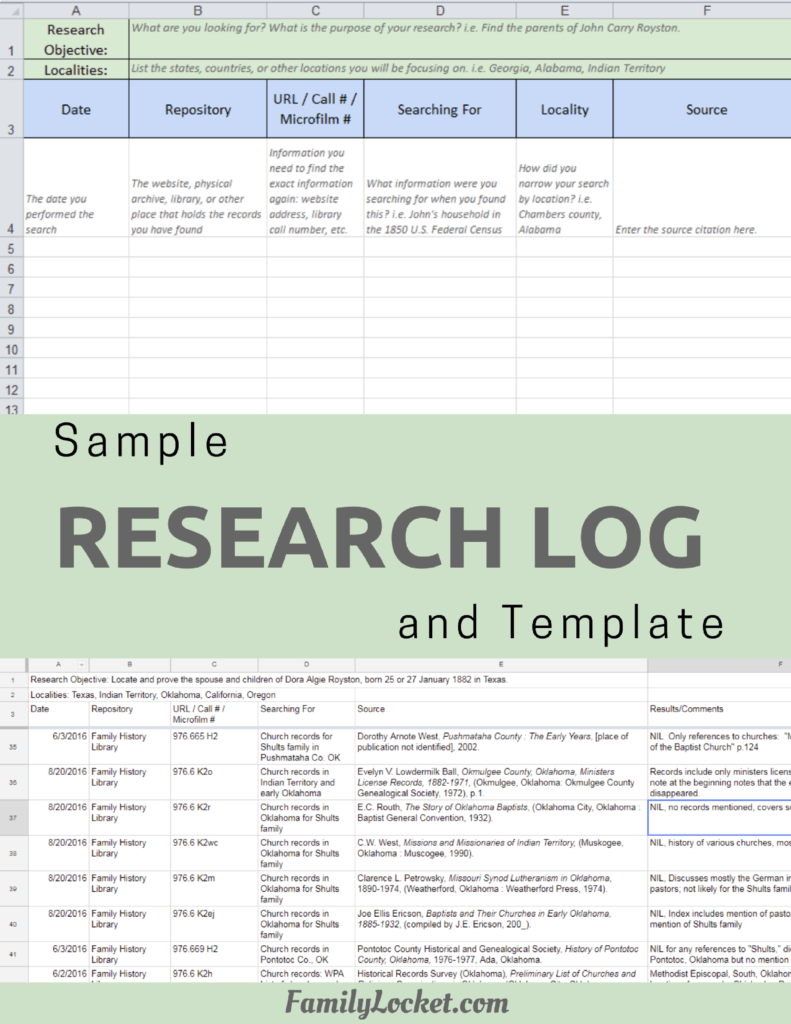
Airtable Research Logs Quick Reference – by Nicole Dyer – https://familylocket.com/product-tag/airtable/
Research Like a Pro: A Genealogist’s Guide book by Diana Elder with Nicole Dyer on Amazon.com – https://amzn.to/2x0ku3d
Research Like a Pro with AI Workbook – Second Edition (eBook) – https://familylocket.com/product/research-like-a-pro-with-ai-workbook-second-edition-ebook/
14-Day Research Like a Pro Challenge Workbook – digital – https://familylocket.com/product/14-day-research-like-a-pro-challenge-workbook-digital-only/ and spiral bound – https://familylocket.com/product/14-day-research-like-a-pro-challenge-workbook-spiral-bound/
Research Like a Pro Webinar Series – monthly case study webinars including documentary evidence and many with DNA evidence – https://familylocket.com/product-category/webinars/
Research Like a Pro eCourse – independent study course – https://familylocket.com/product/research-like-a-pro-e-course/
RLP Study Group – upcoming group and email notification list – https://familylocket.com/services/research-like-a-pro-study-group/
Research Like a Pro Institute Courses – https://familylocket.com/product-category/institute-course/
Research Like a Pro with DNA Resources
Research Like a Pro with DNA: A Genealogist’s Guide to Finding and Confirming Ancestors with DNA Evidence book by Diana Elder, Nicole Dyer, and Robin Wirthlin – https://amzn.to/3gn0hKx
Research Like a Pro with DNA eCourse – independent study course – https://familylocket.com/product/research-like-a-pro-with-dna-ecourse/
RLP with DNA Study Group – upcoming group and email notification list – https://familylocket.com/services/research-like-a-pro-with-dna-study-group/
Thank you
Thanks for listening! We hope that you will share your thoughts about our podcast and help us out by doing the following:
Write a review on iTunes or Apple Podcasts. If you leave a review, we will read it on the podcast and answer any questions that you bring up in your review. Thank you!
Leave a comment in the comment or question in the comment section below.
Share the episode on Twitter, Facebook, or Pinterest.
Subscribe on iTunes or your favorite podcast app.
Sign up for our newsletter to receive notifications of new episodes – https://familylocket.com/sign-up/
Check out this list of genealogy podcasts from Feedspot: Best Genealogy Podcasts – https://blog.feedspot.com/genealogy_podcasts/




Leave a Reply
Thanks for the note!