
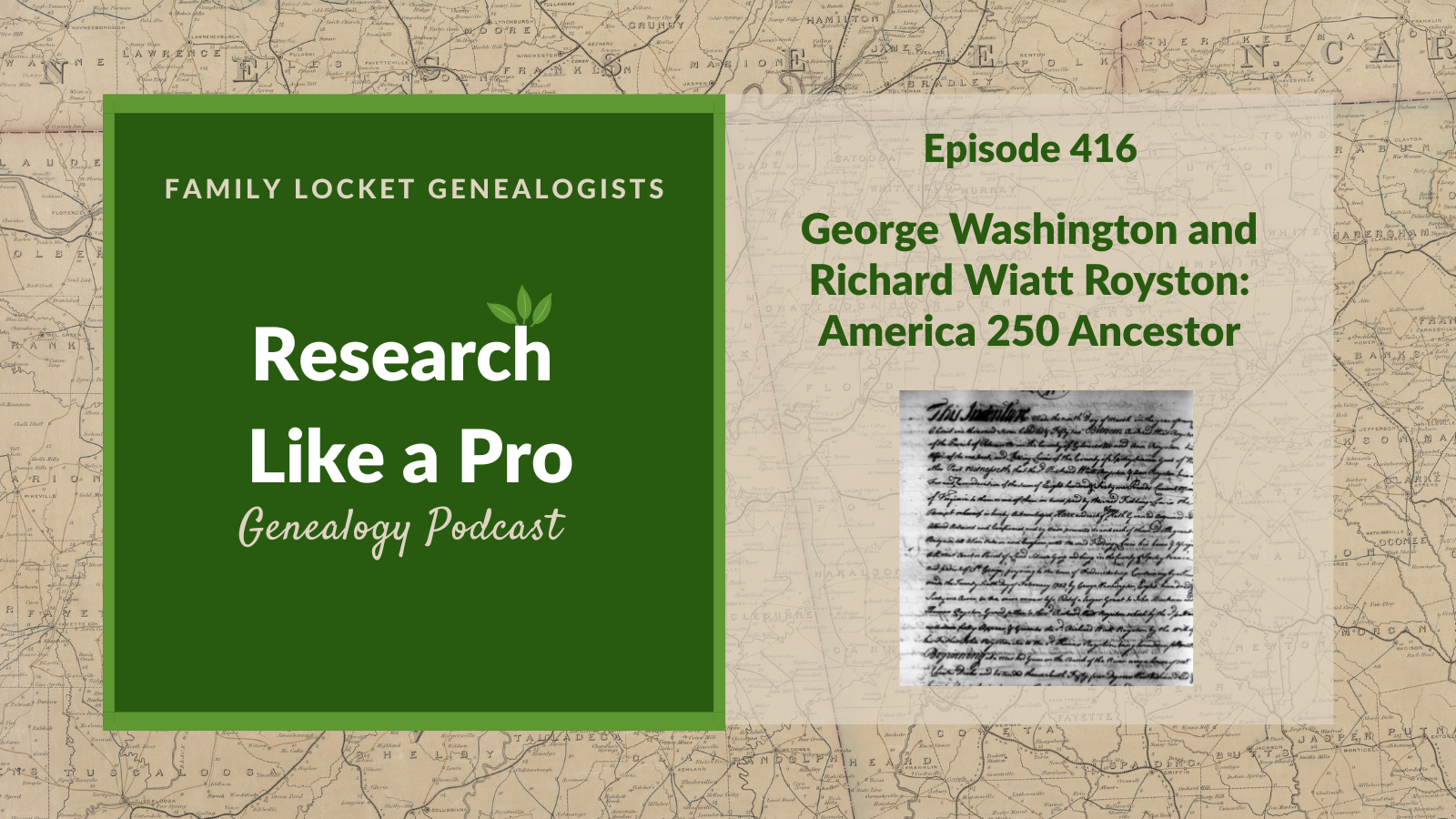
Diana and Nicole discuss the America 250 Ancestors series, which focuses on researching colonial ancestors who lived during the Revolutionary War era. Diana shares her recent trip to Mount Vernon, where she experienced Revolutionary War Weekend and visited the slave quarters and memorial to learn about the 317 enslaved individuals who lived on the estate. Listeners learn how to use historical context to tell the stories of their own ancestors who lived during this foundational time in American history.
Diana highlights her research into her fifth great-grandfather, Richard Wiatt Royston, and his connection to George Washington. She details how Richard and his wife Ann sold land to Fielding Lewis in a 1752 transaction that George Washington personally surveyed. Diana and Nicole examine records such as vestry books, tax lists, and petitions to piece together Richard’s life in Gloucester County, Virginia, including the story of his son John’s time as a runaway apprentice. Through these records and accounts of the extreme economic hardship and natural disasters in the post-Revolutionary era, they demonstrate how to utilize available documentation to construct a richer understanding of an ancestor’s experiences and sacrifices.
This summary was generated by Google Gemini.
Transcript
Nicole (1s):
This is Research Like a Pro, episode 416: George Washington and Richard Wiatt Royston – America 250 Ancestor. Welcome to Research Like a Pro a Genealogy Podcast about taking your research to the next level, hosted by Nicole Dyer and Diana Elder accredited genealogy professional. Diana and Nicole are the mother-daughter team at FamilyLocket.com and the authors of Research Like a Pro A Genealogist’s Guide. With Robin Wirthlin they also co-authored the companion volume, Research Like a Pro with DNA. Join Diana and Nicole as they discuss how to stay organized, make progress in their research and solve difficult cases.
Nicole (41s):
Let’s go. Today’s episode is sponsored by Newspapers.com. Hi everyone. Welcome to Research Like a Pro.
Diana (48s):
Hi Nicole, How are you today?
Nicole (51s):
Hey, I’m doing great. So how’s it been going, watching all those NGS recordings?
Diana (56s):
It’s been so fun and I thought that I would just call out a couple of them that I really enjoyed. You know, it’s really interesting ’cause you read the title and the description and I’m always like, oh, I don’t know if I’m really interested in that or not. But then I start listening to it and it, it is so good. So I would highly recommend watching things that maybe you don’t think you’re going to be interested in or learning something about, You know, if it’s a different location, a place that you don’t usually research. Sometimes I’ll think, oh, I don’t need to listen to that. But I’ve just enjoyed every single one of them. They’ve been so good. So let me just call out a couple of them and I think I’ll just continue to do this for the next few podcast episodes because it’s just fun to talk about them.
Diana (1m 42s):
So one of the ones that I thought was really fun was Mary Kircher Roddy and it was titled, From Revolution to Reunion: Using DNA to Reconnect a German Family in America. So this was so neat. We often wonder how to get those German immigrants connected because it can be so tricky. And so her description says, a German family split after immigrating in 1849, one branch to New York, the other to Illinois, generations later DNA evidence and documentary research reunited their descendants across America and Germany revealing how genetic tools can restore connections lost through migration in the passage of time.
Diana (2m 25s):
So I just really enjoyed, you know, we love using DNA, and immigration is always so tricky and we have found with our client work that a lot of our projects that come like this, you know, the German immigrant who we can never figure out who they are with American records. DNA, points us to the right family back in Germany. So this was a neat one and I enjoyed that. I do have Germans, we have Germans, way back in our lines, but they’re colonial, they’re not mid-1800s. So that was a fun one. It was fun to hear Mary talk about that.
Nicole (3m 1s):
Well that is really fun. I’m glad you got to listen to that class. And I agree that sometimes we don’t know how much we’re gonna like a class until we start listening and there’s always something new to learn and especially where you can learn from the person’s methodology that can be applied to all of our genealogy work. You know, those little things people do that, oh here’s how they organize this, or here’s that thing they did to really dive into the details and the records and that kind of thing.
Diana (3m 30s):
Exactly. And I love finding out the little clues that they used And yeah, everybody researches a little bit differently and it’s always just fascinating to me. And also how they present, you know, how are, how you tell the story. I think that’s fun to see how different people tell the story. So I’ve been enjoying that. Well let’s do some announcements. Our Research Like a Pro Webinar Series for 2026 will be July 18th and this will be, The Roskell Case: Untangling Crossed Trees on FamilySearch, by Jessica Morgan, an Accredited Genealogist. And the description of this sounds so fun.
Diana (4m 12s):
Robert Roskell, born 1803 in Lancashire, England, was listed on FamilySearch Tree with two sets of parents, three wives, and three sets of children. This presentation will go through the critical thinking used to untangle Robert from two other Robert Roskells and accurately document his family. Well, this is a common problem on the FamilySearch tree where so many people have been merged. So the topics will be England, FamilySearch, same-named individuals, Lancaster Parish Records, England Census, English Vital Records, and Bishops transcripts. Jessica is an Accredited Genealogist in England and she loves helping people discover their past.
Diana (4m 53s):
She worked as a professional Genealogist at Ancestry for nine years, helping both clients and Ancestry’s Public Relations team. She provided genealogy research for shows such as “Who Do You Think You Are?”, “Long Lost Family,” and “A New Leaf,” as well as the award-winning Sundance film “Railroad Ties.” A graduate in Medieval History, she specializes in U.K., Irish, Scottish, U.S., and immigration research. She is also a professional writer and loves creating stories that help people engage and explore their family tree. And we’re very lucky because she is one of our team members as well. Well, our next Research Like a Pro study group begins August 26th where we will meet weekly for nine lessons.
Diana (5m 36s):
We will have some break weeks there to get assignments done and the registration is open. We would love to have you join us and if you have done the Research Like a Pro process before, feel free to apply to be a peer group leader. And that application is on our website. We have our newsletter that comes out every Monday so if you have yet yet signed up, please do so. You can get direct links to our new blog posts and know about our upcoming lectures and get coupon codes. Coming up this fall will be the APG Professional Management Conference on October 14th through 17th.
Diana (6m 15s):
I am going to be presenting two lectures, or actually one is a panel, but one lecture is called Easy CRM Tools, Managing Client Projects and Contractors with Google Sheets and Airtable. And then I am doing a panel with three colleagues and it is titled from Concept to Classroom: Genealogists Share How They Built Courses that Teach and Inspire. And Nicole has a panel as well with some of our co colleagues titled, Find Your Voice: Podcasting as a Path to Community, Clients and Credibility. And then she has a workshop, Airtable Meets AI: Smarter Transcription and Research Logging.
Diana (6m 56s):
So that’ll be fun. We’re excited for that conference.
Nicole (6m 59s):
Yeah, that’ll be a fun one. It’s always a little unique to have the professional genealogy conference, you know, talking about genealogy from a different perspective, you know, the perspective of doing this for your job and the different aspects of how you can earn money as a genealogist. Well today we’re talking about a fun thing. America has its birthday and it’s turning 250. So that’s really fun and that’s happening soon after this episode comes out, July 4th. So the celebration of the semiquincentennial of the United States provides an opportunity to reflect on our colonial ancestors and think about these people who built our country and lived during the revolution.
Nicole (7m 43s):
So we may not have traced many of our ancestors to this era. I, for one, have many lines that I’d like to reach back to this era, but for those we have traced back, we can use historical context to tell their story. And in this series, Diana is going to share her experiences in researching her colonial ancestors. So she’s going to be sharing not just the one today, but hopefully in the future, some more of her colonial ancestors to celebrate this year that’s special about America at 250, men and women. And also you all are invited to think about ways to discover and honor your own America, 250 Ancestors. Well Diana and my dad recently visited Washington, DC for the first time and they saw reminders of George Washington throughout the city such as the Capitol, the Washington Monument and the National Gallery.
Diana (8m 36s):
Right. It was so fun, and one of the things of course that we wanted to do was to go to George Washington’s Mount Vernon. And it was funny because we, we had read online that you should get there right at the beginning so you get the the close parking. So we arrived right on time or even like 10 minutes early and there were so many people there already. We did get our good parking and people were just pouring in and we’re like, what this is, this is amazing what’s going on here? And we found that our visit coincided with the Revolutionary War weekend and hundreds of volunteers that set up a military encampment out on the grounds and conducted drills throughout the day.
Diana (9m 16s):
So of course it was going to draw everybody from all over, which was fine because it’s a huge area. And we had already signed up for our mansion tour, so we had that set in stone and it was just a lovely time. They had vendors who were selling everything from tea, colonial tea and I got some tea that was supposed to help with headaches that I’ve been trying out, which is cool. And a vendor tent that had co I, they’re not costumes I learned, they are outfits or uniforms. I made the mistake of saying, oh, your costume is so cool. And the gentleman said, this is a uniform.
Diana (9m 56s):
So we learned something there, but it was really neat and we, we saw George Washington’s tomb, and yeah, so much to see. We spent several hours there and it was just very fortuitous that it turned out to be the Revolutionary War weekend.
Nicole (10m 13s):
That is fortuitous. How fun that you got to do that. Alright, well let’s see what else you got to do there. You also visited the slave quarters and the Slave Memorial where remains have been found of some of the 317 enslaved people who toiled on the estate. So that’s neat. In 1929, the Mount Vernon Ladies Association placed a memorial stone that reads, In memory of the many faithful colored servants of the Washington family buried at Mount Vernon from 1760 to 1860. Their unidentified graves surround this spot. And then a new Slave Memorial was designed by students at Howard University and dedicated in 1983.
Nicole (10m 58s):
As you enter this place, you’ll see graves marked with stones where archeologists have identified as burial sites for the free and enslaved Americans. So there’s an article online called 10 Facts About Washington and Slavery and it shed some light on this subject. About 317 individuals were enslaved at Mount Vernon when Washington died in 1799. By law, his will only freed the 123 individuals that he owned. The other 153 were owned by the Custis Estate from Martha’s first husband and could not be freed by Martha. Those people were then divided among Martha’s grandchildren.
Diana (11m 39s):
Well it was very solemn to go into this memorial. I love that it is set apart, it’s down by Washington’s tomb and it’s where, where the graves have been found. And so if anyone is visiting, make sure you go there. I noticed that it wasn’t as busy as the rest of, you know, the estate and all the other things going on, but I felt like it was really important to go and honor those enslaved people that were there and you know, just look at, look at all the things that the memorials that have been placed. So it was, it was a neat part of the day.
Diana (12m 19s):
Well, why was I interested in George Washington and family history? As we were at Mount Vernon I kept thinking, I know that I’ve got a record that names George Washington related to our Roystons. And so I came home and found that record. So it’s through my fifth great-grandfather, Richard Wiatt Royston. And Richard and his and, Ann, his wife sold land to Fielding Lewis, that George Washington surveyed in 1752. Fielding Lewis was the brother-in-law and second cousin of George Washington. Fielding was born July 7th, 1725 in Gloucester County, which is also the birthplace of our Richard Wiatt Royston.
Diana (13m 5s):
So that was neat to see that they were born about the same time. We believe Richard Wiatt Royston was born about 1720, don’t have a direct record, but you know, we’re using parish registers there to kind of understand when he would’ve been born. So they would’ve been about the same age and they were part of the same Virginia Planter class. George Washington started surveying land really young. He was only 15, and from the years 1749 to 1752 he worked professionally as a surveyor. So this Royston land that he surveyed was on the Rappahannock River, which was adjoining Fredericksburg.
Diana (13m 48s):
And the land was part of an original land grant made to John Buckner and Thomas Royston, who we believe is the grandfather of Richard Wiatt Royston. And then the property passed from Thomas Royston to his son John, who then bequeathed it to his son Richard Wiatt Royston via his will. Richard Wiatt Royston was in Petsworth Parish, Gloucester County, and Gloucester County is one of those that had catastrophic record loss. So there are no deeds or wills that remain for this area, but because the deed was recorded in Spotsylvania County, then we have evidence of the three generations of Royston so, so grateful that sometimes the records are in a different county.
Diana (14m 34s):
And the transcription reads, Part of a larger grant to John Buckner and Thomas Royston grandfather to the said Richard Wiatt Royston by which the said patton will more fully appear and given to the said Richard Wiatt Royston by the will of his father, John Royston, son to the said Thomas Royston. So Nicole and I were talking before we started podcasting about how these deeds in Virginia can be amazing, giving out all of these family relationships and this is such a good example.
Nicole (15m 7s):
Wow, it is really, and we were just com kind of comparing sometimes the land records from like federal land states are just not as rich with FAN club members or family members or other identifying details, genealogical details. Then the state land states like the deed in Virginia that mentions a grandfather, a father and their son. And it’s just amazing to think about what you can find in deeds and it just makes it so that anytime you research in one of these southern states, especially the state land states, how important it is to look at the deeds. And they’re kind of like as important as like birth records would be later on, you know, because they have so much information.
Nicole (15m 54s):
Well that deed, after it was transcribed by AI, Google AI studio, the next thing to do with that deed was to get a summary of it. And AI does such a good job of making abstracts or summaries after being given a full transcription of a deed. And so here’s what the abstract says, created by Google AI studio: Date of Instrument: March 9, 1752. Grantors: Richard Wiatt Royston of the Parish of Petsworth, Gloucester County, Virginia, and Ann Royston, his wife. Grantee: Fielding Lewis of Spotsylvania County, Virginia, Gent.
Nicole (16m 37s):
Consideration: £861 (Eight hundred and sixty-one pounds) current money of Virginia. Property Description: Location: Parish of St. George, Spotsylvania County, Virginia, “joining to the town of Fredericksburg” on the bank of the Rappahannock River. Acreage: 861 acres (more or less). Survey Details: Specifically noted as being “by a Survey made the Twenty Sixth day of February 1752 by George Washington.” Boundaries: Begins at a marked Gum on the bank of the river near the house of Mr. Charles Dick; includes references to the “Back line” of the original tract and various marked trees (Red Oak, Black Oak, Hickory).
Nicole (17m 21s):
Exclusions: Any land previously laid off for the town of Fredericksburg by Act of Assembly is excluded from this sale. So AI did such a great job creating an abstract of that. And it’s interesting just to hear all of the terminology used back then. Pounds were the current money of Virginia. Gent, which is short for gentlemen, and not everyone was listed as a gent. So it was kind of giving you that idea of that kind of how England had a class system where, you know, some people were of the gentle class, they were higher class, and not everybody in Virginia was of that same class.
Diana (18m 5s):
Yeah, a lot of it was whether you owned land or not. And our original Thomas Royston that came over, kept getting more land through the headright system for all the different people he brought over. So he brought over lots of indentured servants who he then got land because he brought them over. So this particular family of ours is of that Planter class. And it’s interesting to see through the records that they continue all the way to the Civil War until, you know, I mean they were all enslavers, and so until that was over and then they had to go, you know, make their way on their own.
Diana (18m 45s):
So it’s interesting to see that same class coming down for a good 200 years in the family.
Nicole (18m 52s):
Okay, well let’s have a word from our Sponsor. This episode is brought to you by Newspapers.com, the ultimate resource for family history research. If you’ve ever hit a brick wall tracing your family tree, Newspapers.com is the tool that breaks it wide open with billions of historical newspaper pages from across the country going back hundreds of years. You can find birth and death notices, wedding announcements, obituaries, immigration records and stories about your ancestors you never even knew existed. Imagine reading a 1920s headline featuring your great-grandmother’s name, or discovering that a long lost relative was mentioned in a small town paper clear across the country. Those moments happen on Newspapers.com every single day. And the search tools make it surprisingly easy.
Nicole (19m 33s):
Just type in a name, a place, a date, and start digging. It’s not just data, it’s your family’s actual story told in real time as history unfolded around them. Whether you’re just starting your family tree or you’ve been researching for years, Newspapers.com has something that will stop you on your tracks. Start uncovering your history today at Newspapers.com/FamilyLocket and enjoy 20% off your subscription. That’s Newspapers.com/FamilyLocket. Your family story is waiting to be found.
Diana (20m 2s):
Well, let’s talk a little bit about Richard Wiatt Royston and his wife Ann. So before I learned to write source cited reports, I created summaries of my research and I had done this Royston research from 2003 to 2008. And so I’m going to read my summary. You’ll see it’s, it’s a little bit sparse, it doesn’t have source citations and a future project will be to revisit this and I want to find all the records and all the additional sources because I know there’s so much more available now. And I’ve written some blog posts about Richard’s son, John Royston, the runaway apprentice and the court case we podcasted about him as well.
Diana (20m 42s):
But here’s what I wrote for my original summary and I’m glad I wrote this because you know, we forget, this was research on, you know, over 20 years ago. Okay, so I wrote Richard Wiatt Royston, son of John Royston and grandson of Thomas Royston is first mentioned in the 1751 land sale of lots 27 and 28 in the town of Fredericksburg. His father had been ordered to build warehouses on these lots in 1742, but was an absentee landlord and the warehouses were in need of repair by 1748. The warehouses continued to carry the Royston name until they burned in the fire of 1807. In 1752, Richard Wiatt and his wife Ann are recorded selling 861 acres of land to Fielding Lewis.
Diana (21m 27s):
This land was the rest of the patent granted to Thomas Royston and John Buckner in 1671. Young George Washington ran the survey for his brother-in-law, Fielding Lewis. So you can see I got the nub of what, what happened with the family and I just need to go through now and source site that and build it out with more context.
Nicole (21m 47s):
Okay, that is so fun that you wrote that summary back then and now to be able to look back on that and see kind of how far your skills have come as far as like, you know, using more records and creating citations and things.
Diana (22m 2s):
Right, we’re always growing as genealogists.
Nicole (22m 4s):
Sometimes I look at back at my first research reports that I wrote and I’m, oh my gosh, it’s hard to read, but we all have to start somewhere and I think it’s so important that you do start writing with documentation and so even if your first report is ugly and not good, that’s totally fine because you’re gonna get better.
Diana (22m 25s):
Yep.
Nicole (22m 26s):
Well, going back to the Roystons, let’s talk about Petsworth Parish and the vestry books. So Richard Wiatt is listed in the vestry books of Kingston and Petsworth Parish. The first entry in the vestry book for Petsworth Parish is dated August 26th, 1755, and he has mentioned many times until the last entry in 1790. The entries in the Kingston Vestry book are from 1770 to 1772. According to Mary Wiatt Gray in her book, Gloucester County, “The first church in Gloucester County was built in Purton iin Petsworth Parish and given the name of Petsworth. This church was built and named by Mrs.
Nicole (23m 7s):
Ann Bernard and her son-in-law, Colonel John Smith, who lived in Purton at an early date. They gave the parish the name Petsworth from their old home parish in England. . . We know very little more about the church in Purton, except that an old record states that this building was beyond repair in 1694. . .” Wow, that’s that’s a long time ago. It must not have been a very sturdy building. Continuing on from this book about Gloucester County it says, “Another church of the same name was built at Poplar Spring. . . This second church must also have been a frame building, because we read that in 1723 a contract was made by the church with James Skelton to build a new church in the same place costing 1,190 pound in Virginia currency.
Nicole (23m 59s):
This new Petsworth Church was of brick and was completed and in use before 1735, for an old record tells us that in that year an immense organ was bought in England for Petsworth Church and shipped to Virginia and landed at Poropotank.” It’s really hard to say some of these Virginian names that came from the Native American words. I don’t think I said that right, but
Diana (24m 26s):
Close enough.
Nicole (24m 27s):
But that’s so fun to imagine the organ being shipped. Oh my goodness. Okay, continuing on, “An artist, Richard Cooke, of King George County , was employed and he painted the altar pieces and frescoed the walls with clouds and angels. There was a mural painting of the “Last Judgment” over the chancel. All this painting was expensive, for again we read from an old account that at a vestry meeting in 1735, it was noted they were directed that seven hundred gold leaf be ordered for the use of the painters.’ (gold leaf was for gilding and was very costly.) This church was a very fine church for a newly settled land. It was so handsome and so grandly fixed up that accounts of its splendor have come down to us by word of mouth from generation to generation.”
Nicole (25m 12s):
“Petsworth lasted for many years. Its congregations were rich and prosperous from their fine tobacco crops. All this wealth and prosperity continued until after the Revolutionary War. At that time other denominations came into being and the congregations at the Episcopal churches, as well as the money being paid into them, now went largely to the new churches. The whole nation, too, was poorer after the six years of war, and the population seems to have grown smaller in Petsworth District about that time.” That is such a rich description of the church. What a neat book about Gloucester County. That’s so cool that you found that. And it, it also strikes me as a little bit sad that the plantation owners were kind of basking in all this wealth off of the backs of their enslaved laborers.
Diana (26m 1s):
Oh, that’s exactly what I was thinking as well. And indentured servants probably as well, but, but mainly I would think enslaved laborers. So yeah, it is, it is sad to put that in context when you really think about where the wealth came from. Well let’s talk about John Royston, the runaway apprentice who we have talked about, Runaway John, he was a runaway apprentice in 1770 and Samuel Daniel of Middlesex County advertises his disappearance in the Virginia Gazette and it says, “Run away from the subscriber, an apprentice lad named John Royston, son of Mr.
Diana (26m 40s):
Richard Wiatt Royston, of Gloucester county, 19 years old last September, about 5 feet 6 inches high, has a frowning down look, and light brown hair tied behind, though not very long; had on a light coloured frieze coat, with a small cape to it, and bound with ferreting, a new broadcloth waistcoat and breeches, I think blue or blue gray, of pretty fine cloth, and took with him sundry other clothes.” He wrote, “rode away a small iron gray mare, and old saddle, which has been one of the best kind, though much worn. He may pretend to know something of the chair making and blacksmiths business. I hereby forewarn all person from employing or harbouring him, on their peril. Whoever takes him up, and brings him tome, shall have 30s.
Diana (27m 24s):
reward. Samuel Daniel. N. B. I have great reason to believe he is in Bedford county, or Prince William, among his acquaintances.” And this was from Middlesex County, February 9th, 1770. So I did a whole project on the court proceedings, which are on record in Middlesex County from 1772 to 1774 between Richard W Royston and Samuel Daniel. All about John, and debts, and other things. So, oh my goodness, such an interesting time in history. And we’ve talked before about why was he running away, why was he apprentice in the first place?
Diana (28m 6s):
You know, had Richard become poor and he needed to indenture his son or you know, apprentice his son or was John just a rebel and needed, maybe he wanted to send him away, he was tired of dealing with him, we don’t know.
Nicole (28m 18s):
Right, yeah. Kind of makes you wonder like were they from that gentleman’s class or were they just like one step below it? Because in that deed, looking back at the deed that I was reading the abstract for, I don’t see, I don’t know if the AI left this out or not, but that said that the grantee was a gent but the grantors, it doesn’t say gent after their name. So.
Diana (28m 41s):
Well I think he was, because he’s in that parish book, that Petsworth Parish book, it’s a vestry book and they’re naming all the different duties and Richard Wiatt Royston is in that numerous times. And so he is definitely, I can’t remember what if it was a deacon in the community. He seemed like he was, you know, one of the leaders of the church and doing all sorts of things in the community. So that, that was what I got from that. But I’ll have to go back and review and see if I still believe that.
Nicole (29m 11s):
Right. He definitely seems like he was upper class or somebody who, I mean he owned a lot of land, he was in the vestry book, so he was definitely a leader in the area.
Diana (29m 19s):
Yep.
Nicole (29m 20s):
So, so that’s true. That’s such an, an interesting perspective to think about.
Diana (29m 26s):
Yeah.
Nicole (29m 26s):
Well that was such a neat ad for the runaway. What else do we have on Richard Wiatt besides his son’s, you know, runaway ad? We have some tax lists and petitions. Richard Wiatt Royston is listed in the 1779 and 1783 Gloucester County tax lists and he’s on the Hubbard list of 1783 for heads of family in Petsworth Parish. So in his household are seven white and eight black people. The 1784 Hubbard list shows nine white people, one dwelling and three other buildings.
Nicole (30m 8s):
In 1778 and 1780, he signed petitions by John Fox regarding approval for a ferry in 1786. He signed a petition asking that the act for incorporating the Protestant Episcopal church not be repealed. And these older petitions are so interesting, the things that they were trying to get.
Diana (30m 23s):
Yeah, they are. And I’m grateful that we have these records because, as we mentioned, Gloucester County records were destroyed. So these are records that show up in other places, so we do have some things for him.
Nicole (30m 40s):
The state level, I guess.
Diana (30m 42s):
State level, yeah. Or maybe even the Hubbard list. I’m not sure. I need to do some research on that and see what that one was all about. But yeah, you know, different jurisdictions, different places the records were sent. Yeah, that’s why we have those. Now, let’s take a look at this 1788 petition. It was of Mrs. Fox, Richard W. Royston, along with William Duvall and James Jones. And according to this petition, they were unable to account for his taxes in the year 1782 and 1783. And Mr. Fox became responsible and upon his death, the estate of his widow and orphans was about to be sacrificed.
Diana (31m 27s):
So definitely we’re seeing that there was a lot of, you know, after the Revolution there was a lot of poverty. So this, this record says, “Sir John Peyton therefore intercedes for Mrs. Fox and begs that judgement suspended over her estate and over himself may not be executed and threatened, whereby their ruin and abject poverty must follow. He shows why it has been impossible to collect the public dues. The poverty of the people is extreme. They have found it necessary to agree among themselves not to purchase the effects of each other when seized by the officers of the law, hence no sale can be made to satisfy execution; and even if this could be done, the prices of property are so low that utter ruin must overtake those forced into the market.
Diana (32m 54s):
To add to this state of affairs on the 23rd and 24th of the month of July a dreadful storm and highest tide even known occurred, which has laid waste all over the lower county, destroying the crops and sweeping away livestock of every kind. Scarce is a plantation which has not suffered by the blowing down of houses. The distress of the people is beyond all conception. Hundreds of families in this county are deprived of everything for another year’s subsistence. The tide, which was six feet deep in some of their houses, has swept all before it and drowned several of the inhabitants. Corn, flax, cotton, and vegetables of every kind died wherever the tide went, if it was not swept away, so that the people are deprived of every necessity of life, even their stock of old corn, horses, and cattle and the greater part of the sheep, hogs, and fowls. A person, one of the sufferers is now present.
Diana (33m 37s):
His accounting of the damage exceeds anything I ever heard of in this part of the world. I am one among them in a small degree to hundreds of others. If something is not done for the relief God knows what will be the consequence. I fear their distress will not here end, for those Lands which have been overflowed are so impregnated with salt that I doubt whether thy will produce anything for some years to come. The loss of fencing alone, had there been no other damage, would have laid the people under great difficulties; indeed, in many places it is almost irreparable. The losses cannot be enumerated. The sight of the plantations are shocking spectacles and the stench of the corn, grass and other vegetables is most disagreeable.”
Nicole (33m 57s):
Oh, so disagreeable,
Diana (33m 58s):
Oh my goodness. Is that so descriptive or what? And that’s from the Calendar of Virginia State Papers and Other Manuscripts. So this is what I believe caused my John Royston to head south to South Carolina because he is in South Carolina by the 1790s, you know, obviously he couldn’t stay here any land that he may have inherited from his father, it’s not farmable, you know, he had to take off, so.
Nicole (34m 28s):
That is very descriptive and you can really learn a lot about what their lives were like, you know, dealing with this kind of storm and the tide and all the vegetables that they were growing, corn, flax, and cotton and other vegetables. Like wow, this was really a neat source.
Diana (34m 46s):
It is. And we were in Gloucester County a couple of years ago and it is right on the coast. It’s right there. And so I can only imagine, I’m sure it was a hurricane that came in and the tide was six feet inundated all the land with so much salt they couldn’t farm for many years. Well Richard Wiatt’s last entry in that vestry book of Petsworth parish is dated 5 April, 1790, so researchers believe that he died soon after
Nicole (35m 18s):
That. That makes sense. Or maybe he just couldn’t work, you know, as a church leader for a while and then died like few years after that, who knows. But I soon later it makes perfect sense sometime in the next few years.
Diana (35m 33s):
Right.
Nicole (35m 33s):
Gloucester County is directly opposite Yorktown on the north side of York River and was heavily involved in the Revolutionary War. British General Cornwallis used this area as a base and constructed fortifications there. A 1781 map of the siege of York at the Library of Congress shows a portion of Gloucester County in the top right corner. General George Washington forced Cornwallis to surrender at Yorktown after a surprise attack. Richard Wiatt Royston born about 1720, was in his fifties and sixties during the war years with an enemy army just across the river. It’s no wonder that the people were impoverished and couldn’t pay taxes. In the years following the war, archeology is slowly revealing evidence of damage such as burned and demolished houses.
Nicole (36m 21s):
We can’t know for certain our ancestors’ revolution stories, but piecing together what little we do have along with historical context, can provide us with a richer view of their lives and sacrifices during their era. And you know, it’s so fun to learn about Richard Wiatt Royston and all the research you’ve done. Good job. And to think about what it was like to live during this time period, you know, during a frontier time. Also the upheaval of storms and the war and the aftermath and then subsequent generations migration. So this had a lot in it. Thanks for sharing all this work.
Diana (36m 57s):
You are very welcome. It, it just reminds me of, we talk about family stories, how they were high and then they were low and this one definitely is showing the high and then the low and then John goes down to Georgia and tries to rebuild and go high again. So, so fascinating to read and to put it in context. I am, I just think it’s so fun to look at all this in the, through the lens of what was happening during the revolution to our ancestors. So I’m excited to do more of these stories and correlate with, with what we know what was happening.
Nicole (37m 34s):
Yeah, that’s fun to think about the oscillating family narrative where our family was doing amazing and then they were doing poorly, but through it all we made it through, you know, we stuck together, we continued like didn’t give up. I don’t know exactly. Whatever the narrative is that you can construct from those highs and those lows
Diana (37m 55s):
Yeah.
Nicole (37m 55s):
Can be helpful to future generations.
Diana (37m 57s):
Right. And we have followed this family all the way through and yeah, lots of challenges all through, but a lot of, lot of family hanging together. So we are, you know, descendants of this line, one of our many, many lines. And so it’s neat to be able to research them. Well thanks everybody for listening and we hope maybe this motivated you a bit to think about your own ancestors that were there during colonial times during the revolution of what was going on with them and where they lived. So thanks for listening and we’ll talk to you next time.
Nicole (38m 35s):
Bye-bye. Thank you for listening. We hope that something you heard today will help you make progress in your research. If you want to learn more, purchase our books, Research Like a Pro and Research Like a Pro with DNA on Amazon.com and other booksellers. You can also register for our online courses or study groups of the same names. Learn more at FamilyLocket.com/services. To share your progress and ask questions, join our private Facebook group by sending us your book receipt or joining our courses to get updates in your email inbox each Monday, subscribe to our newsletter at FamilyLocket.com/newsletter. Please subscribe, rate and review our podcast. We read each review and are so thankful for them. We hope you’ll start now to Research Like a Pro.
Links
George Washington and Richard Wiatt Royston: America 250 Ancestor – Family Locket – https://familylocket.com/george-washington-and-richard-wiatt-royston-america-250-ancestor/
Sponsor – Newspapers.com
For listeners of this podcast, Newspapers.com is offering new subscribers 20% off a Publisher Extra subscription so you can start exploring today. Just use the code “FamilyLocket” at checkout.
Research Like a Pro Resources
Airtable Universe – Nicole’s Airtable Templates – https://www.airtable.com/universe/creator/usrsBSDhwHyLNnP4O/nicole-dyer
Airtable Research Logs Quick Reference – by Nicole Dyer – https://familylocket.com/product-tag/airtable/
Research Like a Pro: A Genealogist’s Guide book by Diana Elder with Nicole Dyer on Amazon.com – https://amzn.to/2x0ku3d
Research Like a Pro with AI Workbook – Second Edition (eBook) – https://familylocket.com/product/research-like-a-pro-with-ai-workbook-second-edition-ebook/
14-Day Research Like a Pro Challenge Workbook – digital – https://familylocket.com/product/14-day-research-like-a-pro-challenge-workbook-digital-only/ and spiral bound – https://familylocket.com/product/14-day-research-like-a-pro-challenge-workbook-spiral-bound/
Research Like a Pro Webinar Series – monthly case study webinars including documentary evidence and many with DNA evidence – https://familylocket.com/product-category/webinars/
Research Like a Pro eCourse – independent study course – https://familylocket.com/product/research-like-a-pro-e-course/
RLP Study Group – upcoming group and email notification list – https://familylocket.com/services/research-like-a-pro-study-group/
Research Like a Pro Institute Courses – https://familylocket.com/product-category/institute-course/
Research Like a Pro with DNA Resources
Research Like a Pro with DNA: A Genealogist’s Guide to Finding and Confirming Ancestors with DNA Evidence book by Diana Elder, Nicole Dyer, and Robin Wirthlin – https://amzn.to/3gn0hKx
Research Like a Pro with DNA eCourse – independent study course – https://familylocket.com/product/research-like-a-pro-with-dna-ecourse/
RLP with DNA Study Group – upcoming group and email notification list – https://familylocket.com/services/research-like-a-pro-with-dna-study-group/
Thank you
Thanks for listening! We hope that you will share your thoughts about our podcast and help us out by doing the following:
Write a review on iTunes or Apple Podcasts. If you leave a review, we will read it on the podcast and answer any questions that you bring up in your review. Thank you!
Leave a comment in the comment or question in the comment section below.
Share the episode on Twitter, Facebook, or Pinterest.
Subscribe on iTunes or your favorite podcast app.
Sign up for our newsletter to receive notifications of new episodes – https://familylocket.com/sign-up/
Check out this list of genealogy podcasts from Feedspot: Best Genealogy Podcasts – https://blog.feedspot.com/genealogy_podcasts/





Leave a Reply
Thanks for the note!