
This is Part 4 of my series on Ancestry’s 2026 Ancestral Regions update, and it carries out the research plan from Part 3.
- Part 1, published on 18 October 2026, explained how AncestryDNA turns a DNA test into a list of Ancestral Regions and what changed between the 2025 and 2026 updates.[1]
- Part 2, published on 1 November 2026, gave five steps for saving, organizing, and analyzing your own Ancestral Regions, using my father, Ellis Guiles, as the example.[2]
- Part 3, published on 13 November 2026, chose one of Ellis’s regions, Atlantic Northeast (Canada & USA), which stood at 3 percent on both 21 October and 9 November 2026, and turned it into a research objective.[3]
Objective: Use mitochondrial DNA (mtDNA) to determine whether Ellis Guiles’s direct maternal-line ancestor could have contributed to Ellis’s Atlantic Northeast (Canada & USA) region. Ellis’s maternal great-grandmother, Abbie Blake, was born about 1855 in Mount Pleasant, Charleston County, South Carolina.
The objective grew out of family lore that Ellis’s great-grandmother, Abbie Blake, was Native American and that her daughter, Augusta Whitesides, played Pocahontas in a traveling circus. Part 3 ended with a five-step research plan, and this post carries that plan out. mtDNA can test the family lore only if each link between Ellis and Abbie holds, so Steps 1 through 3 check those links one generation at a time, from Ellis’s mother back through her mother to Abbie. Step 4 identifies Ellis’s mtDNA haplogroup, and Step 5 compares that haplogroup with the Native American haplogroups. The post also connects Ellis’s haplogroup to the Bantu expansion and to his African regions on Ancestry.
Work the research plan
The blog post discusses only Steps 4 and 5 of the research plan. The full report is attached at the end of the blog post.
Step 4: Identifying Ellis Guiles’s mtDNA Haplogroup
Ellis tested at 23andMe on 19 February 2013. The 23andMe Maternal Haplogroup report states, “Ellis, your maternal haplogroup is L3e3b.”[4] Table 4 traces Ellis’s line from that L root to L3e3b.
| Table 4. The branches of Ellis’s maternal haplogroup, from oldest to youngest.[5] | ||
| Branch | Approximate age | Where the branch formed or spread |
|---|---|---|
| L | 180,000 years | Eastern Africa |
| L3 | 65,000 years | Eastern Africa |
| L3e | 36,000 years | Central or northeastern Africa; later spread with the Bantu expansion |
| L3e3b | 3,500 years | Sub-branch of L3e carried by Ellis’s direct maternal line |
Each branch in Table 4 traces to Africa, and Ellis’s L3e3b is the youngest. L3e3b formed about 3,500 years ago, roughly 140 generations before Ellis was born, and it shares the African origin of L3e.[6] Other sources date the branch differently: FamilyTreeDNA estimates that L3e3b split from L3e3 around 13,000 BCE and that the most recent common ancestor of its tested members lived about 5,150 BCE, while DNAGenics gives about 3,500 to 4,000 years, so the age in Table 4 is one estimate among several.[7] Wikipedia places haplogroup L3 at about 70,000 years old and L3e at about 45,000 years old, compared with 65,000 and 36,000 years in Table 4.[8] The haplogroup is uncommon among 23andMe testers; about one in 1,200 shares it.[9]
L3e, the parent branch of Ellis’s L3e3b, spread across Africa with the Bantu expansion.[10] Beginning about 4,000 years ago, farming communities that spoke Bantu languages moved out of a homeland near the present-day border of Nigeria and Cameroon. One group moved east through the central African rainforest toward the Great Lakes and then south into southeastern Africa, while another moved south along the Atlantic side of the continent.[11] Women who carried L3e traveled with these migrants, which helps explain why the branch is common today in central and southeastern Africa.[12] L3e is also common among African Americans and Afro-Brazilians, whose maternal lines reached the Americas through the transatlantic slave trade.[13]
23andMe assigns a haplogroup based on a limited set of mtDNA markers. A full-sequence mtDNA test reads every position in the mtDNA and can place a person on a smaller branch of the tree. Ellis never tested at FamilyTreeDNA, a company that offers full-sequence mtDNA testing, so his 23andMe result is the only mtDNA evidence available for this objective.[14] Ellis’s maternal haplogroup is L3e3b, a branch of haplogroup L3e.
KEY TAKEAWAY
A haplogroup report names the branch of your direct maternal line and tells you where that branch is found today. Note which company tested you and how detailed the test was.
Step 5: Comparing Ellis’s Haplogroup with Native American Haplogroups
Ellis’s L3e3b haplogroup is not a Native American haplogroup. Roberta Estes, a genetic genealogist who studies Native American DNA, explains which haplogroups are proven to be Native American. Estes writes:[15]
Proven Native American haplogroups include portions of haplogroups A, B, C, D, and X. Some haplogroup subgroups, or subclades of the aforementioned haplogroups, are proven to be Native and some are not, resulting in confusion. In other words, everyone in haplogroup A is not Native American, but within haplogroup A, subgroup A2 and downstream haplogroups—such as A2a, A2b, and so forth—are proven to be Native … No haplogroups other than subgroups of A, B, C, D, and X have been found in ancient remains in the Americas.
L3e3b belongs to none of the five haplogroups Estes names. L3e3b is an African branch of haplogroup L3e, which spread across sub-Saharan Africa with the Bantu expansion.[16] Ellis’s haplogroup therefore does not meet the test for a Native American direct maternal line.
Ellis’s mtDNA eliminates a Native American direct maternal line as the source of his Atlantic Northeast (Canada & USA) region. Ellis inherited his mtDNA from Freda, Freda inherited it from Augusta, and Augusta inherited it from her own mother, so every woman in that line certainly carried the African haplogroup L3e3b. The haplogroup does not depend on the name of Augusta’s mother; the records name her as Abbie Blake, who was probably Augusta’s mother. This result does not support the family story that Abbie was Native American. The mtDNA tests only the direct maternal line, so Native American ancestry through Abbie’s father or another ancestor cannot be entirely excluded, and Ellis’s 3 percent Atlantic Northeast region either came through another line or reflects the uncertainty of a small region.
Ellis’s haplogroup does agree with his Ancestral Regions at the continent and subregion levels. Four of Ellis’s 9 November 2026 regions lie in the areas the Bantu expansion reached (Table 5).[17] Figure 1 places the Bantu routes in Panel A beside Ellis’s African regions on his Ancestry Regions page in Panel B. The purple routes in Panel A cross the central and southern African areas where the large regions in Panel B appear, and those areas include the four regions listed in Table 5. The West Africa macro-region in Panel B, a heading on Ellis’s Regions page, lies near the Bantu homeland in Panel A, so one hypothesis links it to the same population.[18]
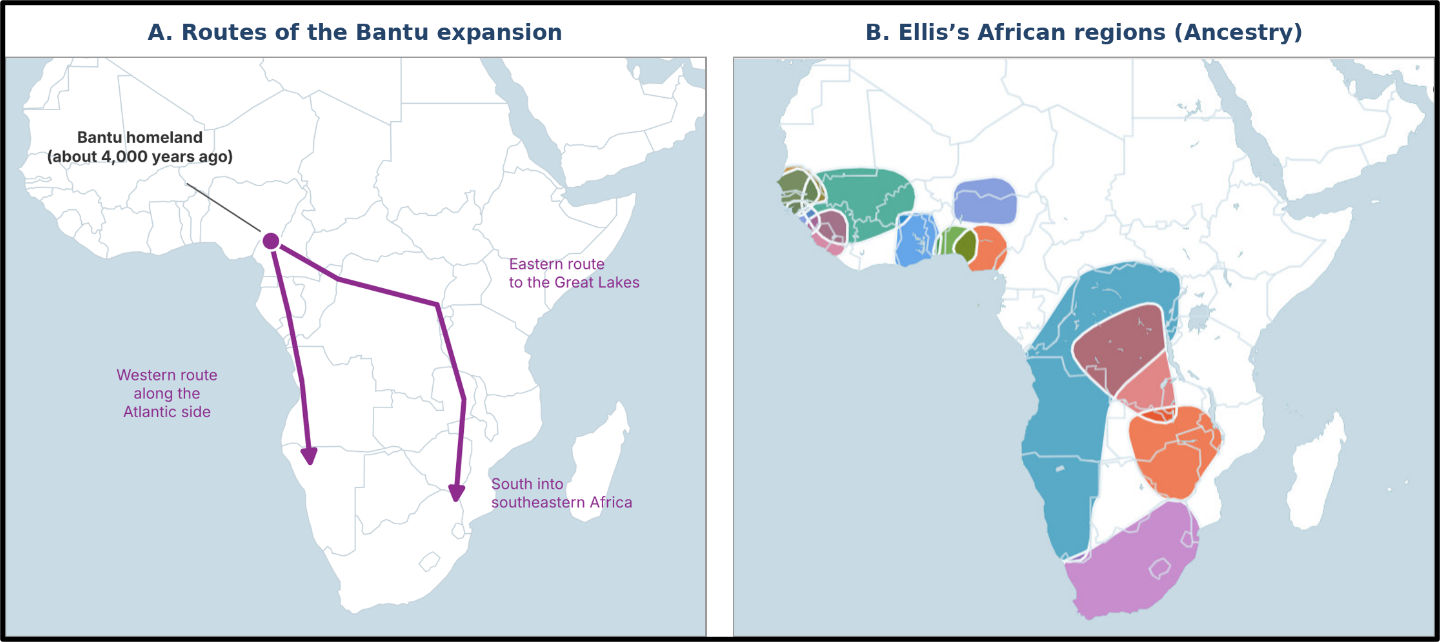
Figure 1. The simplified routes of the Bantu expansion (A) beside Ellis’s African regions on his Ancestry Regions page (B). Panel A was drawn for this post over country outlines from Natural Earth, a free, public-domain map dataset.[20]
| Table 5. Ellis’s 9 November 2026 regions in the areas the Bantu expansion reached.[19] | ||
| Region | Subregion | 9 November 2026 |
|---|---|---|
| Western Bantu & Forest Peoples | Central Africa | 2% |
| DRC–Luba Peoples | Central Africa | 1% |
| Southern Bantu Peoples | Southern Africa | 1% |
| Zimbabwe | Southern Africa | 2% |
| Total | 6% | |
The four regions in Table 5 fall in the Central Africa and Southern Africa subregions, where the Bantu expansion spread and where L3e is common today.[21] The Bantu homeland lay near present-day Cameroon, at the eastern edge of West Africa, and one hypothesis is that some of the DNA in Ellis’s West Africa macro-region (29 percent) comes from the same population, depending on how Bantu speakers spread and mixed with their neighbors.[22] A haplogroup cannot be matched to a specific percentage, because mtDNA follows only one of the many lines that make up Ellis’s Ancestral Regions. Ellis’s African haplogroup is consistent with his African Ancestral Regions, but it cannot confirm any one region.
KEY TAKEAWAY
A haplogroup can test a family story for only one line. Compare your haplogroup with your Ancestral Regions at the continent and subregion levels, not with a single percentage.
Coming Next: Ellis’s family tree holds a second family story that might explain his Atlantic Northeast (Canada & USA) region. The next post will review SideView and explain SideView 2.0, and SideView 2.0 will then become part of a research plan to test that family story.
Full Report – Working the Research Plan to Test a Family Story with mtDNA Part 4
[1]Yvonne Fenster, “A Plain-English Guide to Ancestry’s 2026 Ancestral Regions Update: Part 1,” FamilyLocket (https://familylocket.com/a-plain-english-guide-to-ancestrys-2026-ancestral-regions-update-part-1/ : accessed 21 Nov 2026).
[2]Yvonne Fenster, “Step-By-Step Guide to Analyzing Your Ancestral Regions: Part 2,” FamilyLocket (https://familylocket.com/step-by-step-guide-to-analyzing-your-ancestral-regions-part-2/ : accessed 21 Nov 2026).
[3]Yvonne Fenster, “Turning an Ancestral Region into an Objective and Research Plan: Part 3,” FamilyLocket (https://familylocket.com/turning-an-ancestral-region-into-an-objective-and-research-plan-part-3/ : accessed 21 Nov 2026).
[4]“Maternal Haplogroup,” 23andMe (https://you.23andme.com/reports/maternal_haplogroup/ : accessed 11 Nov 2026); Ellis Guiles maternal haplogroup: L3e3b.
[5]“Maternal Haplogroup,” 23andMe (https://you.23andme.com/reports/maternal_haplogroup/ : accessed 11 Nov 2026); Ellis Guiles maternal haplogroup: L3e3b.
[6]“Maternal Haplogroup,” 23andMe (https://you.23andme.com/reports/maternal_haplogroup/ : accessed 11 Nov 2026); Ellis Guiles maternal haplogroup: L3e3b.
“mtDNA Haplogroup L3E3B,” DNAGenics (https://www.dnagenics.com/haplogroups/mtdna/L3E3B : accessed 21 Nov 2026).
[7]“mtDNA Haplogroup L3e3b,” FamilyTreeDNA Discover (https://discover.familytreedna.com/mtdna/L3e3b/story : accessed 21 Nov 2026).
“mtDNA Haplogroup L3E3B,” DNAGenics (https://www.dnagenics.com/haplogroups/mtdna/L3E3B : accessed 21 Nov 2026).
[8]“Haplogroup L3,” Wikipedia (https://en.wikipedia.org/wiki/Haplogroup_L3 : accessed 21 Nov 2026).
[9]“Maternal Haplogroup,” 23andMe (https://you.23andme.com/reports/maternal_haplogroup/ : accessed 11 Nov 2026); Ellis Guiles maternal haplogroup: L3e3b.
[10]“mtDNA Haplogroup L3E3B,” DNAGenics (https://www.dnagenics.com/haplogroups/mtdna/L3E3B : accessed 21 Nov 2026).
[11]“Bantu expansion,” Wikipedia (https://en.wikipedia.org/wiki/Bantu_expansion : accessed 21 Nov 2026).
[12]“Haplogroup L3,” Wikipedia (https://en.wikipedia.org/wiki/Haplogroup_L3 : accessed 21 Nov 2026).
“mtDNA Haplogroup L3E3B,” DNAGenics (https://www.dnagenics.com/haplogroups/mtdna/L3E3B : accessed 21 Nov 2026).
[13]“Maternal Haplogroup,” 23andMe (https://you.23andme.com/reports/maternal_haplogroup/ : accessed 11 Nov 2026); Ellis Guiles maternal haplogroup: L3e3b.
“Haplogroup L3,” Wikipedia (https://en.wikipedia.org/wiki/Haplogroup_L3 : accessed 21 Nov 2026).
“mtDNA Haplogroup L3E3B,” DNAGenics (https://www.dnagenics.com/haplogroups/mtdna/L3E3B : accessed 21 Nov 2026).
[14]“mtDNA Haplogroup L3e3b,” FamilyTreeDNA Discover (https://discover.familytreedna.com/mtdna/L3e3b/story : accessed 21 Nov 2026).
[15]Roberta Estes, DNA for Native American Genealogy (Baltimore, Maryland: Genealogical Publishing Co., Inc., 2021), 82.
[16]“Haplogroup L3,” Wikipedia (https://en.wikipedia.org/wiki/Haplogroup_L3 : accessed 21 Nov 2026).
“mtDNA Haplogroup L3e3b,” FamilyTreeDNA Discover (https://discover.familytreedna.com/mtdna/L3e3b/story : accessed 21 Nov 2026).
“mtDNA Haplogroup L3E3B,” DNAGenics (https://www.dnagenics.com/haplogroups/mtdna/L3E3B : accessed 21 Nov 2026).
[17]“Bantu expansion,” Wikipedia (https://en.wikipedia.org/wiki/Bantu_expansion : accessed 21 Nov 2026).
“Ellis Green Guiles: Ancestral Regions,” November 2026, database report, Ancestry (https://ancestry.com : accessed 9 Nov 2026).
[18]“Bantu expansion,” Wikipedia (https://en.wikipedia.org/wiki/Bantu_expansion : accessed 21 Nov 2026).
[19]“Ellis Green Guiles: Ancestral Regions,” November 2026, database report, Ancestry (https://ancestry.com : accessed 9 Nov 2026).
[20]“Ellis Green Guiles: Ancestral Regions,” November 2026, database report, Ancestry (https://ancestry.com : accessed 9 Nov 2026), map of African regions.
Public-domain map dataset, Natural Earth (https://www.naturalearthdata.com : accessed 11 Nov 2026).
[21]“Haplogroup L3,” Wikipedia (https://en.wikipedia.org/wiki/Haplogroup_L3 : accessed 21 Nov 2026).
“Bantu expansion,” Wikipedia (https://en.wikipedia.org/wiki/Bantu_expansion : accessed 21 Nov 2026).
[22]“Bantu expansion,” Wikipedia (https://en.wikipedia.org/wiki/Bantu_expansion : accessed 21 Nov 2026).
“Ellis Green Guiles: Ancestral Regions,” November 2026, database report, Ancestry (https://ancestry.com : accessed 9 Nov 2026).








Leave a Reply
Thanks for the note!