
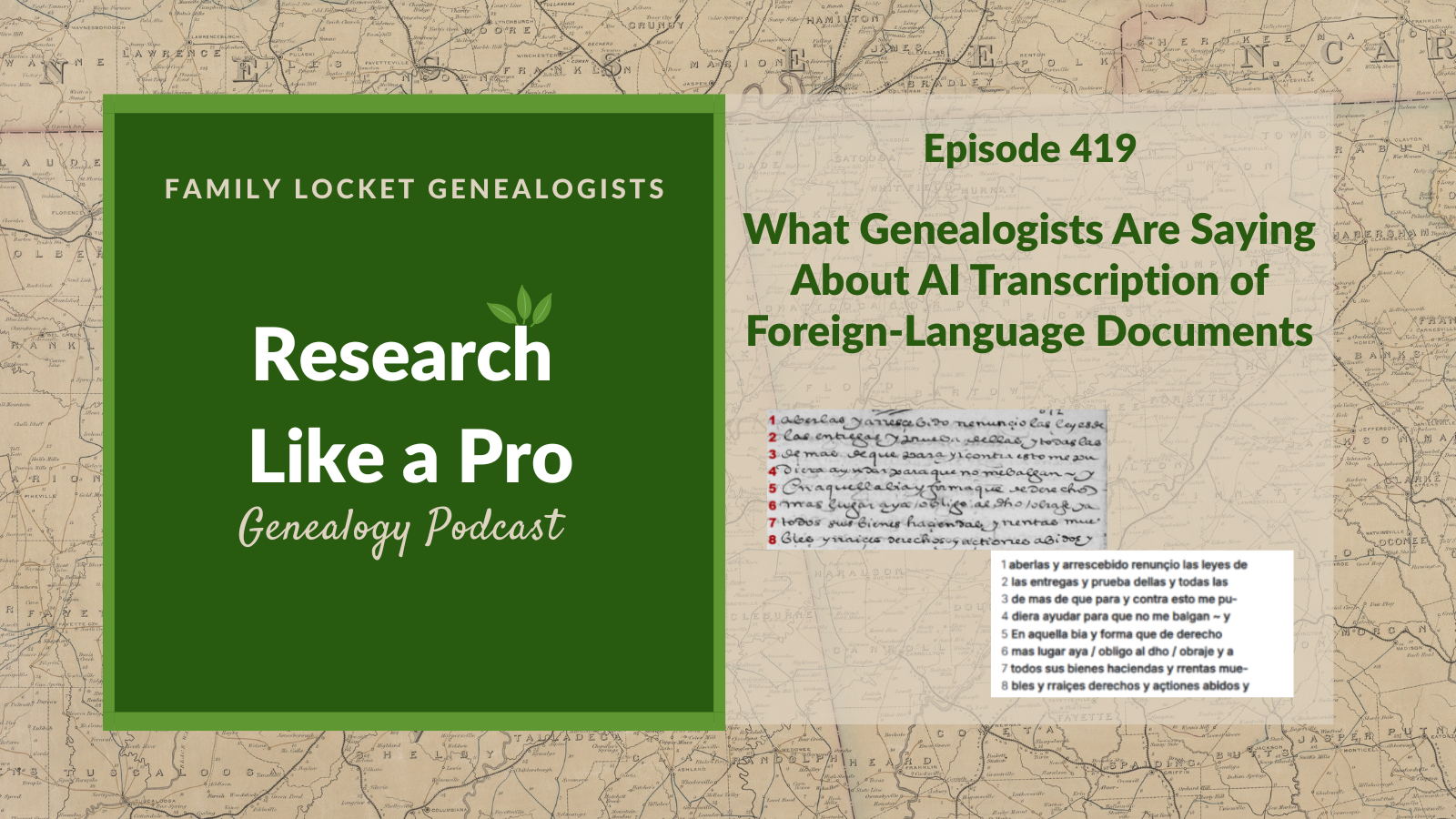
Diana and Nicole discuss how genealogists use artificial intelligence to transcribe handwritten, foreign-language historical documents. They review feedback from a survey regarding experiences with various AI tools, including Transkribus, Gemini, ChatGPT, Claude, and Leo. The researchers report positive experiences, with average accuracy ratings between 7.5 and 8 out of 10. Listeners learn which languages, such as Spanish, German, French, Latin, and Scandinavian, are commonly processed through these tools. The discussion highlights that while AI excels at speed, it frequently struggles with proper names, obscure place names, and table-based data.
The hosts share field-tested strategies for successful transcription. Listeners learn to provide extensive context in their prompts, work in small segments, and perform a manual “rough read” before utilizing AI. Diana and Nicole emphasize the importance of acquiring basic language skills to spot errors, especially when dealing with subtle, plausible hallucinations from large language models. They conclude that AI serves as a powerful assistant but caution that it cannot replace the researcher’s own skill and judgment.
This summary was generated by Google Gemini.
Transcript
Nicole (1s):
This is Research Like a Pro Episode 419: What Genealogists Are Saying About AI Transcription of Foreign-Language Documents. Welcome to Research Like a Pro a Genealogy Podcast about taking your research to the next level, hosted by Nicole Dyer and Diana Elder accredited genealogy professional. Diana and Nicole are the mother-daughter team at FamilyLocket.com and the authors of Research Like a Pro A Genealogist’s Guide. With Robin Wirthlin they also co-authored the companion volume, Research Like a Pro with DNA. Join Diana and Nicole as they discuss how to stay organized, make progress in their research and solve difficult cases.
Nicole (43s):
Let’s go. This episode is sponsored by Newspapers.com. Hi, welcome everyone. This is Research Like a Pro. Hi mom, how are you?
Diana (54s):
I’m good. How are you doing today?
Nicole (56s):
Hey, I am doing well. Should we talk some more about the NGS classes that you’ve been watching?
Diana (1m 3s):
Absolutely. So, you know, everyone listening knows that we really love using AI to help us with our research and with writing stories. And so I was really interested to listen to Gil Bardige who I did not know before NGS, and his title is, When AI Becomes a Genealogist’s Collaborator: Tracing a 1917 Refugee Escape. And his description is, What happens when a genealogist invites storytelling—and AI—as collaborators? Through the 1917 refugee journey of Gittle Bardiga and her son Meyer, this session shows how combining narrative reconstruction with AI tools can lead to discoveries missed in years of record-focused research and offer new strategies for genealogical best practice.
Diana (1m 50s):
Well this is fun. Gil was also on the AI panel with Nicole and we didn’t know him before but went to dinner with the panel, which included him and Steve Little and Nicole and
Nicole (2m 3s):
Marlis
Diana (2m 4s):
Marlis, and I drew a blank there. And so it was fun to get to know someone new who’s working with, oh and Cynthia Baxter,
Nicole (2m 12s):
yeah.
Diana (2m 13s):
and to get to know new people working with AI. And so I love this presentation. It was such an interesting story and Gil really shows how AI helped open his eyes and his mind to some different possibilities. And this was an ancestor of his he thought he had researched completely, but when he started telling her story and using AI he discovered so much more. So it was a, it was really a fun story, kind of a fun exploration of how these tools can help us. I really enjoyed it.
Nicole (2m 44s):
Yeah, Gil is such a fun guy and he is really knowledgeable about AI, so it’s fun to hear from different people how they’re using it and I need to watch that one too. I had fun getting to know him working on the panel that we did together. And I also wanted to mention one of my other, other favorite classes about AI was Blaine Bettinger’s class on ethics and AI and he talked a little bit about the Coalition for Ethical use of AI, and some of the recommendations that the Coalition made and my favorite one, which is to not generate images of ancestors that look realistic and then share those without putting some kind of watermark on them, or something.
Nicole (3m 28s):
Absolutely. So I think that kind of thing is really good to be aware of and think about and it’s good to have people like Blaine who can bring these up to the awareness of everyone in the community.
Diana (3m 40s):
Right. I appreciate that.
Nicole (3m 43s):
Announcements for today. Our next webinar in the Research Like a Pro Webinar Series is on Tuesday, August 18th, Tracing Mathilda: Finding an Ancestor’s Swedish Birthplace through American Records. And this is a return presenter, our friend and colleague, Torhild Shirley, who’s an accredited Genealogist. And this will be about identifying an ancestors’ immigrant birthplace and it’s the key to crossing the ocean in genealogical research. The case study follows Matilda A. Nelson through a variety of American sources to gather the details needed to locate her in Swedish records. The research demonstrates effective strategies for bridging the gap between us and Scandinavian sources.
Nicole (4m 23s):
She will cover Sweden, census records, church, passenger lists, and household examinations. Torhild is a native Norwegian and an Accredited Genealogist® professional. She’s the owner of ScandinavianFamily.com and she has an associate’s degree in technical translation from the University of Agder in Norway, an associate’s degree in Family History Research from Brigham Young University – Idaho, and over 30 years of research experience. She speaks five languages and is fluent in all Scandinavian languages. In addition to research, Torhild is comfortable with the old Gothic handwriting used in Scandinavian documents and can transcribe and translate documents as needed. She has translated many letters from “Family in the old country,” journals, patriarchal blessings, will and probate documents, land records, et cetera.
Nicole (5m 11s):
Torhild values honesty and hard work and will always do her best to meet and exceed a client’s expectations. When not engrossed in research or translation, she enjoys gardening, camping, fishing, snowboarding, and spending time with her large family. Well, Torhild is part of our research team at Family Locket and so if anyone needs Scandinavian research done, reach out because she is an expert in that. So we look forward to her presentation in August. The next Research Like a Pro study group begins August 26th and we are continuing registration until August 20th. So go and sign up. It’s $400. If you wanna be a peer group leader, you get complimentary registration. Just let us know you’re interested and there’s an application on our website.
Nicole (5m 55s):
Our newsletter comes out every Monday by email if you want to get, get notified of new content. And for upcoming conferences we will see you all at the APG Professional Management Conference on October 14th through the 17th. And we’ll be teaching about Airtable, managing client projects, teaching about genealogy, podcasting, and Airtable transcription with AI. Well today’s topic is AI Transcription of Foreign-Language Documents. So if you have ever stared at a page of Kurrent script or a faded colonial Spanish church record and wished for a little help, you are not alone.
Nicole (6m 36s):
As you know, handwritten text recognition is one of my favorite topics, but I mostly research documents created in English. So when it comes to these foreign-language documents, I wanted to learn from all of our followers of the Family Locket newsletter, how they were doing with AI and foreign-language transcription. So back in April I sent out a survey to our newsletter audience and asked some questions about how everyone’s been using AI to help transcribe their handwritten documents in other languages. And so I asked some questions about how it’s going, which tools are working the best for their language. And the response was wonderful. And if you haven’t shared your experience yet, we’d love to hear from you.
Nicole (7m 17s):
So the survey’s still available and I’ll put it in the show notes, but today we’ll go over some of the responses from people initially back in April and May.
Diana (7m 27s):
Okay, so let’s learn a little bit about the people who did respond. These respondents ranged from occasional users to frequent ones, working across a wide variety of languages and centuries. And the languages represented included Spanish (colonial records), German (specifically Gothic script and Kurrent, K-U-R-R-E-N-T, which I’m not familiar with), French, Latin, Slavic languages such as Russian and Polish, Italian, Nordic or Scandinavian languages such as Swedish or Norwegian. And the time periods spanned from the 1600s all the way through the mid-20th century. So that is a really broad range and that really can demonstrate how these tools work.
Diana (8m 14s):
So I love this broad range of languages and time periods.
Nicole (8m 19s):
Okay, I had to look up how to pronounce that word because I just said Kurrent, which sounds wrong. And apparently it’s KU-rent.
Diana (8m 27s):
Ku-rent, okay.
Nicole (8m 28s):
And it’s German.
Diana (8m 29s):
Never heard of that before.
Nicole (8m 31s):
I’m probably still saying it wrong, but
Diana (8m 33s):
Well apparently we don’t know much German. Right? You know, little to none
Nicole (8m 41s):
Ku-rent. So that is a German script and it’s a like a stylized form of German cursive handwriting that was used from the 1500s until the mid 20th century. Alright, so what tools are these Genealogists using? Well, the survey respondents used a variety of tools, often in combination with one another. The most commonly mentioned were Transkribus at transkribus.org, which is a specialized transcription platform developed in partnership with archives, and models. trainable to specific scripts. Another common one was Gemini via the Google AI studio or the Gemini web app.
Nicole (9m 25s):
Also ChatGPT, Claude, and tryleo.ai. Leo, which we just did an episode, an episode on. Many genealogists used more than one tool, which was interesting. And comparing results or using each for different purposes. One person noted using Google Translate to convert French to English and then to, and then Claude to summarize and pull out family relationships. And it’s interesting to see that this kind of multi-tool approach is becoming more and more common.
Diana (9m 56s):
Yes. Well let’s see how everybody decided that things worked. So overall accuracy ratings were that on a scale of one to 10, people were supposed to rate their overall experience with AI transcription for foreign-language documents at an average of around 7.5 to eight out of 10. Well that is really good. That’s maybe a little bit higher than I thought it would be. And the highest ratings interestingly came from those working with French and Spanish colonial records using Gemini with some reporting a perfect 10. Wow, that’s interesting. When asked to rate accuracy in specific categories, respondents gave the following picture: reading the handwriting– most rated this as good to excellent, though fair ratings appeared for older documents and poor-quality scans.
Diana (10m 46s):
Language accuracy–was good across the board with some fair ratings for particularly challenging scripts like Kurrent or coorant, whatever that was, and pre-reform Russian. Punctuation– was generally good to excellent. Table/column data– when applicable ratings were more mixed, with some excellent and some fair. And as we’ve been talking about, this is a known challenge for AI tools. And speed– consistently rated good to excellent by nearly everyone. So the amount of correction needed varied considerably. About half of the respondents reported needing only five to 15% correction, which was minor, while others working with older or more complex scripts needed 16 to 30% correction, moderate.
Diana (11m 30s):
And there were a few working with very old documents in poor condition where they needed significant correction, sometimes more than 50%, which could make AI assistance less efficient then just doing it yourself with a manual transcription.
Nicole (11m 46s):
That’s such a good point that if you have to correct it so much, might as well do it yourself. But then again, I always find that it’s easier to start with something, and then make the corrections even if it’s a lot, especially if it’s really difficult to read.
Diana (12m 4s):
True.
Nicole (12m 5s):
Okay, let’s talk, talk about some of the biggest challenges. You know, where do the tools fall short? The most frequently mentioned challenges are proper names and places, and this can apply to any AI transcription. Nearly everyone mentioned that AI struggles most with surnames, given names, especially in languages where naming conventions differ from English, and place names. One respondent put it plainly: surnames and places in the answer to what are your biggest challenges. Another added that obscure place names and especially cryptic abbreviations were the hardest to verify. Another challenge is old or poor quality documents. The older the record, the trickier it gets.
Nicole (12m 46s):
One respondent noted that their Transkribus model became less accurate the further back in time the documents went. Poor scan quality was another common culprit, as one person observed “light scans, words can be missed.” Another challenge is verifying the results without knowing the language. This was perhaps the most significant concern one person working with pre-reform Russian shared. “I don’t know how to double check the results. It would be easy to miss an improper spelling.” And this is a real limitation that deserves honest attention. And I think in genealogy we always kind of hope there will be a magic way to read every document that we come across. But when it comes to ones that we don’t have any way to check or verify, then we could be introducing errors into our work.
Nicole (13m 31s):
So we have to be really careful with that and do our best to learn a little bit about that language using old, you know, dictionaries and and potentially taking a class in that language. And also working with people who really can read the language and maybe getting someone to verify that it’s correct and probably getting someone to verify an AI transcription could be less time consuming than having them just do it themselves. Who knows, maybe the person would prefer to do it themselves, but it’s such a good thing to be aware of that if we don’t know the language we cannot verify the results as well. Another is subtle hallucinations. And this challenge is common for many people, especially those using Gemini.
Nicole (14m 15s):
People notice that errors from large language models can be surprisingly plausible and so it’s hard to notice the error. One person wrote “To ensure an accurate transcript, I need to review the product very closely. Any errors it makes will be both subtle and plausible given the context.” And this is different from Transkribus where errors “are usually pretty obviously incorrect so pretty easy to spot.” And the final challenge is unusual letter forms and individual scribal hands. One person working with Polish records noted that, “Whomever wrote the records I’m using had a different style for certain letters than most. And it is incredibly challenging to do manually.”
Diana (14m 52s):
These are so fun. I loved hearing all those different challenges. Well now let’s have a word from our Sponsor. This episode is brought to you by Newspapers.com, the ultimate resource for family history research. If you’ve ever hit a brick wall tracing your family tree, Newspapers.com is the tool that breaks it wide open with billions of historical newspaper pages from across the country going back hundreds of years. You can find birth and death notices, wedding announcements, obituaries, immigration records and stories about your ancestors you never even knew existed. Imagine reading a 1920s headline featuring your great-grandmother’s name, or discovering that a long lost relative was mentioned in a small town paper clear across the country.
Diana (15m 36s):
Those moments happen on Newspapers.com every single day. And the search tools make it surprisingly easy. Just type in a name, a place, a date, and start digging. It’s not just data, it’s your family’s actual story told in real time is history unfolded around them. Whether you’re just starting your family tree or you’ve been researching for years, Newspapers.com has something that will stop you in your tracks. Start uncovering your history today at Newspapers.com/FamilyLocket and enjoy 20% off your subscription. That’s Newspapers.com/FamilyLocket. Your family’s story is waiting to be found.
Nicole (16m 13s):
Alright, now we’re gonna get to our section where people have shared tips from the field. And the real gems in any survey are the tips that come from the people who have learned through experience. So I’m gonna go through tips one through four, and then mom, you can do tips five through eight. So tip number 1: provide as much context as possible in your prompt. Tell the AI what language it’s working with, the approximate time period, any names or places you already know, and any quirks of the document. One respondent advised, always provide a sample document and specific instructions such as surnames may be underlined. Another suggested if the document is written in German with Latin mixed, tell the model.
Nicole (16m 56s):
Tip number 2: work in small segments. Trying to transcribe a long document all at once can reduce accuracy. Several people recommended working small segments, one to two paragraphs at a time. Tip number 3: learn at least the basics of the language and script before you begin. You don’t need to be fluent, but knowing key vocabulary pays dividends. One respondent pointed to FamilySearch’s Wiki for French genealogical words as a helpful starting point. Another recommended a local workshop on reading handwritten text to better understand how to catch errors. Knowing what a word should look like in the target language helps you spot problems quickly. And Tip 4: do a rough manual read before turning to AI.
Nicole (17m 37s):
Several of the most experienced people responding to the survey had a similar workflow: Read through the document themselves first, do a manual data extraction, then ask AI for clarification or a full transcript. One, put it this way, this method “forces me to improve my own skill, but it is very slow! Lately, I have been trying to research more efficiently by just doing a rough manual genealogical data extraction before turning to AI, often to ask specific clarifying questions.”
Diana (18m 7s):
I love these. Okay, let’s continue. Number : print the image and transcription side by side for review. One respondent shared a practical tip: “Print out the original image in the transcribed text and review word by word.” This old-fashioned approach works beautifully alongside new technology. Number 6: learn what keywords and phrases look like in the target language ahead of time. One respondent working with Polish records described how learning that Polish birth registries listed the child’s name after the phrase, which I cannot read that it’s in Cyrillic [“дано имя”], allowed them to visually scan the record and find the name quickly without translating word by word.
Diana (18m 50s):
And then the equivalent of “godmother” in French, or “Francisco” versus “Franciszek” vs. something that I can’t read [“Фрэнсис”] in Polish can make all the difference. So that’s a great tip. Number 7: be cautious with table and column data. That’s kind of a common theme. AI tools in general perform less consistently when transcribing records formatted tables or columns. If you’re working with census-style or multi-column records, budget extra time for verification. And then Number 8: A note on MyHeritage Scribe AI for complex documents, one respondent flagged a recurring issue.
Diana (19m 31s):
“Do not use MyHeritage’s AI Scribe for complex documents or ones with small, tight handwriting. It will transcribe, translate into Russian.” This happened “multiple times” and was corroborated by other users. It’s worth knowing before you begin. Oh, well that’s interesting.
Nicole (19m 48s):
Yeah, that’s not good. Nope. I think that’ll get corrected eventually. And it’s like this with any new tool. So, MyHeritage just released this in February for RootsTech, so I bet by next year it’ll be better. Well those were some great tips and I’m just so impressed with all of the people who responded to the survey. All the things that they’ve been learning about using AI to transcribe foreign-language documents. And I know it’s something that as Genealogists, we often come across a language that we’re not familiar with and it can be challenging to know what to do. And of course it’s also tempting to just use AI and trust everything that it says. So these are all such good pieces of advice to try to learn the language, to take a local workshop, do a rough manual read-through, extract some of the data on your own first before getting help with AI.
Nicole (20m 38s):
Do some of the hard work and make AI your partner in learning the language and understanding the document instead of just a magic bullet to give you the exact translation right away. Alright. So let’s talk more about developing your own skills. One respondent’s comment stood out as especially thoughtful, “I always try to read the record myself before using AI because I want to improve my ability to read these scripts and languages. I have learned to read this material in the traditional manner, specifically because of my interest in genealogy, and I’m concerned that anyone relying only on output from these tools, at least right now, will almost certainly have undetected errors in their work.”
Nicole (21m 20s):
This perspective is really good and we all need to think about ways to use AI tools that are wise, and not just trusting it. And I guess the phrase that we always say is trust but verify. AI transcription is a powerful assistant, but it’s not a replacement for developing your own skills and judgment. And one thing that we always kind of come back to whenever we’re discussing, you know, should we use AI for this or that and blah blah blah, is we need to learn the skill and then we can use AI to speed it up. So once we’ve learned how to, you know, extract some of the information we need from these foreign language documents, we’ve learned the basics of the language to be able to do that reliably, then we can use AI to help speed that up.
Nicole (22m 4s):
And the same with writing with AI. Once we’ve learned how to write a genealogical research report, then maybe we can use AI to start helping speed that up. But if somebody who’s a beginner takes AI and has it write their report and they haven’t learned how to write it themselves, they won’t detect the problems that AI is introducing into their writing and they won’t notice that the writing is kind of boring and repetitive and sounds like AI. So it’s just really important to learn how to do the genealogical skill and then use AI to help speed it up.
Diana (22m 37s):
That is just perfect. Well, so our personal recommendation then would be to give it a try. So even the respondents who reported needing significant correction were glad they used the tools, because the time savings are real, and the learning curve is manageable, especially if you start with a document you already know something about. So if you are new to transcribing non-English documents, start with a record where you already know the ancestors’ name and residence. That gives you a baseline to evaluate the AI output with confidence, and work in small segments. Provide as much context as you can in your prompt, and compare the result against the original image carefully. You may be surprised with how much these tools can do and how much faster your research moves when you’re not going to get every letter alone.
Diana (23m 26s):
So I have to say that sometimes just having something to work with, even if it’s not all the way correct, just gives you a huge boost and gives you maybe some, not only confidence, but the incentive to keep going because you don’t have to start from scratch. And I think that’s a huge thing with AI helping us to get going on a task that maybe we’re afraid to tackle. So this was really fun. I’m so glad so many people responded and gave such great ideas.
Nicole (23m 54s):
Yeah, that was really great. Thank you to everyone who took the survey and if you haven’t taken it yet, we’ll probably do a part two of this a little bit down the road. So I’ll put the link of the show notes so everyone else can do the survey. When I started trying AI for translation from language to language, I practiced using some Spanish language documents since that’s the language I learned in high school. And my husband speaks Spanish better than I do, so he can help me if I get stuck. And so I have tried a little bit with transcribing records from South America that I found on FamilySearch with AI and then using AI to translate them as well. And so it was a really good learning process for me.
Nicole (24m 34s):
I learned a lot more about the language and, and it was really neat. So mom, if you had to try this, what kind of language do you think you would work with?
Diana (24m 43s):
Well, I’ve been learning French, so I probably would start with French because I can read French in, you know, like typewritten language for the most part. I, and so reading the handwriting would be easier for me to pick out things.
Nicole (24m 55s):
Yeah.
Diana (24m 55s):
So I should try that. I should give it a try and you know, learn a few of the specific words for genealogy ’cause right now my words are probably not the specific ones, even though I could pick some of them out. And I have actually done some of that. And I’ve also done some Spanish, even though I don’t speak Spanish, I have had projects with Spanish and my husband speaks Spanish as as well. And so together we have figured out some Spanish translations. So where there’s a will, there’s a way. And then, you know, my son speaks Bulgarian and and knows some Cyrillic and knows some Russian. So you know, we’ve got lots of different languages covered here in this household.
Nicole (25m 34s):
Well maybe you should have him come up and help you pronounce that Cyrillic word that you could’ve pronounce earlier.
Diana (25m 42s):
Yeah, maybe I should. Oh my goodness. So funny.
Nicole (25m 46s):
Well when you were studying for your accreditation in Louisiana, did you ever come across French documents?
Diana (25m 50s):
No, I didn’t. Even though I know there could be some, but they would be further back in colonial times. And I was working in Louisiana records in I think mid-1800s. Not super, super old.
Nicole (26m 3s):
Nice.
Diana (26m 3s):
Where I’m sure there’s still some things in French, but, and also we have also done a lot of Latin, you know, in Ireland.
Nicole (26m 10s):
Oh yeah.
Diana (26m 10s):
With the Irish parish records they’re in Latin. So I’ve had to do quite a bit of Latin work and when you see it, you just figure it out. There’s tools on the Research Wiki that that help you with what the words look like. We’ve always had to figure this out as Genealogists and now we just have AI as another tool.
Nicole (26m 32s):
Yes. Well what’s really interesting about AI tools is that the more that language is available in the training data, the better it knows that language, of course, like you would imagine. And so some of the more common languages on the internet are the ones that it’s really good at like Spanish, French, English, German, Portuguese, things like that. And so if you have like a really uncommon language that it’s not really available in the training data, you might have a harder time with transcription and translation for that language using AI. So that’s something to be aware of too. But yeah, it would be fun, mom, you should get a a French document and just play with it and share with us your results in a blog post or something.
Diana (27m 9s):
That would be really fun. I should do that. That would be great.
Nicole (27m 12s):
I thought you were gonna say Danish because we do have so many Danish ancestors on, I have some on dad’s side, you have some on your mom’s side.
Diana (27m 21s):
Yeah, I could do Danish too because I know absolutely nothing about Danish, aside from hearing it in some show we watched a few years back. I tried to read it.
Nicole (27m 31s):
It was in Danish?
Diana (27m 32s):
Yeah, it was in Danish. It was a really fun series. And of course, you know, we had English translations going across the screen, but I heard a lot of Danish.
Nicole (27m 43s):
Well, Torhild could help us with that because she knows all the Scandinavian languages. So if we, if we maybe have learned some, you know, genealogy words in Danish and try to transcribe and translate one of the Danish documents that go along with our ancestors, then she can check it for us.
Diana (27m 58s):
There you go. Well we, we will have to try it out. I think it would be a good exercise to try and you’re right, it would be fun to write a blog post about our experience. I love that idea.
Nicole (28m 10s):
Yeah, I think with this, I think a lot of Genealogists have maybe gotten scared off by, you know, people saying, no, you should not use AI for translation in genealogy ’cause you’re gonna cause errors. But as long as you learn some of these ways to mitigate the challenges and recognize it’s not gonna be perfect, I think it can be a really good learning experience for us to try to learn a language with the help of AI as we look at our genealogical documents. All right. Well thanks everyone for listening. We hope you give it a try. Let us know how it goes, share your comments in the blog post, show notes with us and let us know how it goes.
Nicole (28m 52s):
Alright, we’ll talk to you again next week. Bye
Diana (28m 54s):
Bye-Bye everyone.
Nicole (28m 50s):
Thank you for listening. We hope that something you heard today will help you make progress in your research. If you want to learn more, purchase our books, Research Like a Pro and Research Like a Pro with DNA on Amazon.com and other booksellers. You can also register for our online courses or study groups of the same names. Learn more at FamilyLocket.com/services. To share your progress and ask questions, join our private Facebook group by sending us your book receipt or joining our courses to get updates in your email inbox each Monday, subscribe to our newsletter at FamilyLocket.com/newsletter. Please subscribe, rate and review our podcast. We read each review and are so thankful for them. We hope you’ll start now to Research Like a Pro.
Links
What Genealogists Are Saying About AI Transcription of Foreign-Language Documents – Family Locket – https://familylocket.com/what-genealogists-are-saying-about-ai-transcription-of-foreign-language-documents/
Sponsor – Newspapers.com
For listeners of this podcast, Newspapers.com is offering new subscribers 20% off a Publisher Extra subscription so you can start exploring today. Just use the code “FamilyLocket” at checkout.
Research Like a Pro Resources
Airtable Universe – Nicole’s Airtable Templates – https://www.airtable.com/universe/creator/usrsBSDhwHyLNnP4O/nicole-dyer
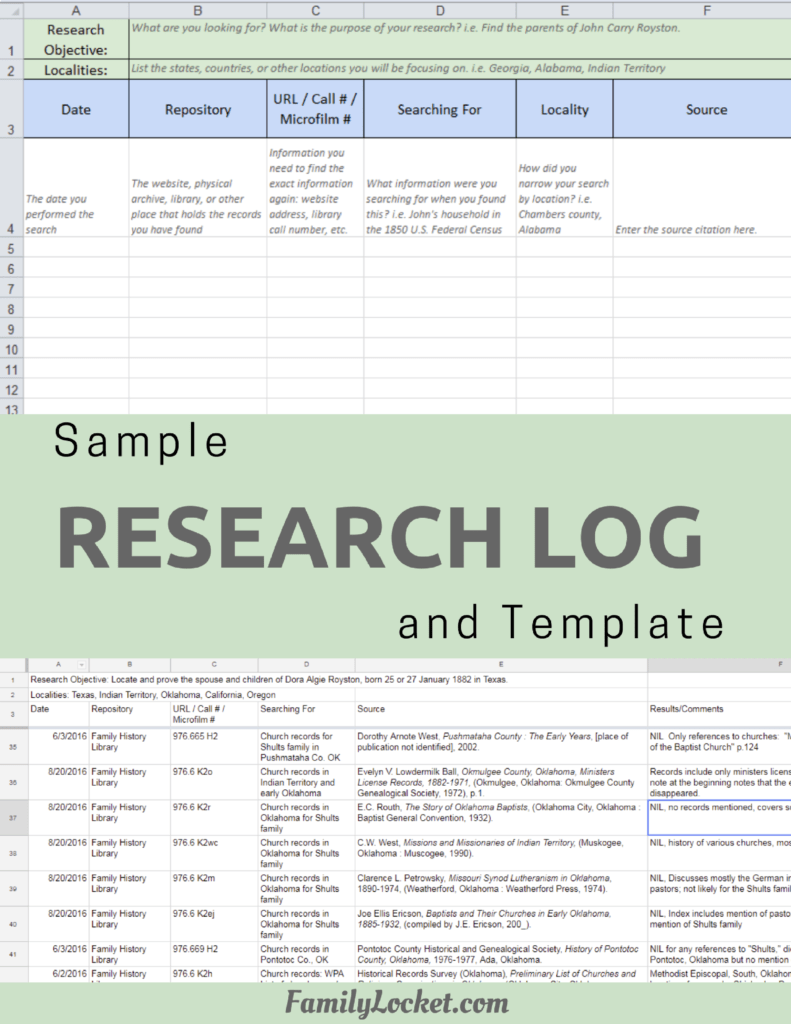
Airtable Research Logs Quick Reference – by Nicole Dyer – https://familylocket.com/product-tag/airtable/
Research Like a Pro: A Genealogist’s Guide book by Diana Elder with Nicole Dyer on Amazon.com – https://amzn.to/2x0ku3d
Research Like a Pro with AI Workbook – Second Edition (eBook) – https://familylocket.com/product/research-like-a-pro-with-ai-workbook-second-edition-ebook/
14-Day Research Like a Pro Challenge Workbook – digital – https://familylocket.com/product/14-day-research-like-a-pro-challenge-workbook-digital-only/ and spiral bound – https://familylocket.com/product/14-day-research-like-a-pro-challenge-workbook-spiral-bound/
Research Like a Pro Webinar Series – monthly case study webinars including documentary evidence and many with DNA evidence – https://familylocket.com/product-category/webinars/
Research Like a Pro eCourse – independent study course – https://familylocket.com/product/research-like-a-pro-e-course/
RLP Study Group – upcoming group and email notification list – https://familylocket.com/services/research-like-a-pro-study-group/
Research Like a Pro Institute Courses – https://familylocket.com/product-category/institute-course/
Research Like a Pro with DNA Resources
Research Like a Pro with DNA: A Genealogist’s Guide to Finding and Confirming Ancestors with DNA Evidence book by Diana Elder, Nicole Dyer, and Robin Wirthlin – https://amzn.to/3gn0hKx
Research Like a Pro with DNA eCourse – independent study course – https://familylocket.com/product/research-like-a-pro-with-dna-ecourse/
RLP with DNA Study Group – upcoming group and email notification list – https://familylocket.com/services/research-like-a-pro-with-dna-study-group/
Thank you
Thanks for listening! We hope that you will share your thoughts about our podcast and help us out by doing the following:
Write a review on iTunes or Apple Podcasts. If you leave a review, we will read it on the podcast and answer any questions that you bring up in your review. Thank you!
Leave a comment in the comment or question in the comment section below.
Share the episode on Twitter, Facebook, or Pinterest.
Subscribe on iTunes or your favorite podcast app.
Sign up for our newsletter to receive notifications of new episodes – https://familylocket.com/sign-up/
Check out this list of genealogy podcasts from Feedspot: Best Genealogy Podcasts – https://blog.feedspot.com/genealogy_podcasts/


Leave a Reply
Thanks for the note!