
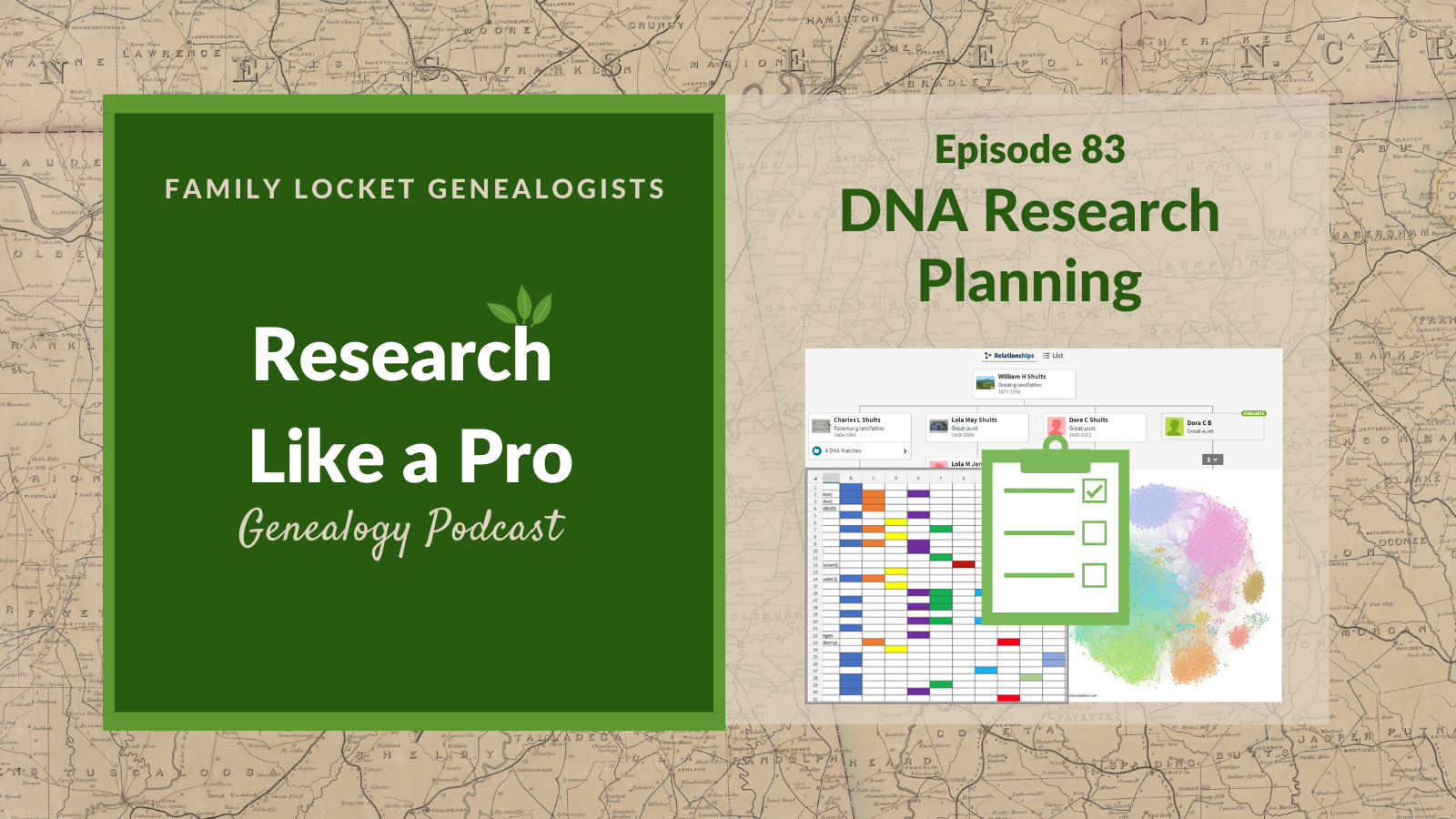
Today’s episode of Research Like a Pro is about how to create a research plan with DNA sources and methods. Robin Wirthlin joins us as we discuss the next step in the Research Like a Pro with DNA process. We talk about the summary of known facts for documentary sources, and also for DNA sources. We go over how to identify possible sources and methods, including DNA analysis tools, then prioritize them. Throughout the episode, Nicole gives examples from an example research objective and plan – who were the parents of Malissa Welch? Join us as we discuss how to research plan with DNA.
Robin’s new DNA process charts:
DNA Process Tree 1 (Verify genetic connections to ancestors) – PDF available for purchase
DNA Process Tree 2 (Solve unknown and misattributed parentage) – PDF available for purchase
Transcript
Nicole (1s):
This is Research Like a Pro episode 83 DNA Research Planning. Welcome to Research Like a Pro a Genealogy Podcast about taking your research to the next level, hosted by Nicole Dyer and Diana Elder accredited genealogy professional. Diana and Nicole are the mother-daughter team at FamilyLocket.com and the creators of the Amazon bestselling book, Research Like a Pro a Genealogists Guide. I’m Nicole co-host of the podcast join Diana and me as we discuss how to stay organized, make progress in our research and solve difficult cases. Let’s go.
Nicole (45s):
Hi everyone and welcome to the show. I’m Nicole Dyer co-host of Research Like a Pro. I’m happy to be here today with Diana and Robin Wirthlin.
Diana (54s):
Hi, Nicole. Hi Robin. So fun to be together on the podcast again.
Robin Wirthlin (59s):
Hi everybody. I love it too. I really enjoy this. And I’m excited to talk about our topics today.
Nicole (1m 6s):
How are you both doing?
Robin Wirthlin (1m 9s):
Good.
Diana (1m 10s):
Yeah, just recovering from SLIG, where it was really fun to be in-person. That was the first time that all three of us had been actually in, physically, in the same room. So that was really fun.
Nicole (1m 21s):
That was fun. Robin, how was your SLIG academy course?
Robin Wirthlin (1m 24s):
It was wonderful. I took Project Management Essentials in Genealogy Research, and I learned a ton. We had top leaders from genealogy companies and FamilySearch, and I, I learned a tremendous amount and it was really fun to network with the other people in the class too and hear some of their experiences.
Nicole (1m 46s):
That sounds wonderful. I wish I could have been there with you. I almost stayed for another week, but then I thought my family would miss me after 14 days. And I’m sure your family’s missed you guys too, but all right, well, today we are talking about DNA again, it’s been a little while since we’ve had a podcast episode about this. So we are continuing with the Research Like a Pro with DNA process and today we’re talking about the specific step for research planning. So maybe we should review all of the previous stuff.
Diana (2m 20s):
Well, I can do that. In fact, this will be good for me to kind of wrap my head around these steps because when we put something aside for a while, sometimes we just need a little review. So the very first step when we’re working with our DNA is to take a DNA test, right? So we first have to determine what is the best DNA test we should take and is that mitochondrial or Y-DNA or autosomal? So once we have taken the test, then we get our match list and we have to understand how we can use those DNA results. So step two is to assess those results.
Diana (3m 2s):
And we have just some simple steps for that in the blog posts. Then step three is organizing. And I think this was one of my favorite steps because I don’t know that I had ever gotten past step two previously. And so charting my DNA matches really, really helped me to see what I had then step four is to create a research objective. So just like in regular research, with our Research Like a Pro process, when we’re working with DNA, we also have to form a research objective. We have to focus in on something we want to figure out with our DNA.
Diana (3m 42s):
Now, once we have that objective, then we analyze our sources and we consider DNA a source, and we look at it and we analyze it for the evidence that will provide for the type of information it’s giving us. And then step number six is Locality Research. So when we look at this with DNA, we take a look at perhaps our ethnicity estimates, or we take a look at what localities are showing up in the trees of our matches. So we actually have some things we can do with Locality and DNA. And then the very next thing that we do is to create our research plan.
Diana (4m 25s):
So step number seven is the research plan. And that’s what we’re talking about today. So you can see that there are so many things that we do to get ready for research planning, so that when we are sitting down to do our plan, we have this whole body of knowledge that we’ve already worked with our DNA on, and we have a better understanding of what we want to do with it. And that really helps us when we do our research planning.
Robin Wirthlin (4m 51s):
You’re so right, Diana, and it’s really important to research plan so that you can be efficient and not get lost out there in the details, but so that you have a clear direction on where you’re going. And the purpose of research planning with DNA is to determine which records and DNA analysis tools and methods will help you answer your research question. So, Nicole, how did your course at SLIG help with research planning?
Nicole (5m 21s):
I’m so glad you asked, because we had a really fun course with Karen Stanbury about using DNA Evidence to Meet Genealogy Standards. And one of the main objectives of the course was to make strategic decisions during our research to help us gather enough data that we can meet the standards. So we did talk a lot about research planning, and one of the activities we did was something called DNA dreamers and it was really fun. Several class volunteers got to present a case that they’re stuck on and would like to come to a conclusion. And so we would present that, I was one of the volunteers, and we presented our case in about 10 minutes, just kind of a quick overview and then ask the rest of the class members, some ideas for what they would do next.
Nicole (6m 8s):
So we kind of had like a brainstorming research planning session together. And then at the end of the brainstorm, we would prioritize and try to pick the next action that we would do. And the main thing I learned is that everyone has like a little bit of a different way that they would do things based on their own experience. So it is helpful I think to ask other people for ideas. Sometimes we get set in our own course or our own way of doing things. Then sometimes it’s hard to think outside of the box. And so I think it’s helpful to have friends, genealogy friends, and DNA friends that we can talk to and get advice, and also to just go learn from other people and watch webinars and go to conferences so we can expand our horizons for research planning ideas.
Nicole (6m 53s):
All right, well, let’s discuss the basic research planning steps. Diana laid out all these steps in her original blog post called Research Like a Pro Number Four, What’s the Plan? So in our episode today, we’ll give some examples of how to follow those steps and add DNA tools and methods in each step. So Diana, tell us about the very first step in research planning, which is summarizing the known facts.
Diana (7m 21s):
All right. So I really love this step. You know, previous to this, we’ve gone through all of our sources and analyzed them. So at this point, I like to take all those things that I learned from the analyze your sources step and put them into a table form and make it pretty simple. So I start with everything that I already know. A lot of times we keep this in our heads. We don’t actually ever write it down and it’s important to get it written down because that makes us process it in a better way. So we figure out what’s already known from our review of the sources, and then we have a nice, neat summary that we can use as we’re doing our research plan.
Nicole (8m 5s):
Great. So then how do we add DNA sources to this part of the research plan?
Robin Wirthlin (8m 10s):
Well, it’s a great question. The first thing that you need to do is review that the DNA sources that relate to your research question, which family branch do they do your DNA matches align with? You want to really drill down and focus in the ones that are related to your research objective. And one of the ways to do that is to create a LucidChart or a diagram that shows the common ancestors. And then you can use shared matches on Ancestry or on 23andMe, you can see who else has DNA in common with you and another person.
Robin Wirthlin (8m 48s):
And you can really focus in on those people that are descended from a certain ancestral couple, and then how those DNA matches are related to the test taker is that most valuable piece of information to include in the summary you are the starting person. And so if you have other people who match you, they share a certain amount of DNA with you, and that helps you to place them into a certain relationship that you either know about beforehand, or that you figure out through logic and using the Shared cM Project, and really a plan applying common sense and your good knowledge and your creativity to make sure they’re in the correct location.
Robin Wirthlin (9m 36s):
And then also include which DNA company that you tested with in your table so you know where to go back to, to look at that person. And you can also include a link in your table to get right back to that person and how much DNA they share with you.
Nicole (9m 53s):
That’s a great summary. For the summary of known facts, of course, we’re going to have our documentary sources like Diana talked about, and then we’ll have our DNA sources and thank you for wrapping that all together so nicely. You know, in the past, I think we had to create our own group of focal DNA test takers by asking our first cousins or aunts and uncles to test, but we don’t need to do that as much anymore if a lot of people in our family have already tested. So that has changed over time. In that summary of known facts, maybe you will have just people that you have asked to test. And so you manage their tests and that’s your base test taker group. And you put them into your summary of known facts just to show that these people have all been shown to be related to each other in the way that we would expect.
Nicole (10m 41s):
And so now we’re ready to go out and compare them with other possible matches that might help with the research objective. Let me give an example of some statements that I might put into my summary of known facts. So say my objective is to find the parents of my third great-grandmother Melissa Welch. My base test-taker is Diana, she’s my mom. And so Diana has six matches that show lines of descent from five different children of Melissa Welsh. So I could say something like the relationship of Diana to her grandfather, Charles Leslie Shults, and her grandmother, Ettie Belle Harris is confirmed through DNA matches to her first cousins, Gary who shares 788 centimorgans and Lisa who shares 805 centimorgans.
Nicole (11m 31s):
So these are just pseudonyms for her actual first cousins. So that statement would show that the relationship to her grandparents is biological and confirmed through DNA matches. Another statement I could say in my summary of known facts would be to talk about the next generation back in between Diana and her second great grandparents. So I could say the relationship of Diana to John C. Harris and Melissa Welch is confirmed through DNA matches to third cousins, Josh sharing, 103 centimorgans, Levi, sharing 70 centimorgans and Dolly sharing 34 centimorgans. Now I’m showing that I’ve confirmed the relationship of Diana to her second great grandparents.
Nicole (12m 13s):
And I misspoke earlier because I said that I would need to confirm the relationship to her first great grandparents, but in our blog post on this, you’ll see on the chart that we actually need a test taker for this level, because nobody has tested from that descendancy. So Diana doesn’t have any second cousins that she can compare with yet. And she actually probably doesn’t need to compare with those second cousins because we do have the relationship with the second great grandparents already confirmed through DNA matches. So these comparisons all help show that I’ve already done research into the DNA matches of the generations leading up to the ancestor and question in my research objective.
Nicole (12m 58s):
So I’ve confirmed that the line is biological up to that point. So now that we’ve done our summary of known facts, what is the next step of research planning, Diana?
Diana (13m 9s):
Well, the next thing is to create a working hypothesis and this is something that we actually write out, and this is what we think happened. I love writing out the hypothesis. It doesn’t have to be accurate. It’s just what we are surmising from everything we have learned about the research problem. So with DNA, maybe we have looked at our Ancestry Thrulines and we have a suggested ancestor with several DNA matches who seem to descend from that ancestor. So our hypothesis could simply be that the suggested ancestor is the father of one of our brick wall ancestors. It doesn’t mean it has to be accurate, it just is our hypothesis that we’re going to test and use our DNA evidence to try to prove.
Diana (13m 56s):
Now, MyHeritage also has a neat thing called the Theory of Relativity tool. And that gives hypothesis about how DNA matches could be related to a common ancestor. And again, it may or may not be accurate, but it is something for a starting point that we could use to either prove or disprove. Now, when we were doing our Lucid charts and putting in our various DNA match connections, then that might’ve shown a hypothesis as well. And maybe we had a dotted line saying, you know, this is a proposed ancestor. Then we could choose that to be our hypothesis. So there’s a lot of things that are kind of rambling around in our brains that we think are right.
Diana (14m 42s):
And this is a perfect chance to write those up and then go to work on our research plan to prove it. But until we write down our hypothesis is just still rambling around in our brains. So Robin, I wanted to ask you a little bit about what you think about Ancestry Thrulines cause there’s a lot of mixed feelings in the Genealogy community on Thrulines.
Robin Wirthlin (15m 4s):
You’re so right, diana, I’ve heard mixed things from a variety of people about it. So it has some strengths and weaknesses. It is based on your trees that you have submitted or your DNA matches have submitted. And then it links you with other DNA matches who have those trees linked to their DNA accounts. So that’s really good. The other person may only have a small one just including up to their grandparents, but then if you happen to have their grandparents in your tree, it will link them to you. So you can absolutely use them as hints. So it’s really a good thing to, to check into it, but just have a healthy dose of skepticism because some people may have copied trees from someone else that have an improper link to a parent, but because they aren’t being careful about seeing the link between parents and children, there could be some faulty information in their family trees.
Robin Wirthlin (16m 8s):
Diana, I think you had a really good example of that.
Diana (16m 10s):
I do, and I think this will be fun to share because I’ve talked a lot on the podcasts and in my book and my writings on FamilyLocket about my great-grandmother Cynthia Dillard Royston and I have been trying to link her to who I have hypothesized is her father, George Washington Dillard. But when I looked at my Thrulines for her to my surprise, I found a proposed ancestor by the name of Hopson Milner, so not even the same surname. And it said that there were 33 matches. Well, when I clicked on that to evaluate it, I see that all 33 DNA matches come down through Cynthia Dillard.
Diana (16m 50s):
So those obviously are correct matches because I have proven my line back to her, but then there’s this very tenuous link from Cynthia Dillard to Hopson Milner and the reason it’s showing up in my Thrulines is that someone has put him in as her father. I haven’t put in any father for Cynthia in my Ancestry tree, I’m still working on proving that. So I just haven’t entered it because I don’t want that to be proliferated through the internet until I’m a hundred percent sure of it. So this Hopson Milner, apparently someone has connected Cynthia to Thomas B Royston, and now it’s showing up as a possible in my Thrulines. But I know it’s absolutely not accurate because looking at the trees, none of the information is lining up.
Diana (17m 37s):
And so I am using my own logic to say, no, this is not correct. On the other hand, I have got some other suggested ancestors that look very good. So it all comes back to good genealogy.
Nicole (17m 50s):
Well, that’s really interesting. And I’ve seen several through lines like that as well, where all of the matches come through my known ancestor and they’re just linking back in the trees to one more generation back. So it doesn’t make any sense. So just like any other source, we just have to evaluate it when you were talking. I thought about something funny that Karen Stanberry said in our course, a couple of weeks ago at SLIG, she was saying that she doesn’t like Thrulines, but she’s trying to listen to her mentor, Tom Jones and consider them because as you know, he sometimes talks about the perils of source snobbery and I’ll link to his article about that in the show notes. But he basically says we should consider all of the sources and not refuse to look at certain ones because we think they’re wrong just evaluate them and decide for ourselves if they have anything useful or not.
Nicole (18m 38s):
All right, let’s do an example of finding a hypothesis. So in my example, before of Melissa Welch’s parents, the way that I could find a hypothesis for that would be to look at the shared matches of Diana’s third cousins that I’ve already identified as matches. So I’ve confirmed that they descend from Melissa Welsh as well. And so looking to see who else shares DNA with Diana, and that match could reveal some matches that are further back, who could be descendants of Melissa’s parents. So for example, I could go to the shared match list of Josh and Diana and see several matches whose relationship to Diana has not yet been identified.
Nicole (19m 21s):
And maybe I’ll notice that these matches share a little bit less DNA with Diana than Josh does indicating that they are more distant. Maybe they fourth cousins. And so perhaps if we trace the pedigree of these more distant matches, we will be able to find the parents of John C. Harris and Melissa Welch. So now I have a hypothesis that could reveal an ancestor we haven’t identified. My hypothesis is just that shared matches Josh and other third cousins, descending for Melissa Welch could be descendants of Melissa’s parents. So Diana, tell us about the next step for research planning after we’ve done our hypothesis.
Diana (19m 58s):
Okay, next we’re going to identify sources and methods. So typically in research planning, we list record sets and the time and place that we’re searching. And we focus on the records that will most likely hold the answer to our research question. So for instance, if our objective was to determine when and where our research subject died, then we would possibly list things like Find a Grave, death certificate, search funeral home records, cemetery searches in the county where we think they died. So we would make a big list of all the things we could think of that would help us to solve our research problem.
Diana (20m 38s):
And we also may be, would want to do some methodology. So maybe we are going to correlate all the tax data, and maybe we’re going to do a study of all the censuses or study of the land. So we come up with all of these focused ideas about how we can solve our research problem. So when we add DNA in the mix, what do we do then, Robin?
Robin Wirthlin (21m 2s):
Well, with DNA Research projects, the sources that we use are our matches. And oftentimes the methods that we utilize include verifying the pedigree of our matches. In unknown parentage research, you put the hypothesized ancestral couple into the correct time and place to have conceived the known individual. We use descendancy research for the hypothesized ancestor and ancestral research for the hypothesized ancestor. So for example, you build up the tree to the hypothesized ancestor, and then you build forward in time identifying the descendants of them.
Robin Wirthlin (21m 41s):
And you try to figure out who are the people that could be possible parents for an adoptee or for someone who’s searching for their unknown mother or father. And when we add DNA methods to our list of our research possibilities, and in our research planning, there are several possibilities and we’ve written articles about some, some really useful DNA methodologies that you could review to see which one fits your specific research project. I would work on clustering. So that means that you’re gathering people who are related to each other and related to you into a group.
Robin Wirthlin (22m 23s):
And Dana Leeds was on a previous podcast and she gave some great ideas about her methodology. that’s named after her in separating your matches into groups according to specific ancestors. We have Pedigree Triangulation, which is looking at family trees or pedigrees that are online and seeing who has a common ancestor listed in their tree that’s in your tree. We use segment triangulation to see which DNA segments on specific chromosomes match you and to other people.
Robin Wirthlin (23m 5s):
And then you see which ancestors you all share in common. And you know, that that specific segment on that Chromosome came from that ancestor or the ancestral couple that you all share chromosome mapping is where you look to see which DNA segments came from different ancestors, DNA painter has a great tool that you can use for chromosome mapping. The What Are The Odds tool that DNA Painter also uses that Shared cM Project to test out hypotheses in a pedigree format. This tool is fantastic and can really help you determine the possibilities of people being in certain relationships.
Robin Wirthlin (23m 52s):
The other thing is to keep on contacting more cousins that are on that pertinent family line and try to identify the who the people are. And so you can place them in the correct relationship and then ask for access to the DNA test results of closer cousins to find additional matches. If they can share their DNA match list with you, especially on Ancestry, then you can see who else they match with in a really simple and easy way by looking at their shared matches. And then we phase the test results. So that means that you assign the DNA test results to one to a mother or a father, and that can help you to determine who’s related on your maternal line or who’s related on your paternal line.
Robin Wirthlin (24m 46s):
And then you can also target test individuals who might help test the hypothesis. This would be somebody who hasn’t taken a DNA test yet, but if they can confirm a relationship or would give more insight into things, then you can buy a test and give it to them. Or you can ask them to buy the test. I just sent a DNA kit off to a cousin yesterday because he descends from a different child of my great-grandparents. And I’m interested to see the results from that because he’s not in the 23andMe database. And you can learn a lot about various DNA analysis tools by reading books about genetic genealogy.
Robin Wirthlin (25m 31s):
Blaine Bettinger has a great book called the Family Tree Guide to DNA Testing and Genetic Genealogy. It’s in its second edition. I highly recommend it. It will help you learn a lot about all things with DNA. Another way that you can learn more about DNA analysis tools are by joining a genetic genealogy group on Facebook. It seems like every DNA tool out there has a specific Facebook group, and they will tell about the latest and greatest things that have been launched. I was looking on the one for Genetic Affairs the other day and learned new things.
Robin Wirthlin (26m 13s):
So it’s, that’s a really great way to be able to keep up on the latest and greatest tools. There are Institute courses on DNA at the Salt Lake Institute of Genealogy and the, GRIPand IGHR, and they are fantastic. And then going to conferences with classes about DNA, you might have something in your local genealogical society or in your state genealogical society or a national conference. And there’s, there are typically now always DNA tracks at those conferences where you can go to class after class about DNA and learn how to use it very well in your own research.
Nicole (26m 59s):
That really is the key to being able to research plan with DNA, because if we don’t know what all the tools are, how will we know which ones to use for our project? So, you know, it is kind of a learning curve at first, maybe we’ll start off our first project and we won’t know all the different tools. We’ll just kind of stick to the ones we know, but we can gain more learning and experience as we go. I think sometimes we’re afraid to start because we don’t know everything yet, but I think it’s good to just get started and learn by doing sometimes. Well, thanks for going through that list of all the different tools that we can identify to use for our DNA Research project. And this step of the research planning process really is just about brainstorming and making a huge list, kind of like in DNA dreamers, when everybody just shouted out a bunch of different ideas.
Nicole (27m 49s):
And for my case, we ended up with about 20 different bullet points of things to do. Sometimes that can be overwhelming to have such a long list, right? And one other point about DNA dreamers, is I noticed that people often would mention a method that they like, because they’ve done it before. And sometimes we might get stuck in a mode of wanting to just use methods that we’ve already done before and not wanting to try something different or something new. So that’s something to consider too, is, am I doing this just because I’ve done this before, or can I expand the possibilities and identify some new tools to use that might help me do this faster?
Nicole (28m 31s):
So now that we have our huge list of possibilities of things to do, the next step is prioritizing. Diana, tell us about prioritizing our research strategy.
Diana (28m 41s):
Okay. I love this step because just listening to Robin, giving all those different ideas, I was starting to get overwhelmed, but thinking, how do you ever choose a strategy? And that’s exactly what we have to do is to create a strategy. We’ve got our big list of sources. Now let’s go back to our example of traditional research. So we may have given ourself a list of 20 things that we could search and methods that we could use, and we have to put some priority into that list. And so some of the things that we think about are how easily we can access that tool or records that. So I would input number one in a research plan to go to a repository that is 10 hours away from my home, because that wouldn’t be the easiest thing to do.
Diana (29m 30s):
I would probably search a record set that was online first that I could do easily. So we’d want to look at the ease of access to that. And then also the time required to search the records that are used the tool. So if I have a client project and it’s only a 10 hour project, then I’m probably not going to do a really involved land study, unless that is the most important thing that could get the answer to the research problem, because the land study could take up all 10 hours and it’s possible it wouldn’t be the most relevant thing to do with that project. And then we really look at the likelihood of the record set or tool to answer the research question.
Diana (30m 13s):
So if we’re trying to figure out when an individual died, then doing a land study, probably wouldn’t be the most likely record set to answer the question, however it is possible, but that would be down on my list of my prioritize research strategy. I think it’s really, really beneficial to do this because for one thing, it helps to clarify what we’re doing. And it helps us to feel in control of our research rather than just kind of jumping around to different things. And that’s what our whole research like approa process is, is helping us to be in control. So Robin, when we add DNA to the mix, how would we prioritize DNA methods?
Diana (30m 56s):
Because you went over several different methods and they’re probably valid points for using all of them. How do you approach this?
Robin Wirthlin (31m 4s):
That’s a great question because some of the tools take a lot longer to learn and really absorb and get your mind wrapped around than others. Well, I would start with a quick and easy DNA tool like auto clustering. You can find that at Genetic Affairs, at, you can also find it on MyHeritage, you can use the Leeds Method. Don’t just jump straight to a more complicated way like chromosome mapping, because it takes more time, or targeted testing because that takes more money. So first of all, check and see if there are simpler tools that you can try first. One thing that we are introducing at FamilyLocket is a DNA Process Tree and this is a step-by-step method where you can ask yourself questions about where you are in the research process, and then it tells you the next step to go to.
Robin Wirthlin (32m 3s):
And it’s a good process that you can follow with every research project that involves DNA. And I love having the process there because you can get stuck in the weeds and get diverted, but this will help you to have a step-by-step method of how to work through your DNA Research. And we are going to sell those as a download on FamilyLocket.com. And we will also have laminated charts available at RootsTech and the National Genealogical Society conference in Salt Lake City. thank you for that.
Nicole (32m 38s):
Robin, thank you for mentioning that. I’m really excited to share these process maps with everyone because they’re going to be so useful and Robin has been working to create them to help them be very intuitive so that you can just look and see what objective you’re trying to do, what type of project, and then go forward in the process map. So check those out and FamilyLocket.com/shop. All right, well, let’s talk about an example of prioritizing for my research question about Melissa Welch’s parents. So I thought it would be interesting to go through what I would have done when I first started and what I would do now, because we learn and develop over time as we start using DNA, right?
Nicole (33m 23s):
So when I first started, I did not know what I was doing and I probably would have just done some surname searches and my DNA matches to find people with the Welch surname. Well, that didn’t really work very well. So I started learning and Robin taught me a lot. And now I’ve learned that it’s much better to do automatic clustering to help you find groups of DNA matches who form a network who match each other and match the test taker, and then use those to help you find a common ancestor by looking at the people in the cluster who have a tree and finding the pedigree intersection. So that’s probably what I would do now with that objective to find Melissa Welch’s parents and Genetic Affairs has a great tool, but since I started using Connected DNA and doing those visual network graphs, those are my new favorite way to do genetic networks and displaying those in a map.
Nicole (34m 21s):
So I would probably make a network graph with Connected DNA and then locate the cluster that had all of the matches to Diana who are confirmed to be descendants of Melissa Welch. And then once I have those people identified it, I would look for clusters that are related to that cluster. And I’ll link to my blog post about connected DNA and network graphs, in case you’re wondering what I’m talking about, and you can see some visualizations of this, but looking at those groups that are related to my research objectives, cluster has been so useful. So then I would try to find where the trees of those matches in the cluster intersected a common ancestral.
Nicole (35m 1s):
And then my last step would be to do traditional research to see if that ancestral couple could have been the parents of Melissa Welch or her husband. So Robin and Diana, maybe this is just my favorite method because it’s what I’ve done before. Am I stuck in a rut? What would you do?
Robin Wirthlin (35m 18s):
I think you’ve got a really great start there because you, the first thing you really have to do is separate out those matches into groups so that you know, that you’re focusing in on the correct family line, that’s a basic important step. And then do you want it to go further with it, especially if you have a more distant ancestor that trying to identify using DNA segments and triangulation can really help you to drill down on the correct relationship because with each generation, the amount of DNA that we inherit from a certain ancestor cause roughly in half. So if you’re going for somebody at four generations back, you’re going to be working with small segments and then let’s say it’s five or six generations back.
Robin Wirthlin (36m 6s):
You’re going to be in very, very small segments. So at that point to really confirm the person, especially if you’ve got two people of the same name and the same general location that are your candidates, you really are going to need to do segment triangulation. What are some of your thoughts on it, Diana?
Diana (36m 27s):
Well ever since you introduced me to Connected DNA, Nicole, that has become my new favorite too. In fact, I just used that tool to solve a client case. And it was really interesting. The match came down to two siblings and it opened up the case in a way that nothing else could have. I couldn’t have used a surname search on Ancestry because the segments were small enough that Ancestry didn’t pick them up in those people’s trees. So the clustering really was very beneficial. I’m really on the fence about doing the segment analysis and triangulation, just like you said, Robin, and tell it’s like one of the later things you do, because it does take so much time.
Diana (37m 15s):
So I think what you’ve done, Nicole here is really good.
Nicole (37m 18s):
I think that’s really good to talk about client research right now, because often we will be doing client research and we won’t have 50 hours to do all these different methods. And so thank you for bringing up the client research project where you really did have to decide what is something useful that I can do with the DNA to help point me in the right direction that won’t take too many hours.
Diana (37m 41s):
Yeah. And the interesting thing about this project was the client had a really strong hypothesis about who the connected people were. And I had listened to his hypothesis, but I could find no documentary evidence to prove it. But using the Connected DNA network graphs, I was able to find that little piece of DNA evidence that totally proved the connection. So of course the client was extremely happy because through DNA we’d been able to prove what he had thought was correct all along, and granted, you know, we could have just said, okay, they’re in the same time in place yes, they’re brother and sister, but having that little piece of DNA evidence just makes it so that you can say yes, this shows that they are connected genetically.
Diana (38m 27s):
So that was really a fun project. And I get to start the second iteration of that soon. And I’m excited to see what else I can find using the DNA work.
Nicole (38m 36s):
So you mentioned that you had proven something with the DNA, but you are doing a second iteration. So does that mean that you’re still going to continue to work to fully prove it to meet the GPS?
Diana (38m 46s):
Yeah. We’re going back to the next generation, of course, right? That’s what we always do. We get one generation and then we need to prove the next.
Nicole (38m 55s):
And I think you have Y DNA evidence to use as well, so that should be interesting.
Diana (38m 59s):
I do. And I’m hoping with the Y DNA that maybe we can even connect up to the immigrant ancestor. I mean, that’s always really the thing that all clients want to know.
Nicole (39m 10s):
That’s interesting that you talk about finding a clue in the DNA that helped lead you to the documents that you needed because in our SLIG course, that was one of the things that we talked about that sometimes we don’t even need to use the DNA evidence in our written summary. It just kind of provides us a clue.
Diana (39m 29s):
That’s interesting. I like that perspective because sometimes writing up the DNA is time-consuming and it can be confusing. So if we don’t need to put the DNA evidence in there because we have documentary evidence that would make it easier.
Nicole (39m 43s):
Yeah. We had kind of a heated debate on that about, you know, should we include how we got there. Robin, I know you have thoughts on this. What are your thoughts?
Robin Wirthlin (39m 51s):
Well, it seems to me that including the DNA evidence would be important because that would be an extra verification. It would be extra bricks in the foundation. And it also may be a jumping off point for a later project. And then maybe you could figure out a way to write that up in a brief summary, instead of going into deep detail about it.
Nicole (40m 15s):
That is such a good point. And that is kind of the conclusion we came to. Now that I remember that it depends on what kind of writing you’re doing. So if you’re doing a client report, then of course you would want to show the client that you spent time looking at DNA and what you found. But if you’re writing up like a case study for publication and you have correlated all the documents and you don’t need to include a lot of, you know, the DNA clues that pointed you there, maybe you don’t have space for that because journals have limited space, then maybe you wouldn’t need to include it.
Robin Wirthlin (40m 46s):
Yeah. So DNA just by itself, doesn’t tell you anything. You have to have documentary evidence to fortify the DNA evidence to have it mean anything. So you can’t just look at your DNA matches and figure something else out. It’s very intertwined with every kind of documentary evidence for relationships, because otherwise you just have raw data. That’s just a string of letters. That doesn’t really mean anything. So if it’s a client research project and they’ve given you access to their DNA, then I would absolutely write up something about the DNA.
Robin Wirthlin (41m 26s):
It’s a confirming factor, right? Because you’ve got a genetic connection back along these lines. And so it gives extra confirmation that you are truly on the right track.
Nicole (41m 37s):
Yeah. And I think it’s interesting too, that one of the new standards and the second edition of Genealogy Standards about DNA just mentioned that when we are talking about relationships, we need to specify whether we’re talking about a biological relationship or not. Because I think throughout the years in genealogy, we have assumed that the lines we’re tracing are biological, but now that we’ve added DNA into the mix, so many of us are discovering that some of our lines that we’ve chased are not our biological lines. And I don’t think that makes them any less important to us, but it does make it so that when we are writing about genealogical conclusions, we do need to specify whether or not it’s biological.
Nicole (42m 20s):
And I think the only way that we can specify a relationship or denote it as a biological relationship is by using DNA evidence.
Robin Wirthlin (42m 29s):
Yeah, I think that’s true. And it doesn’t take away the fact that someone really truly was a child’s parent. They put their whole life and soul into raising that child. So those connections are very important and it’s very important to note those. And then you’re right parallel to that, you can know the biological connections.
Nicole (42m 49s):
Yes. I love that, including both. I think it’s wonderful to discover that you have a new biological line to trace and new ancestors to discover, you know, sometimes that’s the upside of finding a surprise in your tree.
Robin Wirthlin (43m 2s):
I love the way you said that and that’s excellent.
Nicole (43m 6s):
All right. Well that was a fun discussion ladies. Thank you so much for talking today about research planning with DNA evidence. And we could talk about this for hours. So please share your ideas. We’d love to hear from you in the comment section of the blog post with the show notes or on social media. And we will talk to you guys again next week.
Diana (43m 29s):
All right. Bye bye everyone.
Robin Wirthlin (43m 35s):
Goodbye.
Nicole (44m 04s):
Thank you for listening to Research Like a Pro with Diana Elder, accredited genealogy professional and Nicole Dyer. We hope that something you heard today will help you make progress in your own genealogy research. If you like what you heard, please leave us a review on iTunes or Stitcher or visit our website, FamilyLocket.com to contact us. You can find our book Research Like a Pro a Genealogist’s Guide on Amazon.com and other booksellers. We hope you’ll start now to Research Like a Pro.
Links
Genealogy Research Planning with DNA – by Nicole at Family Locket
Research Like a Pro Part 4: What’s the Plan – by Diana at Family Locket
Perils of Source Snobbery – by Tom Jones, originally published in OnBoard 18 (May 2012), shared online at BCGcertification.org
Strategies to Meet Standards with DNA Evidence – Compelling SLIG Course – by Nicole at Family Locket
Connected DNA: The Power of Network Graphs – by Nicole at Family Locket
Past RLP with DNA episodes:
RLP 69 – DNA Tools Part 1: Clustering, Pedigree Triangulation, WATO
RLP 63: Locality Research in a DNA Research Project
RLP 61- Analyzing Your Sources in a DNA Research Project
RLP 57 – Three Steps to Focus Your DNA Research with an Objective
RLP 54 – Three Ways to Chart your DNA Matches
RLP 52 – Using Your DNA Results: 4 Simple Steps
RLP 51 – Which DNA Test Should I Take? DNA Testing Strategy
Study Group – more information and email list
Research Like a Pro: A Genealogist’s Guide by Diana Elder with Nicole Dyer on Amazon.com
Thank you
Thanks for listening! We hope that you will share your thoughts about our podcast and help us out by doing the following:
Share an honest review on iTunes or Stitcher. You can easily write a review with Stitcher, without creating an account. Just scroll to the bottom of the page and click “write a review.” You simply provide a nickname and an email address that will not be published. We value your feedback and your ratings really help this podcast reach others. If you leave a review, we will read it on the podcast and answer any questions that you bring up in your review. Thank you!
Leave a comment in the comment or question in the comment section below.
Share the episode on Twitter, Facebook, or Pinterest.
Subscribe on iTunes, Stitcher, Google Play, or your favorite podcast app.
Sign up for our newsletter to receive notifications of new episodes.
Check out this list of genealogy podcasts from Feedspot: Top 20 Genealogy Podcasts




2 Comments
Leave your reply.